
Four—
Nationalization
Scarcely had work resumed after June '36 when workers, employers, and government officials found themselves drawn into a different kind of struggle, the battle over nationalization. Unlike the strike wave, this conflict was anticipated in advance; no one doubted that the Popular Front government would abide by its promise to "nationalize the war industries and eliminate private commerce in arms." This plank in the electoral program of the left had won widespread support, not least from the powerful veterans associations that viewed private arms manufacturers as "merchants of death" and enemies of peace.[1] The bitterness that arms profiteering had aroused during the First World War had scarcely abated by the mid-1930s. Even center-right politicians endorsed nationalization as long as it was confined to the arms industry. State arsenals, after all, had become commonplace in France by the seventeenth century; a state monopoly over the arms trade appeared to few politicians as a menace to private enterprise. Given this broad acceptance of the notion, and given the importance of nationalization in the thinking since 1918 of many Socialists and CGT moderates like Léon Jouhaux, some kind of program for nationalizing military production seemed a certainty once Léon Blum came to power.
What this plank in the program of the Popular Front meant for the aircraft industry, however, no one knew for sure in the immediate wake of the electoral victory of the left. To be sure, Blum had proposed nationalizing the aircraft industry as early as 1933, and there is some evidence that in 1934–35 officials in the Air Ministry gave consideration to the idea of replacing owners with state-appointed administrators. But concrete proposals did not circulate publicly in aircraft circles before June 1936.[2] Throughout the electoral campaign spokesmen for the left had remained vague about their plans for aviation, partly because the
aircraft industry, by supplying both a commercial and military market, could not be considered an ordinary war industry, and partly because the Popular Front parties remained at odds over the whole question of nationalization. Radicals, viewing it narrowly as a defense policy, wished to restrict it to the arms sector. Many Socialists, however, hoped to nationalize several additional sectors, including railroads, insurance, mining, electricity, and portions of the banking system. They viewed nationalization as a way to socialize investment, restructure industry, weaken the business lobby, and reform the workplace. Ironically, Communist leaders sided with the Radicals on this question. Although by the late 1930s Communist militants would come to value nationalization as a means to increase their political leverage in the French economy, in 1936 most party officials were still skeptical of a policy that smacked of reformism. They also feared alienating the middle class from the Popular Front with far-reaching nationalizations.[3] In the common electoral program Communist and Radical prudence prevailed: only defense industries emerged as targets for nationalization. Still, the status of the aircraft industry in the plans of the Popular Front remained sufficiently ambiguous to keep aircraft employers and workers confused about what to expect from the new Air Ministry.
Everyone understood, however, that something had to be done about the structural problems that had plagued the industry since the early 1930s. Private employers had failed to streamline the industry and modernize production or even to keep up with the modest ambitions of Plan I. The system of groupements had become thoroughly discredited as a form of industrial concentration. Little had been done to alter the habits of overpricing and uncompetitive contracting that government inspectors had exposed years before. With German rearmament well under way, Blum's government faced the urgent task of reinvigorating an industry that had previously defied the efforts of reformers. Nationalization appeared to men like Léon Blum and Pierre Cot as a suitable vehicle for reshaping the industry.
But if the industry's malaise, a history of state-run arms production, popular contempt for arms profiteering, and the electoral triumph of May made it relatively easy to nationalize major sectors of aviation, it was unclear to people in the summer of 1936 just how a nationalized aircraft industry would be structured, financed, supervised, and run. Nor could people predict what it would mean for labor relations, especially after June. By exposing the weakness of the employers' Chambre Syndicale, strengthening the unions, and dramatizing the pivotal role the Air Ministry had assumed in the industry, the June crisis increased the sense of uncertainty about how much power workers and militants might wield in a nationalized firm. After June it seemed inevitable that workers would
feel more confidence in asserting themselves, especially if nationalization created new opportunities to reform the workplace. State ownership, moreover, would give Cot and his new team in the Air Ministry more leverage with employers than government officials had enjoyed before. Thus, nationalization not only provided a way to reorganize the industry; it also opened up new possibilities for redistributing power and authority in a major industrial sector. The protracted process of carrying out the nationalizations, which continued through the fall of 1937, therefore perpetuated the struggle for power in the workplace that June '36 had begun.
Nationalizing the Aircraft Industry
Pierre Cot returned to the Air Ministry eager to give concrete form to the democratic, antifascist convictions of the Popular Front. He had hoped, apparently, for a different post in the government, probably in foreign affairs; but Edouard Daladier, Blum's minister of national defense, convinced him to apply his experience as air minister in 1933 and as president of the Chamber of Deputies Air Commission to the task of rejuvenating the air force. Cot gathered around him an aggressive team—General Philippe Féquant as his air force chief of staff; Colonel Henri Jauneaud as his military chef de cabinet, and Jean Moulin, the future resistance hero, as his civilian chef de cabinet —all men equipped to challenge convention.
Within weeks of moving into what journalist Alexander Werth described as the "dazzlingly modern" Air Ministry on the boulevard Victor, Cot's staff had launched a four-part reform program.[4] First, to democratize aviation, they promoted an ambitious program of "popular aviation." In partnership with Léo Lagrange, the under secretary of state for sports and leisure, Cot created "popular aviation sections," where young people of modest means could learn to fly. Each local section had a directing council, which included a representative of the Air Ministry, a flying instructor, and a delegate of the CGT. Cot hoped this program would not only give a boost to the manufacturers of light aircraft but also diminish the influence of private aéro-clubs and the Fédération Aéronautique by creating a cadre of working-class pilots with sympathies for the Popular Front.[5] Second, Cot sought to reorganize the air force. By restructuring the high command, he replaced senior officials with younger officers eager to implement his program. To overcome the limitations of Plan I, he developed Plan II to boost the air fleet to twenty-four hundred planes by June 1940. Cot's new production plans called for speedier, modernized fighters and more bombers to give the air force a larger strategic role.[6] Third, Cot sought to strengthen military ties to Britain
and the Soviet Union. Since France had little chance of matching German aircraft rearmament in the short run, security depended, in Cot's view, on inter-Allied aerial cooperation.[7] Finally, to overcome the crisis in aircraft production, Cot moved quickly after mid-June to nationalize major portions of the industry. Here lay the key to the entire program: if the industry failed to produce competitive aircraft in huge numbers, none of the other reforms could succeed.
Nationalization appealed to Cot as the most practical device for reorganizing the industry, though it was not the only one imaginable. The British, after all, had expanded their industry in part by enlisting automobile firms and other big companies in airplane production—the "shadow factory" scheme that some men in French aviation circles greatly admired. But given the difficulty Cot and other state officials had had in cajoling the airplane manufacturers to modernize on their own, it was hard to imagine enticing the even more independent automakers of France to play a major role in the volatile business of airplane production. Cot's immediate problem, moreover, was not the size but the inefficient structure of the aircraft industry. Another alternative to nationalization might have been an aggressive use of the decree law of 30 October 1935, which empowered the government to use its control over defense contracts to force firms to merge.[8] But such a strategy, Cot felt, too closely resembled what air ministers had attempted with little success since 1928. Besides, the ministry budgets of the mid-1930s provided little leverage to reshape firms with incentives. "How could we reform the industry," Cot later wrote, "when we had so few credits? [Therefore] I took advantage of the law nationalizing the war industries."[9] He argued that by expropriating a controlling interest in a large number of companies, the state could achieve directly what had eluded employers and Air Ministry officials for so long—the consolidation of firms into a few large enterprises, the location and expansion of factories in the provinces, the modernization of plant and equipment, and the creation of a sustained process of industrial mobilization. State officials could ensure that earnings would be invested rationally and that firms would collaborate in the national interest—sharing research, cooperating to meet orders, and even subdividing manufacturing tasks to hasten production.[10] Cot hoped, too, that nationalization would diminish industry dependence on private bankers, who, as he told the Chamber of Deputies, were more interested in "the profit margin on the contract" than in "the development of special equipment that can allow us to increase production."[11] Nationalization, in short, appealed to left-wing reformers like Cot and Blum because it finally gave state officials the power to do what businessmen, too wedded to short-term profits, had avoided—modernize the industry.
The June strikes had strengthened an additional motive for nationalization—the desire to reduce conflict in an industry where workers and technicians were becoming a cohesive, militant force. When Daladier advocated the nationalization bill before the Chamber of Deputies in August 1936, he pointed out that the strike wave of June had swelled not in state-run arsenals and repair shops but in private firms working for national defense—a phenomenon he contended "reinforced my convictions in favor of nationalization."[12] Daladier and Cot thought that by regularizing production orders and standardizing managerial practices, state officials in a nationalized industry would establish what Stéphane Thouvenot, a young engineer in the Air Ministry, called "social and economic stability in the enterprise."[13] Cot's first acts in office—mediating the June strikes, nullifying sanctions that had been imposed on Air Ministry employees who had taken part in past political demonstrations, and instituting the forty-hour week in the aircraft industry three months before it was required by law—revealed that he intended to be aggressive in replacing traditional labor practices with a more enlightened approach.[14] He hoped, moreover, that by reorganizing the industry and enforcing a forty-hour week, he could eliminate the threat of layoffs that still hung like a cloud over the industry.[15] For reformers like Cot, who wanted to blend a Jacobin vision of social reform with a technocratic drive for efficiency, nationalization offered an opportunity too promising to allow compromise with milder forms of intervention.
Once word surfaced that major portions of the aircraft industry were to be included in the bill proposed by the Blum government to nationalize arms production, a few supporters of the industry in parliament and the press combatted the plan. Georges Houard, the editor of Les Ailes, said nationalization would destroy the industry's competitive character, its creative spirit, and its access to foreign markets. "From the moment the law on nationalization is voted," he wrote, "French aviation will cease to be free. Aviation will be muzzled under the odious, ridiculous, and false pretext that the airplane is a weapon of war."[16] Most opponents of nationalization, like Houard, defended a system of private firms that by maintaining a proper balance between commercial and military sales, exports and state orders, research and mass production, would best serve the national interest.[17] The state, these critics said, already had enough influence in the industry to enforce reforms or reduce profits without "suffocating aviation with a sterilizing nationalization."[18]
Although the protest was shrill, it failed to find much of an echo in the meeting rooms of the employers' Chambre Syndicale. As Cot told a parliamentary committee, "I don't believe I will encounter much resistance from industrialists. Most of them will accept it because they know they can't avoid it and they have a stake in being nationalized with a smile and
a future rather than with no smile and no future."[19] Employers in fact were too weak and divided a group to oppose the policy. Their earlier failure to reform the industry and their demoralization over signing the collective contract in June had isolated them from business and parliamentary allies who under other circumstances might have rallied to their defense.[20] Although Henry de l'Escaille, president of the Chambre Syndicale, had long hoped the aircraft industry would evolve like shipbuilding, where state engineers supervised closely but firms remained private, it was too late to rally people to this view. The Chambre Syndicale convened twice in July to discuss nationalization but failed to produce a consensus for either resisting or complying with Cot's plans.[21] Practically speaking, the Chambre Syndicale left it to employers to negotiate with the Air Ministry on their own. Since many of the employers stood to gain from nationalization by receiving indemnities for their property, or in a few cases appointments to top posts in nationalized firms, there was little support for an open campaign against the policy.
Daladier's nationalization bill passed through parliament by a substantial majority. Since employers themselves failed to spearhead the opposition, and since most deputies of the center-left and center-right felt assured that the bill was a defense measure and not a wedge for further nationalizations, only the far right opposed the policy. The Senate, however, added two key constraints: the defense ministries had to complete the nationalizations by 31 March 1937, and they had to keep the total expenditures below a fixed ceiling. Cot had six months to take over firms and just 270 million francs, not the 400 million he had wanted, to buy out the owners.
Once authorized to expropriate firms, each of the three defense ministries marched in a different direction. The Naval Ministry chose to nationalize only two minor firms and left the shipbuilding industry intact. The War Ministry expropriated nine munitions firms, added them to the ranks of the existing state arsenals, and operated them as state-run firms. Cot's staff pursued yet a third strategy, reorganizing about 80 percent of the airframe sector into five "mixed companies," each with a regional identity—the Société Nationale des Constructions Aéronautiques du Nord, or SNCAN; de l'Ouest, SNCAO; du Sud-ouest, SNCASO; du Sud-est, SNCASE; and du Centre, SNCAC. Each of these "national companies" absorbed most of the plants in its region but maintained at least one plant in Paris or its western suburbs. These firms were to be "mixed" in the sense that the government was to own two-thirds of the stock, with the other third staying in the hands of private investors.
This structure, modeled after Air France, appealed to Cot for a number of reasons. For one thing, it was cheaper: the Air Ministry could use its 270 million francs to purchase a greater number of firms than it could
have acquired had Cot chosen to turn nationalized firms into full-fledged government arsenals, as the War Ministry had chosen to do in the munitions sector. For another, mixed ownership provided a financial incentive for some of the leading airplane builders to remain invested in the industry. Cot and his staff were determined to keep Henry Potez, Marcel Bloch, and some of the other more dynamic young builders involved as leading figures in new nationalized companies. Engineering talent and industrial know-how were too scarce in France to lose these men and the design teams they had established. The Air Ministry did not have an engineering staff equipped to take over the industry directly. Partial ownership of nationalized firms provided one way to keep some of the manufacturers involved.
Furthermore, despite accusations by critics such as Houard, Cot was sensitive to the dangers of étatisation, of miring the industry in the pettiness and rigidity of a state bureaucracy. The mixed company, he said, would "give free play to new approaches and to the creative spirit . . . and at the same time safeguard the freedom of initiative, the stimulus to competition."[22] By allowing these companies to continue to function under the law of 1867 on corporations, "their work," as Cot put it, "will have greater administrative subtlety and financial flexibility, and they will suffer less from red tape than they would if they were simply government offices. The workers will have their collective contracts as elsewhere, and the higher employees will be under individual contract."[23] Under this scheme the state's stock ownership would give the Air and Finance ministries control over the boards of directors and the power to hire and fire top management, while within the companies managers and engineers would have the flexibility of private firms. Cot hoped the mixed company could offer the best of both world—the strategic coordination of a state-managed sector and the competitive drive of private enterprise.
The arrangement in fact worked perfectly as a way to keep several major industrialists at the head of the nationalized companies. Cot's chief negotiator with the owners, Fernand Hederer, first met regularly with Henry Potez, hoping that if the industry's most successful manufacturer could strike a deal with the Air Ministry, the rest would follow. Potez proved to be both receptive and shrewd, for by insisting on being paid immediately for his holdings, he alone among the builders managed to secure his indemnity before the currency devaluation of September 1936.[24] Both he and Marcel Bloch were quick to recognize that nationalization was a windfall for them since as leading designers of military aircraft, they knew the Air Ministry was eager to bargain generously for their participation. In the Chambre Syndicale they urged their colleagues to cooperate with the policy of nationalization, and by December
1936 Cot had appointed Potez and Bloch as chief administrators of SNCAN and SNCAO respectively.[25] To complete the appointment process, he also named Louis Aréne, the former director of Lioré et Oliver, to head SNCASE; Outhenin-Chalandre, the former director of Hanriot, to run SNCAC; and Marius Olive, the number-two man at Bréguet, to lead SNCAO. Henry de l'Escaille, the head of the Chambre Syndicale, was appointed president of the entire group of five firms. In the meantime several of the older pioneers in the industry, including Louis Bréguet, Robert Morane, and Raymond Saulnier, were passed over for directorships in the national companies. By consolidating the industry and bringing men like Potez and Bloch into the nationalized sector, Cot attempted, as he put it later, to "cut off the dead branches" of the industry.[26] The generational distinction between the pioneers and the younger engineers that had for many years created subtle tensions in the Chambre Syndicale now found explicit expression in the contrast between the nationalized and private sectors.
Although nationalization certainly diminished the autonomy of the builders, it was a lucrative bargain for the men chosen to run the new national companies. Besides generous indemnities, they were assured an annual salary of three hundred thousand francs, and their firms were allowed to earn a 10 percent profit over production costs.[27] Any additional profits would be plowed back into plant and equipment, a national fund to finance plant decentralization, and social programs for employees.[28] Although directors would not enjoy immense personal profits, at least from mass-production contracts, they were paid handsomely and were spared the burden of risk since the state assumed more responsibility than before for covering payrolls, meeting cash demands, and raising capital for investment.[29]
The best part of the bargain, however, concerned research. Cot had told parliament that he intended "to preserve complete freedom for research and initiative," which meant finding ways to keep the builders invested in prototype research. As one government official put it, "To nationalize buildings and machines was ultimately just a question of money; to nationalize brains posed a more delicate problem."[30] By November 1936 negotiations between Air Ministry officials and company heads had produced three options.[31] Employers could elect to have their research facilities incorporated into the national companies and receive indemnities accordingly. Several firms chose this option. Alternatively, employers could retain their facilities in private companies and sell prototypes to the state and other customers according to rules established in 1934. In practice such firms assumed the risks of developing a prototype, but if they sold it to the government, they could earn about 15 percent of the market value of every plane mass-produced from the model. The
directors of Morane-Saulnier, Amiot, Latécoère, Gourdou, Levasseur, and Caudron agreed to this option. A third arrangement emerged from negotiations with Potez and Bloch, whom as leading designers Cot was keen to please.
Under the terms of the Potez-Bloch Agreement their research facilities would remain private but would be leased to their national companies as long as they ran the latter; the state would have exclusive rights to the prototypes Bloch and Potez built but would pay them a fixed percentage for all the planes built from their prototypes, as well as a percentage of the market value of the planes that bore their trademark and were built by any of the national companies and state arsenals.[32] Cot later placed a ceiling on this last figure of one million francs a year. Even so, Potez and Bloch stood to make a fortune. Indemnities for their landing fields, offices, and factories (estimated at 27.3 million francs for Bloch and 65 million for Potez); annual salaries for running SNCASO and SNCAN, the most favored of the five national companies; licensing fees for prototypes built before nationalization; a percentage of the sales value of all Bloch and Potez planes built by nationalized or state-run firms; not to mention the indirect benefits of state-financed capital for research—at this cost to the state it was little wonder that Bloch and Potez became enthusiastic supporters of nationalization.
The Potez-Bloch Agreement seemed so good, in fact, that it aroused criticism in parliament. Some members of the Senate Air Commission felt the Air Ministry had ceded too much to Bloch and Potez in return for too little control. Rumors circulated that Bloch and Potez not only enjoyed unhealthy influence in parliament but had even infiltrated the Air Ministry with agents of their own.[33] Cot, however, defended the agreement as a way to keep the two builders invested in the industry. The Air Ministry had in fact offered the same arrangement to other builders, who refused it since no doubt as smaller operators they could make more money under the system adopted in 1934. The Potez-Bloch Agreement survived the controversy, at least through 1937, and Cot's Air Ministry proceeded to implement a nationalization plan that balanced centralized state coordination with profitable incentives for new research.
Alongside research, one other aspect of the industry posed a complicated challenge for Cot's program—motors. Although the airframe sector had been the principal target of reform, Cot was not satisfied to let the engine sector proceed on its own. To be sure, the five main firms building engines—Gnôme-et-Rhône, Hispano-Suiza, Renault, Salmson, and Lorraine—had avoided the structural fragmentation that plagued the airframe sector. They performed much more successfully in the world market, reporting six times the value of material sold during the first half of 1937 than did airframe manufacturers.[34] But engine build-
ers showed signs of falling behind their foreign competitors and had lost favor in the Air Ministry for resisting plant decentralization. Though parliament had in effect precluded massive state takeovers in the engine sector by restricting Cot's indemnity budget—the stock of Gnôme-et-Rhnône alone was worth 231 million francs, or the lion's share of the nationalization budget—the Air Ministry still searched for ways to improve the performance of these firms.[35]
In the spring of 1937 Cot took three steps toward that end. First, he used what money the Air Ministry had to acquire minority stock ownership in Gnôme-et-Rhône and Hispano-Suiza—by no means enough to wield decisive power on their boards, but enough to secure a board position each for the Air and Finance ministries. These state-appointed board members would at least have access to deliberations and make the operations of these firms more transparent to the state.[36] Second, Cot tried, though largely in vain, to stimulate Hispano-Suiza to compete more directly with Gnôme-et-Rhône in the development of new air-cooled motors, for Gnôme-et-Rhône had come to enjoy a near monopoly over engine production for air force.[37] Third, Cot decided in April 1937 to nationalize Lorraine, converting it into the Société Nationale de Construction des Moteurs (SNCM). Once again Potez and Bloch benefited directly, since they each owned a healthy share of Lorraine. As a strategy to improve the motor sector as a whole, the creation of SNCM was a dubious wager; Lorraine represented only 10 percent of the market in engines and had little to offer but a coterie of skilled workers and an aging engineering staff.[38] Cot thought, however, that if he was in no position to nationalize the big firms—Gnôme-et-Rhône and Hispano-Suiza—he could at least try to make the industry more competitive with Lorraine.[39] In fact, Cot's program did little to alter the structure of the engine sector or the autonomy of its major firms.
Thus, nationalization in 1936–37 had real limitations. It was restricted to 80 percent of the airframe sector, and it kept most prototype research in the private sector. Several major industrialists remained in charge at the national companies. The Air Ministry, by failing to nationalize much of the engine sector, remained as dependent as ever on men like Paul-Louis Weiller at Gnôme-et-Rhône who were openly hostile to more state intervention. Even so, nationalization had an enormous impact on the industry. After years of drift and fragmentation companies at last consolidated into a structure that, if it did not produce miracles overnight, at least paved the way for Air Ministry officials to distribute orders and invest in plant, equipment, and training with less regard for the commercial viability of small, inefficient firms. As we shall see, the full benefits of this structure only became apparent when the government finally committed itself financially to rearmament in 1938–39.
The impact of nationalization on the internal politics of the industry became apparent immediately. If the owners did well by indemnities, and if some of them retained positions of preeminence by running national companies, nationalization nonetheless shifted power away from employers into the corridors of the Air and Finance ministries. Both ministries now had representatives on the boards of the national companies, and their authority, combined with the votes of a CGT representative and the power of the Air Ministry to appoint the chief administrator of these firms, gave the government substantial control over them. What is more, Cot's reform program established three new agencies at the national level—the Office Français d'Exportation de Matériel Aéronautique (OFEMA), to promote and approve exports, a service that the Chambre Syndicale had officially provided; the Centre de Recherche, to serve as a clearinghouse for testing and research for the nationalized sector along the lines of the celebrated American National Advisory Committee for Aeronautics; and the Coordinating Committee, bringing together key officials from the Air and Finance ministries, the national companies, and the CGT to standardize managerial practices and propose methods of distributing orders, material and manpower in the nationalized sector.[40] A new division of labor was emerging, at least in the airframe sector, in which state officials took more direct responsibility than before for personnel policy, the organization of production, investment strategy, and the hiring and firing of top management.[41] Although employers still enjoyed a degree of autonomy in the nationalized sector, there was no denying that the political realities of nationalization, especially under the auspices of a Popular Front government, had diminished the authority of the builders. This shift gave workers a chance to fight for more of a voice in the industry.
Workers' Aspirations
Workers did not sit by idly while Pierre Cot and the moguls of aviation negotiated indemnities, directorships, and the Potez-Bloch Agreement. On the contrary, aircraft militants met several times with Cot and his staff in hopes of having a say over policy. The CGT, after all, had lobbied for nationalization in June 1936 and thought state expropriation by a left-wing government would give militants new power in the industry. By November, however, optimism had given way to frustration. Not only did militants feel isolated from the decisions being made at the Air Ministry; the complicated business of drawing up inventories and creating the new national companies disrupted production, making workers fearful of possible layoffs. To make matters worse, by the fall of 1936 a 10 percent rise in the cost of living had largely devoured the wage gains of
June. Workers in the Paris region also worried about what would happen if Cot really shifted production (and jobs) to the provinces. The CGT militant Robert Doury wrote in the labor press that although workers had welcomed nationalization with "deep satisfaction, great anxiety [now] reigns in [their] minds" since the unions were "insufficiently informed to give useful details" on reforms. "Several delegations often came to nothing," he said, "and the anticipated decentralization, by forcing layoffs, deepens the anxiety still more."[42] On 8 October 1936 a delegation of workers and technicians met with Cot to express their anger that men such as Olive, Potez, and Bloch had been chosen as factory directors. "The interview ended," a technician later wrote, "after a few appeasing words from the minister and the granting of one labor representative on the boards of directors [of the national companies]."[43] Trade union patience with the pace of reform and with the exclusion of labor from the politics of nationalization was wearing thin.
By December police informants found impatience growing at the factory level as well. In construction shops at Orly discontent over Cot's policy had become so acute that the CGT leadership "made contact with factory delegates . . . in order to appease the agitation that is threatening." Workers there were astonished that "Wibault, Olive, Potez, de l'Escaille, Outhenin-Chalandre, and Bloch, 'genuine reactionaries, friends of Tardieu, Daudet, Dentin, Laval, etc., . . .' were asked to direct an experiment that ought to have excluded them, while the CGT was still waiting to be asked for advice, even on technical matters."[44] Two other matters troubled these workers: the ministry's "decentralization of the aircraft industry according to the bosses' point of view, which has the effect of exposing militants to employer repression," and the possibility that the hard-won forty-hour week might be sabotaged in the process. Workers at Orly were by no means alone: reports of agitation came in from Marseille, Bourges, and La Courneuve, where workers (and sometimes technicians) expressed anger over falling real wages, yellow unions, and Cot's effort to entice leading employers into the new firms.[45]
Employee discontent made it clear to Cot and the CGT leadership, if it had not been clear before, that they had to settle on some form of worker representation in the management structure of the nationalized sector. If men such as Potez and Bloch were still going to run factories, nationalization would mean something positive to workers only if they had influence on company boards and at the Air Ministry. This interest in worker representation was hardly novel. It drew on a long-standing demand for contrôle ouvrier —the workers' right to oversee, review, or scrutinize management—that resonated deeply within several competing traditions in the French labor movement. Trade union moderates, such as Léon Jouhaux, Léon Chevalme, or aircraft workers in local So-
cialist groups viewed contrôle ouvrier pragmatically as participation in committees that gave employees a voice at all levels of the industrial hierarchy. This perspective derived in part from experience during the First World War, when Albert Thomas, the Socialist armaments minister, introduced a shop steward system and a network of labor-management committees into munitions plants, an approach the CGT expanded on in its Minimum Program of 1918. Contrôle ouvrier also harked back to the revolutionary syndicalist origins of the French labor movement in the late nineteenth century, with its artisanal vision of worker-run enterprises as the key not only to democratizing an industrial society but to modernizing its economy as well. Although revolutionary syndicalism had by the 1930s become but a tiny faction in the labor movement, and contrôle ouvrier had come to mean scrutiny rather than outright control, syndicalist militants such as Pierre Monatte and Maurice Chambelland, writing in La Révolution prolétarienne, still struck an important chord in the minds of working-class radicals when they urged workers to use the shop steward system introduced by the collective agreements of June 1936 to acquire greater control over production and greater autonomy from both management and the unions.[46] Even Communist militants, who since the early 1920s had viewed contrôle ouvrier suspiciously as a syndicalist diversion from party-led class struggle, could ill afford to ignore the popularity of that notion in the ranks of skilled metalworkers. Now that a left-wing government had restored a shop steward system and had supported in principle more extensive forms of representation in the nationalized sector, CGT militants and rank-and-file workers alike wanted to explore how much genuine power worker delegates could acquire over wages, hours, holidays, and work organization—the issues that mattered most to workers.
The most radical statement of what contrôle ouvrier could mean in the aircraft industry came, interestingly enough, from the new union of aircraft technicians. The Fédération des Techniciens and its aviation section, USTA, were part of the CGT, but as a dynamic new union made up of technicians and white-collar employees, it was more independent and potentially more radical ideologically than the older Fédération des Métaux. Some of its leaders were left-wing revolutionaries outside the Communist Party. In 1937 the union published a pamphlet that viewed "worker and technician control" as the centerpiece of reform in the nationalized sector: "It is not enough for the State simply to purchase factories. . . . The Federation demands above all: worker control over management by all the personnel of the nationalized factories, through the mediation of delegates elected and recallable by the personnel."[47] Without workers' control, the union contended, "nationalizations will amount to no more than government financial control covering one great bluff
of expertise." The union even had doubts about Cot's efforts to consolidate an industry into regional companies, rationalize production, and give employees a chance to share profits:
Some people in the government and the CGT think ententes may be a progressive stage toward further socialization of production. We think not. There is a danger of co-optation. Ententes will evolve toward greater conservatism . . . [and] divide workers into one group of more-satisfied members and another group of outcasts. The threat of a schism in the proletariat, with the "embourgeoisement" of one faction, constitutes an undeniable social danger.
To counteract these dangers, the union called for an expansion of the role of delegates, union control over rationalization, and a national labor agreement to address the problems created by decentralization and unstable employment. If workers and technicians had been inclined to give Cot the benefit of the doubt in the summer of 1936, the tone of this pamphlet and the anger that militants expressed over negotiations in the fall of 1936 suggest that labor leaders had ceased to take his commitment to labor reform for granted.
As soon as Cot had completed his negotiations with employers in early 1937, he tried to placate labor. On 15 February he met with Léon Jouhaux and Benoît Frachon, respectively the top moderate and top Communist in the CGT, along with Robert Doury of the Fédération des Métaux, to agree on four levels of representation in the national companies. First, the CGT would appoint two representatives to the Coordination Committee of the SNCAs—one in behalf of workers, the other in behalf of technicians and cadres. Second, the CGT would appoint one representative to the board of each of the national companies. The union members who filled these posts were not necessarily to be aircraft militants since they would be appointed to represent the broad interests of the state rather than the partisan concerns of employees. Third, each national company would have a factory advisory committee composed of the chefs de service, appointed by management, plus two worker representatives and one representative for white-collar employees chosen by shop stewards. "This committee," Cot wrote, "will examine matters of work organization, output, and the coordination of efforts for the proper functioning of the factory." Its role was to be "strictly advisory," leaving management in command.[48] Finally, shop stewards elected directly by employees would continue to perform the duties prescribed in the collective contract of June 1936—representing individual workers, investigating grievances, and addressing problems in hygiene, safety, work discipline, and wages.
If Cot and the CGT leadership struck a quick bargain to implement
this four-tiered structure of representation, it by no means followed that they shared the same vision of labor participation in the management of nationalized firms. The CGT saw participation in avowedly partisan terms as a way to promote the interests of labor over capital. Cot, however, took a more moderate stance, no doubt reflecting his desire to make concessions to labor without alienating the employers he had worked hard to conciliate. In a speech to the personnel at SNCAO in Bouguenais on 20 July 1937 he justified labor participation in pragmatic, almost managerial, terms: "Authority is not dictatorship. In a sensible country such as ours, it must be earned, not imposed. It is good that the world of labor knows that nothing will be decided by the board of directors without those in whom they have placed their confidence having a say, having their voices heard, and participating in the decision." Cot went on to argue that "CGT members of the board of directors will not come to support worker demands; that is the role of shop stewards. The role of board members is . . . to direct the firm in the name of the state, which had mandated them to defend the general interest." Just as progressive managers might direct the firm in a fashion that transcends the narrow interests of investors, so too, cot suggested, labor representatives on the board should look beyond the immediate needs of fellow workers: "I expect much more from this collaboration than a readiness to resolve future conflicts between employers and employees. I believe it can help train new leaders our society needs. The great lesson of history is that an elite that cannot continually renew and rejuvenate itself falls sick and dies." In short, Cot viewed labor participation not as worker's control but as a way to mollify potential conflict and imbue workers with a sense of responsibility to "the state" and "the general interest."[49]
If a reformer as sympathetic to labor as Pierre Cot was still ambivalent about contrôle ouvrier, the experiment in labor representation in the nationalized sector was bound to frustrate workers who saw it as a potential source of power in the workplace. The Coordinating Committee for the national companies quickly triggered just this kind of discontent. According to one report, the two employee representatives on the committee found "it was impossible for them to play an effective role."[50] The committee, after all, was made up mainly of state and management officials. Chronic tensions within the committee, moreover, inspired Cot to circumvent it altogether. Gilles Warnier de Wailly, the Finance Ministry's man on the committee, later reported that after one particularly rancorous session over a hiring issue, Cot began replacing committee meetings with official meetings in his own offices, "from which the CGT representatives were excluded."[51] The experiment with labor participation suffered accordingly.
Likewise, CGT representatives on the boards of the national companies had little impact on management. One labor leader joined each
board in the spring of 1937, when the stock capitalization for the firms expanded and the boards were enlarged. Their presence meant a great deal symbolically for a labor movement long denied legitimacy in France, to say nothing of access to the corporate board room. Subsequent board discussions on labor issues no doubt differed from those that had taken place in the private aircraft companies before 1936, and administrators obviously felt the political weight of labor as never before. The labor representative was, after all, one of among only five or six directors of the firm.[52] But there is no evidence, either from the testimony of officials or from discussions in the labor press, that labor representation brought much of a change in the way these boards worked or in the choices they made. The role of labor was still too modest to be decisive. The question of how militants should use their board positions never surfaced in the metalworking press.[53]
Board participation aroused little controversy; not so the factory advisory committees. On 14 October 1937 the Air Ministry called for each national company to hold committee elections. When some employers balked at this request, ministry officials urged Henry de l'Escaille, the president of the SNCAs, to expedite the elections. André Labarthe, Cot's chief of staff, told de l'Escaille that the committees "will be . . . a very effective aid for management," which, as Cot pointed out, had improved production in the tobacco and railroad industries and in government ministries.[54] The relevant parliamentary commissions, moreover, had endorsed them, and the Air Ministry planned "to bring the newly elected delegates to Paris to give them details on the missions we will ask them to accomplish." De l'Escaille finally cooperated by sending instructions to the companies, but then the real trouble began. Outhenin-Chalandre, the head of the SNCAC, refused to post the election announcement for his workers since he viewed the factory advisory committees as a soviet and Cot's man, Labarthe, as a radical renegade. To fight what he felt was a subversion of managerial authority, Outhenin-Chalandre went straight to Premier Camille Chautemps, demanding that the election be barred. Chautemps concurred. Thereafter Cot felt compelled to make the creation of factory advisory committees more a matter of managerial initiative than of ministerial policy.[55]
Though formal mechanisms for worker participation—the Coordinating Committee for the SNCAs, board memberships, and the factory advisory committees—failed in practice to give labor much of a meaningful voice in the industry, nationalization did produce informal channels through which workers could exercise power. Because managers in the nationalized sector were ultimately accountable to the Air Ministry, and because the Air Ministry had both an economic and a political interest in maintaining working-class loyalty, company officials could not afford to ignore, much less harass, CGT militants in their factories. As a result,
local militants continued to exercise, and even enhance, the influence they had won since May 1936. The shop steward system enabled CGT members to solidify their position within plants by strengthening communication between employees and the union local. In factories where it was not just the workers who joined the union but also technicians, clerical staff, and even foremen, contrôle ouvrier became something of a reality. Managers found that they had to consult shop floor delegates on a regular basis. By April 1937 CGT influence over hiring in a number of plants became strong enough to inspire officials at the metalworking employers organization for the Paris region, the Groupe des Industries Métallurgiques et Mécaniques (GIMM), to warn their brethren in the aircraft industry against losing authority over personnel decisions.[56]
What gave militants even greater influence than they otherwise could have claimed was the open door they enjoyed at the Air Ministry. Cot may have retreated from his commitment to the Coordinating Committee and the factory advisory committees, but he nonetheless remained willing to meet with militants. Since the Air Ministry took an interest in keeping conflicts from getting out of hand and labor militants hoped to win ministry support for local demands, these conversations became a common occurrence and often angered employers.[57]
Among the things that pleased workers and disturbed employers was Cot's willingness to get involved in factory disputes. At the SNCAO plant in Bouguenais, for example, union members notified management and the Air Ministry that they wanted action on a number of issues ranging from wage rates and medical problems to the rehiring of a militant, "Comrade Salaud." Two days later the Air Ministry gave a detailed response, supporting some demands, rejecting others. As for Salaud, "the Minister has decided that [he] will be rehired at the factory with a new one-month trial contract. After that, the Minister will be informed again on the matter and will decide the case of M. Salaud definitively."[58] A ministry willing to embroil itself in managerial details and give a sympathetic hearing to labor encouraged workers to value the informal access of the union to the ministries.
The importance of the political link between local labor organizations and the Air Ministry became all the more clear at Bouguenais four months later when Cot visited the factory to make a speech. He took time that day to meet separately with shop floor delegates, and when he returned to Paris, he ordered de l'Escaille to replace the plant director, M. de Broe, with his assistant, M. Cheveaux. No records remain to reveal just what was said in Cot's meeting with workers nor what grounds Cot may have had for dismissing de Broe. But employers in the industry viewed the incident as evidence of the power labor militants had acquired. Marius Olive, the head of SNCAO, interpreted the affair in political terms:
The official reason [for the dismissal] given at the time was that the existence of a director and assistant director was useless and that one would be sufficient. In reality, the dismissal of M. de Broe, who was very competent, was decided by the Minister because, although [de Broe] was not involved in politics, he was not, it seemed, favorable to the Popular Front. The workers demanded his dismissal and found advocates in the entourage of the Minister, namely, M. Hederer, M. Moulin, the chief of the civilian cabinet, and M. Labarthe. . . . M. Cheveaux has a Popular Front reputation and is very closely tied to Popular Front parliamentarians from the Loire-Inférieure.[59]
However accurate Olive's reading of the events may have been, he certainly testified to the politicization of perceptions in a period when workers began to have influence, albeit modest, over decisions in the industry.
Thus, despite the limitations of the experiment in formal representation, the informal influence workers acquired in the nationalized sector gave workers a tangible stake in the policy. Leverage through the ministry brought militants prestige on the factory floor. One Air Ministry inspector reported with alarm in early 1938 that CGT shop stewards had virtually supplanted the foremen at SNCASO as authority figures on the shop floor—a degree of authority that "exceeds many of the prerogatives that [shop stewards] can claim in the collective contract [of June 1936]."[60] Even the board seats and committees, which produced little real power for workers, still represented an important milestone for labor since these posts gave the CGT greater legitimacy. Moreover, the procedures for appointing representatives implicitly recognized the CGT as the sole spokesman for labor. Factory advisory committees and Air Ministry support for shop stewards implicitly endorsed the notion that union locals were worthy partners in running the industry.
In fact CGT leaders felt considerable pressure to avoid appearing too comfortable sitting at the green felt tables of the industry. Henri Jourdain, the aircraft workers' chief spokesman within the CGT, was careful to avoid shaking hands with employers at committee meetings for fear a newspaper photographer might catch him in a symbolic act of "class collaboration." He steadfastly refused Potez's offers to use a company airplane to visit aircraft factories in the provinces or to use fancy company cars when he got there.[61] Just as nationalization was a policy ambiguously suspended between preserving and challenging traditional managerial authority, so too did militants find themselves awkwardly poised between repudiating and assimilating into a management culture.
The dangers of co-optation, however, paled in comparison to the benefits the CGT accumulated in the process. For nearly two decades since 1918 the French labor movement had scarcely been able to challenge the monopoly of power employers had enjoyed in the workplace. By the
early 1930s virtually nothing had survived from the legacy of labor participation on industrial boards during the First World War apart from the CGT's involvement since 1924 on the advisory panel, the Conseil National Economique. But with June '36, Blum's labor legislation, and the experiment in nationalizing the aircraft industry, a transformation had occurred in industrial relations. By the end of 1937, despite labor's skirmishes with Cot, nationalization had given the CGT a visible presence in the management structure of the industry. Most important, this victory lent the union prestige on the shop floor.
Conflict and Solidarity in the Work Force
Nationalization enhanced the capacity of workers to act collectively by giving them an opportunity to assert themselves in ministries, on company boards, and in the plant level politics of the industry—an opportunity that encouraged them to remain mobilized politically long after the intoxication of June '36 had worn off. To be sure, a certain degree of political demobilization after the strike wave was inevitable, as daily routines restored a sense of inertia to working-class life. What is more, when the Blum government floundered over fiscal policy and eventually fell in June 1937, it became harder for workers to assume the risks of collective action optimistically. Even so, aircraft workers remained highly politicized through 1938, in part because as defense workers, their work was closely tied to military and foreign policy, and in part because nationalization kept them actively involved in controversy over how to run the new national companies. Under these circumstances aircraft employees maintained a greater degree of solidarity—across regions, occupations, and political affiliations—than would otherwise have been the case.
To appreciate the positive effects that nationalization and an identification with the cause of the Popular Front had on employee solidarity, consider first the sources of fragmentation within the work force in aviation that kept employees at odds with one another in 1936 and 1937. Not least was Cot's effort to shift production to the provinces. No aspect of industrial reform met with greater success from the point of view of the Air Ministry than the policy of decentralization away from Paris. By 1938 the provincial portion of the airframe sector had grown to 60 percent, up from 40 percent in 1935.[62] Although the engine companies still clung stubbornly to the Paris region, most of the expansion in the airframe sector between 1935 and 1940 took place in the center, west, and southwest of the country. Of course, nationalization enabled the Air Ministry to decentralize firms directly, and with financial support from the Caisse de Compensation pour la Décentralisation national companies and a few private firms either expanded their operations in Bourges, Toulouse,
Marseille, Bordeaux, Saint-Nazaire, and Nantes or built new plants in such southwestern towns as Figeac, Bidos, and Tarbes.[63] The most spectacular expansion into the provinces would not come until the late 1930s, but the process advanced well enough in 1937 to make it a major concern for the unions.
Labor leaders in Paris viewed decentralization as an attack on working-class militancy. They accused employers and state officials of trying not simply to reduce the industry's vulnerability to German bombardment but also to break the power of Parisian unions and take advantage of cheaper wages in the provinces.[64] Although aircraft militants had criticized the policy along these lines since the early 1930s, it was only with Cot and nationalization, ironically, that decentralization emerged as a serious threat to Parisian employees. The prospect of a transfer to the provinces felt like an assault on an employee's most basic attachments. "What do we think our comrades are to do," one militant wrote, "who have bled themselves for all their working lives to buy a patch of land so they can have a modest house built there for their old age, often making long commitments to lenders as rapacious as they are inhumane? Are white- or even gray-haired workers obligated to transplant themselves into a region where they will have to change . . . their costumes, mores, and ways of living and eating?"[65]
The conversion of the Hanriot plant at Bourges into a national company demonstrated how disruptive the process of decentralization could be for workers. When Air Ministry officials created SNCAC by consolidating Hanriot and Farman in the fall of 1936, they decided to close the Farman plant in Billancourt and send several hundred employees to Bourges in what was the largest set of transfers in the industry. The state financed the move, giving workers up to a year's extra pay to help cover expenses and entice them to give up the metropolis. Management took ample advantage of the situation, inviting only the most skilled and cooperative employees to Bourges. Many refused to go; according to one account, about half the engineers invited to Bourges actually moved there, and only about 20 percent of the workers.[66] Young employees were less likely than their older, married counterparts to leave Paris. As tough as it was to pass up an enviable job, many workers and technicians preferred that decision to the personal upheaval a new life in Bourges might entail.
Assimilation into the local metalworking culture was no simple task. As Maurice Le Mistre, a former supervisor at the Bourges plant, recalled, "Parisian workers had a different mentality. They enjoyed restaurants and the cinema and were used to paying Paris prices. Provincial workers had gardens and went fishing. Parisians worked faster; provincials worked well, but more slowly." With this difference in mind, some
foremen mixed Parisian and local workers together in work teams so that the latter would learn to pick up the pace—a clever effort to get local workers to adopt Parisian work rhythms at provincial wages. If in the long run mixed work teams hastened the assimilation of newcomers into the shop culture at Bourges, its immediate effect was to undermine camaraderie in the shops. Nor was it easy to overcome differences between Parisians and provincials outside the plant. Le Mistre's wife, for example, found Bourges dreary and hostile, especially since local residents often blamed these newcomers for the rise in local prices. "She was born in Paris," Le Mistre said, as if that spoke worlds. "It took a long time to make friends. We were lucky to have a car to make weekend drives back to Paris."[67] In short, it took time for Parisians and provincials to establish the bonds of familiarity that solidarity required.
Decentralization damaged labor unity in another way: it made national unions more vulnerable to geographical tensions, especially tensions between Paris and the provinces. The policy of expanding the aircraft industry in the provinces divided militants since provincial employees stood to gain from the growth that their Parisian counterparts abhorred. It was difficult for national labor federations to attack the policy openly without compromising militants in Toulouse, Bordeaux, and other cities—militants who at some level resented the Parisian orientation of the national union. Indeed, the Fédération des Métaux (FTM) was very much a product of Paris. It was dominated by Communist militants who depended heavily for their political strength on the city's working-class neighborhoods and its red-belt suburbs. When union delegates from forty-six aircraft factories met in March 1937 to create the National Aircraft Section, they established an executive committee markedly Parisian in composition.[68] Yet given the commitment of the government to decentralization, the future of the union clearly lay in the provinces. Until provincial militants had more of a voice in the national FTM, and until the Parisian leadership of the union became more sensitive to the unique features of trade union life in particular regions, it would remain difficult to build solidarity across regions. To be sure, the most active militants kept abreast of events throughout the country, as did two leaders at SNCAO in Nantes, for example, who, police said, followed avidly the struggle to create a sixth national company (SNCAM) in Toulouse.[69] But the regional pride Toulousian workers took in SNCAM, the strong links aircraft workers in Nantes and Saint-Nazaire had with their comrades in shipbuilding, the problems militants faced in forming new unions in isolated towns such as Tarbes and Châteauroux, and the subtle antagonism Parisian newcomers felt in Bourges all pulled militants in different directions and made the challenge of national coordination that much greater.
Just as decentralization presented militants with new opportunities and new problems, so too did the emergence of technicians unions. Before 1936 technicians had been at the mercy of their employers and had shown little sign of following the CGT. But after the sit-down strikes of June '36 technician unions, especially in Parisian aircraft plants, became sizable, stable, and surprisingly radical. The union statutes called for "tightening the lines of solidarity and uniting all employees into a single bloc to struggle against employers' exploitation and liberate work through the socialization of the means of production to the exclusive benefit of the producers of national wealth."[70] Like metalworking militants, aircraft technicians demanded not only wage hikes but also contrôle ouvrier and a say in hiring.[71] Indeed, it was technician militants who criticized most harshly the limits of Cot's reforms.[72] Although not every member of the technicians union may have been committed to a radical vision of workers' control or a socialized economy, many of the designers, draftsmen, and supervisors who came to union meetings by the hundreds were willing to identify with the workers' movement.
Leaders of the technicians union (USTA) viewed links to workers unions as crucial to the success of the union. Raymond Thomas, general secretary of the USTA, urged members "to teach [their fellow technicians and office employees] that the achievements [of June '36] were won with patience, discipline, and solidarity; to show them that they too are capable of it and that from a unity with workers they can do better; to teach them to get to know each other first and then their laboring companions."[73] National leaders of USTA instructed militants to link up with workers through sports committees and special administrative committees composed of a technician, an office employee, a foreman, and two workers designated by the workers union. In fact, local militants made real efforts to build a trade union culture that cut across the class divisions between blue-collar and white-collar workers. Union leaders at the Bloch plant in Courbevoie hosted a "festival for the trade union unity of workers, technicians, and office employees" out at the lake in Vigneux, where bicycle races, a fishing contest, games for the children, and a picnic gave people a chance to get better acquainted.[74] Bridging these occupational gaps was easier said than done, of course. Yet in an industry where technicians made up a substantial portion of the work force and, at least in prototype shops, interacted directly with workers, the mere creation of a viable union committed to radical principles and eager to ally with workers was a giant step in promoting employee solidarity.
Despite this achievement, collaboration between technicians and workers was by no means assured. For one thing, the technicians union was still too young and vulnerable an institution to function as an equal partner with metalworkers unions. Some employers, moreover, battled
fiercely against the technicians union by promoting the rival Syndicat des Cadres de l'Industrie Aéronautique, a white-collar organization that opposed the CGT and came close to serving as a company union.[75] Although this organization had limited appeal, drawing support mainly from office employees, it competed vigorously with the CGT for the loyalty of aircraft technicians. In a few plants, such as Renault-Caudron, Lorraine, and SNCASE at Argenteuil, Syndicats Professionnels also had a small presence.[76] These right-wing, protofascist organizations made little progress in the aircraft industry. But like the Syndicat des Cadres, they made life more difficult for CGT militants trying to recruit engineers and low-level administrative personnel into the Fédération des Techniciens.
Moreover, the technicians union had its share of political problems at the national level. A battle raged within the CGT over whether technician unions should be organized into a separate Fédération des Techniciens or affiliated with the workers unions of their industries, which in the case of aviation meant the FTM. At issue was a principle—whether white-collar unions should be autonomous or integrated into worker unions—as well as politics. A number of the leaders of the inchoate Fédération des Techniciens were non-Communist left-wing radicals who opposed the PCF orientation of the big industrial unions. By April 1937 USTA opted to affiliate officially with the FTM, and in fact many technicians were probably more comfortable with the conventional trade union politics of the FTM than with the left-wing fringe image of the other federation. Competition, however, continued to fester between the two federations: the Fédération des Techniciens chose not to abandon its organizing efforts in the industry and even went so far as to attempt its own contract talks with the Air Ministry after USTA had affiliated with the FTM.[77] Squabbles of this sort made it that much more difficult for blue-collar and white-collar employees to overcome obstacles to collaboration that class and occupational differences had engendered.
In addition to tensions between Paris and the provinces and between technicians and workers, a third kind of conflict remained an impediment to employee solidarity: the rivalry between Socialists and Communists. Just as factionalism weakened the cohesiveness of the Popular Front nationally, so too the competing political loyalties of local militants often surfaced as a source of disharmony in local unions. For the most part, aircraft unions conformed to the general pattern of metalworking, where in their rivalry with ex-confédéré moderates ex-unitaire militants, who were usually Communists or fellow travelers, managed by the fall of 1936 to take control of the FTM.[78] Figures for the Gnôme-et-Rhône factory on the avenue Kellermann in Paris typified the trend: at the beginning of 1936 there were 170 unitaires and eighty confédérés; in
November 650 workers voted for ex-unitaire delegates to the federation congress, whereas only 130 voted for ex-confédérés delegates.[79] In the aircraft industry, as in other metalworking branches, ex-unitaire militants, with their prior foothold in the industry, their centralized organizational structure, and their willingness to link factory issues to national politics, proved better equipped than their rivals to recruit the workers who rushed into unions in the summer of 1936.[80] Close links between ex-unitaire leaders at the national level and the PCF, combined with the efforts of local militants to strengthen factory cells, gave trade unionism in the aircraft industry a Communist orientation. And this pattern endured: at the last CGT congress before the war, held in Nantes in November 1938, all the delegates from the aircraft industry, apart from those sent by the aircraft technicians union of the Paris region, voted on the ex-unitaire side of the issues that most divided the congress.[81]
But PCF influence had its limits. From the few glimpses of party cells that police reports provide, it is apparent that only a minority of union members joined the party. Some of the most active union militants preferred to stay clear of the party and devote themselves strictly to the CGT, albeit with loyalty to the ex-unitaire leadership of the union. Likewise, local Communist militants sometimes had to play down their party connections—as in Bourges, for example, where an aircraft militant opened a meeting by saying, "First of all, we have to point out that this meeting is strictly a union affair and that our comrade Gatignon in no way speaks here in the name of the Communist Party—which had nothing to do with this—but rather [he speaks] in the same capacity as anyone who participates in the discussion, as a worker at the airport."[82] In this respect PCF influence in the political culture of the shop floor came less through the direct channel of the factory cell than through party influence within the FTM hierarchy.
It was in this context of overwhelming ex-unitaire dominance and indirect Communist control, not just in aviation but in many branches of French industry, that the Socialist Party (SFIO) launched an effort to organize support at the workplace. In September 1936 party leaders created Amicales Socialistes d'Entreprise to compete with Communist cells in several major factories, offices, and department stores in the Paris region—including the plants of Blériot and Gnôme-et-Rhône. By 1937 they had set up amicales in nineteen industrial and commercial branches of the economy all over France. This initiative marked a fundamental departure for the SFIO, which since 1905 had stuck firmly to the principle of separating party organization from the workplace apparatus of the CGT. The decline of the Communist Party from 1921 to 1934 had long convinced Socialists that the PCF erred in contradicting the Amiens principle by building factory cells alongside union locals. From the early
1930s to 1936 Socialists looked to planning, rationalization, and state intervention—not to political mobilization in the workplace—as the most promising vehicles for change. But the success of ex-unitaire militants during the summer of 1936 forced them to reconsider the workplace as a pivotal arena of combat.[83] After sixteen years of criticizing Communists for blending party politics and trade unionism, Socialists set out on the paradoxical course of creating amicales in the image of the very Communist cells they had long condemned.
The aircraft industry looked like promising ground for cultivating Amicales Socialistes, especially in Paris and Toulouse. These two cities provided the two conditions that appeared necessary for these organizations to take root—a well-developed Communist presence against which Socialists could organize disillusioned or anti-Communist workers, and a large local Socialist Party to provide support.[84] Police informants estimated that on 29 July 1937, 130 technicians and workers attended an aircraft amicale meeting in Billancourt, as did another fifty at Courbevoie the same evening.[85] Though such figures paled in comparison with those of Communist supporters, they indicated that the Amicales Socialistes had a noticeable following.
In Toulouse, where the SFIO was particularly strong, Socialist workers in aviation fared even better, building up an "action committee," a Socialist education group, and a Socialist sports club for aircraft workers. By November police were reporting that as many as 450 to 600 workers had affiliated with these Socialist groups in Toulouse.[86] In a city with close to two thousand aircraft workers these were impressive numbers indeed. By November, as well, Socialists could claim not only a sizable turnout at their meetings and a readership of 350 for Syndicats, René Belin's new Socialist-oriented labor newspaper; they also had won almost half the posts in the metalworkers local, where they attacked one of the leading Communists in the Toulouse aircraft industry for allegedly embezzling funds. Nor did their organizing drive stop there. The Socialist group at the largest aircraft company in the city authorized young members "to form a group of Young Socialists at the factory to respond to the already-existing group of Young Communists."[87] No one seemed to blanch at this effort to mimic Communist strategies that only a year and a half earlier the SFIO had condemned.
The headway Socialists made in Toulouse suggests that in late 1937 Communist control of the union was by no means a foregone conclusion. Socialist militants perceived that their Communist rivals were vulnerable to criticism, and they spared no chance to exploit it. Their accusations against leading local militants allowed Socialists to imply that Communists had become too entrenched to serve workers effectively. Significantly, local Socialists also portrayed themselves as more seriously com-
mitted to the policy of nationalization. In November 1937 René Desbais, secretary of the Toulouse section of the SFIO, published a lengthy statement in Le Midi socialiste on the state of affairs in aviation, in which he reminded his readers that in 1936 it was the Socialists who had wanted to strengthen the nationalization measures in the Popular Front program. "Other organizations," by which Desbais meant the Radical and Communist parties, "did not believe they ought to vote for these measures, however common, of the Socialist Party and the CGT, and hence they have helped to prevent the first government of the Popular Front from having the means of muzzling the banks and taking the financiers of this country by the throat."[88] Socialists also reminded workers of a more troubling failing of the Communist party—the Moscow connection. In December 1937 Socialists handed out tracts on the famous Zinoviev telegram, the directive from the Third International ordering Communists in 1920 to split from their Socialist colleagues.[89] This reminder of the schism of 1920, published and distributed by the central committee of the Socialist Party, called attention to the foreign character of the PCF. So did Achiari, a local Socialist, who lectured a group of Socialist aircraft workers in late November on the unity of 1905, the rupture of 1920, and the alleged effort of the PCF to impose the slogans of the Communist International on the union under orders from Moscow. "The Socialist Party," Achiari concluded, "had not decided to let the moscoutaires lull it to sleep."[90]
Talk of this sort had a certain appeal, but not enough to give Socialist militants the upper hand locally. After all, Socialists had vulnerabilities of their own. The more they tried to win supporters by attacking the Communists, the more exposed they became to the charge that they were dividing labor. More troubling still, the effort to create parallel organizations in the factories to compete with Communists—the groups, clubs, and youth associations—not only contradicted official claims that the SFIO still fervently believed in separating trade union activity from politics; it also implicitly endorsed the long-standing Communist practice of blending union and party through a network of factory cells. Socialists found themselves in an ideological bind; they could not compete effectively against Communists without violating their own principles. This difficulty made it all the more tempting to stress the one issue that distinguished Communists from Socialists most readily—subservience to the Third International.
Socialists faced a political bind as well. They enjoyed greater access to government officials than did Communists, especially to Pierre Cot and to Blum's finance minister, Vincent Auriol, who figured prominently in the aircraft industry in Toulouse. René Desbais was quick to tell workers in November 1937 that it was a Socialist, not a Communist, delegation
that met with Cot over local concerns.[91] But along with the asset of accessibility came the liability of accountability. During the pivotal moments of nationalization, from the fall of 1936 through the spring that followed, Socialist militants had felt compelled to counsel calm, a stance that won them few followers. Ironically, by the time Socialist groups had taken root in late 1937, Cot and Auriol had lost the political leverage in Paris that might have made Socialist ties more attractive. Auriol had lost the Finance Ministry when Blum fell in June 1937, and although he stayed in the Chautemps government as minister of justice, he no longer held the purse strings of nationalization. Cot had also become too isolated under the Chautemps regime to serve as powerful ally for local militants. To make matters worse, the national network of the Amicales Socialistes came increasingly under the control of Paul Faure and Francis Desphelippon, Socialists who, unlike Blum and Cot, remained rigidly pacifist on foreign policy.[92] Just as Communist militants were to suffer the burdens of their international affiliations, especially in 1939 and 1940, so Socialists in aircraft found the Amicale Socialiste movement evolving out of step with their interests.
The conflict between Socialists and Communists in Toulouse demonstrates how susceptible workers were to political and ideological infighting in 1937. Yet despite these conflicts, employees remained much more unified and capable of acting collectively than they had at any time before June 1936. Solidarity had by no means dissolved, and aircraft workers and technicians remained in the CGT vanguard until the end of 1938. No open breaks had surfaced between workers in different regions, different branches of the industry, different levels of the occupational hierarchy, or even between Socialist and Communist militants. Tensions and rivalries troubled the unions, but for the moment, at least, they were adequately contained. When workers confronted employers or the Air Ministry with demands over wages and working conditions or questions about implementing the nationalization policy, they were still able in 1937 and 1938 to transcend the geographical, occupational, and ideological tensions that divided them.
Six factors help account for the survival of employee solidarity and the high level of collective mobilization workers in aviation demonstrated until the end of 1938. The first was job stability and continuity in the composition of the work force. Heavy turnover and frequent layoffs had made it difficult for workers to act collectively in the early 1930s. Since 1935, when about ten thousand additional workers were hired to produce the planes of Plan I, the work force had stabilized. Shortly thereafter nationalization, relatively high wages, and the Air Ministry's aversion to layoffs kept workers rooted in the industry. Conditions within plants remained stable, as well, since little was done in 1936 and 1937 to mod-
ernize factories and expand production. Nationalization changed the structure of ownership and shifted personnel at the highest levels, but it left the social organization of the shop floor intact. The proximity of prototype shops to mass-production facilities, the use of traditional assembly procedures, the juxtaposition of several kinds of work areas within large hangars and sheds—these characteristics of the airplane plant continued to bring various kinds of workers and technicians into close contact with one another. In this environment the social bonds among workers, technicians, and even some supervisors remained strong, especially under the relatively stable conditions of the Popular Front. Since a local union depended on the long-term commitment of militants bound together by their life within plants, low turnover and a continuity in the work process reinforced union ties all the more.
A second source of solidarity was the common stake that aircraft employees had in building on their great achievement in June 1936—the collective contract for the Parisian aircraft industry. Like workers elsewhere in France, aircraft employees shared a common interest in holding on to the forty-hour week, wage hikes, trade union rights, and paid vacations. But by winning such a favorable contract for workers in aviation, at least in the Paris region, the aircraft strikers of that June also established a solid foundation for subsequent collective bargaining. At the very least the contract would have to be renewed since the Chambre Syndicale and the FTM had agreed at the time to abide by the contract for a year and then open negotiations for its renewal. This prospect for making collective bargaining an enduring institution gave workers a continuing stake in the CGT as their "most representative union." Even more, the precedent of the 1936 contract inspired workers to strive for a national contract, one that applied to aircraft factories in Paris and the provinces alike. This idea appealed to workers everywhere in the industry since everyone on the employee side of the bargaining table wanted to narrow the gap between Parisian and provincial wages. Inflation, moreover, increased the stakes. Although aircraft workers were still some of the best-paid employees in France, they too had watched the gains of 1936 disappear, and their very success in collective bargaining made them all the more determined to use their collective strength and their leverage with the government to win a national wage scale indexed to the rise in prices. Thus, wage issues remained a unifying concern for employees that cut across differences in political partisanship, occupation, and geography.
A third factor reinforcing solidarity in the industry was the organizational strength of the CGT. To be sure, the confederation was still embarrassingly underfinanced and understaffed in comparison to its counterparts in Britain, to say nothing of what German metalworkers had
created during the Weimar Republic. Still, the blossoming of the CGT in aviation, and in metalworking generally, must have felt miraculous to those militants who had struggled in such isolation in the early 1930s. Most workers in aviation joined CGT locals and carried union cards, which often became the sine qua non for getting a job.[93] For the first time, the FTM acquired the financial means to offer members choral societies, sports clubs, trips to the Loire, exhibitions of artwork by métallos, a rest retreat, and even a colonie de vacances in the Seine-et-Marne—services that foreshadowed the full-blown CGT paternalism of the 1950s.[94] Aircraft militants, moreover, emerged as important figures in the FTM. Robert Doury, Henri Jourdain, and Georges Charrière appeared regularly in the pages of L'Union des métaux both as spokesmen for aircraft workers and as national leaders of the metalworkers federation. The visibility of the FTM in the industry, and likewise the increasing importance of aviation as a sector in the FTM, made it easier for workers to feel some loyalty to the union.
No less important in maintaining solidarity in the work force was a fourth factor—the special appeal Popular Front ideology had for people working in a defense industry. Aviation in fact was ideally suited to the main planks of the PCF's Popular Front ideology—antifascism, national defense, workers' rights, and productivism, that is, the affirmation of work discipline, efficiency, and technological progress. What could be more left-wing and patriotic, more Front populaire, than building airplanes for the struggle against fascism in plants where skilled workers strove for efficiency and contrôle ouvrier?
To see how Popular Front ideology had filtered down into the daily lives of at least some CGT members, consider the flying club of the métallos de l'aviation toulousaine, a group of CGT metalworkers at SNCAM in Toulouse who had taken advantage of Cot's program in "popular aviation." In 1938 these metalworker-pilots sent a letter, along with a small model airplane, to a group of aircraft workers in Versailles who were hoping to create their own flying club. The letter, which evokes the spirit of the Popular Front, deserves citing in full:
Dear Comrades:
We have received your letter of 22 June in which you affirm your satisfaction in our sponsorship. This satisfaction is shared by all the comrades of our trade union, and it will always be affirmed in the syndicalist and revolutionary spirit that inspires us all.
We would like the airplane model, representing one of the beautiful types of planes our firm builds, to serve as an example for you of the competitive spirit the labor movement promotes here. If from the point of view of manufacturing and the organization of work we have obtained absolute control, we hope that in another domain you yourselves will be
able to control these flying machines that we only want to construct for peace. With pilots like you coming from the masses, . . . no doubt the crimes perpetrated in Spain and China by international fascism will never blemish our history. On the contrary, you will all rise up for the total liberation of peoples and fight with all your might against fascism.
It is with great pleasure that we accept your invitation to visit during our next trip to Paris. Wishing with all our hearts that our example will be followed and generalized, with our best wishes for your club, which has become a piece of our own, receive from all your sponsors our fraternal syndicalist handshakes.[95]
For these CGT members, learning to fly was a political act, especially because until "popular aviation" came along, local aéro-clubs had commonly been elite, right-wing, preserves. The flying club of the métallos de l'aviation toulousaine was no doubt great fun for its members, a brotherhood of adventure for the off-hours which must have given aircraft workers in particular a special sense of mastery. Still, it was in political terms that the authors of this letter described the achievements of building and flying airplanes. For them, aviation was a vehicle for expressing "the syndicalist and revolutionary spirit," an instrument for "the total liberation of peoples."
But what about most rank-and-file aircraft workers, the 75 to 85 percent of the work force who, though CGT members after June 1936, nonetheless refrained from joining the Communist Party? How far did they go in 1937 and 1938 toward embracing a politicized vision of the Popular Front? It is difficult to recapture the opinions the working-class "silent majority" must have had about the PCF, the SFIO, and the politics of the Popular Front. But some evidence suggests that most rank-and-file aircraft workers, even if they stayed out of the party, felt a basic affinity for the values Communist militants promoted during the Popular Front.
For one thing, non-Communist minority factions in the aircraft industry—Trotskyists, Pivertists, revolutionary anarchists, Catholics, Socialists, and anti-Communist reformists associated with the newspaper Syndicats —all tried to win support from aircraft workers by attacking PCF methods rather than the PCF vision of the Popular Front. None of these minority factions criticized the productivism and antifascism that served as a foundation to Popular Front ideology. Instead, they lashed out against the high-handed tactics Communist militants used to "colonize" the FTM. Socialist militants in Bordeaux, for example, campaigned against the "Stalinist hiring practices" they felt Communist militants had managed to establish by requiring PCF membership cards for new jobs.[96] Many workers must have resented coercive organizing methods. But had a significant number of workers felt openly hostile to the basic
values of the Popular Front, it seems plausible that one minority faction or another would have tried to capitalize on such disaffection, and none did so.
More direct evidence for rank-and-file support for Popular Front ideology can be found in the support aircraft workers lent to the cause of republican Spain. When Spain was plunged into civil war in July 1936, "guns and planes for Spain" became ubiquitous as a slogan at left-wing rallies and in the leaflets and newspapers that workers encountered every day on the trip to work. In the aircraft industry Communist militants found their fellow workers receptive to ideas for aiding the loyalists. At the Bloch plant in Courbevoie workers and technicians demanded that "management allow them to work for free on Saturdays, a rest day under the new forty-hour week, to build planes cheaply for the Spanish government."[97] Jourdain has recalled that during the first weeks of the Spanish conflict, when Blum and Cot tried to slip the loyalists as many fresh planes as they could, aircraft workers contributed two or three unpaid Saturdays to the task of preparing planes for delivery.[98] In September, after Blum opted for nonintervention, aircraft workers joined other metalworkers in the Paris region in demonstrations and brief work stoppages to protest his policy. Because the PCF continued to rally unequivocally to the cause of republican Spain while the SFIO became badly divided over Blum's policy, the issue served to strengthen the position of Communist militants in aviation as elsewhere in French industry.[99] Thus, the Spanish civil war and the continuing controversy over nonintervention reinforced in workers' minds again and again through 1937 how closely tied their work had become to basic choices in foreign policy. No riveter at work on the fuselage of a Bloch 210, however disaffected he might be from party politics, could remain oblivious to the political significance of his work.
A sixth factor, one closely connected to Popular Front ideology, also helped maintain solidarity in the work force—the nationalizations. We have already seen how nationalization gave workers a greater voice in the national companies, both formally and through informal channels to the ministries. Even though workers had complained bitterly over Cot's decision to appoint leading employers to the top posts in the national companies, they still had a common stake in the success of nationalization, a policy associated in everyone's mind with patriotism, the Popular Front, and the parties of the left. For workers, the national companies also embodied the promise of greater respect, better treatment, and more power for employees at the workplace.
Conflicts in Toulouse in 1937 illustrate how invested workers became in nationalization. The two aircraft companies in Toulouse, Dewoitine and Latécoère, posed special problems for Cot because Emile De-
woitine's company, though still operating, had slid into bankruptcy, and Pierre Latécoère refused to let his be nationalized.[100] For a while it appeared Dewoitine would be absorbed into SNCASE, and Latécoère would stay private. But on 25 September 1936 members of the aviation section of the local metalworkers union decided to urge Cot to nationalize both companies and consolidate them into a separate firm, a "sixth group" in the SNCAs. Albert Nicolas, a leading aircraft militant in Toulouse, wrote Cot that "if these two factories are given the means, and if technical expertise were to take the place of financial expertise, we workers know that the experiment would be successful."[101] Cot could not afford to ignore the idea. For one thing, the union local, like most aircraft locals, had burgeoned since June and represented a substantial majority of workers in the two plants.[102] For another, the notion of a separate national company in Toulouse had support in high places. Emile Dewoitine himself backed the movement. A separate national company in Toulouse would presumably assure him the government financing that might not come under the aegis of SNCASE. Since labor militants viewed Dewoitine as a man with whom they could bargain, not the reactionary that Pierre Latécoère was reputed to be, the union and Dewoitine joined forces to advocate a separate nationalized firm. To this alliance came a third source of strength—Vincent Auriol, who as a deputy from Toulouse, a leading Socialist, and the finance minister in Blum's government was well positioned to promote the idea.[103]
In the months that followed, rank-and-file workers rallied to the cause. Several hundred workers gathered on two occasions to greet union delegates returning from Paris after lobbying in the ministries. In February 1937, when Cot was expected to decide the matter, workers at Latécoère peppered their shops with miniature flags proclaiming "Vive le sixième groupe!" In April, when Cot agreed to a sixth company—but one that included only Dewoitine—the workers at Latécoère rebelled, occupying their plant and demanding its nationalization. It took Cot six weeks to reach a settlement. The strikers finally agreed to let the Latécoère company stay private in exchange for the right to transfer to the new nationalized firm; 549 of Latécoère's 807 employees chose to do so.[104] Nationalization was no empty slogan for these workers. Rather, it offered them the prospect of more sympathetic management and something else—a sense that the new firm would be, as Nicolas put it, "the common property of all," not the boss's.[105] In a letter to Auriol Nicolas pledged that "all the workers, office workers, and technicians in Toulouse aviation are ready to demonstrate that nationalization, under the oversight of the Air Ministry, can put our country at the head of progress in international aviation. . . . The working class can show that it can build and erect [airplanes] without the help of swindlers, if it is
given the chance."[106] They dubbed the sixth national company the Société Nationale des Constructions Aéronautiques du Midi (SNCAM), the "du Midi" reflecting a sense of regional pride in the French southwest.
Aircraft workers in SNCAM retained a feeling for the political importance of their firm after it was nationalized. The struggle to create SNCAM had greatly strengthened the CGT; by the fall of 1937 even a majority of foremen at SNCAM had joined the union, and local militants had come to enjoy considerable influence over personnel matters and the day-to-day functioning of the shops. As a result, when in October 1937 Cot broached the idea of absorbing SNCAM into SNCASE as a way of relieving budgetary pressures on the Air Ministry, workers rallied against the plan. By that time employees had even more to protect than before. "Whatever managerial group is imposed on us," local militants told Cot, "we never intend to abandon the gains we currently possess in accord with the present management, namely, the absolute right to oversee hiring and firing and the exams used for hiring; a workers' disciplinary committee to review all sanctions and dismissals; workers' control of the advisory committee to management; the right to oversee work rhythms; continuous contact between the chief of personnel and worker delegates; the maintenance of current wage levels; respect for tacit agreements over retirement; etc."[107] SNCAM's strength, the militants implied, lay in the commitments its workers felt to a firm willing to give them a share of authority. Decisions that threatened this esprit, they warned, would have "disastrous consequences."
Cot backed off from the merger, not just on account of the union reaction but also because local elites lobbied in behalf of SNCAM. La Dépêche du Midi, the leading daily in Toulouse, ran a story on the tremendous morale at the plant, where workers had sacrificed the long Armistice Day weekend to finish a delivery for Air France.[108] When Cot came to town to investigate the situation, the local Chamber of Commerce agreed both to provide SNCAM two million francs outright and to support the firm in raising more capital locally. Faced with this unusual convergence of labor militance and local business boosterism, Cot retreated. SNCAM had won what proved to be a few more years of survival as a separate company in the nationalized sector.
If nationalization enabled aircraft workers in Toulouse to express a sense of regional identity through the creation of SNCAM, the policy also served to tie workers together across regions through their common employment in a national company. In this respect nationalization served to link workers in the provinces more directly to Paris, which became even more important than it had been before as the locus of committees, state officials, and company executives who ran the nationalized sector. In short, workers in the national companies became work-
ers in a more national enterprise, in contrast to workers in private firms, where employees retained a stronger sense of the personalization of authority in the hands of the employer.
A wage dispute at SNCAC in Bourges illustrates how nationalization encouraged provincial workers to direct their attention to the power brokers at the national level. In late 1937 the two CGT locals for aircraft technicians and workers filed grievances at the local conciliation board, established as part of the conciliation and arbitration machinery the Blum government had created in the fall of 1936. These aircraft employees in Bourges wanted wage hikes to match the gains that SNCAC workers at Billancourt had won through a series of four arbitration decisions in Parisian metalworking in 1937.[109] Since these increases applied only to the Paris region, Outhenin-Chalandre, director of SNCAC, saw no reason to raise wages in Bourges. The conciliation board, however, found enough merit in the grievances to recommend the case for arbitration. As procedures stipulated, union militants then drew up a list of acceptable arbiters for the prefect, which in this case included several men prominent in the French aircraft scene, among them two parliamentary deputies, two executives at Air France, an inspector involved in Cot's program of popular aviation, and a left-wing staff associate of Cot's in the Air Ministry. Outhenin-Chalandre objected to all these men, for in his view they had "no relationship with the department of the Cher. It seems to us that the local interest of the conflict would not be respected."[110] The stakes here were obvious: management wanted arbiters who would keep aircraft wages in line with the local labor market; militants wanted men who were politically connected to the Air Ministry and who presumably had an interest in aircraft manufacturing as a national enterprise. Even though Cot, as it turned out, proved unwilling to champion efforts to close the wage gap between Paris and the provinces, the arbitration process nonetheless served as a form of political education—teaching workers to take advantage of the arbitration machinery, solicit the advice of national CGT leaders, rub shoulders with leading officials in Paris, and recognize the national context of their local concerns.[111]
Thus, nationalization reinforced the sense of national solidarity that had emerged among employees in the industry during the strike wave of June 1936. It by no means eliminated the sources of fragmentation in the work force. There was plenty for militants to complain about in the way Cot had organized the national companies. Some of his administrative appointments seemed scandalous to them; and the company boards, with just token labor delegates, were a far cry from the tripartite boards that CGT moderates had been advocating for public enterprises since 1919, boards that would give employees, consumers, and the state equal representation.[112] Even so, through 1937 militants and workers showed no
signs of disparaging nationalization. The national companies still looked like promising arenas for expanding CGT leverage in the workplace.
Employer Disunity
Whereas nationalization helped employees maintain a sense of solidarity despite their internal conflicts, for employers Cot's policy had the opposite effect. The partial nationalization of an industrial branch would have shaken any employers organization, or chambre syndicale. In an aircraft industry already subject to tensions between a younger, more dynamic generation of employers and the founding fathers of the industry, as well as to potential conflicts between airframe, motor, and equipment manufacturers, Pierre Cot's nationalization program proved catastrophic to employer unity. To be sure, the gentlemanly club of the Chambre Syndicale des Industries Aéronautiques continued to function, and Henry de l'Escaille did his best to hold the organization together, all the while serving as president of the national companies. In principle the Chambre Syndicale still had an important role to play for its members: as the only organization representing every sector in the industry, the Chambre Syndicale remained an instrument of collective defense against the designs of nettlesome ministers and the demands of a resurgent labor movement. Moreover, because the Collective Bargaining Act of 24 June 1936 now required employers to negotiate collectively with "the most representative union," namely the CGT, employers became more dependent than ever on the Chambre Syndicale as their own representative body. But just at the time when industrialists in many other sectors tried to rally against the achievements of labor of June '36, businessmen in the airplane industry found themselves drifting toward ruptures—between nationalized and private firms and between airframes and the other two branches of the industry.
What most troubled a number of employers was the fear that nationalized firms would compromise the autonomy of the Chambre Syndicale and, by extension, what remained of the private sector. At a Chambre Syndicale meeting in early 1937 Morelle, a spokesman for accessory manufacturers, explained that he and his colleagues "dreaded seeing their discussions . . . becoming known to their most important client," that is, the state.[113] Directors of nationalized firms, he implied, would develop split loyalties to the Chambre Syndicale and the Air Ministry. When Louis Bréguet wondered aloud "whether the general purpose of the Chambre Syndicale, such as it is defined in the statutes, would have to be modified," Morelle offered a concrete suggestion: "Reinforce the authority of the Chambre Syndicale by making provisions to sanction a breach in solidarity." These anxieties over solidarity prompted employ-
ers in the national companies to respond. De l'Escaille reminded Morelle that "tightening the bond of solidarity must be done by some means other than sanctions since the chambres syndicales are regulated by the law of 1927, which guarantees the complete independence of their members." Potez, too, tried to calm his colleagues, declaring that "the creation of the National Companies changed nothing."[114] As events were to prove, however, many members were not so easily reassured.
If suspicions about the loyalties of national company executives weakened the sense of solidarity in the Chambre Syndicale, labor questions undermined it further. But the divisive effect of collective bargaining became apparent only gradually, for in the spring of 1937 the Chambre Syndicale won a victory by signing a contract with the "friendly" Syndicat des Cadres. This effort to lure away office workers and managerial personnel from the influence of the technicians unions of the CGT—which apparently astonished officials at the Air Ministry—gave employers some hope of using the new bargaining environment to their own advantage.[115] By July 1937 employers began to report that upper-level administrative employees in Saint-Nazaire and Argenteuil had broken even further from their fellow workers by demanding that they be represented on factory boards by their own delegates.[116] Employers responded uniformly to these opportunities to recapture the loyalty of high-level white-collar employees, whose affinity for the labor movement had, after all, been dubious in the first place. But it was much more difficult to maintain a united front against workers, technicians, and their CGT militants. This challenge widened splits in the Chambre Syndicale.
Two issues loomed especially large at the Chambre Syndicale in its deliberations over labor—wage schedules, and the roles that personnel representatives should play in hiring and in apprenticeship training. Although no employer was eager to make concessions, some, namely the directors of the national companies, were better equipped to compromise with labor than were others. With an Air Ministry behind them willing to accommodate wage hikes and at least some forms of labor participation, Bloch, Potez, de l'Escaille, and other employers in the nationalized sector could better afford reforms. Nationalization had changed things, not least the capacity of the major firms in the airframe sector to adapt to the labor innovations Blum had supported in 1936, however much Bloch and Potez may have privately disapproved. This was precisely the division of interest that employers in the engine and accessory sector had feared.
Searching for some way to transcend these conflicts, employers agreed in September 1937 to modify the Chambre Syndicale. They transformed it into the Union Syndicale des Industries Aéronautiques, a
looser structure giving each sector greater freedom to discuss issues on its own.[117] They also created a new subcommittee for the national companies, in effect separating the public and private firms in the older airframe committee. The Union Syndicale would now bring together representatives from five semiautonomous committees: the two for airframes, plus one each for engines, accessories, and civil aviation. But since the Union Syndicale would continue to serve as the principal vehicle for negotiating with trade unions and the ministries, it was unclear what problems had really been solved.
September brought a second change as well: the Union Syndicale decided to withdraw from the major employer associations in metalworking, the UIMM and the GIMM. Union Syndicale minutes fail to disclose why employers chose this path, but two motives seem clear. First, nationalization had compromised the relationship between the Chambre Syndicale and the umbrella organizations to which it had belonged. When de l'Escaille represented the Chambre Syndicale at the UIMM and the GIMM, did he not also, as president of the national companies, compromise the autonomy of these organizations from the state? Though the metalworking organizations by no means sought to purge aircraft from its ranks—and indeed the UIMM had issued a call for employer organizations to consolidate in the face of the challenge from labor and the left—the decision to withdraw spared everyone the ordeal of resolving a difficult problem.[118]
More significant still, the decision to quit the UIMM and the GIMM gave the Union Syndicale greater flexibility to strike its own bargains with labor and the state. Since June 1936, when aircraft employers had signed a collective contract distinct from, and more generous than, the metalworking contract, the Chambre Syndicale represented a progressive fringe within the metalworking sector. In fact, when negotiations reopened in the late spring of 1937 to revise aircraft contracts, national business leaders felt compelled to warn the Chambre Syndicale against making far-reaching concessions to labor. Villey, an official from the Confédération Générale des Patrons Français, addressed the Chambre Syndicale at its April meeting in 1937 and cautioned employers explicitly against expanding workers' influence over hiring and apprenticeship training.[119] Throughout 1937, moreover, the UIMM upheld the view that new contracts ought to be regional, not national, in scope—an effort to keep contracts as limited as possible and prevent agreements struck by the powerful unions in Paris from setting standards for the rest of the country.[120] This principle ran counter to what the aircraft builders had decided to do, namely, accept national contracts provided that wage schedules be regional and the accessory sector be excluded altogether.[121] Whereas the leaders of the UIMM hoped to go as far as possible to
restore employer authority and minimize the effects of collective bargaining, many aircraft manufacturers had come to accept the prospect of national contracts. They turned their attention to making the best bargains they could within that framework. Withdrawal from the UIMM and the GIMM freed the airplane manufacturers both from the constraints these organizations might impose and from the fear that aircraft contracts would set precedents that metalworking employers would feel forced to follow. Flexibility, of course, carried a price—isolation.
These two organizational changes, the creation of the Union Syndicale and the withdrawal from the UIMM and the GIMM, failed to reverse the erosion of solidarity within the ranks of employers. On 2 November 1937 antagonism that had been building up between engine manufacturers and the Union Syndicale took an extraordinary form: Paul-Louis Weiller, president of Gnôme-et-Rhône, issued a private memorandum calling for the major nonnationalized engine firms to break away from the Union Syndicale. Weiller reproached the Chambre Syndicale for "defending the interests of its members poorly, for having let the Technical Service [of the Air Ministry] elaborate new test standards for motors of 150 hours, and for not having protested against the development of a collective contract like that of SNCM [the nationalized engine-building firm]." Weiller went on to criticize Claude Bonnier, the man Cot had named as president of SNCM: "This company president is fully implementing Pierre Cot's program. A labor delegation is [even] sitting on the board of directors."[122] In fact, Bonnier publicly endorsed worker representation on the SNCM board as a way of "finding good and just solutions" to industrial problems and accused opponents of workers representation of being self-serving executives who cared more about protecting their privileges than defending the fundamental principle of managerial authority.[123] With this kind of antipathy between Bonnier and Weiller, and more generally between Weiller and his colleagues in the nationalized sector, an open schism in the Chambre Syndicale became hard to avoid. Weiller put it bluntly: the organization, he said, was "no longer qualified to support nonnationalized firms."
Under Weiller's plan the four private engine firms—Gnôme-et-Rhône, Hispano-Suiza, Salmson, and Renault—would create their own Chambre Syndicale and affiliate with the GIMM. This arrangement would enable engine builders to abstain from any contract the Union Syndicale might sign with the CGT, while enhancing their chances of adopting the lower wage scales of Parisian metalworking employers in the GIMM. Weiller reasoned that workers in the engine sector, unlike their counterparts in airframe manufacturing, were nearly identical to workers in automobile engine shops, and "though they might be slightly more skilled, they should settle for automobile wages."[124] Weiller had
little difficulty attracting the three other firms to his project; already Renault's aviation division had on its own initiative resigned from the aircraft Chambre Syndicale in December 1936 over a dispute about worker representation.[125] By January 1938 the new group had selected a site on the Champs Elysées for its headquarters and by the end of the month had sent de l'Escaille a formal letter of resignation.
However sympathetic many employers may have felt toward Weiller's motives, schism came as a demoralizing blow to the Union Syndicale. Even in the antiseptic language of the minutes of the Union Syndicale meeting of February 1938 the bitterness of controversy came through:
The Conseil d'Administration accepts [the resignations] but in the cases of Gnôme-et-Rhône and Hispano-Suiza [Salmson did not formally resign until the April meeting] considers their resignations doubly inopportune since they ignore the need to maintain employer solidarity and misunderstand the efforts President de l'Escaille has made to meet the difficult task that has devolved to him since May 1936 and that has become particularly thankless under these circumstances. . . . The recent modifications made in the structure of the [Chambre Syndicale] have given it all the flexibility it needs.[126]
Schism weakened the Union Syndicale in more ways than one. Not only did it bring into the open its divisions; by bolting, the engine manufacturers left the Union Syndicale all the more dependent on the strength of the national companies and hence all the more linked to the state. If nationalization served to reinforce worker solidarity, it also served to weaken the employers' capacity for collective action.
Industrial Performance
Aircraft production in 1937 was neither strong enough to silence the critics of nationalization nor weak enough to discredit Pierre Cot's policy. Production figures were unimpressive: the industry delivered 418 planes to the air force, down from 569 in 1936. This decline did not reflect as badly on the industry as it seems, as 226 of the planes were bombers—a breakthrough for the air force.[127] By the second half of 1937, moreover, national companies began to construct Morane 406s and Potez 630s, high-speed aircraft designed in 1935 to meet the challenge of the latest German models.[128] To some extent the poor performance of the industry in 1937 reflected the thorough disruption that nationalization had involved—taking inventories, reorganizing plants, and reassigning personnel. By the second half of the year work had resumed in most plants in the nationalized sector; Cot pointed out that it took Renault-Caudron, a private firm, 40 percent more time and 20 percent more money to build a Bloch 210 bomber than it did the national company, SNCAC.[129]
Still, although nationalization had streamlined the airframe industry in a way that would eventually make it possible to modernize and expand production, output declined 11 percent in 1937, according to one study, and the industry was still caught in a thicket of organizational and financial problems.[130] These shortcomings, moreover, loomed all the larger in people's minds because by the end of 1937 the Germans were building airplanes at six times the pace of the French.[131]
As the insufficiency of production became more apparent in the last quarter of 1937, accusations surfaced along predictable lines. Business publicists and conservative politicians blamed labor for the lag, citing low productivity, the "crisis of authority," the deleterious effects of collective bargaining and the forty-hour week, and nationalization itself as the source of the troubles in the industry. Georges Houard, editor of Les Ailes , remained as acerbic as ever in his criticism of Cot's nationalization program, which he viewed as "the eviction of the pioneers."[132] Labor leaders, in turn, repeated charges that employers still exerted too strong an influence over the nationalized sector and that the Air Ministry had been "much too prudent."[133] More should have been done, militants felt, to impede industrialists, financiers, and military officials bent on "sabotaging" nationalization.
In the highly charged political atmosphere of the Popular Front period it was easy for conservative critics to find a receptive audience for their claims that collective contracts, high wages, a forty-hour week, and strong shop stewards lowered output. But it was difficult to substantiate these claims. Some officials argued that the industry was stymied by a chronic shortage of labor made acute by the forty-hour week, and Marcel Bloch complained about it at SNCASO; yet there was also evidence that in some plants skilled manpower went underutilized for lack of financing or orders, as Paul-Louis Weiller, the head of Gnôme-et-Rhône and no friend of labor, told stockholders in early 1938.[134] The forty-hour week may have hampered a few employers. But until mass production finally got under way in late 1938, it does not appear to have been an important obstacle to production except in prototype departments, where the efforts of technicians and designer-draftsmen were much in demand from 1937 on.[135]
The impact of Blum's labor laws on worker productivity in the aircraft industry was even harder to discern. For one thing, in an industry like aviation, where workers produced airplanes in relatively small batches and where some models called for more labor-intensive methods than others, it was difficult to calculate the effects of wages and working conditions over long periods of time. Moreover, in 1937 Cot's Air Ministry deliberately put extra workers to work on bombers as a way to avert layoffs, even though building these bigger planes required fewer work-
ers per ton than did fighters. When Joseph Roos, a young engineer in the Air Ministry with no notable sympathy for labor, made a systematic study of productivity in 1937, his findings were inconclusive. He argued that in the one factory that produced roughly the same kind of airplane in 1935 as in 1937, hourly output per worker had dropped 5 percent in the intervening two years. Roos admitted that "such a study is touchy in the airframe industry, where workers have to change jobs fairly often and where work rhythms vary significantly with the rank of the plane in the series being produced. The elimination of a bonus or its diminished significance owing to a rise in minimum wages can harm output slightly." Roos concluded, however, that "the troubles with output are not fundamentally important."[136] Air Ministry investigations in early 1938 found no evidence that workers' hourly output had declined.[137] Even as hostile an observer as Paul Boutiron, an engineer who in his Riom testimony castigated Cot and the unions, praised workers for their efforts: "To be fair, the work was well done, and generally highly finished, except for that done by inexperienced novices. Professional conscience did not die."[138] The understanding of labor output, in short, remained impressionistic and was certainly insufficient to discredit Blum's labor reforms.
In fact, nationalization seems to have enhanced worker morale. Cot implied as much when he later pointed out that during his stint as Air Minister aircraft workers struck only in private firms—at Latécoère and Renault-Caudron in 1937. Another private company, Bréguet, was saddled with labor difficulties from June to October 1937, especially at its plant near Paris in Vélizy.[139] Certainly the pressures were greater on managers in the nationalized sector to standardize employment practices and consult with shop floor representatives when problems arose. Administrators at SNCASO made a conscious effort to minimize layoffs, and in an industry where job security had figured so prominently in the strike demands of June 1936, the stability of employment levels in the nationalized sector could only improve morale.[140] It was common lore in the 1930s that jobs in the public sector were easier to keep if you were lucky enough to get one.[141] The national companies, moreover, probably did not try to force employees to work on Saturdays in May 1937 to make up for religious holidays the way Paul-Louis Weiller did at Gnôme-et-Rhône.[142] By the same token the stakes workers had in the success of the national companies, the relatively open channels CGT militants had to Cot's Air Ministry, and the commitment Cot's staff had to iron out problems with local militants all helped ease the friction between workers and management in the nationalized sector. As Cot wrote years later, "The fact remains—to the credit of nationalization and of the Popular Front—that from June 1936 to January 1938 the aeronautic industry was the branch of the French economy in which labor and social problems were
settled with greatest facility; nationalization improved the social climate of production even more than it improved the equipment of factories."[143] Robert Jacomet, a high government official in the Daladier government in 1938, agreed. He told a Senate committee in June 1938 that workers in nationalized plants and state arsenals appeared to have more enthusiasm for their work than their counterparts in the private sector.[144] One retired worker at the state-controlled aircraft arsenal at Châtillon has attributed high morale precisely to the fact that "everyone wanted to participate, to show that we could do things better than in the private sector. . . . Because—it isn't an exaggeration to say it—we had the impression of working for ourselves. I'm not just making a poetic spiel. Without being prodded by management or the foreman—we weren't being wound up like clocks—everyone was imbued with the idea that we were going to prove something."[145] Of course, not everyone was. Some workers no doubt felt as alienated from the workplace in national companies as they had been when their factories were private. But on the whole, nationalization under the Popular Front and the support the CGT gave to the policy did more to improve than impede cooperation on the shop floor.
The crucial obstacles to production in 1937 lay not in the workweek or worker morale but in three long-standing problems that nationalization had failed to solve—the needs to coordinate the production of supplies and accessories, modernize production, and, above all, finance production on a far grander scale. Cot's reforms had done much to streamline the airframe sector by eliminating an inefficient structure that had long supported uncompetitive firms. For the first time a serious policy of decentralization had taken hold. For the first time, too, the Air Ministry had established an effective system for pegging prices at levels closer to the costs of production. But shortages remained. Airframe and engine builders still encountered delays in receiving construction materials, aircraft accessories, and propellers. Delayed machinery deliveries plagued them as well. Although the national companies increased the value of their manufacturing equipment (from 60 percent at SNCAN to 300 percent at SNCAM), the level of investment in plant and equipment remained much too modest to match the pace of German production. As General Hederer testified in December 1937, nationalization had not altered construction times appreciably in the course of the year.[146]
Budgetary austerity lay at the heart of these problems. Just as financial policy proved to be the bane of the Blum government during the first half of 1937, so financial constraints blunted nationalization as an instrument of industrial reform. The air force was still too weak a component of national defense, and rearmament too controversial a priority, to give the aircraft industry the money it needed to build more than six hundred
warplanes a year. Despite the growing recognition that war was likely and that air power could be decisive, the Air Ministry still found itself stymied by an army high command committed to a tactical, not a strategic, air force and a Senate unwilling to finance production on a larger scale. In 1937, when a third of the British defense budget went to the Royal Air Force, the French air force garnered only a sixth of France's.[147]
To make matters worse, Cot's relations with the Finance Ministry soured after June 1937, when the Blum government fell and Georges Bonnet replaced Vincent Auriol at the rue de Rivoli. The finance minister had enormous discretionary control over the budget, and as a conservative member of the Radical Party, Bonnet sought to strengthen the franc by limiting expenditures rather than to finance production. Without Auriol at the Finance Ministry, Cot no longer had a colleague there in sympathy with his reforms, and without Blum as premier, Cot had no ally at the top to forge a coherent rearmament policy. Bonnet not only failed to support Air Ministry plans for the 1938 budget; he also held up funds that had been appropriated for aircraft construction in 1937. At the same time, because financial problems were severe in the industry, the Finance Ministry took more and more control over decisions that would otherwise have been the the domain of the Air Ministry. Likewise, Finance Ministry representatives became increasingly powerful figures on the boards of the national companies.[148] Financial constraints, then, not only stymied the Air Ministry but diminished its power as well. Years later, when critics at the Riom trial blamed Cot for the modest budgets of 1937 and 1938, he answered, "If my efforts [to obtain larger appropriations for aviation] were often fruitless, it was because they clashed, especially after Chautemps had replaced Blum as premier, with the holy alliance of military conservatism of which Pétain was the symbol, and financial orthodoxy, whose guardian was Bonnet."[149]
Budgetary constraints also kept the national companies in a state of chronic financial crisis. Employers complained that they had to spend their time searching almost incessantly for liquid funds, and they still found themselves hard pressed to meet payrolls, to say nothing of improving plant and equipment.[150] Furthermore, when the time came to increase the stock capitalization of these firms, it fell to the state to raise funds; private industrialists who sat on the boards and had initially accounted for nearly a third of the capital by and large abstained from further investment.[151] As a result, the national companies, and by extension the Air Ministry as well, had to turn once again to the banks. Although private businessmen by no means reclaimed the degree of control over the industry they had enjoyed before 1936, a poorly financed nationalized sector failed in 1937 to acquire the autonomy reformers had
originally envisioned. Nationalization succeeded as a way to reorganize a fragmented industry but failed to put the industry on a solid financial footing.
By December 1937 Cot was too isolated in the Chautemps government to carry forward a program of industrial expansion and modernization. Ironically, he found himself at the nadir of his influence just as the pieces of such a program were beginning to fall into place. Several important prototypes, such as the Morane 450, the Dewoitine 520, and the Lioré 45, were nearly done. To redress the critical need for a high performance engine, Cot had purchased an important manufacturing license from the American firm, Pratt and Whitney, much to the dismay of some conservative critics, who saw this move as a threat to French firms.[152] What is more, Premier Chautemps was finally becoming alarmed at the need for aerial rearmament; he returned in early December from a trip to Britain troubled by his government's failure to rebuild the air force as rapidly as the British were now proceeding to do. Chautemp's concern at least gave Cot the opportunity to draw up a new plan to boost production to an annual rate of thirty-four hundred warplanes by 1940 at a cost of eleven billion francs over three years.[153] But Cot himself had run out of political capital. Although his plan would serve as a blueprint for his successor at the Air Ministry, Guy La Chambre, Cot had too little influence to win quick support for a vast new extension of credits.
Nor did military officials in the air force strengthen his hand. Cot's efforts to promote young officers to top posts and reorganize the structure of command had made him enemies in the air force. Deficiencies in aircraft production, moreover, had caused the air force to languish without adequate equipment, thereby damaging morale. Although for a time Cot had won a more prominent role for bombing squadrons in military planning, in the fall of 1937 he was forced to retreat when the army high command reasserted its preference for a more limited air force role.[154] By the end of 1937 Cot's relationship to the air force, and the continuing subordination of the air force itself in military planning, had isolated the Air Ministry all the more. It was in this context that General Vuillemin, a leading staff official and commander of the First Air Corps, sent Cot a shocking memorandum on 15 January 1938 in which he said that in the event of a war with Germany "French aviation would be crushed in a few days."[155] Just when the condition of the air force was finally emerging as a major concern at the highest levels of government, a cabinet crisis forced Chautemps to reshuffle his government, and Cot lost his post at the Air Ministry.
Cot's departure marked the end of the Popular Front era in the aircraft industry. Not that the Popular Front as a national coalition of Radicals, Socialists and Communists had completely disintegrated; its final
collapse would come in the fall of 1938 with the Munich Agreement and the general strike of 30 November. But in aviation Cot's ministry had been pivotal to reform, and its collapse signaled the beginning of a new phase in the industry. To be sure, Cot had failed to achieve a number of objectives he had targeted in the heady summer of 1936—support for Spanish loyalists, cooperation with the Soviet Union, the promotion of collective security, and the modernization of the aircraft industry. But by pushing employers to sign a collective contract in June 1936, nationalizing firms, giving labor militants greater access to the Air Ministry, and supporting (albeit equivocally) the participation of the CGT in the management structure of the nationalized sector, Cot's ministry had transformed social relations in the industry. With employers divided over how to respond to nationalization, and with employees galvanized, despite internal tensions within the work force, into a cohesive trade union movement, the balance of power in the aircraft industry had shifted decisively since 1935.
In short, nationalization had political consequences in addition to the economic consequences it was designed to produce. It undermined the capacity of employers to respond collectively to the expansion of the state's role in the industry, although it by no means prevented some industrialists, especially Marcel Bloch and Henry Potez, from wielding enormous power and profiting accordingly. No less important, nationalization encouraged workers, technicians, and their trade union leaders to become more integrated into the bureaucratic politics of the industry. In this respect nationalization had both a radicalizing and a moderating effect—radicalizing insofar as it gave workers an arena to advocate contrôle ouvrier and a real shift in power on the shop floor; moderating insofar as the practice of organizing delegations, serving on boards and committees, and lobbying in the ministries taught militants to cultivate the art of bureaucratic advocacy within what was still fundamentally a capitalist industrial hierarchy. Above all, nationalization politicized the industry by giving workers and employers alike more of a stake in their relationship to the government and in the partisanship of the Air, Finance, and Labor ministries.
These political effects did not derive simply from the fact that the role of the state expanded in the industry; they sprang as well from the expectations people brought to the process of nationalization. In this respect the aircraft industry differed from the railroads. When the Chautemps government negotiated with the railroad companies in the summer of 1937 to create the Société Nationale des Chemins de Fer (SNCF), militants did not see it as a chance to transform the structure of authority in the railroads. Nor did employers divide between proponents and opponents of state control. Rather, an intense set of negotiations
produced an arrangement giving the state 51 percent of ownership of the railroads and ultimate control over management without provoking the former stockholders and directors into revolt. Although the CGT won four seats on the thirty-three-seat board of SNCF, CGT militants had no illusions that they were on the threshold of social reform. L'Humanité viewed the change cynically as state acquisition "without nationalization."[156] Railway workers did not experience nationalization as a major breakthrough.[157] In terms of labor relations it in fact was not: railway workers still lived in the shadow of two traumatic strike defeats, one in 1910, the other in 1920, when militants had promoted the slogan "Railroads to the railroad workers."[158] Indeed, railroad workers had abstained from the strike wave of June '36.[159] Moreover, it was hardly inspiring for workers to witness such moderates in the Radical Party as Camille Chautemps, Georges Bonnet, and Henri Queuille negotiating with the companies after the Blum government had fallen in June 1937—negotiations that culminated a long, incremental process of bringing the railroads under state control that had begun in the late nineteenth century.
What made nationalization so much more important an event in aviation than in the railroads were the conditions in which it was done—on the heels of June '36, at the height of Popular Front power—and the expectations people had for a policy that appeared to represent, at least potentially, a major shift in management structure. Furthermore, employers came into the negotiations over nationalization already more divided among themselves, and with different interests at stake, than did their counterparts in the railways. Conversely, as part of a highly mobilized wing of the CGT in a dynamic, growing industrial sector, aircraft workers and technicians found themselves in a stronger position to influence policy than were their counterparts in a languishing, older industrial sector such as the railroads. Above all, Young Turk Radicals like Cot and left-wing staff associates like Jean Moulin and André Labarthe in the Air Ministry raised workers' hopes and provoked employers' fears during the period of the Blum government much more readily than did the more conservative men around Bonnet and Queuille in the summer of 1937.
By the same token, if nationalization gave aircraft workers greater leverage than before, it also made them more dependent on officials like Cot, Moulin, Labarthe, Lebas, and Auriol—men whose claim to power gradually eroded as Chautemps's succession of cabinets shifted more and more toward the right wing of the Radical Party. Cot's relationship to workers was complex: he was viewed as both a friend to labor and a cagey politician all too cozy with Bloch and Potez. A year and a half of compromises and accommodations had done little to make Cot, or any-
one else in Blum's original Popular Front government, a worker's hero. When Cot lost his ministry in January 1938, aircraft workers were no more prone to take to the streets than workers in general had been when Blum's cabinet fell the previous June. Even so, once Cot had gone, employees faced a new set of uncertainties about what a more conservative government might do in an industry where state officials had acquired a great deal of influence over day-to-day conditions in the plants. There seemed little danger of returning to the autocratic style of industrial management that had prevailed before June 1936. But in early 1938, with CGT militants anxious to make good the promise of "a genuine nationalization as conceived in the original program of the Popular Front," with employers yearning to regain at least some of their lost authority, and with the pressure to boost production growing daily in the face of the German threat, the prospects for a new set of conflicts appeared likely after Cot's ministerial fall.[160]
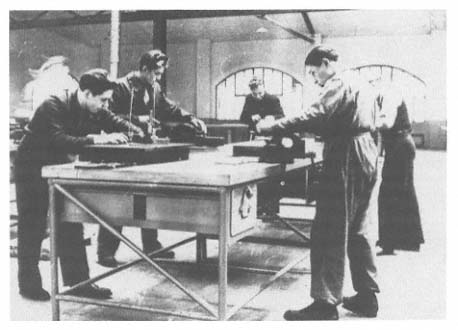
Fig. 1.
Apprentices in training at an Amiot factory near Paris, c. 1939–45. Aircraft companies
depended on a higher proportion of skilled workers than did most metalworking firms.
Many skilled aircraft workers made their start as apprentices in the industry. Others came with
experience from shipbuilding and automobile construction. Even after airplane construction was
modernized in 1938–39, skilled workers remained in high demand. Photo courtesy of SHAA.
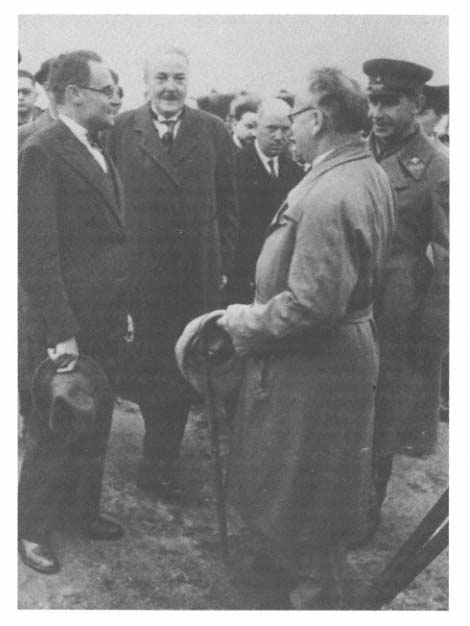
Fig. 2.
Air Minister Pierre Cot (left) and state engineer Albert Caquot (third from left)
on a visit to the Soviet Union in 1937. Cot put great stock in Franco-Soviet
cooperation as a defense against Germany. Photo courtesy of SHAA.
Fig. 3.
"There is a way to increase production other than the sixty-hour week."
After the defeat of the general strike of 30 November 1938 the Daladier government
eliminated the forty-hour week and expanded work hours in defense-related industries.
The CGT argued in vain to rely on other methods than long hours to boost production.
This cartoon from the April 1939 issue of the FTM's L'Union des Métaux called for
reorganizing production into three eight-hour shifts, investing in better machinery, retraining
the unemployed, and expanding apprenticeships.
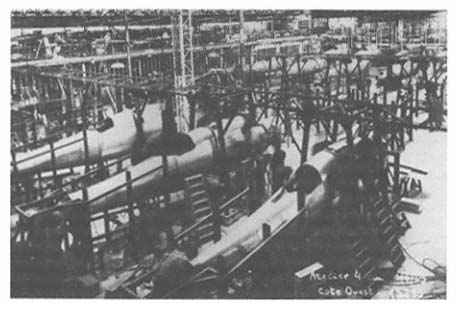
Fig. 4.
Assembly hall for building the Bréguet 691 bomber at the Bréguet factory in Vélizy-Villacoublay
in 1939. Since the First World War airplane construction had taken place in immense assembly sheds
as small work teams put together fuselages and attached wings, fins, cockpits, and accessories to
the emerging aircraft. Yet only in 1938 and 1939 did workers and engineers address the challenge of
building large all-metal airplanes in great numbers. The extensive use of jigs for positioning pieces, tools,
and large structures made the job easier. Photo courtesy of SHAA.
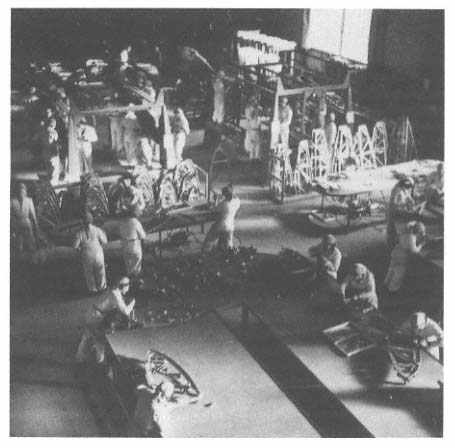
Fig. 5.
Women at work building the Amiot 143 at the Amiot factory in 1939–40.
By simplifying airplane design and reorganizing production methods in 1938 and 1939,
airplane manufacturers found new ways to use semiskilled workers, trained in a matter
of weeks for specialized jobs. Whereas women had comprised a miniscule proportion of
the blue-collar work force in the industry before the war, after September 1939 companies
recruited a great many women to do semiskilled work. They were usually the first to lose
jobs after the defeat of June 1940. Many women later found work in airplane construction
when the industry revived under German auspices during the Occupation. Photo courtesy of SHAA.
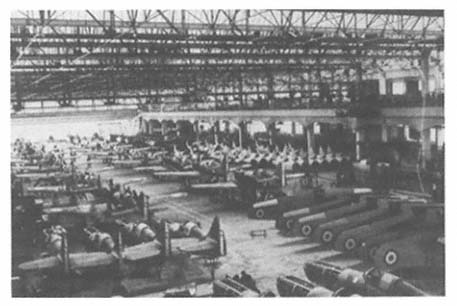
Fig. 6.
Production line for the Dewoitine 520 at the SNCAM factory in Toulouse in 1940.
As impressive as French production turned out to be in 1939–40, the industry never
overcame the handicap of a late start. This picture, taken in Toulouse three days after
the armistice, shows the highly regarded Dewoitine 520 finally coming off the production
line too late for use in the Battle of France. Photo courtesy of the Smithsonian Institution.
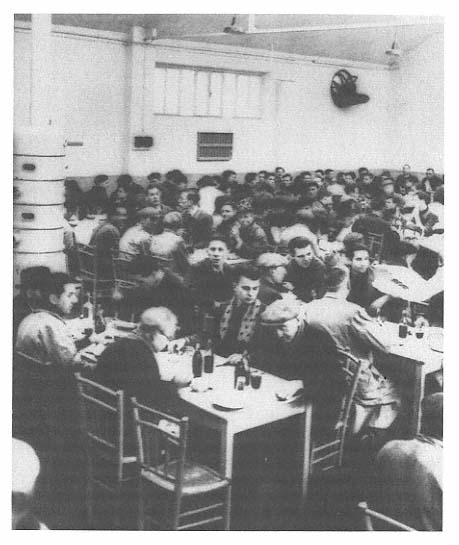
Fig. 7.
Employee dining hall at the Amiot factory, c. 1940. Employers and labor militants had
competing ambitions for factory dining halls. Employers saw them as places to reinforce
their paternalistic authority, militants as places to cultivate support for the CGT. Even
during the Occupation, mealtime in the cafeteria gave militants a chance to promote job
actions and protests. After the Liberation, plant committees dominated by the CGT won
the right to oversee the social-welfare activities of the factory, including the cafeteria.
Photo courtesy of SHAA.
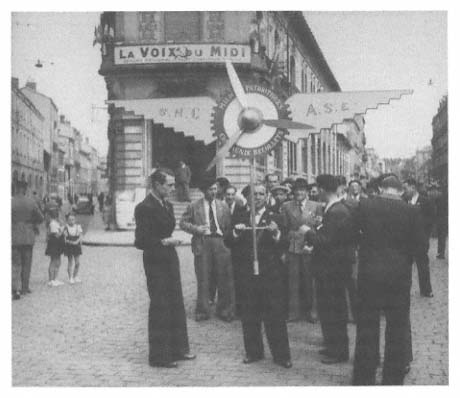
Fig. 8.
SNCASE employees who were members of the Patriotic Militia, a paramilitary organization
designed by the Communist Party to harass the Occupation authorities, gather in the streets of
Toulouse to celebrate the Liberation in 1944. The Resistance enabled Communist militants to
reestablish themselves as leaders of the labor movement in aviation, as in most industries, after
the setback of the Nazi-Soviet pact in 1939. Photo courtesy of the photographer, Jean Dieuzaide.
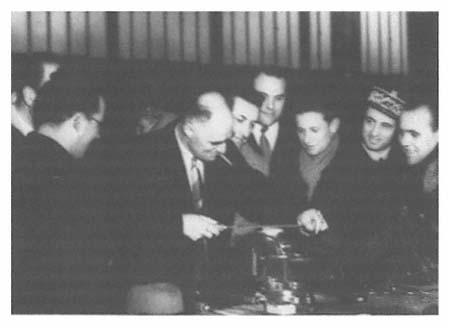
Fig. 9.
Air Minister Charles Tillon visiting the SNCASO plant at Châteauroux in 1945.
As a veteran labor militant and the chief of the military arm of the Communist Resistance,
Tillon tried to make the industry both an arena of labor reform and a model sector for
the party's postwar "battle for production." Photo courtesy of SHAA.
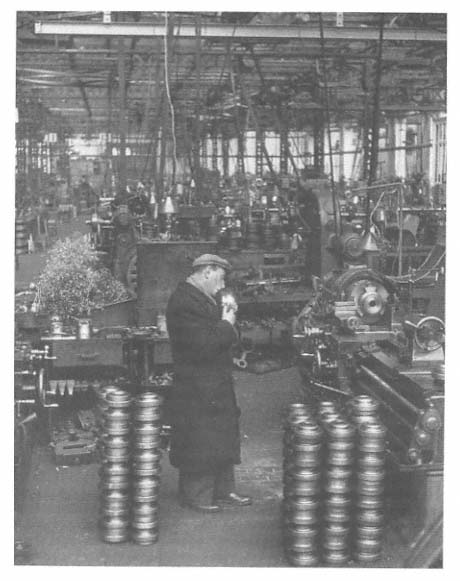
Fig. 10.
"The SNECMA Strike, 1947," by Willy Ronis. Ronis captured this view of a
SNECMA factory during the strike wave of late 1947. The CGT's defeat in the
strike wave made it nearly impossible for aircraft workers to prevent the
massive layoffs and plant closings that followed from government decisions
to restructure the industry. By 1950 thousands of jobs had disappeared, manufacturers
and politicians had established a stable working relationship between the public
and private sectors of the industry, and Communist militants, though still the leading
spokesmen for workers in most airplane factories, had lost much of the political
ground they had won after the Liberation. Photo courtesy of Willy Ronis.
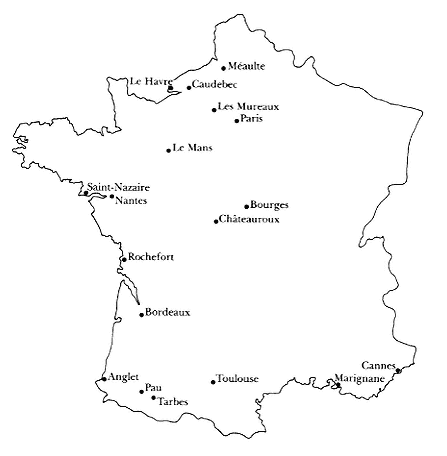
Map 1.
Principal Locations of the Aircraft Factories in France in 1940
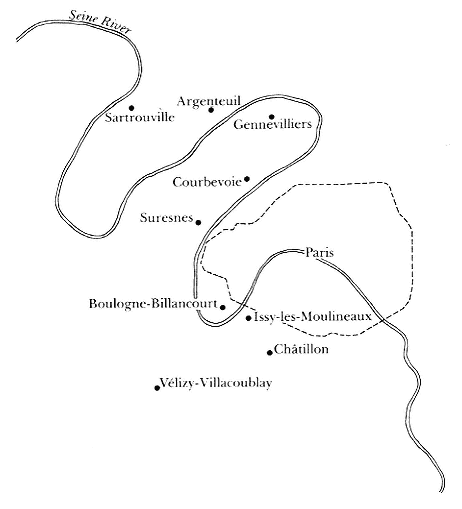
Map 2.
Principal Locations of Aircraft Factories in the Paris Region in 1940