
An Urban Future
While exploring these dimensions of urban management, we must remember that Leningrad long predates the coming to power of the Bolsheviks. Municipal and regional officials in Leningrad, as well as in many other Soviet cities founded prior to 1917, must struggle to match local reality with central decrees within a quite distinct pre-revolutionary environment. This necessary blending of pre- and post-revolutionary inheritances was initially complicated by the Bolsheviks' own ill-defined sense when they seized power that existing urban conditions must somehow be changed.[5] In February 1918, the new Soviet government nationalized land and, eight months later, abolished private property in cities.[6] These policies elevated the state to the status of single agent for all large-scale construction and planning—a condition that perhaps more than any other single factor explains the arid, monotonous, and even oppressive character of much Soviet urban development ever since.
During the 1920s, politicians, planners, and architects engaged in extensive theoretical debates on nearly every urban planning, management, and architectural issue.[7] Throughout most of the decade, the search for new forms of socialist urban settlement was often obscured by factional disputes, which engaged competing groups whose origins lay in prewar Europe and Russia. In essence, these debates narrowed to a disagreement between theorists such as Leonid Sabsovich, who demanded the urbanization of rural areas into nodal points, and their counterparts such as Nikolai Miliutin and Ivan Leonidov, who proposed the dispersal of cities along continuous linear communities adjacent to transportation and power corridors.[8] The second group offered what Sabsovich decried as "automobile socialism." They envisioned services and employment dispersed along efficient road systems linked by fast, flexible, and individually operated transportation.[9] While such a "Cali-
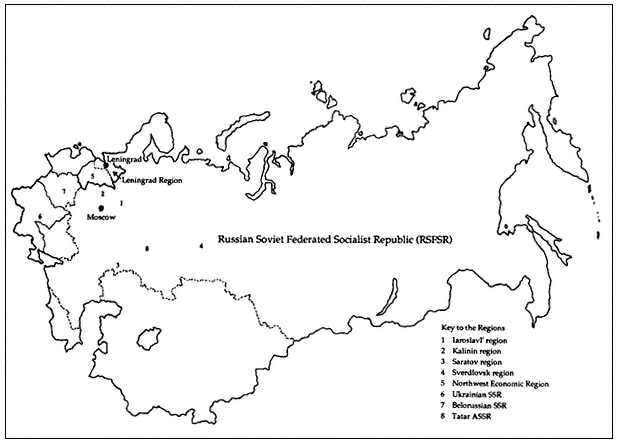
Map 1.
The Russian Soviet Federated Socialist Republic (RSFSR) in the Union of Soviet Socialist Republics (USSR),
showing the Leningrad region (oblast) and the major sources of postwar population migration to Leningrad.
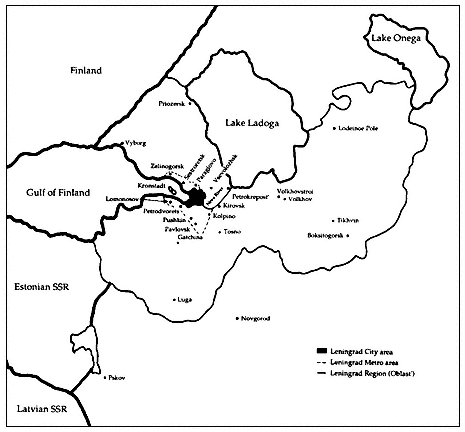
Map 2.
The Leningrad region (oblast), showing the city of Leningrad, the Leningrad metro-
politan area, Leningrad's suburban communities, and the Leningrad urban system.
fornization" of the Soviet hinterland has never taken place, the demands of the "deurbanists" for population ceilings, functional zoning, residential superblocks (or "minidistricts"), and new town development all became incorporated into Soviet holy writ.[10] More significantly, behind both positions lay an essentially antiurban orientation. The city—at least as it then existed—was an artifact of a capitalist or even feudal past. The Soviet future would be based on some new spatial configuration.
Few of the more radical proposals of the 1920s ever left the drawing board. Not only were financial and human resources in critically short supply, but the workers for whom many such projects were designed remained leery of the collective living arrangements of the more extravagant antiurban programs. In addition, by the 1930s, rapid industrialization had become the Soviet state's primary objective, and most political leaders were losing whatever interest they may have had in futuristic urban vistas. As tens of thousands of peasants streamed daily into bloating cities, expediency dictated an urban solution to the debate over the character of socialist cities. In 1931, Lazar Kaganovich brought the antiurbanist revolt to an abrupt conclusion with an address noting that the nationalization of private property made all Soviet cities socialist by definition.[11] He warned that the party would consider any effort to dispute such a position nothing less than sabotage, and this, it should be remembered, was a capital offense.
Kaganovich's declaration ended more than a decade of painful bickering among professionals charged with municipal management. By 1931 there could no longer be any doubt that the Soviet Union's future was to be urban. The massive industrialization drive, focused as it was on cities, necessarily meant that the Soviet Union would emerge as one of the world's leading urban societies.[12] In 1970, for example, the Soviet Union was one of the seven countries in the world with an urban population of over 50 million. By the 1980s, nearly two-thirds of the Soviet population had come to live in urban areas (in the United States, by comparison, almost three-quarters of the population resides in urban areas). Moreover, the Soviet Union has become a world leader in the number of urban centers with more than a million in population.[13] Stalin's industrial vision was an urban vision, so it followed that cities would emerge as pivotal elements in the overall industrial system.