
Period III. The Dissolution (1945)
The ownership structure of Sumitomo at the time of zaibatsu dissolution is indicated in Table 3.4. The dominant shareholder of most group subsidiaries was the holding company, Sumitomo Honsha, and the dominant shareholder of the holding company itself was the Sumitomo family (particularly the head of the family, Sumitomo Kichizaemon), which held 83 percent of the shares at the end of the war. In addition, some cross-holdings existed among the subsidiaries themselves (e.g., Sumitomo Bank's 40 percent stake in Sumitomo Trust and Banking).
With Japan's defeat in World War II and the subsequent arrival of U.S. Occupation Forces came a major overhaul of the Japanese economy as a means toward economic democratization. The most important measures from the point of view of the zaibatsu were the dissolution of the holding companies, the elimination of family assets held in the zaibatsu, the removal of many top executives from first-line subsidiaries, and the breakup of a number of leading zaibatsu companies (Hadley, 1970). The
TABLE 3.4. SUMITOMO GROUP | |||||
Shareholder | |||||
Issuing | Sumitomo | Sumitomo | Sumitomo Bank(%) | Other Sumitomo Companies (%) | Total Sumitomo Holdings (%) |
Sumitomo | 83.3 | 83.3 | |||
Sumitomo | 11.3 | 24.1 | 16.7 | 52.1 | |
Sumitomo | 2.8 | 1.5 | 40.2 | 0.5 | 45.0 |
Sumitomo | 2.6 | 17.0 | 19.6 | ||
Sumitomo | 53.4 | 26.6 | 7.0 | 14.0 | 100.0 |
Sumitomo | 4.3 | 20.9 | 6.8 | 8.7 | 39.7 |
Sumitomo | 4.7 | 24.3 | 1.0 | 8.2 | 38.2 |
NEC | 2.0 | 11.1 | 0.2 | 6.5 | 19.8 |
Nippon Sheet | 4.6 | 19.2 | 0.4 | 24.2 | |
Sumitomo | 7.3 | 17.5 | 0.5 | 6.2 | 31.5 |
Sumitomo | 7.2 | 21.0 | 69.0 | 97.2 | |
SOURCE : Calculated from data provided in Nihon zaibatsu to sono kaitai (reproduced in Futatsugi, 1976, pp. 52-55). Note: All of the above are current company names. | |||||
changes in group structure wrought by the dissolution are depicted schematically in Figures 3.8a and 3.8b. With dissolution, family ownership connections to the honsha (as well as its smaller holdings in the subsidiaries) were eliminated. So too were honsha connections to the direct subsidiaries, or chokkei gaisha.
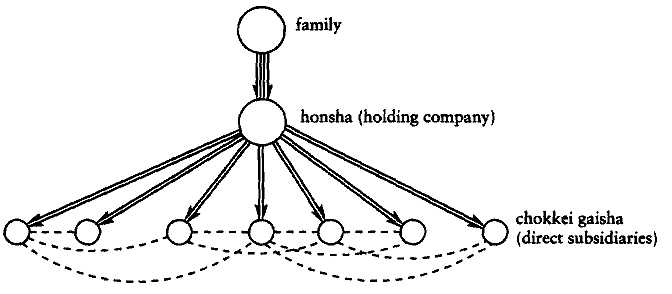
Fig. 3.8a. Prewar Zaibatsu Pattern of Ownership and Control.
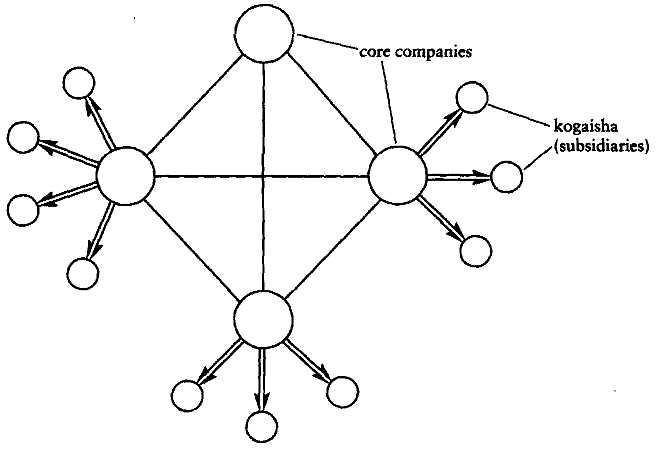
Fig. 3.8b. Postwar Keiretsu Pattern of Ownership and Control.
This left only intersubsidiary connections intact, but these intersubsidiary crossholdings provided an important infrastructure on which to rebuild the groups in the 1950s. The subsidiary companies became the nucleus around which the present-day groups are based, and most have become substantial enterprises in their own right with their own networks of subsidiaries (kogaisha) and satellite firms ringing their periphery. From the prewar zaibatsu, then, came the beginnings of the postwar groups.