
C—
Conclusion:
Digression on the Term "Minyans"
After listing individually each of the Argonauts that Jason invited to participate and then adding the names of the two supernumeraries, Apollonius brings the Catalogue section to a satisfying conclusion by explaining the collective name used to refer to the heroes of the Argonautic expedition. The section ends, that is to say, with an etiology: why were the Argonauts as a whole called "Minyans"? The term was a traditional name for the group,[27] and Apollonius suggests a reason for its origin:

[25] On the thematic significance of dress in the Argonautica , see A. Rose, "Clothing Imagery in Apollonius' Argonautica ," QUCC 21 (1985) 29–44. It is noteworthy that in vase paintings of the Gigantomachy the (civilized) Olympians wear clothing and carry weapons that are manufactured, while the (barbaric) Giants wear skins and wield clubs; cf. E. Kuhnert, "Giganten," Roscher 1.2.1653–73; and LIMC 4.2 s.v. "Gigantes." A similar contrast can be seen in the Gigantomachy featured on the Hellenistic Altar of Zeus at Pergamon; cf. J. J. Pollitt, Art in the Hellenistic Age (Cambridge 1986) 97–110.
[26] See Vian 244–45 ad 112.
[27] See Vian 10 n. 2 for references.
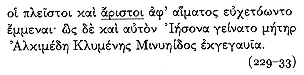
Such was the number of men who gathered to assist the son of
Æson. The people living in the vicinity called all these heroes
Minyans since the majority, and these were the best ,
boasted to descend from the blood of the daughters of Minyas.
Thus, even Jason himself had as mother Alcimede,
who was the daughter of the Minyad Clymene.
The explanation that most of the Argonauts were Minyan in origin can hardly be correct. Indeed, the poet records only seven Minyadae among the group.[28] But it is not Apollonius who has blundered.[29] He is not the ultimate source of the faulty genealogical assertion. Rather the poet reports that those who lived in the vicinity of Iolcus (

Yet there is more involved here than a passing etiology. The Homeric Catalogue of Ships ends with a question:


[28] They are Jason, Admetus, Iphiclus, Euphemus, Talaus, Areius, and Leodocus. Vian 10–12 offers a fine analysis of the problem.
[29] So Vian 11.
[30] For references, see Vian 11 n. 1.
[31] Cf. G. Nagy, The Best of the Achæans (Baltimore 1979) 27.
for the Argonauts resulted from boasts made by those considered the best among the Argonauts. With the question posed at the conclusion of the Catalogue of Ships in mind, the reader would seem to be invited to ask who the best of the Argonauts is, a question that arises all the more naturally given the arrangement of the Catalogue into two halves representing opposing heroic types. This is in fact a question that Apollonius will explicitly ask twice in the course of the first book in contexts where Jason and Heracles vie for this honor. The first instance occurs in the election (332–50); and the second, in the argument following the abandonment of Heracles (1280–1344).[32] Thus, like Homer in his Catalogue, Apollonius too questions the identity of the "best of the heroes," although in a less direct fashion. The thematic opposition between the man of skill and the man of strength in the Catalogue implies that the answer will involve one of these two types of hero. Finally, one might guess from Homer's answer to his own question that one of the heroes may turn out to be the best only in the absence of the other. The events in Book 1 will bear out the validity of both these suggestions.
It would be a mistake indeed to consider the Catalogue of Argonauts a mere listing of the dramatis personæ , required by the conventions of the genre and placed out front simply to get it out of the way. On the contrary, Apollonius has executed a remarkably original and brilliant adaptation of his Homeric model in such a way that he has not only provided the reader with the names, backgrounds, and in some cases revealing vignettes in the lives of the Argonauts; he has also raised—through the structure, presentation, and allusiveness of the Catalogue—the central question regarding the identity and the very nature of the hero of the Argonautica : Who is the best of the Argonauts? Will he bring back the golden fleece by means of some extraordinary skill, or through the exertion of brute strength?
[32] I shall discuss these passages in detail in Chapters 4 and 8.