
Popular Culture and Oral Traditions in African Film
Manthia Diawara
Vol. 41, no. 3 (Spring 1988): 6–14.
In spite of the increasing number of African films released in the course of the last 20 years (from Borom Sarret in 1963 to Nyamanton [The Garbage Boys ] in 1986), there has not been an African film criticism as enlightening and provocative as the criticism generated by the Brazilian Cinema Novo, the theories of Imperfect Cinema, and the recent debates around Third Cinema.[1] This gap must be filled to overcome the repetitious nature of criticism which has addressed itself to African film in the last 25 years and to make possible the definition of a dynamic aesthetic proper to Africa. The lack of African critics who know African traditions is at fault, as well as the critical practice of the West, where the ethnocentrism of European and American film critics has limited them to evaluating African cinema through the prism of Western film language. Thus, they refuse to look at African cinema "straight in the eyes." They think that that cinema is in the process of finding its individuality, that the film-makers have not mastered yet the film medium, that the camera style is still primitive in African films.
European critics are afraid to look at African cinema in the same manner that Africans used to be afraid to watch the first movies from Europe. According to Amadou Hampate Ba, the wise man of Bandiangara, when film was introduced in his village in 1935, the Imam and the head of the village accused it of being loaded with lies, tricks, and anti-Islamic goals. In order to protect the village against this diabolical invention imposed upon them by the colonial administrator, the Imam commanded women and children to stay at home. Only men came to the projection and they closed their eyes for the entire length of the film. At the end, the men told the administrator that women and children could not come because they were afraid of the images in motion on the screen.[2]
Versions of this paper were presented to the colloquium of Film and Oral Literature in Ouagadougou at the 10th Pan-African Film Festival, and to the Center for Black Studies at the University of California, Santa Barbara. I would like to thank the University of California at Santa Barbara for research and travel support in writing the paper.
Today, African cinema must combat this resistance to foreign images. Europeans close their eyes in order not to see the questioning of Western values, the reaffirmation of cultures repressed by the West, and anti-neocolonialist discourses. European critics sent to view these films, in another form of the reactions like those of Amadou Hampate Ba's village chief, bring back inevitably indulgent and nonanalytical comments on African cinema.
To analyze African cinema, one must first understand that 25 years of film production have necessarily created an aesthetic tradition which African filmmakers use as a point of reference which they either follow or contest. An African aesthetic does not come merely from European cinema. To avoid making African cinema into an imperfect appendix to European cinema, one must question Africa itself, and African traditions, to discover the originality of its films. In his article "Sur les formes traditionnelles du roman africain," Mahamadou Kane wrote that "the originality of the African novel must be found more precisely in its relation with the forms of oral literature from 'Black Africa'."[3] In the same article, Kane compared the oral storyteller to the novelist, exploring the themes, the narrative devices, and other features of the novel which also form the basis of the oral tale. He also showed that the novelist, as well as the story-teller, uses realism as a means of expression, resorting to a linear story with one action which enfolds around three units of time (departure, arrival, and return). Like the traditional story-teller, the novelist opts for a didactic enunciation and, consequently, reproduces in the text the apprenticeship of life as well as moral and social codes.
In this article, I will try to bring out the relations between the oral tradition and African cinema in the same manner that Kane does for the novel. I will compare the griot (the bard) to the film-maker, looking particularly at their reproduction of traditional modes of being, so as to show the similarities and the differences between their works.
First of all, it seems logical to underline the fundamental difference between oral literature and cinema. The means put into play in the construction of a film—the camera movement, close-ups, and shot/reverse-shots—are not the same as those used by the story-teller. Indeed, the latter enunciates by incarnating characters one by one, dominating the narrative by his or her presence. The griot depends on spoken language as well as on music to actualize the story. The film-maker, on the contrary, uses the means of mechanical reproduction to give shape to the story. Whereas oral literature speaks of life, cinema reproduces an impression of life.[4]
Putting this difference aside, can one say that the originality of African cinema must be found in the oral tradition? Can one also overlook the notion that African cinema had had nothing to inherit when it started its development?[5] According to this postulate, there would exist only one film language,
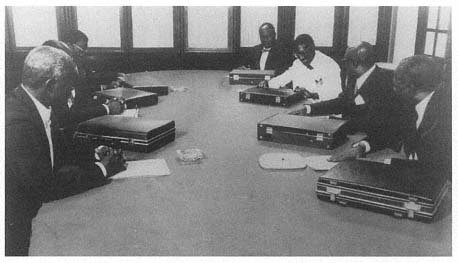
Ousmane Sembene's Xala
(New Yorker Films)
the one to which the West has given birth and which it has perfected. The black film-maker would then only have to place the content of his/her work in a framework that takes its condition of possibility from the rules and precepts already elaborated by Western masters.
However, when African films are examined, one sees that all the directors resort in different ways to oral story-telling forms. As Kane noted in regard to the novelist, the film-maker too is influenced, consciously or unconsciously, by the story-teller's techniques of narrating. "At night, he/she used to be fed with oral tales, historical or cosmogonical legends . . . very often, he/she grew up in a milieu which had a specific mentality as regards the forms of discourse, a sensibility which expressed itself in particular ways."[6]
First it is important to look at the manner in which popular cultures are filmed in African cinema, because such popular practices as song and dance, the performance of the griot, and the representation of African social systems such as polygamy are often used to create the effect of the real in the films. In Xala (Ousmane Sembene's 1974 film about independence and the impotence of the new leaders), for example, after the Africans have taken control of the Chamber of Commerce, song and dance are represented to accentuate the transition of power in the story as a return to authenticity. The dance occurring at the beginning of the film, instead of having a fixed exotic meaning as in anthropological films about Africa, is a spectacle open to several interpretations. First one can see in it the desire of the new public employees to be considered traditional, and
therefore authentic. But one soon realizes that the dance and music outside are used as masks to hide the incompetence of the new leaders inside, who accept bribes from the very Frenchmen they had kicked out. Finally, the dance connotes in an ironic manner the representation of half-naked Africans who are always dancing in European and American films. At the level of the signified, song and dance in Xala position the spectators to criticize the superficial use of tradition by politicians. The opening scene helps the audience build a revolutionary attitude relative to the regressive behavior of the characters in the film.
In Visages de Femmes (Faces of Women , a 1985 film by Desiré Ecaré, which tells two different stories about two women in Ivory Coast), song and dance are narrative processes which move the story forward. In this film song and dance, at the beginning and end of the river love scene, constitute a mini-narrative with a beginning, middle, and end. Through their performance, the women tell the story of how a boy and a girl deceived everybody and met in the river to make love. In Xala Sembene negates the Hollywood stereotypes of exotic Africans and gives a contextual interpretation to song and dance, but in Visages de Femmes Ecaré emphasizes the manner in which song and dance in Africa are used to inform people of what is taking place behind their backs. This balletic cinema, or a cinema that dances in order to tell its story, has its parallel in at least one West African popular theater, the Koteba , which also can imitate all forms of representation through dance.
As the dancers of Visages de Femmes , in their colorful attire, move to the beat of the music in harmony with the rhythm of the editing and the camera movements, one cannot help but think that Ecaré has invented a new language for African cinema. But how is this aesthetization of an African popular culture, which pushes the spectator to identify with the dancing women, different from the old tradition of constructing the body of women as the site of desire in Western cinema? Furthermore it seems that the dance scene, through the use of medium close-ups of women's feet, arms, and heads, is addressed to the desire of the male spectator, and thus contradicts the love-making in the river, which seems to proclaim the sexual freedom of African women. In other words, as Ecaré places song and dance in African cinema, away from anthropological and Hollywood films, he surrenders to the sexist codes of African popular culture which undermine his very attempt to keep alive in Visages de Femmes the political commitment of African directors.
This brief analysis of the representation of song and dance in Xala and Visages de Femmes reveals that the appropriation of popular culture by the fiction film in Africa creates a movement away from Western film language, toward a predominance of traditional narrative codes. Sembene leads this movement by first negating European stereotypes of song and dance in Africa, and by putting into question the African elite's attempt to exploit these popular forms for its
own gains. Ecaré's desire to let African dance and song speak in a cinematic language coincides with a phallocentric construction of the characters which turns them into objects of desire for the spectator. Visages de Femmes teaches us, thus, the necessity for the film-maker to interrogate popular culture in order to divest it of its manifest and/or repressed phallocentrism.
As regards social practices such as polygamy in African film, two examples suffice to illustrate its cinematic representation. In Sey Seyeti (One Man, Several Women , 1980), Ben Diogaye Beye puts polygamy and modernity into play in order to bring to light the contradictions in a contemporary African society. Beye constructs polygamy as the common denominator of the problems of several men in the film, and ends by focusing on the freedom of a young woman who is forced to marry an older man. There is no central story in Sey Seyeti , which tells one anecdote after another, using polygamy as the over-determining factor. This complex film, which runs the risk of confusing the spectator in the West about the relationships among many characters, or of being dismissed as an example of African avant-garde, shocked the inhabitants of Senegal. When it was released, the film provoked an unprecedented reaction in the press from sociologists, ethnologists, and politicians. Beye was accused by some for looking at polygamy, an African custom, with European eyes, and praised by others for boldly exposing a regressive practice which no longer finds its justification in modern Senegal. The fact that Sey Seyeti shocked African audiences, while its message remains opaque or confusing to the spectator in the West, indicates that Beye simultaneously fashioned an African film language while attempting to shed light on the repressiveness of a popular practice such as polygamy.
In Finye (The Wind , by Souleymane Cissé, 1983), polygamy is a principal theme. One of the scenes in this film debunks polygamy by exposing its internal contradictions. Indeed, the youngest of the governor's wives takes the initiative in the quest for a lover by expressing her desire for a young man of her age. The man this young woman chases also happens to be the lover of the governor's daughter. Symbolically, therefore, both women have become the governor's daughters and/or wives because they have the same object of desire. What becomes an issue in this scene is polygamy's inability to answer to the emerging needs of sexual freedom in Africa. But the tradition of polygamy is more seriously questioned in the film by the belittling of its social and economic meaning. Women play the role of respectful spouses, who submit to their husbands in order to cheat on them even better and to get from them what they want. For example, in another scene the oldest and the youngest wives stage a mock fight to distract the husband from his commitment to punish a disloyal daughter. As for the governor/husband marrying three wives, which in the past would have served to emphasize his prestige, this now appears as a movement toward the
weakening of moral and social values. The youngest wife squanders his money, drinks whiskey, and smokes in front of him. These signs of depravity in a traditional Islamic society are ascribed to modernity and the persistence of polygamy. An understanding of local culture (anthropological signs) is necessary to appreciate the play of the actors as authoritative and phallocentric husband, or oldest and youngest wives. One has to go beyond the simplistic conception of art as functional in Africa and see, for example, the aesthetics over-determined by polygamy in the comic scene of the mock fight between the wives.
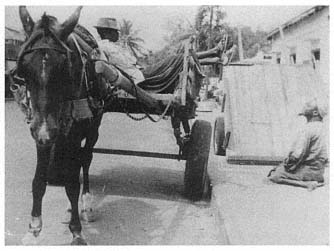
The figure of the griot, symbol of the oral tradition, has also been often represented in African films. Historians of African cinema have already studied the griot's presence in Sembene's films. In a pioneering article on the subject, Mbye Cham argues that Sembene sees himself as "the mouth and ears of his people," and in his role as a film-maker, he "prefers to amalgamate, adapt, develop, and enhance certain features of the gewel [griot] and the Lekbat [story-teller]."[7] In her book The Cinema of Sembene Ousmane (1984), Françoise Pfaff compares Sembene's cinematic techniques with the griot's narrative techniques. She also analyzes the representation of the griot in films such as Niaye, Borom Sarret, Xala , and Ceddo . I will limit myself to the figure of the griot seen in a scene of Borom Sarret : fat, well dressed, and even with a gold tooth. By contrast the "Borom Sarret" (cart driver) is skinny, poorly dressed, and tired from his work. The opposition between these two characters is so striking that it reminds one of an earlier scene where Sembene uses high- and low-angle shots to contrast the cart driver with a crippled beggar who crawls on all fours.
As money is transferred from the cart driver to the griot, one sees tradition as tainted with obvious corruption. The griot turns tradition into a tool of exploitation when he evokes the cart driver's past nobility in order to take away all the money he has earned for the morning labor. The griot's narrative about the cart driver, which would have been authoritative in oral tradition, is debunked here as exploitative and not inclusive of the contemporary realities that oppress the cart driver. Sembene transcends the griot, therefore, and surrounds him and his old narrative with a new vision which traces the mechanism by which people such as the cart driver are exploited. It is important to notice that in the same scene, as the griot goes on taking the cart driver's money, one young boy shines the shoes of another who is stronger and who leaves without paying. Here again Sembene uses high- and low-angle shots, as he does throughout the length of the film to maintain this hierarchy of power not only between people, but also between the two sides of the city.
The richness of this scene is such that it shows the spectator that a return to tradition, to authenticity, does not always bring about solutions to the problems of Africans such as the cart driver. While criticizing the inhuman westernization of the inhabitants of the Europeanized side of the city, the "Plateau," Borom
Cart driver and griot: Borom Sarret
(New Yorker Films)
Sarret questions the unconditional return to tradition. Sembene creates a distance between spectators and the characters in the film which enables the spectators to criticize themselves in their tradition. This cinematic language takes its form and content from the figure of the griot, symbol of the oral tradition which Sembene uses as his point of departure. The difference between this first film by Africa's leading director and Western films resides in Sembene's ability to transform Western cinema's exotic characters like the griot and the cart driver into thematic as well as structural elements for the content and the form of his film language.
In Djeli (The Griot , 1981), on the contrary, Lancine Fadika-Kramo resists this transcendence of the griot's art form. He posits the griot as the point of departure and the master of narrative. Djeli starts with a flashback retracing the griot's mythic origin in order to put into question the hierarchies of the caste system. According to this rhetoric, the griot was originally a hunter who changed trades to become a singer, story-teller, and musician. Interestingly enough, another West African myth of origins, "Gassire's Lute," states that the griot was a brave warrior who, tired of killing, turned into a musician to follow and entertain the warriors.[8]Djeli blames the caste system for the contemporary negative image of griots as inferior to other social groups. To show that this definition of griots is opposed to any revolution of ideas, to love and life, Fadika creates a love story between a man from the griot caste and a woman from another social group so as to reveal the regressiveness of caste systems which suppress such a possibility. The aesthetic in Djeli defines itself as a movement out of the stagnation of caste hierarchies, towards a transformation of tradition into an equalitarian system. It is in this sense that the film valorizes "Djeli-ya"—the state of being a griot—through beautiful images of the griottes (female artists), slow-motion shots of
griottes singing and dancing, and the flashback which shows that griots were originally equal to other groups. The film positions the spectator to get rid of hierarchical notions, to enjoy the art of the griot, and to see a coincidence between the rehabilitation of griots and progress in Africa.
Finally, in Jom (1981), Ababakar Samb paints a romantic figure of griots. According to Samb, they are the historians, the educators, and the guardians of people's conscience. In Jom the griot is the main character, the omniscient narrator of the different sketches that form the film, and the immortal persona who travels through time and space. He remains unchanged by age and by the weapons used by the enemies of tradition. Neither money nor fear can corrupt him. He is the griot of the poor as well as of the rich. Samb's griot, like Sembene's narrator in Borom Sarret , is a committed activist who fights for the right of the oppressed. He provides leadership and moral support to the factory workers who are on strike, ridicules the eccentricities of the nouveaux riches in Africa, and praises the courage and dignity of the migrant workers who had to leave their villages because of the drought.
Samb's construction of the griot and his narrative as master and model respectively for African cinema has for a consequence the subordination of the film-maker's narrative to that of the griot and the creation of a nostalgic mood to serve as a refuge for the spectator. The figure of the griot is used to reinvent a beautiful image of the past. Unlike Sembene, who puts the griot's narrative within a larger narrative, Samb surrenders to the narrative authority of the griot. This romanticization of the griot defines Samb's film language, which valorizes tradition as characterized in the film by authenticity, dignity, and truth, and negates modernism as characterized by alienation, colonialism, and exploitation. Jom positions the spectator to identify with tradition without any attempt at self-criticism: everything positive is pushed on the side of tradition and everything negative on the side of modernism.
Up to now, I have shown the manner in which elements of popular culture have been incorporated into cinema. I will show now how the structure of oral literature has helped to shape the originality of African cinema. At the beginning of this article, I pointed out that film-makers, like novelists, are influenced, consciously or not, by the narrative forms of the oral story-teller. They have been initiated into oral tradition before going to Western schools. The way the story-tellers narrate becomes their point of reference when they take their first steps at a film school. During the rest of their careers, they are bound to be dealing with oral tradition, to move it sometimes, contrasting it with the modern forms of the novel and of cinema, or even to repress it. One can see the influence of oral tradition in all African films, including Xala, The Money Order, Finye , and Baara (The Porter) , even where the narrative forms of the classic novel and cinema dominate.
Sembene's Ceddo
(New Yorker Films)
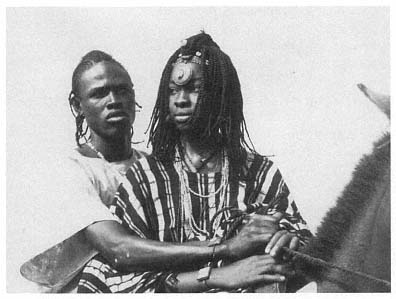
Elsewhere, I showed how Gaston Kabore's Wend Kuuni (The Gift of God , 1983) makes orality its subject and questions the hermetic and conservative structure of tradition in oral literature.[9] One can also mention Sembene's Ceddo as another film which takes the oral tradition for a principal subject and transforms its structure into a revolutionary statement. Sembene's The Money Order is a historical landmark because, for the first time in a film by an African director, the actors speak an African language. But it is in Ceddo that Sembene posits an archeology of discourse in Africa. The richness of the language in proverbs and sayings, the power of the spoken word and of the speaker, are all represented in Ceddo . In the king's court, the discursive space defines itself by including some as members of the discourse in a hierarchical order and by excluding others. The griot, to use the words of Camara Laye, is master of discourse. He controls its distribution and its impact. He is the one through whom the speaking members communicate.
Let's examine the manner in which the subject of orality determines the form of narration in the film. In order to represent the discursive space, the director creates a mise-en-scène in which the griot occupies the center of the circle formed by the king's court, the Imam, the missionary, and the Ceddoes. The fast editing style of European films is replaced by long takes in deep-focus shots. It is as if the camera has taken the griot's position so as to reveal the directions of speech. There are very few camera movements and close-ups. Shot/reverse-
shots are avoided so as not to give the impression that one is dealing with a dialogue scene similar to the ones in Western films.
However, Sembene, like the griot, also makes his presence felt at several points in the diegesis. He is physically present as a Ceddo, carrying firewood on his head, discussing the issue of exile with other Ceddoes, and during the Imam's baptizing of Ceddoes. The use of close-ups of human faces and of objects, in this film where long shots dominate the narration, reveals a didactic intervention on the part of the director. Thus Sembene, like the oral storyteller, determines the reading of the signs for the viewer.
The travel of initiation or the educational quest, which constitutes the structural cell of oral literature, is also an important motif in African cinema (cf. Borom Sarret, La Noire de . . ., L'Exile, Lettre Paysanne, Wend Kuuni, Njangane, Touki Bouki , etc.). The quest defines itself as a movement from the village to the city and ends with the return to the village. One can also interpret it as an alienation and a return to authenticity, as is shown at the end of Touki Bouki , for example.
Ceddo also moves its characters so as to bring them to an awakening of consciousness. The princess, first kidnapped by the Ceddoes, realizes the exploitation of her people by the Imam and joins the Ceddoes in their resistance against the tyranny of the Imam. What above all differentiates Ceddo from the oral narration is its closure. In the oral tradition, the physical return symbolizes the return to the status quo. The griot is conservative and his story helps to reinforce traditional values. In oral traditions, the story is always closed so as not to leave any ambiguity about interpretations. In Ceddo , on the contrary, the return denotes the union of the princess and the Ceddoes. Thus the end of the film, a freeze frame, announces the new day pregnant with several possibilities.
Finally, I will end this study by showing the manner in which one of the best films of the Pan-African Film Festival (FESPACO 1987), Cheick Oumar Sissoko's Nyamanton (see FQ , Winter 1987–88), continues the African film language I have sought to define above. Nyamanton constitutes an educational quest, or an initiation trip for the two main characters, Kalifa and Fanta, who travel daily from their home to the neighborhood where they work. The home symbolizes the interior space where tradition is a refuge, safeguarding parental relations. The children play with their grandparents and the resulting laughs help the family go through their daily difficulties. The city represents the outside, the change of setting and imminent danger. The trips between home and the city enable the children to witness the injustice present in their society and to question its permanence.
Nyamanton , too, like Ceddo , goes beyond the mere imitation of orality to question the griot who is the master of discourse. In one scene Kalifa says to his friend, Aliou, that his father is the greatest liar after Jali Baba, Mali's famous griot. Aliou answers that griots do not lie, that what they say is the true
story and that Kalifa ignores their value. Aliou then starts imitating Jali Baba and sings his friend's praises. One sees in this scene the definition of the griot as a historian on the one hand and, on the other hand, as an artist whose play with words ranks him with liars. But more important than this reference to the figure of the griot and his narrative is the fact that the director's world view takes the place of that of the griot as the most authoritative in the thematization of the kids' relation to everyday life in Africa. In oral tradition, it is through the griot's point of view that one sees and realizes the universe around one. In film, the camera replaces the griot as the director's eyes and constructs the new images of Africa for the spectator. It is in this sense that one says that the African film-maker has replaced the griot in the rewriting of history.
Nyamanton is constructed mostly with long shots. These shots show clearly the space occupied by the women at the house door and Kalifa's father under the tree. The father has to yell when he communicates with women because of the distance separating them. In order to remain within the limits of realism as regards the representation of such spaces, the camera occupies the center between the women and the father, as was the case with the griot in Ceddo . Here, too, close-ups and shot/reverse-shots are avoided as much as possible.
At first sight, this narrative expedient may be dismissed as simply a primitive use of the camera in an attempt to economize on editing. Thus a hasty comparison with Western cinema might bring one to the conclusion that African films lack action. But an analysis based on the forms of oral tradition will highlight the originality of African film language in Nyamanton . First, one can see through an ethnographic insight that the long shots serve better to create the effect of verisimilitude in the narrative. The external space in Africa is less characterized by the display of emotion and closeness between man and woman, and more by a designation of man's space and woman's space in society. The narrator imitates this reality by using mostly long shots and by describing the emotion of the characters instead of showing it. The griot's influence on the film-maker brings about the fact that subjective shots do not always have the same significance in African cinema as in Western cinema. Close-ups of a child's face or of a pack of cigarettes in Nyamanton , for example, are not objects seen by a character but their description by the director/narrator for the spectator. Even the flashforward in the film is a description of the mother coming to an understanding of the situation in which she finds herself. Instead of effacing himself and realizing the story through different characters' narrations, the director in Nyamanton always carries the camera on his shoulder and, like the griot, dominates the narrative with his presence. While Western directors often achieve recognition by letting the story tell itself, African directors, like the griots, master their craft by impressing the spectator with their narrative performance. This may be because, with the griots, one achieves fame not by being the author of new texts but
by being able to reproduce the best versions of old texts. Nyamanton is a new version of such African films in which tradition clashes with modernity, and the popularity of its director lies in the manner in which he describes the most memorable episodes of the clash.
The choice of Nyamanton for the title of the film is also interesting in the context of oral tradition. Etymologically, "Nyamanton" comes from the prefix "Nyama," which in Bambara and Mandinka may be translated as "potentially dangerous forces released through the performance or violation of ritual."[10] "Nyaman" with an "n" at the end means trash. Thus a popular song in West Africa likens Sunjata, King of Mali in the thirteenth century, to a dump-site which hides everything underneath itself, but which cannot be covered by other things. Literally the song refers to Sunjata's vital force which protects his people and which harms his enemies like the plague released from a "Nyama" or from the violation of ritual.[11]
When the title of the film is interpreted in the context of "Nyama" as a West African trope, one sees how Sissoko positions the spectator to take a personal responsibility in reducing the children's future to trash collection, and to fear the retribution of "Nyama." Sunjata, too, had a difficult childhood, and those who were responsible were punished. On the other hand, the likening of the children to Sunjata leads the spectator to identify them with the collective future of Africa. As in Ceddo , orality is here again made the subject of the film in order to arraign the repressive forces of tradition and modernism.
Finally, the oral tradition also influenced the French title of the film, La leçon des ordures (The Lesson of Garbage) . Sissoko wanted to oppose to "The Lesson of Things," which students in Francophone Africa learn every morning from French textbooks, the lessons learnt about Malian society by Kalifa and Aliou through their work as garbage boys. As "leçon des choses" becomes interchangeable with "leçon des ordures," and both are little more than "Nyaman," the film creates the necessity to question the lessons inherited from the former colonial powers. There is no doubt that the form of African cinema is influenced by its traditional content. Understanding the role played by the oral tradition in African film enables the critic to see how the film-maker has transformed this tradition into a new ideology. But it is also possible to study the way in which the African content has changed the cinematic language of the West. This is what transpires when one examines the strategies by which film has incorporated African traditions. The African director makes conscious and unconscious references to the griot's narrative techniques.