
The Tedrow Area
The complexity of channel cutting and filling in the uppermost Hell Creek Formation is shown in the Tedrow area (the term "Tedrow area" describes exposures adjacent to and including Sections FF-GG, Plate 3; Figure 6). The Brown-Grey, Upper Tedrow, and "Lower Tedrow" channel fills, and a mudstone lens containing Cretaceous pollen, are exposed in the Tedrow area, but determination of a sequence of depositional events for the channel fills and mudstone lens is difficult because Holocene erosion has removed critical information. These difficulties highlight the uncertainty inherent in biostratigraphic study of complex fluvial channel deposits, even in an area in which three-dimensional exposures are available.
The "Lower Tedrow" Channel is a trough cross-stratified sandstone containing a sparsely sampled vertebrate fauna consisting of associated ceratopsian skeletal remains (Figure 7) and a few isolated mammal teeth referable to Ragnarok and
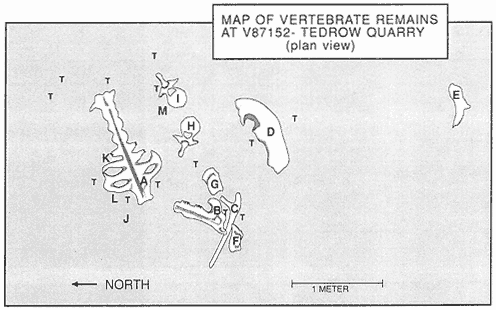
Figure 7
Plan view of Tedrow Dinosaur Quarry (V87152). Letters on quarry map identify the following
elements: (A) Sacrum: broken at base of neural arch over nearly entire length, entire dorsal
part of sacrum absent. Transverse processes missing on many vertebrae. (B) Mandible (right):
edentulous; dentary, surangular, and possibly angular present. Dental battery fractured-
weathered. (C) Dorsal rib #2 (left): distal end of shaft lost. (D) Squamosal (right): lateral edge
and posterior portion of parietal suture present; broken medially at site of large ventro-medial
depression. (E) Squamosal fragment (left): only posterior portion present. (F) and (G) Squamosal
fragments (left): can be rearticulated; groove for quadrate (F) and heavy ridge of bone
(across F-G) against which process of exoccipital abuts present; E-F-G from same squamosal.
(H) Cervical vertebra #7: end of right transverse process lost. (I) Cervical vertebra #6. Note: J, K,
L, M, and T not figured. (J) Cervical vertebra #8?: 50% of vertebra recovered as float; neural
arch reconstructed. (K) Two unidentified fragments: wedged against sacrum; one fragment
well rounded. (L) Frill? fragment (27×10 cm) nestled against sacrum. (M) Frill? fragment
(14×10 cm). (T) Turtle shell fragments scattered throughout quarry; many from one individual
of Adocus . Also present, but not shown, are many unidentifiable bone fragments (<12 cm length).
Stygimys . The dinosaur remains were quarried from the basal lag of the channel fill, which also contained clay balls, fragments of turtle shell, and carbonized plant debris (V87152, Figures 6, 7). Two molars of Ragnarok and two incisors of Stygimys were collected .7-.8 m and 1.5-1.7 m above the base of the channel fill, respectively (Figure 6). These specimens occur within troughs containing clay balls and other vertebrate fossils. It is uncertain if the dinosaur remains and the mammals occur within sediments deposited in the same depositional event (see discussion of Upper Tedrow Channel below).
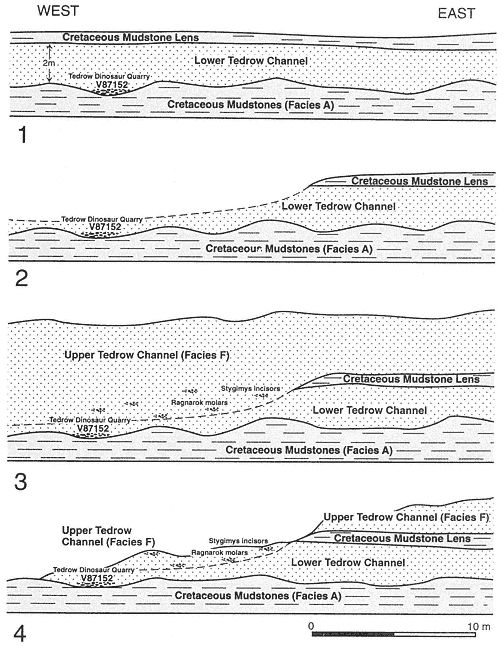
Figure 8
Scenario 1 sequence. (1) Deposition of Lower Tedrow Channel fill with dinosaur remains in
basal lag, capped by mudstone lens with Cretaceous pollen. (2) Partial removal of 1 during
entrenchment of Upper Tedrow Channel. Dinosaur remains in Lower Tedrow Channel fill not
disturbed. (3) Deposition of Upper Tedrow Channel fill, including the mammals Stygimys and
Ragnarok . (4) Area as exposed today. In this scenario, the associated dinosaur remains
and the mammals were deposited in separate filling events or stories. Based on pollen,
the lower story with the dinosaur bones would be Cretaceous and the higher story with
the mammal teeth would be Paleocene.
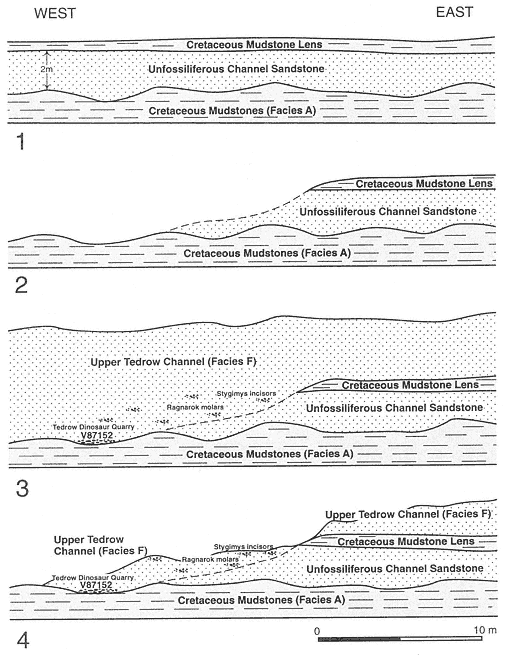
Figure 9
Scenario 2 sequence. (1) Deposition of unfossiliferous sandstone channel fill, capped by
a mudstone lens containing Cretaceous pollen. (2) Partial removal of 1 during entrenchment
of Upper Tedrow Channel. (3) Deposition of Upper Tedrow Channel fill, with dinosaur remains
in basal lag and the mammals Stygimys and Ragnarok higher in the fill. (4) Area as exposed
today. In this scenario, all the vertebrate remains in the "Lower Tedrow" Channel are Paleocene
unless reworked from Cretaceous sediments. Also, the "Lower Tedrow" Channel is a localized
depression in the Upper Tedrow Channel, and both were filled at about the same time.
The "Lower Tedrow" Channel could be Cretaceous or Paleocene, depending on whether it is part of the Upper Tedrow Channel. Situated 2 m above (topographically) the base of the "Lower Tedrow" Channel is a thick mudstone lens containing Cretaceous pollen (Lofgren and Hotton, 1988), which is overlain by the Upper Tedrow Channel (Figure 6). It is uncertain whether this mudstone ever extended across the part of the channel fill that produced the dinosaur remains (contra Lofgren and Hotton, 1988) and mammal teeth. Erosion has removed the critical area in which the Cretaceous mudstone lens would have been either in superposition above part of the "Lower Tedrow" Channel or clearly cut out by the Upper Tedrow Channel (Figures 8, 9). If the latter were true, then the "Lower Tedrow" Channel would represent a localized depression in the Upper Tedrow Channel (Figure 9, nos. 2-3).
The Brown-Grey Channel contains a well sampled Bug Creek assemblage in its basal lag (V87072, Figure 6) and its palynological age is Paleocene. This channel fill cuts the mudstone lens containing Cretaceous pollen. Lofgren and Hotton (1988) thought that the mudstone lens overlay the Brown-Grey Channel; this is now known to be incorrect.
Upper Tedrow is a multi-storied channel fill whose lowest story may include part or all of the "Lower Tedrow" Channel. The Upper Tedrow Channel is Paleocene because it cuts the Brown-Grey (Figure 6; Section GG, Plate 3) and Second Level channels (Sections P, 856, Plate 4), both of which produce Paleocene pollen (Table 3). Therefore, if part of the "Lower Tedrow" Channel is a localized depression of the Upper Tedrow Channel, it is probably Paleocene in age.
On the basis of preliminary palynological and geological investigations outlined in Lofgren and Hotton (1988), it was thought that the sequence of events in the Tedrow Area was: (1) deposition of the Brown-Grey Channel; (2) entrenchment of the "Lower Tedrow" Channel containing the dinosaur remains and subsequent filling; (3) deposition of the mudstone lens overlying "Lower Tedrow" during the Cretaceous; (4) entrenchment of Upper Tedrow into all three of the above. If this sequence of events were correct, then the "Lower Tedrow" and Brown-Grey channels would be Cretaceous and the Upper Tedrow Channel would be Paleocene. Trenching in the Tedrow area in 1989 revealed that the Brown-Grey Channel cuts the Cretaceous mudstone lens. This is corroborated by the presence of a Paleocene pollen assemblage in samples 88DLL7-14-13 and 88DLL7-14-30 from the Brown-Grey Channel, which also indicates that this channel is younger than the Cretaceous mudstone lens. However, the "Lower Tedrow" Channel appears to cut the Brown-Grey Channel when traced westward. This is impossible, because the Brown-Grey Channel cannot be cut by a channel ("Lower Tedrow") that is capped by a unit (mudstone lens) cut by the Brown-Grey Channel (Figure 6). Therefore, part of the "Lower Tedrow" Channel must be equivalent to the Upper Tedrow scouring event (that cut the Brown-Grey Channel and the Cretaceous mudstone lens). This fact negates a two-stage channeling hypothesis in which all vertebrate remains in the "Lower Tedrow" Channel are Cretaceous, and the "Lower" and Upper Tedrow channels are two distinct cut-and-fill events (contra Lofgren and Hotton, 1988).
Based on available geologic data from the Tedrow Area, two possible scenarios of
depositional events are presented in Figures 8 and 9, and neither can be falsified by direct field observation. If correct, the first hypothesis (Figure 8) would indicate a Cretaceous age for the dinosaur remains and a Paleocene age for the mammals. The second (Figure 9) would indicate a Paleocene age for both the dinosaur remains and the mammals, unless reworking of fossils occurred.
If the dinosaur remains were not reworked, then choosing between the two hypotheses has important implications for the timing of dinosaur extinction. The first hypothesis is more in line with conventional palynological-faunal correlations in which dinosaur remains indicate a Cretaceous age and the mammal Ragnarok indicates a Paleocene age. Ragnarok is only known to occur in clear association with Paleocene palynofloras at McGuire Creek and elsewhere in McCone County (Sloan et al., 1986; Rigby et al., 1987; Rigby, 1989). The associated ceratopsian remains would indicate a Cretaceous age for the base of the channel fill.
The second hypothesis is more controversial, because the presence of associated dinosaur remains in a Paleocene channel fill might suggest dinosaur survival into the Paleocene. The association of disarticulated skeletal material (Figure 7) might suggest that the bones were not reworked. However, reworking of dinosaur remains that persist in near association would be possible if the remains were eroded from nearby bank material and underwent little or no transport. Dinosaur remains have been found in channel deposits containing Paleocene pollen at McGuire Creek and elsewhere (Sloan et al., 1986; Rigby et al., 1987) but that these remains are not reworked from Cretaceous sediments has not been satisfactorily documented (Lofgren et al., 1990). Therefore, if the second hypothesis is correct, the dinosaur remains probably were reworked from nearby Cretaceous sediments into which the Upper Tedrow Channel was entrenched.
In summary, difficulties encountered in biostratigraphic study of complex fluvial deposits in the Tedrow Area indicate that determining a clear sequence of depositional events in even a limited area can be difficult. The complexity of channel cutting and filling in the upper Hell Creek Formation is imposing.