
Emerging from the Ritual Mask
No image in Mesoamerican spiritual art more clearly illustrates all that is contained in the metaphor of the ritual mask than that of the ruler of Yaxchilán, Bird Jaguar by name, carved on the rear face of Stela 11 (pl. 31) at that site. Though the image is essentially a frontal view of the splendidly arrayed figure of the ruler, his face is shown in profile, and depicted in front of his face is a mask that is an integral part of and extends downward from his elaborate symbolic headdress. It is important to realize that this image, for all the realism of its depiction of the facial features of Bird Jaguar and the figures kneeling in front of him, is the result not of an attempt by the carver to portray natural reality but rather the result of his application to the stone of an elaborate set of artistic conventions designed to permit the symbolic communication of spiritual reality. The frontal view of the body allows the viewer to see—and "read"—the symbolic details of the ruler's costume, while the profile view of the head is surely designed to afford the viewer precisely the same experience as that of Hopi children seeing the unmasked kachinas for the first time. What has been called an X-ray view of the face within the mask allows the simultaneous depiction of the masked face of the costumed ruler which was presented to his subjects on the ritual occasion and the human face of the man within the mask.
We can paraphrase Gill's interpretation of the Hopi children's initiatory experience as an explanation of the effect of such an image. The viewer of the stela would be forced to realize that Bird Jaguar, in symbolically becoming the god depicted by the mask, has actually entered the liminal realm in which he can be human and divine simultaneously. He is, at this precise point in time and space, "manifesting the sacred,"[17] demonstrating that "only through symbolization is the sacred manifest." Thus, the man within the mask "becomes something else " yet remains himself. And as the viewer must surely have known, the something else he now seemed to be was what he had essentially been all the time. The apparent contradiction between these two identities is the "paradox of sacredness"; Bird Jaguar is the animating force within the mask of the divine at the same time that the essence of that divine spirit is the life-force within him. The convention by which this image on the stela is constructed in itself makes this truth apparent.
In the image of Bird Jaguar, we see a graphic portrayal of precisely the same relationship between ruler and god delineated in the ritual entreaty made by the newly installed Aztec ruler which we will analyze in our discussion of transformation. Speaking to Tezcatlipoca, the "lord of the near, of the nigh," of the succession of rulers of which he is now the latest, he says, "Thou wilt have them replace thee, thou wilt have them substitute for thee, thou wilt hide thyself in them; from within them thou wilt speak; they will pronounce for thee."[18] Bird Jaguar, also at the point of accession to rulership, [19] wears his entreaty to the god. That god "hidden within" Bird Jaguar is manifested by the mask, and Bird Jaguar speaks the commands of the god through the mask just as the god speaks through Bird Jaguar. In the timeless moment of ritual, the identities of Bird Jaguar and the god merge to reveal a truth more fundamental than those of the natural world.
What Schele and Miller say about Maya ritual—"These scenes do not appear to represent play-acting but, rather, a true transformation into a divine being"[20] —is exactly what Gill said of the kachina—"The spiritual must reside in some manifest form to be held in common by the community. The view, often taken, that the kachinas are 'merely impersonations' fails to recognize the full religious nature of the kachina performance." In this sense, "Maya ritual was more than a symbolic act. It . . . transformed spiritual beings into corporeal existence in the human realm and allowed people and objects to become the sacred beings they represented."[21] Such transformation was not limited to the Hopi and the Maya; it took place in rituals throughout pre-Columbian Mesoamerica. Thus, for the Maya, as for all the other cultures of Mesoamerica, masks and other costume parts were "the instruments in which sacred power accrued,"[22] and through their ritual use, that power, the life-force, could enter man's world.
Yaxchilán's Stela 11 and other uses of the X-ray convention in the art of the Maya[23] and their counterparts in the other Classic period cultures of Mesoamerica would seem to suggest a prototypical X-ray technique in the art of the Olmec, and a particularly striking example of the Olmec use of this convention fortunately survives in the large polychrome mural found on the face of a cliff above a cave at Oxtotitlán, Guerrero (pl. 5). Despite the
fact that it was painted between 1,500 and 2,000 years before the carving of Yaxchilán Stela 11, it depicts its subject according to precisely the same representational conventions. Its central figure, also a ruler, is depicted frontally so as to display the symbolic regalia in which he is dressed, and his face, precisely as Bird Jaguar's, is depicted in profile within a cutaway mask. The conventions governing Maya art allow Bird Jaguar's status as a ruler to be indicated by the glyphs on the stela and by the figures kneeling before him, and the placement of the Olmec figure atop the upper jaw of a jaguar that forms the niche on a throne/altar similar to those found in the Olmec heartland is a similarly conventional way of indicating his status to the viewer. It is probably true as well that in both cases the rulers are particularly identified. That such a detailed similarity would exist at such widely separated points in time, space, and culture is an amazing testimony to the importance of these conventions, especially since only the conventions are the same; the particular masks and costumes are quite different from one another.
Such differences no doubt reflect the passage of time. While there is the suggestion of a connection with fertility in the mask of Bird Jaguar, that connection has been subordinated almost entirely to his status as the ruler of a relatively complex, sophisticated, and aggressive city-state, a status that is particularly indicated here by his symbolic connections with warfare. There is no such subordination at Oxtotitlán where the symbols of fertility are predominant. According to Grove, "it is probable that Oxtotitlán functioned as a shrine to water and fertility," and even in recent years, water is reputed to have cascaded out of the cave into the land below suggesting that Oxtotitlán continues to be seen as a "mystical source of water." The grottoes of the cave are themselves decorated with fertility-related paintings, and the mural above the entrances to the cave "must have presented an impressive sight," proclaiming the cave's significance to those arriving.[24]
For the symbolic regalia worn by the figure in the mural announces the fertility theme. Soustelle and Grove identify several water motifs,[25] and, as we have shown in our discussion of the rain god, there is a fundamental relationship between the cave/mouth form of the niche on the throne/altar and fertility. More important from our point of view, however, is the fertility symbolism of the mask itself. The face on the mask is clearly that of a bird, and significantly a hook-beaked, goggle-eyed bird remarkably similar to the bird mask depicted in the headdresses of the god impersonator and the attendant priests on the Tlalocan mural at Teotihuacán's Tepantitla apartment compound (colorplate 3) which we examined in our discussion on Tlaloc.[26] The X-ray technique is obviously used here to identify the particular ruler with the forces of fertility; like those forces, he is an expression of the gods, and his personal identity is to be understood as coexistent with his divine status. The fact that this mural is remarkably similar iconographically and in placement to the relief carving at Chalcatzingo, which is referred to as El Rey (pl. 7), suggests that these conventions were widespread among the Olmecs.
The use of the X-ray convention in the art of the Olmec and the Maya captured in stone and paint the moment of liminality achieved by the ruler in ritual, and that moment is also suggested in related ways in other depictions of impersonators. Ceramic figurines of masked impersonators, for example, are found at Classic period Maya sites, especially at Jaina, which indicate that a man is wearing the mask by making the mask and headdress removable. A typical figurine wears a headdress containing "the Mosaic Monster whose huge mouth gapes open to emit an animal skull with an articulated lower jaw. This skull is a mask that fits over the face of the king. Thus, the king becomes the apotheosis of this god when he goes to war,"[27] and yet when the headdress with the mask is removed, a gentle human face is revealed. The scene on Lintel 26 from Structure 23 at Yaxchilán which depicts a ruler identified as Shield-Jaguar receiving a jaguar mask from his ritually attired wife similarly manifests, in a somewhat different way, the coexistence of the faces of the man and the god as the viewer of the scene knows full well that that mask will soon cover the face of the ruler. In all these images, we see the Maya equivalent of the unmasked kachina.
Still another way of revealing the human face beneath the mask is illustrated by a large ceramic figure of an impersonator wearing a helmet mask covering his head and shoulders found in a Zapotec tomb at Monte Albán (pl. 34). If one looks at the proper angle through the slightly opened jaws of the mask,[28] the fully modeled head of the man inside the opossum mask can be seen. While this figure achieves the effect of the X-ray technique, it also indicates the relationship between that technique and another, even more important, convention used to represent the relationship between man and god, a convention that another Zapotec figure (pl. 35), now in the Brooklyn Museum, illustrates. That figure similarly portrays a human head inside the mask/head of an animal whose spiked back suggests its crocodilian nature. The crawling figure carries a bowl on its back, but the significant symbolic feature, from our point of view, is that the jaws of the animal are open wide so that the human head is fully visible.[29] Thus the opossum-masked, standing figure is midway between the god impersonator whose face is fully hidden (though made visible through the X-ray convention) and the fully visible human face emerging from the jaws of the crawling crocodilian figure.
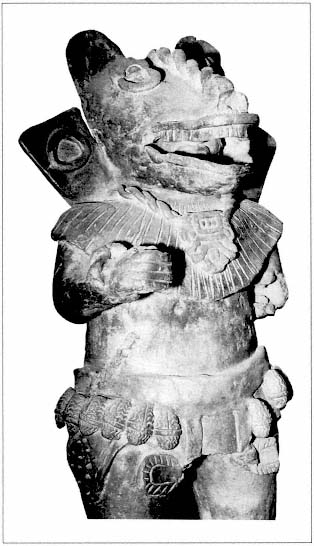
Pl. 34.
Opossum-masked ritual figure, Monte Albán.
The face of the wearer of the ritual mask
is visible through the open mouth
(Museo Nacional de Antropologia, Mexico).
This progression from hidden to visible human faces suggests that the widespread Mesoamerican technique of representing a face, and even a whole figure at times, emerging from the jaws of a mask was conceived as an expression of a particular stage of the liminal ritual moment. This suggests, in turn, that the liminal state was imagined not as monolithic but as a series of stages, a continuum joining man to god which must be seen as a visual counterpart to the process of "unfolding" by which the life-force enters the world.
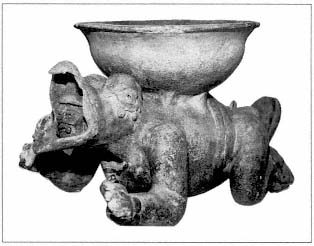
Pl. 35.
Crawling figure with human face emerging
from open mouth, Zapotec (Brooklyn Museum).
In fact, a careful examination of representations of ritual in pre-Columbian spiritual art reveals that the specific form of the masks which allowed ritual performers to exist, for the ritual moment, "betwixt and between" the world of spirit and the world of nature allowed the precise designation of that series of stages of liminality by progressively removing the human face from beneath the mask. Closest to the world of the spirit and farthest from man's secular world, god impersonators, like the Hopi kachina dancers, wore masks that completely covered the face. Hidden within the masks, they "became" the gods whose masks they wore and thus manifested in the natural world the spiritual qualities inherent in those gods.[30] The X-ray technique thus provided a way of portraying in art, but not in ritual, the fully masked impersonator while simultaneously revealing his human identity. He is a man become a god in the ritual moment; his inner spiritual identity has been made visible.
While the fully masked impersonator most clearly "becomes" the god, the most dramatic portrayal of the liminal position of man in relationship to the world of the spirit shows the head or even the entire upper body of a human being emerging from the jaws of the mask of the god as in the Zapotec crawling figure. Among the most fascinating of such representations is one of the earliest, and, significantly, it is clearly related to ritual. La Venta's Monument 19 (pl. 36) depicts a priest, identifiable as such by the valiselike bag he carries in his extended right hand, seated within the womblike enveloping body of a powerful, protective serpent. The relationship between priest and serpent is suggested by the fact that the priest's head is depicted within the open jaws of a mask/ headdress identical to the serpent's head. Thus, it is doubly clear that the human figure emerges from and is an expression, in ritual, of the composite serpent figure. As Elizabeth Easby and John Scott point out, the serpent's "stylized head, repeated in the mask helmet of the human figure, combines features of serpent, jaguar, and bird of prey."[31] That combination, especially in connection with the crest or plume above the serpent's head, leads us, along with many other scholars, to conclude this is a prototypical plumed serpent, perhaps the first of those that would later become the Mexican Quetzalcóatl and the Maya Kukulcán.[32]
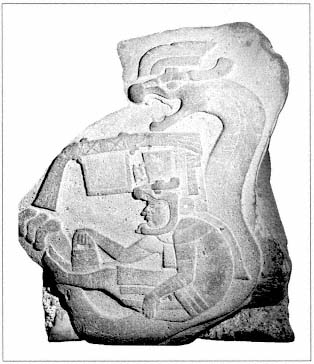
Pl. 36.
Monument 19, La Venta (Museo Nacional de Antropologia, México).
More significantly, however, this bas-relief epitomizes the depiction of liminality in Mesoamerican ritual art. In the jaws of the serpent mask, the priest is metaphorically midway between earthly reality and the world of the spirit; emerging from the "womb" formed by the serpent, in much the same way that the serpent emerges from the sheltering, fertile earth, the masked priest, whose "curved back . . echoes the line of the cape and the snake's body, "[33] is perilously close to the world of the spirit—whose danger is here indicated by the fact that this particular serpent is a rattlesnake— and yet is protected by ritual from the danger, from "succumbing to the blast and going to pieces." This, then, is a magnificent visual expression of the mystery of the liminal experience that can only occur in a place "betwixt and between" in a time that is no longer in time.
Mesoamerican spiritual art contains literally countless examples of faces and figures similarly emerging from the jaws of animal or composite masks. Perhaps the most celebrated later example of this motif is the exquisite small Toltec plumbate sculpture covered with mother-of-pearl mosaic (pl. 37) which has been described as a face-painted warrior emerging from the mouth of a coyote or as the bearded face of Quetzalcóatl emerging from the jaws of the Feathered Serpent.[34] As we have seen (pls. 21, 22, 24), the same theme is found elsewhere in the Valley of Mexico in the early Postclassic, and it culminates in Aztec stone sculpture, relief carving, and codex illustration.[35]
While numerous examples of open-jawed helmet masks on ritual figures can also be seen in the earlier art of the Classic period, perhaps the most interesting example in the Valley of Mexico depicts priests wearing headdresses containing only the upper jaw of what would be a helmet mask were the lower jaw present. This sort of headdress no doubt developed from the full mask, but in terms of liminality, it is a step removed as the dramatic sense of emergence from the world of the spirit has departed with that missing lower jaw, leaving behind only the symbolic indication of that emergence. These particular priests appear in ritual procession in a mural (pl. 38) in the Tlalocan complex at Teotihuacán's Tepantitla apartment compound, and they have come to be known as the Sowing Priests because the streams of water flowing from their hands are filled with seedlike objects which they could be imagined as sowing. Identified as priests by their ritual bags, like that carried by the figure on La Venta's Monument 19, these men are depicted in a ritual context, and the priests' ritual regalia, the "seeded" streams decorated with rows of flowers falling from their hands, the facial paint, the necklaces of shells, the two scrolls similar to speech scrolls rising from their hands, and, most important, the feathered serpent headdresses, all combine to leave no doubt that the focus of their ritual is fertility.[36]
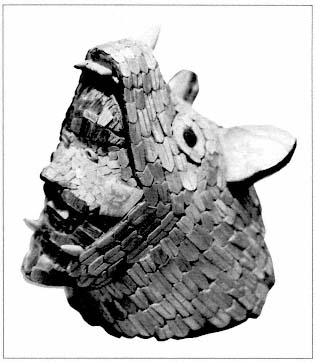
Pl. 37.
Plumbate effigy jar lid covered with mother-ofpearl mosaic,
found near El Corral temple, Tula
(Museo Nacional de Antropologia, México).
It is thus significant that the open-jawed serpent of the headdress is virtually identical to the plumed serpents projecting from the frieze of the Temple of Quetzalcóatl at Teotihuacán (pl. 20) because as we have seen in the preceding section, those serpents are directly related to fertility ritual.
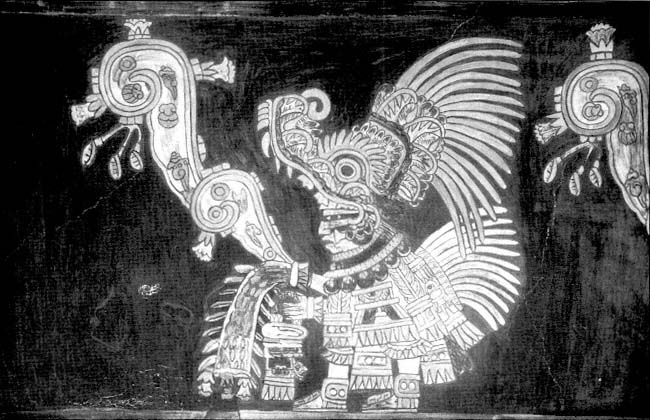
Pl. 38.
Sowing Priests mural, Tepantitla, Teotihuacán, detail
(reproduction in the Museo Nacional de Antropologia, México).
The priests' faces, painted with red bands at eye and nose level, emerge beneath the raised upper jaws of the feathered serpents whose eyes, like the eyes of the priests, are depicted frontally, while the rest of each figure is characteristically depicted in profile. Thus these priests, like the Olmec priest of La Venta's Monument 19, are identified with and function as the conduit for the movement of the spiritual power represented by the Plumed Serpent into the world. It seems likely, then, that at Teotihuacán as well as in the later history of the Valley of Mexico and perhaps earlier among the Olmecs "Quetzalcóatl is more than just a symbol of water and fertility; he is also the patron of the priesthood which carried out vital ritual actions,"[37] and that function is indicated by the mask/headdress his priests wear.
There are a number of other depictions at Teotihuacán of helmet masks, both with and without lower jaws, from the mouths of which emerge human faces, and this motif was not limited to the Valley of Mexico. A great number of the funerary urns found in tombs at Monte Albán depict similar masks and headdresses. In fact, one of the most magnificent urns from the period Monte Albán II (pl. 39) during which, according to Covarrubias, the finest urns, "majestic and imposing in size and design,"[38] were produced, was found in Tomb 77 and depicts "a powerful middle-aged portrait face within the helmet" framed beautifully within "concave and convex planes" made up of "overlapping ochre and green plates of clay."[39] The headdress or upper part of the helmet represents a broad-billed bird[40] while beneath the portrait face, a wide circular band almost abstractly suggests a lower jaw, providing a beautiful foil for the facial features of the portrait. While our information concerning the meanings of the symbols of Monte Albán art is so limited as to make it impossible to identify the particular aspect of the supernatural represented by this imposing helmet/mask, it is clear that its creator is suggesting the emergence of this very particular person from that aspect of the spiritual realm symbolized by the mask. And it is fascinating to realize that this urn was created to be placed in a tomb, perhaps designed to accompany the person portrayed in his return to the world of the spirit. This urn, in that sense, is composed of two masks—the mask of the sacred bird and the death mask of the man. The complex interplay suggested by one's emerging from the other just as life emerges from the spirit suggests metaphorically both the complexity and profundity of the liminal state within which this interplay takes place, a complexity even greater in view of the fact that the meaning of this urn is involved not with the emergence of birth but with the return of death. As one would expect, a number of other urns have been found at Monte Albán which display similar headdresses and helmet masks, one type of which
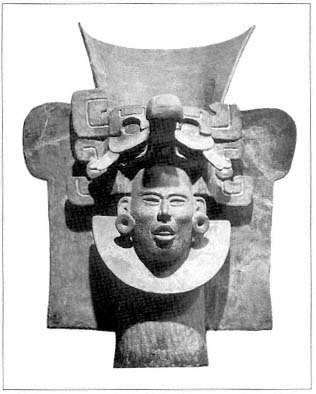
Pl. 39.
Funerary urn, Tomb 77, Monte Albán II
(Museo Nacional de Antropologia, México).
has a headdress representing the upper jaw of a serpent[41] which looks remarkably like the headdresses worn by the Sowing Priests of Teotihuacán.
Figures emerging from the mouths of animal and composite masks are characteristic of Classic period Maya art as well. They are found on stelae and architectural carving in such profusion that it would be impossible for us even to list here the seemingly endless variations on the theme played by Maya sculptors. Tatiana Proskouriakoff describes the type as it is found on stelae:
The design of the headdress most commonly worn by the principal figure on Maya stelae consists of a central mask with attached plumes and other ornaments. It is possible that originally the head of the figure was enclosed in the gaping jaws of the mask, for what looks like a lower jaw beneath the face is seen on one of the Cycle 8 monuments at Uaxactún and recurs later as a decorative element. In most designs only the upper jaw of the mask is shown, the lower is entirely omitted.[42]
According to Schele and Miller, that central mask most often represented a god whose identity "depended on the ritual context," and that ritual, as we indicated above, "transformed spiritual beings into corporeal existence in the human realm and allowed people and objects to become the sacred beings they represented."[43] A particularly striking, though highly stylized example of this motif in late Classic or early Postclassic Maya art is a carved stone sculpture (pl. 40) that once decorated the upper temple of the Pyramid of the Magician at Uxmal. It depicts a head with a heavily scarified face and a crownlike headband made up of circular forms emerging from the stylized open jaws of a serpent. Ruz describes the portrait as displaying "the sullen frown and disdainful mouth of a priest,"[44] and Stierlin suggests that he is a priest of Quetzalcóatl, the Plumed Serpent who was to become the "much-venerated Kukulcán" in the Postclassic Yucatán.[45] Thus, this sculpture may be related to the architectural carvings at Chichén Itzá which manifest the same theme, and it is surely a Yucatec Maya version of the relief carvings of the Classic period characterized by Proskouriakoff.
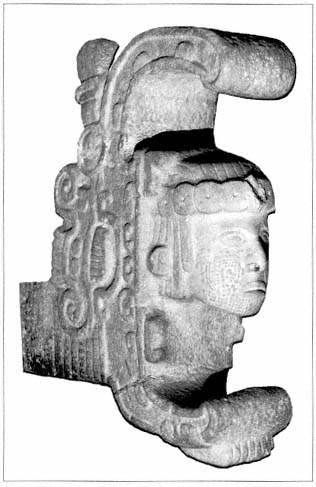
Pl. 40.
Architectural sculpture, El Advino, Uxmal
(Museo Nacional de Antropologia, México).
Schele and Miller also believe, for a different reason, that such a Maya depiction of a figure emerging from the open jaws of a serpent is a visual image of what we have been calling the liminal experience. They contend that the ritual bloodletting often depicted in Maya art was designed to induce hallucinatory visions, "symbolized visually by a rearing snake . . . [with] the persona contacted through the vision . . . shown emerging from [the snake's] gaping mouth," and that "through
such visions, the Maya came directly into contact with their gods and ancestors."[46] In our terms, then, that bloodletting, like the ingestion of hallucinogens, allowed the ritual performer to transcend the limits of the world of nature, entering a liminal "no-place and no-time" in which he would encounter the gods and his ancestors who had "become gods" on their death. These same ritual performers, often rulers, are precisely the figures commonly depicted wearing the helmet masks and masked headdresses from which their faces emerge, suggesting in still another way the fundamental relationship between their position and power and the liminal state through which it was achieved and legitimized. The masks, in this sense, are visual metaphors of their psychological immersion in the world of the spirit.
This symbolic theme of emergence, as we suggested earlier, appears everywhere in the spiritual art of Mesoamerica, and one of its most beautiful manifestations comes from a tradition separate from, though intimately related to, those of central Mexico, Oaxaca, and the Maya. It is the profoundly simple, life-sized Huastec figure of a ritually dressed standing man from Amatlán, Veracruz (pl. 41). The man's face emerges from under the upper jaw of a mask of a seemingly human face with just the suggestion of the mask's lower jaw beneath the man's face. The eyes of the mask are almost closed, and on either side of it, in the place of earrings, hang limp human hands. The face and mask are set against a semicircular plane forming a headdress which is repeated in inverted, U-shaped form beneath the face in the garment covering the chest of the man, a shape that is also repeated in the earrings he wears. In the middle of that U-shaped form is a hole in the chest of the figure which would probably have held a piece of jade representing the heart. Above the upper semicircle and below the U-shaped plane extend rectangular planar forms, giving the sculpture the appearance of an abstract composition of planes, an appearance obviously meant to contrast sharply with the lifelike demeanor of the face and the vigorous positions of the arms. In addition to the use of geometrical forms as counterpoints to living forms, life, here, is juxtaposed to death in the contrast between the face and the mask, between the dead hands and the living ones, and between a skeletal face carved on the back of the semicircular plane of the headdress and the frontal living face. The location of the heart in this composition suggests its centrality to this theme of life emerging from and returning to death as the heart was, after all, the primary symbol of life for Mesoamerica, and its sacrifice marked the ultimate movement from the life of man into, and beyond, the liminal state in which man, through ritual, became god.
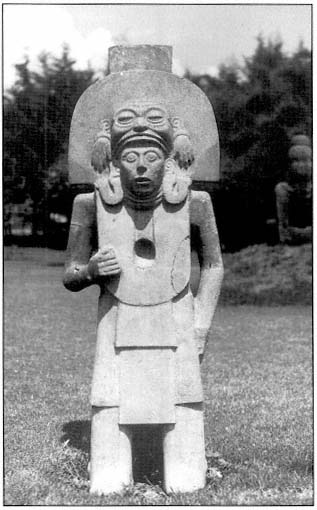
Pl. 41.
Huastec standing figure, Amatlán, Veracruz. Behind the figure's face,
on the rear of the sculpture, a skeletal face appears
(reproduction at Museo de Antropologia de Xalapa).
Two typical stelae also from Veracruz, one reputedly from San Miguel Chapultepec and the other from Cerro de las Mesas (pls. 42 and 43) provide a fitting conclusion to this discussion. The figures depicted, probably rulers, are dressed in identical regalia, and that regalia, especially the complex headdress, is a virtual symphony of masks. Each wears a buccal mask over the lower portion of his face, and each face emerges from the open jaws of an enormous, stylized serpent mask that is surmounted by a second open-jawed serpent mask. Still another open-jawed serpent mask is attached to the rear of the headdress, and a small jaguar head or mask is attached to each man's knee. This openjawed serpent mask is found elsewhere in the art of Veracruz and is important enough symbolically to be depicted alone as the central element on a stela from Castillo de Teayo. These five formidable masks, three of them open-jawed serpents, when "read" together no doubt symbolically identified the divine source of the ruler's power and placed his ritual action depicted here in that liminal zone in which he "became" the power symbolized by
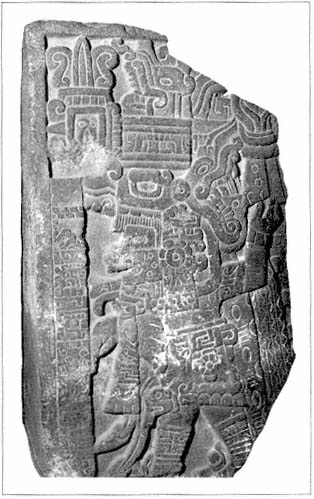
Pl. 42.
Stela, San Miguel Chapultepec, Veracruz
(Museo Nacional de Antropologia, México).
the masks. In this connection, it is interesting that the buccal mask, symbolic of the god's features merging with his own, is not that of the open-jawed serpent from which he emerges and which he also wears as an emblem on the front and back of his headdress. As was the case with the impersonator in the Tepantitla mural (colorplate 3), a distinction is made here between the more general aspect of the realm of the spirit symbolized by the serpent and the ruler's particular ritual contact with that realm symbolized by the merging of his human face with the buccal mask. Thus, we have on these stelae several aspects of liminality displayed in a single image. The ruler emerges from the realm of the spirit and wears the mask symbolic of that emergence as an emblem while at the same time his human identity is merged with a spiritual identity. Viewing that image, his subjects would have had no doubt about the power and legitimacy of his rule.
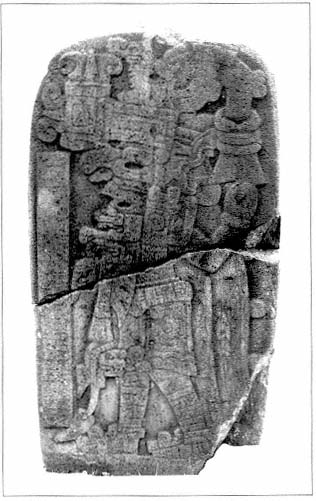
Pl. 43.
Stela 5, Cerro de las Mesas, Veracruz
(Museo de Antropologia de Xalapa).
Step by step, then, through the convention of depicting the faces of ritual performers within the jaws of composite masks, Mesoamerican spiritual art depicts those human beings from the state of being totally immersed in the world of the spirit and barely visible through the slightly opened mouth of the mask to the point of having emerged from that immersion wearing the upper jaw of the mask as a headdress symbolic of their state. This conventional manipulation of the degree and manner of exposure of the human face allows the delineation of the precise relationship of the human being with the world of the spirit just as the features of the mask allow a precise definition of a particular facet of the spiritual realm. But whatever the degree of immersion and the identity of the spiritual force, the metaphor underlying all of these representations is the emergence of life from the spirit, the manifestation of the life-force in a particular living being, for as Gill points out, "only through symbolization is the sacred manifest."