
Waldesnacht
If Mädchenlied pays homage to Brahms's sophisticated Volkston, Schoenberg's Waldesnacht draws impressively on the rich fund of broad, slow songs like Feldeinsamkeit. Where Heyse's "Mädchenlied" poem is concise and epigrammatic, his "Waldesnacht" is expansive, almost hymnic:
Waldesnacht, du wunderkühle,
Die ich tausend Male grüß,
Nach dem lauten Weltgewühle
O wie ist dein Rauschen süß!
Träumerisch die müden Glieder
Berg' ich weich ins Moos,
Und mir ist, als würd' ich wieder
All der irren Qualen los.
Fernes Flötenlied, vertöne,
Das ein weites Sehnen rührt
Die Gedanken in die schöne,
Ach, mißgönnte Ferne führt!
Laß die Waldesnacht mich wiegen,
Stillen jede Pein,
Und ein seliges Genügen
Saug' ich mit den Düften ein.
In den heimlich engen Kreisen
Wird dir wohl, du wildes Herz,
Und ein Friede schwebt mit leisen
Flügelschlägen niederwärts.
Singet, holde Vögellieder,
Mich in Schlummer sacht!
Irre Qualen, löst euch wieder;
Wildes Herz, nun gute Nacht!
Forest night, wondrous cool, I greet you a thousandfold; after the noisy
turmoil of the world, oh, how sweet is your rustling! Dreamily I bury my
weary limbs in the soft moss, and it is as if I were freed from all my
confused torments.
Sound, distant flute song, which stirs a vast longing and leads my
thoughts to the lovely distance, oh so begrudged! Let the forest night
lull me and silence my pain, and I breathe a blissful contentedness with its
fragrance.
In your secretive, close confines you will recover, restless heart. And peace
floats downward on gently beating wings. Sing me to gentle slumber,
tender bird songs! Begone, delirious torments; good night, then, restless
heart!
Schoenberg's setting of the poem is modified strophic; the changes come principally in the vocal part of lines 5–6 of each stanza, analogous to mm. 14–17. (Appendix ex. G gives only the first musical strophe in full.) For this song, Schoenberg had a direct model in Brahms's own setting of the Heyse's "Waldesnacht" as a song for mixed chorus, op. 62 (ex. 3.3). A comparison of the opening phrase in the two settings will show how Schoenberg responds to Brahms's predilection for asymmetry. The first two lines of the poem, which have eight regular metrical stresses, would fall naturally into a phrase of four full measures, divided 2+2. Where in one of his earlier songs Schoenberg would almost certainly have followed the four-square approach, here he emulates Brahms in extending the first phrase to five measures, or eighteen quarter beats. But he follows the spirit rather than the letter of Brahms's practice: Brahms augments the note values on "kühle" and "die"; Schoenberg creates a beautiful ascending melisma
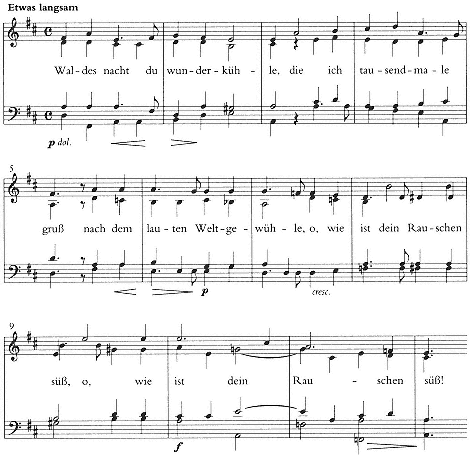
Example 3.3
Brahms, Waldesnacht , op. 62, no. 3.
on the first syllable of "wunder." By means of word repetition, Brahms extends his second phrase still further, to six full measures, or twenty-four quarter beats. Schoenberg moves in the opposite direction, compressing lines 3–4 into four measures plus an upbeat, or seventeen quarter beats.
Schoenberg's integration of chromatic detail within a diatonic context places this song well beyond his other Brahmsian efforts and can, indeed, stand beside Brahms's own practice in chromatic passages like mm. 6–10 of the choral song Waldesnacht. We might note especially Schoenberg's elegant treatment of the flatted sixth degree,


Example 3.4
Schoenberg, Waldesnacht , strophe 3, mm. 58–61 (vocal part only).
monically respelled as

The


Two other aspects of the song merit comment here. The first is the subtle evolution of the piano texture across the strophe. The staggered arpeggiation of mm. 3–12 gives way in m. 13 to full chords alternating between the hands. After the fermata of m. 17, this texture evolves into the parallel chordal style in which the piano doubles the voice. We have encountered this texture before, in the "Anders kommen" section of Ecloge. There it seemed merely awkward, and Schoenberg eventually abandoned it (see ex. 3.2c above). In Waldesnacht, however, the parallel chordal style has been carefully prepared and makes for a wonderfully effective climax to the musical strophe.
The second aspect of the song that is noteworthy is the transformation of the vocal part in the third strophe, at mm. 58–61 (ex. 3.4; cf. mm. 14–17 of Appendix ex. G). Here the voice in essence takes over the top line of the piano part (with the addition of a downward sixth leap at "Vogel"). The enharmonic and chromatic steps carry this phrase well beyond the Brahmsian idiom of the rest of the song. Indeed, this kind of line—as well as its harmonic underpinning, including a whole-tone chord on the last beat ofm. 14/58—would be at home in a Schoenberg work of 1899, or perhaps in Gurrelieder.[5]
[5] This vocal line actually represents a revision written by Schoenberg over the original line, which was as in strophe i. In SW A2: 85, Schmidt opts for the original version and banishes the chromatic revision to the critical report (SW B1/2/I: 294). This seems to me an unfortunate editorial decision. Schoenberg 1987 gives mm. 58–61, as in my ex. 3.4.
This passage shows quite vividly that Waldesnacht marks the farthest Schoenberg could go within the Brahms "style". Together with the variation movement of the D-Major String Quartet (examined in the previous chapter), the song can be said to represent the culmination of his period of Brahms study; it is his graduation piece, so to speak, or the work pointing the way out of the "Brahms fog". That path was to be opened still more forcefully in the fall of 1897 with Schoenberg's turn away from the kind of poetry represented by Heyse to the newer kind of verse embodied in the works of Richard Dehmel.