
Dance Properties
Rattles.
—Rattles accompany every Pueblo dance. Frequently they are incorporated as decorative elements on separate garments, as, for example, the shell, hoof, and cone tinklers on the kilt and the legging fringes. Nowadays, American-made sleighbells are seen on straps around the knees and arms and on belts around the waist.
Perhaps the most interesting rattle is that of tortoise shell (pl. 20) worn by almost every masked dancer. It is a rattle of especial sacredness because the tortoise lives in the water and has influence with the Rain Gods. When the men wear tortoise shell in the dance, the belief is that the supernaturals hear the rattle and thus know that the Indian needs rain for his crops. The tortoise is captured near the water holes or sacred springs. After the shells are cleaned and dried, the toes of deer are tied
on by a piece of buckskin rove through holes in one side of the shell. A second piece of thong, passed through holes in the other side, ties the shell around the leg just under the knee. As the foot is lifted in the dance, the leg hits the pendent hoofs, sending them up to strike the back of the shell with a loud, sharp clatter.[*]
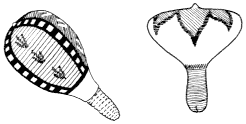
Figure 20
Gourd rattles
Shells and the dewclaws of various animals are hung on thongs and fastened to little sticks so that they produce a clicking noise. The gourd rattles are the ones most frequently carried. The dried shell of the gourd is thoroughly cleaned; then the seeds are removed through a small hole and replaced by pebbles of white quartz, colored stone, or small crystals.[77] When the gourd has no neck by which the rattle may be carried, a corncob or wooden handle is inserted in the hole. Occasionally, a tapering handle goes all the way through the gourd and is held in place by a peg on the other side. These rattles are painted in divers colors and in designs appropriate to the suggestion of motion.
Skin rattles are made of pieces of rawhide sewn together in rectangular or ring shapes. Pebbles are enclosed and a handle is affixed. A special Antelope-fraternity rattle at Hopi is made of a dampened skin stretched over a wooden hoop perpendicular to a wooden handle, the whole forming a kind of frame. The skin is pulled completely around this frame, the rattle is put in, and the skin is fastened and painted white. The sound of this rattle is similar to the warning of the rattlesnake, a rattle with a rustling quality rather than the loud sharpness of the gourd.
Before it is carried in a ceremony, each rattle is 'blessed' by tying on it with cotton cord a downy white eagle or 'breath' feather. At the top
* At Isleta a distinction is made: shells of the water turtle are worn by one group, and those of the land turtle by another (Parsons, 1932, p. 355).
of the long standard carried by the leader of the chorus there are a decorated gourd rattle and many feathers, as well as the swirling white kilt or banner. Bunches of horns from cow and mountain sheep may be carried noisily about by the Rain Makers, while hoofs of cattle, shoulder blades of sheep, and bones of other animals serve the purpose of rattles and noisemakers. A thin, rhomboidal piece of wood tied to the end of a string or thong is whirled rapidly through the air like a bull-roarer and
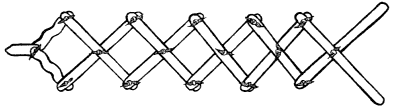
Figure 21.
Lazy tongs lightning frame.
adds its appreciable measure of noise (pl. 40). In the ceremonial dance it is often handled by one of the clown priests.
Wands.
—The priest leaders carry several different feather wands. These are the insignia of the kiva or organization which happens to be performing. Moreover, these brilliantly clothed fetishes are works of art by reason of the careful selection and arrangement of feathers and the remarkable precision with which each feather is bound in place.
There is a lightning wand which is cut from wood in a zigzag shape to imitate that phenomenon of nature. It is carried by certain impersonators in dances devoted to rainmaking.[78] The quick striking of the lightning is represented to the Indian mind by a mechanized frame of strips of wood, pegged or tied together like a lazy tongs, folded and unfolded by two handles at one end.[79] This is one of their most highly developed mechanical devices, and the ceremonial lightning thus created never fails to inspire the spectators with wonder and amazement. Representations of lightning end in arrow-shaped points because the Pueblo Indian believes that each flash is tipped with a stone knife.[80]
Warriors and those concerned with the hunt always carry brightly painted, curved rabbit sticks or bows and arrows trimmed with downy eagle feathers which float from the tips and interspacings along the strings. Sprigs of evergreen are carried in the hand, parallel to the bow.
At Santa Clara a section of gourd is mounted on a short stick and carried by each male dancer in the Zuñi Basket Dance. This piece of gourd is painted green on the concave surface and decorated with four eagle feathers. It is said to represent the sun, especially when stick and emblem are held aloft.[81]
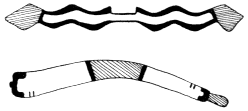
Figure 22.
Hopi dance wands: upper, lightning dance
wand; lower, rabbit-stick dance wand.
The women's dance wands are rectangular tablets with a handle at one end. In dancing for rain these are carried vertically in each hand. A single, wide tablet may have two handles side by side; it is then carried with both hands in front of the body.[82] In the center is painted a figure of a rain god with curving cloud shapes and streaks of rain above him and a stylized ear of corn below. The whole is topped with downy feathers and crisp yellow heads of seed grass, and puffs of eagle down float at intervals from each side. At Zuñi another hand wand, of great beauty, is carried. It is made of slender sticks "about eighteen inches long, painted white and adorned with delicate white duck feathers in groups of two, the space between being the width of the first three fingers placed crosswise within a few inches of their ends".[83] There are also little, formal bouquets made of feathers beautifully arranged with respect to color and size, and having borders of evergreens and a final edging of shells or dainty, bone-colored dewclaws of the deer or antelope (pl. 22).
Many of the dancers carry tall staffs to indicate their office or to give
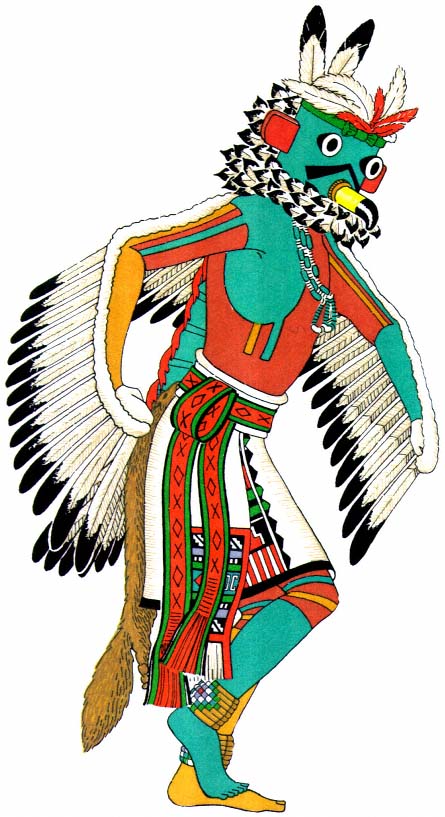
Plate 24.
Eagle Kachina, Hopi. Bird form stylized by introduction
of all the elements of the conventional kachina costume.
dignity to their impersonations (pls. 29, 30). The staffs are variously ornamented with feathers, evergreen, cornhusks, ears of corn, and other sacred symbols.
Baskets.
—The round, flat, basket plaques, made by the Hopi or purchased by other villages from nomadic neighbors, are used most significantly in the Basket Dance. This is definitely a woman's dance, though sometimes the services of a few men are utilized. The major symbolism is centered in the food basket, the usefulness of which is inestimable since it covers the span of life. It holds all the seeds to be planted in the earth, in due time to flower and become grain. It carries the ripened harvest and winnows the seed from the chaff. When the harvest is ground, it bears the meal, and later it brings the thin, colored rolls of piki bread which is made for the sustenance and ceremony of the tribe.[84]
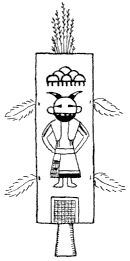
Figure 23.
Zuñi dance wand carried by women dancers.
Designs represent cloud, rain god, and corn.
The Hopi baskets are made with both the coil and the wicker technique. They are constructed of the tough, strong stems and small twigs of various desert plants which have been cleaned and dyed the pleasing soft colors of earth and herb. The two techniques are very different. The wicker designs diverge as they leave the center, growing larger and more effective, whereas the coilwork restricts the design to a radial pattern which is forced out from center to circumference and has a tighter and more concentrated feeling. Baskets are made specially for this ceremony and at the end of the dance are thrown to the onlookers, to the accompaniment of clamor and agitation.
In the Sun Basket Dance of Santa Clara, performed by two boys and two girls, each of the girls "carries a basket decorated inside with an orange-colored sun symbol and on the edge with long fringes of red-dyed angora wool. In the principal movement of the dance these baskets are
swung in a double arc, with graceful drooping of the entire body, the flame-colored corona flashing out in a conventionalized but quite realistic picture of the sun".[85]
A greater number of symbolic elements are to be found among the objects carried in the hands of dancers and impersonators than in the colors and designs of dress and mask. With their background in literal fact and phenomena, these objects have outgrown their material phase and have become ceremonial. Devices making use of mechanics in construction are here displayed in their most advanced form. The Pueblo Indian has never been mechanically gifted; even today he has an utter lack of knowledge and interest in the mechanistic features of civilization; his most advanced development in this direction is gauged by his childish delight and wondering belief in the reality of the serpent effigy and its simple manipulation by stick or horsehair thread. His talent lies in another field. By neglecting the mechanical forms he has advanced in the art of surface decoration. He has gained mastery in the field of design.