
5. Anatomy of a Tribal Uprising
It was on the eleventh of January 1979 that I left Kabul, and I reached my home on the third night. I spent one night in Narang, the second night I spent in the district center [alaqadari], and the third night I reached home. Before I reached home, I went to the house of a man who was originally from my village of Gul Salak. All the people were gathered there. They were worried. “How did he get here? What happened? What’s it all about?” Some of them thought that I had become the governor since I knew all the ministers. They were thinking things like this. When they gathered, they wanted to find out my opinion. One asked, “How’s everything in Kabul? How did you get here? How did you get permission? How did you come?” That sort of thing. I saw that there were probably forty or fifty people inside the room and there were some more sitting outside.
The owner of the house was there. All the people from his village were there, along with whomever happened to be there from other places. Opponents of the government had also come. I took a 500 Afghani note out of my pocket. I gave it to the owner of the house.
He said, “What am I supposed to do with this?”
I told him, “Brother, you are a poor man. You can’t give all these people food.”
He said, “To whom?”
I said, “To them. You can’t feed all of them. Even if you can’t give them anything else, you can give them sugarless tea.”
He said, “To which people?”
I said, “To the mujahidin.”
He said, “Really?” His mouth dropped when he said this, and then he turned to his relatives and said, “Replace the red flag with the white one.”
I said, “Don’t put up a white flag. If you’ve got a red one up, then take it down.” Immediately, his sons and cousins went out and took down the flag—the red flag—while we were sitting there. The people there immediately realized what was going on. [1]
The mouth of the Pech Valley runs north and west from the provincial capital of Chagha Serai (also known as Asadabad), which sits at the confluence of the Pech and Kunar rivers (Map 2). The Pech River has two main branches that join at the village of Ningalam: the one entering Ningalam from the north flows from the Waigal Valley of Nuristan; the second descends through most of its length north to south from the Parun Valley of Nuristan before entering Ningalam from the west. The two branches of the Pech are of considerable strategic and commercial significance because they link the Kunar Valley and the Pakistan frontier with Badakhshan Province in the northeast, Panjshir to the west, and Laghman to the southwest. While vehicular traffic can traverse only the lower and middle reaches of the valley, Pech offers foot travelers access to the northern and central flanks of the Hindu Kush without having to go through any major cities, a fact that made the earlier opposition in Pech of considerable importance to the government.
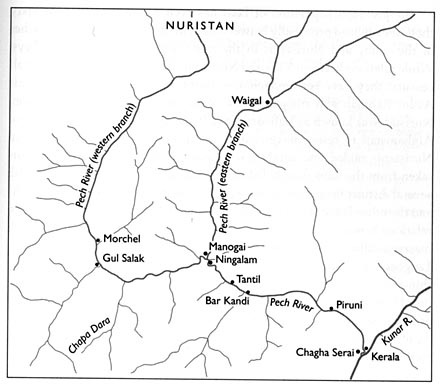
Map 2. Pech Valley
The pre-1978 population of Pech has been estimated at around sixty thousand, divided principally between Safis in the lower and middle reaches of the valley and Nuristanis in the more inaccessible northern valleys. While relations between Safis and Nuristanis have improved in the last half century, they have been antagonistic historically. Until 1897, when Amir Abdur Rahman sent troops in to force the submission of the population, Nuristan was known as Kafiristan, and it was the last remaining region of Afghanistan to resist conversion to Islam. Prior to that time, Safis and Nuristanis raided one another, with young Kafir men wearing turbans taken from the Safis they killed as emblems of prestige. [2] Nuristanis speak several distinct languages unconnected to Pakhtu, the language of the Safis and the other Pakhtun tribes along the frontier. Despite these impediments, relations between Safis and Nuristanis improved after the conquest, with marriage alliances and trading partnerships becoming frequent occurrences. Language differences aside, Nuristanis and Safis share a number of other things in common: both traditionally organize themselves as nested patrilineal lineages and tribes; both adhere to a code of honorable conduct that exalts male bravery, female modesty, hospitality to guests, and the centrality of the tribal council in resolving disputes and making collective decisions. Here as elsewhere on the frontier, the dark side of this code of conduct is the proclivity for tribesmen to become enmeshed in rivalries and feuds with close agnatic kin and the frequent resort to violence in response to major grievances and minor insults.
In the summer of 1978, however, rivalries were held in check as more and more of the population of the area threw their support to those advocating armed insurrection against the government. The general reasons for this opposition, while similar to those expressed by Wakil, are also more extensive and, according to a report by Delawar Sahre, a Nuristani who was active in the uprising, revolve around several themes.
Disrespect for Islam: “They openly told people to give up the old Qur’an and study the new books of Marx and Lenin.” “Muhammad was said to be a somewhat intelligent man who wrote the Qur’an himself.” “There is no time for saying prayers, fasting during Ramazan, or paying zakat (religious tax). We should all just work and obey Taraki’s decrees.” “They arrested and killed many of the scholars and banned the prayers and preaching in the mosques.” “Instead of ‘Allah-o Akbar,’ they shouted the slogans of ‘hurrah.’” [3]
Immorality of government officials: “They illegally entered peoples’ homes and robbed them. They also committed many cruel acts and killed people.” “When talking to people, they were impudent and insulted them and used abusive language.” “They encouraged people to do bad things, like drink alcohol, gamble, smoke hashish, use prostitutes, and avoid their religious duties.” “They worshiped the Kremlin as their qibla (the direction toward which Muslims offer their prayers).”
Interference in domestic affairs: “They threatened and summoned people to the sub-divisional headquarters and interrupted their work.” “They tried to aggravate tribal and personal differences.” “They indoctrinated school children in communism and taught them to spy on their parents.” “They said that women were free and equal to men and that dowry and bride-price, along with marriage itself, would gradually be eliminated.” “They decided disputes—even those involving marriage and divorce—by decisions taken by the party provincial council.” “The Khalqis wanted to enlist women in organizations and send most of them to Moscow.” [4]
Disrespect for traditional elites and private property: “They dishonored, insulted and killed the tribal leaders, and told us that landowners and khans are the people’s enemies and should be destroyed.” “They told us that land is not private property. It belongs to the farmers, and the farmers are the government’s hired workers.” “They stole the farmers’ labor under the pretext of co-operatives.” [5]
The grievances cited here are similar to those mentioned by residents of other areas that took up arms against the Khalqis in 1978 and 1979. The emphasis varies from region to region, so that sometimes abuses involving women predominate, sometimes attacks on traditional elites, sometimes land reform, sometimes the character and behavior of government officials. In the case of Pech, the causes of discontent seem fairly evenly divided among the above categories, although disrespect for religion and religious leaders is probably cited more often than any other issue. Despite this fact, however, the vast majority of the population in Pech, including many mullas initially, joined a tribal front in which religious figures played their traditional supporting role of helping to mediate between opposing sides and between combatants and noncombatants without assuming positions of outright leadership.
In their separate descriptions of the events of this period, both Samiullah Safi and Delawar Sahre divide the Pech Uprising into three primary stages, the first of which, when the insurrection remained limited in scope, lasted roughly from the burning of Ningalam in June to December 1978. The second stage, through the winter and spring of 1979, was the period when tribal leaders took control of the uprising, and the population as a whole joined together to oust government representatives. The third stage, beginning in the summer of 1979, was the period of Islamic party ascendance, which essentially signaled the end of the tribal rebellion and the beginning of the Islamic jihad controlled by resistance organizations in Peshawar, Pakistan.
In the period following the government’s destruction of Ningalam, the insurrection was not generalized, even though most people were outraged by the regime’s actions. A small force did succeed in capturing the government base in the village of Manogai after the Ningalam incident, but it was quickly recaptured, and the rebels fell back, demoralized and aware that the ground had not yet been established for a popular uprising. Most government installations were still untouched, and government programs—including the establishment of a cooperative fund—were going forward. Khalqi officials moved freely from village to village, and many homes still had red flags fluttering above them. To rebel leaders, it was clear that the uprising would be hamstrung as long as Khalqi sympathizers were present in the villages and the government was able to co-opt village leaders, some of whom supported the government simply because their rivals were on the side of the rebels.
Shortly after the recapture of Manogai, the government organized a large delegation (jirga) to meet with the rebels. The jirga was composed of Safi elders from neighboring valleys (Mazar and Badel), prominent Safis living in Kabul, and elders from other parts of Nuristan not yet committed to the uprising. The official in charge promised to rebuild Ningalam, but leaders of the rebellion, including the commander, Abdul Jabar, who was himself from Ningalam, refused these entreaties, and the jirga ended in failure for the government, which quickly resumed air attacks against rebel positions and armed tribal militias in the lower part of the valley. Many of those who supported the resistance at this early stage did so covertly, in some cases even working for the government during the day and joining the rebels at night for mostly ineffectual hit-and-run attacks.
Wakil’s departure from Kabul occurred in January 1979, after he announced to the editor of the journal Erfan that he intended to take his allotted twenty-day vacation and travel with his family back to Pech. Though the government tried to stop them en route, Wakil and his family were able to proceed to their village. From there, he sent out a message to the leaders of the nascent uprising, requesting that they attend a meeting in his home. Antigovernment activities were still scattered at this stage of the uprising. Although the rebels were being given food and shelter in neighboring valleys, few others had as yet shown any willingness to follow their example by taking up arms, and government officials were still going about their business. Wakil’s appearance back in Pech seems to have been a significant factor in galvanizing popular sentiment against the government and setting in motion preparations for an expansion of the resistance. As a former parliamentary deputy and son of one of the tribe’s most legendary khans, Wakil was an established leader who was considered more knowledgeable than other Safis of the ways of Kabul and the wider world. In addition, he was also known as an effective speaker, and his powers of persuasion were widely recognized (Fig. 8).
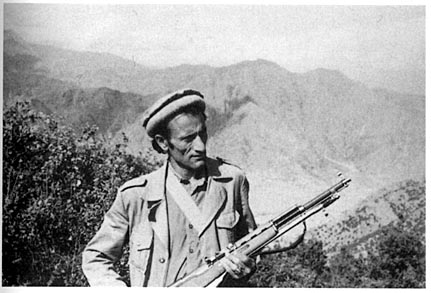
8. Samiullah Safi (“Wakil”), Pech Valley, May 1985 (courtesy of Samiullah Safi).
Wakil’s oratory would prove most useful in the period to follow because the pressing need for the rebels was to enlist the support of the great number of people in the area who remained undecided in the conflict. This was to be Wakil’s primary role, and most of the stories he told me from this time, including the story quoted here of his first meeting with a group of Safis on the day of his return, involve speeches he made to massed groups of his fellow tribesmen (Fig. 9). The most important of these meetings took place three days after his homecoming, on January 18, when he invited Abdul Jabar of Ningalam, who had been in command of the uprising to this point, and other Safi and Nuristani leaders to his house in Morchel. The decision was made at this meeting to destroy the district headquarters at Chapa Dara two days hence.
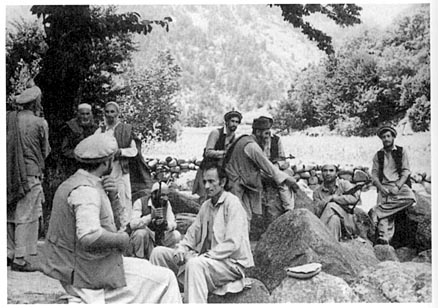
9. Samiullah Safi (center, facing left, bare-headed), Dewagal Valley, August 1989 (courtesy of Samiullah Safi).
Of primary concern to Wakil in the days after his arrival was that the government not be given any inadvertent assistance in stifling the still tentative antigovernment agitation. Thus, for example, because the district administrator was from the Wadir lineage of the Safi tribe, it was decided that the first attack should be led by members of that branch so that the government could not later propagandize among the Wadirs that a Gurbuz or Mahsud Safi captured “your Wadir brother.” Once the district administrator was captured, he would be kept not in Nuristan (even though it was more isolated and safer from government counterattack) but among his fellow Safis to prevent the government from driving a wedge between Safis and Nuristanis. Finally, the order was given that there should be no looting because this would also allow the government to announce that “they had attacked the government center to plunder the rifles and weapons, that this Wakil tells us to rise up and these khans tell us to rise up only because they want to digest these weapons. It was for this reason that even the smallest theft was forbidden [haram].”
Jirga and Lashkar
The tribal army [lashkar] stretched all the way from Nuristan to the district headquarters [alaqadari]—this whole district. It was such a lashkar that I thought to myself, “It seemed like every bush had one hundred flowers and they were all human beings.” Their enthusiasm was shared by the women and children who were also there, and they were all shouting slogans, very loud. Starting from Parun and Kantiwa [in Nuristan, at the top of the Pech Valley], all the way to Chapa Dara—all this was one district. All the people from this district were there. No one except the very elderly who couldn’t walk remained at home. They all came armed and committed to fight. There were maybe fifteen or twenty thousand people. They had destroyed the district headquarters, and now it was the turn of the woleswali [regional administration center]
The capture of the district headquarters was the first major event in the second stage of the uprising—a period in which jirgas were held and a tribally organized uprising was begun. At this stage, the lower half of the valley was still solidly in government hands. A Khalqi militia was also in place, and the mouth of the valley was open, so the government was able to bring in troops and supplies from the provincial capital. The government tended to have greater support on the south side of the formidably wide and swift Pech River. The south side is where the main road lay, which meant that the government had greater contact with villages on this side and greater ability to exert its force. It also meant that villages within sight of one another were often on opposite sides of the political divide, which by this point had thoroughly split the region. The leaders of the uprising recognized that they had to accomplish two goals: to gain the support of villages that were still under government control and to cut off the lower part of the valley to prevent the government from sending in reinforcements.
Wakil, along with other tribal and religious leaders from Nuristan and all three branches of the Safi tribe, formed jirgas representing the upper half of the Pech Valley to visit villages in the lower part of the valley, the various side valleys, and parts of Nuristan. Accompanied by a small detachment of armed men, the jirgas would approach each village and ask to meet with the village elders to encourage them to support the uprising. If they agreed, they would take an oath on behalf of their village (qaumi do‘a) and guarantee their oath by dispatching a contingent of young men—representing each branch and lineage of the tribe resident in that area—to join the lashkar, which was usually trailing a few villages behind. Then the jirga would set off for the next village, gradually moving closer and closer to the regional administration center. As the jirga moved down the valley, the lashkar followed in its wake. It was important at this stage for the first contact with a previously uncommitted village to be made by the jirga and not by the lashkar. The leaders were determined to preserve tribal unity, which necessitated that villages be given the opportunity to join the movement voluntarily. This was not always possible, however, as the jirga sometimes came under fire as it approached villages in which the government still had influence.
Wakil recalled for me one such confrontation near the village of Udaigram. After the jirga approached the village “in a rain of bullets,” the village elders sent out two old women carrying a copy of the Qur’an in their hands. This is a traditional way to initiate a cease-fire, and Wakil went forward to speak with the women:
A woman came in front of us with a Holy Qur’an in her hand. The people of the village had sent two women to meet us. I said, “Mother, what is this?”
“I swear by this Holy Qur’an that our houses are under their guns. They will kill our children and nothing will remain behind.”
I told these mothers, “You should be ashamed before this Qur’an. You are our mothers. In the village of Ningalam, they burned the homes of three or four thousand families. Did they have mothers there like you? Did they have children like your children? Did they have property or calves or goats, yes or no?”
She said, “They had them.”
I told her, “You should go and tell those who are sitting peacefully, ‘Shame on you! Rise up!’ You’ve taken up the Holy Qur’an. You should be ashamed of yourselves. You come to us from the Khalqis, from their ranks. They don’t believe in the Qur’an, but those who are rising up, they respect the Qur’an. You shame this book.”
She said, “What can I do? They made me do it.” The old woman said this. “And we are also under their bombardment, and our houses are under their guns.”
I said, “We’ll buy time for you. We’ll transport your children and your property to the mountains or wherever. We’ll do this. In one night, we’ll do it. You shouldn’t worry at all.” I kissed the Holy Qur’an and placed 20 rupees on it. I said, “This is a matter of honor [nang] for you. It’s shameful. You are Safi mothers. Your children, what sacrifices they are making, and you say this. It’s bad.”
Following this encounter, the jirga met with the elders of the village throughout that day, and that evening they took an oath to support the jihad and invited the jirga to stay with them as it was cold and they were “under the threat of the [government’s] guns.” There were twenty people in the jirga—ten to twelve representatives and mullas and a few members of the lashkar who were there to protect them—and they were sent off to different houses in the village so that “no one villager would have to go to too much trouble or supply too much food.” That night, a group of Khalqi sympathizers who had not accepted the elders’ oath to support the jihad conceived a plot to attack the members of the jirga:
All of a sudden there was a hue and cry. It was raining—it was such heavy rain. It was evening. I put on my boots and got up. I asked someone, “What’s happening?” One of our elders was shouting at the villagers. He said, “You are untrustworthy. Before you took an oath with us, and now your young men want to start some sort of a plot.” He suddenly fled—he didn’t flee exactly, he ran in the direction of the lashkar, which was two or three villages behind us in order to tell them to attack the village.
As soon as he had left, the other elders quickly gave me the responsibility of intercepting the lashkar. “Go. You can never tell. The lashkar might became impassioned and arrive suddenly and enter the village, and the soldiers would fire at them from above, and this might become like Ningalam, all because they have been overcome with passion. Go ahead and tell them to wait. Don’t send more than five hundred men, five hundred armed men and no more since any additional force would be dangerous.”
I agreed, and as I was going, up ahead of me, all of a sudden, I could hear [the lashkar] shouting, “Allah Akbar!” They almost killed me. Most of them were people from our own village. They were in the first group to arrive since the man who had gone before me—a haji [an honorific title for a man who has completed the pilgrimage to Mecca] whose name I have forgotten—he’s from Ningalam—he let out a cry that they had captured the elders and they had even taken Wakil—he meant me. “They took him! The government took him! The government took our elders with the help of the villagers, and if we don’t finish them off tonight, they will send all of the elders to Kabul tomorrow and execute them. [They will take them] in the helicopters!”
Suddenly, that very night, it was all lit up, in the direction of the government forces. See the difference in sentiments on this side of the river and that side of the river. I immediately sent men to the other side of the river to tell them that the elders hadn’t been taken and to be careful not to go or they’d capture all of us.
Later, I scolded that haji—I mean those other elders scolded him— “You haven’t done a good thing. The danger here was that the government has seen this, what the situation is.” He had panicked when there wasn’t even any firing going on. Who knows—if we had fired at [the villagers] and hurt them, they would have captured us. They wouldn’t have let us live.
After that, all of us stayed there in that village. Nearly five hundred from the different tribes—we divided the men into groups and stationed them in different places. There were 120 from two of the branches, and 100 each from the other two. We brought them to the village, and that night we were in their houses, and we told them to cook us some chicken. And that night they cooked chicken for all of the four or five hundred mujahidin, the young men who had come. In every house, they ate well off them until the morning. This was a tribal punishment [jaza] that we inflicted on them—that one time you take an oath, then, some among you attack us. We didn’t punish them anymore than having five or ten people going to every house and having them kill a chicken for them and show them good hospitality.
We told them, “Not even one of you can leave. If they bomb us, you will get killed along with us. We’re in the same village, in the same predicament.” They had to do it, and they vowed again—their elders vowed again—to support the jihad.
While the jirgas were moving down the valley, another group of mujahidin attacked a large government force at Tantil. The mujahidin managed to encircle the force, but the siege was broken when government militia fell on them from the rear. Both sides suffered heavy casualties, but the mujahidin captured a large quantity of weapons and ammunition and gained renewed confidence that, under the right conditions, they could take on and defeat the enemy. This battle—the bloodiest to date—was followed on March 10 by the conquest of Bar Kandi. Again, in an attempt to preserve tribal unity, the mujahidin followed their victory by not allowing anyone from the village to be punished and offering their opponents a full pardon if they agreed to join against the government. To prevent disputes over booty—which is one of the most pernicious sources of tribal rivalry—the jirga decided that individual mujahidin could keep only one light weapon each. All other captured weapons had to be turned over to the jirga, which would be responsible for their disposition.
The decisive battle of the uprising to that point in time occurred later in March, when the mujahidin attacked the Khalqi position at Utapur, near the base of the valley. The battle continued for several days before the mujahidin finally succeeded in taking the fort at Srah Morgah and then Utapur itself. After the capture of Srah Morgah, the battle turned into a rout, with Khalqi officials, soldiers, and sympathizers trying to flee in convoy to the provincial capital. Mujahidin hidden along the route of escape at Pirunai Dag succeeded in damaging several of the lead vehicles, effectively blocking the road and forcing the enemy to surrender. Within days of this victory, which isolated the remaining government forces within Pech, the remaining government outposts, including the base at Ningalam, were subdued, and the valley was liberated from Khalqi control.
First Setbacks
At that time, [a woman who] had come to my house told my wife that for thirty days her children had been eating boiled grass and no bread. In the house, I was told that this woman had come, and I was very moved by her situation. In the house we had some crops, and I asked one of my servants what we had. He told me that we had seventy ser of raw potatoes, which was equal to forty-five ser in Kabul—one Kabul ser is equal to seven kilos—and we had about a week before the wheat harvest. Although we had a big family and many guests and they said we wouldn’t have enough, I told him to give the woman five ser. This was more important than our experiencing hunger because the woman had little children.
This was to be given to them, but before getting his portion the young husband of this women had taken his bag and gone about fifteen kilometers away to see whether he could find some corn to bring back. He also had a gun with him, the kind we call baghalpur, which has a very short effective range. It has very big bullets. It’s very old, actually an antique, and is sold in antique stores. He had this kind of gun, and while he was off trying to find corn, he heard that there had been an attack—the Russians attacked again—and he left his things there and went to fight. He was missing for three days before he returned to the area, and we thought that he had been killed someplace.
I asked him, “You went to get corn. Your children are hungry. Why did you go to fight?”
He replied, “I heard that there was a battle. I had a gun with me. What else could I do? Food wasn’t as important as fighting.” He was young.
I asked him, “Were you able to fire?” He replied, “No. I didn’t see anyone. It was a bombardment. There was nothing else.” From there, he had gone to Bar Kandi, then to Waigal Valley. From Waigal Valley, he had come to his house in Tsarigal. This was the spirit of jihad among the people.
The capture of Utapur and Ningalam represented the high point of the uprising in Pech—militarily, organizationally, and culturally. During this second stage of the uprising, not only had individual tribes succeeded in working together, but also Safis had joined in common cause with non-Pakhtun Nuristanis and Kohistanis from neighboring valleys. A council of jihad had been established and had elected a Nuristani, Haji Abdul Ghafur Khan, as its chief (amir) and a Safi from Ningalam, Abdul Jabar, as commander-in-chief of the fighting forces. The lashkar itself was divided into four tribal fronts (one Nuristani and three from each of the branches of the Safi tribe—one of which was led by Matiullah Khan, Wakil’s younger brother). To this point, disputes had generally been kept in check, in large part because of the care taken by jihad leaders to respect the conventions of tribal culture. For example, during the battle of Utapur, Said Ahmad Khan and Matiullah had been responsible for killing a Safi who had joined the Khalqis. Although it was still winter and snow was on the ground, Said Ahmad Khan, who was from the same village as the dead man, insisted that they carry the body back to the man’s family. They set out that night, reaching the man’s home the next morning, and “because of this, he convinced many of the members of this man’s family to become mujahidin.” This story is one of a number Wakil told me in which personal and tribal enmities were avoided because actions that might have been taken as insults or attacks against individuals by rivals were shown to be collectively sanctioned by the jihad council and the tribe as a whole.
Throughout this period, the Khalqis fought back both militarily and through propaganda, which they hoped would win over the hearts and minds of the citizenry. In particular, the regime tried to convince the people that its programs were in the best interests of Islam, but few were inclined to trust government statements, no matter how hard the regime tried to make them convincing:
One time, the Khalqis had failed to write “bismillah” on the top of leaflets dropped from a plane, and with one voice the people said that this was proof of their blasphemy. Another time, presumably to make up for their earlier mistake, they wrote not only “bismillah” but also “Allah Akbar” and the kalama [“There is no god but Allah, and Muhammad is His Prophet”]. This time, the people with one voice said, “They have thrown the blessed kalama on the ground, and in this way they pollute it under the feet of humans and animals.”
One of the regime’s aims in spreading propaganda was to try to aggravate long-standing differences and prejudices in the region. For example, it tried to incite Safis against Nuristanis by dropping leaflets on Safi villages that reminded the people how the Nuristanis had taken arms from the government and assisted them in defeating the Safis during the 1945–1946 conflict. Similarly, the regime also tried to take advantage of age-old disputes over grazing rights between Gujars, who traditionally brought their flocks to Nuristan in the summer months, and Nuristanis, who controlled the pastures, by promising the Gujars arms and title to disputed lands if they joined the government side. They also reportedly told the nontribal peasants (dehqan) in lower Pech and the area around the provincial capital that their time had finally come. “The peasants had supported the government during the first Safi War, and the Safis had looted their homes and businesses in retaliation. The Khalqis tried to fan this resentment but were unsuccessful, and again the houses of those people who supported the government were burned by the Safis and Nuristanis.” Finally, the government tried to undermine tribal unity by bringing in militias from more distant tribes, principally Shinwaris from Ningrahar Province, to fight against the Safi rebels. According to Wakil, the fathers of these Shinwaris had previously helped defeat the Safis during the Safi War, but the Safis were careful not to aggravate the bad blood between the tribes any more than necessary.
In the spring of 1979, everything seemed to be going right for the resistance. The Khalqis had been removed from Pech, and other tribes and groups in Kunar were also beginning to organize themselves to join the uprising that the Safis and Nuristanis had started. Within Pech, the jihad council began to look beyond its own valley to the capture of the provincial capital of Chagha Serai, located at the confluence of the Pech and Kunar rivers. With their capture of the government bases at Chapa Dara, Utapur, and Ningalam, the mujahidin of Pech had the weapons and ammunition to mount such a campaign, and so in April they made their first attempt to capture Chagha Serai.
The assault was carried out at night, but from the first the mujahidin encountered more resistance than they had anticipated and were unable to penetrate the town itself. One group of mujahidin tried to enter Chagha Serai through the neighboring village of Kerala, but the army was able to circle the village with tanks and armored personnel carriers before the mujahidin could escape. The mujahidin held out until noon the next day but ultimately ran out of ammunition. Only three of the original fifty-two mujahidin survived the battle. The following day, Friday, April 20, 1979, the army, accompanied by Soviet advisors dressed in Afghan uniforms, returned to Kerala and gathered all the adult men and teenage boys into a field, where they were to participate in a “jirga.” Women and children were forced into a neighboring mosque, where they watched as officers first accused the villagers of collaborating with the mujahidin and then unloaded their guns into the mass of men. In all, an estimated seventeen hundred men and boys were massacred, and the women and children were forced to flee to Pakistan, where they became some of the first of the 3.5 million Afghans who would take refuge in that country in the next two years. [6]
If one had to point to the key moments when the tribal uprising began its steady decline, the massacre at Kerala would be one, for this event forever changed the terms of engagement. The government, under the supervision of its Soviet advisors, decided that the only way to deal with an uprising of the sort they faced in Kunar was to terrorize civilian populations into withholding their support for the insurgency. For their part, the rebels were shocked by what happened in Kerala, especially the fact that the government had targeted noncombatants. According to tribal custom, fighting should be carried out between armed men who willingly court the risks of combat, while civilians are kept out of the line of fire. To target unarmed men was antithetical to the code of conduct expected of men who value honor. Clearly, however, honor was irrelevant to the government, and the realization of this fact demonstrated to the rebel forces that traditional rules no longer applied and that they would have to reconceive how they organized against and confronted such an enemy.
Honor is a total system of belief and action and requires commitment on both sides to work. [7] When one party to a conflict demonstrates its willingness to abrogate the rules of honor to gain an advantage, the relevance and viability of honor are put in question. Thus, one of the long-term effects of Kerala and of the government’s general willingness to target civilians and to use impersonal means of destruction against its own population was to undermine the ways in which tribes interacted with the state. Honor was no longer a sufficient frame either to explain the conflict or to rationalize the death and destruction rained down on the tribes by government aircraft and artillery. Honor presupposes that those killed will be male combatants who willingly faced the risks that lead to their deaths. It cannot explain or justify the deaths of innocent civilians or of large numbers of combatants who die not in hand-to-hand combat but from machine-launched missiles, bombs, and artillery shells. In providing a framework for comprehending evil and valorizing the death of innocents, Islam proved much more effective than traditional tribal codes, and the eventual takeover of the uprising by Islamic parties is partly to be understood by this fact.
A second setback to the tribal jihad was suffered shortly after the Kerala massacre. In the wake of the defeat at Chagha Serai, the jihad council, realizing that its forces already surrounded the provincial capital on the west from Pech and on the north from the Nuristani valley of Kamdesh, decided that its chances would be improved if it could attack from a third side as well. [8] To achieve this end, Wakil and other Safi and Nuristani elders traveled to Bajaur to ask the Mahmund and Salarzai tribes on the other side of the border to join the mujahidin of Pech in clearing the Kunar Valley of government forces. While largely independent of Pakistani authority in most civil and judicial matters, Bajaur was still under the political jurisdiction of Pakistan, and the Pech jirga knew that the Pakistan government might oppose having its tribes directly participating in an Afghan conflict—even if it was against a government for which Pakistan felt no affection. Still, Wakil reasoned that Safis had repeatedly crossed the border to assist their Pakhtun brothers in jihads against the British, and so it was assumed that honor would oblige the Bajauri tribes to reciprocate the assistance they had received in the past.
The Pech jirga stayed for two months in Bajaur, trying to convince the Nawab of Khar, the paramount political figure in the area, and other tribal leaders to join the jihad. Wakil even tried to shame his counterparts in Bajaur into offering assistance (“Either you should come yourselves and fight, or we will fight and you should provide food for us”). The most he could extract, however, was a promise from the Nawab that the jirga could take four artillery pieces—an offer Wakil reports to have answered with disdain. (“I told him, ‘If you need artillery pieces, I’ll give you the ones we have taken from the Russians. The only assistance we require is that food and water and other necessities be dispatched to the mujahidin. Or you yourself take up the Mauser [rifle] and fight from this side so that we can completely surround [Chagha Serai] and free the province.’”)
In retrospect, Wakil appears to have been naive in expecting to receive assistance from beyond the border. To the best of my knowledge, the last contingent of Safis to join in a cross-border jihad did so in 1959, when Prime Minister Muhammad Daud convinced tribesmen from the border area to cross over into Bajaur to attack government positions in that area. [9] This skirmish was supposed to aid Daud’s advocacy of an independent Pakhtunistan, but although several tribesmen were killed, the Pakhtunistan movement made little headway. Nevertheless, the governments of both Afghanistan and Pakistan had continued to draw “their” tribes into their own national orbits through the enticements of education, employment, and commerce. Wakil also failed to recognize that the Khalqis would have their own partisans along the frontier, where such well-known Pakhtun leftists as Ajmal Khan Khattak, Abdul Ghafar Khan (the founder of the “red shirts movement”), and his son, Wali Khan, had all been active. At any rate, the failure of the Bajauri tribes to join the Safis and Nuristanis for an attack on Chagha Serai was a significant reversal and an indication that the ideal of a transborder tribal lashkar rising up to reclaim the Kunar Valley would remain a chimera. Significant as it was, however, the failure in Bajaur was a relatively minor setback compared with others that would befall the tribes during the spring and summer of 1979 and that would forever change the character and direction of the Afghan jihad.
The Ascendance of Islam
Two months later, I think it was in April or May 1979, we went back to Kunar, and the mujahidin who were with us were saying, “[The Bajauris] won’t be able to do anything. We should fight ourselves. They won’t do anything.” Then we returned, and I was in Nuristan. Hizb[-i Islami] and Jamiat[-i Islami] [political parties] had differences between themselves. They would both take the weapons from each other, but there wasn’t any bloodshed. There were also other parties whose names I hadn’t heard. Before that, we only knew of Hizb-i Islami and Jamiat-i Islami. We hadn’t heard the names of the other parties that were established later. We didn’t know about [Maulavi Yunis] Khales or any of the others, except that [Commander] Jabar would sometimes mention the name of [Hazrat Sibghatullah] Mujaddidi every once in a while. In the beginning, there was only Jamiat-i Islami. Not even the name of Hizb-i Islami existed. The only known organization was Jamiat.
To this point, I have not mentioned the role of Islamic leaders or parties in the Pech uprising because they had not been of major significance. The first assault on a government base—before the burning of Ningalam—was carried out in Shigal on May 23, 1978, by Islamic militants affiliated with the Hizb-i Islami party, but this was an isolated and unsuccessful incident in which one Khalqi schoolteacher was killed. For their part, most of the Safis and Nuristanis who had taken up arms did so in part because they viewed the Khalqi regime as a threat to Islam, but this conviction had little practical significance since the command structure and fighting were organized on a tribal basis. Beginning in the summer of 1979, however, Islam began to increase in importance relative to the tribe. To make sense of this change, it is necessary to consider the traditional place of religion in Pech.
Both the Safis and Nuristanis of Pech express devotion to Islam, but this devotion, in itself, does not differentiate them from the vast majority of other tribes on the Afghan frontier or in Afghanistan generally; the Islam practiced in this area is distinguished, however, by its more “fundamentalist” interpretation of proper Islamic devotion and practice. Thus, in contrast to many Pakhtun areas, this region—Nuristan in particular—has a paucity of shrines, and the veneration of Sufi saints—alive or dead—is much less common here than elsewhere and is even frowned on by many. Likewise, the use of amulets, the donation of alms to mullas (a‘ena or chanda), and other acts not expressly permitted in the Qur’an or hadith (traditions attributed to the Prophet Muhammad) have long been viewed by some clerics in the area as unlawful innovations (bidat) that must be expunged from popular practice.
Many have speculated about why people in this region should have proven more receptive than most other Afghans to a fundamentalist interpretation of Islamic practice. One theory more relevant to Nuristan than to the Safi tribe is that because Nuristanis have more recently taken up Islam, they—like converts elsewhere—have embraced the faith more zealously and more rigorously than most other believers, who have generations of accumulated tradition behind them and who often take faith and practice for granted. If this theory is too pat, it can still be argued that those responsible for bringing Islam to Nuristan were principally madrasa-trained mullas in service to the government rather than the more entrepreneurial Sufi saints responsible for conversion in many other places. Popular traditions such as saint veneration and the use of amulets, which have developed in other regions over many centuries and which are rooted deeply in domestic practice, have also not had time to take hold in this area. If it is true, as many believe, that the Safis themselves were originally “kafir” in origin (via exile or emigration from Kafiristan) and thus relatively recent converts to Islam, then the same might also be the case for them.
Proximity to Pakistan also must be factored in, for a large percentage of Nuristanis and Safis who were interested in studying Islamic doctrine beyond what was available to them locally chose to study at madrasas on the other side of the border. The Pakistani madrasa most often mentioned as the destination of would-be Nuristani and Safi religious scholars is the Panj Pir madrasa, which is famous for its reliance on the Qur’an and hadith as sources and its vehement rejection of popular and scholastic beliefs that lack sanction in the original sources. Prior to 1978, most mullas who returned from studying at the Panj Pir madrasa focused their efforts on expunging from local practice the innovations in popular religious devotion that had been taken up in the area. A few younger Panj Piri mullas did stray onto more dangerous ground, criticizing King Zahir Shah and later President Daud for the religious shortcomings of their regimes, but these mullas did not find many supporters—even among those who supported their attempts to reform popular practice. After the revolution and first uprising, however, these same mullas became the conduits through which the Islamic resistance parties headquartered in Pakistan established themselves in the region, and later they became local liaisons for would-be mujahidin from Saudi Arabia and other Arab countries trying to gain a foothold for themselves in the Afghan jihad.
At the beginning of the uprising, though, Islam had not yet risen to the fore as the dominant idiom of government resistance, and mullas—while generally respected for their religious devotion and knowledge (minimal as it usually was)—were viewed as dependents (hamsaya) of the khans and maleks and not quite the equal of others in the tribe. Because independence is so highly esteemed in tribal society, the clientage of mullas ensured that respect for religious learning was interlaced with a measure of contempt, as seen in Safi’s comment that “the innate characteristic of mullas is to expect to be given something from others. If you give them money, they will do anything.” This is a common stereotype, and while people recognize that there are good and bad mullas, the general perception during the first months of the uprising was that the proper place for mullas was as functionaries in the jirgas, where they could help mediate disputes and provide religious validation for the decisions arrived at by the tribal elders. Mullas were not expected to participate in the fighting or to make command decisions; so when the Islamic parties first appeared, their determination to take a more active leadership role in the conflict was unexpected, unprecedented, and unsettling to many. According to Sahre, roughly 80 percent of the people of the region supported tribal unity against the government; 15 to 20 percent backed the government; and less than 5 percent supported one of the Islamic parties. Echoing comments made by Samiullah Safi, Sahre noted that few people in the first months of the uprising had ever heard of the parties, although Hizb-i Islami and Jamiat-i Islami had begun to make minimal inroads in the region. [10]
All of this began to change about the time that Wakil returned from Bajaur. At this point he became aware that Hizb and Jamiat were offering money and weapons to those willing to join and to accept identification cards. Everyone’s major concern at that time was getting weapons, and this more than anything else became the prize over which tribe and party would fight for supremacy. The first instance of this sort of internal conflict occurred after the capture of Utapur and Ningalam, when the rebels came into possession of a vast quantity of weapons, including rifles, shoulder-held rocket-propelled grenade launchers (RPGs), Dshika anti-aircraft batteries, and 76-millimeter automatic guns. While individuals were allowed to keep one light weapon each, everything else was initially held by the jihad council. In the first flush of euphoria over their victories and in full expectation of an incipient national uprising and further acquisitions of arms, the council distributed many of the weapons to mujahidin in the neighboring valleys of Kunar, as well as in Badakhshan, Panjshir, and Laghman. The council also gave out heavy weapons to local people who had been in the military and knew how to use them, and these people became one of the first targets of Islamic-party recruitment:
Hizb-i Islami and Jamiat-i Islami—both of them were working among these mujahidin. They were working very hard, and they were working covertly. For example, you are from the Mahsud tribe. You have a rocket launcher. Someone over there . . . has come and has talked to you and given you a pistol. He has become your friend and given you money and other things. Secretly, he has brought you individually into the party. Here, there’s the general organization of the tribe, but in actuality Hizb and Jamiat were working covertly among them. The Ikhwan was working in Kunar from way back. They had been here for a long time; whether within Hizb-i Islami or Jamiat-i Islami, they were working vigorously among the people. Those whom they had turned into Hizbis or Jamiatis were those who had been given their heavy weapons.
While the tribal council was giving away weapons, Hizb and Jamiat were hoarding theirs, realizing perhaps more clearly than others that the conflict would not be over any time soon. They also recognized that weapons were not only an important resource for battle but also a way to leverage support away from tribal unity. Thus, as inspiring as a story like the one about the young husband who went running off to battle with his antique rifle might be, the reality was that people needed reliable and effective weapons not only to fight the enemy but also to best their tribal rival (sial). A vital dynamic of tribal society—arguably the fuel that keeps honor alive as a moral code—is the understanding that a man will not willingly allow his paternal cousins and other peers to outdo him in any competitive endeavor, particularly combat. One gains renown by being the first into the fray, the most daring in the pursuit of glory, and the most successful in battle. Rivalry (siali) therefore required results, and when weapons were not available from tribal sources, individuals turned to the parties who were only too happy to give them some as long as they agreed to become members and to submit to party discipline.
In the early summer of 1979, after the failure of the jirga in Bajaur, relations between the tribes and the parties, which were already strained, deteriorated even further as the jihad council came to realize that Haji Ghafur, to that point the overall amir of the Safi and Nuristani lashkar, had been secretly working with Hizb-i Islami. In response to this news, the council took away its support from Haji Ghafur and elected Wakil to take over as amir. It also tried to improve communications and logistics within the region by appointing regional and district administrators in each of the old government centers and maleks in every village and voted to give the organization a formal name—the Front of Free Mujahidin (Junbesh-i Mujahidin Azad). The idea behind the name was to contrast the tribal lashkar with those guerrillas who were tied to the exile political parties. However, in adopting some of the attributes of a formal organization, the tribe also acknowledged the increasing influence of the parties and the fact that to fight them the tribe had increasingly to become like them.
Despite efforts at better coordination, the organization Wakil took over was beset with problems, the most important of which was probably its susceptibility to subversion. The government still had many informers and spies in the valley and even within the council. According to both Sahre and Wakil, these government agents sowed disunity within the council and reported council plans back to the regime. The vulnerability of the council to infiltration reflected one of a number of inherent structural problems faced by the Front, in this case the necessity in a tribal coalition to include elders and commanders from every branch and village in all deliberations. Every group expected to be involved in decision making, and tribesmen do not readily accept the authority of others in the best circumstances and certainly not in situations in which they do not even have the opportunity to express their opinions. Consequently, council meetings tended to attract hundreds of people and to continue for days on end; meetings were so large and lengthy, in fact, that they were sometimes strafed and bombed after being noticed by government aircraft.
Another structural problem had to do with the nature of the lashkar, which is organized along tribal lines, with each lineage fighting as a group and accepting the authority of its own leaders (Fig. 10). Members of a lashkar do not readily accept the authority of outsiders, and so decisions are difficult to reach without exhaustive consultation. Further, as I noted in Heroes of the Age in a discussion of a tribal jihad against the British at the end of the nineteenth century, the ethos underlying the lashkar tends to impede the mounting of effective military campaigns, in part because tribesmen resist the idea of assigning specific roles to different individuals or groups, especially if such assignments mean that some men will be relegated to providing food for other tribesmen or otherwise being kept out of battle. According to the Pakhtun ethos, battle was “an opportunity for besting . . . personal rivals every bit as much as for gaining larger victories, and this ethos meant that few were willing to accept subordinate or specialized roles.” [11] Problems such as these are compounded when a campaign stalls, as the Pech Uprising did after the capture of Ningalam and Utapur. Lashkars operate most effectively when they are moving and able to replenish their food, supplies, and morale through new conquests. But because the Pech lashkar had to rely on nearby villagers for food and shelter, it soon depleted the supplies close to hand, while overwhelming local reserves of hospitality as well.
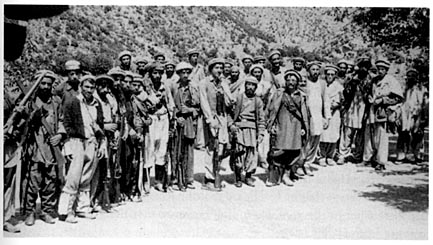
10. Safi Iashkar, n.d. (courtesy of Samiullah Safi).
Wakil’s problems were further complicated in July with the sudden appearance of a local religious leader named Maulavi Hussain, an event witnessed and recorded by Sahre:
Maulavi Hussain, also known as Jamil-ur-Rahman, was a Safi from Ningalam who had studied in the Panj Pir madrasa in Pakistan. During the democratic period, he had gained some local notoriety when he ran for parliament, but, in keeping with popular sentiments about the proper role of religious scholars, he gained few votes and finished last among a dozen candidates. In the early 1970s, when the Muslim Youth Organization (Sazman-i Jawanan-i Musulman) first became active, Hussain began working with them and was briefly arrested in 1973. Most of the Muslim Youth leaders either were imprisoned or fled to Pakistan during President Daud’s time in office. Hussain maintained his contacts with Gulbuddin Hekmatyar, Qazi Muhammad Amin, and other former student leaders in Peshawar, who at that time were in the process of transforming the Muslim Youth Organization into the Hizb-i Islami Afghanistan political party. Immediately following the Khalqi coup in 1978, Hussain returned to Kunar to organize against the new regime and was involved in the incident in which the Khalqi schoolteacher was killed. In the following months, he continued traveling between Pakistan and Shigal, where he established his primary base and from which he worked to extend his influence into the Pech Valley.One day, the sound of guns and bombs was heard. Everybody ran towards the caves in the mountains, thinking the enemy was attacking Utapur. Eventually, some people were sent to see what was going on, and it was discovered that Maulavi Hussain had arrived in Utapur from the Hezb office in Peshawar and the firing was done by Hezbis to welcome him. The Maulavi opened the Hezb office in Utapur, and, to keep up with them, Jamiat opened an office as well. [12]
On arriving in Pech in the summer of 1979, Hussain wasted little time asserting his presence, as Wakil discovered when he traveled to Nuristan shortly after Hussain’s triumphal arrival in Utapur. The reason for Wakil’s trip to Wama was that he had heard that the Khalqis might be trying to create dissension in the area. He found, however, that the greater threat was coming from Hizb-i Islami:
The Hizbis there were distributing identity cards, and they were telling [the people], “You can’t do this or that, and the amir must also be a religious scholar. And he must have a beard, and he should be clean [sutra] and pure [safa], and wear white clothes, and his appearance should be the typical example of a mulla. Only such a person can be the amir—no one else.” And at this time they put forward Maulavi Hussain as the amir. They had only been using Haji Ghafur. Since he wasn’t a scholar and was illiterate, he couldn’t be the amir. Instead Maulavi Hussain should be it. This was a plot against the people in the interests of Maulavi Hussain and Hizb-i Islami.
Instead of operating in unison with Wakil’s Front, which still maintained the loyalty of the majority of Safis and Nuristanis, both Hizb and Jamiat worked separately, using their supply line to Pakistan to provide their supporters with food, clothing, weapons, and ammunition. Hussain also sought to undermine the legitimacy of the Front by disseminating a decree declaring that the collection of religious taxes (in the form of food) for the Front was against Islamic law because the free mujahidin did not have an amir who was a religious scholar. Further, and even more destructively, he announced that the campaign that had been conducted so far against the government could not be considered a lawful jihad because it had not been authorized and commanded by a legitimate Muslim leader operating according to religious principles. Consequently, all those who had died to this point could not be called martyrs (shahidan), and the religious reward promised to martyrs in Islam was not guaranteed to them. These decrees created confusion and demoralization within the Front, for neither Wakil nor any other tribesman could say definitively that Hussain was wrong. He, after all, was the most credible religious authority in Pech, and the mullas associated with the Front were generally village educated and unable to stand against Hussain in an argument involving religious sources.
The Mutiny at Asmar
In the midst of the conflict with Hizb-i Islami, news arrived in Pech that the army base at Asmar had mutinied and was preparing to attack Chagha Serai. This was a milestone event, for it not only indicated the growing dissension within the regime, but also presented a signal opportunity to expand what was to that point a series of local uprisings into a major campaign to capture the Kunar Valley and even the city of Jalalabad, which is at the base of the Kunar Valley and the most important city in eastern Afghanistan. The mutiny at Asmar was a major coup for the resistance, not least because the mutineers brought with them forty-five artillery pieces, forty zigoyak anti-aircraft guns, and nearly four thousand AK-47s. [13] Equally important, the soldiers from Asmar had the training to use these weapons and were prepared to turn them against the regime. In preparation for an attack on Chagha Serai, Commander Abdur Rauf transported his men and weapons from Asmar to the villages of Shin Koruk and Shigal, which were close to Chagha Serai. Shigal, it will be recalled, was also the principal center of operations for Hussain, and his involvement in the ensuing events was most controversial and ambiguous.
What is known for certain is this. A plan of attack was drawn up by the Front, the Islamic parties, and Commander Rauf. According to this plan, the artillery brought out of Asmar by Commander Rauf would begin firing on Chagha Serai at dawn, and the combined forces of the various mujahidin groups would approach Chagha Serai under cover of the artillery fire. The attack began as planned with the commencement of the artillery barrage, but the assault never took place because of rumors spreading among the mujahidin that the operation had been called off. In the confusion that followed, the arms belonging to the Asmar garrison were stolen, and it is reported that the bulk of the readily moveable weapons—AK-47s, RPGs, and recoilless rifles—were eventually transported to Pakistan and sold in the Bajaur arms bazaar.
The failure of the assault on Chagha Serai and the looting of the Asmar garrison were crucial events in the war. Not only was the possibility of a regional tribal uprising foreclosed by the failure of this operation, but relations between groups, already strained, were also permanently poisoned. From this point on, the antigovernment resistance was permeated with suspicion. Never again would the Front give away weapons to groups from other regions. Weapons hereafter became the principal currency for economic and political survival, and they had to be jealously bargained for and controlled. After Asmar, distrust and dispute became the hallmarks of the Afghan jihad—not only in Kunar but in every province. Asmar also was a significant military setback. In the summer of 1979 the regime in Kabul was coming unglued. Amin had become first minister in March and had instituted an increasingly brutal campaign to cement his own power and destroy his rivals. Amin’s reign of terror would culminate in his assassination of President Nur Muhammad Taraki, which in turn precipitated the Soviet invasion of Afghanistan in December 1979. Amin’s unpopular leadership had made the regime particularly vulnerable. Military desertions were increasing, as more and more soldiers wanted out of a situation in which they were arresting and killing their own countrymen. Asmar could have served as a signal to other military units unhappy with the Khalqi regime that the regime could be overthrown, but it was not to be. Instead, after Asmar, military units came to realize that the resistance was deeply divided and that offering their support to either side could be their undoing. [14]
Not surprisingly, there are many different interpretations of what happened, most of them critical of Hussain and Hizb-i Islami. Wakil, for example, claimed that at the time of the Asmar incident a letter from a Hizb-i Islami mulla living in Nuristan came into his hands that declared that the operation against Chagha Serai had been called off. The distribution of such letters was enough, in his view, to sabotage the assault, for “someone would attack and get a foothold inside, and then someone else doesn’t attack and leaves their flank exposed. . . . All of this was a conspiracy.” Wakil also tells of a time shortly after Asmar when Hizb mujahidin tried to transport fifty-four zigoyaks, Dshikas, and Kalashnikovs looted from the Asmar garrison. The weapons were on their way to Kohistan via Pech and were stopped by the Front. For two months, a jirga met to consider the disposition of the weapons, and despite vigorous objections from Hizb leaders, including Hekmatyar himself, the jirga elected to keep the weapons on the grounds that they had been stolen from Asmar and the mujahidin and were not owned by any one party. In the jirga’s view, even if these weapons were bound for another mujahidin group, it would be dishonorable to allow this theft to go unnoticed and unavenged. As Wakil explained, “If someone were to take away someone’s gun, it would be an insult and a great shame. Even if a man doesn’t have the power to defend himself [right away], he keeps the insult in his heart, and whenever he has the power, he will kill the person who takes his gun.” [15]
In an interview in Peshawar in the spring of 1983, Abdur Rauf, the commander of the Asmar garrison and himself a member of the Safi tribe from Kapisa Province, told me of his growing disenchantment with the regime prior to the mutiny, the laborious secret planning that had gone on, and the final execution of the plan, which involved killing Khalqi political officers and sympathizers within the garrison. After successfully eliminating the opposition and before news of the mutiny had leaked out, he met with Hussain and, “because he was from the same tribe,” told him his plan to attack Chagha Serai. Commander Rauf believed that there was still time to launch an assault before a counterattack could be organized, but Hussain insisted that such an attack should be undertaken only by order of Hizb-i Islami, and he began to fulminate against the other Peshawar-based parties, which he described as representatives of former King Zahir Shah and full of communist sympathizers.
Commander Rauf said that Hussain informed him that these rival parties should be eliminated first and only then should the jihad against the communists begin. Hussain also insisted that the weapons from the Asmar garrison be turned over to him and later met with Rauf’s troops, urging them to lay down their weapons and return to their home provinces. Despite his growing distrust of Hussain, Rauf claims to have accepted his demand to turn over his weapons because he did not have any personal familiarity with the organization of the resistance and Hussain appeared to be in charge of the area. He also told me that he was confused by all the talk of Zahir Shah and the treachery of the parties and, recognizing his own vulnerability, wanted to be accepted by his new allies—despite his own past service to the regime—as a true believer and faithful servant of Islam. [16]
Not surprisingly, Hussain’s commentary on the Asmar incident differed markedly from the views of the others. [17] He claimed in an interview with me that Rauf was an opportunist who joined in the planning of the mutiny only after officers who were secretly aligned with Hizb-i Islami had laid the groundwork. Like Rauf, these officers were not all they appeared to be, and, in Hussain’s account, they agreed to accept a bribe from rival political parties in Peshawar to sabotage Hizb-i Islami and the Chagha Serai operation. In his version of events, these officers, in conjunction with local tribesmen, seized on the confusion surrounding the Chagha Serai assault to loot the Asmar garrison. Although the bulk of the testimony is stacked against Hussain, it is still not improbable to suppose that Safi tribesmen might have jumped at the opportunity to obtain the Asmar weapons. A generation before, during the Safi War of 1945–1946, tribesmen had shown their passion for booty when they looted the government treasury at Chagha Serai, and by the summer of 1979 many were in desperate economic straits because they had not been able to work their land or to carry on the business and trade that sustained many residents of Pech. However, even if Safis did participate in the looting, Hizb still appears to have been at least indirectly responsible for establishing the climate of distrust and noncooperation within which the rumors that destroyed the assault on Chagha Serai could have taken hold and might have seemed believable. Three months earlier, when Ningalam and Utapur were taken, such rumors probably would not have been believed, and if they had been believed by some, the communication between leaders and troops was such that they could have been squelched. However, by the summer of 1979, with the biggest and most important military operation on the line, no one knew whom to believe, and the result was the effective collapse not only of the assault but also of the tribal uprising itself.
Second Exile
On Saturday night, May 10–11, 1980, the Russians landed twelve helicopters behind our front lines in Bar Kandi, which is a Mahsud [Safi] area. About six MiG jets provided air support. A number of mujahidin immediately went in that direction—the mujahidin who had fronts in Utapur. The Russians initiated a fierce attack on the mujahidin headquarters at Utapur. Near this place, at the entrance of the mountain valley near Utapur, the Russians landed a second force, on this side of Qatar Qala. In this attack, the forces were in all likelihood Cubans. They had black uniforms. Through this tactic, the Russians managed to disperse the mujahidin forces and cut our communications. It became difficult for one mujahidin front to help another, and they were scattered in different valleys. But the next night, the powerful force of the heroic warriors of Pech Valley routed and inflicted heavy casualties on the Russian force that had landed behind the mujahidin lines at Bar Kandi. That night, the entire Russian force was destroyed and most of the enemy were killed and the rest fled.
Following that, on Tuesday, they landed more forces by helicopter, and that same day they landed other troops in Ningalam. They also dispatched soldiers to Tangi Rechalam, Chapa Dara, and toward Morchel. Really I myself had never seen such a huge force and such modern military equipment and such tactics for scattering the mujahidin. I couldn’t have imagined it. I had taken a position high up on a mountain and saw through my binoculars that the majority of the enemy forces were Russians and Cubans and two-thirds of their force were armed with rocket launchers. When the infantry hit one of the huge trees [with a rocket], the whole trunk would collapse. They were all carrying rockets. I was trying to count the number of modern military helicopters, and I lost count after thirty or thirty-five. At this time, the wheat was ripe. The harvest would have started a week later, but we immediately began our great exile [muhajirat]. It was a great flight toward the inaccessible mountains inside the Nuristan part of Pech Valley.
Following the looting of the Asmar garrison and the failure of the assault on Chagha Serai, the formerly unified tribal alliance became factionalized. The Front of Free Mujahidin under Wakil’s leadership continued to advocate fighting on the basis of tribal organization, but the parties were able to offer weapons to those who joined, and this proved a powerful incentive to many Safis. In an effort to reclaim the unity that had been lost at Asmar and Chagha Serai, Nuristani leaders met in October 1979 and then sent a delegation to Utapur to meet with the Safi leaders headquartered there, but continued disagreements with Hizb-i Islami prevented any progress from being made. Efforts to reunify the fighting forces remained stalled throughout the critical period between Taraki’s assassination and the Soviet invasion in December. In March, a Soviet force attacked Asmar, Pech, and Dewagal, with helicopters and MiGs bombing and strafing mujahidin bases and a Soviet force entering Ningalam. Despite these setbacks, the mujahidin made a spirited defense of their homeland, and Wakil even noted that two women, around fifty years of age, appeared at the front with swords in their belts and participated in the fighting. The government base at Utapur was dislodged, and the mujahidin managed to inflict significant casualties as the invaders were forced to retreat down the main road to Chagha Serai.
The following month, the mujahidin staged a nighttime raid on the provincial capital, during which the government armory was looted and destroyed, but the euphoria from this victory was short-lived, as the Soviets responded by mounting a far larger and more effective assault on Pech. This time, the absence of a unified command along with the overwhelming superiority of Soviet arms took their toll, and the “great exile” Wakil refers to began in earnest. Hizb-i Islami leaders had been urging people to emigrate for some time, but the combination of disunity and the direct intervention of Soviet troops with their sophisticated weaponry finally convinced people that the situation had become hopeless. Initially, Safis headed for the relative safety of the high mountains of Nuristan. It was spring, however, and the Nuristanis, who lived on a minimal subsistence diet of milk, cheese, and barley in the best of times, could not support the additional population; the Safi refugees decided that they would have to continue on to Pakistan:
After the people had offered prayers and decided to become refugees, my older brother, Sho’eb Khan, took me aside privately. He said to me, “My wife and children, we have never experienced anything like this, going to an unknown place. We cannot accept charity [khairat]. Our conscience won’t allow us. I can’t do construction work, and we don’t belong to those parties. Therefore, this is what we should do—these wives of ours”—he was very serious, he’s still alive—“our wives and the children whom we can’t take care of—we should kill them all. We should kill them so they won’t fall into the hands of the Russians. We will gather them at the grave of our father, and then we ourselves will become martyrs. There’s nothing else to do. Our death would be more honorable than if we were to expect some hand from above to come down and give us our daily bread. Our wives have never even walked along a road, and these are high mountains—very high! They are in purda [satr] and never even leave the house and can’t walk two steps outside. Where could they go? The only way is to die, and the only honorable way is that we kill them with our own hands so that they don’t fall into the hands of the Russians or anyone else. We kill them, and then we fight until we die.”
Then I told him, “This is both against Islam and also cowardly [najawani] and dishonorable [be ghairati]. Our women are going to tell us, ‘You can’t fight against the Russians, so instead you kill us. What have we done wrong?’” After this, I managed to convinced him, but he is that kind of person and he would have done it. But I convinced him that doing this wouldn’t be [according to] Islam or honor or magnanimity [hemat]. Whatever is ahead for this tribe and people is destined for us too. We had no other choice since it was a tribal decision.
Sho’eb Khan’s inclination to kill all the women of the family rather than have them migrate to Pakistan is reminiscent of two earlier episodes referred to by Wakil in his life story. The first is the statement attributed to Sultan Muhammad Khan that he could not join in the Safi War in 1945 because his women were “like invalids” and would be unable to endure the rigors of war. The second is the meeting of Wakil’s older kinsmen after Sultan Muhammad’s arrest and their deliberation over killing their women and children rather than submitting to the humiliation of exile. Here, thirty-five years later, the same vehemence and zeal are manifest in the proposal of Wakil’s older brother. Sho’eb Khan’s motivation was his fear that his family would suffer humiliation and dishonor, but wealth was also an underlying factor in this situation. The family’s material prosperity, which allowed the males of the family to confine the women to the house while tenant farmers tended the fields, had the unintended consequence of making the family more vulnerable. Having female dependents is a manifestation of a man’s honor, but the obverse of that relationship is that one’s dependents can also compromise honor. Seclusion is a partial response to that problem, but it is always incomplete and subject to disruption. In this instance, Wakil was able to convince his brother that killing the women of the family would be a false solution to the problem, but the problem nevertheless remained and continued to fester for Safi and other Pakhtun tribesmen as they experienced the reality of exile and their own incorporation as dependents within a bureaucratically organized refugee system.
Wakil and his family, accompanied by sheep and goats, journeyed for twenty-four days, camping at night and traveling furtively through the mountains, always fearful of being detected by helicopters. Adults carried one or two children on their backs, and each evening an animal would be slaughtered to provide food. In late June, they reached the pass overlooking Chitral. When they reached the border, Wakil recalled looking at his sister and seeing tears on her cheeks. He asked her why she was crying, and she replied, “When we were exiled from Kunar to Herat, we were crying and saying to ourselves that they were making us flee. But Afghanistan was our homeland. That was Herat. What difference did it make where it was? That was our feeling then. Now we are becoming refugees from our homeland; we are going into exile. Now we are leaving our homeland. See this side is the soil of Pakistan and that side is the soil of Afghanistan.” Pakistani militia units were stationed at the border. Wakil asked one militiaman how long the exodus from Pech Valley had been going on. He replied that people had been arriving at the border for the last twenty days, with between five and seven hundred families passing through the check post every forty-eight hours.
Initially, the Safi families all congregated in Dir, the place that Sultan Muhammad had gone to when he was exiled after his father’s murder. For a month, they fended for themselves in makeshift tents while waiting for the authorities to give them a site and resources for an official refugee tented village; but this permission was not forthcoming, and the elders sent Wakil to Peshawar to speak to higher-ups in the refugee administration about establishing a camp for the families of the Front of Free Mujahidin. The authorities in both Peshawar and Islamabad denied the request, however, on the grounds that they supported only those refugees who belonged to one of the authorized Afghan political parties. This was the final and in some ways greatest indignity—that in becoming refugees they had also to accept the leadership of the very groups that had helped to undermine the tribal uprising and forced them to become refugees. If the Safis wanted to receive rations and tents and be allowed to live legally in Pakistan, they had first to stand in line at the office of one of the parties to receive from them a party membership card.
Conclusion
There is a Mahsud Safi from Gul Salak named Haji Jalal Khan. He is a very simple old man but also the best example of a white-bearded mujahid that you could find. The young would not go to any battle if he didn’t accompany them. The young fighters would say to him, “If you don’t come with us, we won’t go to battle.” He would go to a battle and would sit in a cave, or someplace, and watch over all the belongings of the mujahidin and fix their food and do all of the work. He was continuously involved in the battles.
I will tell you one story about this Haji Jalal Khan, who was a very simple man and illiterate. Someone had sent a cow to feed the free mujahidin in our Front. We didn’t kill the cow but instead sent it to the fighting front for the mujahidin to eat. They took the cow up in the mountains to Shahbazai, where the front was located, above Chagha Serai. An artillery shell falls and explodes, and before it can be properly butchered, the cow is wounded and falls down.
When the mujahidin see that it is wounded, they immediately butcher it. Then the mujahidin divide up the meat among the mujahidin. Haji Jalal Khan won’t eat any of it, and they ask him, “Why aren’t you eating?”
He doesn’t say anything to the mujahidin about why he isn’t eating. He says to them, “I have a stomach problem. If I eat anything, I will get sick. I can’t eat either its soup or its meat.” But, after this, I asked Haji Jalal Khan, “Why didn’t you eat this?”
He said, “Well, this cow was a martyr.”
I said, “If you wouldn’t eat this cow because it was a martyr, why did you let the other mujahidin eat it?”
“Because if they hadn’t eaten, the poor guys, they were hungry. Not even bread was available. They were hungry. They had to eat, and if I had said anything, they wouldn’t have eaten, and that would have been a great cruelty against the rights of the mujahidin. But my conscience wouldn’t allow me to eat the meat of a cow that had been wounded by the cannon of the enemy, the cannon of the Russians. In my opinion, she was a martyr.”
Samiullah Safi told me the story of Haji Jalal Khan as an example of the spirit of the tribal uprising in its early days. Many people had that feeling and commitment. Participation in the fighting against the government became an extension of the Pakhtun ethos of individual zeal (ghairat) and bravery (shuja‘at). As Wakil noted to me, when a boy reaches adolescence, his first thought is to get his father to buy him a gun since only through fighting can a boy demonstrate his worth as a man. Safis, like other Pakhtuns, idealize heroes, and one of the important sentiments that helped ignite the uprising against the Khalqis was the desire of individual men to prove their ability as fighters. “Because they hear the legends about how so-and-so fought like this in this war or that, people know that so-and-so is a true war hero, has never been defeated in war, and has never caught a bullet in his back. If he has been wounded, it was always in the front. . . . This sentiment was one of the elements that inspired the rebellion.”
As part of this ethos, every individual tried to show his bravery and skill in battle, and every tribal unit tried to outdo rival groups. Those who were slow to enter battle or who failed to demonstrate the proper attitude would be subject to the ridicule (paighur) of women in their group, which, as the following story illustrates, was a sanction that Pakhtun men took seriously:
In Gul Salak, there was a family with four brothers. [The jirga] had decided that it should only be required for one member from every family to be continuously present at the front, but all four of these brothers went to the war front. Once I went back to the village from the front and saw that all four were gone, and I asked why. Then I learned that one of the brothers had been at home, and he had slapped one of his sisters-in-law because of some problem. When he slapped her, she said, “You’re ready to hit me. Your brothers are at the front while you are sitting at home, and you only hit me.” After this incident, he wouldn’t sit at home but instead would go to the front. This was the mentality then.
The enthusiasm of this first period lasted little more than a year, and for a variety of reasons it then declined. Some of these reasons have to do with problems inherent in the tribal way of making war. Others have to do with government efforts at subverting the tribal uprising. But probably the most important involve the emergence of the Islamic resistance parties. With respect to the internal problems, some, having to do with the lashkar as a vehicle of military mobilization, have already been mentioned. The lashkar is a formation that does best when it is moving through enemy territory and is able to live off conquered booty in the villages it passes through. With minimal logistical support and division of responsibility, it does less well when stalled for a protracted period of time, as was the case in Pech in 1978–1979. The jirga as a decision-making body also has its problems in this context, privileging as it does maximal involvement over coherence, consensus over quickness. Furthermore, with so many participants, jirga deliberations were difficult to keep under wraps, and consequently government agents could easily infiltrate and disrupt the proceedings.
Among the government’s agents were some of the better-off and more influential men in the tribe. As was the case in the Safi War of 1945–1946, the most enthusiastic fighters were generally younger men with less to lose and more to gain from taking on the government. Men of wealth, however, had a great deal to lose, and so the Marxist government, despite all its talk of enfranchising the masses, as often tried to buy off local elites as to destroy them. Some of these elites responded positively to government entreaties and bribes in a generally futile effort to preserve their influence, which was being taken over by rising leaders, who were, in some cases, younger tribesmen making reputations for themselves in the fighting and, in others, mullas brought to power by the Peshawar parties.
The martial ethos of the Pakhtuns and the desire of every male to be involved in the fighting also had a downside. In the beginning, people joined with whatever weapons were at hand, but over time they clamored for better weapons. The capture of government bases supplied this need initially, but this input of better weapons seemed only to stoke the greed of some tribesmen, who began to focus more on booty than on the battle itself: “There were even one or two people . . . who had ropes wrapped around their waists. This was so that they could carry all the booty and captured weapons on their backs with this rope and take it away.” The larger problem with weapons was that the parties had more of them than anyone else, and, as a result, those who wanted them had to come knocking at party doors to get them. The parties took advantage of the demand for weapons to play rivals against one another. Since it was the prevailing ethos for each individual to want to outdo his peers in fighting prowess, it was in the individual’s interest to have the best possible weapons, as much to outperform his rival as to defeat the government. Similarly, tribal leaders also wanted to demonstrate their continued power by supplying their followers with weapons and resources. The government was one source that these leaders could go to, but as it became clear that the tribe was overwhelmingly against the government, continued involvement with the government became overly risky. That left the parties as the only viable source of the resources tribal leaders needed to continue supplying their followers and thereby preventing a mass defection to other leaders.
More than anything else, weapons were the lever with which the parties dislodged tribal leadership, but there were other factors as well, including the use of Islamic ideology. As noted, Maulavi Hussain and other party leaders flummoxed tribal leaders with their announcements that Islamic doctrine required an Islamic scholar be in charge of the uprising, that taxes and donations collected for the benefit of the fighters were meritorious only if they were collected by and for the Islamic parties, and that only members of an Islamic party were guaranteed entrance to paradise if they should die in battle. With more and more people emigrating, the party control over the refugee camps also helped cement their power back home, as tribesmen came increasingly to realize that they could neither fight effectively nor leave their families in the safety of the camps without the support of one of the parties.
One of the overall effects of the parties was to deaden the enthusiasm of the first stage of fighting:
In the beginning, when the movement was spontaneous, [people] would fight with sticks and clubs and axes, and now they have all the weapons they could want, but they don’t fight like before. Before they would go to the mountains on empty stomachs and without proper clothing, but today what happens has no resemblance to that. Before, people had no fear of death because of the idea of ghazi [being a veteran of jihad] and martyrdom, but now before thinking of their own martyrdom they think about the martyrdom of their leaders and those close to them. They wait to see their leaders do it first before doing it themselves. This is the spirit that has entered the people. They think that what they have gotten in the name of Islam they won’t give up to free their country.
Another effect of the parties was that people began to fear these new leaders, not only because of what they might do to them in the present but, more important, because they feared God and the divine sanctions that would come their way if the Muslim leaders condemned them:
Parties deluded people into thinking that they had to become true Muslims. For example, there was a man from Pech named Qayyum who was about sixty years of age. . . . This man was studying a book, a book written by Maududi. [A friend of mine] asked him what book it was, and he said, “It’s a very good book. It shows you what Islam is.” After he had become knowledgeable about this book, he would sit out by the public path and study it. People had told him that he was under suspicion by Hizb-i Islami—that since he had a son who had a clerk’s position in Kabul he couldn’t be a good Muslim. Therefore, he was obliged without even thinking about it to go to Hizb-i Islami and work for them to prove his religiosity. He had to do the work of the Hizbis to show that he was a good Muslim. [18]
Over time, party domination became complete as the Front was forced to cease operations in Pech and was prevented by the Pakistani government from opening an office in Peshawar. In other border areas, the same pattern was followed with local variations, as independent fronts were squeezed out by the wealthier, better connected, and ideologically more resilient religious parties. As discussed in greater depth in Chapter Seven, those who did survive usually managed to do so by accepting the nominal authority of one of the more moderate parties run by Sufi leaders and traditional clerics. These parties were generally more poorly funded than the radical parties, but they were also not as ideologically extreme and were more tolerant of local leaders and the continuation of traditional patterns of association and action. Consequently, tribal fronts sometimes did continue to operate, although the context and content of their activities were different from those of the first year of fighting, when the spirit of unity was at a peak that was never again approximated in the subsequent two decades of fighting.
As for Wakil himself, he initially became one of the leaders of a Kunar provincial unity organization (Ettehad-i Wilayat-i Kunar) that was founded in 1980. Despite the involvement of many prominent Kunaris and leaders from the first stage of uprisings, the organization floundered for lack of funds and was shut down in 1981 by the Pakistan government when it decided to allow only the seven religious parties to operate and receive official support. Thereafter, Wakil worked intermittently with a group of other educated Afghans to run the Afghan Information Center, which provided objective, nonparty-based information on the war. However, he was never convinced of the utility of this work and frequently found himself in arguments with other members of the center. Eventually, he left the group and remained unattached and more or less unoccupied until January 1990, when he was attacked in Peshawar by an armed group of men. Because of this attack and other threats made against him, he was given travel documents by the United Nations and received a visa from the Norwegian government to resettle in that country. Though most of his brothers have returned to Pech, Wakil has gone back only for brief visits and has decided to remain with his immediate family in Norway, where he lives today.
Notes
1. Samiullah Safi interview, February 14, 1983. Unless otherwise indicated, all quotations in this chapter are from this interview.
2. See Robertson 1974 [1896] and Jones 1974 for historical background on Kafir/Safi relations.
3. I have heard from many Afghans that they were confused when they first heard the Khalqis use the exclamation “hurrah,” which had no roots in Afghan cultural practice and which presumably the Khalqis borrowed from the Soviets. Various theories arose in rural areas as to what “hurrah” might mean. Among these theories was the notion that it was the name of Lenin’s wife and that they were being encouraged to shout her praises as well as those of Lenin himself.
4. During the Safi War in 1945–1946, similar rumors circulated through the Pech Valley that women would be shipped off to Kabul to become prostitutes.
5. Sahre, n.d. The quotations are taken from Sahre’s manuscript; the categories are my own.
6. See Girardet 1985, 107–110.
7. See Pitt-Rivers 1966 and Bourdieu 1966.
8. At the time of the insurgency in Pech, a separate uprising was going on in the Kamdesh Valley of Nuristan, which is the northern extension of the Kunar Valley. These two uprisings, one coming from the west and one from the north, both threatened the provincial capital of Chagha Serai. For information on the Kamdesh uprising, see Strand 1984.
9. Shahmahmood Miakhel, personal communication, August 10, 2001.
10. Sahre, n.d., and in an interview conducted in Peshawar, May 21, 1984.11. Edwards 1996, 196.
11. Sahre, n.d..
12. Sahre, n.d..
13. Interview with Commander Abdur Rauf, Peshawar, September 29, 1983.
14. Delawar Sahre’s account of the Asmar incident confirms that of Samiullah Safi. He also indicates in his report that at a meeting in Nuristan in mid-July tribal leaders decided to make a final attempt to reunify the jihad and agreed to send a delegation to Utapur to meet Maulavi Hussain. The Hizb leader would not agree to participate in a non-party-based alliance, however, particularly after the rival, and more moderate, Jamiat party agreed to join.
15. On the symbolic significance of taking away a man’s weapon, see Edwards 1996, 73–77.
16. Another commander I spoke with from the neighboring valley of Deh Wuz, who was also involved in the negotiations with Rauf and the planned attack on Chagha Serai, supports Rauf’s version of events. In an interview conducted in 1984, this commander told me that the Hizb-i Islami mujahidin purposely deceived Rauf and plundered his troops.
17. Interview with Maulavi Hussain, Peshawar, May 2, 1984.
18. The Maududi referred to is Maulana Maududi, the founder of the Jamiat-i Islami political party, which took much the same line as the Ikhwan ul-Muslimin and played much the same political role in Pakistan as the Ikhwan played in Egypt.