
Classes and Traditions
In Udaipur as elsewhere in Rajasthan, Rajputs understand themselves as belonging to one of three traditional classes. There are royal Rajputs, noble Rajputs, and ordinary Rajputs. The royal Rajputs ruled independent states, some of which, like Mewar, held vast territories. The heads of state were called maharajas (great kings), except for the Mewari ruler, who was styled maharana , meaning the same thing, this status distinction marking his superiority over the other independent rulers. These royal titles are still very much in use.
Serving the maharajas were noblemen, to this day called thakurs or sometimes rajas , both terms meaning "king." Their families lived on
[7] Spelling of Chitor varies widely on signs, maps, and texts; alternatives are Chittore, Chittor, Citaur, Chitaur.
2.
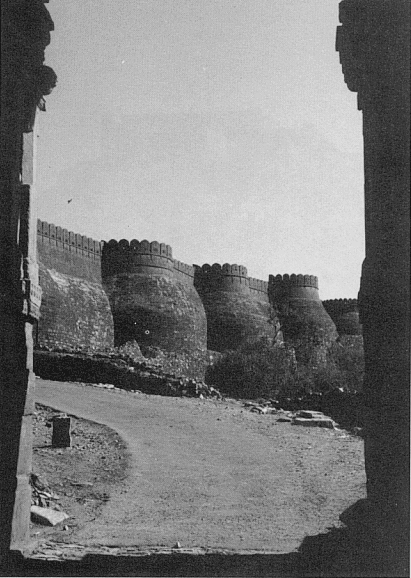
Crenellated walls of the fortress at Kumbhalgarh, a former capital of Mewar.
3.
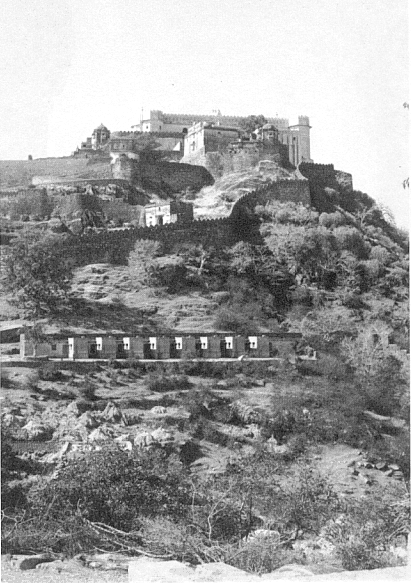
The fortress at Kumbhalgarh; rugged Mewar terrain.
estates, thikanas , granted by the maharajas in return for military and administrative service. The thikanas consisted of a given number of villages, which the noblemen governed and taxed. When residing at their estates, the noblemen lived in palaces, which, if built in pre-British days, were usually protected by fortresses with tall crenellated walls. While attending their maharaja in his capital, however, they lived in rambling urban mansions (havelis ). Mewari noblemen spent up to six months a year living in their Udaipur households. Today, they remain distinctly aware of their privileged status as former advisors to the Maharana.
Finally, there are the ordinary, nonaristocratic Rajputs. While all Rajputs claim royal blood, some have been poor and powerless. The explanation all Rajputs give for this is primogeniture.[8] In traditional Rajput society the eldest son inherited his father's estate and title. Younger sons, potential threats to political stability, were encouraged to take their friends and followers, leave their brothers' kingdoms, and seek fortune by conquering their own lands or by entering into the service of a maharaja and winning from him a thikana grant. In turn, their younger sons set off to gain fortune and title; the prospects open to these second-generation younger sons were more limited than those that had been open to their fathers because they had fewer followers and other resources to take with them in their quests for power. Moreover, they had comparatively little to offer a maharaja in return for a thikana . Over a period of generations, youngest sons wound up with little or nothing at all and had to take up farming and living in small villages. These village Rajputs are referred to as "little brother" (chota bhai ) Rajputs.
Despite the class differences represented by these three groups, Rajputs maintain that they are all related to one another, however distantly, either by descent or marriage. They openly acknowledge that the genealogies of all real Rajputs intersect somewhere or other.[9] Moreover, they consider all Rajputs members of a single, if scattered, Rajput community. This community is the entire Rajput caste, or jati , within which their daughters must be married.
Given the many political and status levels of Rajput society, I won-
[8] Here as elsewhere my primary interest is not how things happened but how Rajputs understand them: not history, but its indigenous construction, grounds ethos. Doubtless primogeniture is partly responsible for creating chota bhai communities, but other factors, probably including upward caste mobility, enter the picture.
[9] The force of this qualification is that there are many whom members of the Rajput community regard as impersonators, lower-caste persons trying to infiltrate their ranks through marriage. They believe the community is and must remain constant; only its generations can and should change.
dered at first if it would be possible to discover any truly common Rajput tradition. As I learned more about the Rajputs, however, I found great continuity both of Rajput tradition and interpretation throughout the rungs of the Rajput hierarchy. In talking with men and interviewing women from royal, noble, and village households I found that Rajputs at each level identify the same traditions as important to Rajputs. Thus women from the three levels of society claim that all Rajput women must perform the same religious functions, chief among which are worshiping Rajput kuldevis (goddesses of the kul ) and venerating family sati s (women who have immolated themselves on their husbands' funeral pyres).[10] As I grew familiar with these traditions, it struck me that women narrating kuldevi and sati stories often contextualized their stories by referring to well-known stories of Rajput heroines. Within a few weeks of my arrival in Udaipur, I had learned many legends about the various heroines admired throughout Rajput society. All Rajput women knew these legends, though village women were often less clear on the historical details of these stories than noble and royal women. Because the Rajputs I met quite consistently identified traditions of kuldevi s, sati s, and ancestral heroines (virangana s) as the ones most important to Rajput women, and because the traditions provide several points of access to the ethos of Rajput women, I have organized my investigation into caste duty and gender roles around analysis of these traditions.[11]
Although the reasons for the importance of these traditions will emerge in the chapters following, a few preliminary remarks about them are in order. As concerning kuldevi worship, it is important to note that the literature on Rajput tradition, by no measure vast, has paid scant attention to the Rajput kuldevi . Though a number of prominent authors, some whose work I draw on, have analyzed the Rajput kul as a kinship unit, no author has devoted serious study to the kuldevi , who is the primary recipient of Rajput devotion and the primary emblem of Rajput identity.
There is scholarship (some of it quite recent) that treats apparently similar deities, including non-Rajput kuldevi s, who are worshiped by groups in various parts of India. It can be roughly divided into four categories: one comprising studies of deities, who are associated with
[10] A kul is a kinship segmentation unit that I discuss in the following chapters.
[11] I shall use other devotional traditions, especially those important to men, as context for these traditions. My ongoing book-length study of hero veneration treats many of these more fully.
one or more groups;[12] another comprising studies of villages or regions, some of whose deities are said to be connected with a group or groups;[13] a third comprising studies of kingship, in which the legitimating aspect of deity worship is explored;[14] and a fourth comprising studies of folklore, in which deities and their communities are analyzed in passing.[15] Authors often refer to such deities as "tutelary deities" but give little explanation for why a deity is in fact a tutelary deity or how a tutelary deity differs from other deities. In most cases, providing such an explanation would require authors to digress substantially from the concerns that they explore. Thus they use the phrase as a rather imprecise convenience that refers to no indigenous category of divine protector. They posit a special relationship between a given deity and a particular group or groups but neither explore the nature of that relationship nor analyze it with reference to relationships between other tutelary deities and their affiliated groups.
The term "lineage deity" is somewhat more precise in that it specifies a kinship relationship but often does not specify the extent or nature of a "lineage," which might be a small or an extensive segmentary kinship unit. Scholars use the word to refer to very different levels of kinship organization and identity.[16]
When scholars do use the indigenous terms kuldevi or kuldevta (kul deity), they still face the matter of definition, for the term's meaning
[12] Examples are Eveline Meyer, Ankalaparmecuvari (Stuttgart: Steiner Verlag, 1986); Gilles Tarabout, Sacrifier et donner à voir en pays Malabar (Paris: Ecole Française d'Extreme-Orient, 1986); Alf Hiltebeitel, The Cult of Draupadi , vol. 1 (Chicago: University of Chicago Press, 1988); William Harman, The Sacred Marriage of a Hindu Goddess (Bloomington: Indiana University Press, 1989); C. J. Fuller, Servants of the Goddess (Cambridge: Cambridge University Press, 1984); Gananath Obeyesekere, The Cult of the Goddess Pattini (Chicago: University of Chicago Press, 1984); Olivier Herrenschmidt, "Le sacrifice du buffle en Andhra cotier," Purusartha 5 (1981).
[13] See Marie-Louise Reinich, Les dieux et les hommes (Paris: Mouton, 1979); Nicholas Dirks, The Hollow Crown (Cambridge: Cambridge University Press, 1987); Lynn Bennett, Dangerous Wives and Sacred Sisters (New York: Columbia University Press, 1983); Gerald Berreman, Hindus of the Himalayas (Berkeley: University of California Press, 1972); and Edgar Thurstan, "Komati" entry in Castes and Tribes of Southern India (Madras: Government Press, 1909).
[14] For examples, articles from Purusartha 10 (1986) by Dennis Vidal ("Le puits et le sanctuaire"), Jean-Claude Galey ("Totalité et hiérarchie"), and Henri Stern ("Le temple d'Eklingji et le royaume du Mewar [Rajasthan]"); France Bhattacharya, "La déesse et le royaume," Purusartha 5 (1981); and Dirks, Hollow Crown .
[15] Examples are Velcheru Narayana Rao, "Epics and Ideologies," in Another Harmony , ed. Stuart H. Blackburn and A. K. Ramanujan (Berkeley: University of California Press, 1986); Brenda Beck, The Three Twins (Bloomington: Indiana University Press, 1982); and Gene H. Roghair, The Epic of Palnadu (Oxford: Clarendon Press, 1982).
[16] I first noted this variation during my frequent and often animated discussions with Veena Das at Amherst College in the spring of 1986.
varies from place to place and group to group. Thus with the borrowing of the word kul , we see that a divinity is conceptualized with reference to this particular kinship group. Often, however, the kul deity is not actually associated with a kinship group designated by the term kul . As we shall see, some Rajput kuldevi s are associated with kul s, and others are associated with smaller segmentary units. Elsewhere, deities deemed kul deities protect many different groups belonging to various kul s, sub-kul s, and castes.[17]
This study examines associations between kuldevi s—all Rajputs worship female, not male, kul deities—and their Rajput kinship groups. As it turns out, the notion conveyed by the term kuldevi is specific to the Rajasthani context. Understanding kuldevi tradition sheds abundant light on indigenous constructions of caste, kinship, and residency in Rajasthan; I believe that the same might well be true of kul deity traditions in other communities elsewhere in India.
Given the relative dearth of information on kul deities, it is perhaps not too surprising to find that no study has viewed kuldevi worship from the vantage point of women. In this study I show that Rajput men's and women's evaluations of the nature of kuldevi personality and of the meaning of kuldevi mythology vary dramatically. The sociological implications of this variance are important; focusing on kuldevi tradition reveals a number of crucial assumptions about the way women understand personal and familial obligations. For example, these assumptions challenge the traditional typification of North Indian wives as sociologically and religiously isolated from their natal religious traditions.[18]
As to sati s, I might mention that when I arrived in Rajasthan there existed no scholarly treatment of contemporary satimata veneration in this state. Those who had worked in Rajasthan had discussed the importance of commemorative sati stones and remarked that these monuments still play a part in the religious lives of some Rajasthanis.[19] No one, however, had investigated the tradition of veneration and discussed its paramount role in the religious lives of Rajputs today.[20] I was quite
[17] See Hiltebeitel, Cult of Draupadi ; Meyer, Ankalaparmecuvari ; and Roghair, Epic of Palnadu .
[18] Also challenging this assumption are two papers presented at the conference, Women's Rites, Women's Desires, Harvard University, April 1988: William Sax, "Village Daughter, Village Goddess," 17; and Lindsey Harlan, "Kuldevi Tradition among Rajput Women," 15. Also see Bennett, Dangerous Wives , 169; and William Sax's manuscript, Mountain Goddess (forthcoming from Oxford University Press), passim.
[19] See, for example, Ann Grodzins Gold, Fruitful Journeys (Berkeley: University of California Press, 1988).
[20] Paul Courtright is working on a largely historical manuscript that will incorporate some contemporary materials (The Goddess and the Dreadful Practice [forthcoming from Oxford University Press]).
honestly surprised to find that satimata veneration remains a thriving tradition, though the practice of self-immolation has become almost extinct.[21]
These days few people interested in India are unaware that sati veneration is a living tradition. Since September 1987, when the young Rajput woman Rup Kanwar joined her husband on his cremation pyre in a small village in eastern Rajasthan, the Indian papers and magazines have been full of articles and editorials on sati immolation.[22] The controversy sparked by the case has drawn international attention, including coverage by the New York Times .[23] It recounts the flocking of Rajasthanis to the cremation site, which, to the dismay and indeed the outrage of many, has become a place of pilgrimage. In the first month after Rup Kanwar's death alone over two hundred thousand people visited her newly built shrine to pay respects and receive her blessing.
The case has catalyzed impassioned debates, both national and local, about the necessity for discouraging self-immolation through prosecuting accomplices and forbidding institutionally sponsored sati glorification. The controversy has been accompanied by large demonstrations organized by those who denounce the practice (with some Indian feminists at the forefront) or by those who support it (with some conservative Rajputs at the forefront). In short, as I found out firsthand on a recent trip back to India, sati veneration has become a politically salient and emotionally charged issue.
Given this explosive atmosphere, it is particularly important to understand the tradition of sati veneration as it has existed within the Rajput community. Although I find the idea of self-immolation horrifying, my purpose here is not to evaluate the contemporary national controversy politically and ethically. That extremely important task, now being pursued so vigorously in India, is in many ways beyond the limited scope and design of this study and would require a large and disruptive digression.[24] Rather, my task here is to give the best description of the Rajput tradition of veneration that I can, having revealed the intellectual
[21] From literature and from discussions with ethnographers I conclude that Rajasthan retains the most widespread and thriving tradition of sati veneration in India.
[22] Examples of substantial press treatment include Rajni Bakshi, "Shame," Illustrated Weekly of India , 4 Oct. 1987; Inderjit Bhadvar, "Militant Defiance," India Today , 31 Oct. 1987; Manushi , special double issue, nos. 42–43, September–December 1987; Ashis Nandy, "The Human Factor," Illustrated Weekly of India , 17 Jan. 1988; Seminar 342, "Sati: a symposium on widow immolation and its social context" (February 1988).
[23] See Steven R. Weisman, "Indian Widow's Death at Pyre Creates Shrine," New York Times , 19 Sept. 1987.
[24] Because the Kanwar incident took place after my departure from India I have no systematic field research on local reactions to it. For a historical overview of sati immolation, see V. N. Datta, Sati (Delhi: Manohar, 1988).
interests and motivations that brought me to consider the topic in the first place.
By way of introducing the heroine stories to be analyzed in my final chapters, I should say that not nearly enough work has been done by way of analyzing how specific groups of people construe popular narratives that are part of their culture. Often researchers have gathered narratives without benefiting from the direct interpretive commentary that indigenous narrators can give them.[25] Because I was interested in the heroic stories as possible repositories of moral paradigms, I was keenly interested in voluntary exegesis.
One thing that surprised me in the course of interviewing was that when women listed their favorite heroines, they almost invariably insisted on telling the stories about these heroines in full, even if they knew that I had heard the stories many times. Clearly they thought that I could not possibly understand who a heroine was unless I understood crucial features of her behavior. These could only be pointed out properly in the context of storytelling. The evaluative glosses that women volunteered and of course the usually very subtle variations that they narrated gave me a rich source of information about women's values. Moreover, because the two stories that dominated women's responses, the stories of Mira and Padmini, radically conflict at one level in the values they espouse, only the interpretive and evaluative comments women made gradually enabled me to understand the broader, more encompassing normative ideals that the stories share. Furthermore, the Mira and Padmini stories have conveniently served to illustrate in narrative form some basic resolutions of normative dilemmas discussed in the kuldevi and sati chapters.