
I. The Eponymous State Cults in Alexandria and Royal Cults in Egyptian Temples
At this point some attention needs to be given to the cult of Alexander and the Ptolemies. The theological concept was Greek. It proceeded from the idea that the deeds of some men had shown them as founders, benefactors, and saviors of their cities, and therefore as heroes or gods. The cult was founded by Ptolemy I Soter in the dry of Alexandria (see section II.1.b), and the names of the priests were used for dating all official documents, both state and private, even those of minor importance. Dating by eponymous priests or other officials was a common practice of Greek cities.[51] But the Alexandrian eponymous priesthoods were used not only for the city, but throughout the entire kingdom. For the purpose of dating, it would have been sufficient to count the years of the king, as was the Macedonian as well as the oriental practice.[52] Admittedly, from our point of view eponymous dating is very helpful in determining the date of a document, because regnal years are frequently
[51] For a survey see R. Sherk, "The Eponymous Officials of Greek Cities," ZPE 83 (1990): 249-288, ZPE 84 (1990): 231-295, ZPE 88 (1991): 225-260, ZPE 93 (1992): 223-272, esp. 259-265 on the eponymous cults in Alexandria and Ptolemaïs (no. 212); the final part will appear in 1993.
[52] The Macedonians counted regnal years, but this was also Egyptian practice. The Macedonian year, however, followed a different rationale. The first Egyptian year ran from accession to Thoth 1, the beginning of the next civil year, which then was counted as the second regnal year. The first year could thus be very short. The Macedonians made the accession day the new year's day of the regnal year, at least in principle. Thus, the first year runs from the day of accession till the day before the first anniversary, when the second year begins.
ambiguous. Under the early Ptolemies three different regnal years were used: one according to the Macedonian practice, another according to Egyptian custom, and a third one for the fiscal year.[53] In official documents, dating by eponymous priests supplemented the regnal year; and in this combination, the dating by eponymous priests indicated that the regnal years were counted the Macedonian way. But because of the length of the list of the eponymous priests, dating by eponymous priests was a very cumbersome way to resolve the ambiguity of regnal dating. In short, the practical purpose was hardly a sufficient reason for the creation of a single eponymous cult, not to speak of the ever increasing numbers that flourished in Alexandria and Ptolemaïs. Hence, eponymous dating in Egypt fulfilled, by and large, a symbolic function. On a first level, through the combination of dating by regnal years and eponymous officials, the kingdom represented itself in the double imagery of kingship and Greek city, even if the latter meant little in political reality. On the second level, the eponymous officials were priests, not other state or city officials. The combination of regnal years and eponymous priests of the state cult pointed to the unity between the administrative and religious functions of kingship. And on a third level, the eponymous cults in Alexandria were devoted to Alexander, the founder of the city,
[53] The Egyptian calendar was perhaps the most important contribution which the Egyptian tradition gave to the Ptolemaic economy and administration. Already during the reign of Philadelphos, the Macedonian calendar lost all practical importance and became ceremonial, and by 257 BC a certain Numenios being ordered to meet the dioiketes Apollonios in Memphis did not know the Egyptian equivalent to the Macedonian date of the king's birthday (P. Cairo Zen . 4.59541). It is significant that for fifteen years Philadelphos was not bothered by the fact that the Egyptians would not accept the count of regnal years which he had introduced for the Macedonian count in 282 BC . But in 267 BC the need for reform could no longer be denied, and the Egyptian count was changed too (n. 61). By this time the Egyptian calendar had taken over in all other regards. For a while an additional financial year was used, but it was based on the Egyptian calendar; the only difference was its beginning on Mecheir first—that is, in March—thus producing a year that should have been attractive for an agricultural economy. It is not known when this financial year was introduced; but it might be noted that in the year 21 of Philadelphos it practically coincided with the Macedonian regnal year. The financial year was never in general use.
Moreover, when Philadelphos changed the count of the Macedonian regnal year as early as in his first year (282 BC ; see n. 61) and the first year became the fourth, he calculated the retroactive first year from his elevation to coregent (possibly on Dystros 12, 285, his so-called birthday; see n. 110 [2 b]) to the next Macedonian new year's day of his own count (presumably Dystros 25, 285; see n. 96). The new first year may have had less than two weeks. The retroactive count was of no practical consequence, but it avoided having the period of Dystros 12-24 occur twice in the same year. The method followed the practice used for the Egyptian regnal year. See nn. 52 and 61; and Koenen, Agonistiche Inschrift , 52f. An attempt by Euergetes to introduce an intercalation system into the Egyptian calendar was an instant failure.
and to the subsequent Ptolemies. Thus the state cult of the city propagated the divine nature of kingship and the kings; the state cult was a means of propagating the ideology of Ptolemaic kingship.[54]
The main facts are well known.[55] We may turn to an example and look at the protocol of the decree of the synod of Egyptian priests assembled in Memphis mainly for the coronation of Ptolemy V Epiphanes in 196 BC ; this decree is best known through the Rosetta inscription. It combines the Greek eponymous dating with the Egyptian dating by the royal titularry, the "Great Name," of Epiphanes and is accompanied by the regnal year 9.[56]
a. The Egyptian Royal Titulary of Epiphanes and the Eponymous Priests of His State Cults: The Formulas
The Greek version of the synodal decree of Memphis (Rosetta inscription):
|
|
|
|




[54] The propagandistic use of the dating formula goes beyond these generalities. I have called the Ptolemaic dating formula a seismograph that indicates the changes in both the cult of the dynasty and the power structure (in the edition of P. Köln inv. no. 5063 [P . Köln 2.81; SB 10763]: "Kleopatra III. als Priesterin des Alexanderkultes," ZPE 5 [1970]: 71).
[55] J. Ijsewijn, De sacerdotibus sacerdotiisque Alexandri Magni et Lagidarum eponymis (Brussels, 1961), 196; P. M. Fraser, Ptolemaic Alexandria (Oxford, 1972) 1:214-226; F. W. Walbank, CAH 7.1.96-99; Préaux, Monde hellénistique 1:255-261; C. Habicht, Gottmenschentum und griechische Städte , 2d ed., Zetemata 14 (Munich, 1970), 230ff.; Koenen, "Adaption," esp. 154-170; for the Philopatores also see E. Lanciers, "Die Vergöttlichung und die Ehe des Ptolemaios IV. und der Arsinoe III," APF 34 (1988): 27-32; for the modern fasti of these priesthoods see G. Van der Veken in W. Clarysse and G. Van der Veken with the assistance of S. P. Vleeming, The Eponymous Priests of Ptolemaic Egypt , P. L. Bat. 24 (Leiden, 1983). I restrict myself to a brief survey.
[56] OGIS 1.90 (SEG 8.463; 33.1357; cf. n. 45); for the demotic and hieroglyphic texts in transliterations and all three texts in translation see S. Quirke and C. Andrews, The Rosetta Stone: Facsimile Drawing (London, 1988). The upper part of the stone with the first hieroglyphic lines is broken off. The text can be supplied from parallel versions; see Spiegelberg, Der demotische Text , 77-86 (parallel Greek text and translations of the Egyptian texts). For the hieroglyphic version of the royal titulary I follow Spiegelberg. In Ptolemaic times, hieroglyphic was a dead language, and the hieroglyphic texts of the bilingual and trilingual decrees are artificial creations. Yet this traditional and formulaic language remains important, particularly in the case of the royal names. See also G. Roeder, Die ägyptische Religion in Texten und Bildern , vol. 3, Kulte, Orakel und Naturverehrung im alten Ägypten (Zürich and Stuttgart, 1960), 167-190. The only other king for whom a Greek translation of the Egyptian royal titulary is extant in Philopator; see H.-J. Thissen, Studien zum Raphiadekret , Beitr. z. klass. Phil. 23 (Meisenheim, 1966); Koenen, "Adaptation," esp. 155 n. 36. For the connection of the Egyptian royal titulary with Greek dating and stylization of decrees see Jean Bingen, "Normalité et spécificité de l'épigraphie grecque et romaine de l'Égypte," in Egitto e storia antica , 15-35, esp. 20-24.
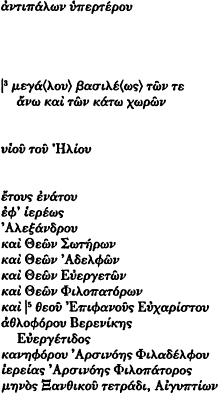 | 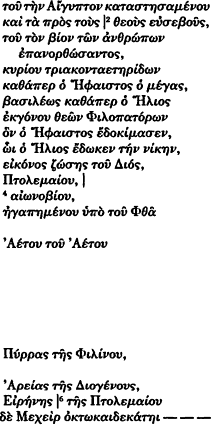 |
The hieroglyphic version (see n. 56):
|38 In year 9 on the fourth of Xandikos, which in the reckoning of the inhabitants of Egypt is the second month of the winter season under the Majesty of
Horus-Re (Hr ) | the Youth who has appeared as king in place of his father |
Lord of the Two Crowns (nb.tj ) | the glorious[57] |
who has made firm the Two Countries, | |
who has made Egypt beautiful, | |
who in his heart is pious towards the gods |
[57] The Egyptian versions offer a traditional phrase which is best translated: "great in his might." Hieroglyphic ph.tj is frequently ascribed to kings and refers to physical strength as well as to power and reputation. The Greek translation interprets the word in the latter sense. See Thissen, Studien , 31f.; and Spiegelberg's translation, Der demotische Text , 31.
Horus triumphant over Seth of Ombos (Hr nb.tj ) | who is green life for men,[58] |
Lord of the hb-sd[*] festival like Ptah-Tnn | |
king just like Re | |
King of Upper and Lower Egypt | the heir of the two Father-loving Gods |
|39 (njswt-bjt[*] ) | |
chosen by Ptah | |
 | |
Living Image of Amun | |
Son of Re (  | Ptolemy |
Living forever, | |
Beloved by Ptah, | |
the Shining God (= Epiphanes), | |
the Charitable God (= Eucharistos), | |
the son of Ptolemy and Arsinoe, the two Father-loving Gods | |
when . . . |
b. The Development of the Greek Eponymous State Cults and Egyptian Temple Cults of the Ptolemies
The protocol of the synodal decree of Memphis combines the Egyptian royal titulary (the kings "Great Name") with the regnal year and with the eponymous dates of the state cults in Alexandria . The count of regnal years is part of both the Egyptian and the Macedonian tradition (see n. 52) and thus mediates between the Egyptian and the Greek elements. At Epiphanes' time the priesthood of Alexander contained the series of Ptolemaic rulers from Ptolemy I Soter and Berenike I to Epiphanes, the reigning king; and several other eponymous cults had been added. The development of this formula is characterized by the following steps:
In 290/89 Ptolemy I Sorer , who claimed the same lineage as Alexander, founded a new cult of Alexander[59] with an eponymous priesthood, at the time called simply the "priest." Ptolemaios himself had already received cultic honors on the island of Rhodes from the league of the Nesiotai and in Ptolemaïs as founder of the city. Moreover, at least once,
[59] At the time when this institution was founded, a cult dedicated to Alexander the founder seems already to have existed in Alexandria. Ptolemy I had buried Alexander first in Memphis, then in Alexandria.
he and his wife Berenike received a dedication as  in Egypt. All these honors were based on specific merits in specific cases, but they went one step farther: on coins Ptolemy Sorer wears the aigis of Zeus. He thus appears Zeus-like. The genealogy I mentioned rendered him a descendant of Zeus. But the deification of the
  was only established by his son and successor Philadelphos in 280 BC .
Ptolemy II Philadelphos founded a cult of himself and his wife Arsinoe II, probably in 272/1 BC. At this time Arsinoe II already had the name Philadelphos,[60] and she was still alive. Now the title of the eponymous "priest" became "the priest of Alexander and the


[60] Fraser, Ptolemaic Alexandria 1:217 and 2:367 no. 228; Koenen, "Adaption," 157, 159.
ladelphos founded separate cults. But the Theoi Soteres appear in the series of gods by whom, in continuation of pharaonic practice, people would officially swear. For example, a papyrus of 250 BC testifies that somebody "swears by King Ptolemy, the son of King Ptolemy and Queen Berenike, the Soteres, and by Arsinoe Philadelphos, the Gods Adelphoi, and by the Gods Soteres, their parents."[62]
In his fifth year (243/2) Euergetes added his name and that of his
[62] P. Sorb . 1.32.4-9 with notes. The list of gods was to grow in a similar way as in the title of the priest of Alexander (but with reversed order). For example, at the time of Epiphanes, one would swear "by King Ptolemy, the son of Ptolemy and of Arsinoe the Gods Philopatores, and by the Gods Philopatores and the Gods Adelphoi and the Gods Euergetai and the Gods Soteres and Sarapis and Isis and all the other gods" (P. Petr . 2.46 [Wilcken, Chrest . 110]). Later, of course, the formula was shortened (e.g., P. Oxy . 49.3482.28-29 of 73 BC ), just as the dating formula was abridged. The inclusion of other gods corresponds to traditional Egyptian practice; the king could either replace old gods or be invoked side by side with them (cf. E. Seidl, Der Eid im ptolemäischen Recht [1929], 45-48), but the generalization "and all the other gods" is Greek (cf. nn. 172 and 182).
wife Berenike II to the title of the priest of Alexander and the Theoi Adelphoi ; in the ninth year (288 BC ) the Egyptian priests who were gathered at Kanopos followed the precedent of the Greek cult and, in their own cults, added the title of priest "of the Theoi Euergetai " to the titles of all priests in the entire country; the Euergetai were  of the Egyptian gods. In addition to the existing four classes of priests they created a new class called
  .[63] They resolved to enlarge the honors which in the Egyptian temples were already given "to King Ptolemy and Queen Berenike the Gods Euergetai and for their parents the Gods Adelphoi and their ancestors the Gods Soteres" (20-22 [ = 15-17]).[64] It is unfortunately not dear whether this refers to separate cults or whether, as seems likely, these cults were meant to be dynastic: the cults of "the Theoi Euergetai, Theoi Adelphoi , and Theoi Soteres ." But Alexander, the first name to be mentioned in the series of divine names in the Greek title of his priest, is not included in the Egyptian version, and the names are arranged in reverse order.[65] From Euergetes on, we indeed find priests identified as "servants" of the royal couple and of other gods; and in the course of history the ancestors of the royal couple were added and the list grew just as the title of the priest of Alexander kept growing. Later, there were priests identified by the main god of the temple where they served, plus the royal couples from the Philadelphoi or Euergetai on to the reigning king. The theory that the Egyptians worshiped only the deceased kings can no longer be maintained. Although they began their own ruler cult with Arsinoe II (see nn. 68, 69) and, in contrast with the Greeks, only after her death, already with Euergetes this distinction no longer applies. The Egyptian cult developed in the Egyptian temples, while the Greek ruler cult, that of Alexander and of the Ptolemies as well as that of individual kings and queens, developed in Alexandria and other places where the Greeks lived. Greeks and Egyptians followed their own traditions, yet the Greek and Egyptian institutions of the ruler cult fulfilled similar functions. It is essential to realize that the Egyptian priests accepted the Greek cult names of the royal couples. We will return to this below.[66]
[63] Can ., Greek 24f. (Kôm el-Hisn 19). This resolution was only partly implemented, and the title was merely given to specific individuals; see Thompson, Memphis , 134, and below.
[65] Cf. the genealogically arranged series of Ptolemaic kings by whom the official oath was sworn; see nn. 62 and 172.
[66] For the preceding paragraph see J. Quaegebeur, "Egyptian Clergy and the Ptolemaic Cult," AncSoc 20 (1989): 93-113; for the titles of priests referred to above, see 104f. It is worthwhile to quote Quaegebeur's conclusion: "I have tried to demonstrate that, parallel with the Hellenistic dynastic cult, a native version developed which encompassed, from Ptolemy III on, the ancestors as well as the living monarchs. I prefer not to use the passive term 'reception' in connection with the dynastic cult since the higher clergy participated actively in the development of their version of the royal cult, which had always been part of the temple ritual but was adapted to the history of the new royal house." For veneration of the ancestors of the ruling king in Egyptian temples see also Winter, "Herrscherkult." Recently D. Fishwick (following E. Winter) has again asserted that only deceased Ptolemies were worshiped in Egyptian temples ("Statues Taxes in Roman Egypt," Historia 38 [1989]: 335-347. For the Egyptian priest of the royal cult, see also E. Lanciers, "Die ägyptischen Priester des ptolemäischen Königskultes (Zusammenfassung)," in Life in a Multi-Cultural Society , 207-208.
Philopator , as he was already named as a child, received veneration from the Egyptians early on; after his marriage to Arsinoe III, Theban priests were called "priests of Amun, the Gods Adelphoi, the Gods Euergetai, and the Gods Philopatores." Presumably on the occasion of the wedding (in or before 220 BC ) the couple added themselves to the cults of the Egyptian gods in the form in which the Greek dynastic cult flourished in the Egyptian temples.[67] Then, beginning with the seventh year (216/5 BC )—that is, with the year following the Battle of Raphia—Philopator and Arsinoe III were added to the Greek cult and the dating formula. It is certainly unexpected that the inclusion of the Philopatores in the Alexandrian cult was anticipated by first adding them under their Greek names to the Egyptian cults. The road to this initiative was paved by the enthusiasm with which the Egyptian temple had accepted Arsinoe II and, consequently, the Theoi Adelphoi .[68]
In the following year, Philopator included Ptolemy Soter and Berenike in the title of the priest of Alexander in their proper chronological order, thus finally establishing the genealogical line of the dynasty. This last step was not followed by the Egyptian dynastic cult, which excluded Alexander and Ptolemy Soter. In the Greek cult, the Ptolemaic god-kings were  of Alexander; in the Egyptian cult, they were
 of the Egyptian gods. Thus, his insertion would have been theo-
[67] P. Vatic. dem . 2037B of Thoth of the third year (October 15 to November 15, 220); the title of the priests occurs in the signature. It is significant that the dating formula of the document does not contain the addition of the Theoi Philopatores . Before the document attracted renewed attention, the wedding was dated by J. Quaegebeur to shortly before the Battle of Raphia (June 8, 217 BC ; "Documents Concerning the Cult of Arsinoe Philadelphos at Memphis," JNES 30 [1971]: 248 with n. 60; for the date of the battle see Koenen, "Adaption," 165 n. 64). For the interpretation of P. Vatic. dem . and its far-reaching consequences see Lanciers, "Vergöttlichung." For a discussion of the problems see also Huss, Aussenpolitik Ptolemaios' IV , 260-265.
[68] See especially J. Quaegebeur, "Ptolémée II en adoration devant Arsinoe II divinisée," BIFAO 69 (1971): 191-217, "Documents"; cf. eundem, "Reines ptolémaïques et traditions égyptiennes," in Ptolemaïsche Ägypten , 245-262, and "Cleopatra VII," 42; Thompson, Memphis , 126-138. For the material interest that the temples had in founding cults for Arsinoe II see section II.1.e.
logically difficult. Here is the problem: from the Egyptian point of view Alexander could merely have become the first in the series of ancestors; thus he would not have had the primary position which he had in the Greek series, where he was the god who originally and ultimately gave his name to the title of the priest. If, however, it was better to leave Alexander out of the Egyptian cult, then it was also convenient to avoid the introduction of Soter into the series. To be sure, there was no theological problem, and already under Euergetes the priests had decided in principle to include Soter in the series of kings to be venerated in the Egyptian temples. But it seems it was convenient not to add him to the series, since his insertion would have brought the question of Alexander into play. Doing nothing was better, as long as the Ptolemaic kings did not insist that the temples follow the lead of the Alexandrian cult.[69]
In the end,[70] the king became, indirectly, his own priest. Ptolemy VIII Euergetes II was priest of Apollo in Cyrene, most likely when he was ousted from Egypt by his brother and resided in Cyrene. Apollo was identified with Horus, and the Egyptian king lived the role of Horus. Being king and priest of Apollo implied a claim to the Egyptian throne. But it also opened the door for a development which let later Ptolemaic kings become priests of Alexander and the Ptolemies, including themselves. Ptolemy IX Soter II had this priesthood through almost his entire reign (116-107; and once before [135/4]), Ptolemy X Alexander at least for three years (107-105 and 84/3), and Kleopatra III at least once (105/4). It was common throughout the Hellenistic world that, in times of economic hardships, Greek cities made the local god or goddess serve as eponymous priest: the deity was her or his own priest. This meant in practical terms that. no person wealthy enough had been found and that, hence, the temple of the deity assumed the costs of the priesthood. In this respect, the feature is perfectly Greek. It is also understandable that Ptolemaic kings undertook to fill in and to bear the costs. Yet the fact that they, being kings, implicitly worshiped themselves is without precedent in the Greek institution. The presence of Kleopatra III, a woman, in a male priesthood is even more remarkable. It is reminiscent of Queen Hatshepsut, who was depicted with the male beard of the Egyptian king; but there are closer historical antecedents: in Edfu, Berenike
[69] For the silent exclusion of Alexander and Soter see Winter, "Herrscherkult," 156f. ("Ebenso scheint mir der Beginn der Herrscherreihen in den ägyptischen Templen mit Ptol. II und Arsinoe II aus dem hieroglyphischen Material nicht erklärbar"). Cf. Quaegebeur, "Cleopatra VII," 42. For the introduction of the name of Philometor into the title of the dynastic priest see section II.1.d (Philometor).
[70] For certain changes under Ptolemy V Epiphanes see E. Lanciers, ZPE 66 (1986): 61-63.
II, the wife of Euergetes, received a female Horus-name and thus was regarded as pharaoh.[71]
In addition to these male priesthoods for the king, queens also received their separate cult, in Egyptian as well as in Greek temples.[72] The priestesses of their Alexandrian cult became eponymous. Philadelphos created the priesthood of the kanephoros of Arsinoe Philadelphos either in 269/8, when Arsinoe II was still alive, as we now know, or more likely after her death in the beginning of July 268 (n. 61).[73] After her death, the king was a god on earth and the queen a goddess in heaven. In 211/0 Philopator added the Athlophoros of his mother, Berenike Euergetis, and in 199/8 Epiphanes included a priestess of his mother, Arsinoe. There were still more changes to come, and some indicated a slow propagandistic Egyptianization of the ideas, albeit not of the forms in which the cults were practiced.[74] Suffice it to say that the Ptolemaic queens took an extraordinary part in the deification. King and queen were the divine couple in the image of Zeus and Hera.
There was a second eponymous state cult of the Ptolemies in Egypt, founded by Ptolemy IV Philopator in Ptolemaïs in the south of Egypt, north of Thebes, in 215/4, when he also inserted Ptolemy I into the Alexandrian title of the priest of Alexander. The cult in Ptolemaïs was
[71] For documentation of the Ptolemaic priesthoods see Van der Veken's list in Eponymous Priests; for the king serving as his own priest see R. Sherk, "Eponymous Officials," ZPE 93 (1972): 265; on Kleopatra III see Koenen, "Kleopatra III"; for Berenike's Horus-name see Quaegebeur, "Egyptian Clergy," 98 with n. 27; for Hatshepsut see also n. 8 and section II.1.d (Philometor).
[72] For the evidence of Egyptian cults see the literature quoted in n. 68.
[73] The first securely attested kanephoros is Aristomache daughter of Aristomachos in 267/6. Matela or Metals of P. dem. Brux . may now rather be assigned to 259/8; and Eukleia daughter of Aristodikos could have been the first kanephoros or could belong to a later year. See Van der Veken, in Eponymous Priests 6-7, and Fraser, Ptolemaic Alexandria 2:366 n. 225.
originally for Ptolemy I Soter and Philopator the reigning king, but over time the cults multiplied and changed. Ptolemy VI Philometor removed himself from the title of the priest of Soter, and instead received a separate eponymous cult for himself and his wife. In imitation of the Alexandrian cult he also added a kanephoros of Arsinoe. There was a tendency to build independent cults for individual kings and queens, but their accumulation reflected the dynastic line as did the title of the priest of Alexander in Alexandria. As Alexander was the core of the Alexandrian cult, so Ptolemy I was the center of the cult in Ptolemaïs. Whereas the eponymous priests of Alexandria were used throughout the kingdom, those of Ptolemaïs were only used in the south. The double list of eponymous priests of Alexandria and Ptolemaïs staged the old Egyptian symbolism of the two countries in a new form: it was the king's ritual duty to unify the Two Countries—that is, in the main meaning of the phrase, Lower and Upper Egypt.[75] Thus now, at least in the south, the Ptolemaic rule presented itself in two different sets of eponymous state cults, each of them stretching from the present ruler or the royal couple back to Alexander and Soter, respectively. The dynastic line that represented the succession, by itself a perfectly Greek thought, was capable of expressing the Egyptian idea of transferring the power of kingship from the ancestors to the reigning king.[76]
c. The Official Egyptian Titulary of the King in the Protocols of Documents
The Greek dating formula amounted to an ever-growing protocol. Its function in part paralleled the protocol of the old Egyptian dating formula, which only temples continued to use. When it was combined with the Greek formula, the Egyptian preceded the latter. The Egyptian formula is based on the royal titulary or "Great Name" (see section II.1.a) which each king received at his coronation. It consists of five invariable titles (left column), each of which is followed by an individual name (right column). In general terms, the "Great Name" expresses the divine origin of the king, as the Greek dating formula does in a different way. It lacks an elaborate genealogy but lets the king ap-
[75] More on this in section II.1.c (2) and (4); W. H. Mineur, Callimachus: Hymn to Delos (Leiden, 1984), 165f. on line 168; P. Bing, The Well-Read Muse , Hypomnemata 90 (Göttingen, 1988), 136; Koenen, "Gallus," 136 n. 64, and "Adaption," 186f.
[76] See also section II.1.c (4); Quaegebeur, "Egyptian Clergy," 96, with a quotation from L. Bell, "Luxor Temple and the Cult of the Royal Ka," JNES 44 (1985): 283, stating that in the New Kingdom the rite served "to identify the reigning monarch with the divine ancestors."
The eponymous priesthoods made up the largest portion of the dating formula in official documents, side by side with the brief indication of the year of the king; the formula could get longer than the contract itself. Hence abbreviations were invented, but this is of no immediate interest in the present context.
pear as an incorporation of the gods, the original kings of the country. Thus, in the traditional parts of the name, in the invariable rifles (left column), the king appears as the son of the creator god. He is not called a "god," as in the Greek cults. In fact, he is only a god inasmuch as he exercises the creative and protective function of specific gods. He is not a god because honored as a god for his previous deeds, but he is the visible presence of the gods because of his divine office. Therefore, he repeats the deeds which the gods have done in mythical times. The pharaoh does not earn his divinity, but he displays it by playing his role. Despite such differences, it is clear that the Greek formula serves a general purpose similar to the Egyptian titulary. It propagates the king as the divine ruler. A closer, albeit rather quick look at the different elements of the Egyptian "Great Name" and the meaning of the Greek cult names confirms this impression.[77]
(1) "The King"

(2) "The Lord of the Crowns"

[77] In the following remarks I shall leave aside the changes in meaning that developed in the long history of the royal titulary in spite of its rather static terminology. For more information see Thissen, Raphiadekret , 27-42; J. yon Beckerath, Handbuch der ägyptischen Königsnamen , Münchener Ägyptol. Studien 20 (Munich and Berlin, 1984), 1-42; H. Frankfort, Kingship and the Gods (Chicago, 1948), 46f.; G. J. Thierry, De religieuze betekenis van bet aegyptische koningschap (Leiden, 1913); A. Moret, Du caractère religieux de la royauté pharaonique , Ann. du Musée Guimet, Bibl. d'Ét. 15 (Paris, 1902), esp. 18-32.
and Lower Egypt, Nekhbet and Wadjet. Egypt was mythically regarded as a double kingdom and, through the ritual of the coronation, each king unified the two parts of the country (cf. section II.1.b [end] and (4) below). But this is too abstract. The two crowns were incorporations of the two tutelary goddesses of the double monarchy. By appearing in the crowns of the king, they protect the Two Countries. This idea is picked up in the corresponding names, which describe the king as being glorious, putting Egypt in order, and being pious towards the gods.
(3) The title "The Triumphant over His Enemies" is an interpretative rendition of what originally meant "Horus of (or upon) Gold" or more generally the "Falcon of Gold." In the late period of Egyptian history this was understood as "Horus being victorious over Seth" (Hr nb.tj ); hence the Greek translation. Thus, the title recalls the same myth which we encountered with the first title: when Seth had killed Osiris, the previous king, and had thus pushed the land back into its original chaos, he was conquered by Horus; the land was reestablished and regained the state in which Re had created it from chaos. The following individual name focuses on the same ideas: restoration of life (or rather: the king is life), renewal of the creation by Re, and the permanent renewal by means of a specific festival, the sed festival or thirty-year festival (see n. 110 [2a]).
(4) The njswt-bjt[*] title, "The Great King of the Upper and Lower Countries," again stresses the idea of the double monarchy represented in hieroglyphic form by the "Sedge" and the "Bee," the symbols for Upper and Lower Egypt (cf. section II.1.c [2]). It is followed by the individual "prenomen" of the king, which is encircled by a cartouche. Starting with the cartouche of Euergetes, it is here that the Egyptian titulary accommodated the genealogical descent so crucial for the Greek formula: "the descendant of the Gods Philopatores." The idea of descent becomes crucial for the prenomen (cf. n. 76). The filiation is followed by more traditional names assuring that the king has been approved by the gods; thus "Whom Helios Gave Victory" is simply a translation of the Egyptian name User-Ka-Re, literally "Strong Is the Spirit of Re." Moreover, Epiphanes received the name "Living Image of Zeus"; he is on earth what Zeus or, to use the Egyptian name of the god, what Amun-Re is in heaven. According to Egyptian beliefs this indicates that Amun-Re is living in him and that it is Epiphanes who on earth exhibits the might of Amun-Re, his father.[78]
[78] The pharaoh is generally the "image of God NN." The hieroglyphic phrase used for Epiphanes is shm-'nh-(n)-Jmn[*] , which in its general sense recalls the name of Tutankhamun (eighteenth dynasty): twt-'nh-Jmn[*] . Both words, shm[*] and twt , mean "image," but twt can also be rendered "complete, perfect"; and Tutankhamun's name may originally have meant "Perfect-with-Life-is-Amun" (G. Fecht, "Amarna-Probleme," ZAeS 85 [1960]: 90). Substituting shm[*] for twt is replacing an unwanted ambiguity by a meaningful one. shm[*] is not only very commonly used for "image" but originally meant "might." Thus, the Egyptian phrase used for Epiphanes still yields the connotation of "Living Might of Amun." See E. Hornung, "Der Mensch als 'Bild Gottes' in Ägypten," in O. Loretz, Die Gottebenbildlichkeit des Menschen , Schriften des Deutschen Instituts für Wissensch. Pädagogik (Munich, 1967), 123-156, esp. 137-150 and 143-145; eundem, Conceptions of God in Egypt: The One and the Many , trans. from Der Eine und die Vielen (Darmstadt, 1971) by J. Baines (Ithaca, N.Y., 1982), 135-142.
(5) The same idea appears in the final title: "Son of Amun-Re" ( R' ). I have already mentioned the legend of the birth of Ptolemy I. In the language of Greek myth, it reflected the Egyptian beliefs that the king was the son of, and protected by, the supreme god, that is, by Amun-Re, who in Greek terms corresponded to both Zeus and Helios. Alexander was depicted on coins as "Amun-Re," the ram god. Furthermore, the Macedonian king had marched to the Oasis of Amun in Siwa as soon as he had taken Egypt and, if for once we can trust Pseudo-Kallisthenes, had been crowned in the temple of Ptah at Memphis.[79] The march to Siwa was time-consuming and is dangerous even nowadays. It resulted from a shrewd calculation. Alexander could count on the fact that he would be greeted as the Egyptian king, hence as the "son of Amun." The same would have happened in any other Egyptian temple, but only the temple of Amun in Siwa had authority in the Greek world. Hence the message spread to Greece. In Egypt, legends were told illustrating the fifth rifle. In Pseudo-Kallisthenes, Alexander is fathered by Nektanebos, the Egyptian king, who appears as Amun. When Alexander appears on coins with the horn of a ram, this picture expresses his descent from the ram god Amun.[80]
The fifth title is followed by the proper names of the king, in the case of Epiphanes by a transcription of his Greek name "Ptolemaios" and traditional Egyptian names which further assure that he is "beloved by Ptah." The latter means more than the English phrase indicates to the
[79] Koenen, Agonstische Inschrift , 29-32; cf. Thompson, Memphis , 106: "When Alexander the Great took Egypt in 332 BC , he visited . . . Memphis, where he sacrificed to the Apis bull and to other gods, celebrating in the city with both gymnastic and musical contests. Arrian, unlike the later Alexander Romance , makes no mention of an actual enthronement ceremony here in the temple of Ptah, but it is dear that in Memphis, sacrificing to the Apis bull in its native form, Alexander was claiming acceptance as pharaoh among the Egyptians whom he now ruled." Most recently S. M. Burstein, "Pharaoh Alexander: A Scholarly Myth." AncSoc 22 (1991): 139-145, has argued against any coronation before that of Epiphanes, and specifically against a coronation of Alexander.
[80] See Grimm, "Vergöttlichung"; R. Merkelbach, Die Quellen des griechischen Alexanderromans , 2d ed., Zetemata 9 (Munich, 1977), 77-82; Koenen, "Adaption," 167; H. Brunner, Die Geburt des Gottkönigs: Studien zur Überlieferung eines altägyptischen Mythos , Ägyptol. Abh. 10 (Wiesbaden, 1964), esp. 22-31, 42-58; Moftah, Königsdogma , 99-106.
modern reader. It attests that Ptolemy is the son of the god, this time the son of Ptah. Or, to use another phrase recently used to explain the meaning: "A ruler described as beloved of a god becomes a form of that god."[81]
The proper names are again encircled by a cartouche. After the car-touche the Greek cult-names ("Epiphanes Eucharistos") are added, a practice which already began with the name of Ptolemy Soter. In the Rosettana the cult-names are followed by the proper names of the kings parents. By accommodating the Greek filiation the last two titles of the "Great Name" adopt the propaganda functions of the Greek dating formula. First, there is the filiation of the king with the cult-names of his parents (after the fourth title), then the king's own proper name "Ptolemaios," his own cult-names, and finally again his filiation, this time with the parents named by their proper names.
d. The Meaning of Greek Dynastic Cult-Names
In light of the preceding consideration of the Egyptian titulary, it will now turn out that the Greek cult-names capture more of the tenets of the Egyptian titulary than can be assumed at first glance. But again, I will have to restrict the presentation of the evidence to the most important examples.[82]
"Soter" and "Euergetes" were names recalling the Greek honors for men who had served their city in an extraordinary way. Yet the same names expressed ideas of Egyptian kingship. In the capacity of his second title the king was the divine protector of his country and of the gods. When Philopator in his nb.tj name is called "the savior of men" (cf. section II.1.c [2]), the same Egyptian word is used that appears in the translation of  (ntrw[*] ndw[*] cf. n. 87). It already occurs in the greeting which the gods extend to Haremheb at his coronation (ndy.n[*] "our protector"); and Sesostris I and Neferhotep I are each called "protector of the gods." Another Egyptian word for the same idea appears in the titulary extant in the temple of Philae: Shed , "savior." Similarly the transcription for "Euergetes" is derived from mnh[*] , an epithet that a later generation gave to King Snofru (fourth dynasty).
"Philadelphos" is originally the name for Queen Arsinoe If; the couple was called  . The name alludes to the mythical marriages of Tefnut the daughter of Shu and her brother Shu, or of Osiris and his sister Isis, who conquered even death and became the exemplar
[81] Bell, "Luxor Temple," 290 n. 222; Quaegebeur, "Egyptian Clergy," 101; for the imagery of love as expressing the ideology of Ptolemaic kingship, see Koenen, "Adaption," 157-168, and section II.1.d below.
[82] The following is a shortened version of what I said in "Adaption," 152-170; the documentation is given there.
of love; in this capacity Isis was invoked in magic.[83] In the Isis aretalogy from Cyme, Isis calls herself  (6), just as Berenike II and occasionally Kleopatra II are called
 or
or  . In the Mendes Stele, Arsinoe II is "sweet with love," an Egyptian term of praise for women. From the Greek point of view, the queen loved the king, her brother, and the king responded with the same love. The ideological importance becomes even clearer when Euergetes and Berenike II are officially represented as brother and sister, when in reality they were cousins by adoption (see n. 170). While such marriages were perfectly acceptable to the Greeks, brother and sister marriage was not. The relationship which, in the case of Phi-ladelphos, Sotades had castigated as an unholy marriage ("You push your prick into the unholy hole"),[84] had become the most holy because, according to Theokritos, it imitated the marriage of Zeus and Hera (Ptol . 130ff.). Similarly, it is praised by Kallimachos (SH 254.2).[85] According to the Greek view, it was the mother's love for their father that made the children similar to him. Thus, the love of the rulers guaranteed the birth of the legitimate successor (Theokr. Ptol . 38-44). "Love" became part of the ideology of Ptolemaic kingship, and this development was strongly influenced by the Egyptian dogma.[86]
From the Egyptian point of view, Arsinoe's love for her brother is closely related to her beneficence. She is "beneficient towards her brother"; in this epithet the word is used that describes the Egyptian equivalent of "Euergetes " (mnh.t[*] n sn-s[*] ). Moreover, "Philopatores ," the name of Ptolemy IV and his wife Arsinoe III, is from the Egyptian point of view merely a variant of the same set of ideas. The king had received the name Philopator when he was a boy. It designated him as successor. Shortly after his wedding, he added the cult of Philopatores to the Egyptian cults, at least to the cult of Amun. That was four years before he introduced his cult into the Alexandrian dynastic cult (see section II.1.b). This second step followed the Battle of Raphia, in which, as the Egyptian priests issuing the Raphia decree tell us, the king had killed his enemies "like previously Harsiesis" (i.e., Horus). The king received a statue which was called "Horus who protects his father, whose victory is beautiful." This is Harendotes, Hrnd[*] it.f , "Horus the protector [or "savior"] of his father."[87] The love of his father manifested itself in the victory over the enemies of his father. He took revenge and protected his father. The same beliefs were attached to Alexander, who in the Alexander Romance is called "the avenger

as we may say with Egyptian terminology, "the savior of his father." In this phrase, the term "father" was ambiguous. It referred to the dead king as well as to the gods. Ultimately both meanings were identical. In mythical terms each pharaoh is the avenger of his father; he shows this quality in the succession and, very specifically, in the rituals of the coronation in which he awakens his predecessor to the life of Osiris, the dead king, and restores the order of the world, which through the death of the king had lapsed into chaos.
Originally, the dynastic cult and its organization grew out of Greek thinking, although it aimed at the creation of an institution comparable to the role of pharaoh as god on earth and in office. Hence, Philopator (or rather his advisors) had no hesitations about seeing the cult of the Philopatores added to the Egyptian cults immediately after the wedding. With regard to the Greeks he had to wait until his victory over Antiochos had indeed established him as "Philopator."
"Philometor " is a similar formation. Kleopatra I, the mother of Ptolemy VI, ruled in his place when he was a minor (181-176), and in protocols of documents her name preceded his. It seems that he received the name Philometor right at the beginning of this joint rule.[90] At this point the name was clear in its meaning for the Greeks: it put the son and male partner of the joint rule in the second place and appealed to his obligation toward his mother, who continued to be called Theos Epiphanes . From the Egyptian point of view, the land was then governed by Isis with her child Horus. It was only after the death of Kleopatra in the fifth year (177/6) that Ptolemy VI added to the title of the dynastic priest the phrase "and of King Ptolemy Philometor"; in the next year he married his sister Kleopatra II,[91] and in the following, seventh, year his name and his wife's were added to the title of the dynastic priest as the


[91] It was a children's wedding; Philometor was eleven years old; for his birth in 186 see my discussion in "Die demotische Zivilprozessordnung," APF 17 (1960): 11-16, esp. 13f. with n. 2.
In Egyptian eyes, and possibly without the knowledge of the Greeks, the significance may have gone even further. Pharaoh was Kamutef , "the bull of his mother." He fathered himself out of his mother, thus eternally renewing the kingship. The king was Min or Horus, "who impregnated his mother." This terrible incest, even more upsetting than the one expressed in the name of Philadelphos, was a consequence of theological and ideological constructs, and therefore did not imply any consummation of the incest. When father and son, predecessor and king, function in the same role of King Horus, then the son as well as the father is the lover of Isis, the mother of Pharaoh. In the role of king, individuals were not distinguishable. They performed the cyclic renewal and guaranteed the eternal permanence of pharaonic kingship.
Finally, I may mention "Epiphanes ," a name which again seemed easily understandable for Hellenistic Greeks: the king is a manifestation of the divine, visible to men and not far remote. In Egypt, however, Epiphanes corresponds to the idea of pharaoh as ntr nfr , the "good (or "beautiful") god." On the occasion of his coronation at the age of thirteen, he "appeared on the throne," that is, he rose in his role as sun-god, whose daily victory over darkness restored Egypt from chaos. Ptolemy V seems to have received this name at his coronation. According to the Egyptian translation, he is the god "who comes forward" (or "the resplendent god"). The identification with Re, the sun-god, is evident; he is, indeed, the son of Re (see section II. 1.c [5]).
The discussion of the few remaining names would not add substantially to what already has been said.[92] The names discussed demonstrate that the Greek cult names were selected with great care: they sounded Greek to Greeks and yet Egyptians could recognize their pharaoh. Given the way in which Greeks thought about deification on the basis of deeds and merits, it was a matter of diplomacy to find the right moment for adding the ruling king to the dynastic cult. Occasionally the king would use the popularity of the queen to pave the way (Arsinoe II). In other cases he would have the Egyptian temples make the first step and test the waters (Philopator).[93] In any case, the Greek state cult must not be seen in isolation from the Egyptian cult. In the Egyptian temples the kings, queens, and other members of their family were worshiped under their Greek cult-names, and the Greek rulers entered the Egyptian
[92] "Apion" is dear, and hardly needs to be discussed; for "Tryphon" see H. Heinen, "Die Tryphe des Ptolemaios VIII. Euergetes II.: Beobachtungen zum ptolemäischen Herrscherideal und zu einer römischcn Gesandtschaft in Ägypten (140/39)," in Althistorische Studien , 116-130; Kyrieleis, Bildnisse , 163f., who sees the representation of corpulence in pictures of the early Ptolemies in this context (see section I, above, on the mosaics from Thmuis [figs. 2a and b]).
[93] See also section II.1.b (2) and (4); for Philopator see section II.1.b (4).
temples as  . The Greek and Egyptian ruler cults, each an institution in its own right, each directing itself to, and appealing to the loyalty of, its own audience, nevertheless reciprocally influenced each other.[94]
e. The Apomoira for the Temples
In this context we may now turn to a more practical item, the apomoira , a tax of generally 16.7% (in special cases, a reduced rate of 10%) on the proceeds from vineyards and garden land. This was most likely a traditional tax paid to the temples at least in late pharaonic times; hence the name of the tax is probably translated from Egyptian: demotic dni.t.w , "portion," namely, of the gods.[95] As was mentioned, Philadelphos added a new priesthood, the kanephoros of Arsinoe, to the eponymous priesthood of Alexander in 269 BC when Arsinoe II, his sister and wife, was still alive or, more likely, shortly after her death in the beginning of June of 268 (see section II.1.b with nn. 61 and 73). At that time cults for Arsinoe were founded throughout the country, probably with retroaction to the beginning of the year on March 28/29 (Dystros 25), 268 BC .[96] In order to finance the expendi-
[94] Quaegebeur, "Cleopatra VII," 44f. with regard to Arsinoe II; see also his other contributions to this subject (n. 68). Cf. Hauben, "Aspects," 466f.; "Par. le blais du culte dynastique, les Ptolémées donc pouvaient relier les gens, aussi bien les Égypfiens que les Grecs, chaque groupe dans sa propre tradition, à l'état ptolémaïque."
[96] The date is derived from P. Rev. Laws col. 37 (M. T. Lenger, C. Ord. Ptol . 18), which in the twenty-third year ordered the farmers of vineyards and gardenland to provide written information on the total harvest for years 18-21 (i.e., for the period before collection through tax farmers began) as well as information on the amount and the temple to which the apomoira was paid in each year; the temples had to submit corresponding information (see above). The beginning of the eighteenth year was obviously the administrative starting point for the appropriation of the apomoira to the cult of Arsinoe. The year began on the evening of March 29, 268, but the vintage would not begin before the middle of July at the earliest. In the calculation of the Macedonian regnal year, I retain Dystros 25 as the Macedonian new year's day (see Agonistiche Inschrift , 39-43 and tables; also Pest-man, Zenon Archive , 215ff. [Pestman's tables start with 260]); Samuel, Ptolemaic Chronology , took Dystros 24 as the new year's day, and in this he is now followed by R. A. Hazzard, "Regnal Year"; E. Grzybek, however, Calendrier macédonien , follows a suggestion of F. Uebel that makes Dystros 27 the new year's day (BO 21 [1964]: 312; Kleruchen , 14; but see eundem, "Jenaer Kleruchenurkunden," APF 22/23 [1974]: 89-114, and Koenen, Agonistiche Inschrift , 41 n. 79; see also n. 113, below). Furthermore, the calculation is based on the assumption that the twenty-five-year cycle, which can be reconstructed from P. dem. Carlsberg 9, was not adjusted by one day as Samuel suggested (pp. 58f.). Therefore most dates fall one day earlier than they would fall in Samuel's calculation.
tures, the proceeds from the apomoira were reassigned to the cult of Arsinoe, or more specifically "to sacrifices and libations" in her cult (P. Rev. Laws 36.19). We can only guess that the proceeds were meant to serve the cult of the new goddess in both Greek and Egyptian temples.
In a next step, the system of collection of this tax was changed and brought in line with the collection of other taxes by the state. From April 14, 264 BC , the tax was farmed by the highest bidder—a Greek procedure—although the actual collection was left to officials of the state, thus adding additional control. The proceeds in wine and money went to the treasury, and we may assume that the treasury was to transfer them to Greek and Egyptian temples, where they were to serve the new cults of Arsinoe. In short, the administration of this tax was absorbed into the Greek system; moreover, the Greek authorities had it in their power to divide the proceeds between Greek and Egyptian cults.[97]
An exception was made for the temples: they were exempted from paying this tax (P. Rev. Laws 36.7-10) and continued to collect it from tenants of their  .[98] In light of this fact we can now better understand the king's repeated assurances that the temple could keep this revenue. In the Rosettana the synod of the Egyptian priests, gathered at Memphis in 196 BC on the occasion of Epiphanes' coronation (see section II.1.a), recognizes that, according to the Greek version, the king "has ordered . . . that the apomoira which is owed to the gods from vineyards and gardens and from other possessions that belonged to the gods during the reign of his father, should remain in place."[99] Similarly, in the philanthropa decree of 118 BC ,[100] the joint rulers order that the temples will continue to "receive the apomoira which they used to
[97] P. Rev. Laws 36 (C. Ord. Ptol . 17) and 37. On the so-called Revenue Laws, a collection of regulations regarding tax farming, see J. Bingen, Le papyrus Revenue Laws: Tradition grecque et adaptation hellénistique , Rheinisch-Westfälische Akad. d. Wiss., Geisteswissenschaften, Vorträge G 231 (Opladen, 1978), esp. 17f. on the apomoira; Préaux, Économie , 165-181, and Monde hellénistique 1:378; H. Kortenbeutel, RE Suppl. 7:43f. While the tax for gardens was always paid in money, the tax for vineyards was originally paid in wine, although, around 190 BC , payment in money became optional and later obligatory (now see J. Kaimio, P. Hels . 1:122-126).
[100] For the philanthropa decrees see sections I (on P. Tebt . 1.5), II, and II.2, as well as the final remarks of this paper.
receive from vineyards, gardens, and other possessions."[101] In other words, the temples retain the apomoira which they used to receive, that is, the apomoira paid by the tenants of their  .[102] The use of this apomoira from temple land remained unrestricted; it was for the gods in general.
Did the temples lose money, clout, and independence through Philadelphos' appropriation of the apomoira? If we are right in suspecting that the proceeds of the tax from nontemple land was now shared between the Greek and the Egyptian cults, the Egyptian temples would have continued to receive part of it for their cults of Arsinoe. Under Epiphanes the proceedings from the apomoira were earmarked for (Arsinoe) "Philadelphos and the Gods Philopatores."[103] Again we may expect that this was applicable to the Egyptian as well to the Greek cult, but in practical terms the change will not have meant much. The restriction to the cult of Arsinoe and Philopatores was less of a burden than it seems. In the Egyptian temples Arsinoe as well as the Philopatores were worshiped as the ancestors of the ruling kings. When the synodal decree of the Egyptian priests gathered at Kanopos was moved to introduce cults for the ruling couple, the king and the queen were added to the rifles of all priests, just as they were added to the Greek priesthood of Alexander; the ancestors were included in the honors (see sections II.1.a
and b). An entire new class of priests was established, festivals founded, statues erected, and so on, and the ancestors were part of this. Moreover, inasmuch as Arsinoe and the Philopatores were  of the Egyptian gods, the priests may have been able to use some part of the allocation even for their regular cult.[104] the supervision would have been in the hands of the kings representative in the temple, the epistates . According to the evidence available, these controllers were selected from priestly families (see n. 17). In short, the fact that this revenue was earmarked for the cult of Arsinoe and, later, the Philopatores, must have been an enticement to introduce the Greek cults into the Egyptian temples, albeit in an Egyptianized form.
Given the extent of the cult of queens and kings we may expect that the apomoira collected by the state was good business for the temples. The proceeds were designated for the cult of Arsinoe at a time when the development of new vineyards and garden land boomed. Much of the land reclamation in the Fayum produced vineyards, because the planting of vineyards was a popular means of creating privately operated landholdings. Hence, even before the new regulations went into effect, the area of land subject to this tax had grown substantially; all vineyards, except those belonging to the temples, were now subject to this tax. Thus, the total volume of the tax must have been growing far beyond what the temples had been able to collect. Given the growth of the income from the tax, it is not certain whether the temples had less profit from it than at the time when they collected the tax themselves. The state's system was more effective than collection by the temples.[105] By way of analogy, the churches in modem Germany have never been better off than since the state began to collect a tax to finance the churches (the so-called Kirchensteuer ). In short, the apomoira brought money into the temples, financed the new cults and chapels, and, in spite of the restrictions on the use of the money, was a boost for the economy of the temples.
There remains a reservation: the temptation not to deliver to the cult what was designated to it must have been great when the state was in a crisis, in particular since the temples lacked any means of control. Yet contrary to what has sometimes been said, we have no clear attestation that the apomoira was ever used for secular purposes.[106]
[104] Cf. Quaegebeur, "Documents égyptiens," 713f.
[105] The impact may have been different in different parts of the country, depending on the number and sizes of gardens and vineyards.
[106] Secular misuse of the revenue has been claimed for P. Köln 5.221 and P. Col. Zen . 1.55. The former (edited and discussed in detail by H. Schäfer) is an account and calculation of payments of apomoira presumably from about 189 BC . After an empty space, the same scribe wrote an instruction (?) for the distribution of wine with reference to an order by the dioiketes: one portion is to be used in Ptolemaïs, another portion is to be brought to the military camp in Theogonis for furnishing the wine rations, and a third portion is to be reserved for home consumption in the villages and for furnishing the wine ration of an employee of a scribe. The wine is here used for secular purposes, but with regard to both syntax and content the connection with the preceding account of apomoira is less clear. Moreover, the actual use of the wine does not address the question how the account was settled between the state and the temples; the state may well have transferred money to a temple account. The Col. Zen . papyrus is a receipt for amounts of wine; one is taken from the apomoira paid to the goddess Philadelphos and is to be used for the wages of the guards under the recipient's charge. This transaction is subject to analogous difficulties of interpretation; see Préaux, Ëconomie , 180f.; for the Rosettana and P. Tebt . 1.5, which also have been claimed as evidence for secular use of the apomoira, see above.