
Oakland:
All Catalytic Reactions Are Not the Same
As these examples show, there is great diversity in urban settings, in the potential role of urban catalysts, and in the forms that catalysts take. In some situations the goal is to preserve the urban fabric while introducing new elements. In other places it is necessary to reinforce a fabric that has been eroded by poorly conceived developments and other causes. In still other, newer, cities, there may be no discernible order; there the catalytic effort introduces an ordering principle to guide subsequent development.
Many of the examples cited above are of the first type. Milwaukee's Grand Avenue, for example, required a cautious interweaving of existing buildings and the retention of the traditional character of downtown. If too much were removed or changed, the sense of the downtown could be lost. Although the strong character of existing buildings downtown was a positive feature, retail locations there were attenuated and disconnected, a liability that suburban shopping centers had overcome. Consequently, the approach was to connect existing blocks through a linking building. As a result, the feel of a downtown grid, with its traditional buildings, was retained and a readily accessible, integrated shopping complex was created.
In Georgetown, too, the existing character needed to be retained while modern development was introduced. This was accomplished through the use of familiar materials, by maintaining a respect for street edges and major pedestrian paths, and by limiting building heights.
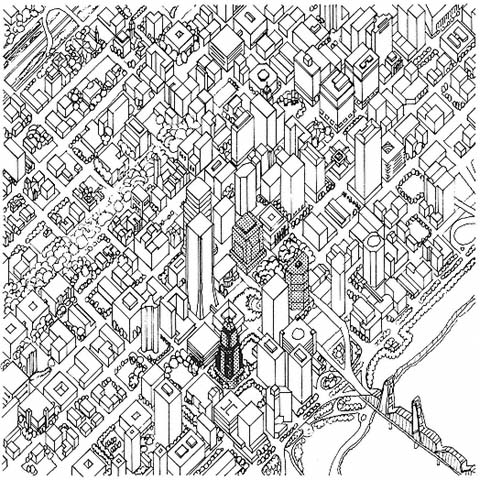
By contrast, in Portland's Pioneer Place development it was not so much the existing architectural character that had to be preserved as the block pattern of two-hundred-foot squares. In recent years the development pattern has been to place a single major building on each small block. The Pioneer Place project follows this pattern established by the Portland Building, the Justice Building, the KOIN Center, and several other recent complexes that have a tower as the centerpiece of each block. To preserve the block system, have a single focal point on each of the three blocks, and still facilitate economical retailing, an innovative layout was needed, one that makes use of the level below grade. Thus
71.
Several recent buildings (shaded) fill their block-sized sites, thus reinforcing the urban pattern and
the sense of the street. From top to bottom in the drawing: Portland Building, Michael Graves,
architect, 1983; Justice Building, Zimmer Gunsul Frasca Partnership, 1983; KOIN Center, Zimmer
Gunsul Frasca Partnership, 1983.
the needs of both urban design and retail planning are satisfied in the development.
Another city, Oakland, California, provides an example of the need to reinforce what is left of its original urban fabric. Oakland developed as a hub at the eastern edge of San Francisco Bay, across from its more famous neighbor. Its fortunes were those of other turn-of-the-century cities responsive to westward expansion, the settlement of California, and commerce with the Far East. Its problems are those of late twentieth-century
cities: competition with suburbs and a concentration of the poor and disadvantaged. Consequently, the city center is rich in the architecture of commerce but has less and less commerce to support it. Landscaped parks and cultural amenities testify to decades of civic pride and commitment, but more often downtown Oakland is known for poverty and decay. Retail activity has declined in Oakland's downtown, the dramatic diagonal intersection of Broadway, Telegraph, and San Pablo avenues. The city's turn-of-the-century character is eroding. Parking lots abound.
Once again, however, Oakland has an opportunity to blossom as the San Francisco Bay area grows. It is a crossroads of transportation and offers an alternative to San Francisco's more intensive and expensive business and residential districts. A reconstituted retail center would offer an alternative to typical suburban shopping complexes.
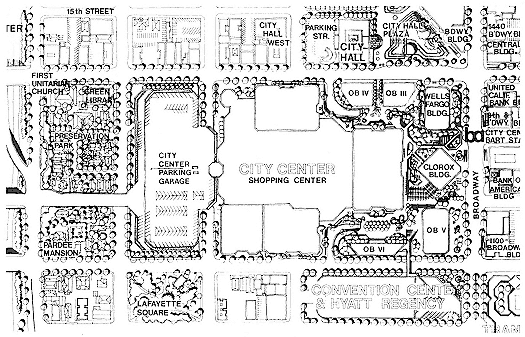
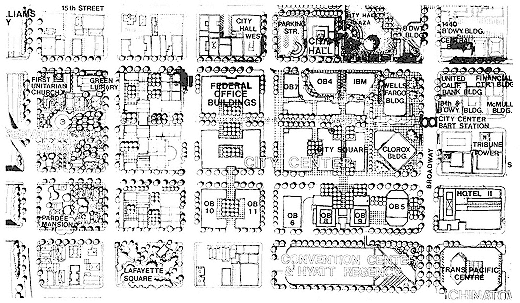
A city center redevelopment scheme was initially conceived as a total clearance to create a superblock that would erase not only the few remaining Victorian buildings but the unique intersection of streets as well. Fortunately, another approach has been chosen, one that seeks a resurgence of the urban character inherent in Oakland's unique plan and history. The overall plan for the City Center project has been redefined as a finer-grained office, retail, and housing complex. The earlier proposal for a suburban-style shopping center is gone, and the idea of the superblock has been partly recanted. Martin Luther King Jr. Way will be drawn into the project, becoming the primary address for many of the buildings. Re-
72.
Original Oakland City Center design ("OB" indicates the location of an office building).
73.
New scheme for Oakland City Center.
placing the proposed large department stores will be offices and a smaller specialty shopping area with an emphasis on restaurants. Thus in the new City Center plan part of the original street grid is reintroduced, the buildings are smaller and more in keeping with the scale of the surroundings, and the overall structure of the city is strengthened rather than rebuilt.
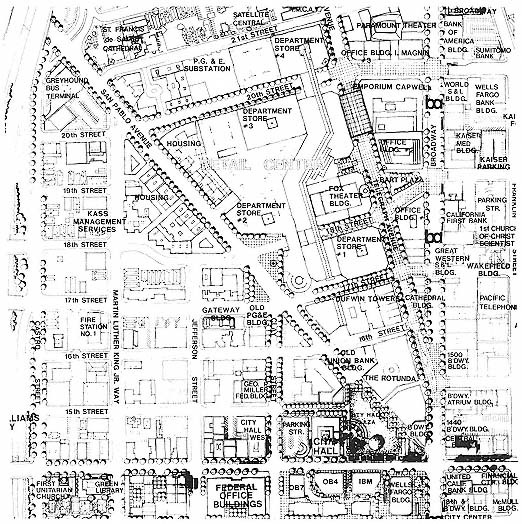
Rethinking the City Center project provided an opportunity to reinforce retail shopping patterns in an adjacent area. Because the single remaining department store in downtown Oakland (Emporium-Capwell) is located six blocks north, some critics suggested that the first plan for the new City Center misplaced the retail component, that it would make more sense to locate new department stores and shops nearer the existing one. In fact, this is what will happen. A recent plan places a new retail and mixed-use complex in the triangle bounded by San Pablo and Telegraph avenues and Twentieth Street. This scheme reinforces Oakland's urban fabric in several ways:
1. It is keyed to the existence of the Fox Theater, an important landmark. The Fox will provide a "front door" and work as part of a new plaza linking Telegraph Avenue, Broadway, and the BART (Bay Area Rapid Transit) station, thus uniting the most important loci of pedestrians downtown.
2. The scheme further re-establishes Telegraph Avenue as a major shopping and pedestrian precinct by both locating new stores there and creating a setting for additional stores there in the future.
3. Emporium-Capwell is tied in by a glazed canopy spanning Telegraph Avenue and by second-level bridges.
74.
Plan for revitalizing retail core of Oakland, ELS / Elbasani and Logan, architects, 1985.
4. Frontage on San Pablo Avenue becomes a focus for affordable new housing, which is badly needed.
Recipes for effective urban chemistry are probably as numerous as cities themselves. Seldom will an approach appropriate to one locale work without adjustments in another. But it is possible to generalize about the approaches available in reconstructing a city. One method is to preserve the fabric, to work within it, as most architects have done in Portland. Another is to reinforce a fabric that has come undone. Milwaukee's commercial core has been tightened by the Grand Avenue. A third is to repair a fabric that has lost its power to order the city. This is the direction Oakland is taking. A fourth is to create a new format for the city,
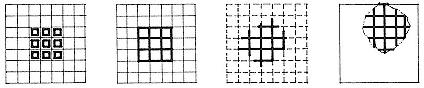
75.
Diagrammatic representation (read left to right) of preserving, reinforcing,
repairing, and creating urban fabric.
to give it a new order. Phoenix is taking this direction, as we shall see below.