
Period II. The Development of Sumitomo Zaibatsu (1868-1945)
The greatest threat to Sumitomo as an ongoing entity came following the Meiji Restoration in 1868. Sumitomo was closely connected to and privileged by the shogun-its Besshi mine operated on land controlled by the shogunate, and received low-priced rice for its mine workers and special trading concessions. These ties were to prove detrimental in collecting debts from former warlords who had fallen out with the shogun. At the same time, commodity prices were dropping dramatically, and the Sumitomo family discussed selling the Besshi mine to finance their debts. They were swayed away from this, however, by the manager of the mine at the time, Hirose Saihai. Hirose argued, with great prescience, that the mine could, with work, continue to be Sumitomo's core operation (its "cash cow," in contemporary vernacular). Hirose introduced Western technology into the mine and turned what had been a dying enterprise into the mainstay of the expanding Sumitomo group, quintupling output in just over two decades. As a reward, he was made director general of Sumitomo headquarters, becoming the first in a Dine of nonfamily, professional managers to run the Sumitomo group.
Apart from a venture in the commodity mortgage loan business and several short-lived attempts to enter textiles and camphor, Sumitomo remained during the first several decades of the Meiji period primarily a copper business, focused on its Besshi mine. It was not until Hirose was succeeded by his nephew, Iba Teigo, and Sumitomo was again on solid financial ground, that Sumitomo took advantage of the opportunities the Meiji period afforded for the entrepreneurially inclined and true diversification took place. Iba started the Sumitomo Bank in 1895, among other smaller enterprises. The third professional director general, Suzuki Masaya, presided over Sumitomo's expansion in coal mining, fertilizer manufacturing, and other enterprises during the early 1900s. A succession of professional managers followed in the interim between the two world wars, and with them came aggressive diversification by Sumitomo into life insurance, trust banking, and various manufacturing industries, notably steel, electrical products, and glass. It was during this period that most Sumitomo companies came into existence, as shown in the Sumitomo "family tree" in Figure 3.7.
The Commercial Law of 1890 established three types of company
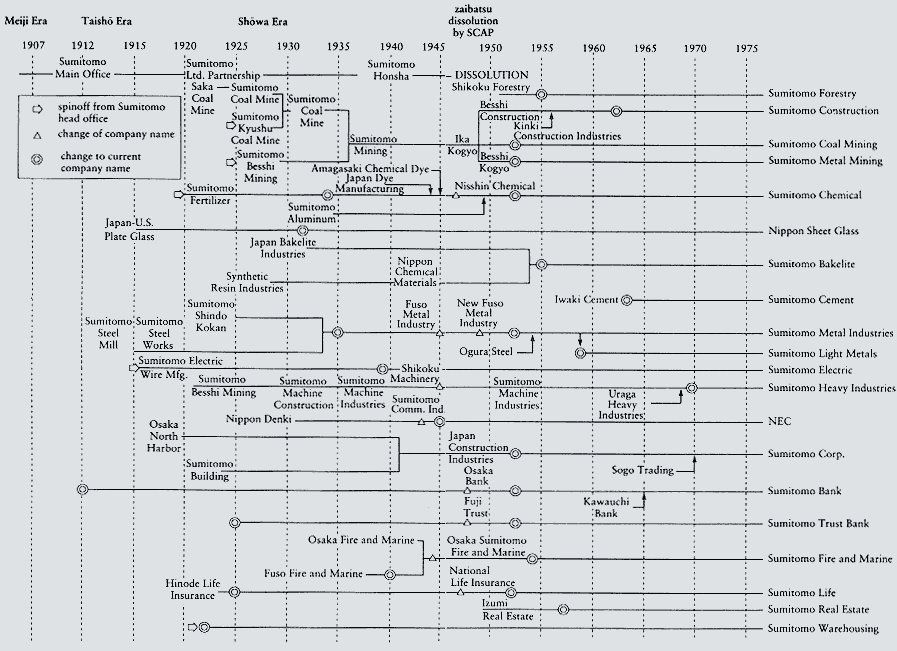
Fig. 3.7. Sumitomo Family Tree. Source: Asano (1978). Note: The chart depicts the
evolution of the core firms in the present-day Sumitomo group. Startups are
counted from their first listing as stock companies.
Image has been moved to previous page
forms in Japan: the general joint stock company, the limited partnership (goshi ), and the unlimited partnership (gomei ). The zaibatsu, as a rule, adopted the joint company form for their operating companies and either the limited partnership or the unlimited partnership form for the holding company. In 1896, the Sumitomo family constitution was changed in order to establish a holding company (Sumitomo Honten) assigned the role of overseeing the operating companies. This headquarters was given the form of a limited partnership in 1921 with a total capital of ¥ 150 million. The titular president of Sumitomo Goshigaisha, as it was now called, was the head of the Sumitomo household, Sumitomo Kichizaemon. Kichizaemon, however, delegated actual management duties to the director general at that time, Suzuki Masaya. The head office required that all companies submit plans for equipment investment and operations to the office annually before the fiscal year began. These were reviewed by the head office and adjusted to take into consideration the entire zaibatsu before being submitted for the approval of the board of directors (rijikai ). Control was strict. The head office expected monthly and ten-day reports from the operating companies. Detailed regulations were incorporated into the Sumitomo Kaho (family constitution and company manual) and later into the Shasoku (a revised version of the Kaho ). The general financial controlling function was performed by the accounting department and the accounts section of the general affairs department of the head office.
The organizational structure of the zaibatsu in the 1920s was comparatively straightforward. The head office collected the surpluses from its operating companies and allocated funds in businesses it thought would be profitable. Where Sumitomo Goshigaisha ran short of funds, it borrowed them from its financial institutions, especially from the Sumitomo Bank. The method of capital allocation within the zaibatsu, therefore, involved loans to and deposits from member companies, directed through the head office.
Perhaps the key issue facing every zaibatsu at the time was how to balance the desire to expand business while maintaining control over the operating companies. Sumitomo only gradually and cautiously transformed its enterprises into joint stock companies. Sumitomo Bank (started in 1895) became a joint stock company in 1911, Sumitomo Metal Industries (1901) in 1915, and Sumitomo Electric (1911) in 1920. However, the shares of most of these companies were not publicly issued, but rather were held by other Sumitomo companies. During the prewar period, only five firms (though among the largest) opened shares
to the public-Sumitomo Bank (in 1917), Sumitomo Trust and Banking (1925), Sumitomo Chemical (1934), Sumitomo Metal Industries (1935), and Sumitomo Electric (1937)-and ownership and capitalization were carefully controlled. Other enterprises such as coal mining and sales, copper drawing, and chemical fertilizer remained under direct management of the headquarters. Sumitomo Kichizaemon himself owned 98.7 percent of Sumitomo Goshigaisha in 1927, as well as major portions of six subsidiaries. Operating control, however, was delegated to professional managers hired by the family, who simultaneously served as the board of directors.
Movements to the joint stock form appear not to have been for the purpose of raising outside capital, for nearly all shares were still held by the Sumitomo family and the head office. The system of finance was still dosed. Rather, it seems they were a means of gaining control over subsidiaries akin to the purposes of the modern-day profit center. Yasuoka (quoted in Asajima, 1984, p. 113) argues that the joint stock company form in the zaibatsu at the time served to "rationalize the holdings and management of the various enterprises" and to "organize a system that can expand to giant size." Similarly, Masaki (1978, p. 33) suggests that "what the zaibatsu tried to stress was not the capital-raising function but the control-concentrating function of incorporation."
A second advantage of public incorporation was in diffusing public opinion, for the 1930s were marked by periodic public outcries against the zaibatsu and their dosed financial system. The increasingly powerful military was dubious about what it perceived as competition for power and pressured the zaibatsu into increasing donations to public works projects. That the zaibatsu were sensitive to public pressure is indicated in the public explanation given by the Mitsubishi zaibatsu for the opening of one of its subsidiaries, Mitsubishi Heavy Industries, to the public in 1934. It stated that it was going public for the purpose of "avoiding monopoly of profit by a few rich families and making the company open to the general public" (quoted in Masaki, 1978, p. 46). Public offerings, then, were one means of diffusing this pressure by opening the group, albeit nominally, to outside capital.
Sumitomo Goshigaisha was incorporated as Sumitomo Honsha in 1937, though its shares were never offered to the public (they remained in the hands of family members). Ironically, given earlier right-wing animosity, the zaibatsu prospered during the next eight years as a result of the military war effort. Sumitomo companies which were benefiting from military demand (Sumitomo Metal Industries, Sumitomo Chemi-
cal, Sumitomo Industries, etc.) increasingly needed to rely on sources of funds other than the head office. These were primarily loans from Sumitomo Bank and other Sumitomo financial institutions and external loans from special financial institutions, in particular the Bank of Japan. Funds from other city banks were rarely used. In this way the external funds that were introduced would not disturb the internal control structure of the zaibatsu. It was a system that depended on and was made successful by deposits from the general public and borrowings from government-controlled sources.
Companies also offered equity shares, but again, not for the purpose of gaining outside capital. These tended to be limited to "friendly" shareholders-primarily other subsidiaries and zaibatsu family members. Life insurance companies were important holders since they were expected to have no desire to control other companies. Employees and their relatives were also offered shares. Masaki (1978, p. 46) reports that Mitsubishi was quite explicit that their shares were not a publicly tradable commodity, issuing shares in 1928 with the following proviso: "Since these stocks are offered for a long-term investment, such action as immediately selling them should be abstained from in the light of moral obligation to the company. If it is necessary, however, to sell them, inform the head office beforehand so that we can buy them back at the selling price."