
Chapter Three
Stories
"No my dear fellow, I can't help you. It's too dangerous. You're risking your skin if you do this, and I won't take on the responsibility with your people. In the French zone I could easily get you out of a bad fix. In the Spanish zone I am powerless, and our neighbors don't trifle with arms smugglers. The firing squad follows hard upon arrest. If you're caught red-handed transporting illicit war material you'll be shot straightaway. You understand why, to my great regret, I won't be able to satisfy your request."
With those cheerless words an old Moroccan friend greets me. However, let's face it, I came to Morocco to connect with arms traffickers . . .
I insist some more. I appeal to our old friendship, to war memories that bind us together, to anything that can crack my companion's unyielding obstinacy. Nothing in his hard face betrays the least susceptibility to my entreaties. So I play my big card.
"I'll try to make do without you."
He pales a bit. His eyelids flutter rapidly. I know I've stung him and now he, in turn, implores me.
"Don't do it. Forget your scheme while there's still time!"
"I tell you again, I have to live with these people. Don't worry, you'll have a letter for my director and another for the consul. In case of a ruckus, if the affair goes badly, you'll know it right away. Then it's up to you to move heaven and earth to get me out of their clutches. Come on. Give a little. I won't rest until you say yes!"
Through the pergola I glimpse the immutable blue sea. A light wind from the east skims softly along its surface. A light mist, raised by the heat, hides the horizon and joins ocean to sky. My listener rises, gaz[es] out. . . . I too leave my seat and draw near.
"Come on, you're not going to let me go back to France empty-handed? What would people say about this wretched chasseur d'aventures ?"
He shakes his head slowly and before my mulish look murmurs rather than speaks:
"All right, I'm going to try to arrange a meeting for you with a man who knows everything about these sordid transactions. He's made his fortune out of them. Now he's a tidy bourgeois, well off and worth several millions. . . . He knows the men and was one of their chiefs. Although he doesn't do business with them any more, he sees them often. He knows all about their shipments. Needless to say you must give him every assurance of your discretion. However I doubt he'll accept. He's suspicious by habit and by profession."[1]
So begins Hubert Bouchet's front-page exposé in the Journal on weapons trafficking to Morocco. Running for a week in the summer of 1931 under the title "En expédition avec les contrebandiers d'armes de guerre au Maroc: Une grande enquête du Journal ," the series spun a dazzling if predictable tale.[2] There was a meeting with the ex-contraband chieftain—"the bourgeois adventurer"—and then, five days later, a Café X rendezvous with Ahmed, Bouchet's cicerone into the world of the smugglers. "You'll be a gunrunner for a week," Bouchet was told. "You'll live with your companions and share their fears, their dangers, and also their desires." And then there was the promised journey with arms smugglers, by sea from Barcelona to Morocco and then inland by caravan over mountains to the lair of Berber tribesmen. At the end of the series Bouchet recounted the machinations of spies and subversives—Shakib Arslan, Adolphe Langenheim (whom he labeled the German spy master in Morocco), and "certain heads of espionage for a foreign power, fishers in troubled waters and fomenters of riots." These, he argued, were responsible for the upsurge in gunrunning to the Rif. France, Bouchet concluded, must either take forceful measures or face the risk of serious consequences in the protectorate.
Stories, it may be said, are projections of their times, but then what is the historian to make of these articles? They are about gunrunners and spies, but they are also personal adventures, and if their conclusion is often alarmist, that word scarcely describes their tone or their style. One reading could emphasize their investigative probing into subversion in Morocco, yet another could just as easily concentrate on the author's delight in telling a story and the formulaic nature of the series with its trumped-up ambiance and recognizable motifs of reconstituted conversations or mysterious guides into the underworld. Bouchet perhaps was writing an exposé, but he was also selling a story to a mass circulating daily. Once the series ran its course, another followed on contemporary China and then another on the contemporary American Far West.
This combination of danger and storytelling pervaded the literature on espionage between the wars. The genre, even when crafted from pure imagination as most frequently it was, bordered on the hard word of security that we are accustomed to regarding as the central concern of these decades. Still, interwar spy stories were never simply about security, or vulnerability, or any of the other qualities we might attribute to an era suspended between one war and another.
War memoirs are a good case in point. Probably no medium contributed to the escalation in spy stories as did the published reminiscences of secret agents from the war. There were accounts by French spies like Joseph Crozier and Marthe Richard or the spy master Ladoux, but the French publisher Payot also brought out translations of the wartime memoirs of foreign secret agents and spy trackers: Max Wild's Adventures in the Secret Service, 1914-1918 , Max Ronge's Espionage , J. C. Silber's Secret Weapons: Memoirs of a German Spy in the War Office from 1914 to 1919 , George Aston's Secret Service: English Espionage and Counterespionage during the War , and H. C. Hoy's 40 O.B., or How the War was Won figured among these. The genre added to the sheer bulk of literature on intrigue between the two world wars, and it created a model for telling tales to be picked up by the spy novelists whose numbers and output multiplied dramatically.
Yet at times the influence ran in the reverse. War memoirs were a complex literature with many voices and hence many meanings. They were, at the basic level, about memories of war and thus about living with the war well after its ending. Fastened to the compulsion to write memoirs and the desire to buy them was that indelible, haunting quality of the war that clung to the French in the twenties and thirties and found its complement in the ubiquitous war monuments or in secret-war literature. War memoirs, however, were also about telling stories, admittedly stories about the war but nevertheless stories whose accent was on atmosphere, drama, suspense, and heroics. They were constructed, forced, designed to be fun, and were above all written for a market that craved tales of this kind. In this we can perceive a host of intentions or revelations, all of which lead us far astray from the war as a traumatic, oppressive event. Spy memoirs conveyed a fascination with the war, a desire to tell its story and then tell it again. There was a hankering in this literature to hold onto the war, to sustain its ambiance and its drama for the years to follow. This suggestion may come as a surprise for a period we regard as intense and crisis-ridden; but the willed ambiance of these memoirs, like that of most interwar spy literature, is inescapable. The mood and atmospherics that seem to us a natu-
ral product of these years were, to a large extent, a fabrication of writers and their public who often saw in the war less a scar than a source of excitement to prolong and mine for the more mundane times ahead. Such mining, or exploiting, in fact, provided not infrequently the prevalent tone. Focusing on the impact of the war, one is liable to miss the case with which it was turned into entertainment once the shooting was over. Memoirs were intended to sell, and they demonstrated an endless capacity of the age to transform great events into mass-consumption commodities.[3]
Memoirs were also a way of writing about personal exploits in a world run riot with bureaucracies and technology. Spy accounts especially suited this mode because they suggested that in a war of vast military machines the individual could still make a difference. They were a literature of adventure as well as of war, and they made the spy an intrepid figure like the long-distance fliers whose heroics peppered the front pages through the twenties and thirties. Moreover, war memoirs took on a certain literary cast illustrating how ways of remembering were shaped by postwar values and fashions. The spy as hero was itself a postwar invention that fit the new model of the hard man or woman of action and abandon. In the tales of Crozier, Richard, and Ladoux could be found the characters and styles of Joseph Kessel, Paul Morand, and Maurice Dekobra.
There were, then, a multiplicity of moods embedded in the spy literature of these years, and the historian of interwar France must be sensitive to all of them. Running through the spy tales of the twenties and thirties are the nastiness and fear we might expect of these decades, but also humor, embellishment, and sheer pleasure in spinning a yarn. If the stories people tell are projections of their times, then these stories steer us beyond yearnings for peace and security or the unhinging of the Third Republic toward calmer, less troubled waters. After 1918 the French lived in the shadow of the war and with the press of events in a highly charged time, but they did so in complex, highly nuanced ways. There were perceptions of danger but also tremendous powers to absorb or deflect what might otherwise have been threatening. Spy literature could be both a symptom and cause of the present-mindedness of the period, reflecting and affecting the imprint of current affairs upon the consciousness of people. Yet the shape that intrusiveness took varied widely according to the style and devices of reporting. It could play upon hatreds and anxieties and ideological commitments but also upon more universal desires to read a good story. Under such circumstances,
familiar words for the period like choice or vulnerability capture only a partial reality. Certainly, to the extent that spy tales measured the age, there was no greater exhibition of alarmism after the war than there had been before and what there was shared the stage with effects of a far different kind.
Thus we encounter a character like Mâh le Sinistre in Charles Robert-Dumas's 1935 spy novel The Lead Idol .[4] He is Mongolian, a Bolshevik secret agent, a brute and fanatic who slices open the bellies of his enemies in seedy hotel rooms. By day he operates as an exporter in Paris. As a spy he steals French military secrets and sells them to the Germans. A master chemist, he concocts a vapor—his "Ecstasy 136"—that acts as an aphrodisiac on women he desires, but he also fabricates a gas that can annihilate every man, woman, and child in Paris in a matter of hours. Only his weakness for French undercover agent Muguette, who blows his brains out, prevents the release of the lethal gas trigger. Obviously Robert-Dumas piled into Mâh the images and stereotypes of the thirties—the conflation of bolshevism with Asiatic barbarity and of gas wars with spies are two that come readily to mind—and I suppose it is possible to write ad nauseam about the historically conditioned creation of this storyline. But there is also something of Mâh that lurks in the deeper recesses of the mind that people will always pay money to read about and that probably explains why this poorly constructed novel sold more than twenty-seven thousand copies in the midst of the depression. So in the end, like milieu, it is the rich coloration of the literature—the jazzed-up journalism, the tales of spy heroes, the Mâh le Sinistres—that commands our attention. It does so not because there were no more menacing images to spy writing, but because the cheap thrills and storytelling instincts predominated and because they resurrect a side to the entre-deux-guerres that we have lost sight of.
Pierre Yrondy's From Cocaine . . . to Gas!!! gives some idea of the darker side of spy literature that was nevertheless extensive in these years and should not be forgotten. It tells the tale of a German plot to destroy the French nation through drugs, deadly bacteria, and ultimately gas bombs flown in by drones. Its cast includes an army of touts, pimps, commercial travelers, financiers, worldly salon women, but also Jewish refugees, all of them Nazi operatives or traffickers in narcotics. Spies, the author tells us, will be the determining force in the next war, delivering their lethal blows from behind the French lines. The novel, of course, is noth-
ing more than a contrived piece of nonsense, excruciatingly bad as an art form. Yet it translates a complex of interwar moods into projections of the secret agent as the purveyor of doom and destruction.[5]
The theme of gas wars and spies, for instance, was common to the period, as was the image of the spy as drug dealer. Marcel Nadaud and André Fage's Postwar Army of Crime, Cocaine, and Espionage associated the one with the other as did Marcel Montarron's account of narcotics trafficking in White Poison , which argued that prodigious narcotics rings could be compared only to espionage agencies. Drug kingpins, Montarron wrote, were neither manufacturers nor gangsters but men "whose vision extends well beyond frontiers . . . they are mysterious masters of the world, people for whom drugs are—who knows?—a means of domination stealthier than a cartridge belt." Drug trafficking appeared in spy novels like Charles Robert-Dumas's Triangle Brand and Pierre Darlix's Last Stop, Smyrna , in which British intelligence runs guns to counterrevolutionaries in Odessa behind the cover of a floating White Russian opium den. In Charles Lucieto's Delivered to the Enemy , published in 1928, a British agent uncovers evidence of massive German rearmament, gets wind of German plans to wage chemical warfare, and learns that the Germans are trafficking in heroin and cocaine to corrupt the elites of their enemies.[6] The equation of spies with drug dealers, in a sense, played on clear connections between drug trafficking and espionage after the war. The volume of each grew substantially in the twenties and thirties. Each employed clandestine organizations that were international in scope and whose methods—for example, codes for communicating intelligence or advising of shipments—seemed indistinguishable. Moreover, the line between them was easy to cross, especially in gunrunning, so that the narcotics trade in general resonated with the close ties that emerged between criminality and interwar espionage; indeed even a drug lord like Louis-Théodore Lyon had reputedly once worked for the Deuxime Bureau.[7] Drugs, like spies, were also silent forces, working behind lines and undermining national strengths from within, and this too explains the compression of the spy and drug trafficker into a single, malevolent presence.
The conspiratorial dimensions to Yrondy's tale were no less representative. The obsession with conspiracy was a convention in France, reaching back to the French revolution and beyond; but it acquired new meanings and greater coherence from the events of war and revolution in the twentieth century. Creating, disclosing, and unraveling conspiracies, particularly through the medium of the spy story, might almost be
viewed as a national pastime of the French in the interwar period. Out of the rich dank soil of these decades, fertilized with real tales of kidnappings, spy rings, GPUs, and Gestapos, sprung all kinds of phantoms. There were stories of Lawrence's occult presence in the Middle East and charges of Abd-el-Krim's and Shakib Arslan's role as agents of London, Berlin, or Moscow. There were visions of an international of criminals hired out for subversion to fascists and communists, the cold dread details exposed by The Brown Network , and the vogue in Fu Manchu novels whose translations in the thirties were publishing successes; printings of thirty-five thousand copies almost always sold out by the end of the decade. Henry Champly's Road to Shanghai: White Slave Traffic in Asia , which touched all bases—conspiracy, sexual depravity, subversion, anti-Semitism, and the Yellow Peril—was no less successful. Its estimated sales topped one hundred thousand.[8] Particularly notable was the Protocols of the Wise Men of Zion , which laid out a Jewish plot to dominate the world and whose relation to spy stories was a curious one. Predating the war but diffused widely thereafter, its fantastic charges were accepted with more credence than we would like to believe once Russia had fallen into the hands of radical revolutionaries, not a few of Jewish origins. Even as respectable a publisher as Grasset brought out an edition that sold twenty thousand copies by 1940. Other variations on the theme appeared in D. Petrovsky's Russia Under the Jews , Lucien Pemjean's Toward Invasion , Céline's Bagatelles for a Massacre , Léon de Poncins's Mysterious Jewish International (published in 1936 as part of his series, The Dictatorship of Hidden Forces ), or in Poncins's Secret History of the Spanish War , which Ilya Ehrenburg found for sale at a French train station in 1938.[9]
What is to be remarked is how closely other conspiracies paralleled these tales of a Jewish International, and very possibly were modeled upon them. Consider, for example, Robert Boucard's Intelligence Service Revealed . According to Boucard, the British intelligence service was the clandestine maker of British foreign policy. Its hand could be found behind the French revolution, the Panama Canal scandal, the murder of Warren G. Harding, the Versailles treaties, and the civil war in Spain. The book, in fact, read as if Boucard were constructing his story from a Jewish conspiracy kit. Everything was there, "occult supergovernment," omnipresent agents, financial stranglehold, source of all troubles, maker of the peace, and a bid for universal domination. On the cover a giant hand gripped the globe. Other editions featured a spider. Comparable parallels turned up elsewhere. Even as earnest a publication as The Brown
Network , the émigré description of the Nazi conspiracy including its international associations, its foreign newspaper and radio stations, its travel bureaus, as well as its terror squads, sounded suspiciously like Protocols-talk of the Jewish Telegraphic Agency, the Jewish Bureau of Correspondence, the B'nai B'rith universal order, ad infinitum.[10] Perhaps all visions of international conspiracies will always turn out roughly the same. If they are to be truly frightening, they must all possess secret armies, bottomless resources, worldwide tentacles, and megalomaniacal designs. Yet there was also a Jewish formula, widely disseminated between the wars, whose similarity to others was likely to have been more than coincidental, and whatever the case the correspondence between Jews and spies—yet another of Yrondy's images—was never an accident in these years. Baudinire, publisher of the Secret War series, also put out anti-Semitic tracts. The French edition of Stéphane Richter's Secret Service carried advertising for The few or the Parasite International .[11] Jews were vilified as spies, as they had been at the time of the Dreyfus affair. The Russian revolution and then a wider debate on the danger of foreigners in a decade of depression and deteriorating international conditions guaranteed a renewed fixation with the image.[12] Indeed the refugee spy or fake refugee agent emerged as all but a stock character in the spy literature of the thirties.[13]
Finally there was the sheer demonic force of the spy threat that Yrondy insisted upon and that recurred throughout interwar spy tales. As before the war German spies remained in the foreground, typically methodical, dishonorable, and a threat to the very lifeblood of the nation. They were the habitual villains in the spy novels and, to be sure, of most of the war memoirs. Journalistic accounts dwelt on German military and political espionage. They tracked Gestapo networks in Europe and German secret agents in Morocco. A familiar nemesis like Langenheim or even Nicolai (who, in reality, appears to have had little to do with German intelligence after the war) remained a haunting, lurking figure in the literature. Meticulous portrayals of the technical proficiency of enemy operations and their extensive support systems built to a certain extent upon real phenomena but then blew up the picture beyond all proportion. Fifth-column images, we have seen, would not come with a fury until the forties, yet their direct source was visions from the twenties and especially from the thirties of the danger and methods of German espionage.
There was also a diabolical dimension to the threat that surfaced in Yrondy's drug traffickers and gas bombers, in Lucieto's complement of
the same, and in Jean Bardanne's portrait of a mad German scientist in War and Bacteria . The Communist menace unleashed comparable visions that can be seen in the nightmarish uses to which the spy as Red agent was put. As to be expected there were elaborate descriptions of Soviet intelligence and subversion networks. But woven into anti-Communist writing between the wars were deeper, darker forebodings that saw in Red Russia the very emanation of anticivilization, a relapse to despotic Asiatic origins welling up from the black holes of centuries past. In this near psychopathological abomination of bolshevism, the authors' fear, hatred, and a reflexive anti-Semitism combined to produce terrifying portraits of Russia as a land of darkness and depravity. There was a gratuitous repetition of stories of GPU terror and bestiality, a quickness to pile up awesome statistics or to detail torture in all its graphic perversity;[14] and this strain too passed to the spy writers.
One need look no further than Charles Lucieto's abysmal spy novels of the late 1920s and early 1930s, whose claims to vast sales, though undoubtedly grossly exaggerated, indicated nonetheless a certain readership. Devoid of suspense, irony, character development, or even logic, these stories relied on ideological imagery alone to drive the plot forward. In The Red Virgin of the Kremlin , British superspy James Nobody (!) operates undercover in the Soviet Union as "the virgin's" chauffeur and is told he is expected to perform "night services" for his mistress. Captured, he is subjected to an array of sadistic Bolshevik torturers. Later we learn that the Communists have massacred millions of Russians because party leaders are mostly Jews. In the sequel, Delivered to the Enemy , German rearmament proceeds with Russian connivance. In The Mystery of Monte Carlo Lucieto presents us with Véra Roudine, a vice-ridden Russian secret police terrorist with erogenous zones most sensitive to the criminal touch: "I have never seen her except in the company of the worst scoundrels the world can produce, and her sadism is such that she had no hesitation to choose as her lover in Moscow that infamous, bloody, ferocious beast Soumkoff, the head executioner of the Cheka."[15]
Nothing in this writing can be called idiosyncratic. Robert-Dumas's Vitriolic Mask , which sold over twenty-five thousand copies in the 1930s, featured the Soviet terrorist Doumkine, whose real name was David Saloman Wunschelburg. In The GPU Spy (published as part of the Secret War series, whose volumes are estimated to have sold fifteen to twenty thousand copies each), Jean Bardanne created the Jewish sadist Marzoff, master of GPU affairs at Kiev and a man who boasted of shooting a half-million victims. Goldman-Meyer of Barcelona (also in the Secret
War series) transported the theme to the Spanish civil war with tales of Jewish-Red terror by the revolutionary FAI (despite this total ignorance of Spanish leftist politics—the FAI was anarchist—the preface assured readers that "the account about to be read is not made up. The facts are authentic: the characters alone have different names for reasons one can guess"). Maurice Laporte's Red Spies: The Underside to Soviet Espionage in France , published in 1929, included a horrific depiction of Béla Kun as the "Red butcher": "His moral ugliness, his blemishes, his lack of the most elementary scruples, his proverbial cruelty . . . his frightfully carnal instincts make him, morally speaking, a monster whose characteristics repeat themselves among many foreign and French Communists." No less excessive was Roman Gul's gallery of early Cheka sadists: Remover, the female Hungarian, executing eighty-four victims with probably just as many orgasms; Braude, stripping bare her victims, the better to frisk them before pulling the trigger; Menzhinskii, the chief, the aesthete, the scribbler of erotic stories, conducting GPU terror from his divan.[16]
Such stories recall how the defining attributes of these years—international insecurity, totalitarian politics, refugee floods, civil war, and political polarization—could militate toward thinking about spies. Through images of the spy as conspirator, infiltrator, and malevolent force (driven home by the resort to the sexually destructive female), it is possible to chart the history of interwar anxieties and to see further evidence of an age scarred by vulnerability and a sense that things were spinning out of control. Certainly the rifts in the postwar fabric of the nation led each side to settle on its own brand of enemies and to slander these with the epithet of spy. The Left clamored for harder measures against White Russian and fascist secret agents. The Right fired up its anticommunism or bore down upon the German Jewish spy. To a certain extent the telling of stories about spies was obsessive because it reflected an ideologically divided people preoccupied with determining who was on one's own side and who was with the enemy's. Nor did what was known of the real world of spies impose great strains upon the imagination.
Still one must wonder what to think of the following vignette by a certain French journalist who was one of the most inveterate purveyors of spy alarms in these years. It occurs in 1932 in Berlin in the bureau of a trafficker of stolen or fabricated documents. The trafficker is a man of nebulous origins known only as P. The journalist comes to the office and says he needs important documentation on German armaments, slyly adding that he knows P. can procure these for him. P.'s eyes disap-
pear beneath his heavy eyelids. He reflects for ten seconds—not a short period of silence—and then replies indignantly that the Monsieur is mistaken. The journalist is not fazed. He says he knows that P. served with German intelligence in Egypt in the First World War and that he sold out the Germans to the English. He adds that in 1917 at Geneva "in the affair of the Russian revolution," P. deceived the French and English, betrayed the Italians for the sake of the Austrians, and betrayed the Germans for the sake of the Italians. He knows, moreover, that E's clients include Colonel Nicolai and the Soviet government, and that the P. of Berlin is none other than the V. of Moscow and the H. of Belgrade. If E will not cooperate then the journalist is prepared to go to any lengths, even blackmail, to get what he wants.
P. turns green, his accent becomes sharper. He tells the journalist that one telephone call to the Reich authorities will take care of his visitor. The journalist parries, announcing that he has enclosed everything he knows about P. in a letter that will be handed over to a certain Major Marcks in an hour if the journalist fails to show for a rendezvous. P. tries to riposte but to little avail. He uses his German, English, and French, all heavily accented, on the reporter, trying to determine the intruder's nationality. Failing at this he then turns over a dossier to the newsman, but the latter waves it away. The journalist says that he knows this file was sold to an Englishman in Cologne for one thousand marks, and later to a Frenchman for one thousand francs, and that copies are circulating at a still lower price in Geneva, Madrid, and Rome. The document, moreover, comes directly from the Reichswehr which has released it for purposes of disinformation.
P. tries to pass another worthless document off on the journalist who dismisses it out of hand. Defeated, P. goes to his cupboard and returns with a yellow envelope that he says he is sending off to Moscow. The journalist can copy it in the office or take it with him against a ten thousand mark guarantee. The journalist drops two thousand-franc bills on the table, adding contemptuously that he does not need to furnish Sieur P. with a guarantee. Then he walks out with the papers, telling P. that he will telephone in an hour with the location for fetching the documents. This ends the vignette, but not the account. The journalist, who is the author of a book on secret papers and false passports, tells his readers that only upon descending to the street could he remember that this was Berlin. At P.'s he had the sense that he was in one of those Mediterranean dives in Athens or Galata or Salonika or Alexandria where one hustles cards, sells women, robs Americans, and traffics in
arms, secret papers, and false documents. "And these spy dens," he insists, "have been set up in every country since the war."[17]
This preposterous tale was the concoction of Jean Bardanne, who also wrote The GPU Spy and War and Bacteria , suggested that one-fifth of all Jewish refugees were Nazi spies, and with Stavisky, German Spy proclaimed the Stavisky affair the work of international criminals in the pay of Berlin and Moscow. He wrote under a pseudonym, a common characteristic of spy novelists but in this case an indication of a history of flights from reality. His personal life was no less unsavory than his writings, consisting of swindles, fraudulent bankruptcies, and persistent efforts to pass himself off as a Deuxième Bureau agent—which almost certainly he was not. Perhaps the vicious, sinister overtones to his insider books and spy novels that he published with the Secret War series in the thirties were no more than projections of his own sense of failure or of the cynical way in which he conducted his private affairs.[18]
The vignette of P., however, crosses over into other realms of spy writing. It bears the telltale imprint of the age less for its alarms than for its storytelling atmospherics and for the protean backdrop of spies against which the story takes place. Its milieu of traffickers, foreigners of undetermined origins, and secret agents from the First World War carrying on as if nothing had changed recalls the emblematic side to spy literature that arose with the war and did not exist before it. In certain ways that side manifested itself through the correlation of the secret agent with the distinctive new politics of fascism and communism. In the literature Hitler became Gestapo agent number one and the GPU ruled over Russia.[19] The Gestapo, the GPU, and the OVRA kept the card files, launched radio wars, employed terrorists, and maintained armies of secret agents among professionals and criminals.
But the spy as a sign of the times was also a far more diffuse figure. If after 1870 the spy in French literature had been most often a German, the interwar limelight revealed a wide cast of characters. There were Germans but also Soviet spies and assorted refugee internationals, White Russian, Croatian, Macedonian, Ukrainian, Italian, and anti-Nazi émigrés whose intrigues were inseparable from interwar espionage and the checkerboard moves of global politics. There were also Spanish, Italian, Hungarian, Polish, Romanian, English, Japanese, Chinese, and, to be sure, French secret agents who occasionally pushed their way onto center stage. And creeping through the interstices or hanging about in the shadows were those inevitable camp followers of the interwar mi-
lieu: private spy rings, rogue agents, gunrunners, and the forgers of papers.
This diffuseness worked into the meaning of the spy. It spoke of menace and danger but also to a sense of living in an age of internationalism and impermanence and to the prolonged presence of the war. Its kaleidoscopic character brought together a multiplicity of spies in a multiplicity of combinations that carried with it moods of uncertainty, though not necessarily those of anxiety. Spies signaled movement and open-endedness, and their very range a world of infinite possibilities. To a degree the diffuseness of the literature, or its many spotlights, softened the blow of living in an era of indeterminacy.
More basic than fear was the gratuitous presence of the spy or of international intrigue to authenticate what the French called the aprèsguerre . Spies lent a feel for living between one age and another or, as P. did, for the carryover of the war. The routine portrait of Comintern agents, Gestapo goons, and refugee conspirators provided a contextualized present for storylines. Thus, as we have noted, spies appeared everywhere after the war as if certain scenarios, settings, or characters could not do without them. They made cameo entrées or functioned as props. Joseph Kessel used them as backdrop or ambiance in his potboilers and the adventurer Perken, in Malraux's Royal Way , "[made] me think of the great officials of the Intelligence Service that England employs and disavows at the same time."[20]
Or Maurice Dekobra, whose wildly successful Madonna of the Sleeping Cars dabbled in international intrigue, returned more explicitly to the theme of secret agents in the sequel, The Gondola of Illusions , but again in the diffusely offhanded manner of these years. Here the beautiful but restless Lady Diana falls in love with Ruzzini, formerly the éminence grise of Italian intelligence during the First World War. There is also Leslie Warren, British intelligence ace who has worked alongside Lawrence, speaks Arabic like a Bedouin, and, as Ruzzini confides to his lover, "is as much at home in the Great Mosque of Mecca as you are in a Park Lane salon." Ruzzini is now running guns to Egyptian nationalists and waging a war of personal revenge against Warren, who had raped his sister. Diana follows Ruzzini to Egypt, unwittingly leads Warren to his hideout, and promises to sleep with Warren (no new adventure for Diana; Warren is one of her past conquests) if he will stay Ruzzini's execution. As Warren begins his advances, he is fatally bitten by a cobra Lady Diana has hidden in her clothes. The novel ends with War-
ren dead, Ruzzini executed, and Lady Diana contemplating entering a convent, a far cry from Yrondy's horror tale. The real point to the book was titillation and a fast buck turned on a previous winner, but it is noteworthy that between the wars the French were inclined to find that the formula worked best when combined with spies and contemporary politics.[21]
Spies, then, were creatures emblematic of their day, but mostly of life at a specific moment in time. They were, like their array of characters, evocatively diffuse and never reducible to mere paranoia. Admittedly there was much in their literature that spoke to vulnerability, insecurity, and xenophobia. And no one who doted on spies ever wrote of French tentacles. In the spy tales the French came out nearly always as flies, only rarely as the spiders spinning the web. Indeed if this had been all there was to the interwar spy, then it would be easy to see in the imagery a reaffirmation of a sad, dreary finale to the republic. There was, however, a good deal more.
Much of what the French read about espionage they read in the memoirs of wartime spies. Typical of those published in France after the war was George Hill's Go Spy The Land , translated into Ma vie d'espion . The title was well chosen. Hill had grown up in Russia, the son of an English merchant whose business interests ranged from Siberia to Turkestan. As a boy Hill learned to speak half a dozen languages fluently, and he experienced firsthand the 1905 revolution in which intrigue was a norm. Once, traveling down the Volga with his father, he met a British secret agent who disguised himself first as a German trader and then as an Afghan. Later, as a businessman in Russia, Hill helped smuggle a young revolutionary out of the country. Adventure, intrigue, and false identities were thus familiar elements in his life before the war made them his vocation.
With the coming of the war Hill was a natural for British intelligence. Recruited into the service, he was sent through a special secret agent course run by Scotland Yard specialists. They taught him how to shadow a suspect and how to tell in turn when he was being followed. He learned how to use codes and write in secret ink and was instructed in "all the ruses useful to spies." He also learned Bulgarian, and once he could speak the language British intelligence infiltrated him among Bulgarian internees suspected of harboring a secret agent. Masquerading as a Bulgarian born in America, Hill ferreted out the man he was
seeking, who revealed that he was on a mission to organize an espionage center in Scandinavia. Hill's next assignment was Salonika, where he ran agents and occasionally personally reconnoitered the Bulgarian front. He learned to fly and took advantage of this skill to land his agents behind enemy lines. Hill moved on to Alexandria, a city that along with Cairo he described as "hotbeds of intrigue and international espionage. I was associated with a man called Theorides who was a spy in the service of the Greek government. He controlled a band of cutthroats who hovered round the bazaars and were used for all sorts of illegal work. It was Theorides who first told me of the marvellous work that was being done by an Englishman who was disguised and lived as an Arab, Colonel Lawrence of Arabia." Later, at Cairo, Hill met Lawrence, whom he described as calm and reserved.
In July 1917 the British sent Hill to Russia. On the way he passed through Stockholm, "a town . . . full of spies watching the train stations, the hotels, the restaurants, and the night clubs." In Russia he had several adventures and then, after Brest-Litovsk, took charge of gathering intelligence on German troops and German agents remaining in Russia. Occasionally he worked with Sidney Reilly, but Reilly's mission was directed against the Bolsheviks, so the two men largely went their separate ways. Hill claimed that at first he helped the Bolsheviks organize an intelligence division to observe German troop movements and a counterespionage operation to combat German spies. Then he established his own secret network of spies, couriers, and saboteurs who derailed German trains and harassed German units in the Ukraine. Hill arranged arms, money, and passports for his men. When the Bolsheviks ordered his arrest he went underground, growing a beard and assuming a false identity. Disguised as a Russian of German descent, he continued his intelligence and sabotage efforts. Finally he left Russia with Bruce Lockhart. Even after the armistice, Hill was again off on an intelligence mission, this time spying in the Black Sea region with Sidney Reilly. Or so he said. As Christopher Andrew has shown, much that Hill wrote was puffery, but the record was impressive nonetheless. As memoirs went, these were full of intrigue and danger, exactly the sort of thing the French were publishing in droves after the war.[22]
There were many reasons for the wealth of spy literature in the interwar years. One was the gaudy reality of the milieu and another was the usefulness of the spy or of secret-war imagery for expressing international conditions and dangers following the war. Adventure and romanticism, which the following chapter will take up, were significant factors
as well in the surge of spy writing. It might also be argued that the rise of the spy novel represented an internationalization of the detective story in a century when international affairs intruded more intensely on the lives and consciousness of individual Europeans. A well developed tradition of police stories existed in France before 1914 and the genre grew in popularity between the wars. Undoubtedly the spy novel built in certain ways upon the roman policier , just as an earlier fascination with master criminals translated into evil, nightmarish visions of enemy spies following the Russian revolution and the rise of the Nazis.[23]
The flood of spy tales also expressed a hunger for war stories once the slaughter had ceased. The war was a horror, but it was no less a story of epic proportions and undoubtedly the greatest adventure of modern times. People who had wondered if they would ever see a life beyond the war now found that they could not live without it. Monuments were a reminder of the carnage the war had left in its wake but they were also a way of holding onto the war, of capturing for the present the great drama of the past. War literature, in more explicit fashion, served much the same purpose. The publishing of war books was an industry, and it really did not matter if the author was French, British, German, or Austrian so long as the book was about the battles or the strategy or the campaigns or the experiences of the First World War. I have found, for instance, a sheet of paper folded into eighths and inserted in a war memoir that lists two hundred and thirty other titles on the war by the same publisher, including advertising for forthcoming editions. Among its listings: Sir George Arthur's Kitchener and the War (1914-1916) ; Baron von Buttlar's Zeppelins in Combat ; Jules Poirier's The Bombardments of Paris (1914-1918) ; General Youri Danilov's Russia in the World War ; Antoine Grillet's Foot Soldier: Memoirs of War, 1914-1919 ; Captain Ganzin's French Cavalry in the World War ; Commandant Delmas's My Men Under Fire ; Lawrence's Revolt in the Desert ; General von Kluck's March on Paris ; Andreas Michelsen's Submarine War, 1914-1918 ; and Filson Young's On Board the Battle Cruisers .[24] This thirst for war books and the recounting of exploits led naturally to the writing of memoirs by secret agents and intelligence officers from the First World War. Again there was no discrimination by nationality so long as the author had a story to tell. Many of the spy memoirs published in France were translations of foreign editions. There were also memoirs written by the French. Among the best were the tales of Joseph Crozier and Marthe Richard.
Joseph Crozier was a First World War spy in every meaning of the
term. His story would be a familiar one in the next world war, but there was no precedent for it before 1914. The war caught him in Brussels, where he says he was looking into business prospects in aviation, although his interest was also that of the sportsman. He was recruited by the Deuxième Bureau and sent to Barcelona to conclude an arms deal. Then Crozier went to Holland where his real work as a secret agent began. Holland in 1915 was a weak link in the blockade that the Allies had established to starve the Central Powers into submission. Officially all foodstuffs and raw materials imported into the Netherlands passed through the blockade with the stipulation that the Dutch would not reexport them to Germany or to a third country from which they could be forwarded to the enemy. The organization charged with carrying out this regulation was the Nederlandsche Overzee Trust (or NOT), a government clearing house to which all imports were consigned. The task was an impossible one and the country crawled with bootleggers, secret agents, and bottom-line businessmen who found ways to smuggle goods across into Germany. Crozier's mission was to uncover the business houses that were violating the blockade and to forward any other useful intelligence that might come his way.
Arriving in Rotterdam in 1915, Crozier established himself in two locations under two separate identities. On the Mathenesserlaan he set himself up as Pierre Desgranges, an official representative on an obscure French military mission. On the Nieuwe Binnenweg he went under his own name and posed as an importer and exporter of oils and fats, joining the ranks of other unscrupulous businessmen who were prepared to do business with the Germans. To maintain his cover the Allies placed him on their blacklist while liberally keeping open his channels of supply. Crozier became known as a man who could deliver the goods and who was prepared to do so for anyone capable of paying the price. He opened a branch office in Düsseldorf and made a number of business trips into Germany. Through these excursions and through his business contacts in Rotterdam he was able to gather considerable intelligence on how the Germans and their agents were running the blockade. Crozier also operated a furniture business in Heerlen, a soap factory at Schiedam on the outskirts of Rotterdam, and an opium den in Amsterdam. The latter attracted an elegant clientele and served as an additional listening post. Crozier kept his role in the den purposely obscure, and he left the management to a Belgian who was prepared to work against the Germans and who was married to a Creole from the Dutch East Indies.
The personnel in the two houses on the Mathenesserlaan and the Nieuwe Binnenweg were kept distinctly apart. Joseph Crozier the merchant surrounded himself with Belgian business employees. At his military mission Pierre Desgranges collected a diverse group of associates to assist in his intelligence work. These included an old friend, Dr. De Blauw; a Belgian military captain; a fervently Catholic and Francophile farmer from Limburg; a Belgian officer whose family, we are told, had been the victims of terrible German atrocities; and a fanatical monk who, Crozier says, would have done the Spanish Inquisition proud. The French agent also maintained a stable of informants and passers, again rigorously divided between the two cover operations. The informants worked for Desgranges and were drawn from the ranks of crooks, common spies, and deserters who hung about Rotterdam. The passers were mostly smugglers and poachers who operated perpetually outside the law and for whom wartime meant simply outmaneuvering Germans instead of gamekeepers and douanes . Recruited by Crozier the merchant, they saw in their patron a kindred spirit, a renegade businessman and ringleader who was prepared to take his profits wherever he found them. To help couriers across the border with Belgium the one day and to smuggle contraband into Germany the next posed neither moral nor intellectual dilemmas to these men as long as the money kept flowing, which it did. Under these conditions, Crozier established a successful intelligence network, including one that was able to bring information and men across from Belgium into Holland.
Crozier was playing a dangerous game and he knew it. One false step in Rotterdam and his cover was blown; one mistake in Düsseldorf and a worse fate awaited him. Perhaps his saving grace was that he was prepared to be as ruthless and as dirty as spying in wartime required. Murder pervaded Crozier's account. In his preface he noted that at one point in the war British intelligence warned him to steer clear of the Swiss border so as not to interfere with certain British arrangements. Crozier stated laconically: "I obeyed." Other agents who did not, he added, had long since disappeared. Deeper into his account he described the attempt of a German agent to infiltrate his organization. Crozier and his men chloroformed the German and dumped him into the Meuse. He described his friend, Dr. De Blauw, as a man fascinated with clandestine methods of killing. Once De Blauw waxed lyrical about the qualifies of the Indian poison curare. Inject a person with the drag, he noted, and the victim would begin to die within two minutes. First the voice would go, then the limbs would be paralyzed, and then the face. It would be a
horrible death, because the victim's mind would remain intact throughout, registering the gradual destruction of the body. But the drug would be as silent as the victim, leaving no trace of the cause of death. Moreover, one could produce the poison artificially out of products available in Rotterdam. Working himself up, the doctor progressed to deadly microbes and the possibility of wiping out millions before anyone suspected a thing. In fact, De Blauw insisted, if the Desgranges gang wanted, it could annihilate all of the Dutch in a matter of weeks. "That is so," Crozier replied to quiet him down, "but in my opinion that would be a shame. It takes all kinds to make a world. There are already too few neutrals and pirates are on the verge of disappearing. The planet, I think, would be a rather boring place if we had only heroes. And then, if Holland perished we'd have to resuscitate her: life is so pleasant here this evening in this peaceful country where everyone feels a little like a king."
The remark brought the discussion to a dose, but not the killing. When Crozier's secretary became addicted to opium and betrayed several members of the organization, Crozier had her eliminated. None, not even innocent bystanders, were safe from this crew should they venture into the wrong place at the wrong time. A raid on a German courier way station to America made this chillingly dear. Deployed as lookouts on the Boompjes quai while two men slipped inside the spy house to rifle through papers, Crozier and his gang began to converge upon a lone man walking their way. Then the man veered off, breaking the tension of the false alert. But Crozier left no doubt that if the stranger had made one false move, even by accident, he would have been chloroformed, dumped in the car, and deposited somewhere in the Meuse.
In the second half of the memoirs Crozier shifted his tales of the remorseless world of wartime intrigue to the high seas, recounting his adventures as a wartime privateer. He purchased a Norwegian freighter, the Hélios , once shipping became tight in the wake of German submarine warfare, to assure that his contraband supplies could get through. The idea to convert the ship into an armed pirate vessel raiding German supply ships came from his captain, a Dutchman named Scheffer, an old merchant marine officer who was audacious, tough as nails, and interested only in gold. Redesigned as a deadly surface raider, the Hélios provided Crozier and his men more occasions to stalk danger and dispatch anyone who got in their way. A ship broker named Hagelen operating out of Rotterdam and smuggling contraband to the Germans caught on to Crozier but was soon to regret it. Joining Hagelen was a German
deserter named Lang, who had worked in the past as an informant for Desgranges. The two went to the Norwegian port of Stavanger, where the Hélios was charging a cargo. Their plan was to win Scheffer over to their side and then to seize the boat and turn it over to the Germans. Scheffer pretended to go along and invited the two conspirators to dinner aboard the Hélios . As they dined, the freighter slipped out to sea. Later that night two sacks containing Hagelen and Lang slid down a plank into the ocean.
Crozier apparently never had any hesitation about doing away with his enemies the moment they posed an immediate threat to him. Murder seemed almost his automatic defense. Julius Becker was another victim. He was a secret messenger carrying special papers to German representatives in New York. The German consul general in Rotterdam asked Crozier (the importer-exporter) to transport Becker on the Hétios , con-tiding Becker's mission and offering to pay Crozier twenty thousand florins for his trouble. The proposition placed Crozier in a ticklish position. En route to America the Hélios was to intercept several small ships carrying contraband for Germany, and Becker's presence would create a complication. And yet to refuse would compromise the trust and reputation Crozier had built up among the Germans; so he agreed. Once out to sea, however, Crozier's agents on board the Hélios killed Becker. Afterward, an agent went through Becker's papers, read the secret messages, and then impersonated Becker when the ship arrived in New York, delivering the papers as if nothing had happened.
Crozier's maverick style was bound to run afoul of the French authorities. By November 1916, he tells us, he was in such hot water for operating out of channels that he was recalled from Holland, and in February he was assigned to an infantry unit stationed at Besanon. Nine months later, however, resurrected by Clemenceau, Crozier, in the persona of Desgranges, was back in the Netherlands gathering economic intelligence on the Germans. As the war wound down, Crozier's assignment was to keep watch over German and Russian revolutionary circles. March 1919 brought an end to his mission and also to his memoirs, which revealed a sophistication of method and also of milieu that one had not seen before the First World War.[25]
The motifs of Crozier's narrative—the undercover agent, the ruthlessness of the contemporary spy war, the rich milieu of wartime espionage—all turned up in the memoirs of Marthe Richard, perhaps France's most celebrated spy in the First World War. Born Marthe Betenfeld in Lorraine in 1889, the daughter of a worker, Richard spent
her early life in a series of revolts against family and the drudgery of sewing-shop work. She tried to run away to Paris, was caught and placed in a religious home, escaped and ran away again, and made it to the capital, where she met Henri Richer, a well-to-do businessman. After a fling with an Italian lover, she settled in with Richer at his Mans estate. There she took up flying, performed at air shows, and survived a crash landing. She and Richer married as he went off to war. He was to die at the front in 1915. She served in French intelligence as a spy, after being rebuffed in her attempts to enlist as an aviator. After the war she married Thomas Crompton, an English businessman, but he died in 1928 of uremia. Between the wars she returned to her earlier love of flying and performed in promotions sponsored by the Ministry of Air in a Potez-43 provided by the government. During the Second World War she joined the resistance (or so she claimed), and afterward she emerged as a cause célèbre because of her campaign to shut down the brothels of France.[26] But long before this grand controversy she had grown accustomed to the spotlight.
Georges Ladoux, the head of French counterespionage in the First World War, made her famous with a book published in 1932 about her adventures as a secret agent in Spain.[27] Three years later, Richard produced her own (and often different) version under the title My Life as a Spy: In the Service of France , a tale no less gripping than Crozier's. Invited by Ladoux to join the secret service (the story is now Richard's as she tells it in her memoirs), she demurred until her husband's death at the front.[28] Ladoux sent her first to Sweden on a botched mission and then to Spain where she infiltrated German intelligence and lived her greatest adventures. She posed as a Frenchwoman in search of a fortune and prepared to trade on what she knew or could ferret out about French aviation. Using her own name and her past as a flyer, she appeared a credible source. Von Krohn himself recruited her, giving her a special pen and invisible ink and providing her with the code name S-32. He also told her, in the same tough-guy style that turns up in Crozier, that if she betrayed him her life wouldn't be worth a plug nickel (or three thousand pesetas, as he put it), no matter if she fled to Paris or New York. Eventually she became von Krohn's lover, living the life of a double agent with all the dangers and suspicions that came with that territory. The von Krohns invited her to dinner where they spoke in German to test her avowal that she knew nothing of the language, centering their conversation on the theme that all Frenchwomen were whores and dropping allusions to poisoned dishes for their guest. Rich-
ard never batted an eye, a performance that will surprise no one who has ever read anything about her. However she subsequently asked Ladoux to have one of his Madrid agents follow her to give the impression that the French regarded her as a questionable character.
She did not escape suspicion altogether. Either yon Kalle or Ratibor, the German ambassador to Spain, tried to have her killed in a boating incident, but she jumped overboard in time and escaped with only a bullet through the shoulder. Von Krohn, however, she played for a fool. Through her intimacy with the man she learned the details of enemy intrigues in Morocco and the location of a secret passageway through the Pyrenees that the Germans were using to infiltrate spies and sabotage materials into France. When von Krohn sent her to Argentina with a packet of weevils destined for Allied food supplies, she contacted a French agent on board ship and destroyed the weevils in ways that would not blow her cover. Her ultimate goal was to drug von Krohn and then steal the contents of his safe. She requested help from French intelligence—narcotics in particular—but they stalled on that matter and demurred again when she requested a visa so she could return once and for all to France. Exasperated and sensing herself abandoned, she finally took matters into her own hands. Inviting yon Krohn to a tea salon—a very public place where he could take no immediate action—she told him to his face that she was a French secret agent. Then she went to Ratibor and told him she was von Krohn's lover and that he had given her money out of his secret service funds. To plunge the knife in as deeply as she could, she revealed that von Krohn had confided to her the combination to his safe. Then handing Ratibor a packet of love letters from von Krohn, she walked out of the embassy and returned to Paris. So ended her wartime adventures as a spy. The book had a modern, gritty feel to it with its aura of toughness and of bureaucratic betrayal and it closed on a note of disillusionment that added to the image of the singular, honorable spy forced to maneuver on her own in an inhospitable world.[29]
These were not, however, memoirs to take completely seriously, any more than Crozier's tales or the accounts of Ladoux who was initially responsible for Richard's celebrity and who wrote two additional memoirs of his own, Spy Chasers: How I Arrested Mata Hari and Recollections (Counterespionage) , which was published posthumously.[30] None of these books could be read as God's truth without a serious dose of credulity. All were written by practiced dissemblers and characters of dubious repute. Crozier was a rogue operator who was already engaging in run-
ning battles with officialdom by the end of 1915. He was accused of forwarding imprecise or questionable information and of seeking to avoid any level of control. He shot back that the French representatives in Holland were jeopardizing his cover, and that his intelligence was better than theirs.[31] Most likely Crozier was closer to the truth than were those who attacked him and resented his unorthodox methods and very possibly his superior sources. Whether his removal in November 1916 was a matter of jealousy and bureaucratic revenge remains, however, an uncertain proposition. By the thirties when he wrote up his memoirs he appears to have been dealing in arms, and one is tempted to wonder whether his connections with traffickers preceded his wartime service as a spy. Such activity would explain his initial mission to Spain and perhaps even his success as a smuggler in the war. Ladoux was a man who not only operated in the shadows but cast shadows upon his own incorruptibility. Before 1914 he had been a career officer but also a financier with attachments to questionable speculators. During the war he badly compromised himself in the suspicious affairs that surrounded the sale of one of the great Paris dailies, the Journal , to men with German financial backing, among these Paul Bolo Pasha, who was later arrested and executed for trafficking with the enemy. In March 1918 Ladoux was indicted for commerce with the enemy and the fob lowing January he entered the Santé prison. Sûreté reports from the time of his indictment do not reveal much confidence in the man. Eventually he was acquitted of all charges, but one of his former associates was found guilty and executed, and the judgment on Ladoux was not without its dissenters.[32] As for Marthe Richard, the facts of her life are buried beneath layers of legend and calumny.[33] Credibility was not a strong suit of these memoirists, whose own lives were a mélange of fact and fable. Joseph Davrichevii, a Russian émigré who was Richard's friend, fellow agent in Spain, and probably her lover, most likely came closest to the mark when he wrote in his own memoirs that to know the whole story of Marthe Richard in the First World War one would have to seat Ladoux, Ignatiev, von Krohn, and the head of British intelligence at the same table and force them to "speak frankly; and even then one wouldn't learn everything. They would lie, all four of them."[34]
Truth, however, was not what these memoirs were about. Nor did they have much or perhaps even anything to do with the war as a traumatic experience. Bearing witness to the war, unburdening oneself of the war, laying claims to the war ("our war"; the poilu 's war), and condemning the war were all part of memoir literature,[35] but only a part.
The more familiar memoirs of this sort shared the war market with that other vast literature that sought to return to the great adventures of the war—On Board the Cruiser 'Gaulois'; Memoirs of Marshal Galliéni; The Marne Campaign in 1914 ; or My Adventures in the Secret Service, 1914-1918 —some memoirs and some not, but all responding to the needs not only of the authors who wrote them but of the editors who published them and the public who bought them. Invited by victory and skirting the great horrors in the West—it is interesting how many of these books were about war on the edges: in the air, at sea, in campaigns to the East—these tales from the war pitched their appeal toward more universal desires. Memoirists like Crozier and Richard, whose war had also been on the periphery and yet about winning, wrote for this market and were part of this literature and consequently of the postwar culture that produced it. They used that literature to justify themselves and to line their own pockets. They did so, moreover, in ways that accorded with the demand for certain types of stories. The result was a new kind of spy and spy literature that has remained with us ever since.
One facet of that change was the shift from the image of the spy as a figure of menace and betrayal to a figure of heroic proportions.[36] The shift was largely a constructed one sprung from the confluence of ego and capitalism. From the pens of Crozier, Ladoux, and Richard came legend and myth, a manufactured mystique that others would also exploit. Richard was clearly the first among equals. Ladoux launched her on the course of fame, and her memoirs that followed were largely designed to cash in on the celebrity and to amend the record as she saw fit. Davrichevii's memoirs added a third version, implicitly acknowledging with his discussion of Marthe that she was a person of public import. By the mid-1930s, Richard figured in three stories of her life or of espionage in Spain that attributed to her a major role in defeating the Germans. She had stolen the secrets of von Krohn, sent German submarines to the bottom of the sea, thwarted sabotage attempts in France and Latin America, and made the world safe for democracy. She was a heroine who had incurred incredible risks and looked danger and death squarely in the face—all in the service of her country. It was a wonderful story that Richard (or Ladoux) sold to the mass Paris weekly, Paris-Soir , and to the moviemakers who produced yet another version of her life, starring Edwige Feuillre and Erich von Stroheim. Spy writers like the journalist Paul Allard and Robert Boucard wrote about Richard.[37] To keep the bandwagon rolling, Richard concocted two new accounts of
her life as a woman of adventure in the 1930s, Spies in War and Peace (1920-1938) and My Latest Secret Missions: Spain 1936-1938 .[38]
Neither Ladoux nor Crozier could keep up with this pace, but as best he could each touted his own role in winning the war. Counting his book on Richard, who was simply the most celebrated agent he had run, Ladoux produced three sets of memoirs or recollections of his accomplishments as the head of French counterespionage. Crozier wrote three different versions of his own exploits as an undercover agent in the Netherlands, on the high seas, or among German revolutionaries, rivaling the best that Richard had to offer.[39] He too found his way into the mass press—in his case the Matin —and he too turned up in Allard as the cold-blooded man of action he had set as his self-image in his memoirs. They had met, Allard said, on the Ile St-Louis, where Crozier had asked, "Do you know how to assassinate? . . . I can give you lessons. I have thirty-eight murders on my conscience." Crozier had then, as Allard recounted, pulled out of his pocket a small metallic tube not unlike a woman's lipstick and released a spring, forcing the sudden emergence of ten deadly needles. "That," he told Allard, "is clean, it's sure, it's humane! Watch how it works. One press of the thumb! The needle shoots out and the poison—a good deal more potent and cunning than curare because it leaves no trace in the blood—penetrates the flesh. Death comes with terrifying quickness. Nothing remains to be done except to throw the body into the water."[40] These were the kinds of stories one could tell about spies or spies could tell about themselves after the war. Their extraordinary adventures, merged with a larger public desire to read about the thrills of the war, vaulted the secret agent to intrepid, heroic status. The status transferred, moreover, to the perhaps only slightly more fictional characters who emerged as the heroes of a new kind of spy writing, Lucieto's James Nobody, for example, or Robert-Dumas's Commandant Benoît of the Deuxième Bureau. The telling of their adventures in a series of books was not much different, either, from the sequels that real spooks like Richard, Ladoux, and Crozier retailed about themselves.
Facilitating the construction of legends was the need to relocate heroism following the war. There was nothing exceptionally heroic about espionage in that conflagration. Infantry charges in the face of machine guns or the retrieval of the wounded demanded as much or more courage and personal sacrifice. They were in fact routine in the war, although that was the problem. In an age of mass organizations and death tolls
in the millions, heroics needed more than the reflexive daring of soldiers up and down the line to seize and hold the imagination. Valor required a personal, extraordinary element lost in a war of great grinding military machines. Secret agents offered a return to the personal adventure and thus to the individual as the focus of heroism. Cast alone in a pitiless, dangerous word, spies were thrown back on their own resources of daring and cunning. Only to the extent that they summoned up these qualities could they hope to survive and carry out their mission.
Even more, in a war of stalemate and wasted endeavors, spies created the illusion that an individual could still make a difference. Bureaucratic agencies designed to intercept, decrypt, and analyze telecommunications increasingly encroached on intelligence work, but the literary focus remained on the indispensability of the individual spy. A Crozier in the Netherlands or a Richard in Spain might just tip the balance in the favor of France. Failure of these missions meant the Germans might win. If not, then why bother to send them at all, a question the memoirists were careful not to ask. Heroism without consequence was the reality of the war, but this was not the heroism of public acclamation. Thus the combination of isolation, personal bravery, and exploits with the possibility of singlehandedly turning the tide gave secret agents an edge in asserting a claim to legendary stature. It was the same formula that worked for Lawrence of Arabia or the German Wassmuss whose adventures had truly been extraordinary, even if by and large meaningless. Pilots shared in the same glory often for the same reasons. The principal contribution of aviators in the First Word War was reconnaissance for the troops on the ground. At best they were adjuncts to the greater baffles on land and sea, and it was only toward the end of the war when they flew in large formations that fighters played more than a negligible role. The air ace was completely peripheral to the outcome of the war yet not in the public's perception. The ace who seemed to return warfare to chivalric encounters garnered the adulation of the masses below.
One cannot but remark upon the correspondence between pilots and spies. Between the two word wars flyers were without doubt the greatest of heroes. Their long-distance flights, often designed to set records, wiped other stories off the front pages. Many of their exploits were unassailably legendary. They flew in all conditions and, in the 1920s, in single-engine planes with open cockpits, no radios, and no weather reports. For those pilots who flew on the Latécoère line over the western Sahara, accidents were frequent and forced landings risked death by de-
hydration or capture and enslavement by Moors under the most savage conditions.[41] Yet like the reputation of spies, the heroism of pilots was constructed, first by the pilots themselves and then by their publicists who hitched a ride on their fame. The pilots created an ethos of their own, founded on camaraderie, discipline, and duty but also by asserting that flying was purer, nobler, more gallant than practically anything else that humans could accomplish, all the time enslaving themselves to absurd rituals in the service of the business enterprises they worked for, such as the insistence that the mail must go through without a moments delay no matter what the cost in human lives or machinery. Their honor codes were designed to affirm through a minimum of words the exalted, superior nature of flying.[42] Because most people on the ground shared in the mundane definition of their own lives that fliers assigned to them, they accorded to pilots the status these appropriated. The blaring headlines themselves were a tribute to the rule.
Genuine heroes like Jean Mermoz were destined for idolatry. Mermoz flew on the "line" (the Latécoère route), enduring crash landings and capture and ransom. Later he pioneered mail routes across the Andes. He demonstrated that pilots could fly under the most adverse circumstances, including night flights without instruments or lights from below. Bold, muscular, supremely confident in his command of an aircraft, and absolutely fearless, he never turned away from a challenge. He believed in the sacredness of flying, but he also loved climbing behind the controls of a plane because it allowed him to test the extreme limits of his human powers of skill and endurance. Once, seeking a passage through the Andes where the mountains soared in a solid block nearly three miles high and unable to find an opening for his Laté-25 (whose maximum altitude was a thousand feet less), he looked for an air current that could lift him over the barrier, a perilous maneuver even above far less rugged terrain. He found one, but it carried so forcefully into a down current that he was forced to crash-land on the side of the mountain. Marooned several miles high on a remote tip of the world, he and his mechanic, Collenot, were doomed to a freezing death and snowy entombment. But Mermoz refused to give up. They set off on foot, with three condors circling overhead. After an hour, however, and only five hundred meters' progress, Mermoz realized that they would never make it out alive at this pace. "Collenot," he told his mechanic, "We're going to have to repair the taxi."
Returning to the plane, both men worked through the night, and then another day and night, until Collenot had repaired the plane
sufficiently to fly. Then they pushed the aircraft up the side of the incline to gain what starting power they could. Once down the cliff Mermoz was forced to bounce the plane off the edges of ravines to get clear of the mountain. The slightest misjudgment would have meant total failure, but Mermoz carried it off with such improbable success that at first no one would believe his story. (To the trained pilot today it still sounds apocryphal, although Mermoz's biographer insisted the story was true and verified by an expedition sent into the Andes.) When Mermoz disappeared over the southern Atlantic in 1936, he was probably France's greatest flyer. So great was his fame that when a false report of his rescue was released, theater shows stopped to announce the news, strangers embraced in the streets, and people sang in the métro.[43] After his death his friend Joseph Kessel, who had flown in the war and written several hymns to flying, recorded Mermoz's life story in a book that fell nothing short of hagiography. A serialized version ran for several weeks in France's largest daily, Paris-Soir . The bound volume sold over seventy-five thousand copies.[44]
Like secret agents, although surpassing them, long-distance flyers offered the interwar imagination something it was seeking in the realm of human action. They demonstrated that feats of daring and adventure and service were still possible in a century that belonged to the masses. There was in flying an inherent fascination with energy and speed or simply with soaring to great heights, but the element of forcing an opening or a space for heroic assertion cannot be discounted. Spies like Marthe Richard could attain similar celebrity because they tapped into the same sentiments of heroism in the life stories they created about themselves. Moreover, neither the pilot nor the spy was a paladin in opposition to the age. Each represented a reformulation of the hero fit for a culture of organization and machinery. Modern spies armed themselves with an arsenal of radio transmitters, miniature cameras, and other high-tech devices for stealing secrets or blowing up factories. They operated often in lonely, perilous isolation—and therein was their appeal—yet behind them lay a network or support system of laboratories, analysts, master spies, safe houses, and couriers. Pilots were people who mastered their machines, used them to affirm their prowess and to exercise control over their self-created destiny. With the technology of aviation they challenged nature to her limits, gambled all, and often came back the winner. At times the machine was the enemy, fragile, ill-equipped, lacking the staying power of its pilot. But there was also a fascination and pride in the machinery, and a constant effort to work it
to perfection.[45] Launched into a hostile world on their own, aviators too were tethered to a systematic lifeline just as they coupled their heroics to an ethic of teamwork and interdependence. Even in the pioneering days of the line, pilots flew in teams, touched down at prearranged bases, depended on fast-working ground crews to speed them on their way, and accepted without question the hierarchy of the Latécoère organization. Later, radio signals and bigger planes made flying a coordinated effort. A typical transatlantic flight in the mid-1930s required two pilots, a navigator, a radio operator, and a mechanic. Here is takeoff as Mermoz described it:
Everyone is already at his post.
The pilots light up the instrument panel and regulate its intensity. The controls are tested, the engine levers are set in their position for takeoff. . . .
The mechanic is at his post, alone. . . .
The navigator has already readied his maps, checked his compasses and drift indicators, taken out his books, placed his sextant within reach and gazed at his slide rule.
The wireless operator has warmed up his radio, turned it off, turned it back on, adjusted the dials on their circuit with the touch of a watchmaker. Everything is ready. . . .
The machine, weighted down, little by little gains speed in the deafening noise of the full throttled engines, then . . . the seaplane slides along the surface.
After some fifty seconds under the stress of the controls, it tears loose from the water.
The adventure has begun.[46]
Once aloft radio contact with the ground was constant and regular. Within the aircraft speed, position, and fuel consumption were logged for company files. The thrill of flying joined with routinization, because the ultimate aim of aviators and secret agents alike was security and control. Pilots flew to dare the elements but also to demonstrate the regularity of air communication. Even over the Sahara and the Andes this prosaic resolution was the goal. Danger, however, remained the basic element, as it did for spies. For all his expertise and support systems, Mermoz still ended up at the bottom of the ocean. That was why the man, along with his comrades, was so capable of capturing the nation's imagination.
There were other similarities between secret agents and flyers. One flew above ground, one went "underground," but each broke free of the terrestrial humdrum. The drab uniforms of modern warfare had made heroics less dashing. Pilots, in turn, adopted a uniform style all their
own, rugged and glamorous, while spies, in imagery if not in fact, dressed in trench coats or the clothing of the enemy, itself unexceptional yet a constant source of peril. Most noticeably the two came together in the same person. The mercenary pilot of fortune tacking toward intrigue was a common enough figure between the wars.[47] H. D. the flyer turned into H. D. the spy. George Hill took up flying on the Balkan front and used planes for secret agent drops behind lines. Both Richard and Davrichevii were pilots before they entered French intelligence. Each was caught up in the mystique of flying. Davrichevii chanted the standard refrain about the aviator's state of grace. Richard spoke to Ladoux about "the baptism of the air" and then, mixing her metaphors, said that one's first flight was like a first love—you never forgot the novelty of the sensation. Crozier had connections to aviation before the war. Sensing the appropriateness of the image, he wrote that intelligence operatives should possess the same qualities as aviators, the same reflexes and economy of movement and the same "impenetrable mask." They must "know and never forget that at their post they risk neither wounds nor captivity but only death. A pilot's crash leaves little hope of another outcome; the spy's no other epilogue than the firing squad."[48] Self-lionizing spies were right to join forces with the flyers, but the effort was not all that necessary. Each provided the culture with sensations and exploits befitting the age. The same impulse that made a Mermoz a darling of the crowds cast the limelight upon a Richard; and from it emerged the spy novel and the secret agent as a hero.
But what heroes these spies! A man who dumped bodies into the Meuse and bragged about thirty-eight murders to his credit. A woman whose exploits began with the surrender of her body to a Prussian. It is difficult to imagine such people as the stuff of heroism or honor before 1914. After the war that was not the case. One thinks, for example, of the fabulously popular Madonna of the Sleeping Cars , a breezy pulp novel from the twenties starring Lady Diana Wyndham. She is beautiful, carefree, open to adventure. A French humorist has dubbed her the Madonna of the sleeping cars for the thousands of miles she has traveled on continental railroads. "A consummate bit of irony," she admits, "because although I may look like one, I have none of the other attributes. As a matter of fact, I have been in every European watering-place; I've lost more billet-doux than you could shake a stick at, between the pages of timetables and illustrated magazines."[49] She dances nude at a charity fund-raiser to flout convention and shock society. When she fears her fortune is lost, she goes "slumming" to temper herself for harder times
ahead. Plans to recoup her investments by exploiting an oil concession in Russia lead her to Varichkine, a Bolshevik agent with the power to help her. He offers his services in exchange for one night with the celebrated Madonna, yet she proposes marriage, not out of desire for respectability but because she cannot forgo the supreme opportunity to scandalize her peers by marrying a Red. When the novel is over and all castles in the air have come crashing to the ground, she is off again on the Orient Express:
I have a ticket for Constantinople. But I may stop off at Vienna or Budapest. That depends absolutely on chance or on the colour of the eyes of my neighbour in the compartment. I have reserved rooms at the Imperial, on the Ring, and at the Hungaria, on the quay at Budapest: but I am just as likely to sleep in some horrible hotel in Josephstadt or in a palace on the hillside at Budapest. . . . I am, even more than usually, open to suggestion. My life has been monotonous, these last six months. Don't you agree with me, Gérard? It is high time that I changed the menu and dug my spurs into my beloved adventure. A migrating bird, weary of capitals and watering places, I shall make my nest at the will of my desire, I shall sing in the moonlight when the spirit moves me and I shall seek illusions far from the lying world I know so well. I proudly withdraw the pessimistic avowals I made at Glensloy, my dear. . . . Life is always beautiful after all. Men will never be any less stupid. And I'm giving myself exactly six weeks to discover the imbecile who will cater to my whims and ripen in my safe deposit box some golden apples from the garden of the Hesperides.[50]
Other stories like Paul Morand's Flèche d'Orient with its celebration of pilot sangfroid and its portrait of the homme moderne ,[51] or Joseph Kessel's Siberian Nights come readily to mind. In the latter the pilot Estienne recounts his adventures at Vladivostok right after the war. It is the time of the Russian civil war and Estienne is in charge of assuring freight shipments to French troops in the hinterland. The train station swarms with refugees; ragged, diseased, they camp out on the floor; one literally has to climb over them to walk across the great hall. On the tracks in the yard a trainload of Semenovtsy has arrived. These are the Cossack troops of the Ataman Semenov, a law unto themselves in the far reaches of civil war Siberia. The tales of the Semenovtsy are chilling. Armed to the teeth, their weapon of preference is the nagaika , a whip that can rip a man's skin off with one flick of the wrist. The road to their headquarters in Chita is marked in the winter by human signposts—the naked cadavers of mutilated Red Guards or peasants—their frozen arms pointing in the direction of Semenov. Nevertheless Estienne says that he was curious to meet them "because they inspired in
me not only disgust but that sort of morbid attraction that elementary, instinctual violence and a life given over to its commands has always held for me."
Sooner than Estienne anticipated his wish is granted. One of Semenov's men has whipped an employee in the train station because he has run out of candles. A colonel in Kolchak's army comes out to protest. With another flick of the wrist the cossack rips open the colonel's cheek. Instinctively Estienne's hand moves toward his revolver but he has been told not to intervene in les querelles russes . A cossack lieutenant arrives and the scene comes to an end. The lieutenant, Artemieff, sees Estienne, takes a liking to him, and invites him to their train out in the yard. Drawn to their violence and barbarism, Estienne immediately accepts. The Semenovtsy train is made of old luxury cars that outdo anything Estienne has ever seen. Booty from their raids and their pillage render them even more dazzling. The Semenovtsy Estienne sees within are everything he could possibly imagine: savage, ferocious, indifferent to human suffering, thoroughly unrestrained in their willingness to resort to violence. At first they are in a subdued mood—"One would have thought beasts of prey at their rest." Then the drinking begins. In the midst of the drinking Grichka, the cossack with the whip in the train station, reappears. He says that he and two companions were ambushed in town and that the other two were killed. The mood in the car suddenly turns ugly, terrifyingly so. The captain complains that because of the foreign troops he is unable to set the port afire. Tartzoff, one of the men in the car, suggests to Estienne that they leave: "Now they are going to get dead drunk and that will end in a shooting."
Tartzoff takes Estienne to The Aquarium, a late-night bar frequented by officers of the Allied forces in the harbor. Another wild, drunken scene ensues. At their table is Major Robinson who, Tartzoff confides, is an officer in British intelligence. The major tosses back one glass of vodka and cognac after another. Then he asks Estienne if he has a revolver. Estienne asks why. Robinson says that he wants to shoot a fat speculator sitting nearby. Then the major collapses in a drunken stupor.
Later Estienne follows Tartzoff to a ramshackle building where an old woman pimps for her daughter. Tartzoff is a client, but this trip he has vengeance in mind; it is the daughter—Aglaé—who has set up the ambush. Grichka and a dozen other cossacks break in. Aglaé spits in Grichka's face. With his nagaika he lashes her naked body. Then the cossacks gang-rape her. This time Estienne does try to intervene, but they throw him out a window. As the book closes, he reawakens to find
the shanty in flames. It was a story that could be written only after the war and one that Kessel would tell and retell in his construction of the myth of homo kesselianus . He himself had lived through most of it, experiencing the same unreserved fascination that had led Estienne into the railway car. "I realized," he later admitted, "that a part of me, in my most troubled inner self, was like them."[52]
Or there was Roger Vercel's tale of Captain Conan that captured the Prix Goncourt in 1934. It too occurs just after the war, on the Balkan front in Romania and Bulgaria. Conan is a brute, a tough guy, a scrap-per, and a conqueror, for whom the war has been the grandest adventure. Ripped out of a life so dull he can scarcely summon the will to recall it, he finds his readjustment to peacetime all but unbearable. When Norbert, the narrator, asks Conan what he had done before:
There was a long pause, he seemed to be searching, painfully, unable to tear himself away from the black trench he was staring at. Finally, in a completely different voice, a colorless, bleak, poignant voice, he answered:
"I was in notions, like my father . . ."
Then the voice grew more assured, retrieving the memory of some ancient pride:
"But we also dealt in shirts . . . and some ready-to-wear."
He looked at me:
"And then, you know, once a month, there was the fair, and lots of people . . ."è
During the war Conan has discovered for the first time in his life his extraordinary gifts as a hunter and killer of men. The petit commerant is metamorphosed into a warrior, a magnificent one, and placed in command of roughnecks like himself, he fashions them into a crack commando force. De Scève, another officer, tells Norbert that he should have seen them in the war. "One day I came upon them during their training exercises. It was ferocious and soundless: hand-to-hand combat, strikes to the throat, terrific swings with their rifle butts, throws of their hunting knives that quivered wildly as they struck into the planks of their targets. 'All that,' [Conan] explained to me, 'is fantastic because it makes no noise. Only, if you're after prisoners, you've got to do it all over again. They all come in damaged goods! . . . What we need are the Roman gladiator nets I once saw in the movies: with that you'll have your Bul, alive and kicking!'"
What is left for these buccaneers when the war is over is largely the story Vercel has to tell. Conan rebels, swaggers, and crashes through Bucharest as if the war had never come to an end, makes his men and
himself into a law of their own. Norbert senses that an explosion is coming:
I perceived in him neither insensitivity nor bravado, but a tenacious desire for combat, combat against the narrow military formalities, the odious routine, the barracks where they intended to break him. If he took as personal offenses the most general of measures, it was because they stung him to the quick, in his deep instincts as a war chief, the instinct of mercenaries who, the fight over, disband and rediscover at least liberty in the absence of battle! He was a man to grab for it, to desert, if the sordid bureaucrats drove him to the edge. I discovered beneath his buffooneries an obstinate revolt that terrified me. They would cage him up, perhaps, but at the cost of several trainers. Unfortunately, people never allow a wild beast to digest its trainer in peace!
Finally the commandos run completely amok, knocking off the Palais de Glace, a popular Romanian nightclub. They shoot the place up, kill the cashier, and kick in a woman's abdomen as they stomp down the stairway; she dies of peritonitis. Norbert, now military prosecutor, clashes with Conan who was not in on the caper but regards it all as a matter of course. What did you expect, he asks Norbert, of men who are good only for fighting and have come to know this of themselves. Norbert responds "with one of those convenient words one always keeps on one's person: adapt." But Conan replies that he might as well tell a dog bred to hunt to make do with salad because the hunting grounds are closed. "Is he supposed to drop his instinct like a turd?" Conan cannot give up the war. Thrown into the jungle he has discovered his paradise, and like a cornered beast he lashes out at the living death closing in on him. A war hero, he is in peacetime a man out of control, a rogue soldier, a petit bonhomme terrifiant . Still Norbert and the others are irresistibly drawn to him, and he towers above everyone else in the novel. It is a disquieting yet magnetic portrait of the violence uncorked by the war and of the insurgency of those who would not see it squeezed back into the bottle.[53]
The point is not that the public visage of celebrated spies was a composite of such books nor even of detective stories or movies, although clearly there were certain resemblances (Crozier's little speech to De Blauw, for example, could have come straight from Dekobra). Rather war and revolution had interjected into European culture a willed flirtation with roughness, abandon, and violence that diffused throughout interwar literature and found expression in the spy story. Respect for toughness, for men who wore leather jackets, for women who scorned convention and tempted danger, or for people who carried Brownings
was part of the interwar idiom, and it encouraged the writing of tales about spies who inhabited a rough-and-rumble world and fired pistol shots in the dark. A costaud like Crozier or an unbridled character like Richard, who once said, "I like to play with fire, with danger, with suspicion," could write proudly of their adventures, indeed play up the rough spots, because life was venturesome after the war and in such a world fame and honor fell to the hardy and to the wild.[54] Postwar culture created space for the spy story, abetted its construction, pushed along the action, and made it respectable.
Ultimately, however, cultural affinity led back to the enormous market in war stories. There was no desire in France to forget about the war. It was an epic to rival the Iliad , and people were prepared to read about it over and over again. That insatiable appetite turned the war into a commodity, an experience to be consumed for pleasure and exploited for profit. People wrote about the war to cash in on the market, and when the war stories ran out they concocted new ones to feed the unending demand. Spy stories especially benefited from this hunger not only because secret agents were encouraged to publish their memoirs but because espionage was the perfect medium for keeping the trade in war books alive. It was difficult to create a new version of the Battle of the Marne, but wartime intrigue was infinitely reinventable. Ladoux sensed this when he turned his memoirs into a series of episodic tales strung out over several volumes. It did not matter, for example, that the Swiss hotel intrigues he described read suspiciously like one of the Ashenden stories or that French undercover agents who passed themselves off as Irish nationalists, and chose the name Lord O'Connell as their cover, were not likely to survive the war.[55] War stories sold.
Richard's sequels—Spies in War and Peace; My Latest Secret Missions —demonstrated still greater possibilities. These too were an episodic mishmash with Richard floating through life as the Jessica Fletcher of her day, incessantly running into old acquaintances and relatives who draw her back into the spy world. Nearly all the characters in these books are former spies like herself, people whose wartime experiences continue into the postwar years. One is Jeanne, a dancer friend who works for Soviet intelligence. Jeanne tells Richard about her missions in Istanbul right after the war, then in Moscow during the NEP (new economic policy), and then in Berlin. On the verge of a breakdown, Jeanne is desperately trying to break free of the Soviets, who have no intention of letting her go. She hides for three months in a convent, but on the train taking the community to a religious retreat two GPU agents
kidnap her and take her to Paris. There "in the rue Notre-Dame de Lorette, she moves dazed through the crowd that drifts in with the night: Negroes, prostitutes, pimps, pederasts. They seat her beside a Swedish industrialist who must be gotten drunk and made to talk."[56] Later Richard learns that Jeanne was seen gambling like a madwoman in Monte Carlo, then sliding slowly off her chair, dead from poisoning.
Before Jeanne's disappearance, the dancer tells Richard about Jim Rodwell, a former British agent Richard had encountered in Spain during the war and then again in Romania in 1920. Breaking with the British and horribly disfigured in an explosion, Rodwell has become a Soviet operative and a pyromaniac, using his intelligence work as a pretext to set fire to boats, trains, and factories. In Berlin Richard meets up with Nicolas Yorman, a man of mysterious origins who holds at least three passports and directs a private espionage bureau. Yorman attempts to recruit her for a mission, and although she refuses he briefs her on two German spies from the war who are currently running a German spy ring in France. Richard returns home to track down the network. Soon she meets her relative Sacha, a Trotskyite who tries to embroil her in his intrigues. He disappears in the purges. Through an old colleague from the Deuxième Bureau she is drawn into the spy battles of civil war Spain. At Hendaye she meets yon S., a German spy who operated as a double agent in Manchuria in 1927, has turned up since on missions in Europe and Ethiopia, and is now thick in intrigues in Spain. Richard has a partner photograph his papers. Later, with the help of her nephew who has joined the International Brigades, she unmasks a British intelligence agent. And so on.
The formula was open-ended, and one suspects that only the intervention of the Second World War prevented yet another spinoff, or what today would be called Marthe IV .[57] In her sequels Richard demonstrated how war stories could be manufactured over and over and over again simply by translating them into the continued adventures of wartime spies. Essentially all spy literature traded on the same formula, churning out stories of a war in peacetime with all the adventures and exploits and intrigues that consumers expected of the war book market. The secret-war image, with all its attendant suggestiveness of an unending war, was itself little more than a marketing device. It tapped into the desire to hold on to the war, not simply to commemorate it but to tell and retell that extraordinary event. Secret-war literature kept the mood of wartime alive, allowing its purveyors to exploit those urges by reconstructing war stories out of interwar materials. At its best the formula
was all but seamless. Richard, propelled down an endless stream of adventures set in motion since 1914, found no release from her wartime life as a spy. "In the midst of peace," Allard wrote, "Joseph Crozier has not disarmed."[58]
Perhaps what Richard and her kind understood best was the enormous entertainment potential of espionage. We are so accustomed to seeing the interwar years as a time of scarring and tumult that we tend to neglect the routine and boredom ruling most people's lives, for which the antidote was fabricated escapism. Movies, radio, and long-distance flights answered that need, as did espionage when packaged properly. Impresarios like Ladoux and Richard stuffed their stories with theatrics and ambiance. They invented, inflated, and embellished, giving the public the atmospheric spy world it obviously craved. Richard gave them sex, violence, White Russians, and the pègre internationale . For good measure she threw in the Spanish civil war and the purges but only as a backdrop for spinning out her stories, exhibiting how the present-mindedness of the period could be converted into thrills and entertainment and hence into one more commodity for sale. "Yorman and Rod-well," she wrote, "still live off espionage. But espionage that eats away at them, secretly, day and night, in their sleep, in their travels, in their amours, the endless obsession for combat that will kill them just like the others."[59] This was the language of the Saturday matinee. Ladoux went one better in his version of Richard's first meeting with von Krohn. Whisked away by an unknown spy chieftain, she finds herself trapped in a hillside hotel. She tries to break free but the man—yon Krohn—bars her way. "You'll leave here only over my dead body," he tells her. "Then I'll leave dead," replies Richard who pulls out a dagger:
Two steps scarcely separate the adversaries. The man seems to stiffen in order to clear them in a bound. But the aviatrice's limpid eyes once again focus on his and paralyze his spirit. An unbelievable struggle takes place within the stranger's inner depths, and by turns he grows pale and then crimson.
A more fearsome battle rages behind the immobile features of the young woman.
And, all at once, the dagger falls from her hands, while a strange luminescence colors her gaze as if it had just filled with all the clearness of the sunset, with all the light of a past that, like the sun, hesitates on the edge of a boundless horizon before sinking beneath the waves.
But the stranger has thrown himself upon her and already his face is up against Marthe's.
"Coward," she has just time enough to cry before walling up her lips, her slight but last refuge menaced by the greedy mouth of the conqueror who envel-
ops her but cannot see, because the Lark's eyelids dose along with her lips, the flash of a look, mingling sorrow and contempt, that has taken flight beyond the gilded peaks of the Pyrenees, to the calvary of Menancourt, the tragic Hill 180 where the dead man [Marthe's husband], torn to pieces by German bullets, can now rest in peace.
He is about to be avenged![60]
We are back at the Journal article with which this chapter began, and the storytelling that permeated interwar spy writing.
Storytelling—forcing the ambiance or embellishing the reporting or simply the love of spinning out a story—was ingrained in the writing on intrigue between the wars. Memoirists engaged in it shamelessly. Spy novelists, by their sheer presence and proliferation, made telling tales a part of the literature. A spy novel like The Seven Heads of the Green Dragon packed in current events, real personages, and the sense of a world gliding toward chaos and destruction.[61] Yet it was also playful, silly, and escapist, blurring reality and make-believe so that a historical present was recreated as fantasy. For the press the temptation to embellish could be irresistible. When the White Russian Kutepov disappeared in 1930, Détective magazine put five reporters—les cinq —on the trail of the general. To break the case they set off after "the conspirators of destiny," the men and women "who mount their armies, their police, their spies, their faithful, and their traitors" behind locked doors "where no light penetrates." The five went to a "conspirators' tavern." They traveled to an informant's apartment, and then to the Black Cat cabaret in Antwerp. They listened to a blond woman who was a favorite of Russian sailors tell them that she had received no visitors from two Soviet freighters anchored in the harbor ten days earlier. "Something," she divulged to the sleuths from Paris, "must have happened on board." Then the five returned to Paris and a villa in Neuilly where they watched a famous Russian clairvoyant run his fingers over Kutepov's clothing, tremble and grow pale, and finally murmur: "I see him alive carried away on a road. I see him in a dark port. I see him on a ship . . ."[62]
In the hunt for Kutepov, the five and their informants described the extraordinary powers of the Soviet secret police, yet that too was part of the game of making the story as exciting as possible. Seven years later, when the Cagoule story broke, the magazine wrote of "civil-war arsenals," a "putsch in the manner of Hitler or Franco," and how "for-
eign agents, clerks of the great international sharks—arms merchants, speculators, civil-war organizers—incited and subsidized the Cagoule." But it also said:
A new secret threw out roots in Clermont, city of secrets, a secret more thrilling than adulteries, Friday afternoon teas, [or] Saturday evening secret debauches. One awakened honest bourgeois at ten in the evening, one got them to their cars, one ordered them to Chambéry or Paris to pick up wonderful submachine guns that cooled automatically. They met mysterious emissaries in the deep of the night, at deserted intersections. One had to know passwords.
"Republic!" said the emissary.
"France," repeated the conspirator.
It was stranger than in the detective novels.[63]
This style, with variations, was pandemic. Even at their soberest the mass dailies covered the great intrigues as mysteries to be solved. They followed the piste —"The Normandy piste holds"; "The place de la Convention piste leads nowhere"[64] —until the case could be cracked or the quarry cornered. Instinctively they descended on the romanesque or storylike quality of affairs, conflating reality with the artifices of mass entertainment: "The saga continues"; "one has the impression of reading a thrilling and extraordinary detective story"; "the perfect spy from a movie repertoire"; "unfolding like a novel." Headlines introduced "The Characters in the Drama" or "The Day of the Drama."[65]
No story—terror, civil war, espionage—was beyond ornamentation. Paul Schulz, a former Free Corps gangster turned Nazi was "the world-class killer, the killer for pleasure, the beautiful, the formidable, the terrifying beast of prey." Paris-Soir ran the story in October 1938 as the sort of spy filler the paper dragged out periodically when it was looking for something eye-catching to round out an edition.[66]Police Magazine reported on secret agents in civil war Spain as if they were short story material, replete with narrative, dialogue, melodrama, and sex.[67]
The appetite for jacked-up spy stories or for insider information of the "true tales from the spy world" genre appears to have been boundless in these years. Newspapers pulled them out of the files (or thin air) with abandon, and a new kind of journalist, the professional spy watcher or spy gossip columnist, appeared on the scene. Paul Lanoir had represented a prewar exemplar, but it was really only after the war that this sort of writing moved easily from alarmism to sheer fascination with spies. Although its practitioners could sound clarion calls, they were just as likely to dabble in the espionage "non-story" or in warmed-over exposés, absorbing "the shadow world" into the machinery of con-
sumerism. Bardanne and Xavier de Hautecloque, who wrote a series on the shadow powers of the world—"Les puissances des ténèbres"—for the Petit Journal in 1931, were two such traffickers, although a still more prolific scribbler was Paul Allard. Among his many books were The Truth about the Merchants of Arms; The Quai d'Orsay; Police Anarchy ; and The Secrets of the Elysées . He also wrote several works and innumerable articles on espionage posing as an authority. Louis de Jong cited his When Hitler Spies on France (completed in September 1939) as an example of French fifth-column writing at the beginning of the Second World War. The typical Allard production, however, was the neatly packaged vignette or atmospheric exposé that merely strung together odds and ends and had no coherence or even purpose except its price on the market. He was, perhaps, an environmentalist ahead of his time in the sense that he recycled everything he wrote. As late as 1939 he was churning out articles for Paris-Soir and Match on "the code war" ("Yes, a war . . . a permanent war, underhanded, secret. A war smack in the middle of peace that knows neither friends nor enemies. A war of brains, mathematicians . . . of sorcerers") or on "beautiful spies" ("The year 1938 was the year of the beautiful spies. . . . All of them placed their sex appeal at the service of their country . . . and their own interests").[68]
Not all stories followed this pattern. Between the wars intrigue presented two faces to the French. One was the intrusive face through which international events and forces bore in upon readers and made present-mindedness an intense and inescapable fact of the age. This face could be cruelly menacing, reminding one of enemies at home or of vast foreign organizations designed to wreak havoc in France. At its worst it could exploit sensational stories of hijackings and kidnappings as a springboard to ideological attacks or xenophobic excoriations. Or it could simply focus on the international affairs of the moment. The interest in spy stories reflected a desire to read about the present. Espionage and intrigue captured what was new or different about postwar Europe, how the new dictatorships worked, or why a sense of flux persisted beyond the peace. Indeed after the war foreign news more and more dominated the press.[69] Intrigue, especially the great sensationalist stories that broke with nearly uninterrupted regularity and came to supersede crime stories, gave that news a palpable presence. The unraveling of the Kutepov or Miller mysteries riveted readers' attention on the world at large, driving the forces and tensions of that world into the daily consciousness of a mass audience. However, embedded in sensationalism were also tremendous possibilities for embellishment and
storytelling and here was intrigue's other face in these years. It is impossible to read through the interwar coverage of intrigue without sensing the sheer pleasure of going with a story that could sell. From intrusiveness to entertainment was a very short step, and few who were in the business of reporting news hesitated to take it. That visage merits a closer look, because like scare stories and memoirs it winds us back deeper into the moods of the thirties.
A story from the margins—that of Matuska the dynamiter—is one striking example because the directions it took and the coverage it evoked were illustrative of contemporary attitudes and styles of reporting. Matuska was an Austrian citizen of Hungarian origins. In 1931 he attempted to wreck two trains, failed, blew up a third train in Germany, and dynamited a fourth—the night express from Budapest to Vienna—at Bia-Torbagy, seventeen kilometers outside of Budapest.[70] The bombings, of which the Bia-Torbagy smash-up was by far the bloodiest, killed twenty-two people and seriously injured another hundred and fifty. In 1934 Matuska went on trial in Budapest and in it the outlines of the affair become telling.[71] The historical dimensions to the case, if one chose to concentrate on them, were conspicuous. Certain evidence, for example, suggested a potential Red lead to follow, and even by 1934, when it was clear that Matuska was a severely disturbed individual, there were some like the presiding judge at his trial who continued to believe in a communist connection. Moreover, Matuska himself was in a way a victim of his times. The Austrian army had trained him in the war to blow up bridges and viaducts, and a relative said that the war had deeply affected his mental condition. There was also the coincidence in timing between the trial and the investigation into the Marseilles murders by Ustasha terrorists. The Ustashi, too, had dynamited trains, and at times the two stories shared the same pages in the mass dailies.
Yet the trial of Matuska had little to do with any of these things. Communism and the war received only a passing mention and parallels with the Ustashi not even that. Instead attention focused on the more bizarre and sensational side to the defendant's character, especially Matuska's revelation that he was under the power of a man named Léo. Matuska said that Léo had first appeared in the form of a classmate who had taught him the meaning of Satan. Then at the age of thirteen he had watched spellbound as a traveling magician put on a show at his school. This person too was Léo who reappeared in the war in the guise of his captain and then later in Vienna as the source of inspiration for
his train-smashing feats. A journalist, Baranyi, testified that there had been a real Léo, a man named Jean Kiss, who was well known for his skills as a conjurer and hypnotist. It was Kiss who had so impressed Matuska at the age of thirteen. In his testimony Baranyi said that he had met Léo/Kiss in the company of Matuska at the Café New York in Budapest in the late 1920s and that Kiss had boasted that Matuska was a medium with whom he could do anything. Other witnesses testified that Léo/Kiss was incapable of performing the feats attributed to him. Issues of hypnotism and insanity dominated the trial, quickly pushing the themes of communism or terrorism into the background.[72]
Matuska's tribunal found him guilty of a capital crime, which brought a sad ending to a tragic story. Yet tragedy scarcely characterized the tone of the trial. Speculation about Léo raised it to a strange, even grotesque, level that fell back to earth in moments of base, flat-out fatuity. At one point Matuska threw the courtroom into dead silence by announcing that Léo was present in the hall. Asked to indicate the mesmerist, Matuska pointed directly to one of the judges. The presiding judge gave him three days' special punishment for this tomfoolery, but the defendant's apologies won him temporary mercy and a waiver of the sentence. At another moment an eighty-three-year-old doctor fainted on the witness stand from the heat in the courtroom. A glass of cognac brought him around, but then it was discovered that the witness was the head of the Hungarian antialcohol league and had not taken a drink for sixty-seven years. There was also an incident toward the end of the trial when an attractive young woman sat down as a spectator in the courtroom. Matuska's inclination to sexual excess was well known to the court—in a nine-day period following the dynamiting at Bia-Torbagy he had gone on a twelve-woman binge in the red light district of Budapest—and he began to stare at her intently, ogling the woman to the point that he was oblivious to questions from the presiding judge. Nearly choking with indignation, the jurist sentenced Matuska to five days special punishment. Matuska lashed back at the judge that he was, after all, only a man and that the woman was a good deal more pleasant to look at than he was. Later the woman asked the judge not to punish Matuska and once again the sentence was waived.
All this was grist for the media mills. Détective magazine labeled Matuska "the Sadist of the Rails," and Paris-Soir called him a "monster" and "the greatest criminal of the century." The latter tabloid, well on its way to becoming the most widely read daily in France, pounced on everything that was sensational or amusing about the case. It fastened
on the episodes of fainting and ogling, and when its correspondent recounted that Matuska had earlier promised to tell all in exchange for a quarter-hour speech in Hungarian, German, English, and French (acknowledging that he knew only the first two languages and would need time to study the latter), the journalist could not refrain from remarking that this was equivalent to the condemned man, asked to state his last wish, replying: "I want to learn Chinese." The newspaper proclaimed Matuska a man in the grip of a sexual obsession. Only the bloody consequences of his dynamitings, it wrote, could appease that all-powerful spell. Playing the sexual angle for all it was worth, it sent its correspondent to interview the women Matuska had picked up on his famous nine-day spree. One said Matuska had taken her to a church and made her kneel down and repeat a prayer he had written. Another said he had taken her to a restaurant and told her "The world will have known three geniuses: Attila, Napoleon, Matuska." Such were les étranges amours de Matuska . When the trial lagged or filler was needed, an article was dragged out on voodoo in Paris. When it was necessary to set the scene as the trial was about to begin, the Hungarian capital was draped in purple:
Not the least contrast to this adventure is to see Budapest, the city of laughter, the homeland of waltzes . . . Pest where red, gypsy violins sing, Buda where poets and Magyar saints dream, serve as the setting for this drama of blood, eroticism, and madness.
In short, what is striking about the Matuska affair is that a case one might have expected in 1934 to have followed the leads to the Red specter or to international terrorism could run so readily in other directions. By following the pattern of conventional sensationalism and rendering horrific crimes into public spectacle, the Matuska trial showed how story lines, commercial pressures, and untrammeled humor could combine, even in the thirties, to reduce events to a source of mass pleasure.[73]
One reason for this kind of coverage was that tales of intrigue and terror could throw up wildly contrasting moods. There was, of course, the crueler side to affairs. When Ignace Reiss was murdered by Soviet agents on a road outside Lausanne in 1937, the story caught the gray, dispirited tones we associate with the thirties. His life, Paris-Soir noted, was "a document on our times."[74] He was among that generation swept up in the Russian revolution and devoted totally to its cause. Polish Communist party worker, Comintern agent, Red Army intelligence
agent, and then, to continue working abroad, GPU agent, marked the stages of his revolutionary career. He had organized spy networks throughout Europe and arranged arms sales to Spain. By 1937 he was disillusioned, sickened by the purges, and determined not to return to a Lubianka bullet in the back of his neck. Aware that he was signing his own death sentence, he nevertheless defected from the party and wrote a letter denouncing Stalin. Then he went into hiding in Switzerland. He made the mistake, however, of retaining contact with an old German socialist friend, Gertrude Schildbach, who under pressure betrayed his whereabouts to the Soviet secret police. To liquidate Reiss the GPU organized an assassination squad among their White Russian operatives in Paris, including Dmitry Smirenskii (known as Marcel Rollin) and Vladimir Kudratiev, who was closely connected with General Skoblin. Others on the hit team were Franois Rossi (his real name was Roland) and Charles Martignat. As their lookout the squad recruited a young Swiss woman, Renate Steiner, who was seeking a Soviet visa and had been advised to go to the Union for Repatriation of Russians Abroad at 12, rue de Buci in Paris. The union was the cover organization through which Kudratiev and Smirenskii operated. Steiner was unknown to Reiss and would be able to track him without tipping him off. Most likely she had no idea she was marking a man for murder. Afterwards the Swiss police had little difficulty rounding her up and learning everything she knew about the assassination. When the team was ready to move, Schildbach was brought in to set up the target. On September 4 she dined with Reiss in Lausanne and then they went for a drive. That night the Swiss police found Reiss's bullet-riddled body outside town on the Chamblandes road.[75] Today one can follow the story through the newspaper runs in the Bibliothèque nationale. On the front page of the 3 October edition of Le Journal are photos of four of the figures involved: Kudratiev sly, diffident, opaque; Smirenskii wearing a peaked worker's cap of the times, tough and brash; Schildbach bespectacled and severe; Steiner aloofly elegant beneath her fashionable hat set at an angle over one eye. A movie seeking to reconstruct the cold, real flavor of the thirties could do worse than model its characters after these pictures.
Yet the decade was itself irrepressibly conscious of the cinematic overtones to its own history, and this too must be taken into account. "As thrilling as the most extraordinary adventure film" was how the same Paris-Soir article described Reiss's document on his times. Headlines—"The Life and Death of Ignace Reiss, Secret Agent"—underscored the
setting.[76] Even a chilling affair like the Reiss murder could receive such treatment because not everything about intrigue was coolly efficient or menacing, nor was it inexorably fraught with the tragic wreckage of the age. There was also a frivolous and farcical side that could provoke a good guffaw or two and that made espionage a ripe commodity for public amusement.
The microbe affair, occurring as it did at approximately the same time as the liquidation of Reiss, provides a good counterpoint. Gas and bacteria warfare were two of the most dreaded possibilities of the era. The microbe affair fell considerably shy of these fears. Its outlines and cast of characters were, in fact, so deliciously ridiculous that it is difficult to believe that it was not the concoction of some slapstick writer slipped into police archives for comic relief. The heart of the affair was a plan to infiltrate two human guinea pigs, injected with an "anemia" virus, behind Nationalist lines in Spain. The two men would have immunity bur would infect Franco's forces and enable the Loyalists to slice through to victory. The masterminds of this harebrained scheme, as best the police could piece it together, were three ne'er-do-wells, Jean P., Jacques M. (also known as Captain Jack), and a mysterious figure called Ivan Ivanovitch, who was possibly the same person as Jean P. or just as likely the figment of someone's imagination. Jean P. came from a well-to-do family (his father was a lawyer and chevalier of the Legion of Honor) and must have been an albatross around the necks of his parents. He passed himself off as a test pilot (a lie), bought and sold cars and films, and generally seems to have led the useless life of a rich boy. According to one police report he also trafficked in weapons. Captain Jack's pedigree was of another sort. He was born in Warsaw in 1911 of Polish parents who probably emigrated soon after to France. He had fought with the Republican militia in the Spanish civil war and seems to have known Maurice Thorez. He had also been charged with swindling money from the Amsterdam-Pleyel committee and was wanted for burglary in the French provinces. As for the guinea pigs, one was an undistinguished journalist named Bouguenec, who was unemployed and living off "expedients" by 1937. The other, Chabrat, had had run-ins with the police, mostly for theft, since the age of eighteen.
For wastrels and desperadoes like these the microbe affair was never anything more than an elaborate scare. It is highly questionable whether the Spanish Republicans or the Nationalists, who were very quickly put on to the plot, were ever so gullible as to take its terms seriously, but somehow it evolved from wild talk to action in ways that the police
could never quite determine. Especially uncertain was who was bankrolling the affair. One police report suggested that the schemers had swindled considerable sums from the Republican government and then to cover their risks sold what they knew to the Nationalist side. A slightly later report concluded that the Loyalists had never swallowed the bait and that financing early on had come from a Nationalist banker and associate of Juan March who realized the propaganda value of capturing human germ bombs supposedly unleashed by the republic.
Whatever the intentions, or the backing, the scheme quickly degenerated into burlesque. A week of preparation before heading south was primarily consecrated to boozing in various Parisian night spots. On the eve of their departure Bouguenec dropped several thousand francs on drinks for himself and five friends at the Chapeau Rouge and then another fifty-five hundred francs at the Romance bar on the rue Pigalle (both he and Chabrat had been given a large advance by Jean P.). The next day the two guinea pigs left Paris in a large touring car driven by the chauffeur of Jean P.'s mistress. They reached Bayonne on 11 March and gave themselves over to another week of drinking. Both seem to have shot their mouths off about their "mission," very possibly to assure immediate and easy arrest once they crossed over to the other side. On 19 March they went to a room at the Grand Hotel where a man described as a French intellectual administered their injections. Then the men got into their car and drove over the international bridge where the Spanish authorities immediately turned them back into France. Bouguenec and Chabrat then holed up at the Hotel Regina in Hendaye where they returned to their habits of easy living until the last of their money was spent and they sent out an SOS to Jean P. He hustled down to Hendaye, chewed the two out, and had them injected once again. According to one source the injections this time were administered by an Englishman named Teddy Graham. According to another they were given by a Spanish doctor in the presence of an officer in Franco's army. Once shot up with the evidence the two men were taken by Jean P. to a path leading across the border and told to follow it. The two obeyed orders and were immediately arrested by the waiting agents of Franco. Several months later press releases out of Spain announced that a Nationalist military court had found Bouguenec and Chabrat guilty of spreading infectious diseases behind military lines and that the two had been executed. However, when Bouguenec's father brought charges in court to determine who was responsible for sending his son to his death, Bouguenec fils immediately let it be known that he was alive and well in
sunny Spain and that he would be returning to France shortly. Throughout the press campaign that followed there was, interestingly enough, speculation that an Englishman named Kerrignan or Karrigan or Cérigan was mixed up in the affair. The name sounds tantalizing close to that of the flimflam man Corrigan. We will probably never know whether or not he was involved in these shenanigans, but certainly he would have felt at home with these people.[77]
For all its deadliness, a touch of the ridiculous or the absurd clung to intrigue throughout the interwar years. There was Tamborini and his pants in the Perpignan police station and there were the vaudevillian antics of Kusonskii and his comrades. There was also the preposterous but very real story of Karbec, a medium hired at the time of the Kutepov affair to follow the trail of the general.[78] Comparable monkey business can be found in the memoirs of the Soviet defector Besedovskii who had been chargé d'affaires at the Paris legation and who took time from his tales of Red terror and depravity to recall a few priceless stories about the Soviet secret police. One concerned Jean Sosnovskii, the Comintern liaison with party leaders in Warsaw in the early 1920s. Sosnovskii prided himself on his skills as a conspirator, even though he was nearly illiterate and memorized his instructions every night without any understanding of what they were about. His ridiculous getups—Besedovskii said they had the look of a carbonaro in the Opéra-Comique—provided the Polish Sûreté with a direct lead to secret party headquarters. Besedovskii also recounted the botch-ups of Petro Dekhtiarenko who had murdered and raped his way through the Russian civil war. Assigned to the Ukrainian mission in Warsaw, he committed gaffe upon gaffe. He hung a sign on his office door—Regional Section of the Warsaw Cheka—until the ambassador, Schumskii, begged him to remove it. Ignorant of even one word of Polish, Dekhtiarenko plunged nevertheless into the Warsaw black market in state secrets and confidential documents. His greatest coup was procuring a copy of a secret treaty between Poland and Luxembourg. By the agreement, Luxembourg pledged to send an army of two hundred thousand men by sea to its ally in the event of a war between Poland and Russia; in exchange Poland would cede Poznan to Luxembourg. Schumskii laughed so hard every time he told this story that he broke down in tears.[79]
Such laughter or easy humor amidst more sinister revelations was a reflexive posture in these years, although not one that has been given its due. Like the charlatans and screwups who populated the milieu it too contributed to the disposition to play up the lighter side of a story.
It surfaced in the compulsive urge to pass on a good tale or in a certain style of reporting that never refused a good witticism. Book writers like Besedovskii surrendered to the urge, and so did government officials or influential commentators. The French representative in Stockholm dutifully reported to the foreign minister on a secret session in the Soviet legation where the embassy counselor, Dimitrievskii, had read a confidential circular calling for tougher measures against the opposition in exile. Then, and one can imagine the mischievous grin and the countless other times he buttonholed friends with the story, he appended at the bottom:
Although the following has no relation to the information in this letter, I cannot resist the pleasure of passing it on.
Having been named minister to Mexico, M. Dimitrievskii has refused the assignment because, as he told one of my associates, "there really have been too many revolutions in Mexico."[80]
Albert Londres, one of France's most celebrated foreign correspondents, was a master of the style. His coverage of the war catapulted him to public recognition and over the next fourteen years he filed reports and exposés from all over the world until his untimely death in the Georges-Philippar fire off the Somaliland coast in 1932. He could be trenchantly critical but his trademark was droll irony and sarcasm that had the result of making a joke out of a number of the stories he covered. Writing about the white slave trade to Latin America he delighted in parodying the pimps' bourgeois self-delusions, their pleasure in Raymond Poincaré's return to power because solid, secure governments were good for trade, or their images of themselves as modern-day Samuel Smiles:
"The profession of pimp, Monsieur Albert, is nothing for an ordinary man to undertake. We must be administrators, instructors, comforters, and experts in hygiene. We need self-possession, a knowledge of character, insight, kindness, firmness and self-denial; and above all things, perseverance. . . .
"Our profession, unfortunately, is not what it was. The war has done its demoralizing work among us just as it has elsewhere. . . The world of today seems entirely Without decency or self-respect.
"The men of the 'center' [i.e., the white slaver milieu] . . . keep women free from vice. What do they do without us? They smoke, drink, dance, take snow, flirt, and even have affairs with each other."
At these last words the three others displayed the deepest indignation.
"Yes," said Cicero, "they're that depraved."[81]
When Londres traveled to the Balkans to report on terrorism he brought with him the same tongue-in-cheek style. The Macedonian irredentists who dynamited and murdered their way through Bulgaria and Yugoslavia were, in his reportage, The Comitadjis , transformed into jokesters and setups for the inevitable punch line. Only the book's conclusion, as Londres turned serious, brought the one-liners to an end. The style was personal but scarcely inimitable. The same ironic penchant for laughing off terror turned up in Jacques Deval's description of train travel in the Far East and in Jean Bommart's Chinese fish stories, the best of the interwar spy novels.[82] Even more, as a model of reporting it set a standard that blended well with other imperatives toward storytelling.
One of these was the thin veil dividing news and consumerism in modern mass media. It would be a mistake to miss in interwar culture, despite the highly charged events of the times, the degree to which mass marketing of news converted information and entertainment into one another. The great dailies of the day—Paris-Soir, Le Petit Parisien, Le Journal, Le Matin —all had their point of view (particularly the latter), but their principal purpose was to sell papers, and as many as possible. Anything that might capture public attention was given its day until its run was exhausted and a new story pushed it to the back pages or off the paper altogether. The consequence was that all news could be interchangeable, either sharing its "newsworthiness" with adjacent stories or its successor when its impact was spent. Mass culture had the effect of reducing information to "self-contained miscellaneous items to be consumed or disregarded" by the people who purchased them.[83] Whatever individuals made of what they read is probably forever beyond our comprehension, and not even a Karbec nor a Léo could likely provide a clear answer. Yet the style of presentation, both in layout and coverage, reflected the perception that news was a commodity, particularly if one packaged it properly. Thus simply to pick one of a boundless number of examples, the Petit Parisien edition from 23 September 1937 head-lined front-page stories on (1) international negotiations at Geneva, (2) Japanese bombings of Canton and Nanking, (3) the 1938 national budget, (4) the arrest of burglars at châteaux and villas, (5) the C-2 affair (the aborted hijacking of a Spanish submarine laid up at a French port), (6) the middleweight boxing match between Marcel Thil and Fred Apostoli, (7) Charles Boyer, (8) Gabriele d'Annunzio being named to the Italian Academy, and (9) a colonial luncheon in Paris. In short there was something for everyone and which story captured the greatest atten-
tion is difficult to say, although the very next day's edition gave the biggest headline to Marcel Thil's defeat in the tenth round, while the disappearance of General Miller took over the two right-hand columns. One could point just as well to the juxtaposition of hard news, trumped up news, and advertisements for Lux soap or Carol Lombard's endorsement of Lucky Strike cigarettes on the advice of her voice professor. A five-column article in Le Journal on the Miller kidnapping, spread over page three, shared space with a small story headlined "The Gorilla of Villette has been Arrested," an apparent news item about a gorilla who had escaped from his cage because of a corn on his foot that was nothing more than an advertisement for Devil corn removal, available at all pharmacies.[84] This masking of commercialism as news was symptomatic of a market where anything that would sell was given its due and where the most salable side was often presented. Intrigue stories were fascinating and that was how they were played; their spot in the paper was generally one reserved for crime stories or anything else with sensationalizing potential. A run of the mass dailies from this period reveals extensive coverage of Munich or the Stavisky riots; but Hollywood or boxers or pilots—or anything else that could carry people beyond the ordinary—also commanded readers' attention.
In an opening passage from his Chinese Fish novel, Jean Bommart captured the feel of the mechanics of this press and its driving appetite for a daily diet of news it could sell. The narrator, René Bordier, is acting copy editor for the Parisian daily La Nouvelle and desperately in need of material for the front page. He is counting on the death of a major political figure but the individual in question ungallantly clings to life and with forty-five minutes to go Bordier refiles the obituary in a drawer where it has sat for ten years, periodically updated with a new photo. Feverishly Bordier runs through the agency dispatches. A sex maniac crime offers some filler, but even after cutting and pasting, le père Rousseau, the compositor, announces that they are still seventy-seven lines short. The situation for Bordier is bordering on the tragic. He puts in a rush call to Bouquet at the prefecture. Bouquet is the head of the press bureau and a former journalist. He has a prodigious imagination and can recite a sensational story in three lines or a hundred depending on need. Like a produce vendor, Bouquet rattles off the inventory of the day. There is a fire in the rue des Rosiers, but the structure aflame is only a rabbit hutch. Plaintively Bordier reminds him that he needs sixty lines of copy. "Seventy-seven," whispers Rousseau with an eye on the clock. Bouquet then dishes up the death of Rafiquet. "Who's that, a
deputy? Oh, the painter Rafiquet. That might be of some use." Then Bouquet really delivers. The car of the marquise de Chaussac has collided With an auto driven by the comedienne Marguita. The marquise's Pekinese is dead. Marguita has a cut on her little finger. "Perfect, magnificent . . . thank you," breathes Bordier as he hangs up the phone. His problems are over. The accident will get a large headline, Rafiquet's death one slightly smaller: "The entire French painting world is in mourning." The man was lucky to have died on a day with a big hole to fill, mutters Bordier to himself; he has never heard of Rafiquet.[85]
The formula had been pioneered in the latter half of the nineteenth century. In the 1860s the Petit Journal achieved a daily edition of several hundred thousand issues out of serial novels, cheap murder thrills, low prices, and the exploitation of railroads to build a national distribution network. Prominent coverage of a murder of a family with six children in the Parisian suburbs in 1869—the Troppmann affair—demonstrated the extraordinary effect sensationalized news could have upon sales. When the Troppmann affair began, the Petit Journal was printing roughly three hundred and fifty thousand copies a day; at its end the printing had climbed to six hundred thousand. Other newspapers, most notably the Petit Parisien and then Le Journal and Le Matin , expropriated the formula and developed it further, adding contests, manufactured news, sports, and more attractive layouts to capture a mass clientele. A constant fare of crime or murder stories, occasionally inflated into elaborate dramas as in the case of the Gouffé or Steinheil affairs, remained a major motor of sales. So effective were these faits divers in drawing readership that their reporting techniques carried over to coverage of the rest of the news, assuring still wider audiences and circulations. By the eve of the war the Petit Parisien alone was printing a million and a half copies a day and altogether the big four flooded the country with four and a half million issues daily.[86]
Not surprisingly the search for salable news extended to fast-breaking stories of intrigue. The demonstrated mass appeal of murders and man-hunts destined exposés of the Russian secret police for the front pages, while the tendency of the mass press to report all of its news in the style that it reported street crimes guaranteed dramatic handling of any revelation where politics and the police blotter converged. The murder of General Seliverstov by the Russian émigré Padlevskii in 1890 captured headlines for several days, as did the sensational unmaskings nearly twenty years later of Okhrana agents provocateurs Landesen-Harting and Azef (although curiously the latter affair was not quite the
sensation in the Petit Parisien or the Petit Journal that one might have expected, perhaps because of Franco-Russian relations or Russian subsidies under the table).[87] Immediately after shooting Seliverstov, Padlevskii had gone into hiding, and first the search for his whereabouts and then the revelation that he had been smuggled out of France with the help of a reporter gave the story a life of its own.[88] In 1909 La Matin accompanied its coverage of Azef with the serialization of the memoirs of Michael Bakai, a former official of the Russian police who had quit the force and joined the revolutionaries. "He is going to tell us of the spectacular scenes that he witnessed, the conspiracies he saw fomented, the attacks provoked and organized by secret agents." The material was in fact pretty heady stuff, including a graphic description of an Okhrana torture chamber in Warsaw.[89]
This kind of treatment was expanded and elaborated after the war. Why is not certain, although both the history of the press and of espionage suggest some answers. Clearly one factor was the greater competitive environment for dailies in the interwar years. Particularly in the thirties mounting costs and the loss of readers to a regionally based press led Parisian newspapers to more aggressive marketing and the search for big stories. A more fickle public flitting from one paper to the next accentuated the need to create attractions and capture attention.[90] Another factor was simply technological advance in paper quality and reproduction techniques that permitted a more expansive use of photography in daily printings.[91] Photographs, splashed across the front pages or in ensembles at the back made newspapers more visually alluring. The power of pictures to captivate an audience implied that imagery was everything and that content was synonymous with a story's impressionistic or evocative side. In this regard one must wonder what impact motion pictures had upon reporting styles, obliging or encouraging the latter to charge up the atmospherics that went into articles.
Out of the new competitiveness and new techniques emerged a new press. The great success stories of the interwar years were not the old dailies who sought to adapt as best as they could but the splashy new tabloid Paris-Soir or the new illustrated magazines whose rise has been equated in significance with the earlier emergence of a penny press.[92] No one comprehended better than the managing team behind Paris-Soir the essentially apolitical desires of a mass readership that craved style over content and devoured any story as long as it was sufficiently interesting or short. What these editors particularly understood was that people bought newspapers less to be informed than to be entertained.
They did not fear big news; they lusted after it. They wanted to experience big events, but without too much effort or anxiety, and hence they preferred the eyewitness feel or the anecdotal, human-interest approach to too much concentration on hard information. They wanted blaring headlines to assure them that a story was important, lots of pictures, and a sense of excitement reined in With a reminder that nothing really mattered. Such conclusions may appear cynical, but there is no other way of explaining the phenomenal success of Paris-Soir , which gave its readers exactly these things.
Paris-Soir greeted stories like the Stavisky scandal as a gift from the gods, plastered them all over the front pages, and accompanied them with serials like Georges Simenon's insider tales of the crime milieu—"On the Edges of the Stavisky Affair"—for those who could always read more of the same. For those seeking comparable but different sensations the paper offered Jean Lasserre's "Port of Call Women" (which ran simultaneously with the Stavisky coverage). Foreign affairs always captured attention but same-size headlines trumpeted news about Saint Bernard dogs going to the Himalayas or the gangster Kid Tiger's identity change ("An unbelievable true adventure"). Other non-stories like the stream of anecdotes flowing from the Hitler-Mussolini Rome meeting in 1938 or the front-page article "Madame Scholtz-Klink the '100% Nazi' Rules Over 30,000,000 German Women and Has Just Founded Schools for Fiancés in Every District"[93] dished up the digestible side of the Nazis. Sports had a page of their own, except when they carried over to the front headlines. Layouts were eye-catching. At the end of each issue was a full page of photos, in random order and without hierarchy, like the rest of the news. All of this worked with exceptional results. Paris-Soir was the modern paper of its day, housed in a nine-story modern building. Where other papers' profits and readership fell in the thirties, Paris-Soir's soared. Average printings of sixty thousand at the start of the thirties climbed to half a million in early 1932, a million in 1934, more than a million and a haft in 1937 and nearly a million and three-quarters in 1939. Daily runs of two million or more were common after 1936.[94] No other paper could claim such a public.
Rivaling the success of Paris-Soir were the new photo magazines that exploded upon the market in the twenties and thirties. Designed to cultivate and exploit every mass taste through a jaunty, snapshot view of the world, weeklies like Ciné Magazine and Ciné-Miroir (for women), Détective (for crime fans), or Vu, Lu , the later Vu et Lu , and Match (for the all-purpose news fan) captured an ever-widening readership. Their
entrepreneurs came from nearly every corner of the press world. Jean Prouvost, the flashy proprietor of Paris-Soir , carried his magical touch over to the hugely successful Marie-Claire that sustained an initial printing of half a million and doubled it by the eve of the war. Prouvost was also responsible for the new Match that first appeared in July 1938 and whose printings also rose to a million by 1939. Even Gaston Gallimard, who was the publisher for some of the most prestigious authors in France, invaded the market with magazines like the casual quasi-erotic Voilà (begun 1931) and Détective (begun 1928). Collaborating on each were the Kessel brothers who brought a good feel for the cultivation of mood and ambiance and no restraint whatever in exploiting the flamboyant, sensational side to a story. Joining them on Détective were Marcel Montarron, Paul Bringuier, and Louis Roubaud; contributing correspondents included Paul Morand, Albert Londres, and Pierre MacOrlan. Détective in particular was a merchandising triumph, making Gallimard a fortune and inspiring a number of imitations. Readers snapped up its sleazy descents into the underworld and its bombastic investigative exposés of crimes, scandals, and intrigue. Its tone was dramatic and often accusatory, but in Détective the story was everything and its success built on little more than the promise to titillate, fascinate, and provide a good read. Like Mâh le Sinistre of Robert-Dumas's Leaden Idol, Détective appealed to certain universal desires beyond politics or history. Because its editors understood how to package these with a contemporary veneer, they kept the journal afloat for more than a decade. There are no established figures for Détective , but printings probably averaged in the hundreds of thousands, especially in the early years with perhaps some dropoff toward the end of the thirties.[95]
Together Paris-Soir and Détective were powerful media for drawing out the storytelling potential to intrigue. Typically, the spy writer Allard contributed to both. Their significance, however, lay less in their power as a mechanism in place for exploiting possibilities than in their representation of a public desire for reading such tales. There was a side to interwar culture that was fascinated with big news but in ways that extended beyond concerns of the day and that fostered the creation of mass dailies and weeklies like Paris-Soir, Voilà, Police Magazine, and Détective . The hunger for entertainment, amusement, ambiance, or simply a good laugh competed with the portrayal of France in the grip of events and, judging by circulation figures, was often the winner.
What drove the storytelling capacity forward was the fabulous quality to the stories that broke, particularly in the thirties. The great revela-
tions of the interwar years may have intruded context and events forever upon interwar consciousness. But they were also, quite simply, delicious tales that few imaginations could have invented on their own. Fascist spies, communist secret agents, traffickers and gunrunners, the Spanish civil war, and the incomparable madhouse of White Russian intrigues all but conspired to provide the French with a series of sensations that begged for the telling. Especially the White Russians.
The Kutepov kidnapping was a reporter's dream. First, there was the mystery of why he had disappeared—vanished!—from the streets of Paris on a late Sunday morning in January 1930. Then once it was clear that Kutepov had been snatched, there was le guet-apens or the trap and how it had been sprung. Rumors circulated of an extensive surveillance network encompassing nearly all of Kutepov's neighborhood. He had been watched from the shop opposite his building, from the laundry nearby, from the neighborhood café where a spy was permanently on station. There was the trip Kutepov had made to Berlin earlier in January when he had met with two Red Army officers. Had they warned Kutepov that he was in danger or was the meeting part of the setup? There were the circumstances of the snatch: two cars—a gray limousine and a red taxi—a fake policeman who had stationed himself on the rue Rousselet for a number of Sundays, and a mysterious blond woman in a beige coat who may have drawn Kutepov out alone on that fatal morning in January. An ex-officer and taxicab driver denounced Ludmilla Choban as la dame au manteau beige . Then he went mad and was confined in a mental home where he screamed to be rescued, believing the Red Army had taken him prisoner. Weeks later, however, there were still rumors of the Lady in the Beige Coat. Ordinarily a brigade of taxicab drivers watched over Kutepov. On the eve of the kidnapping the general had informed his guardian angel for the morrow, a man named Form-nato, that his services would not be required. A different decision might have saved his life, except for the fact that Fortunato overslept the following morning. The former White Russian lieutenant told reporters he was certain someone had tampered with his alarm clock.
After the guet-apens came the piste or the trail of the kidnappers once they had sped away from the intersection of rues Rousselet and Oudinot. Sightings of the "phantom auto" or gray cars and red taxis poured into police headquarters. At one point there were ninety-eight pistes . A police digging crew went to the woods of Meudon but unearthed only a mountain of dirt. A hotel keeper in the Loiret reported that on the day after the kidnapping a gray car covered with mud—indicating a
hurried, long journey—had pulled up outside his inn. He said that the curtains were drawn in the car but that he could see three men sleeping in the back. On the front passenger seat was a big sack of meat that could have contained a human body. The driver of the car came in for a glass of rum. He was young, tired, had a two-days' growth of beard, and spoke with a Polish or Russian accent. About thirty seconds after the gray car pulled out a dirty red taxi had also passed by. On the ninth of February there was a report of an earlier sighting of the phantom auto in the region of Mons. On the eleventh it was reported that on the evening following the kidnapping a gray car covered with mud had been spotted in Brussels taking the Antwerp road. On the same day there was a report out of Hamburg; local police had signaled the presence of GPU agents coming from Paris. By the third week of the case there was the Normandy piste (based on more sightings) and the possibility that Kutepov or his corpse had been embarked on a Soviet freighter waiting at sea. Meanwhile in Paris there was the recourse to mediums to determine Kutepov's fate. The affair faded out of the newspapers toward the end of February with the best ending imaginable—the only thing certain was that on the morning of 26 January 1930, three men had forced Kutepov into a gray car.
The 1932 murder of the president of France by Paul Gorgulov, a bigamist, rapist, prospective moon traveler, and head of a "Green" Russian Fascist party whose membership numbered only himself, was no less fantastic a story; although the disappearance of General Miller five years later was the best White Russian extravaganza of them all. So luxuriant was this general's story in plot turns and characters that one might almost suspect Paris-Soir of commissioning the crime to step up its sales. Even the ideological ax grinder Le Matin found the affair and its spinoffs an incredible circus: "Some Russians are plaintiffs! Some Russians are victims! Some Russians are arrested! Some Russians have fled!"[96] The affair had everything: intrigue, mystery, melancholy, sweep, and the inimitable touch of White Russian farce.
There were once again the circumstances of the kidnapping—la journée du drame —compounded this time by Kusonskii's unbelievable gaffe and then Skoblin's disappearance from the grasp of his interrogators. There was Plevitzkaïa's alibi for herself and her husband, the passage of time at Caroline's dress shop, which the press studied meticulously to show with elaborate descriptions and charts the holes in the story. There was the mysterious embassy van that had sped from Paris to Le Havre on the day of the kidnapping and then the abrupt departure
of the Maria Ulianova that seemed to contravene all customs of shipping. Again there was elaborate dissection of the time of the journey, the speed of the van, the size of the crate loaded aboard, and the reasons for the Maria Ulianova's unscheduled sailing. There were the searches of premises, the confiscation of papers, and then the revelations of an émigré international possessing "defense centers," foreign agents, spy networks, and an "inner line" ran by a renegade general. There were Fedosenko's accusations. There was Colonel Chimerin the taxi driver whose body was fished out of the Seine in February 1938 ("a 'Russian drama' with all that is vague, troubling, elusive entailed in that term").[97] The police wrote him off as a déséquilibré and a suicide, but in letters left behind he claimed to have penetrated to the heart of the affair and to be pursued by invisible enemies. There was Skoblin the double and perhaps triple agent. There were the ubiquitous taxicab generals. Above all there was La Plevitzkaïa.
Her life was a fable, an adventure, the summation of an era. She had been born a peasant girl in the province of Koursk. She had entered a cloister, had begun her novitiate, had ran away with the circus, and then with a traveling musical troupe. She had sung in the streets and in the restaurants of Russia. She had met a dancer named Plevitzkii and had married him, hence La Plevitzkaïa. She had sung at the Nizhni Novgorod fair, in the grand concert halls, in St. Petersburg before the czar. She had sung at the front in the war for the Imperial army. She had sung in the revolution for soldiers at the Red Army front, but had then passed into White Russian hands. She had met Skoblin in one of their camps, had fallen in love, and divorced now twice over, had married him. When the White cause was lost she had followed the emigration, continuing her career all over the world. In Bulgaria, Turkey, throughout Europe and America she had sung her haunting melodies. Her home was in Paris, where alongside her husband she had become a fixture of White émigré circles.[98]
When Skoblin vanished she quickly moved to center stage in the case. She was rumored to have attended all her husband's meetings, to have received all her mail in code, and to have run "her agents" throughout France and abroad. In prison she pleaded for her "green bible;" fostering suspicions that this held the key to a secret and underhanded correspondence. Her trial in December 1938 was one of the great spectacles of the decade. Taxis of the Don streamed into the courtroom, parading their titles and medals, throwing their squabbles into the public arena, accusing La Plevitzkaïa (and Skoblin) of everything under the sun. Sha-
tilov, who had served as chief of staff under Wrangel and had then driven a cab, said Plevitzkaïa was the éminence grise of her husband, she shot back that he was a detestable man, and he replied that she was a ham. Besedovskii recounted a distant evening of poker at the Soviet embassy with the GPU head of station, recalling how the latter had confided that he had an agent among Kutepov's entourage: a general married to a singer. A taxicab driver with the unfortunate name of Trotsky testified that the Soviets had murdered Miller in a villa on the boulevard de Montmorency and had then packed his corpse into a crate. This caused a considerable stir until it was remarked that Trotsky had been trepanned and that there were earlier contradictory and incoherent depositions from the man. A Madame Gody, who had known Colonel Chimerin and whose own lover was another Russian cabbie who had died under "mysterious" circumstances, came forward with the promise of cracking the case open; but her testimony was a dud and so exasperated the presiding judge that he waved the poor woman away, commenting that there had been much ado about nothing and that the courts time had been wasted. That may have been so, but few others, whether they believed Gody or not, would have come to this judgment. Just one year earlier, when the French correspondent Titaÿna had asked a German official for the lowdown on Hitler's relationship with Leni Riefenstahl, the indignant authority had responded, "How can you even suspect such a thing? Obviously you must come from Paris with ideas like that!"[99] But in 1938 even stick-in-the-mud Germans were hanging on every word of the trial. "The Plevitzkaïa Case . . . ," an embassy official reported back to the Auswärtiges Amt in Berlin, "is so gripping that it can be ranked among the great political show trials and is probably destined for movies, the stage, or novels"[100]
The White Russian affairs were the cream of the decade, but nearly every case that broke in the thirties frothed with the materials for storytelling. Guides, conspiracies, bunglers, strutters, cheap theatrics, the Mata-Hari trope of the mysterious, seductive, or exotic female—Plevitzkaïa, the woman in the beige coat, the blond courier of the Marseilles assassinations, "la belle Mingua" of the C-2 affair, Paul Allard's year of the beautiful spies—reappeared with almost premeditated consistency. Stimuli for promotions were all but inexhaustible. The milieu provided stories that amused or boggled the imagination and hence contributed to the growth in a spy writing market. Its richness was itself an imperative toward storytelling because the buffoonery, the circuses, or the sheer dazzling quality of these cases prompted no less an abandon in
their narration. Like the microbe affair, the great sensationalist cases of the thirties soared past deep ideological issues or sinister, deadly forces threatening to France. They brimmed with humor, chicanery, extravagance, mystery, curiosity, or outright fascination that made them the showstoppers they became in the press. Moreover from all sides came collusion in storytelling. The mass dailies or weeklies hungered for stories that would sell. The public clamored for the fluff, cheap thrills, and entertainment on which a Paris-Soir or a Détective thrived. Spy stories that played to the crowd implied a sizable readership hooked on the politics and news of the present so long as these were rendered consumable. In the growing market for spy novels, spy memoirs, or spy sensations to read about one discerns an insatiable appetite for sensation: pure, present-minded, sensation itself. Perhaps it represented a certain wishing away of the threats or dangers by making them digestible, de-horned so to speak. Yet just as likely it reflected active, aggressive urges to play with and enjoy contemporary events until all pleasure was squeezed out and consumed and the story was discarded to make room for a successor.
In between press lords and public were reporters with few scruples about bending the rules. In his memoirs Marcel Montarron tells the story of Georges London, a celebrated court reporter, covering a parricide trial in the provinces. Faced with a first-edition deadline that fell before the opening of the session, and aware that it was the custom of the town to bring the accused on foot from the prison to the courthouse, London phoned in an account of what he was sure would take place: an enraged crowd gathering on the sidewalks and shouting vengeful threats at the defendant. Then he settled back to enjoy his lunch. At one o'clock, glancing through the restaurant window, he saw the gendarmes approaching with their prisoner. Alone. Through deserted streets. Surrounded by absolute silence. "Not even the shadow of a gawker." Taking matters into his own hands, London ran to the door, threw it open, and bawled at the top of his voice: "Kill him." Then satisfied that his professional integrity was intact, he returned to his meal, "his soul at peace with itself."[101] Stories, it appears, were whatever reporters decided to make of them.
Even more, reporters used the enquête or the grand reportage series as it emerged and developed in these years as a vehicle for their own self-aggrandizing ambitions. Most reportages paraded as exposés or fabulous adventures but in essence they were created stories designed to establish for their authors a certain standing and independence and perhaps fi-
nancial success in the press world. For Albert Londres the grand reportage was an opportunity for reforms, but also a compulsive search for raw, unclaimed territory that would be a sensation (why else go to Cayenne or the white slave bordellos of Argentina?) and an object of amusement as well as concern. For Joseph Kessel the grand reportage was a tide to appropriate and a means to fund adventures. The result, paralleling earlier trends in the cloning of crime stories, was a reporting style that spread throughout the profession and that encouraged the conversion of great contemporary issues or hard pressing news into yet more vehicles for personal triumphs and trumped-up storytelling.
Just to take one example one might consider Edmond Demaitre's series, "Je suis un sans-patrie" (I am a man without a country), that ran in the Petit Parisien at the end of 19382.[102] To get his story about the fate of stateless people in the inhospitable climate of the thirties, Demaitre went to ground as a Czech refugee, a veteran of the International Brigades without papers and afraid to return home. He traveled to Nansen headquarters in Geneva. He holed up in a Swiss refugee flophouse where he was told that he was staring at a jail cell at the end of the line. He crossed clandestinely into France. He crossed back into Switzerland. He crossed once again back into France, this time stopped by border guards who chucked him back and forth across the frontier. In Paris he met with a trafficker who explained the range of prices of passports, visas, and identity cards, and the pressures that drove up their costs. Then he wrote up his account, getting his facts right yet scarcely scratching the surface of his subject. Nor does it appear that he ever intended to. Altogether Demaitre spent approximately three days as a refugee. His trips back and forth across the Franco-Swiss border were nonsensical. Every cliché in the trade—forced situations, reconstructed conversations, guides or interlocutors who carried forward the action, conjured ambiance ("with the merchants of sleep"; "the dregs of the milieu"; "the mysteries of the nomad world of the heimatlos "), and one-liners—were crammed into the series. In the final article there was an analysis of the situation and a call for a remedy (in this case New Guinea as a Jewish homeland), but no one who has read through the interwar press will be deceived by this obligatory lip-service to serious thinking. The refugee crisis of the late 1930s was real and pressing; for Demaitre it was merely a story. What he produced was an enquête with everything this had come to mean by 1938: a packaged, readable vignette of the "I was there" genre that filled the gap between yesterday's exposé and
tomorrow's adventure. When more sensational news broke it is hardly surprising that it, too, could be swept up in a style of storytelling.
The lighter, more playful touch to these years was, then, a product of a number of things. There was a market for spy stories that looked to espionage for more than condemnation or self-flagellation and there was also a lively humor to the age that incorporated its way into reporting styles. There were the burlesque or fabulous qualities to affairs that all but forced an accommodating style and there was the confluence of entrepreneurship and demand in a mass media that saw in all news little more than a commodity to sell. To these may be added a conscious romanticizing or pursuit of ambiance whose full dimensions carry over to the following chapter. Perhaps most important was a certain mood in the period that despite its ability to lash out at enemies or to sound alarms was curiously at ease with itself and thoroughly capable of absorbing the present into an object of contemplation and amusement. Writing about intrigue between the wars could, in the end, be anything its authors chose it to be. Some preferred conspiracy, hatred, and fear. More often than not, however, the French chose to write up a good story and to cash in on the pleasures that came with that choice.
So we return to the question of what to make of this literature. Certainly lurking behind the great wealth of spy stories that followed the war were the insecurities and divisions of the interwar period. There was no short supply of the harder side to spy writing. Conspiracy, xenophobia, hate-mongering, vulnerability, ideological divisiveness, antirepublicanism, and anxiety were all present in the literature on espionage between the wars. Both the abundance and the kind of spy tales that surfaced—from the treatment of international communism, refugee politics, the Spanish civil war, or the Moscow purge trials to the Brown Net portraits and future-war literature—make it easy to understand why once war had broken out the French gave themselves over to fifth-column mania.
To a degree the spy became in an era of international tensions the repository for fears that before 1914 had resided elsewhere. Fears over criminality or the social and racial health of the nation were, so to speak, internationalized after the war in the figure of the spy. Thus the merger of criminals and secret agents in the writings of Bardanne and Yrondy (far exceeding the real overlap of milieus) or the projection of social threats onto Bolshevik agents and the conflation of refugee dangers with
refugee spies. More broadly, spy literature thrived in an age where international insecurities predominated. Fascination with spies, whatever its form, was prompted by the geopolitical realities of the times. Even Marthe Richard or Détective exploited those realities to sell their stories. The spy novel itself represented a certain internationalization of the older roman noir tradition. Not surprisingly a greater flow of spy stories gushed forth in the thirties when international events had pushed to the forefront of national attention.
Yet it was also a complex, even, at times, sophisticated literature that represented more than alarmism or spy mania. Part of that complexity was simply the diffuseness to postwar spy writing, for instance, the matter-of-factness in the later "memoirs" of Richard, where spies were the props for setting a scene. One encountered spies everywhere, in all sizes and colors, not as the coordinated elements of a single conspiracy but as the ubiquitous products of international politics in an age of perpetual unsettlement and flux. Much like Major Robinson in Kessel's Siberian Nights , the spy became an interwar fixture. No contemporary account was complete without at least one or two secret agents. Common, anticipated, multiform as well as multitudinous, the interwar spy faded into the background noise of the era, a far cry from the Stieber myth that had emerged half a century earlier. Paradoxically routine omnipresence made the spy a less menacing presence and opened avenues for more wide-ranging treatment. Diffuseness of tone or of approach followed accordingly.
The result was that spies in the literature became many, things. They were a vehicle for reflecting and writing about contemporary times. They were contemporary adventurers who like pilots satisfied certain universal desires in a century where traditional sources of heroism seemed blocked. They, were a source of unending war stories for a nation that consciously and willingly refused to let the war go. And they were a source of ceaseless entertainment in an age that loved a good story and possessed the mechanisms and milieus to produce one. In each respect they were representations of an interwar culture that encompassed a wide range of sentiments and that was given to more than expressions of anxiety, bitterness, or loss of control.
Thus the complexity of spy writing reflected a complexity of moods and that is the lesson this literature leaves with us. Crisis, decline, vulnerability, or whatever words we customarily apply to these years scarcely fit a large body of tales that touched closely on security issues and yet flaunted the inclination to laugh them away. Beneath the tumult
and mass demonstrations interwar France displayed a curious ability to stand back and write about the world in detached, playful ways all the while exuding a sense of living with great events in a historical epoch. It would of course be preposterous to suggest that these were happy-go-lucky times but no more so than to suggest that this was a period when the French wrung their hands or each other's throats and lost all sense of humor and control. The truth it seems lay somewhere in between, a commonsensical notion that nevertheless has infrequently seen its day.[103] We cannot escape the fact that in the supposedly darkest days of the thirties spies and intriguers were absorbed easily into the surf of storytelling. It leaves the impression of a people who could keep on an even keel and who sensed they would somehow muddle through.
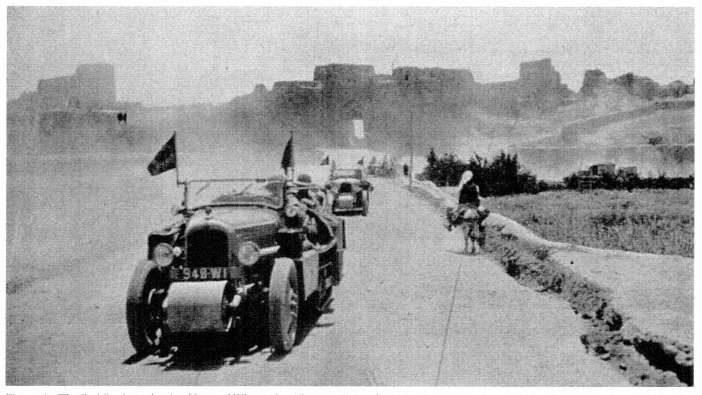
Figure 4.
The Croisière jaune leaving Herat. (L'Illustration/Courtesy Agence Sygma)