
McGuire Creek Biostratigraphy
Development of biostratigraphic units at McGuire Creek that span the uppermost Hell Creek Formation is limited because of the lack of stratigraphic control on channel fills that yield fossil assemblages. References to Plates 2-4 are given to demonstrate biostratigraphic relationships in the following discussion (simplified version in Figure 5).
In spite of poor stratigraphic control, superpositional or cross-cutting relationships between channel facies or lignite beds (TL or MCZ) can be determined in some cases. The Jacks Channel local fauna (Puercan) is younger than the others listed in Table 3 because Jacks Channel lies entirely above the MCZ (Section EE, Plates 2 and 3). The other local faunas were collected from channel fills that are (or apparently were) capped by the MCZ prior to Holocene erosion.
Below the MCZ, limited temporal ordering of local faunas containing Bug Creek assemblages can be determined. The Little Roundtop Local Fauna is older than the Second Level Local Fauna because these respective channel fills are in superposition (Sections 861-R, Plate 3). The crosscutting relationship between the channel fills reveals that the Black Spring Coulee Local Fauna is younger than the Second Level Local Fauna (Section 871-II, Plate 4). The Upper Tedrow Channel cuts and/or overlies both the Second Level (Sections O-P-856-855, Plate 4) and Brown-Grey (Section GG, Plate 3) channels. The biostratigraphic utility of these relationships is limited, however, because only one mammal, Meniscoessus robustus , has been found in the Upper Tedrow Channel. The "Three Buttes Local Fauna" is an informal grouping of vertebrate assemblages found in the erosional remnants of channel fill(s) in an area adjacent to exposures mapped as Upper Tedrow or Second Level channels (Plate 1; NE quadrant, SE quadrant, Section 28, T 22N, R 43 E). However, lag deposits which produce fossils included within this "local fauna" are poorly constrained stratigraphically and cannot be correlated with either channel fill because of Holocene erosion of intervening exposures ("Three Buttes Local Fauna" is placed in quotations in Appendix 2 to denote this uncertainty).
The remaining channel fills containing the Lancian (K-Mark, Section BB, Plate 3), other Bug Creek (Shiprock, Section M1, Plate 3; Up-Up-the-Creek, Plate 1), and Puercan (Z-Line, Sections JJ-N-W, Plate 2) local faunas lack stratigraphic control, making their temporal relationships uncertain (other than relative to Jacks Channel). Usually lateral correlation of strata that cap each channel fill would aid in determining relative age, but all upper Hell Creek channel fills are (or apparently were) capped by the same laterally traceable stratigraphic unit, the MCZ.
Palynological data adds little information useful for more detailed biostratigraphic zonation of the uppermost Hell Creek Formation because all sites yielding vertebrates (with the exception of Matt's Dino Quarry Channel) yield similar palynofloras (Table 3, Figure 5).
In summary, it is virtually impossible to develop a local biostratigraphic zonation for the upper Hell Creek Formation at McGuire Creek that orders the three kinds of vertebrate assemblages. The uppermost 25 m of the Hell Creek Formation contains the records of a major faunal turnover, but the transition is recorded within channel-filling events that are not amenable to biostratigraphic subdivision.
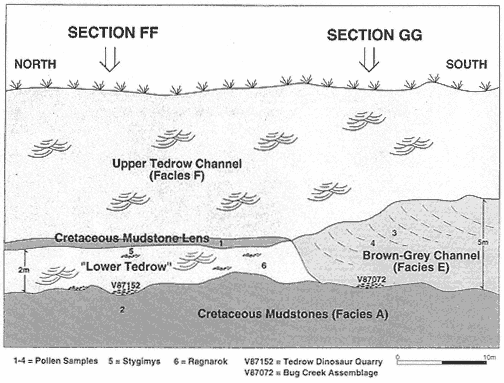
Figure 6
Idealized cross-section of the Tedrow Area showing location of fossil and rock sample sites,
channel fills, and contacts between depositional units. The position of measured sections FF
and GG are shown on Plate 3. Rock samples analyzed for pollen are: (1) 86DLL7-29-1:
Cretaceous; (2) 86DLL7-29-2: Cretaceous; (3) 88DLL7-14-30: Paleocene; (4) 88DLL7-14-13:
Paleocene. Isolated mammal specimens are: (5) Stygimys incisors. (6) Ragnarok lower molars.