
Cinderella on the Lower East Side: the Golden Chance
Toward the end of 1915, DeMille began to work increasingly with scenarist Jeanie Macpherson on original screenplays, rather than adaptations, and
scored impressive hits with both The Cheat and The Golden Chance . A move that secured his claim to authorship, the decision to collaborate with a scriptwriter rather than to purchase rights to existing works was also cost-effective: Macpherson received $250 for the script of The Golden Chance , whereas playwright and novelist Charles Kenyon was paid an advance of $2,000 against 10 percent of the royalties for the adaptation of Kindling .[23] As critical acclaim for The Cheat and The Golden Chance foreshadowed, DeMille's collaboration with Macpherson would be extraordinarily productive during the silent era. The director later summed up their working relationship as follows: "She was not a good writer. She would bring in wonderful ideas but she could not carry a story all the way through in writing. Her name is on many things because she wrote with me. I carried the story and she would bring me many, many ideas."[24]
Due to studio personnel and scheduling problems, DeMille worked simultaneously on The Cheat and The Golden Chance by filming around the clock in two shifts. Production on The Golden Chance , which had commenced on October 26, 1915, was first delayed because of an unsatisfactory script and then halted as a result of difficulties with both the initial director and leading actress. Lasky explained to Goldwyn, "The Goodrich picture. . . has been held up on account of the scenario. . . . Cecil finally gave up trying to put the scenario into shape and he and Jeanie wrote an original which looks very good." As for the leading actress, he remarked, "Cecil claims that Goodrich is often under the influence of liquor and is altogether very stupid." DeMille, who had begun filming The Cheat on October 20, decided to assume direction of The Golden Chance , as well, to meet a scheduled release date, replaced Edna Goodrich with Cleo Ridgley in the lead, and started shooting the film on November 5. Completed first on November 10, The Cheat was released to enthusiastic reviews on December 13. The director continued to work on a tight schedule so that The Golden Chance , concluded on November 26, was premiered a mere six weeks after the domestic release of The Cheat .[25] Within a relatively short period of time, The Cheat was enshrined as part of the canon of silent cinema, especially by enthusiastic critics in war-ravaged Paris. Although overshadowed by the éclat of the earlier feature, The Golden Chance also received critical acclaim. Indeed, the two films are comparable in that the moral dilemma represented by women as consumers is displaced onto lower-class and racial components in the body politic. The Golden Chance also shows striking parallels with earlier films about tenement life such as Chimmie Fadden and Kindling . DeMille in fact recycled the set of the Schultzes' apartment in Kindling as a slum dwelling in the later release. According to realist conventions exploited in the earlier texts, The Golden Chance serves as an exercise in middle-class voyeurism with the heroine in the mediatory role of a tourist. As such, it draws a moral lesson from a conventional juxtaposition of urban rich and poor, whereas The Cheat not
only focuses on the problematic intersection of race and gender but also prefigures consumption as Jazz Age spectacle.
An updated society drama, The Golden Chance introduces the characters during the credits in a succession of medium shots in low-key lighting: Mr. and Mrs. Hillary, (Ernest Joy and Edythe Chapman), identified as members of the "Smart Set," are playing chess; Roger Manning (Wallace Reid), shown with his valet, is "A Millionaire" in formal dress and top hat; Jimmy the "Rat" (Raymond Hatton), dangling a cigarette from his lip, is obviously a Bowery bum. Appearing last in the sequence in separate shots are a husband and wife who, in contrast to the first couple, are clearly differentiated with respect to social class and moral standing. Steve Denby (H. B. Carpenter) is introduced in a shot in which a large beer sign dominates a darkened screen until a light gradually reveals him awakening from a drunken stupor. Mary Denby (Cleo Ridgley), identified as "His Wife," appears in a shot that, unlike the rest of the credits, is photographed from a slightly oblique angle to show her leaning out the window of a tenement building to enjoy a ray of sunshine. She waters a scraggly geranium in a pot that shares space on the fire escape with milk bottles and laundry draped over a railing.
An actress who began her career at Universal, Cleo Ridgley typifies the blond, stately, aristocratic woman who starred in director Lois Weber's feature films.[26] Appearing rather incongruous as a slum woman in The Golden Chance , she is, according to an insert, a judge's daughter who eloped with a "young city man of questionable reputation." A sentimental heroine in the tradition of country maidens seduced by city slickers, Mary lives to regret her decision. All too predictably, she becomes destitute and faces empty cupboards in a tenement building in a disreputable neighborhood. According to the script, Steve engineers a sex role reversal when he sneers in a dialogue title that was altered in the film, "You needn't think because you're a Van Cortlandt, that you're too good to work!" (The Van Cortlandts were Chimmie Fadden's Fifth Avenue employers in the comedy series.) Steve "indicates angrily—she is to look for a job—and right away—She says nothing, but looks straight in front of her showing the hurt and humiliation of everything he has said. He turns at the door, just as he is about to leave, to ask her emphatically if she understands what he has said about working."[27]
Contrary to the script, Mary herself decides in the film to become a seamstress at the Hillarys' residence, a turn of events similar to the plot of Kindling . But, whereas Maggie Schultz expresses outrage at the disparity between rich and poor, Mary is seduced by a sumptuous decor and fashionable gowns and jewelry. Aptly titled the "House of Enchantment," the mansion becomes a site of self-theatricalization and replicates a department store in its enticing display of goods. When she applies for employment,
Mary follows the maid into a living room photographed in an extreme long shot that shows a richly carpeted floor, a writing table next to an elegant floor lamp, a uniformed butler awaiting the instructions of his seated mistress, and a grand staircase with a landing between two flights of stairs.[28] After a brief interview, Mrs. Hillary leads Mary up to the second floor, or the back region of the house, where she will assume her duties as a seamstress. Already enchanted by the decor, the young woman peers curiously about her while ascending the stairs. A tapestry decorates the rear wall of the staircase, and a female statue suggestive of a manikin stands conspicuously in the foreground on the newel post of the bannister at the foot of the landing. The role of the manikin, as Stuart Culver argues, is to mediate between "consumer and commodity by tempting people to confuse themselves with things," surely an example of the reification of human consciousness articulated by Georg Lukács. The plate glass window thus "becomes a stage for the performance of a specific drama of desire."[29] An enactment of just such a drama occurs in The Golden Chance as the screen becomes a department store display or a site for the construction of the "new woman."
The transformation of Mary into a showpiece dramatizes a convergence of desire expressed in terms of exchange value in the reification of social relations; that is, human beings are commodified as objects, on the one hand, and objects are invested with human qualities, on the other. Signifying the dominance of the commodity form, the destitute heroine wears fashionable gowns and accessories that represent romance, the millionaire pursues a beautiful woman befitting his status, and the upper-middle-class couple convert social engagements into business deals. Downstairs, in a long shot in front of a large, gilt-framed painting, the Hillarys initiate these transactions by luring Roger Manning to their home with the prospect of meeting "the prettiest girl in the world" as a dinner guest. Paralleling the casting dilemma of the film, in which Cleo Ridgley replaced the female lead, the evening's entertainment requires a substitute for "the prettiest girl," who is indisposed. Upstairs, in the bedroom where she has finished sewing, Mary drapes a beaded gown against her body in a dimly lit shot that enhances her mood of reverie. A cut to the Hillarys, now shown in a closer medium shot, reveals their disappointment about the turn of events. Suddenly, Mrs. Hillary remembers Mary upstairs. Confronted with the proposal that she become a substitute guest as she is leaving the back region, Mary is incredulous and calls attention to her threadbare clothes. As the script indicates, "Mrs. Hillary sees gown, and watching Mary shrewdly holds up the dazzling silk against Mary—indicates how pretty she would look in it, etc. She watches this effect on Mary's face (the lure of things beautiful for a woman) as Mary capitulates."[30] DeMille cuts back and forth between front and back regions of the mansion as a prelude to the evening's entertainment in which
all signs of labor will have vanished. A sense of unreality thus pervades performance rituals as the effortlessness of appearances attests to genteel control of the stage, if not the backstage, as a site of social reproduction.
As "The Substitute," Mary is showcased in an impressive entrance in a full-length gown with train, as lateral and frontal shots of her descending the grand staircase are intercut with shots of Roger, including a close-up in profile, mesmerized by her beauty. Upon their introduction, Mary and Roger are immediately linked as a romantic couple in two-shots before, during, and after dinner. DeMille himself sketched camera placements on the script to show the dinner sequence from angles that would emphasize how much the couple are absorbed with each other, as the camera pans left and right to show a guest unable to intrude on their conversation.[31] At the end of the evening's performance, however, Mary confronts her personal dilemma in the back region of the upstairs bedroom. DeMille moves his camera in for a closer medium shot as she removes a borrowed silk slipper and compares it with her worn shoe. As disembodied parts of herself, the footwear symbolizes the role that Mary will enact in the plot, that is, the tenement woman who resumes her former status as a socialite after an unhappy sojourn on the Lower East Side.
The drama of social appearances as an indecipherable hieroglyph continues when Mrs. Hillary hires Mary for a return engagment so that her husband may conclude a business deal with Roger. A revealing shot shows Mr. and Mrs. Hillary playing chess in the foreground and observing the young couple through a draped doorway in the background. DeMille is obviously staging a play-within-a-play in a complicated parlor game that escalates into a moral dilemma when Mary and Roger fall in love. At the end of the evening, Mary looks into the mirror as she is seated before a dresser and gazes at successive reflections of Roger and then her husband, Steve. A woman's personal identity and social status, in sum, is dependent upon the commodities that a man's income secures for her. During the following sequence, which is photographed in extreme low-key lighting and includes striking reverse angle shots in suspenseful moments, Orientalist fantasies about illicit sexuality and luxury abound. Goaded by Jimmy the "Rat," Steve startles Mary in a poorly executed robbery attempt by sneaking into her room in the middle of the night. Fingering her jewels and expensive lingerie with a leer, he asks, "Who's the Guy?" A blackmail scheme that further substantiates the paranoia of the rich regarding the urban masses lures Roger, now informed about Mary's plight, to the Lower East Side, but results in a fatal injury for Steve. When Roger tells Mary in a medium two-shot that her husband is dead, she responds by looking away from him to her left before the final fade-out. With her own demise as a worn-out tenement woman, Mary may now be resurrected as a socialite in a process that rep-
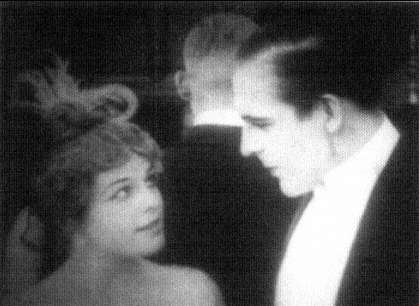
19. As Cinderella in an upper-class drawing room, Cleo Ridgley enchants
a millionaire (Wallace Reid) in The Golden Chance (1915), an original
screenplay by Jeanie Macpherson. (Photo courtesy George Eastman House )
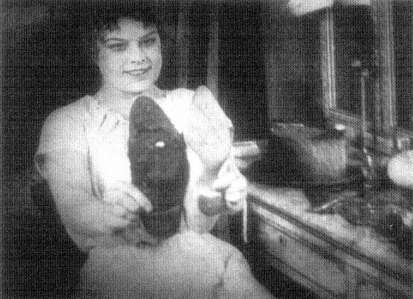
20. After playing the role of a socialite at an elegant dinner, Cleo
Ridgley sits in front of a dresser and contrasts her worn shoe
with a silk slipper. (Photo courtesy George Eastman House )
licates fashion cycles. Fashion, according to Walter Benjamin, "is the eternal return of the new."[32]
Critic Peter Milne, who later praised DeMille in Motion Picture Directing , noted that the lighting in The Golden Chance resulted in "subdued" backgrounds against which "the characters in the foreground stand out in stereoscopic relation." Comparing the film's mise-en-scène to the stereo-graph, a device that heightened the spectator's sense of voyeurism and illusion of reality, Milne described the director's practice of using black drops to illuminate characters in the foreground.[33] W. Stephen Bush also called attention to "wonderful lighting effects [that] lend an indescribable charm and lustre to numerous scenes in the play. Never before have the lighting effects, i.e. the skillful play with light and shade, been used to such marvelous advantage. The highly critical spectators who saw the first display of the film were betrayed into loud approval by the many and novel effects." Acknowledging that he was at a loss for hyperbole, Bush compared DeMille's mise-en-scène with the paintings of Titian and Tintoretto.[34] Since most of the scenes in The Golden Chance take place indoors or at night, a high percentage of the shots were in low-key lighting that enhanced the dreamlike experience of the heroine and, given the Victorian trope of darkness and light, rendered performance rituals morally ambiguous. Further, as critics acknowledged, the lighting casts a luminous glow on sets such as "The House of Enchantment" and "picturesque" slum dwellings as images for middle-class consumption. DeMille's lighting effects, in other words, conveyed moral ambiguity, as opposed to a schematic representation of good and evil, by enhancing desire for commodities that included cinematic images for visual appropriation.
The Golden Chance serves as a primer on the construction of the "new woman" and thus comments on the compromised role of women who are seduced by goods and are themselves commodified in an unending cycle of exchange. According to F. Scott Fitzgerald, the "new woman" in the guise of a flapper was "lovely and expensive and about nineteen."[35] As a consumer, she constituted a threat to male breadwinner status due to an insatiable appetite for material goods. Charles Dana Gibson, whose shirt-waisted Gibson girl was superceded by the flapper, shows such a woman gloating as a man drowns in a Life drawing titled "In the Swim Dedicated to Extravagant Women."[36] As historians point out, the word consumption originally meant "to destroy, to use up, to waste, to exhaust" and thus signified tuberculosis in the medical lexicon.[37] Despite respectable middle-class status, the "new woman" as consumer was linked to a sinful world of luxury associated with the demimondaine. Although she symbolized modernity with her carefree manner and streamlined dress, the flapper could trace her silent-screen lineage to the vampire who devoured men without
conscience to satisfy extravagant whims in films such as The Vampire (1913) and A Fool There Was (1915).[38]
A discourse on the "new woman," The Golden Chance displaces anxiety about female behavior in a consumer culture onto degenerate lower-class males like Steve and Jimmy the "Rat." According to the script, Mary must be shown as a wife "who does not neglect Steve—no matter how bad he is."[39] Steve, however, typifies the irresponsible drunkard censured by temperance crusaders concerned about the welfare of families. Audience reaction to his characterization should be gauged with reference to the fact that by 1911, the Women's Christian Temperance Union had become the largest women's organization in an era characterized by social activism.[40] Steve's decadence not only exculpates Mary for being deceitful but also justifies the existence of social hierarchies. But the heroine is not completely without guilt. A pawn used to attract a millionaire in both the Hillarys' business deals and her husband's blackmail scheme, Mary attempts to retain her integrity but is nevertheless compromised. When Mrs. Hillary offers her a bonus— "You have played your part admirably. Will you accept this as a token of my appreciation?"—she rejects this commodification of a romantic experience. Still, her refusal to accept an additional payment implies that to the extent she was not playing the role of a socialite, she was being false to her marriage vows. Despite the scapegoating of drunken, lower-class men, DeMille's resolution of the moral ambiguities of a consumer culture as confronted by women is equivocal. Significantly, the final shot of the film shows Mary looking away from Roger when he tells her that Steve is dead and thus renders the ending inconclusive.
A brief consideration of DeMille's remake of The Golden Chance , titled Forbidden Fruit (1921), is chronologically out of order in assessing his career but instructive with respect to filming upper-class consumption as spectacle. The Mallory (previously Hillary) mansion now has an arched vestibule with glass doors, gigantic potted plants, and a sunken garden, an elegant space that must be traversed before gaining entry to a high-ceilinged living room that dwarfs its occupants. Mary Maddock (formerly Denby) is still married to a shiftless bum named Steve, but she is no longer the daughter of a judge. Persuading her to play the role of a dinner guest, Mrs. Mallory (Kathlyn Williams) orders her maid to "phone Celeste—tell her to open her shop and send me her best selection of gowns, lingerie, slippers, stockings, gloves, and fans." A parade of uniformed bell boys subsequently arrives with huge packages as Mary (Agnes Ayres) receives the attention of several maids. She is seated at a semicircular dresser in an elegant boudoir with slender columns encircling a bed on a circular carpet. Unrestrained by scruples, the seamstress is delighted by the finery, removes her wedding ring, and admires a large solitaire. She also manages to pass the "ordeal by fork" with minimal
assistance and plays the role of a socialite with aplomb. During one sequence, she and Nelson Rogers (formerly Roger) even attend a play-within-a-play titled Forbidden Fruit . DeMille interrupts this Cinderella fantasy with an even more sumptuous fairy tale in the form of flashbacks to a magnificent eighteenth-century court that is a feast for the eyes. Indeed, Mary wins forgiveness for her deception by confessing that she could not resist playing Cinderella because she was "unhappy and lonely and heart-hungry," an admission that serves as a pretext for one of the film's glittering flashback sequences. After Steve's death, an epilogue titled "Life's Springtime" provides a resolution when Nelson (Forrest Stanley) arrives with a slipper to claim his Cinderella and kisses her while holding her foot.
What conclusions may be drawn about the nature of a consumer culture from this brief account of the remake in comparison to The Golden Chance? First, DeMille escalates the level of conspicuous consumption in Forbidden Fruit so that historical flashbacks are required for more ostentatious spectacle than those afforded by contemporary life. Consumption, in other words, represents an endless cycle in which time is but another dimension of waste as history itself becomes commodified. Second, the characters evince little or no compunction about the enjoyment of luxury, although Victorian sentimentalism dictates moralizing attitudes as well as didactic intertitles. Third, Mary Maddock appears to move in the smart set with relative ease, signifying that social mobility is a result of cash rather than cultivation. And last, the commodification of film spectacle, especially in extravagant and outré flashback sequences, leaves very little to the imagination of spectators for whom visual appropriation serves as a substitute for material gratification. DeMille's film language in effect is translated into a readable hieroglyph for a mass audience that is increasingly female and that has limited access to luxury goods as displayed on the screen. Whereas The Golden Chance demanded some input from the spectator in response to its moral ambiguity and inconclusive ending, Forbidden Fruit simply requires an awestruck audience.