
Chapter Eight—
The Red Bluff Diversion Dam
Richard J. Hallock
One of the major causes, and perhaps the single most important recent known cause of the decline of salmon and steelhead in the Sacramento River is Red Bluff Diversion Dam (RBDD). Completed in 1964, the U.S. Bureau of Reclamation's diversion dam is located on the Sacramento River two miles downstream from Red Bluff. Initially incorporated into the diversion complex were state-of-the-art fish protection facilities that were plagued with problems and modified structurally and operationally. Key features were determined to be unusable in recent years.
The bureau presently maintains and operates RBDD and the upper two or three miles of the Tehama-Colusa and Corning canals, including the Corning Canal pumping plant. The Tehama-Colusa Canal Authority, an association of water users, now operates and maintains the remainder of the Tehama-Colusa and Corning canals. The Tehama-Colusa Fish Facilities have been deactivated, and the salmon spawning and rearing areas are no longer in use. Some of the funds formerly allocated to operation of these facilities have been transferred to Coleman National Fish Hatchery; a portion is still used for maintenance of the deactivated facilities. The Tehama-Colusa Fish Facilities offices, shops, and storage buildings are now occupied by the U.S. Fish and Wildlife Service's (USFWS) Fisher-
This essay is condensed from Sacramento River System Salmon and Steelhead Problems and Enhancement Opportunities, a report prepared by Hallock for the California Advisory Committee on Salmon and Steelhead Trout, June 1987; updated June 1989.
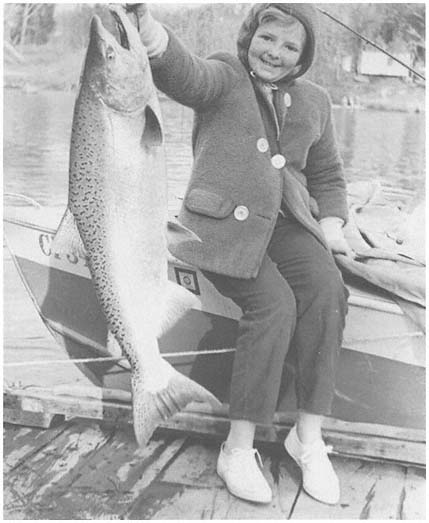
Sacramento River chinook salmon like this one typically weigh from
twenty to thirty pounds.
(California Department of Fish and Game)
ies Assistance office. This office, among its other duties, operates and maintains in part the fishways at RBDD and is also responsible for fish counting operations there.
The Bureau of Reclamation is presently replacing the inefficient louver-type fish screen at the entrance to the Tehama-Colusa Canal
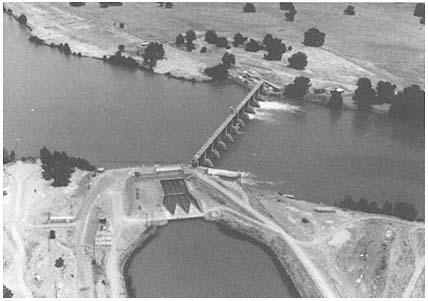
Part of a grand design that failed. Despite hopes of engineers and fishery
planners in 1966, the Red Bluff Diversion Dam is now considered a major
cause of recent declines of salmon and steelhead populations in the upper
Sacramento River.
(Dave Vogel)
with a positive, 32-revolving-drum type of fish screen. The bureau also is increasing canal diversion capabilities from 2,800 to 3,200 cubic feet per second by adding one new bay at the entrance. During an average water year (without the new bay) 700,000 acre-feet of water is diverted into the Tehama-Colusa Canal and an additional 50,000 acre-feet is diverted into the Corning Canal. The diversion headworks near the right-bank abutment is screened to prevent fish in the river from entering the canals.
Sacramento River water levels are controlled by eleven dam gates, each 60 feet wide and 18 feet high, incorporated in the 752-foot-long structure. Water is released by raising one or more gates. A fishway, with closed-circuit television to count adult salmon and steelhead, is located on each dam abutment. A fish trap is incorporated into the left-bank fishway, where adult salmon and steelhead can be examined and released or selected for transfer to other locations.
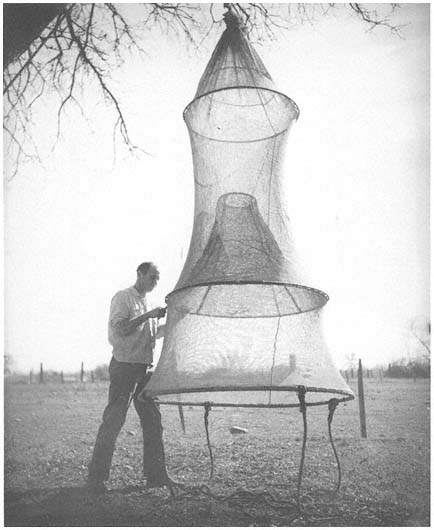
Fyke net being repaired. These nets are used for sampling fish
populations for study.
(California Department of Fish and Game)
Spawning Distribution Changes
Shortly after RBDD became fully operational in 1966, portentous changes occurred in the distribution and total number of fall-run salmon using the upper Sacramento River system. Prior to 1966
more than 90 percent of the total salmon population spawned above the dam site and less than 10 percent below. During the first decade of the dam's operation, the spawning distribution pattern changed: less than 40 percent were spawning above the dam and more than 60 percent below. Changes in these percentages have coincided with overall declines in total populations. Thus both relative and actual numbers of salmon that spawn in waters above the dam have dropped dramatically.
Problems
The problems at RBDD are primarily related to passage of both adult and juvenile salmonids. Adult salmon are delayed below the dam from one to forty days, and more than 26 percent that approach the dam never get past it. Of the four salmon runs, adult fish passage problems cause the most damage to winter-run salmon. Delay time, which adversely affect spawning success, increases with increases in flow, since the adult fish have more difficulty finding the fishways at higher flows. Juvenile salmonids that do not have to pass the dam on their way to the sea have a greater chance of survival than those that do—fingerling fall-run salmon 46 percent greater and yearling steelhead up to 25 percent greater. Studies conducted in 1974 by the U.S. Fish and Wildlife Service showed losses as high as 55 to 60 percent being suffered by juvenile salmon passing the dam during daylight hours.
Fish losses specific to RBDD are caused in part by (1) inadequate attraction flows from the fishways, which result in delay and blockage of adults moving upstream, and (2) turbulence immediately below the dam, which disorients both juvenile and adult salmonids. In particular, the juveniles moving downstream are thrown to the surface after passing under the dam gates, where they become easy prey for predatory fishes, especially Sacramento River squawfish. Other documented losses of juveniles have resulted from the canal headworks fish screen.
Fish Losses
Historical data are lacking for all but fall-run salmon, resulting in less accuracy in estimating the effect of RBDD on late fall-, winter-, and
spring-run salmon, as well as steelhead. Between 1969 and 1982, however, RBDD has caused an estimated loss in the upper Sacramento River system's adult salmon populations of 114,000 fish: 57,000 fall run, 17,000 late fall run, and 40,000 winter run. These losses have deprived the fisheries of about 228,000 salmon a year at a catch-to-escapement ratio of two-to-one. Other researchers agree with such estimates. In a 1986 report to the USFWS, R. R. Reisenbichler estimated that solving the problems at RBDD would return the fall-run salmon population to 1955–1956 levels. In addition, an estimated decline of 6,000 sea-run steelhead in the upper Sacramento River has been attributed to RBDD.
Problems of Handling Ripe Salmon
The Department of Fish and Game routinely samples fish migrating upstream in the trapping facility at RBDD to separate the total closed-circuit counts into the various runs and to look for marked and tagged fish. Between 1971 and 1974, about fourteen hundred ripe female salmon (losing eggs when handled) with an estimated average potential of seven million eggs were handled annually. The number of ripe females handled currently (1989) would no doubt be less, even with increased sampling, because of population declines, especially in winter-, spring-, and late fall-run salmon. At present, these fish are still released in hopes that they will eventually spawn successfully, but success seems unlikely.
To solve this problem of ripe spawners, the U.S. Fish and Wildlife Service constructed an incubation station near the left-bank fishway that became operational in 1979. It has not been used to date, primarily because of lack of personnel and management interest. The handling of seven million eggs in this facility annually could have added between seven thousand and thirty thousand fish to the ocean catch, depending upon their size when released. Moreover, this procedure could have given a boost to the now endangered winter-run salmon, since in the 1971–1974 period more than a million of the total eggs would have come from ripe winter-run salmon in May and June. Since the winter-run chinook population declined to about five hundred fish in 1989, such an egg take would no longer be possible. The problem is further compounded by the fact that the incubation station will apparently never be used for its original purpose, since it is
now being transferred by the USFWS to the U.S. Forest Service, managers of the adjacent recreation area.
Squawfish Predation
Between 1978 and 1985 the number of adult Sacramento squawfish counted annually as they passed upstream through the fishways at RBDD ranged from a low of thirteen thousand in 1983 to a high of twenty-five thousand in 1978 and averaged about eighteen thousand. Squawfish concentrate below RBDD in the spring and early summer, where they prey heavily on juvenile salmon and steelhead on their way to the sea. Turbulence caused by large volumes of water flowing under the dam gates disorients the juvenile salmon and increases their vulnerability to predation immediately below the dam. Squawfish sampled below the dam during two sampling periods in June 1977 had consumed an average of 0.5 and 1.5 juvenile salmon shortly before capture. In May and June 1977, an estimated twelve thousand squawfish were concentrated below RBDD—representing a potential daily consumption rate in excess of one hundred thousand juvenile salmon. During the spring and summer months of especially dry years, striped bass also become quite numerous and are serious predators of juvenile salmon immediately below RBDD. For example, during one study the stomach of a twenty-five-inch-long striped bass captured below the dam was found to contain the remains of twenty-one juvenile salmon. Studies in April and May 1984 showed that squawfish predation was causing losses among juvenile salmon as high as 55 percent during the daytime.
To control squawfish at RBDD an electronic shocking device was installed in the left-bank fishway and tested in 1985. This device was quite successful in destroying adult squawfish in the fishway as they were migrating upstream. Its operation had an adverse effect on salmon migration, however, so use of the shocker was discontinued. Apparently when squawfish, and certain other species, are under stress a warning odor is emitted. In 1987 a new device, its purchase funded in part by the Marin Rod and Gun Club, was tested in the left-bank fishway. Its purpose was to reduce stress by capturing squawfish alive in the fishway and then destroying them elsewhere.
Currently, electronic device testing is at best intermittent since the gates at RBDD are raised for a four-month period between December 1 and April 1 to provide "free" adult passage for the endangered winter-run chinooks. The National Marine Fisheries Service also funded a study to determine whether a commercial squawfish fishery might be feasible. A contract was let to a commercial fisherman to remove squawfish at RBDD, but harvested fish cannot be sold commercially because their flesh has been found to be contaminated with dioxin.
Lake Red Bluff Power Project
The city of Redding applied to the Federal Energy Regulatory Commission (FERC) in 1983 for a license to operate Lake Red Bluff Power Project. FERC denied the permit, but Redding has appealed. The city of Redding's plan is somewhat similar to a plan developed by the Bureau of Reclamation to develop power at RBDD—a plan that the bureau is not actively seeking to implement at this time.
A major concern with the city of Redding's proposed power project is the potential direct turbine mortality of juvenile salmon and steelhead migrating downstream—that is, those fish which cannot be diverted or screened from passing through the turbines. Indirect mortality—that is, increased predation on stunned, disoriented, or debilitated juveniles that have passed through the turbines—could also be significant. Adult salmon and steelhead passage upstream at RBDD could also be adversely affected, since the proposed project provides for inadequate fish attraction flows to the fishways.
Recommendations
To help solve adult fish passage problems at RBDD, both fishways should be modified to provide exit flows two to three times what they are now. At the same time, comparative evaluations should be made of proposals to improve fish passage by further enlarging the east-bank fishway or by constructing a new fish bypass channel around the east side of the dam. These recommendations are in agreement with some of the key recommendations made by the
U.S. Fish and Wildlife Service in their three action study programs aimed at implementing solutions to fishery problems at RBDD.
Even with these recommended actions, it is doubtful that manipulation of RBDD operations, within the constraints of present and proposed future water demands, will ever completely reverse present losses. Strictly from a fishery standpoint, the logical solution to RBDD fish passage problems would be to replace the dam with a pumping plant to supply water to the Tehama-Colusa and Corning canals. At the Glenn-Colusa Irrigation District, a pumping plant similar in size to the one that would be required at Red Bluff was installed at a cost of $10,000,000 in 1984. If RBDD is not to be replaced with a pumping plant, or another source of water is not developed that would allow raising the gates, a formal agreement should be made relative to raising the gates at least during the nonirrigation season to improve fish passage.
Until studies demonstrate that ripe salmon handled at the RBDD trapping facility spawn successfully in the river if released, they should be spawned artificially and their spawn placed in the USFWS incubation station constructed for that purpose. Operation of this facility should be funded by the Bureau of Reclamation, owners and operators of RBDD. Moreover, studies should be intensified to develop a positive plan for eliminating squawfish predation at RBDD. Finally, the city of Redding's proposed Lake Red Bluff Power Project should be opposed unless all the fish protective measures recommended by DFG and USFWS are incorporated in the project.