
Historical Considerations
Other, historical, considerations enable us to attain a higher degree of probability in dating the hermitage than archaeological evidence permits: the great ascetic revival of the ninth century, the possible effect of the ninth-century Viking raids on the Skellig monks, and the dating of the cross slab found on the oratory terrace.
[3] Moreover, Michael O'Sullivan does not believe that the shape of the garden terrace is an altogether natural one and suggests that a certain amount of quarrying was done to level it and expand its width. He notes that he "would expect weathering to reflect the subtle bedding contrast we have here |i.e., between fine sandstone and siltstone| and to produce only a slight indentation on the rock face at bed boundaries—this is not the case here; the terrace 'cut' displays a pronounced bench feature. The cleavage plane orientation would not promote the development of such a rebate as the site is oriented 'across the grain', and I would expect the rear wall to be a joint-plane, rather than a hackly surface" (written communication, March 1, 1988).
[4] O'Sullivan, 1987. In a written communication in 1988, he noted further that some quarrying may well have been carried out below the Needle's Eye, pointing out the availability of accessible fractured rock in a bedding surface near the lowest steps cut into the rock just above Christ's Saddle. A complete investigation of all the quarrying sites has not been attempted.
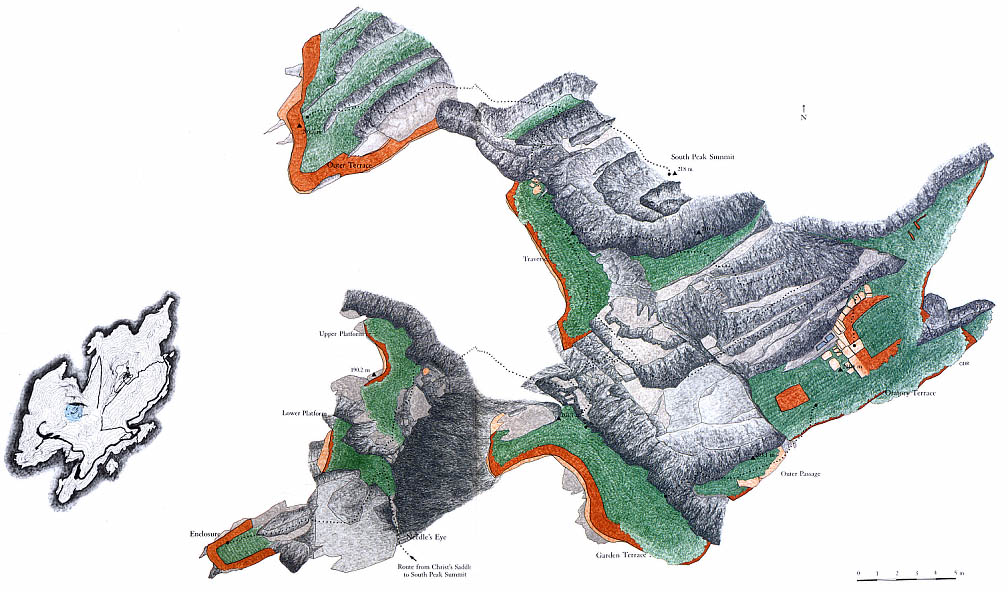
Fig. 57
Skellig Michael, South Peak. Composite plan by Grellan Rourke of the man-made terraces and structures of the peak,
projected on a single plane. The area included in this plan is indicated on the inset from Map 2, a contour map of
Skellig Michael.
The Ascetic Revival of the Ninth Century
Ascetic solitaries were common in the Irish church at a very early date. The ascetic tradition of the sixth and seventh centuries was particularly strong and remained so until the eighth century, when it suffered a temporary decline with the growth and secularization of the great monastic paruchiae . The ascetic revival of the late eighth and early ninth centuries was led by a group of highly articulate and persuasive monks who referred to themselves as the Célí Dé, the "companions of God," but were popularly referred to as the Culdees. We are convinced that the hermitage of the South Peak is an expression of Skellig Michael's enthusiasm for the Culdee revival. To understand the cultural and chronological implications of this movement we must review briefly the history of Irish eremitism and the fluctuating attitudes of the Irish toward the anchoritic ideal during the first few centuries after monasticism was introduced into Ireland.
One of the outstanding characteristics of Irish monasticism was the desire to imitate as closely as possible the monastic pattern of the first desert monks of Egypt. The life of the solitary ascetic who fled the world in search of union with God was celebrated in Europe, as in Egypt, as the highest and purest form of monastic life. St. Anthony, whose life and deeds in the Thebaid desert had been a major force in popularizing monasticism in the fourth century, was the heroic exemplar. The biography of St. Anthony by Athanasius (ca. 296–377) helped to disseminate Antonian asceticism throughout Europe.[5] In St. Martin (ca. 316–400) Europe found its counterpart to St. Anthony, and soon the Life of St. Martin by Sulpicius Severus (ca. 363–420) circulated throughout Europe along with the Life of Anthony .[6] Solitary asceticism was praised throughout Europe, but nowhere was it imitated so faithfully, for so long, or on such a grand scale as in Ireland. Enthusiastically adopting Antonian ideals, early Irish monks began with hermitages and small eremitic colonies. The sixth-century Irish monk Columbanus exhorted his fellows: "Let us die to ourselves that we may live to Christ; for we cannot live to Him unless first we die to ourselves, that is, to our wills."[7] In another sermon he admonished his followers, "Have no mercy on transitory things, lest you lose what is eternal; the whole world is foreign to you who are born and buried bare."[8] Thus two centuries and a continent away, the words and spirit were still entirely Antonian.
In adhering to this spirit, the Irish monks constantly sought the equivalent of the Egyptian desert. On the Irish mainland the locations of old hermitages are still recognizable by the name dysert or disert . The most determined ascetics, however, sought their desert on islands in the sea. The hagiographies contain countless references to monks searching for "a solitude in the pathless sea."[9]
The second half of the sixth century saw the beginning of another aspect of Irish monachism: the creation of monastic paruchiae . These were monastic communities, geographically widespread but united in confederation under the rule of the abbot of the chief monastery. This organizational structure was directly related to the preexisting secular social system in which several petty kings owed allegiance to an overking; in fact, paruchiae were
[5] St. Athanasius wrote his Vita Antonii shortly after the death (356/357) of the great anchorite to furnish monks in other parts of the world with a model of ascetic life and to reassure the church that monachism was not heretical but orthodox. In 388 the treatise was translated into Latin by Evagrius of Antioch. For a translation into English with a rich body of textual annotations, see Athanasius, The Life of Antony and the Letter to Marcellinus , trans. Gregg, 1980.
[6] For a recent edition of the Latin text translated into French by Jacques Fontaine, see the Bibliography under Sulpicius Severus. A translation into English by Alexander Roberts can be found under the same heading.
[7] "Nosque nobis moriamur ut Christo vivamus; ei enim vivere non possumus nisi nobis ante, hoc est, nostris voluntatibus moriamur" (Sancti Columbani Opera , ed. and trans. Walker, 1957, 102–3).
[8] "Ne parcas caducis, ne aeterna perdas; alienus tibi totus mundus est, qui nudus natus nudus sepeliris" (ibid., 78–79).
[9] The Vita Sancti Columbae by Adamnan is full of these references. The following example is typical: "Some of our brethren have lately set sail, and are anxious to discover a desert in the pathless sea." (Aliqui ex nostris nuper emigraverunt, desertum in pelago intransmeabili invenire optantes) (ed. and trans. Reeves, 1874, 71, 185).
frequently allied with and supported by the ruling families. For example, all of the monasteries belonging to the paruchia of St. Columba were in the territory controlled by his family, the Uí Néill, and seven of the first eight abbots of Iona, the chief Columban monastery, were relatives of St. Columba's. In time, economic and social dependence on aristocratic families caused the gradual secularization of many of the great monastic confederations.[10]
During the seventh century monastic paruchiae were becoming increasingly important and common. But the earlier Egyptian ideals of ascetic simplicity and austerity were not forgotten, and monasteries continued to support and encourage ascetics. It was not unusual for the founders of monasteries to spend some time as hermits, either early in life or upon the approach of old age.[11] The great scholastic monastery of Bangor still consciously looked to the model of Egyptian monachism and felt itself the direct spiritual descendant of Egypt. The Antiphonary of Bangor , written between 680 and 691, makes some nineteen references to Egypt; the attitude embodied in them is summed up perfectly in one of the quatrains:
A House full of Delights
Built on Rock
A veritable vine
Transmitted from Egypt.
Domus deliciis plena
Super petram constructa
Necon vinea vera
Ex Aegypto transducta.[12]
By the eighth century the monastic paruchiae exercised effective control over the Irish church. The great wealth and power resulting from their alliance with ruling families led to the creation of great monastic schools from which beautiful manuscripts and decorative metalwork emerged. Inevitably in a system where family lands were frequently also monastic lands and where the monastic and the secular were often inseparable and indistinguishable from each other, a certain secularization of the monasteries occurred. In some cases abbacies became secular and administrative, and their succession passed down not only in families but also from father to son. Abbot Corman of the Monasterboice monastery died in 764 and was succeeded by his son Dub-da-inber. At Trevet between 774 and 839 a father, son, and grandson made up the abbatial succession. This increasing secularization of monasteries, though not inherently evil, did facilitate abuses of monastic ideals. The difference was blurred between goals, attitudes, and position in the spiritual and secular worlds.[13]
Monks even went to war. In 764 Clonmacnoise and Durrow were involved in an armed conflict in which two hundred men of Durrow are said to have been killed. In Emain Macha in 759 Ulstermen fought with the southern Uí Néill. According to The Annals of Tigernach this battle took place "at
[10] For a discussion of the formation of paruchiae , see de Paor and de Paor |1958|, 1967, 50–51; Hughes |1966|, 1980, chap. 7.
[11] St. Cuthbert spent most of the last eleven years of his life in a hermitage on Farne Island after retiring as abbot of Lindisfarne in 676. St. Fursey spent some time as a hermit on an island in Lough Corrib near Galway (ca. 630) before he traveled to England and the Continent to found monasteries (Henry 1963, 1:41). On Fursey see also Bede, trans. Sherley-Price, 1955, bk. 3, chap. 19.
[12] For the text see Antiphonary of Bangor , ed. Warren, 1895, 2:28. The date is discussed in the introduction to that volume.
[13] For a lucid account of the secularization of the church in the eighth century, see Hughes |1966|, 1980, 163.
the will of Airechtach, priest of Armagh through discord with Abbot Fer-dáchrich" (Hughes [1966] 1980, 170). The references to ecclesiastical synods, common in the sixth and seventh centuries, declined in the eighth century, suggesting that the abbots were looking more to the secular kings than to their fellow churchmen for support (Hughes [1966] 1980, 170–72).
By the late eighth century a reaction to this state of affairs resulted in a great Irish ascetic and anchoritic revival. The reformers were determined to remove from monachism any preoccupation with secular affairs; in general they sought a return to the old desert ideal of prayer, meditation, and asceticism (Hughes [1966] 1980, 173–77). The most influential leader of this movement was Máel-ruain, founder of the monastery of Tallaght, a community of ascetics. His followers, unlike earlier ascetics, were forbidden to go on pilgrimage and were instructed to avoid worldly disputes and to avoid asking visitors for news of the world, "since it might harass and disturb the mind of him to whom it was told."[14]
In addition to forming communities of ascetics, individual Culdees commonly attached themselves as anchorites to one of the great monasteries. In two manuscripts dating from the period 830–840 a monk has recorded the customs and discipline of Máel-ruain and his chief disciple Máel-díthruib of Terryglass, making several references to this practice. "A certain anchorite lived in Clonmacnoise named Laisren, quite naked and free from sin"; and "there was a certain anchorite from Slain—Now he had dairying and store of victuals given him by the monastery."[15]
The Culdees were not the only practitioners of this anchoritic revival. The ninth-century Rule of Columba advised hermits to be by themselves in a retired spot near a chief monastery. The monastery could provide food, clothes, and spiritual direction; the anchorite, in turn, could spend part of his day teaching, writing, or otherwise assisting the monastery. In the ninth century the term anchorite meant a monk who practiced severe asceticism. He could be a solitary recluse or the chief scribe of a monastery who went into seclusion for only part of the year. The chief duties of the ascetic were prayer and study. But if a monk could not bring himself to tears of compunction in his prayers, the Rule counseled him to turn to manual labor until he sweat (1873, 119, 121).
By example and word, Culdees became the most important ascetic force in Ireland during the late eighth and ninth centuries. Their beliefs spread in part because of the fame of their scholarship. The two main Culdee monasteries, Tallaght and Findglais, were called the two eyes of Ireland in a ninth-century monastic text, The Triads of Ireland .[16] From these monasteries came several manuscripts containing the Culdee doctrine: the Monastery of Tallaght , the Teaching of Máel-ruain , and the Rule of the Célí Dé . Additionally, there is a section on Culdees in the ninth-century work the Rule of St. Carthage .[17]
Yet powerful as was the Culdees' influence during this period, it did nothing to alter the basic organizational structure of the Irish church. Lack of uniformity was one outstanding characteristic of the early Irish mo-
[15] "Araile ancarae robui hi cluaoin mac naois laisrien a ainm imnocht imdilmain cen ní for a cubus" (Monastery of Tallaght , 155). "Báoi alaile anchoire antuaid o sláne colcu. Coibnius dochuttae. Rochachti iarum commor corroabstinit. Robaoi iarum áirgi laisim o muindtir taiseit on muindtir" (159).
[16] "Di snil Herenn-Tamlachta, Findglais," The Triads of Ireland , ed. and trans. Meyer, 1906, 3. See also Flower, 1932, 66–75, for a fuller discussion of the role of anchorites and Culdees in ninth-century Ireland. The most complete discussion of the Culdees to date, incorporating all documentary references to them, is found in O'Dwyer, 1981.
[17] The Teaching of Máelruain and The Rule of the Célí Dé can be found in The Rule of Tallaght , ed. and trans. Gwynn, in Hermathena no. 44, 2d supp. vol., 1927, 1–87. The part of the Rule of St. Carthage that discusses the Culdees may be found in Mac-Ewen, 1915, 1:131.
nastic orders; each house had its own rules and practices. There was never any attempt to exercise or enforce the organizational discipline common to continental Benedictines.[18] Following the Culdees' lead was always purely voluntary, a matter of conscience; their appeal to the individual was emotional and carried with it no authority for enforcement. Paradoxically, this may mean that the appeal and influence of the Culdees were greatest among monks, like those of Skellig Michael, who were already living a severely ascetic life.
Spiritual power unsupported by a unified organization tends to dissipate in time. So it was with the influence of the Culdees. The secularization and growth of the great monastic paruchiae continued and increased in the tenth century.
Arrival of the Vikings
The monks of Skellig Michael might have had another reason for their strong interest in supporting the dreams and aspirations of a hermit. In the ninth century the Vikings began to raid the island. After a first bitter experience, in which the monastery was brutalized, the monks would have wanted to build a temporary place of safety from attack.
The earliest undisputed reference to Viking raids on Skellig Michael is in the Annals of Inisfallen , where under the year 824 it is stated: "Scelec was plundered by the heathens and Etgal was carried off into captivity, and he died of hunger on their hands."[19] The annals do not tell why Etgal was taken away, but the reason is easy to guess. The Vikings believed that every monastery possessed either valuable objects of gold and silver or important men, like the abbot, who could either be held for ransom or enslaved.
Two mentions of Viking raids appear in the War of the Gaedhil with the Gaill , the first in an entry of 821–823 about Etgal, the second (which is undated) after the Etgal entry and before another dated 850:
There came a fleet from Luimnech in the south of Erinn, they plundered Skellig Michael, and Inishfallen and Disert Donnain and Cluain Mor, and they killed Rudgaile, son of Selbach, the anchorite. It was he whom the angel set loose twice, and the foreigners bound him twice each time.[20]
The monks of Skellig Michael had reason to be anxious, for the approaches to their monastery were not easily defended. The monastery itself could be reached by flights of steps on three sides of the island, on slopes that, apart from steepness, offered no obstacle to armed men. But the hermitage on the South Peak was a different matter. The only access, on the southwest face, was by a single obscure and easily defended passage, the Needle's Eye. This was an insurmountable barrier, where Viking intruders trying to hoist themselves up could easily have been knocked down one by one by a single defender, whom the intruders could not even see. If by chance a hell-bent Viking managed to survive the Needle's Eye, he would still have had to pass three more places from which a monk throwing stones could send him into a headlong plunge.
[18] For a discussion of the difference between Irish and Benedictine monachism and a detailed analysis of the organizational philosophy that governed the latter, see the chapter entitled "The Monastic Polity," in Horn and Born, 1979, 327–55. In this same work (vi) readers will find a map showing the origins and diffusion of these two great monastic movements.
[20] "Tanic longes o Luimniuch i ndescert nhErend, cor inriset Sceleg Michil, ocus Inis Fathlind, ocus Disirt Donnain, ocus Cluain mor; co ro marbsat Rudgaile mac Trebthaidhi, ocus Cormac mac Selbaig anchora. Is desside ra hoslaic angel po di, ocus poscenglaitis na Gaill cac nuairi" (War of the Gaedhil with the Gaill , ed. Todd, 1867, 228–29).
The hermitage was a secure refuge for short periods of time if the monks had sufficient warning. When the ocean was whipped by storms and clouds darkened the skies, the monks felt secure from Viking attack. A poem in the margin of a ninth-century Irish manuscript expresses this feeling with striking beauty. It might well have been written on Skellig Michael.
The wind is rough tonight
tossing the white combed ocean.
I need not dread fierce Vikings
crossing the Irish Sea.
Is acher ingaith innocht
fufuasan fairggae findfolt
ni agor reimm mora minn
dondlaechraid lainn ua
lothlind.[21]
On a clear, calm day, however, the monks could not feel safe, for then maritime attack was a continual threat. To have time to hide their ecclesiastical treasures and flee to safety, the monks needed warning. The hermit on the South Peak was in an excellent position to spot danger and alert the monastery, for from the top he had a 360-degree view of the ocean. No Viking fleet could approach the island unobserved.
The Date of the Cross Slab
The design on the cross slab found on the hermit's oratory terrace in 1982 is a further means of dating the hermitage. The remains of this cross slab were found under a shallow overgrowth of sea campion approximately one meter west of the hermit's oratory. The left edge, as one faces the cross, is intact and appears to have been shaped, being smooth and straight for most of its length. The right edge is damaged; at its base, the slab is preserved to almost its full original width, but from there upward the edge curves severely inward; and at its clearly broken upper end, the width of the slab is reduced by almost half. Most of the upper part of the engraved design is missing; from the dimensions of the remaining design it can be inferred that in its original state the slab must have been a little over one meter high (Figs. 58 and 59).
This cross belongs to the category known as a developed ring cross—an encircled cross whose arms extend beyond the circle. It is one of the most popular designs for crosses in Ireland and is so closely identified with the Irish that it has become known as the Celtic cross. (For further discussion of the origin and stylistic development of the ring cross, see the Appendix.)
In 1961 Pádraig Lionard studied the use of designs on recumbent cross slabs and was able to develop a typology and chronology for many of them. Outline ring crosses were a popular motif on recumbent slabs, having been engraved on 150 out of 800 to 900 slabs. Two-thirds of the slabs engraved with ring crosses also have inscriptions on them referring to known abbots, ecclesiastics, and princes, thus permitting more precise dating than for most cross designs. The earliest datable example (Fig. 60)—and the only one from
[21] St. Gall Priscian , margin gloss. Contained in Thesaurus Palaeohibernicus , ed. and trans. Stokes and Strachan |1901|, 1975, 2:290. For the English version quoted here see de Paor, 1967, 93, n. 2. Another translation, more literal and considerably less poetic, has been published by Stokes and Strachan, 2:290: "Bitter is the wind tonight. It tosses the ocean's white hair: I fear not the coursing of a clear sea by the fierce heroes from Lothlend."
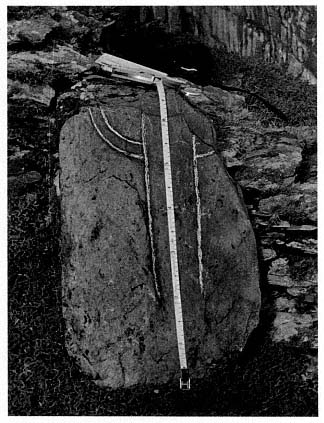
Fig. 58
Fragment of a slab engraved with a cross, found on the
oratory terrace in the summer of 1982. It is 68 centimeters
high and 43 centimeters at its widest point. It broke,
doubtless, because it is only 1.5 centimeters thick.
Photograph by Lee Snodgrass.
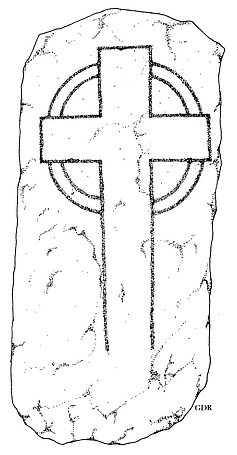
Fig. 59
Reconstruction of the developed ring
cross shown in Figure 58.
Drawing by Grellan Rourke.
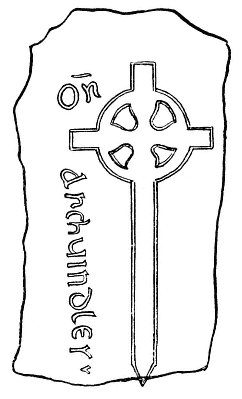
Fig. 60
Clonmacnoise, Offaly. Cross slab decorated
with the earliest developed ring cross of
Ireland now known. From Féilscríbhinn
Torna , ed. Séamus Pender.
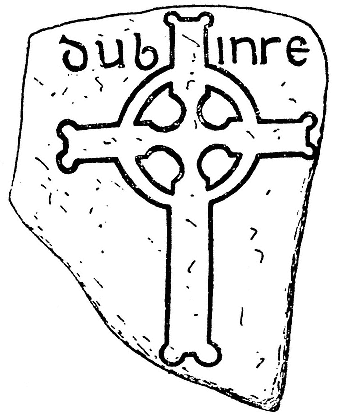
Fig. 61
Fuerte, Roscommon. Cross slab engraved with a developed
ring cross and the name Dubinre, probably from the year 814.
From Pádraig Lionard, "Early Irish Cross-Slabs."
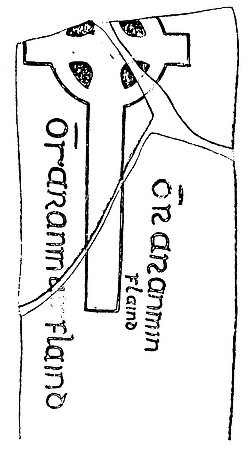
Fig. 62
Iona, Scotland. Cross slab engraved with a
developed ring cross and the inscription
"Or Ar Anmin Flaind," commemorating
Flann, abbot of Iona, d. 891. From Pádraig
Lionard, "Early Irish Cross-Slabs."
the eighth century—is on a recumbent slab at Clonmacnoise, inscribed "Or Ar Chuindless," which dates to 720–724 (Lionard 1961, 126). Only one example, moreover, has been dated to the tenth century and none at all to the eleventh. All the others were dated to the ninth century. Two of these are shown in Figures 61 and 62, one from the year 814, the other from 891.
Thus we could date the South Peak hermitage to the ninth century with complete assurance, except that the slab on the South Peak is not recumbent but erect. Lionard notes that the use of outline ring crosses on pillars and erect slabs is uncommon, there being only about fifteen of them.[22] Recumbent grave slabs are always burial markers, whereas small erect slabs were used both for gravestones and for other purposes. Nevertheless, the difference between these small stone markers used in ecclesiastical settings is probably not significant. Indeed, they are so similar that it is frequently hard to differentiate them. Because the design for recumbent slabs was at the height of its popularity during the ninth century, it is highly probable that the few outline ring crosses seen on pillars and erect slabs also belong to this period.
In thus calculating the date of the hermitage, we are aware that we have moved into an area of historical speculation. No individual part of our argument is susceptible to incontrovertible proof. Yet we believe that the argument as a whole carries a high degree of historical persuasiveness.
[22] Lionard also notes: "By contrast only 12 of the 26 linear ringed crosses are on recumbent slabs. The main incidence of this latter type is along the west coast where ringed outline crosses are few" (1961, 127). This is the type of detail that gives archaeologists gray hairs.