
Two
Success Stories: Lineage and Elite Status in Hanyang County, Hubei, c. 1368-1949
William T. Rowe
In 1946 the Han lineage of Jiangxia county (which included the Hubei provincial capital, Wuchang) published the fourth edition of its genealogy.[1] Listed as general editor was one Han Jiwei, a graduate of Fudan University in Shanghai. Immediately upon graduation, Jiwei had assumed the presidency of a small municipal technical college at Hankou, subsequently leaving to take a post in a local iron and steel firm, and eventually setting up his own steel mill. He had done well, for at the time of his genealogy's compilation, he was general director of the Hankou Steel Trade Association. Han Jiwei was a direct sixteenth-generation descendent of a man who in 1368 had been installed as Wuchang prefect by the founding emperor of the Ming dynasty.
The conventional picture of late imperial Chinese society as marked by rapid social mobility, long doubted by some, has come under increasing attack in recent years.[2] Yet a case such as that of Han Jiwei still seems somewhat startling, in the suggestion it offers of an hereditary local elite solidly entrenched despite dramatic political, economic, and social change over nearly six centuries. Was his an isolated case? The evidence presented in this article argues that, at least in one local area, it was not. In this region of the confluence of the Yangzi and Han rivers (map 2.1), almost precisely at the geographic heart of China proper, very long-term continuity of local elite lineages was not the exception but the rule.
In comparison to European or Japanese landed elites, those of late-imperial China faced formidable obstacles to reproducing their status over generations. China had no significantly widespread system of hereditary aristocratic rank. Access to political office and its concomitant social and economic rewards was in theory—and, within limits, in reality as well—determined by merit rather than birthright. Most damaging of all was the
near universality in China of partible inheritance; when combined with the pervasive legal principle of free alienability of land, this practice effectively prevented preserving intact estates from generation to generation. Whereas in much of Europe primogeniture and entail allowed landed elites to keep the patrimony relatively undivided, Chinese elites with few local exceptions seem not to have had recourse to any such "feudal" protections for their status.[3] How then did certain elites remain so entrenched? In this paper I will suggest some tentative answers, by drawing a comparative profile of several prominent lineages from a single local area.
The basic materials for this study are fourteen genealogies (zupu ) from lineages of south-central Hubei.[4] Nine of these lineages were from Hanyang county; the remaining five were from contiguous counties.[5] The Hanyang genealogies include all those known to exist today, incorporating all those from the county listed in the standard bibliographies compiled by Taga Akigoro and by the Genealogical Society of Utah,[6] as well as others I myself have discovered in China and the United States. Still, the sample presents some problems. It is clear that only a small percentage of published genealogies from the area have survived and that only a minority of Hanyang's prominent lineages are represented here. Among these, our group of lineages is potentially self-selective because the very fact that they troubled to publish genealogies suggests that they had a long local pedigree to advertise, which indeed they did. Based on my broader reading of Hanyang county sources, however, I have found no reason to believe that, in either their generational depth or any other respect, this group of elite lineages was atypical of those in the area as a whole.
Let me introduce at the outset several notes of caution regarding the relationship I wish to draw between lineages and elites. First, the membership of the lineages studied here was far from exhaustive of the elite stratum in the Hanyang area. Second, membership in these or others of what I have termed "elite lineages" by no means guaranteed that a given individual would enjoy elite status; within such lineages, component patrilines did better or less well, and their fortunes rose and fell nonsynchronously over time. Third, the territorial arena within which these lineages or their elite members exercised dominance was not precisely coterminous; as we shall see, for most this arena was one or another subdistrict (xiang ) of Hanyang, rather than the county as a whole. Finally, it was not necessarily true that a given member of the local elite would belong to any formalized lineage group, "elite" or otherwise, although it should become evident that the individual would very likely belong to one.
With these cautionary notes in mind, however, I propose to argue, first, that the lineage provided a considerable corporate resource to be drawn upon by its members, in a wide variety of ways, to achieve and reproduce personal or familial elite status. Second, in Hanyang at least, this powerful
instrument allowed members of certain advantaged lineages to maintain local elite status over many centuries in the late-imperial and Republican periods. Finally, and in light of the above qualifications rather less conclusively, our genealogical evidence suggests that in this area of China the idea that families might rise from local agrarian roots below into the local elite was little more than a myth.
The Logality
Hanyang county straddles the Han River just at its point of confluence with the Yangzi (map 2.1).[7] The terrain is flat and deltalike, laced with rivulets and dotted with backwater lakes and marshes. Although the hazards of flood are considerable, the soil is fertile, and the area's paddy-rice agriculture can produce handsome surpluses in nonflood years. Agricultural surplus and excellent water transportation, combined with the proximity of the great inter-regional trading center of Hankou, allowed Hanyang and its environs to develop after the late Ming into one of the most commercialized local systems in China. Its commerce entailed not only market gardening and fishing to feed the nearby urban population but also, increasingly, production of cotton and ramie to serve extraregional markets. Handicraft spinning, weaving, and other artisanal sidelines such as oil pressing were highly developed; consequently, nonadministrative market towns (zhen ) proliferated, though not as intensively as in the hyperdeveloped Jiangnan.[8]
In the character of its local elite as well, Hanyang occupied a position somewhere between Jiangnan and the rest of the empire. Concentration of landownership was high, but not as high as in the richer Yangzi and Pearl river deltas. This landlord wealth was reflected in levels of academic achievement, which were among the highest in Hubei but still low enough to attract immigrants from Jiangnan seeking to capitalize on Hanyang's weaker competition for the local quota of civil service examination degrees. Based on the evidence of gazetteer biographies and lists of examination degree holders, the elite of the area seems to have been rather broadly based, including members of some thirty to forty prominent descent groups. As was true elsewhere in China, it probably also grew over our period as a percentage of the total population. Whether it was an open elite is another question.
Founding the Line
The assignment by subsequent generations of the honored place as "founding ancestor" (shizu ) to one rather than another lineage forebear was a decision complicated by many factors, as we shall see. Nevertheless, with certain exceptions, lineages in Hanyang most often dated their founding from' the generation during which they had relocated to the county and declared it
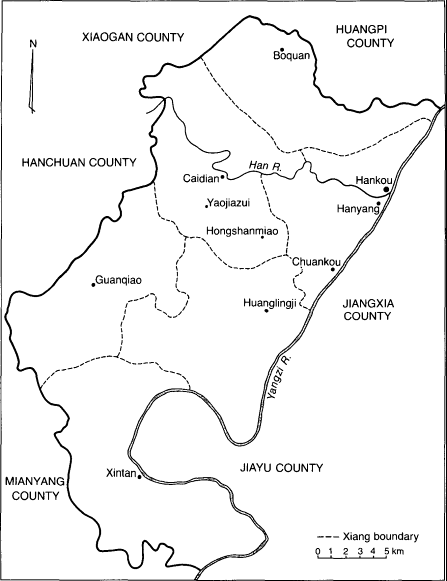
Map. 2.1.
Hanyang County, c. 1880.
SOURCE: Hanyang xianzhi 1867; Hanyang xian yutu 1901; Hanyang xian xiangtu 1933.
TABLE 2.1. | ||||
Surname | New native place | Old native place | Date of arrival | Comment |
Zhang (1) | Hanyang: Boquan | Hubei: Macheng | c. 1644 | Via Huangpi |
Zhang (2) | Hanyang: Boquan | Jiangxi: Yugan | c. 1350 | Via Huangpi |
Lao | Hanyang: Hankou | Zhejiang | c. 1550 | Via Hunan |
Ling | Hanyang: Guanqiao | Jiangxi: Ji'an | 1373 | Via Hanchuan |
Liu (1) | Hanyang: Lianhuati | Jiangxi | 1466 | |
Luo | Hanyang: Hongshanmiao | Jiangxi: Taihe | 1406 | Via several localities |
Yao (1) | Hanyang: Caidian | Jiangxi: Xinjian | c. 1368 | |
Yao (2) | Hanyang: Yaojiazui | Jiangsu: Jurong | 1368 | |
Ye | Hanyang: Huanglingji | Jiangsu: Lishui | 1750 | Via Nanjing; owned property in Hankou since c. 1655 |
Zhang (3) | Mianyang | Jiangxi: Wan'an | c. 1368 | |
Feng | Mianyang | Jiangsu: Fengyang | c. 1368 | |
Han | Jiangxia | Jiangxi: Nankang | c. 1368 | |
Gui | Jiangxia | Jiangxi: Linchuan | 1369 | |
Liu (2) | Mianyang | Jiangsu: Wuxian | 1369 | |
their legal native place. All the lineages in our sample knew clearly how they had arrived in the area and could chronicle the generations of descent from the first immigrant in convincing detail. Table 2.1 depicts when and from where the local arrival took place for all lineages under consideration and reveals remarkable similarity between the cases. Of the fourteen lineages, eight had come from neighboring Jiangxi province, and all but one of the remainder from Jiangnan (southern Jiangsu or northern Zhejiang). They were thus part of the great westward population shift that has marked the Yangzi valley for nearly the past millennium. We might expect that many of these people had come following Zhang Xianzhong's devastations during the Ming-Qing transition, when, in Wei Yuan's famous phrase, "the people of Hubei filled up [the depopulated] Sichuan, and Jiangxi filled up Hubei." In fact, however, only one of our lineages arrived during this period, and it came only from Macheng county in northeastern Hubei. The Ming-Qing transition did see a considerable immigration into the Yangzi-Han confluence area, but these early Qing arrivals had come too late to establish themselves as leading lineages of the area. For the most part, the roles of dominant lineages had already long been cast.
The majority of our lineages arrived in the confluence area during the Yuan-Ming transition: fully half came almost precisely at the moment of the Ming founding, and two others slightly before or after that event. Why? Several lineages stated, rather conventionally, that their ancestors were "fleeing military disorder" in their former locality, and this must generally have been true.[9] However, no fewer than five of our kin groups acknowledged their descent from officers in the army of Ming Taizu, and two others also descended from officials of that same general era. The founder of the Caidian Yao, Yao Fulong, had come from Jiangxi to command the Xiang-Han Garrison; the Yaojiazui Yao founder, Yao Xingyi, commanded the Hubei courier detachment. Both changed their registration upon retirement from office and settled in Hanyang county. Feng Xingshan and Gui Fuyi held military posts and subsequently settled in Mianyang and Jiangxia counties, respectively. Han Yi, rewarded for his military service with the civil post of Wuchang prefect, moved his family permanently to Jiangxia. Liu Ben changed his registration to Hanyang county in 1466, after retiring from service as Hubei provincial judge. And the lineage with the longest demonstrable local pedigree stemmed from Zhang Deyi, who had moved to Hanyang while filling his family's hereditary military command under the Mongols and whose son moved almost immediately into a civil official post under Ming Taizu.[10] The founding of the Ming, in sum, seems to have been a pivotal event in forming subsequent local-elite society.
One final lineage among our sample represents something of a special case. The Ye owed their local roots to two men of the early Qing. Ye Wenji
(1636-1694), a native of Lishui (Jiangsu), operated a small general store in Nanjing and read medical treatises as a hobby. Sometime in the mid-seventeenth century he arrived at the great commercial port of Hankou and realized his ambition to open an herbal medicine shop and clinic. Apparently, Wenji had the good fortune to treat a Manchu prince who was bivouacking near the city, and the successful outcome brought immediate fame and fortune to his Hankou practice. More concretely, Wenji also hit upon two patent medicines, an eye drop and a medicated wine, which achieved tremendous local sales. Wenji eventually retired to Nanjing, leaving his Yekaitai Medicine Store in the care of an agent, and for three generations his descendents enjoyed a scholarly life-style there, based upon the profits of the Hankou store. On the death of Wenji's grandson Hongliang in 1750, however, the latter's three sons decided to divide their patrimony. One son, Ye Tingfang (1733-79), took as his share the Yekaitai store. Tingfang moved his family permanently to Hankou to more closely oversee the shop's operations, though he continued his literati life-style and remained aloof from daily business management. He was subsequently honored as founder of the Ye's Hanyang line.[11]
The Ye were somewhat unusual because their elite position in Hanyang county derived solely from a commerical windfall in Hankou. Yet their uniqueness should not be overstated. In subsequent generations most Ye households behaved as literati landlords, presenting themselves in local society with singular success as proper Confucian gentry. So successful were they, in fact, that one suspects their case was replicated, less dramatically but rather frequently, in the history of other prominent lineages both locally and elsewhere. In any event, the Ye did share with our other lineages the common feature of having entered Hanyang society at the top, pre-equipped with high status and considerable wealth. Whether this wealth was derived from commercial or bureaucratic sources, it is noteworthy that not a single prominent Hanyang lineage whose genealogy survives had achieved its elite status primarily on the basis of local agricultural success.
Economic Bases of Elite Maintenance
The existing literature on maintaining elite status by lineages in late imperial China has emphasized two factors: landholding and bureaucratic service. Scholars have argued heatedly over the relative importance of the two in elite strategies, but for the most part the debate has considered these the only significant alternatives.[12] There are, of course, several good reasons for this. The records left by most elites stress their authors' mental conformity to the ideal of the "planter-scholar" (gengdu ), and undoubtedly a fair amount of reality supported this idealized self-image.[13] Nevertheless, the evidence
from Hanyang reveals that, beyond land ownership and official position, both commerce and military service played important—in some cases paramount—roles in maintaining wealth and social position.
Landholding . It is obvious, I think, that most component households of most lineages, however elite, subsisted on income from agriculture. It is thus no surprise that each of our fourteen lineage founders was credited with acquiring a sizable rural estate, which in almost all cases became the ceremonial center for the subsequent lineage organization. In the Luo, for example, the founder is depicted as wandering peripatetically through central China, fleeing military strife, until he reached the Chuannan area in southern Hanyang county. There in a dream he was told that if he broke ground at that spot he would have countless progeny; naturally, he did so.
The more common situation, however, resembled that of Yao Xingyi, who, when appointed to a lucrative military post in Hanyang, used the proceeds to procure tracts of paddy and mountain land in the county's south-central portion "in order to bequeath to his heirs." Similarly, Liu Ben in the mid-fifteenth century used his official salary to buy a large estate in the sparsely settled area of Lianhuadi, southwest of the county seat, from which his descendents spread out to acquire land throughout this Xiannan subdistrict (xiang ).[14] The ease of acquisition of large tracts of property by lineage founders undoubtedly had much to do with the ready availability of land around the Yangzi-Han confluence at the start of the Ming, due to the devastations of peasant rebellion, the radical redistributionist policies of a new regime, and a still relatively undeveloped local agriculture.[15] Most of our genealogies suggest that their founding ancestors were pioneers in land reclamation. The two brothers who founded the Ling, for example, are said to have spent five years clearing and draining their new property in the Guan-qiao area of western Hanyang before it could be successfully cultivated or even inhabited.[16]
This desire to root oneself in agriculture touched even the mercantile Ye. Shortly after relocating from Nanjing to Hankou, Ye Tingfang procured a large tract of rural land in east-central Hanyang, around the town of Huang-lingji. Unlike contemporary England, where "commercial profits were rarely large enough to buy up whole estates, [and so] merchants were more likely to find close association with landowners through marriage,"[17] Chinese gentry-merchants by Qing times could easily buy into the rural elite. The Ye did this with a passion. According to a family account book from the mid-nineteenth century, Tingfang's descendents had by that time accumulated well over one thousand mu of land in both Hanyang and their former native county in Jiangsu.[18]
Although the Ye were extreme in being so clearly merchants first and landowners second, this pattern of ploughing commercial profits into land was hardly unusual during the Qing. The Yaojiazui Yao lineage, for exam-
ple, around 1683 acquired the enormous rural estate that later became their official native place, using profits (reputedly more than a million taels) gleaned from the Liang Huai salt trade by two brothers of the thirteenth generation.[19] One cannot simply assume that capital acquired from commerce was invested in land for status rather than profit. By the 1860s one branch's rural property included substantial acreage in southern Hubei's booming Yangloudong tea country, which was so phenomenally profitable that the successful merchant Yao Lunzhi gave up his business in order to devote full time to his family's landholding accounts.[20]
Was landholding on a large scale thus sufficient by itself to maintain a lineage's elite status over several centuries? I think not. For some patrilines within lineages, such as that of Yao Lunzhi, landholding was certainly very lucrative. In the genealogy of our other Yao lineage, too, we are told that certain component lines were so wealthy from the proceeds of their land that they even chose to decline official posts.[21] Nevertheless, the general pattern of behavior of all our lineages, the Yao included, suggests unquestionably that in the long term landownership alone proved economically inadequate for maintaining status. Each sought and found additional avenues of support.
Bureaucratic Service . The socially approved complement to land ownership was office holding, and the approved route to office holding was via the civil service examination system. However, when one totals the number of examination successes enjoyed by our lineages, one cannot but be struck by how relatively unsuccessful they were. Table 2.2 presents the number of successes in the two upper-level examinations (juren and jinshi ) achieved by the overall Hanyang county population and by several surname groups within that population. First, I list several surname groups for which we have genealogies, even though the successful examination candidates bearing those surnames were not necessarily from these lineages; then I list for comparison some other local surname groups that I suspect to be roughly comparable in size.
Although the sources do not provide data needed to disaggregate successful examination candidates by actual lineage rather than surname, it nevertheless seems clear that the relative success rate of groups under study was low indeed. This is even more striking when we consider the lowest recorded degree level, the gongsheng . While the Hanyang population as a whole enjoyed thousands of such successes over the 224-year period (1644-1867), the Lao surname achieved only one, the Ling none, the Luo nine, the Yao six, and the Ye six. Given the financial resources available to these groups for education, it seems fair to conclude that, ideology to the contrary, academic success was simply not an important strategy adopted by these lineages to ensure continued local prominence.
For persons of wealth, influence, and good breeding, of course, lack of an
TABLE 2.2. | |||
Juren | Jinshi | ||
Hanyang county total | 350 | 79 | |
Surnames with surviving genealogies | |||
Lao  | 1 | 1 | |
Ling  | 0 | 0 | |
Luo  | 4 | 0 | |
Yao  | 2 | 0 | |
Ye  | 4 | 2 | |
Some other local surnames | |||
Jiang  | 10 | 3 | |
Hu  | 14 | 3 | |
Wang  | 10 | 1 | |
Wu  | 16 | 3 | |
SOURCE : Hanyang xianzhi (Hanyang county gazetteer, 1867), ch. 16. | |||
upper-level examination degree was no insurmountable obstacle to entering bureaucratic service, and indeed each of our genealogies claims a handful of ancestors who did hold bureaucratic posts. However, a pattern seems to emerge here as well. Descended often from a founding ancestor who was himself a middle-level bureaucrat, our lineages tended to produce a few distinguished officials in early generations, followed by several centuries of only sporadic government service or none at all. For example, the Ling produced two county magistrates in the early fifteenth century and no officials thereafter; the Luo, two magistrates and a subprefect in the Ming and none in the Qing; the Caidian Yao, a magistrate, a prefect, and a senior secretary of the Board of Rites in the fifteenth century and not a single civil administrator in the next five centuries.[22] These histories suggest two stages in elite strategies: An early period of zealous pursuit of public office effectively consolidated the lineage's wealth and local prestige for many generations to come; subsequent descendents turned their energies toward more inward looking husbanding of this legacy and developing its material potential.
In its own way the Hankou Ye replicated this pattern at a later time. Despite their commercial roots, the Ye, the most recently arrived of our lineages, produced Hanyang county's most celebrated officials of the mid-and late Qing. The Hanyang line's founder Ye Tingfang had himself been a stipended scholar of his native district in Jiangsu. His son Weiwen became a jinshi in 1788 and rose to become secretary of the Board of Punishments. One of Weiwen's grandsons, Ye Mingfeng, was a juren of 1837, and another was the
famous and ill-fated Commissioner Ye Mingchen, a jinshi of 1835 and grand secretary after 1856.[23] After this brief fluorescence, the Ye never produced another examination success. In the late Qing and early Republic they purchased a number of local government posts, in some of which—notably fiscal posts such as domestic customs and salt bureau superintendencies—they actually served. Ye Mingchen's grandson, the restaurateur Ye Fengzhi, served as informal adviser to a warlord governor of Hubei, and his son Yong-zhai was a member of the Provincial Assembly.[24] But these were positions transparently designed to protect and enlarge family fortunes in a turbulent political era. Like the older Hanyang lineages, the Ye had reached and passed their peak of political glory early in their organizational life. After the generation of Ye Mingchen, the Ye devoted themselves primarily to direct management of their expanding commercial ventures.[25]
Indeed, only a single case among our lineages failed to follow the general pattern, and this exception was symptomatic of another set of status maintenance strategies. One Zhang lineage, descended from a line of Yuan military officers, produced only two important civil officials in its six-century history in Hanyang, but these could not have come at more opportune times. One, Zhang Rui, even though his father was a Yuan general, took and passed the jinshi examination the first time it was offered under the Ming (1370) and served in a succession of provincial posts. The second—the exceptional case—was Zhang Jing, a jinshi of 1618 who made an effortless transition from local official service under 'the Ming to similar service under the Manchus, rising eventually to become president of the Board of War.[26] Elite lineages of Hanyang were an extraordinary flexible group, and, as the Zhang demonstrated, this flexibility was not impaired by dynastic loyalism.
Military Service . We customarily think of the Chinese gentry, much like their English namesakes, as a thoroughly amilitary ruling class that had risen out of the ashes of an older military elite. Thus it comes as something of a surprise to find so many prominent local lineages owing their origins to military service. In part we may dismiss this as the short-term product of an anti-Mongol Han nativist rebellion and the turbulence of dynastic change. It is somewhat more difficult to explain an elite lineage like the Zhang, which could convincingly trace its origins to a line of hereditary military officers, but even here we can point to their good sense in adeptly moving from military to civil bureaucratic service when the alien and peculiarly militarized Mongol dynasty gave way to more familiar Chinese-style regimes under the Ming and Qing. Was the role of military service in maintaining elite status reduced to insignificance, then, after the fourteenth century? In at least one Hanyang case it most definitely was not.
The Caidian Yao lineage was described in a preface to its mid-nineteenth century genealogy as made up predominantly of "farmers and fishermen,"[27]
and in numbers this may have been true. Yet as a general depiction of the Yao descent group in Hanyang it certainly conceals more than it reveals. The Yao were extremely diversified in both occupation and status. A key component of this diversification was military service, a tradition that went back to the circumstances of its founding in 1368. Unlike any of the other lineages surveyed here, and unlike the vast majority of Hanyang county residents, all Yao member households bore an hereditary military registration (junji ). Legally, at least, they were soldiers, not ordinary commoners (min ). This basic fact of the Yao's existence contributed to their maintenance of local-elite status in several ways.
First and foremost, it gave them land. The Yao's founding ancestor, Yao Fulong, had been appointed by Ming Taizu to command Hubei's Xiang-Han Garrison and transferred his native registration to Hanyang. We are told that he purchased a tract of private paddy land (mintian ) in the heart of Hanyang's lake country around Mount Zha and then acquired a large stretch of military colony land (tuntian ) near Zhaojiafan. Both of these he leased to tenants. Fulong then received an imperial commission to undertake massive reclamation of land along the lakeshores and Yangzi and Han riverbanks. All the property he purchased or reclaimed was reclassified as "military land" (juntian ), a designation it retained into the 1890s, when the Qing government sought to resurvey the land and reevaluate its fiscal status.[28] Legally, military land fell into an ambiguous category between state and private. As hereditary military colony headmen (tuntou ), Yao Fulong and his descendents held essentially stewardship responsibilities over this property, but, as was true throughout most of China, over time stewardship became effective ownership. Gradually during the fifteenth and sixteenth centuries regional officials handed over ownership rights to such land to its occupants, in return for assumption of somewhat modified land tax burdens.[29] It is uncertain whether the Yao received title to all the land accumulated by Yao Fulong, or whether this was divided between them and others of the original military colonists. It is clear, however, that they received the lion's share, which was thereafter subdivided as parts of various Yao patrimonies.
Second, the Yao had claims to a number of military or quasi-military posts in their home area, which gave them both income and local power. They were members of the hereditary officer class that, as Romeyn Taylor has shown, the Ming took over with few modifications from the Mongols.[30] The Yao's basic post was commander of a wei , a unit of some five thousand men, but with the move of the capital to the north during the Yongle reign (1403-24), Yao men were also charged with collecting tax grain from the local area and conscripting transport labor for the newly instituted northern grain tribute. By Qing times their military duties had essentially become those of local grain tribute administrators.[31] These duties were apparently onerous, and at some point the Yao obtained imperial approval to have their
hereditary assumption of this post made voluntary. Thereafter, many Yao men shunned the job, but several, including Yao Yukui (1791-1861) and his son Wanchen, allegedly served with distinction, initiating important reforms in the management of transport personnel at the Hanko depot.[32]
When the duties of the grain transport service declined in the later nineteenth century due to commutation to cash payments, and when the structure of the Qing military establishment changed following the Taiping Rebellion, certain Yao men continued their lineage's military tradition in new ways. Although not a function of birthright per se, their achievement of these positions was certainly aided by their continuing possession of a military registration. For example, Lieutenant Yao Caishi (1842-1907) was awarded the Blue Peacock Feather for his work in combating riverine smuggling at the Xintan customs station in southern Hanyang. His cousin Yao Caihe became commanding officer of a Xiang Army detachment at Hankou.[33]
Finally, beyond the more tangible rewards of land and careers, their hereditary military status provided the Yao with access to a network of patronage and influence outside the normal channels available to other local elites. Let me cite but two examples. In the 1820s Yao Yukui found himself imprisoned by the Hanyang magistrate as a result of charges brought by antagonists in a lawsuit. Yukui sent his younger brother to ask a high grain transport official to intervene, citing his family's military registration and many generations in the transport service. This official sent a letter to the Hubei governor, who directed the Hanyang magistrate to overturn the charges against Yukui. Seventy years later, when the Qing sought to reassess military lands in Hubei, Yao Caishi used his connections with a local Xiang Army commander to have Yao lineage lands protected from any tax increase.[34]
How much of an anomaly was the military character of the Caidian Yao? There must surely have been other locally powerful lineages who also held military registration or participated regularly in the grain transport bureaucracy, but were they numerous enough to be statistically important? This is a subject for future research. Yet it is significant, I feel, that I had known of the Yao's existence for years with numerous references to their various activities in Hanyang county but only recently discovered their military registration. Not a few such lineages may lie similarly concealed.
Commercial Activities . In his seminal 1941 article, "The Rise of the Gentry," R. H. Tawney depicted this nonaristocratic English landed elite as an essentially "bourgeois" stratum; its power grew along with the market's expansion, and it largely maintained itself by a close relationship with trade. Although subsequent scholars have found Tawney's picture overdrawn, most would probably accept a more moderate version of his thesis.[35] By contrast, the gentry of China are commonly seen as avoiding any major participation in trade—other than investment in financial institutions such as
pawnshops or Shansi banks—until the last decades of the nineteenth century. After all, the dominant Confucian tradition ostensibly despised commercial profits. The lack of primogeniture in China would also seem not to have provided the push necessary to get younger sons off the patrimonial estate and into trade, as happened in parts of Europe. The biases inherent in our most commonly consulted historical sources have systematically reinforced this view. For example, one would search in vain through the sanitized biographies of Grand Secretary Ye Mingchen and several of his kinsmen in the Hanyang county gazetteer for any mention of their economic dependence on commercial activity.[36]
The Ye were, of course, merchants first and foremost; what Chang Chung-li has termed a "gentry-merchant clan."[37] But others of our lineages, whose origins were not primarily mercantile, also participated significantly in commercial ventures. For some, involvement in trade may arguably have come rather late in their collective histories. The Liu of Lianhuati, for example, seem to have been primarily rural landlords until the 1870s, when several of their members founded leather goods and related firms in Hankou and Wuchang.[38] Others, like the Luo of Hongshanmiao, engaged in commercial activities since at least the late Ming, but they seem to have kept these secondary in their overall strategies of maintenance.[39] However, still others' commercial ties were both long-lasting and basic to their group interests. Both Yao lineages fell into this last category.
By the eighteenth century, if not before, members of the Caidian Yao lineage had begun to apply the financial acumen acquired as grain transport administrators and managers of their large rural estates to many mercantile ventures. Some became involved in the enormously profitable Liang-Huai salt trade; others opened a chain of old-style banks at Hankou; at least one became a porcelain merchant at the great industrial center of Jingdezhen in Jiangsi. In the second half of the nineteenth century they moved systematically into Hankou's interregional copper trade, with the Yaochunhe Store around 1870 and the Yaotaihe Store about 1890. Managed by two different branches of the lineage, the stores were at once spiritedly competitive and part of an overall Yao strategy for lineage enrichment; both were extremely successful. The Yaotaihe Store was destroyed during the 1911 Revolution, but it was rebuilt in the British Concession and subsequently opened numerous branches throughout the city.[40]
Our other Yao lineage, centered at Yaojiazui, made huge early profits in the Liang-Huai salt trade; beginning in the sixteenth century, it founded more than a dozen silk and cotton textile dealerships in local commercial centers throughout the river confluence area. In the nineteenth century they, like their namesakes from Caidian, gained a foothold in the empirewide copper and lead trade.[41] Though rural-based, they were by no means rustic literati landlords.
What percentage of lineage members were involved in trade? One suggestion is provided in the genealogy of the Luo, whose compilers fortuitously decided to list the primary occupations of some 135 member households that had moved out of the local area. Of these, 45 (exactly one-third) were listed as merchants, the remainder being distributed among farmers, scholars, and other callings.[42] Although it is likely that the proportion of merchants among those who moved away was higher than that among those who stayed at home, it is also clear that the Luo were far from the most commercialized of our lineage groups. Thus, if this one-third figure overstates the percentage of merchants among our elite lineage members, it may not do so by much.
Regardless of the actual numerical significance of merchants in our lineages, there is no doubt that the merchant component exercised a disproportionate degree of influence within the groups, just as it did within Hanyang society as a whole. In the case of the Ye and the Caidian Yao, for example, we have seen that the lineage estate itself was purchased and bequeathed by successful merchants. In the Yaojiazui Yao, Yao Mingli (1855-1906), the enormously wealthy founder of the Yaochunhe Copper Store, rebuilt the lineage temple in the early twentieth century, and the enterprising widow of Yao Zhongjie (née Li) not only expanded her late husband's Yaotaihe Store but also initiated and largely funded the 1923 Yao genealogy compilation. Around 1910 Luo Liangmo, scion of a small and relatively junior line within his branch of the Luo lineage, became head of that branch (fenzheng ) by virtue of his commercial success. Similarly, around 1930 Hankou industrialist Liu Songping called together the heads of his lineage's several branches, reconstructed the lineage temple, rewrote the lineage rules, and commissioned the recompilation of the genealogy.[43]
In late-imperial and Republican Hanyang, then, the interpenetration of commercial and rural elites was rather thorough. As long as merchants played their Confucian roles well, they were not only accepted into elite society but actively welcomed. For their part, rural elites showed little aversion to engaging in commercial pursuits. They did so throughout our period but increasingly over time, as the profitability of trade became ever more apparent.
Modem Sector Careers . As seen in the story of Han Jiwei with which I opened this essay, the evidence of our genealogies far from supports the conventional picture of a tradition-bound local elite, gradually displaced in the years after Shimonoseki by a new, progressive-minded, Westernized elite drawn from different social origins. Rather, we see the same families and social groups that dominated Chinese local society for generations quite successfully adapting and maintaining their status following the dramatic changes of industrialization, republicanism, and abolition of the examination
system. Not only did they adapt, but in many cases they also seem to have been at the forefront of change.
As was the case with English landed elites, those of Hanyang seem to have profited considerably from industrialization. Commissioner Ye Mingchen's grandson, Ye Fengzhi, for instance, operated a chain of electrical equipment dealerships in Shanghai and elsewhere, and in 1924 he cofounded the Han-Huang-Chu Steamship Company. One of Han Jiwei's kinsmen opened a modern printing firm in Wuchang in the 1930s, another an eyeglass dealership in Hankou, and a third a smelting plant in Hanyang city.[44]
More in keeping with their literati image, the generation born in the 1880s perceived the benefits of Western-style education and used these new skills to carve out for themselves important places within Republican China's new professions and rapidly growing technocracy. For example, Yao Fangxun of the Caidian Yao graduated from Hubei province's first Western-style secondary school and then from the Provincial Police Academy, becoming police commissioner of Jingmen county. His brother Fangchi, a graduate of Liang-hu Normal College, became education commissioner of Yingshan and Jing-shan counties. Yao Changxuan of the Yaojiazui Yao as a child received a classical education in preparation for the civil service exams, then adroitly shifted tracks to obtain a B.A. from Lianghu Normal College. Both his brother Changzong and his son Guangpu received degrees from Hubei Provincial Law School. All three served in numerous county and provincial posts, in such areas as legal administration, public security, and public works; Changzong in 1930 became Hanyang County educational commissioner. Zhang Qingyun, a Provincial Law School graduate, became a prominent lawyer in Wuhan during the 1920s.[45]
Such individuals were neither more cynically self-serving than modern professionals in other societies nor were they hypocritical in embracing Western-imported aspects of New China. Nevertheless, they quite comfortably retained strong elements of their inherited cultural and status group legacy. Indeed, their success in the new career arenas of twentieth-century China seems often to have heightened their attachment to this heritage. Barrister Zhang Qingyun and entrepreneur Han Benxu, for example, edited their lineages' genealogies, as did industrialist Liu Songping, founder of the "Wuhan Association for the Encouragement of Progress." Both the frequent compilation of genealogies in the twentieth century and the prominent role taken in this process by professional and entrepreneurial elites suggest that, as Morton Fried pointed out several decades ago, a surprisingly positive correlation existed between the rise of the industrial city and the resurgent appeal of old-style lineage organization.[46] Liu Songping himself offered one reason for the link when he argued that the way to construct an orderly, modern China lay in revitalizing its natural building blocks—the great corporate lineages.
Residence Patterns
The conventional depiction of Chinese lineages held that this type of "traditional" social organization was incompatible with urban life. For example, in her classic study of clan rules, Hui-chen Wang Liu based her case for a fundamental conflict "between the Confucian value scheme and the city mode of living" on lineage rules that cautioned members about the moral hazards of urban life.[47] As late as 1977, Hugh Baker argued that "in the face of opportunities for comparatively rapid individual economic advancement, the drive to a group unity of the kind afforded by the lineage seems to have been much less strong. City-based ancestral trust groups of the type found in the rural lineage were probably rare."[48] But this view, based on a forced dichotomy of urban and rural life-styles and attitudes, has been attacked in recent studies that stress instead the "continuity" or "continuum" between urban and rural in China.[49] Moreover, G. William Skinner suggests that lineages by no means shunned the city; they often thrived there. In Skinner's view, "The more urbanized the local system, the more favorably [the lineage] was situated to pursue advantageous mobility strategies and maximize profits from its corporate holdings."[50]
Information on residence contained in our genealogies supports this notion of the high compatibility of lineage organization with urban life. In general, the chief magnet for lineage members not actually working in agriculture was the nonadministrative market town (zhen ). The most important (after Hankou) of Hanyang's many market towns was Caidian, a Hah River port whose population around 1800 may have reached thirty thousand.[51] Several of our lineages were effectively headquartered there. One Yao lineage listed its native place as Yaojialin, a Caidian suburb; the Yaojiazui Yao lineage listed Caidian as headquarters of one of its branches; the Liu lineage listed the small village of Lianhuati as its native place, but actually its ancestral temple was in Caidian, where its most influential members dwelled. Others of our lineages were headquartered in other major zhen . The Luo lineage was centered on Chuankou, a medium-sized Yangzi River port upstream from Hankou, and the Ling at Guanqiao, the chief market town of western Hanyang county. Although the Ye was effectively centered in Hankou, its formal "ancestral home" of Huanglingji was the major market town of south-central Hanyang. A similar pattern obtained in counties surrounding Hanyang: the Han lineage was headquartered in Jinkou, an important Yangzi River port in Jiangxia county, and the Liu of Mianyang county were centered at Liujiahe, a suburb of the major Han River port of Xiantao.
When we look at relocation to the great regional metropolis of Hankou, we are no longer considering simply a step up the graded hierarchy of central places. Although located in Hanyang county, Hankou was oriented primarily to the national rather than the local economy, and its connection with its
regional hinterland was at best tangential. Dominated economically and socially by interregional traders of non-Hubei origin, Hankou never provided a congenial place of congregation for rural landlord literati. It was entirely possible for local elites dwelling close to the great port to have no connection with it whatsoever; on the evidence of its 1876 genealogy, this seems to have been the case with one of our Zhang lineages. Clearly those elites who did establish themselves in Hankou, as did most lineages in our sample, did so out of a deliberate commitment to enter a qualitatively different sphere of activity and consciousness.
Numerous reasons, including civil or military official service, might call one to Hankou, but most people were attracted by commercial opportunity. For example, according to the genealogy biography of Yao Quan (1858-1914), the subject's immediate family had been severely hurt economically by the Taiping devastations, and its decline had been further hastened by the passion of Quan's father for literati pursuits and his corresponding neglect of family accounts. At the father's insistence, Quan spent his youth diligently acquiring a classical education, all the while chafing at his family's increasing impoverishment. Immediately upon the fathers's death, however, Quan hurried to Hankou to "study commerce" (xuemao ); he eventually became a wealthy salt merchant.[52]
Most of our lineages similarly established a lasting Hankou connection. The Ye and the Lao, of course, were first and foremost Hankou people, and the two Yao lineages had particularly strong and enduring Hankou components. There was also movement by other groups:
The Guanqiao Ling . The genealogy records seven members who relocated to Hankou. The first of these, an eleventh-generation descendent, set up a raw cotton dealership there around 1750. Five more followed in the thirteenth generation and another in the fifteenth around 1820.
The Hongshanmiao Luo . At least six lineage members moved to Hankou. The first, a ninth-generation medical doctor, moved in the late seventeenth century. The remainder were all merchants, two moving in the eighteenth century and the others in the late nineteenth.
The Boquan Zhang . Two members established patrilines at Hankou in the third quarter of the eighteenth century; others followed in the early twentieth.
The Lianhuati Liu . Two brothers moved to Hankou in the 1880s, followed by numerous other kinsmen in the early twentieth century.[53]
The Mianyang Liu . Between the mid-nineteenth and the early twentieth century, at least ten lineage members from four distinct branches moved to Hankou and established flourishing patrilines there. All were merchants, many in the tobacco trade.
The Jiangxia Han . The genealogy shows no relocation to Hankou prior to
Han Benxu, a merchant who moved c. 1875. Many lineage members followed in the 1920s and 1930s.
The Mianyang Feng . Lineage members began to relocate to Hankou only in the early twentieth century.[54]
In sum, we find no movement to Hankou by any members of local elite lineages during the Ming, but a gradual process of relocation begins in the early Qing. The movement accelerated after the mid-nineteenth century and once again around the turn of the twentieth century. Our lineages, in other words, only slowly took advantage of the tremendous commercial opportunities offered by Hankou. I believe that this was due less to any basic aversion to commercial activity than to a well-grounded perception that Hankou, as the home of extraprovincial merchants with high levels of capitalization, was an alien and inhospitable place of business.[55] This changed in the mid-nineteenth century as a result of several factors, including the intensified development of export agriculture in the south-central Hubei region itself, the restructuring of commercial opportunities afforded by the Taiping razing of the Wuhan cities, and the new opportunities presented by opening Hankou to foreign trade in 1861. Finally, in the new economic and political climate created by the debacle of the Sino-Japanese War and the advent of rapid local industrialization after 1895, the last barriers to urbanization fell away. Many younger members of our lineages—including for the first time substantial numbers from counties beyond Hanyang itself—clearly came to feel that engagement in the new entrepreneurial world of Hankou was not only an opportunity but also an imperative to those who would assist in the great cause of national and lineage salvation.[56]
Corporate Strategies of Status Maintenance
To this point, I have been speaking of "elite lineages" despite the fact that, after the first few generations, many if not most patrilines within such lineages had likely lost their individual claim to elite status. Is the notion of elite lineages then valid at all? I believe it is, for several reasons. Inclusion within the genealogical table of a descent group of long local pedigree, listing several prominent men, provided even the humblest households some measure of leverage in their dealings with neighbors and the local administration. More demonstrably, men of genuine wealth and power in Hanyang regularly felt the urge to establish, revive, or strengthen kinship ties and organization. Above all there is the simple, evident fact that a regular link uniting elites of one generation or century with those of another was membership in a common, purposely organized lineage group.
Steven Sangren has recently argued that we ought to think of Chinese lineages less in terms of kinship than of "corporation"; his point is that the
lineage organization is not a simple accident of heredity but rather the deliberate adoption by a collection of economic actors of a group strategy that will, they believe, enhance their life chances.[57] A less charitable view, propounded most emphatically by Imahori Seiji, would see lineage organization imposed on a willing or unwilling rank-and-file by a leadership that foresees the possibility of turning to its own advantage the community ties thus created by granting the leadership control over collective material resources and allowing them to enforce the social harmony necessary to perpetuate their own superior position.[58] The two views, of course, are not mutually exclusive, and both are substantially supported by the evidence of our genealogies. In what follows, we will look first at the structure of lineage organization in Hanyang, and then at several potential advantages such organization offered, albeit differentially, to member households.
Group Boundaries and Group Structure . Genealogies, by their very nature, are produced after-the-fact by men who are making crucial decisions about just who are and who are not fellow lineage members (tongzu ). The most critical, though by no means the only, decision to be made in defining group boundaries lay in identifying the proper lineage founder (shizu ). The most common choice taken by our groups was to accord this honor to the first member of the line to move into the local area and change his legal registration, but this was far from the only available option. For several reasons a group might want to date its first generation prior to its arrival in the area: the desire to include within the fold wealthy or otherwise useful kinsmen still residing in the old home area, or the simple wish to establish for the lineage the cachet of greater antiquity than its neighbors. The corresponding disadvantage, of course, was the potential dilution of group solidarity. Even after the founding ancestor had been decided upon, the group was faced with a real choice whether or not to retain as lineage members kinsmen who had moved out of the local area, as well as their descendents. In other words, lineages in practice were not "natural" descent groups but deliberately crafted human artifacts.
Most lineages chose to root their corporate identity firmly in the county of current residence, thus adopting the kind of "localist strategy" Robert Hymes has seen as typical of Chinese kinship organization since the Sung.[59] Yet they did this in various ways. The Luo, for example, granted themselves an ancient pedigree by claiming knowledge of their family history since the Han; but they followed the common model in making the early Ming migrant to Hanyang their "founding ancestor" and including in their lineage only his descendents. A variant of this strategy was adopted by the Mianyang Zhang, who dated their origins to the Song and, unlike the Luo, opted to locate their founding ancestor in that distant era. They thus placed their migration to Hubei in the sixteenth, not the first, generation, and con-
tinued to claim their old home county in Jiangxi as their formal native place. Nevertheless, in practice they followed the common localist strategy by actually including in their genealogy only those persons descended from the first forebears to have arrived in their current home county.[60]
Only two of our fourteen lineages differ strikingly from the general localist pattern. According to the internal history of one Boquan Zhang lineage, founder Zhang Deyi had established his line in Huangpi county, north of Hanyang, around 1350. Thereafter some of his descendents had moved to Boquan in Hanyang and others to neighboring Xiaogan county. During the first half of the Ming the three separate county branches retained close ties but later gradually lost contact. Around 1723, however, leaders of all three branches were independently compiling genealogies when they "rediscovered" their common roots and decided to publish a single lineage history.[61] It is noteworthy in light of G. William Skinner's marketing model of Chinese social organization that the three counties making up the catchment area of the united Zhang lineage did clearly form a single integrated marketing system, linked by countless small rivulets ultimately converging on the Yangzi-Han confluence; yet precisely because their proposed lineage organization spanned county lines they were obliged to defend in detail their actions before a local administration wary of unduly large extragovernmental organizations. As it happened, the chosen scale eventually proved too broad to be practical for the Zhang themselves. Whereas the 1723 genealogy was chiefly compiled by, and gave honored place to, the senior Huangpi branch, the 1862 edition gave precedence to the Hanyang branch, by then clearly the most prosperous. By the time of the 1921 revision, both the Huangpi and the Xiaogan branches had dropped away, and only the Hanyang line was included, even though Zhang Deyi of Huangpi was still listed as founding ancestor and his generation as generation number one.[62]
Most unusual, and by far most suspect, is the Ye genealogical record. Although the Ye was in fact the most recently arrived of our Hanyang lineages (and perhaps because of this fact), it claimed greatest antiquity of all. It claimed as founding ancestor a step-brother of the founder of the Zhou dynasty (1122 B.C. ) but modestly began the genealogical table only with Ye Yu (d. A.D. 44), a high official of the later Han, making those generations currently alive at the time of compilation generations number fifty-eight through sixty-one. Records of early ancestors are, not surprising, only spotty, but in fact a relatively continuous table of descent is supplied for generations after the thirty-third. This was the time of Ye Gui (b. A.D. 894), who was said to be part of a major migration from North China into the Huizhou area of Anhui province following the collapse of the Tang. Then in the fiftieth generation (sixteenth century), three Ye brothers moved from Huizhou to Lishui county in Jiangsu, which the Ye in the twentieth century still claimed as their native place.[63]
What prevents all of this from being dismissed out of hand as an arriviste merchant family's desperate search for ancient pedigree is the fact that, of all our genealogies, only the Ye did not restrict itself to descendents of the Hanyang line. They alone conspicuously abjured the localist strategy. Although Ye Tingfang had moved his legal registration to Hanyang in the eighteenth century and although his descendents in Hankou were by far the most prosperous patriline within the lineage and themselves undertook compilation of the 1873 genealogy, they portrayed themselves merely as a relatively junior branch of a much greater, nationally dispersed composite lineage. Tables of descent of numerous other branches, in the ancestral home Lishui and elsewhere, are included in the genealogy. Such detail convinces me that the Hankou Ye, if not actually tied by blood to these predominantly Lower Yangzi "relatives," had at least found sufficient economic cause to form a fictive kinship bond with bearers of their common surname in various downriver localities.
The Ye were exceptional; aggressive inclusiveness was not a usual lineage goal. Most groups, like the Boquan Zhang, eventually settled upon a fairly modest operational size, and it might even be said that an important goal of organizing descent groups into corporate lineages was specifically to exclude possible candidates for kinship. On the very first page of its genealogy, for example, the Luo stated there were many different Luo-surname families in Hanyang and that the work at hand was intended to differentiate those who were truly members of the Hongshanmiao Luo from those who were not. The preface to the combined Huangpi-Xiaogan-Hanyang Zhang genealogy of I723, moreover, frankly admitted that the compilers' desire not to "admit indiscriminately" households into the corporate group had led to considerable squabbling with excluded parties.[64] This was especially important when more than one descent group sharing a common surname inhabited a common locality, as was the case with our two Zhang lineages from the town of Boquan or the two Yao lineages from nearby areas of central Hanyang county.
The deliberate nature of lineage construction is seen even more clearly when we turn from the question of boundaries to that of internal structure, the lineage's warp and weft: branches (zhi ) and generations (pai ). Our genealogies reveal the lavish attention that lineage elders paid to such questions, which were clearly seen as basic to the group's integrity. The compilers of a nineteenth-century Yao genealogy, for instance, complained in their preface that even though some symbols of common identity such as an ancestral temple had long existed, precisely because in the past "branches were not clearly sorted out and generational characters not clearly assigned," lineage consciousness could be said to have existed in only a very few members.[65] In looking back over the early history of a lineage one can usually spot a particular generation in which generational characters (zipai ) were first adopted,
and probably the agnates then first articulated their intention to act as a self-conscious descent group, if not a corporate lineage. In following successive editions of one genealogy, moreover, one sees the attempt by lineage elders to prescribe generational characters for succeeding generations, and later, in cases where for whatever reason these had been shunned in favor of other characters, to redraw the table to conform with historical practice.[66] In many cases, it should be noted, these generational characters were never used by the individual in real life situations; they were simply part of his so-called "genealogy name" (puhui ), used only to locate him in his genealogical table.[67]
Deciding when to divide a lineage into collateral branches was usually a function of geographic movement out of the ancestral village, but when such movement occurred there was still a choice between remaining within the old branch and lineage, forming a new branch, or leaving the lineage altogether; the option chosen might strongly reflect political relations within the group and overall group goals. Mature lineages such as the Zhang or Yao might have respectively nine or ten branches, each associated with a particular locality within the home county.[68] The leaders of the branches would meet, usually annually, to take care of joint business and reaffirm intentions for future corporate solidarity. They were not always successful. The Liu of Mianyang, for example, had divided into eight branches in the fifth generation. The 1924 genealogy, however, recorded genealogical tables down to the current twenty-fifth generation for three branches only. One branch was said to have biologically died out, and the other four were recorded only to the twentieth generation, at which point they fell away from the composite lineage.[69]
Collective Property . Why such a determined effort to shape and maintain corporate lineage structures? One reason might be to serve as vehicles for ownership of property. Vesting ownership of the patrimony or a share of it in a corporate lineage group was one way to avoid the leveling influences of partible inheritance, akin to the entail systems of aristocratic Europe. Alternatively, the corporate lineage might be made proprietor of property accumulated after the fact, as in the "charitable estates" (yizhuang ) advocated by Neo-Confucian social thinkers and actually created in many parts of China. Surveying evidence from the empire as a whole, however, Patricia Ebrey has recently argued that significant amounts of collective property were not the rule outside the southeast and may have existed for only a small minority of Chinese lineages, however formal their organization.[70] The evidence from Hanyang supports her judgment; ownership of income-producing property seems not to have been an essential rationale for the existence of any lineage group in our sample.
All of our lineages did own an ancestral temple, which was basic to their
collective identity; most if not all also possessed lineage grave sites. Additional collective property was frequently vested in intermediary units between the individual and the lineage as a whole, such as branches and patrilines; the rural estate of the Hankou Ye family and the tea plantations of one line (fang ) of the Yaojiazui Yao were just such cases. However, only six of our fourteen genealogies refer to income-producing property owned by the entire corporate lineage, and even in these cases the amount of such property seems to have been rather small.
Usually the property was referred to as "ritual land" (jitian ), that is, land whose income went to finance the ancestral sacrifices and upkeep of the lineage temple.[71] Although this term might sometimes be used as a euphemism for lands held for other profit-making purposes, this does not seem to have been generally true in Hanyang; however, we do know that in the Caidian Yao and the Hongshanmiao Luo revenue from ritual land also financed a school for lineage members (jiashu ).[72] None of our genealogies specifically refers to a "charitable estate," and only two refer to a portion of their collective property as "charity land" (yitian ); in only the Caidian Yao do we have hard evidence that revenue from this land actually supported indigent lineage members.[73] Nowhere in any of our genealogies are we told of more general distribution of the proceeds of lineage lands to member households.
Corporately owned lineage land was a rather late development in Han-yang, and its amount rose over the course of our period. The Yaojiazui Yao ritual lands, for example, were first acquired in 1683 and added to nine times between 1799 and 1864. The Caidian Yao lands dated only from the early nineteenth century, and those of the Luo only from the post-Taiping era. Additions to corporate lands came either by contribution of wealthy lineage members (the Mianyang Liu property was augmented considerably in the 1920s by gifts of a Hankou merchant, Liu Zhongqi), or, in at least one case, by reinvestment of revenues from the lands themselves.[74]
Despite this growth, and although the economic importance of corporate holdings varied from lineage to lineage, in no case were they particularly extensive. One Zhang lineage, for example, stated in its 1862 lineage rules that whereas previously revenues from lineage lands had been negligible, the group was at that time acquiring property that would yield a total of six taels per year.[75] The holdings of the Yaojiazui Yao, which the owners claimed to be extraordinarily large in comparison to those of other area lineages, yielded a total annual rent of less than thirty taels.[76] Such figures are not insignificant, but they suggest that corporate holdings were miniscule compared to the personal wealth of many individual lineage members and the patrimonial estates of certain component lines. Thus, although it seems clear that collective property was a source of lineage pride and a symbol of kin identity, in the Hanyang area it served neither as a regular means of support for lineage members nor as a viable alternative to primogeniture for perpetuating intact hereditary estates.
Diversification and Distribution . If corporate organization on the part of Hanyang lineages was not intended primarily as a vehicle for capital accumulation and property ownership, it proved useful for providing a human unit of sufficient scale to allow the occupational diversification and geographic distribution necessary for husbanding and developing aggregate, not collective, group resources. We see occupational diversity encouraged in lineage rules; for example, the Yaojiazui Yao states: "Members of our lineage must select an occupation in order to earn their subsistence, whether as scholars, cultivators, artisans, or merchants. They are forbidden to waste their energies loafing, or in idle pastimes, excessive drinking, or gambling, thereby disgracing their ancestors and bringing harm to their home."[77]
Agricultural activity would ideally be combined with scholarship and official service. Lineages pooled resources in the hope of promoting a member into a position from whence he could dispense official patronage to kinsmen; the revenue from the Zhang corporate lands, noted above, for example, was used to help underwrite the educational expenses of promising lineage boys. More important in the Yangzi-Han confluence area, however, was the combination of agriculture and commerce. We have already encountered the case of Yao Quan, who left his rural home in the 1870s to "study commerce" with a kinsman in Hankou. This pattern, and indeed this phrase, recurs frequently in our sources; unlike Yao Quan, who defied his family to move into trade, in most instances the lad was specifically selected and ordered by his family to apprentice with another lineage member. It is significant that such apprenticeship relations were routinely formed across patrilines and even branches. Similarly, the various mineral dealerships of the Caidian Yao and textile dealerships of the Yaojiazui Yao represented different branches of the lineage, even while they acknowledged their mutual connections by repeating key characters in their shop names and introduced each other to valued extraregional (and eventually foreign) suppliers and customers.
Organization based upon kinship ties also allowed geographic distribution of group members. Lineages adhering to the localist strategy would theoretically drop from membership households that moved permanently to localities far from the home area, and such examples appear with regularity in our genealogical tables. Violations of this procedure could and did occur, however, when the dictates of commerce made lineage contacts in outports desirable. Groups such as the Luo and the Mianyang Liu, for instance, had members residing at most major commercial centers of Hubei, Hunan, and Jiangxi.[78] Most ambitiously far-flung was the Zhang of Mianyang, which maintained cadet lines in Chongqing, Guangzhou, and dozens of localities along the vast Yangzi-Han-Xiang river system, as well as at Chuankou in Hanyang, Babukou in Xiaogan, and other smaller ports of the immediate confluence area.[79] Most likely these lineages were affiliated with the "Han bang" (Han River guild), a loose confederation of merchants from the lower Hah valley who shipped and marketed their region's produce—above all,
cotton and ramie—throughout central and western China. In any case, members seem to have used their lineage ties as the basis of what Philip Curtin has called a "trade diaspora,"[80] a common enough phenomenon in late imperial China, most familiarly associated with the somewhat grander Shanxi, Huizhou, and Ningbo merchant families.
Internal Control . Hilary Beattie has convincingly argued that the impetus to impose formal lineage structures was felt by the elite most deeply in the wake of major social upheavals.[81] The chief instance she cites, that of the Ming-Qing transition, very likely did spark a surge of lineage building in Hanyang, as it did in Beattie's southern Anhui, but our surviving sources are silent on this point. We do, however, see a period of both frantic recompilation of lineage rules and reconstruction of lineage temples in the aftermath of the class warfare and local devastations of the Taiping Rebellion, and this activity is often explicitly identified as a response to the special needs of this era.[82] It is also surely no coincidence that seven of our fourteen genealogies date from the uncertain period between the effective collapse of central government in 1915 and the Japanese occupation of 1937 or that no less than three were compiled in the immediate postwar years (1946-48).
Lineage organization was a fundamental method of social control, in the interests of both the group as a whole and its leadership in particular. The lineage rules of one of our Zhang lineages, first drawn up in 1723 and reiterated several times through the 1920s, provide an example of the sort of solidarity lineage elders sought to impose on their kin. Members were enjoined to observe lineage exogeny and to refrain from filing lawsuits against kinsmen or hoarding grain when kinsmen were in need. In 1723, three lineage elders submitted this proposed code to the local magistrate, successfully requesting that he formally ratify both the code and the power of the lineage headman (zuzhang ) to discipline the membership. They based their petition rather ominously on the need to "instruct in filiality" (jiaoxiao ) bad elements within the lineage , who might otherwise routinely take advantage of weaker relatives.[83]
Lineage headmen in Hanyang enjoyed considerable disciplinary powers. The powers stipulated for the Caidian Yao head, for example, included not only the ceremonial (overseeing ancestral sacrifices and members' weddings and funerals) and the financial (collection of rents, payment of taxes on sacrificial lands, and support for lineage widows, orphans, and examination candidates) but also those powers to "admonish and reform" deviant lineage members.[84] In some cases headmen also enjoyed the power of proxy tax remittance (baolan ) for the lineage group.
This tax power is seen most dramatically in the 1723 Zhang petition for lineage incorporation. In requesting the unusual privilege of incorporating across county boundaries, the petitioners proposed a system under which
lineage headmen would collect grain tribute assessments from all lineage members and remit these directly to the authorities. They described this as an example of "rural community self-help." Though a cynic might simply see lineage leaders enriching themselves by exacting a commission as tax farmers, I think the chief motivation was otherwise. The petitioners appealed to the local magistrate to allow them this right, above all "in order to avoid the extreme vexation of runners and prompters coming at the end of the year."[85] In other words, the magistrate would get his money free from the profiteering of unsavory bureaucratic underlings (distaste for whom was shared by officials and local elite alike), and the wealthier members of the lineage would be spared the extortion of tax clerks who hitherto had held them responsible for defaults of their poorer kinsmen. By incorporating themselves the way the Zhang did in 1723 elites within the lineage undertook to guarantee payments by kinsmen, assuming the power to discipline defaulters, and by drawing up a clear genealogical table they conveniently excluded bearers of their surname with whom they did not acknowledge kinship and for whom they wished not to accept fiscal liability. In this as in many other ways, the internal imposition of discipline over lineage members was closely tied to solidarity versus the outside world, government and neighbors alike.
External Relations . In their relations with the outside world, Hanyang lineages apparently sought a balance between insularity and integration, between pursuit of narrow lineage and wider community interests. Lineage solidarity and group resources were crucial weapons in the contest for control of local material resources. The Caidian Yao, for example, engaged in a running feud over property rights with another locally powerful descent group, the Yu, which began in the 1750s under Yao Guanghan (d. 1805). In the early nineteenth century the feud was revived by Yao Yukui (1791-1861), who filed suit in the county yamen to guarantee access by Yao fishermen to lakeshores owned by the Yu. This so-called "lineage lawsuit" (zusong ) dragged on for more than fifteen years, kept alive by repeated filing of charges and countercharges.[86] Such feuds provided useful means not only to pursue material advantages but also to deepen solidarity within the group. The Yao genealogy for instance makes a great point of the fact that Yao Yukui, not from a fishing household, was yet willing to suffer considerable personal hardship on behalf of poorer fishing kinsmen; it seems hardly coincidental that this same Yukui spearheaded the mid-nineteenth-century recompilation of the Yao genealogy and restoration of the group's corporate property.
While pressing such group claims, however, lineage elders usually took care in their relations with the wider community to assume leadership and philanthropic roles appropriate to Confucian local elites. Local Hanyang sources regularly list the contributions of members of our groups to county
school construction, water control, flood and famine relief, repairs to altars of local tutelary deities, financing of river lifeboat services, and so on.[87] Not surprising, several prominent members of our lineages also played leading roles in organizing and commanding local militia resistance to the Taiping rebels in the 1850s.[88] The credit for such public service activism accrued to the individual, of course, but also in a more general way to the corporate lineage. For example, even the hostile history of the Ye compiled in the People's Republic emphasized that the ostentatious magnanimity of certain members was reflected in a positive local image of the group as a whole and in good public relations for its various business enterprises.[89]
Confucian social leadership could sometimes be turned to the advantage of the group in very practical ways. For instance the Yao-Yu feud just mentioned seems to have begun when Yao Guanghan succeeded in having himself placed in charge of a project he had devised to construct a Yangzi river dike protecting south-bank farmland. The Yu perceived the project as favoring Yao holdings at Yu expense. When, a century later, Yao Yukui had himself appointed by Governor Hu Linyi to conduct a cadastral survey for reassessing grain tribute obligations in the wake of the Taiping wars, the Yao genealogy unabashedly gloated over this opportunity to benefit their own lineage and correspondingly disadvantage the Yu.
More generally, social activism was useful in maintaining the lineage's cultural hegemony—the sense within local society that members of such lineages justified by their conduct possessing a greater than normal share of local wealth and resources, and that they were in some sense the common population's social betters. Championing local causes and displaying visible philanthropy (by no means necessarily devoid of genuinely felt moral imperatives) were means of perpetuating this charisma; so too was a public posture of cultural refinement and educational achievement. We have noted that members of our lineages on the whole were not unusually successful in the civil service examinations, yet they certainly did receive a better than average education in classical arts and letters, conspicuously displayed in such ways as patronizing local educational institutions. Yao Guangmei, for example, expended great money and effort to have the Hanyang county quota for stipended scholars raised around 1805, and Ye Zhaogang—not a scholar but a proprietor of the Beijing branch of his family's medicine store—renovated the hostel for Hanyang county examination candidates at the capital.[90] They also patronized promising nonkin local scholars, financed the publication of literary works, founded and participated in local literary societies, and collected rare books and art objects.[91] All these were ways of exemplifying through their life-styles the gengdu (planter scholar) ideal.
What was the geographic scale of our lineage members' social activism and the range of their influence? Studying the early modern British local elite, Alan Everitt has spoken of the "county community" as the basic com-
ponent element of elite society.[92] In China as well, an interlocking, self-conscious local community seems to have played an important role in shaping elite lineages' behavior; but whereas the locus of this community in China as in Britain might at times be the county (xian ), the evidence of our genealogies argues that more often identity was focused on a subcounty unit. At the very least, the Han River formed a clear boundary for lineage power; several of our groups speak repeatedly of their attachment to the area known as "Hannan" (that portion of Hanyang county lying south of the Han), and the two of our Hanyang lineages that did not hail from the area (the two Boquan Zhang lineages) seem to have moved in an orbit separate from the others.
But the spatial unit by far most commonly invoked in our genealogies is the subcounty administrative division, the xiang . Hanyang county had eight such subdistricts, each centered on a major market town (xiangzhen ) such as Caidian, Huanglingji, Boquan, or Guanqiao. For most of our lineages the xiang was the social horizon—most member households dwelled within its borders, and the lineage headquarters was the xiang- level town. When elite activism extended beyond the immediate kinship group, it often explicity focused on the subdistrict community (xiangdang ). Lineage leaders wrote routinely of "the people of our xiang ," expressed concern over xiang problems, and participated in xiang- wide public projects.[93] Most Hanyang lineages, in short, seem to have been precisely the sort of xiangzu (xiang- centered lineage) identified by Fu Yiling as the characteristic Ming-Qing kinship group,[94] and their leadership the very type of the xiangshen (subdistrict gentry or—better—"local elites") so commonly encountered in late imperial sources.
Our materials allow us only to speculate on the degree of local dominance exercised by this subdistrict community of elites, but it may have been considerable. In the Qing, for example, the subdistricts were the major units of land-tax assessment and collection—Hanyang's twenty-one tax precincts (li ) were directly subordinated to them in the fiscal hierarchy[95] —and the sub-district elite must have enjoyed great leverage in the fiscal process. When, in the twentieth century, the xiang were transformed into units of "local self-government," with their administrative seats at the xiang- level market towns,[96] our lineage leaders would seem to have been ideally placed to derive maximum advantage from these currents of "modern" political change.
Conclusion
The collective profile we have drawn of elite lineages in Hanyang and adjacent counties above all presents remarkable long-term continuity. There was certainly some downward mobility within the elite; the 1867 county gazetteer reveals for example that the Cai—after whom Caidian had been named—"was in former generations a great lineage, but now has much declined."[97]
There was also from time to time a bit of new blood, as epitomized by the Ye. It is noteworthy, however, that the Ye entered the Hanyang elite through the back door, as it were, from outside the region via the interregional marketplace of Hankou. Whatever the limitations of our sample, the evidence of these fourteen genealogies suggests not only elite continuity but also nearly complete absence of promotion into the elite from local, rural roots.
The modern social hierarchy in Hanyang county seems to have been largely the product of a single revolutionary era, the first reign of the Ming dynasty. Other scholars have noted similar developments elsewhere. Looking at the origins of local elites in Hunan, for instance, Peter Perdue has remarked on the very high percentage who established themselves at the start of the Ming (in Hunan as in Hanyang most of these came from Jiangxi). Jerry Dennerline and Hilary Beattie have similarly noticed a lasting social hierarchy by lineage established during the Yuan-Ming transition in the Yangzi delta and in southern Anhui, respectively.[98] The evidence seems to be growing, therefore, for a new periodization of Chinese social history that would treat "post-Mongol China" as a discrete temporal unit.
Especially fascinating is the pattern displayed in our sources (and noted also for Hunan by Perdue) of frequent elite descent from soldier officials in the victorious army of Ming Taizu. One is even tempted to see in this something of an analog to European-style feudalism, with families of elites being essentially enfeoffed in return for military service. This impression is strengthened by the fact that two of our lineages, the Boquan Zhang and the Caidian Yao, were actually descended from lines of hereditary military office holders. In China, of course, such enfeoffment was hardly as widespread or as systematic as in Europe, but it may not have been wholly absent.
For most of our lineages, the cause of their rise was not the same as the means of their subsequent maintenance. Unquestionably, all benefited in great measure from the vast landholdings bequeathed by lineage founders. Yet, because no effective alternative to partible inheritance was found or apparently even sought, the adequacy of the landed estate as a basis for elite maintenance declined over generations with a cold mathematical logic. Thus the picture we observe is one of considerable flexibility, versatility, and adaptability in maintaining the economic bases of local status. One aspect of this adaptability was the capacity to transfer one's allegiance and political service from one regime to another. A second was the ability to fit quite comfortably into the new structure of economic and political opportunity offered by Western-inspired industrialization and state-building efforts in the late nineteenth and early twentieth century. Indeed, it might even be said that the very impossibility of maintaining status over generations on the basis solely of land gave the Chinese elite an advantage over its European counterpart in the face of major structural change, by having so thoroughly conditioned it to the need for constant flexibility and innovation.
Probably the most striking aspect of this flexibility was a diversified occupational portfolio, which gave an honored place to careers in trade. Corresponding to this was an apparently deliberate group strategy of geographic distribution, which included—even emphasized—urban residence. Like their British counterparts, members of our local elite were (in Namier's famous term) "amphibious"—equally at home in town and countryside.[99] Since very early in their histories most lineages had been centered in market towns, and over the nineteenth and twentieth century their urban membership grew in number, in the urbanness of their place of residence (more and more moving to metropolitan Hankou), and in their relative influence within the lineage. Well before the close of our period many of our lineage members might be classified as "pseudo-gentry," the term used by Everitt to describe the portion of the British elite that lived in cities, supported itself from neither a rural estate nor administrative office holding and yet by its cultured life-style and wide-ranging connections was popularly seen as belonging to the gentry stratum.[100]
Finally, our local elites displayed flexibility and versatility in using corporate lineage organization to maintain their status. Lineage structures were neither predetermined by heredity nor necessarily identical; rather, our actors used the rich cultural repertoire of organizational tools at their disposal (native places, generational characters, scales of branch and lineage organization, etc.) deliberately and creatively to fashion formal groups of maximum practicality. They were also able periodically to restructure such organizations as situations changed. Corporate lineage groupings varied in function as well as form, rendering futile any attempt to generalize too broadly about "why" lineages organized. For example, though collective property seems not to have been a critical factor underlying any of our groups, its importance clearly varied from one lineage to another. Other incentives for organization included those to diversify assets, to ward off predations of state functionaries, and to compete more effectively for local resources. The lineage group had many potential uses, and even within a single local area different groups organized for different sets of purposes.
To all, however, organization was useful in some way, and the evidence argues eloquently that the lineage group was a major vehicle for reproducing elite status over the course of generations and centuries. The primary effect of partible inheritance, then, and the chief difference between the Chinese local elite and their European counterparts, may have been just this: for the Chinese the more populous lineage, rather than the individual patriline, served as this vehicle. Lines rose and fell, but the lineage endured.