
Heavy Songs
The heavy songs are wordless, and they are generally performed with a "sobbing" vocal delivery much like that heard in the Deerskin Dance or the Jump Dance. The solo part of a heavy song
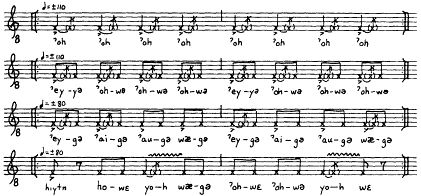
Example 8.
Typical "rhythm" parts chanted by male accompanists in the Brush Dance.
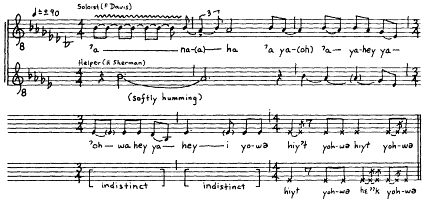
Example 9.
Segment of a heavy song with accompaniment in heterophonic style.
by Elmer Jarnaghan (Hupa) is transcribed in example 10. The song is typical in beginning with a short intonation that establishes a tonal and rhythmic framework for what will follow. This bit of "rhythm"[5] also sets the tempo for the accompanists or "helpers." It also usually defines the tonic pitch of the solo part, and indeed it does so here though Jarnaghan has somewhat masked the fact by echoing the final note of each phrase-group (except X) with a measure or two of "rhythm" sung a minor third lower.[6]
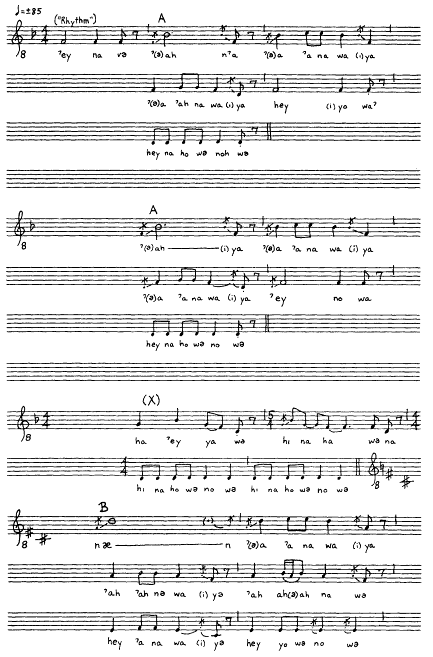
Example 10.
Brush Dance heavy song performed by Elmer Jarnaghan (Hupa) and recorded
by Richard Keeling in 1979.
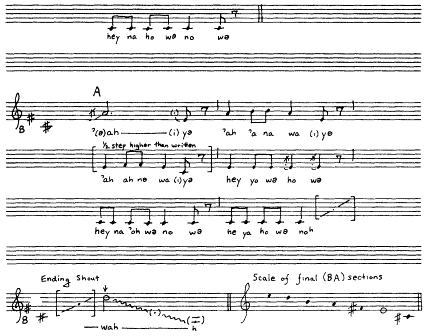
Example 10.
Brush Dance heavy song performed by Elmer Jarnaghan (Hupa) and recorded
by Richard Keeling in 1979. (continued)
As in most Brush Dance songs, each phrase-group begins with a melodic leap to a relatively high pitch and descends gradually to cadence in the chanting of "rhythm." Thus each section typically ends with the solo singer allowing his voice to become absorbed in the glottalized ostinato of the group.
Most of these songs include a contrasting (B) section in which the singer moves up to a higher pitch level and delivers new melodic material in a climactic fashion. Thus the most typical structure is an AAB-type form, though note that the letters refer to phrase-groups rather than to motives as in previous analyses of other genres. The song in example 10 has an extra phrase-group (X) and a recapitulation which make its form AA(X)BA, but this follows the basic pattern and is only one of many possible variants that are heard.[7]
All of these Brush Dance songs are rhythmically exciting. Even though example 10 is rather slow in tempo and modest in its use
of syncopation, the singer is constantly "stretching" the beat against that of the ostinato, much as a modern blues singer might. When Indian singers tap their foot to the music, they raise the toe on the downbeat and let it fall on the offbeat, thus producing a cross-accent like that produced by a jazz drummer when he strikes the ride cymbal on the weak beats of a 4/4 measure.
In the dance itself this cross-accent is particularly noticeable, as all the dancers rock their bodies in a similar counter-rhythmic fashion and wear heavy shell necklaces which rustle loudly in concert with the movement. The men heave their torsos up and down from the waist in a rather forceful way, and if there are girls in the pit they bob up and down on the balls of their feet in a more restrained way. All these songs have a duple feel, and 4/4 meter is the general rule.
The reader may have noticed that the pitch level of the song drops one half-step between phrase-groups X and B, and instances of "pitch drift" (in either direction) are common in the repertory as a whole. Adjusting for this, we find a scale that is anhemitonic and pentatonic, but here again (as in examples 3 and 7) the scale is irregular in that notes of the upper octave and lower octave do not correspond exactly. As mentioned previously, this is not the general rule but occurs often enough to be regarded as stylistic. Here again the melodic range is wide, and the overall contour is descending or perhaps terraced-descending. Finally, the ending of the song is signaled by a closing "flourish" shouted by the soloist, and this is a general characteristic of Brush Dance songs.
While the song in example 10 seems to have a relatively static or "fixed" character, others such as the one transcribed in example 11 are more spontaneous or improvisatory in nature.
In example 11 the formal structure is ABB1 , the B1 phrase-group being drawn out into a rather lengthy improvisation. Thus the tension increases as the song moves toward an end. The songs are sung three times, and a superior singer often embellishes the last section of the song more and more each time, dramatically extending the climax of the music. Ewing Davis was a master at this, but other modern singers use a similar approach.
Having examined different versions of the AAB-type form in modern recordings, it is interesting to compare a Brush Dance song performed in 1906 by Domingo (Yurok), a famous singer from
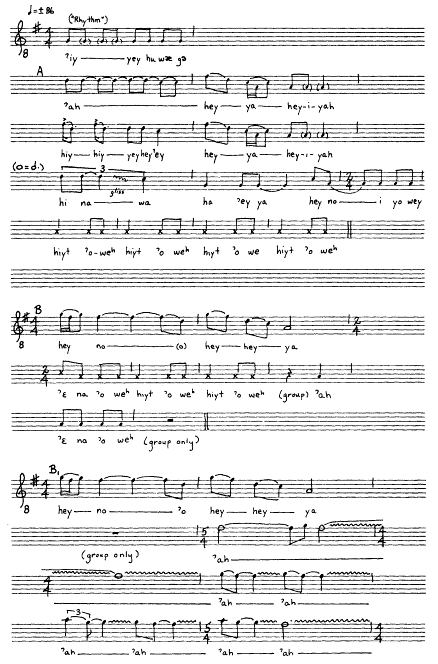
Example 11.
Brush Dance heavy song sung by Ewing Davis (Hupa) and recorded
by Frank Quinn in 1956.
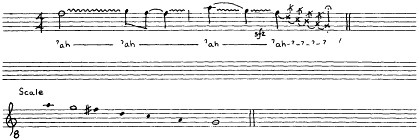
Example 11.
Brush Dance heavy song sung by Ewing Davis (Hupa) and recorded
by Frank Quinn in 1956. (continued)
Weitchpec. Generally speaking, the style is typical of that heard on cylinder recordings collected among Yuroks around the turn of the century.
Like the modern songs discussed previously, the song in example 12 is wordless. The early song also resembles recent ones in that its melody consists mainly of an alternation between motives sung in the upper register and "rhythm" motives chanted in the lower part of the singer's range. But instead of having the AAB-type form, which has been postulated as a sort of norm in modern singing, this one has an irregular structure in which "rhythm" motives are much more prominent. This occurs in other early recordings and seems to suggest that the relatively common AAB-type form in modern recordings could be a recent development. A similar trend was noted with respect to Deerskin Dance songs.