
2—
New Jobs for Cyclotroneers
On June 27, 1940, four men representing together the nation's best research universities and technical schools, its largest private foundations and most advanced applied science, and its most prestigious scientists obtained from Roosevelt a commission to set up a National Defense Research Committee (NDRC) under the authority of the forgotten Council of National Defense of World War I. These pooh-bahs of science and technology were Vannevar Bush, accomplished electrical engineer, former vice president of MIT, head of the Carnegie Institution, head of the National Advisory Committee for Aeronautics; Karl T. Compton, physicist, president of MIT, trustee of the Rockefeller Foundation; James B. Conant, chemist, president of Harvard; and Frank B. Jewett, electrical engineer, head of Bell Labs, president of the National Academy of Sciences.[77] All four have appeared in our pages as promoters of cyclotrons. They were to recruit from the corps of cyclotroneers many of the men who would direct the major wartime laboratories. They knew that cyclotroneers understood how to work at the borders and edges of science and technology, and how to work in teams: cyclotroneers and their fellow travelers did not fear big projects, did not disdain to scrounge when necessary, did not insist on perfection or protocol. They were ideal people for crash programs.
[76] "Atom smasher wins highest scientific honor," University Explorer, [Nov 1939] (40/15); R.W. Wood to Lawrence, 13 Nov 1939 (37/24).
[77] Hewlett and Anderson, New world , 24–5; Baxter, Scientists against time , 14–16.
In the Ether
In October 1940 Alfred Loomis, who had been appointed head of microwave work under Karl Compton's division of NDRC, called members of his committee to meetings at his home and laboratory in Tuxedo Park, New York. Lawrence was among them. They agreed that the technology made possible, and the emergency recommended, the establishment of a central national laboratory to do "anything and everything that was needed to make microwaves work."[78] To confuse the enemy, and in honorific obfuscation, the center, located at MIT, took the name "Radiation Laboratory." It invented or perfected many sorts of radars operating at wavelengths around and below 10 cm. In devising these most important aids to detection and navigation of ships and planes, blind landings, gun laying, and so on, the MIT Radiation Laboratory drew twice over on the experience of cyclotroneers. For one, it acquired appropriately socialized staff with relevant technical knowledge. ("If all the energy which has gone into nuclear physics since 1932 were turned onto this problem [the air menace]," Cockcroft had predicted, "it would be solved.") To head the new Rad Lab, the Microwave Committee chose Lee DuBridge of Rochester, whom Lawrence rated as the most desirable laboratory leader of his generation, an excellent physicist, administrator, and team player, the perfect cyclotroneer. As DuBridge later recalled, with an exaggeration that illustrates the strength of the brotherhood he represented so well, "our whole initial group at the MIT laboratory were the cyclotroneers—all had been associated with Ernest [Lawrence] either remotely or intimately." A meeting on applied nuclear physics in Cambridge around November 1, 1940, arranged by Livingston and attended by 600 physicists from all across the country, provided a perfect recruiting ground.[79]
[78] Loomis to Lawrence, 1 Oct, and reply, 3 Oct 1940 (46/8); MIT, Five years , 12, quote.
[79] Cockcroft to Lawrence, 24 Oct 1938 (4/5); Lawrence to Zeleny, 5 Mar 1940 (18/44); Guerlac, Radar , 260–1; DuBridge, interview by James Culp, Oct 1981, 11, quote; Condon, BAS, 1:11 (15 May 1946), 8–9.
Table 10.1 lists the ten cyclotroneers engaged during the first three months of the MIT Rad Lab's operations. One came and stayed as director; six entered as or quickly became group leaders; five left as division leaders (there were seven R&D divisions in all); two ended on the laboratory's steering committee. Lawrence's devotion to Loomis and conviction of the importance of radar caused him to send his very best men, Alvarez and McMillan, and his expert on radio frequency systems, Salisbury. McMillan, who left MIT soonest, worked on field tests of an interception system against aircraft and on airborne radar for detecting and homing on ships. Salisbury directed efforts in his specialty. Alvarez, who stayed the longest of the Berkeley group, moved furthest. After helping to develop radar for attack planes, he invented a system to guide approaching aircraft from the ground and directed work on other aids to detection, navigation, and identification.[80] Another man from Berkeley, Lauriston Marshall of the Department of Electrical Engineering, had a career at the MIT laboratory similar to a cyclotroneer's: he came to work on magnetrons, rose immediately to group leader, then chairman of the Ship Committee and director of the British Branch of the Radiation Laboratory, and closed the war as head of the Laboratory's Operational Research Section attached to the Headquarters of the U.S. Air Force in the Pacific.
Marshall represents the second way in which accelerator laboratories contributed essentially to radar. In the late 1930s, he helped transform Sloan's latest piece of cyclotronics into a generator of radio waves at a frequency and power suitable to radar. This was a tube designed to remove the obstacle encountered in the early 1930s to the development of the Wideröe linac into a useful tool in nuclear physics. To recall the old difficulty, a Wideröe machine for protons of reasonable size and ambitious energy would require a power oscillator working at a wavelength of two or three meters, about an order of magnitude shorter than commercial tubes could easily handle. As he remembered his
[80] Lawrence to Dunning, 9 Nov 1940 (6/19); MIT, Rad. Lab., "Staff;" Alvarez, Adventures , 86–101. We omit mention of radar work at Bell Labs, not because it lacked importance, but because it lacked cyclotroneers; Fisk, Hagstrum, and Hartman, Bell System techn. jl., 25:2 (1946), 1–189.
| ||||||||||||||||||||||||||||||||||||||||||||||||||||||||||||||||||||||||||||||
tinkering to improve their performance, Sloan "just pushed triodes and tetrodes to high power, high frequency, beyond anything the cyclotron needed." By May 1940, he and Marshall had a tube that oscillated at 50 cm and with great power—some 2,500 watts. Cooksey reported this news to Loomis, who had not waited for the NDRC to begin to push work on microwave electronics. Loomis was elated.[81] The cause of elation: the size of radar sets diminished, while the detail of the objects they could see increased, with decline of wavelength down to about 1 cm, where atmospheric absorption begins to make trouble. The Sloan-Marshall tube, or "resnatron," held promise as the fast-paced heart of a powerful, centimetric microwave transmitter for airborne use.[82]
As soon as he became head of the NDRC's microwave work, Loomis asked Lawrence to take responsibility for the further development of the resnatron "in a big way," as "the major war research of the University [of California]." The Research Corporation, which had patented the resnatron, gave $4,500; Loomis provided $1,500 from his deep pocket and a promise of $20,000 of NDRC funds. Lawrence agreed to sail "full speed ahead" with the help, if necessary, of moneys diverted from the 184-inch cyclotron.[83] The good ship resnatron was then not the only centimetric pulser at sea in the Bay Area. Loomis had asked Lawrence to send Sloan and Marshall to San Carlos, California, to join their work with efforts under way there to perfect something called the klystron.[84] Like the resnatron, the klystron resulted from efforts at a university—in its case Stanford—to overcome the frequency limit of commercial oscillator tubes. Stanford wanted a very powerful x-ray tube, no less than 3 MV, but did not want to pay for it. Considering strategies in 1934, William Hansen, an instructor in Stanford's physics department, thought to set up oscillations in a
[81] Sloan, interview by A. Norberg, 10 Dec 1974, 52–3, quote (TBL); Cooksey to Loomis, 14 May 1940, and other correspondence of Loomis, Cooksey, and Lawrence, May 1940 (46/8).
[82] Terman, Elect. radio eng. , 810, 854, 1018–9.
[83] Loomis to Lawrence, 9 Jul and 12 Aug 1940, and Lawrence to Loomis, 26 Jul and 6 and 29 Aug, 28 Sep 1940 (46/8).
[84] Loomis to Lawrence, 26 June, and reply, 1 Jul 1940 (46/8); Poillon to P.R. Bassett, Sperry, 26 June, and to Lawrence, 2 Aug 1940, and Lawrence to Poillon, 6 and 24 Aug 1940 (15/18).
cavity, a transmission line, as it were, with no inner electrode. The thing itself is simple enough in principle and, moreover, of convenient size: a cube 10 cm on a side resonates at a wavelength of 14 cm. It may be driven by a transmission line that creates an appropriate magnetic field within a loop coupled to the cavity. A struck bell is a crude, but serviceable, analogy. In 1937 Hansen had a visionary plan to drive electrons to 100 MeV within his "rhumbatron," as he called his cavity resonator. He sent off a report, in the usual way, to a professional journal; but Stanford's administrators, sensing something big, made him hold it back for a year while they made sure of the commercial possibilities.[85]
The rhumbatron transformed into the klystron when Hansen's former roommate, Russell Varian, discovered a novel way to control electrons. That was in the summer of 1937. Varian and his brother Sigurd, a former commercial pilot, then worked with Hansen as unpaid research associates on the design of a microwave device for navigating and detecting airplanes. This purpose had seized Sigurd Varian, who knew the dangers of commercial flying and could imagine those of enemy action. The klystron (fig. 10.1) consists of two reentrant cavities C1 and C2 , separated by a drift space RS. A beam of electrons from the tubular cathode at the top accelerates under the dc voltage between M and the grid P, whence they drift through the field-free region PQ and into the neck of the "buncher" cavity C1 . Between Q and R they suffer an oscillating field created through the loop F. This experience causes them to collect into bunches in the drift space RS: an electron that crosses just before the oscillating field rises to zero will be slowed; one that crosses when the field goes positive will speed up. As they drift, the retarded early electron, the on-time electron, and the hurrying late electron will congregate. The neck of the "catcher" cavity C2 stands where the density is greatest and the induced field has the proper phase to oppose the motion of the bunches (and so derive energy from them). The congregations pass at the frequency of the buncher, thereby exciting very strong
[85] Science news , in Science, 84 (16 Oct 1936), suppl., 9, reported that Hansen had electrons of 5 MeV; Nahmias to Joliot, 28 Apr 1937 (JP, F25), mentioned the plan for 100 MeV; Hansen, Jl. appl. phys., 9 (1938), 654–63, rec'd 17 Jul 1937; Ginzton, IEEE, Spectrum (Feb 1975), 33.
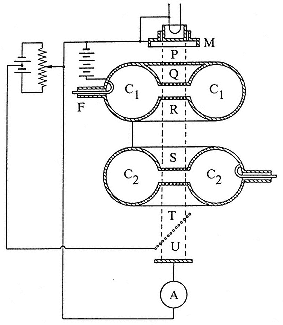
Fig. 10.1
The klystron as first described by the Varian
brothers. R. Varian and S. Varian, J1 appl. phys. ,
10 (1939), 324.
oscillations in the tuned catcher. The deceleration of the bunches in the catcher prevents them from overcoming the opposing voltage between T and U, a fact recorded by the meter at A. The whole business rests in a vacuum. By August 1937 a cardboard version coated with copper foil was working at l = 13 cm. The Sperry Corporation undertook to develop it for aircraft detection.[86] This was the line of research to which Loomis wished to couple development of the Sloan-Marshall tube. As it happened, the Varians and Hansen went to Sperry's research laboratory in New York, where the klystron developed into a versatile circuit element. Hansen spent much of his time in the East lecturing about microwaves at the MIT Radiation Library.
[86] Ginzton, IEEE, Spectrum (Feb 1975), 34–9; Varian and Varian, Jl. appl. phys., 10 (1939), 321–7; Webster, ibid., 501–8, 864–72. The business can be followed in detail in the Hansen Papers, Stanford Univ. Library.
Neither Berkeley's nor Stanford's entry into what had become a worldwide race for a transmitter of centimetric radar could generate the necessary power in 1940. The device on which the MIT Rad Lab was raised later in the year had much in common with them, however; it came from a university laboratory much concerned with particle accelerators and exploited the bunching principle introduced by the Varian brothers. This "cavity magnetron" came from Oliphant's institute at the University of Birmingham. Its inventors, J.T. Randall and H.A.H. Boot, arranged an anode consisting of a thick ring scalloped by cavities around a central cylindrical cathode (fig. 10.2). Electrons move toward the anode under a dc potential and a magnetic field strong enough to bend them all back to the cathode. When the cavities resonate under an external impulse, their radio frequency fields, leaking into the anode space, slow some electrons enough that the magnetic force on them (which is proportional to their velocity) no longer suffices to return them to the cathode. Electrons so affected bunch together and add energy to the resonant cavities as they pass en route to the anode. In effect, the cavity magnetron is to the klystron what the cyclotron is to the linac.[87]
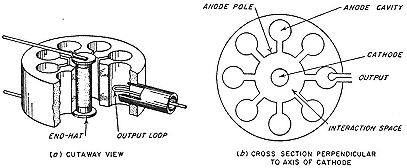
Fig. 10.2
The cavity magnetron. Modulation of the radial electrostatic field between
the cylindrical cathode and the concentric anode-block by a high-frequency
field leaking from the cavities causes some of the electrons to bunch.
Terman, Elec. rad. eng. , 689.
[87] Terman, Elect. radio eng. , 689—95; Hagstrum, IRE, Proc., 35 (June 1947), 548–64.
The cavity magnetron was the centerpiece of many ingenious devices that a British technical mission under Henry Tizard, which included Cockcroft and Fowler, showed American military and scientific men in September 1940 in the hope of returns in kind. The magnetron made an impression. The Naval Research Laboratory then had a klystron transmitter operating at 10 watts. The British cavity magnetron gave a thousand times as much power at the same wavelengths. Cockcroft and E.J. Bowen explained its operation in detail at a gathering at Loomis's estate at the end of September. Two weeks later, on October 12–13, the Microwave Committee met with Bowen and Cockcroft, again at Tuxedo Park. They decided to copy Britain in entrusting development of radar to interdisciplinary teams of academic scientists and engineers. Lawrence ran to Loomis's telephone. "During the next few weeks [as Bowen recalled] he was to telephone every physicist of consequence in the United States." A month or so later the MIT Rad Lab, "a central laboratory built on the British lines, was in operation."[88]
The magnetron did not end the war for the resnatron. After Marshall threw in his lot with the MIT group and Sloan at last won his Ph.D. in Berkeley, the new doctor took his tube for treatment at Westinghouse's Research Laboratory in Pittsburgh. There it waxed exceedingly robust. Westinghouse built forty-two of the final design, each of which weighed 500 pounds. These fat resnatrons knocked out everything on the air. They were of first importance in jamming German radar on D-Day.[89]
Elsewhere
In August 1941 Lawrence pulled McMillan from the ether at MIT and dropped him in the water at San Diego. A new laboratory, run jointly by the navy and Jewett's division of NDRC, was being organized there under a contract with the University of California. Its director, Vern Knudsen, professor of physics at UCLA, had built up a small, strong group in applied acoustics with support from the movie industry, for which he had built
[88] Clark, Tizard , 264–70; MIT, Five years , 12, quote; Bowen, Radar days , 157–9, 168–78, quotes; Guerlac, Radar , 248–50.
[89] Anon., Westinghouse eng., 6:2 (Mar 1946), 47.
sound stages. But neither Hollywood nor UCLA had given him work on the scale on which he was now to perform: to study the physics of underwater sound, especially means to measure its spead precisely; to improve or design new methods of underwater detection and evasion appropriate to conditions in the Pacific; and to develop training manuals and devices for operators with very little technical knowledge. Knudsen turned for help to the physicist at the University of California most experienced in big operations. Lawrence "came down [to San Diego], spent time with us . . . , and participated in formulating our research program."[90]
Perhaps most usefully, Lawrence furnished McMillan, much to the irritation of the leaders of the MIT Rad Lab. With the breadth of view and ingenuity that had made him so valuable a member of Lawrence's Laboratory, McMillan contributed to all phases of the work at San Diego. He devised an echo repeater, "Beeping Tom," the first contribution from Knudsen's shop accepted by the navy, which simultaneously freed submarines from service as training targets and sonar operators from the need for practice at sea. He was particularly effective, according to Knudsen's successor, G.P. Harnwell, "in criticizing and directing the program of the laboratory in the fundamental investigations assigned to it."[91]
The first group of cyclotroneers entirely mobilized by NDRC was Tuve's force in the Carnegie Institution. In September 1940 they put aside their Crocker clone for "nights and days with defense work." They had taken on the task of knocking enemy planes from the sky. At the time, conventional wisdom rated very highly an antiaircraft system that could hit one plane in 2,500 shots. Under this mild inhibition, the Luftwaffe could bomb and strafe without much worry about guns on the ground. Following conversations between Lauritsen and Tuve and the navy's Bureau of Ordnance in August, the NDRC contracted with the Carnegie Institution for "preliminary experimental studies on new ordnance
[90] Baxter, Scientists against time , 172–4, 180; Hackman, Seek and strike , 251–2; Knudsen, interview with L. Delsasso and W.J. King, 18 May 1964 (AIP), 24–8, 46–7, quote.
[91] McMillan to Lawrence, 18 June, 4 Jul, and 22 Aug 1941, and Lawrence to McMillan, 8 Jul 1941 (12/30); McMillan to Lawrence, 18 June 1942 (12/31); Harnwell to Bush, 5 Oct 1942 (McMillan P).
devices." Tuve learned about what the British had done from Cockcroft and Fowler and set out to make a fuse activated by radio that would detonate near its target. Everyone working on the Carnegie cyclotron—Tuve himself, L.R. Hafstad, R.B. Roberts, G.K. Green, and Philip Abelson—went to work to make a radio sufficiently small and tough to fit into the space of an ice cream cone and withstand the inspiring forces—some tens of thousands of times greater than the force of gravity—exerted during firing on a five-inch shell. The Carnegie's administration, however, preferred to see its expensive cyclotron brought to completion; and, in a gambit we shall see repeated, requested Tuve's men to return to their machine as a measure of national defense. He rejected the request as selfish and the aim as ineffectual. "Representatives of every Cyclotron Laboratory in the country have individually asked us what they could use their cyclotrons for in defense work and no valid ideas have been forthcoming. . . . It is easy for an enthusiastic entrepreneur to make a casual remark that a cyclotron can be classified as a defense project. If the Institution staff had no other defense work of clearly greater urgency, this would be our position [too] as it was previous to August."[92]
Tuve did find a little war work for his new three-story cyclotron laboratory. He and his associates dropped miniature radio tubes from its roof onto the concrete driveway below as a test of fragility. Enough survived to prompt contracting with their makers. When he declared the worthlessness of cyclotrons for national defense, Tuve had three sorts of tiny tubes that could withstand firing in a five-inch shell. By May 1941, a basic design for a fuse triggered by radio was in hand; but premature firings and duds troubled its tests during the summer. The bombing of Pearl Harbor brought new urgency and manpower to the project and its relocation to a large garage in Maryland. This new facility, dubbed the Applied Physics Laboratory of Johns Hopkins University, which contracted for its operation, improved reliability and invented an ingenious mechanism to prevent unintended explosions. Late in 1942, 4,500 shells, perfectly safe to their users,
[92] Tuve, "Report for September 1940" (MAT, 21/"extra copies"); quotes from, resp., Tuve to Condon, 23 Oct 1940 (MAT, 24/"MIT conf."), and Tuve to Fleming, 25 Jan 1941 (MAT, 25/"cycl. 1940").
reached the Pacific Fleet. In their first engagement they brought down a Japanese bomber in four shots. The project compared in importance, success, and expense with the making of the atomic bomb.[93]
One of Bush's first prizes as chairman of NDRC was the Advisory Committee on Uranium. This body, chaired by Lyman J. Briggs, director of the National Bureau of Standards, had resulted from the famous letter alerting Roosevelt to the possibility of nuclear weapons, signed by Einstein but composed by Szilard and his fellow Hungarian refugees Eugene Wigner and Edward Teller. Briggs was no cyclotroneer. His committee, which had the frequent optimistic advice of Szilard, had not accomplished much by May 1940, after seven months of existence. The delay and the apparent indifference of the armed services to the opportunities opened by fission made the refugees impatient and, perhaps, self-important. "We ought not to try to save the country for the Americans [Wigner wrote Bethe], but to push them to save themselves."[94] Without their pushing, however, a typically American instrument—a body of self-moving private citizens appointed by the president to mobilize scientists within and outside government—had come into being that would vitalize the uranium project.
The citizens, the founders of NDRC, had been drawn into the business of the uranium committee a few months before the creation of their organization. The news from Columbia in March 1940 that, as predicted by Bohr, U235 was the party guilty of fission by slow neutrons, directed attention to the importance of the separation of uranium isotopes. In April, at the meeting of the American Physical Society in Washington, Beams, Fermi, Nier, Tuve, and Urey decided that Beams's ultracentrifuge offered the best hope for separation in kilogram amounts. In May, Beams, Cooksey, Karl Compton, and Lawrence reached a similar conclusion. Compton notified Bush (as head of the rich Carnegie
[93] Baxter, Scientists against time , 221–33, 241–2. Over 130 million proximity fuses were made at an average unit cost of $20; their manufacture eventually monopolized 25 percent of the American electronics industry and 75 percent of the facilities for molding plastic.
[94] Wigner to Bethe, 21 May 1940 (HAB, 14/22/976); Hewlett and Anderson, New world , 19–24.
Institution), who already knew about Beams's work from Tuve, whose department had deliberated purchasing a centrifuge for biological work. Tuve had rated Beams's model, which cost $5,000, as the best available for separating isotopes (he had tracers in mind) and biological materials. Tuve now recommended to Bush that the Carnegie Institution give Beams $10,000 to determine whether U235 could be spun free from U238 . In Tuve's opinion, centrifugation offered "the only hope of separating the isotopes of any but the light elements in quantity." Neither thermal diffusion nor the mass spectrograph (electromagnetic separation) seemed competitive to him.[95]
Bush agreed to provide money and call meetings. The Naval Research Laboratory had been helping Beams with supplies and apparatus at a level estimated by Tuve at $2,000 a year. After Bush's intervention, the army and navy put up $100,000 to study the separation of isotopes, primarily by centrifugation, but also by thermal liquid diffusion, as proposed by Carnegie's Abelson, then recently returned from Berkeley and work on element 93.[96] A possibility that Tuve had not considered explicitly, diffusion of uranium hexafluoride gas through tiny holes in a "barrier," which would slightly enrich the lighter isotope, appealed to Urey and others at Columbia, who obtained money from NDRC in the winter of 1940/41 to follow it up. The runaway favorite in July 1941, as judged by a budget then proposed by Briggs's committee, was Beams's centrifuge ($95,000); Columbia's gaseous diffusion ($25,000) came a poor second. At just this moment, however, the British intervened as decisively as they had in the fall of 1940.[97]
For a year and a half, Chadwick, Cockcroft, Oliphant, Thomson and other leading British physicists knew that a bomb might be made from 10 kg or less of separated U235 . The relevant
[95] Compton to Bush, 9 May 1940 (KTC); Hewlett and Anderson, New world , 23–4; Abelson and Tuve, "The current status of the ultracentrifuge as a research tool," 17 Jan 1940 (MAT, 25/"biophys. 1940"); Tuve to Bush, 13 Apr 1940 (MAT, 19/"Beams"); Beams, RMP, 10 (1938), 248–51; Loofbourow, RMP, 12 (1940), 324–9.
[96] Bush to Compton, 14 May, and Loomis to Compton, 17 May 1940 (KTC); Tuve to Bush, 13 Apr 1940 (MAT, 19/"Beams"); Hewlett and Anderson, New world , 27, 32.
[97] Hewlett and Anderson, New world , 40–3.
considerations had been put forward in February 1940 by the émigrés O.R. Frisch (Cambridge) and Rudolph Peierls (Birmingham), who assumed, among much else, that fast neutrons as well as slow ones could cause fission in U235 . "From rather simple theoretical arguments," they wrote, without arguing, "it can be concluded that almost every collision produces fission and that neutrons of any energy are effective." This was a capital point: a slow neutron bomb would be more likely to fizzle than to devastate. And where procure the U235 ? Frisch and Peierls suggested gaseous thermal diffusion. Another émigré, Franz Simon (Oxford), showed that diffusion through a barrier could do much better. In his optimistic calculations, completed in December 1940, a plant covering forty acres and employing 1,200 people could turn out 1 kg of 99 percent pure U235 in a day. During the first six months of 1941, these prophecies drew strength from rough measurements by Tuve's group, which confirmed the fundamental hypothesis of fast-neutron fission on a sample of U235 provided by Nier. Peierls exulted: "There is [now] no doubt that the whole scheme is feasible (provided the technical problems of isotope separation are satisfactorily solved)." The official report of the British uranium committee (called the MAUD Committee) of July 1941 endorsed and refined the original Frisch-Peierls memorandum: twenty-five pounds of active material, a gaseous diffusion plant costing £5 million, a bomb deliverable at the end of 1943 equivalent in destructive power to 1,800 tons of TNT.[98]
The MAUD report changed American thinking. Although everybody had known that a chain reaction, if achieved, might make possible a nuclear explosive, Briggs's uranium committee did not have a bomb as its goal. Looking back with the greater wisdom of 1943, Fermi recalled that he knew of no one working with either fission or element 94 in the United States who appreciated their potential as explosives until the spring (or, better, the early summer) of 1941. Ignorance of British thinking was not the reason for this devaluation. Oliphant had written Lawrence in May 1939 that the British defense authorities insisted on looking
[98] Gowing, Britain and atomic energy , 58, 67–8 (quote), 77, 390, 392, 394–8; Smyth, Atomic energy , 66.
into the possibilities of a bomb, however remote, "as there are rumours that great developments have taken place recently along these lines in Germany." Lawrence, conceding the possibility, had asked "Segrè and some of the other boys" to see whether they could fission lead or bismuth. Typically, he saw neither a danger nor the likelihood of imminent success, but an entrepreneurial opportunity. "This sort of thing is another reason why the British government should come forward with generous support of nuclear physics."[99] Nor did disclosure of the Frisch-Peierls report by the Tizard mission inspire Lawrence or other leaders of American nuclear physics to set a high priority on making bombs. Cockcroft thought them overly skeptical about military applications and overly fascinated with the possibilities of nuclear power.[100] But then Britain, not the United States, was at war.
The pace of the Briggs committee exasperated some of its members, particularly Urey, and busy outsiders like Lawrence. In March 1941 Lawrence managed through Karl Compton to have himself assigned by a reluctant Bush—who did not like being pressured—to the post of temporary consultant to Briggs. Lawrence obtained a modest increase ($2,000) in support of the Laboratory's work on elements 93 and 94 and a contract to Nier for 5 mg of U235 . His role was that of gadfly; he did not urge a change of program but greater vigor and less secrecy in pursuing the self-sustaining pile.[101] At the instigation of Briggs, Bush asked Jewett to convene a committee of the National Academy of Sciences to evaluate the uranium program. Jewett appointed A.H. Compton, Coolidge, Lawrence, John Slater of MIT, and John Van Vleck of Harvard. Their report, finished in May, did not emphasize a bomb; it was vague and uplifting, in the style of Lawrence's requests for major funding. The uranium project should be supported for the general significance of achieving a chain reaction and for the importance of even a moderate separation of uranium isotopes; if successful, the project might produce,
[99] Fermi to A.H. Compton, 31 Aug 1943 (Fermi P); Oliphant to Lawrence, 30 May, and reply, 15 June 1939 (14/6).
[100] Hewlett and Anderson, New world , 28–9; Hartcup and Allibone, Cockcroft , 124.
[101] Hewlett and Anderson, New world , 35–9; Bush, Pieces , 60; Compton, Atomic quest , 47.
in order of military importance, radioelements in sufficient quantities to poison enemy territory, power plant for submarines, and a bomb, the last unlikely before 1945.[102]
Bush and Conant then knew about British hopes for a bomb, which Conant had learned of during a sojourn in London in the early spring as liaison between NDRC and British defense authorities. He and Bush dismissed the NAS report as too vague on bombs and too fanciful on power. They asked for another. Jewett added two engineers to the committee. Its report, of 11 July, did not differ significantly from its predecessor's. Conant inclined to squelch the project. No one seemed to know much of the MAUD report or to take it seriously. Lawrence heard about it in September 1941, not from Briggs, who appears to have kept the report secret even from himself, but from Oliphant, on tour of American laboratories engaged in radar and other war work. What had been missed in the United States, judging from a letter from Coolidge, who had chaired the NAS committees, was the connection between fast-neutron fission, ten-kilogram explosives, and practical gaseous diffusion. Oliphant raised Lawrence's enthusiasm for nuclear bombs. Oliphant thought that 10 kg of pure U235 might be within reach, perhaps by cyclotronics. And there was also element 94, which the Laboratory had shown to be fissionable and MAUD had mentioned as an alternative, if unlikely, explosive.[103] At the end of September 1941, just after meeting with Oliphant, Lawrence attended the fiftieth anniversary celebrations of the University of Chicago. There he met with Compton and Conant and urged that a new NAS committee be empanelled to consider the uranium project in the light of the MAUD report.[104]
[102] Smyth, Atomic energy , 50–2; Hewlett and Anderson, New world , 36.
[103] Cockburn and Ellyard, Oliphant , 102–6; Coolidge to Jewett, 11 Sep 1941, ibid., 106; Gowing, Britain and atomic energy , 433. According to Cockburn and Ellyard, Oliphant , 104, Fermi doubted the possibility of a fast-neutron explosive.
[104] Compton, Atomic quest , 8; Smyth, Atomic energy , 51–2; Lawrence, "Historical notes," 26 Mar 1945. Compton misdates the meeting in Chicago to early or mid September, before Oliphant reached Berkeley; Lawrence arrived in Chicago on 25 Sep, according to Lawrence to Compton, 5 Sep 1941 (4/10).
The illumination from London came just after Bush had reorganized and extended his empire. On June 28, 1941, he took over the directorship of a new agency, the Office of Scientific Research and Development (OSRD), which gave him responsibility for development of instruments of war as well as for research of military interest, authority to coordinate the efforts of various agencies, and immediate access to the president. Conant took the chairmanship of NDRC and Briggs remained as chairman of the uranium committee, which Bush raised to an independent unit, "S-1," of OSRD. He and Conant followed Lawrence's and others' promptings and returned to the NAS to ask for a new review with emphasis on the U235 bomb and the gaseous-diffusion plant. While the new committee deliberated under the chairmanship of A.H. Compton, Bush conferred with the president. He left the White House on October 9 with authority to expedite research on nuclear weapons in every way possible short of the construction of production plants. Compton's committee, which included Lawrence and Oppenheimer, endorsed the British findings, with some qualifications that proved wrong. Oppenheimer expected that 100 kg of U235 would be needed for a bomb. The committee thought that centrifugation might work. They raised the cost of separation to $100 million.[105]
On December 18, less than two weeks after Pearl Harbor, the complete S-1 section met at the National Bureau of Standards. It was time for a crash program. And to let contracts. Lawrence spoke up, immediately and eloquently, for study of electromagnetic separation on a large scale. The committee immediately recommended a sum of $400,000. It was easier than dealing with the Rockefeller Foundation.[106]
[105] Hewlett and Anderson, New world , 44–50.
[106] Ibid., 52.