
Court Theatre and the Indarsabha
The folk antecedents for Svang were augmented by midnineteenth-century theatrical developments in the princely establishments of the ruling elite, as well as in the urban centers where British-bred bourgeois culture was forming. The court and city as cultural loci were not isolated
from the rural-based traditions already surveyed, but each lent to theatrical performance a unique set of conditions and conventions. It is only in examining each tradition separately that the panorama of pre-modern theatre comes to life, and the emergent and combinatory nature of Svang and Nautanki takes on comprehensible shape.
Theatre was a principal pursuit of a number of kings across northern India in the period from 1600 to 1850, and they patronized theatrical performances held in their palaces as well as in public to amuse and edify the populace. Passing reference has been made to Braj dramas such as Hasyarnava and Madhava vinoda commissioned by or performed in the presence of royalty; the legendary connection between the Rajput courts and the early Khyal theatre has also been noted. The exact relation of court performances to the local drama traditions and available vernacular texts is a topic requiring research beyond the scope of this book. It would be particularly useful to know more about performance styles and their affinities to the secular folk traditions. For the present, we scan the range of court-related theatre, culminating in the appearance of Urdu drama in association with the midnineteenth-century court of Lucknow.
A flourishing court theatre based upon the Vaishnava movement was patronized by the ruling dynasties of Mithila, Nepal, Bundelkhand, and Assam from the fifteenth to the nineteenth centuries.[74] About a hundred plays were written by thirty-five dramatists during these four centuries, inspired in the main by the devotional songs of Vidyapati and Chandidas and traceable ultimately to Jayadeva's Gita govinda , written at the end of the twelfth century. Suniti Kumar Chatterji describes these dramas as "elementary dialogues of two or more actors accompanied by songs," and they appeared first in Bengal and northern Bihar (Mithila), spreading thence to Assam, Orissa, and Nepal.[75] The themes came from the Sanskrit epics and Puranas but also included the folk epics of eastern India, such as Raja gopichandra .[76]
The Malla kings of Nepal were great patrons of drama from whose courts in Patan, Bhatgaon, and Kathmandu come many of the surviving play texts. Although the Mallas' native language was Newari, a Tibeto-Burman tongue, various Indo-Aryan languages spoken in the vicinity were widely understood. The plays contain a mixture of dialects: stage directions in Newari; prose conversations in Bengali, Maithili, Kosali, or Awadhi; and songs in Maithili and other dialects.[77] One of these plays, Harishchandra nrityam , was written in 1651 by Ramabhadra Sarman for performance. in the Indrayatra, a large festival held in the
streets and squares of Kathmandu. Cassiano Beligatti, a padre en route to Tibet, wrote an extensive account of Indrayatra performances he witnessed between 1725 and 1750. Although he mentioned no specific titles, his description corresponds to the features inferred from the Harishchandra nrityam and other manuscript sources.[78]
Another Kathmandu manuscript, Krishnacharitopakhyan natakam , dated 1835, was enacted during the Indrayatra for nine days, by a troupe of 238 Newari performers. It was put on at the British residency before a mixed audience of Nepali court officials, Indians, and Britishers. The familiar Krishna lila from the tenth book of the Bhagavat purana formed the story. This play is written in Khari Boli Hindi, and Shardadevi Vedalankar claims it to be the earliest extant manuscript of a performed drama written in the modern vernacular.[79]
In the Bundelkhand region of Madhya Pradesh, theatre prospered at the court of Gangadhar Rao (reigned 1835-1853), husband of Lakshmibai, Rani of Jhansi. A man of sophisticated taste, Gangadhar Rao was a patron of theatre and made stage appearances himself on occasion.[80]Shakuntala and Harishchandra were two of the dramas exhibited in his court; the names of female dancers and scene painters have been preserved from the period. The plays were full of instrumental music, singing, and dancing, with conversations spoken in prose. This theatre survived until the end of the nineteenth century, when the noted Hindi novelist Vrindavan Lal Varma viewed some of its plays.[81] We do not know whether any texts were preserved from the Jhansi court theatre.
The last of the Nawabs of Lucknow, Wajid Ali Shah (reigned 1847-1856), ranks among the preeminent royal patrons of the arts in nineteenth-century India. Seated on the throne at the time of the British takeover of Awadh, Wajid All has been alternately praised for his magnificent court with its aesthetic refinement and condemned for his moral decadence and inattention to administration.[82] Several important performance genres such as the Kathak style of dance and the light classical song form thumri received his early support, and a host of minor forms thrived too.[83] In the theatrical realm, the Nawab encouraged the Radha-Krishna themes found in other North Indian courts. Attracted to song and dance from childhood, he established a rahaskhana

skit, Radha kanhaiya ka qissa , first played in Huzur Bagh in 1843.[85] Upon ascending the throne, he adapted several Persian-style romances for the stage and sponsored performances of them in Qaisar Bagh.[86]
During the reign of Wajid Ali, a drama by Aga Hasan Amanat entitled Indarsabha was staged in Lucknow. This play has long been considered the first written in the Urdu language. Opinions differ regarding the circumstances of its debut. Ram Babu Saksena, Somnath Gupta, and Annemarie Schimmel assert that Amanat was a courtier of Wajid All, and that he was commissioned to write Indarsabha for a court performance. Saksena and Gupta also cite the oral tradition that the Nawab played the title role of Indra for the opening.[87] Masud Hasan Rizvi ("Adib"), however, attempts to disprove Amanat's association with Wajid Ali Shah, maintaining that Amanat was never present at court owing to paralysis of his vocal chords. He recounts Amanat's own story, namely that the play was written at the suggestion of friends as an exercise in poetic virtuosity. Adib postulates that the Indarsabha was intended for a popular stage and was premiered before the common citizens of Lucknow, although Amanat may have imitated the king's rahas performances.[88]
Another controversy concerns European influence on the Indarsabha . Given the absence of antecedents for theatre in the Indo-Islamic tradition, several Urdu literary historians have opined that the Indarsabha was based on Western opera, introduced into Lucknow's court by visiting European musicians.[89] John Pemble notes that European music was in general not popular at court, and he concludes that operatic influence "does seem far-fetched."[90] From another perspective, Hindi literary historians have linked the Indarsabha to the Indian folk traditions, claiming Amanat's play as a vital bridge between ancient Sanskrit dramatic works and more recent regional theatre.[91]
Regardless of whether it was ever produced in court, the Indarsabha set a new standard for popular drama in North India. The work fuses Hindu and Muslim elements of plot, meter, and language in a form more indicative of its Indian and Awadhi origins than anything European. The events take place in the court of the mythic Indra, king of the gods, who sits in state encircled by fairies. Sabz Pari (emerald fairy) has been smitten by love for Gulfam, an earthly prince. Through the intervention of Kala Dev (black genie), she smuggles Gulfam into Indra's heaven. Displeased at this infraction, Indra casts Gulfam into a well and clips the wings of Sabz Pari. The pari , however, is undaunted and, sing-
ing irresistible songs in the disguise of a jogin (female mendicant), eventually earns her lover's release. Indra grants his blessings to the couple, and the lovers are reunited.
Replete with pageantry, fantasy, and romance, the Indarsabha was a multimedia piece incorporating narrative, poetry, dance, and music within the visually opulent setting of Indra's heaven. King Indra, originally a Vedic deity, had by late medieval times become an emblem of the lordly human monarch, particularly in his hedonistic aspect. He was often depicted surrounded by a harem of beautiful dancing girls.[92] This Hindu icon, with its popular symbolic relevance to India's Muslim kings, is wedded in the Indarsabha to a story of Islamic origin. The paris and devs belong to the dastan storytelling tradition imported from Persia.[93] Specific motifs seem to be imitated from several Urdu romances, including Mir Hasan's Sihr-ul-bayan and the Gulzar-e-nasim .[94]
Whereas Gopichand was the favorite nineteenth-century drama of folk derivation, the Indarsabha achieved pride of place in the newly spawned Indo-Muslim theatre. It earned immediate fame and soon appeared on stages all over India. The manuscript became a runaway bestseller. The first edition was published in Kanpur in 1853 (fig. 8).[95] The publishing peak occurred in the 1870s; during that decade, thirty-three editions were published from major cities in Uttar Pradesh and Bihar, as well as Lahore, Bombay, Calcutta, and Madras. The title Indarsabha was stolen by several imitators, the most successful being Madarilal.[96] Many Urdu dramas on the theme of a fairy succumbing to love for a mortal were written, using the word sabha or majlis (referring to the "aerial assembly") in the title.[97] Bharatendu Harishchandra even wrote a one-act parody entitled Bandar sabha (The monkey assembly).[98] The reputation of the work spread to Europe; it was translated into German by Friedrich Rosen in 1892.[99]
The Indarsabha phenomenon dominated the theatrical world until the era of the talking cinema. Henceforth, aristocratic Islamic prototypes of costume, scenery, language, music, and story matter were widely emulated. The fact that Muslim rule in India virtually ended three years after the play appeared added to rather than detracted from its prestige, for the image of Indra with his delight-inducing assembly came to represent the precolonial past in all its splendor and carefreeness. The emerging Indian elite may have scorned this nostalgic attitude as reactionary, defeatist, and decadent, but for the less sophisticated audience of popular theatre, the Indo-Muslim monarchy signified power and
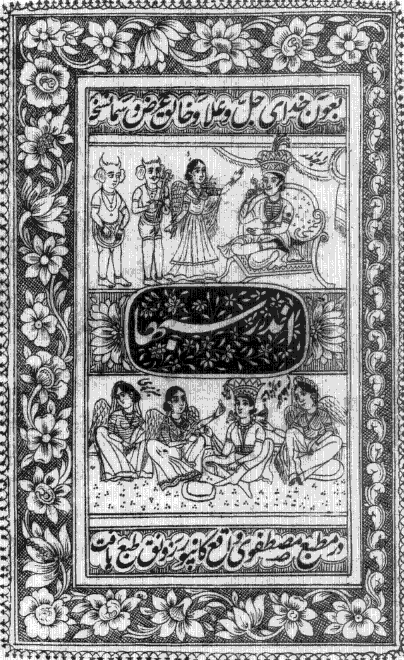
Fig. 8.
Title page of the first edition of Indarsabha by Amanat (Kanpur, 1853).
By permission of the British Library.
privilege. Feudal attachments remained strong, and they continued to dominate the popular culture of North India even as the first signs of a postfeudal reformist ethic in playwriting emerged.
After the Indarsabha , the Svang theatre became heavily imbued with Islamic flavor. Backdrop curtains painted with palace arches and pillars conjured up the courtly ambience, as did Nawabi styles of dress, head-wear, and ornaments. The aristocratic tone of the Indarsabha was imitated by adopting Urdu diction and modes of address. The folk vocatives betaji or pyareji (son, dear) used in early Sangit texts gave way to flourishes like lakht-e-jigar (piece of my liver, i.e., son or daughter) or jan-e-man (beloved of my heart). Stories based on Islamic materials, Syahposh, Benazir badr-e-munir, Laila majnun , and others, became more frequent Svang topics. These influences are clearly visible in the Hathras Sangit texts from the turn of the century.
The Indarsabha in this manner accelerated a process that transplanted court-based styles of music, dance, and poetry to a popular milieu. The perennial movements of exchange between refined and folk forms accelerated in the rapid breakdown of the patronage structure after the annexation of Awadh. Performers in search of employment must have turned to the rapidly growing theatrical sphere for survival. In consequence, styles such as Kathak, thumri , and ghazal were transplanted to the popular performance sphere, where they met less discriminating but not unenthusiastic patrons and audiences. By the same token, poetic meters and song forms moved from the court to the public milieu. The Indarsabha text contains the earliest instances of the chaubola meter, the six-line chhand that became the standard doha plus chaubola of Svang, as well as a variety of ghazal verses and many types of folk songs (basant, holi, dadra, savan , and bihag ). This metrical and musical diversity went hand in hand with the new style in stagecraft, and it stimulated the Svang poets in Hathras to incorporate a greater variety of verse types into their plays—a trend quite marked by 1900.