
Introduction
In 1979, the Chinese government formalized a new policy of openness to the West. For the first time in many years, Chinese artists could study the art of Europe and North America. Meanwhile, Western art historians began looking curiously into the art world of contemporary China. The lack of comprehension was mutual and almost total. Chinese art administrators, including Jiang Feng, an important figure in our study, traveled to France hoping to find the glorious source of China's revolutionary oil painting. They found it, of course, in the museums of Paris, but were appalled that its practice was largely defunct.
Western enthusiasts of Chinese landscape painting, the author among them, flocked to Beijing in search of the inheritors of China's great artistic tradition. Although we saw many artists and exhibitions, the painting we had come to find was hung in China's museums, not practiced in her studios. The art exhibited in Beijing in 1980 was very different from traditional Chinese painting; it also differed from contemporary Western art in many significant ways. To a Westerner, modern Chinese art was either bad or, more charitably, incomprehensible. The Chinese art world judged most contemporary Western art in the same terms.[1]
In the years between 1949 and 1979, the Chinese Communist party (CCP) succeeded in eradicating most of the artistic styles and techniques of which it disapproved. By the end of that period, most practitioners of unapproved styles had died or were very old and had no followers; only the most elderly of living artists had ever personally experienced the making of serious nonpolitical art, either in its traditional Chinese form or in Western form. Traditional landscape painting and modern international art had been replaced by styles that had never before existed in China. By 1979, the art of the People's Republic of
China was strikingly different in style and subject matter both from contemporary Western art and from the art practiced in other Chinese areas such as Taiwan, Hong Kong, and Singapore.
The purpose of this book is to describe what happened in the world of Chinese pictorial art between 1949 and 1979 to leave such a large cultural gap. Among the most important changes was the elevation of realistic painting, which was practiced in all media but most commonly in oils and gouache, to a prestigious position. This change is remarkable, for although Western styles of art were employed by some earlier artists, they had largely failed to take root before 1949.[2] Moreover, the complete integration of selected Western media and styles into all levels of the Chinese art educational system served, I believe, to sever Chinese art from much of its past.
Although artists have continued to paint in ink and color on Chinese paper and to mount some of their pictures in the traditional hanging scroll format, officially mandated changes in brushwork, theme, and style have been so great as to alter irrevocably the practice of Chinese painting. In particular, the subtle and culturally charged brush conventions that were practiced by masters of China's past have been eradicated from contemporary practice. With them has passed from existence a crucial element in the visual and intellectual pleasure that traditional Chinese viewers experienced in their art.
The changes accomplished during the three decades of our study have continued to drive the Chinese art world since 1979 and will continue to do so for the foreseeable future. Laments for a lost past, however, may be both purposeless and premature. The proscription of many conventions of previous art has opened the door to innovation, to a potential cosmopolitanism, and to inevitable reevaluations and revivals of the very traditions that have been suppressed. While we cannot predict the future of Chinese art, it is clear that, in its various forms, it is emerging as a legacy of, as a development of, or as a rejection of the artistic programs in effect during the formative Maoist period.
We will explore, by means of a chronologically organized narrative, the nature of those programs and their practical effects. Our text will discuss the means by which cultural controls were asserted over art, the ways in which artists responded to the new system, and the works of art that they produced as a result. The first chapter is a brief introduction to key personalities and to salient organizational features of the pre-1949 Chinese art world. Chapter 2, on the reform of Chinese art between 1949 and 1952, describes the reorganization of the art education system; the fate of self-employed artists; the establishment of a new Communist art bureaucracy; the rather limited stylistic, thematic, and technical changes that bureaucracy promoted; and the ideological ramifications of certain styles and techniques. A prominent theme of the book as a whole—the problem of how artists coped with arbitrarily shifting political requirements—appears, already, in this early period.
The third chapter, which covers the period 1953-1957, explores the influence that the Soviet Union had on Chinese art and the consequent problems for the practice of traditional painting. An important result of the centralized cultural policies of the period was a new emphasis on technical facility and ideological uniformity, standards that have persisted in the art and criticism of subsequent decades. Chapter 4 continues to describe the manner in which the disagreements between pro-Soviet and traditionalist artists, aggravated by conflicting factional alignments, were brought to the surface by the Hundred Flowers liberalization of 1956. Strangely, the issue formed the basis for political condemnations during the Anti-Rightist campaign of 1957, with support for traditional painting coming to be viewed as a test of party loyalty.
Chapter 5 describes the complicated developments that took place between 1957 and 1965. Regional groups of printmakers and painters in the traditional media emerged in such places as Sichuan, Heilongjiang, Xi'an, and Nanjing. The artistic diversification that accompanied the administrative decentralization of the period yielded some of the most original developments in China's new art.
The effects on the Chinese art world of the Cultural Revolution, which lasted from 1966 to 1976, are described in chapter 6. Our narrative discusses the mobilization of student artists to create the pictorial iconography of the Cultural Revolution, the destruction of the art bureaucracy, and finally the reestablishment of a streamlined and quasi-military arts administration. The radical homogenization of stylistic and thematic approach that was a primary characteristic of official art in the early 1970s had a profound impact on many painters active in the period. Our study concludes with an outline of some preliminary attempts to overturn socialist realism in the post-Mao era.
A note about research methodology may be appropriate at this point. My primary sources have been publications of various kinds from China, works of art viewed in Chinese and Western collections, and interviews with artists and administrators conducted between 1986 and 1990. The personal contact with artists has been particularly valuable because it gave me a hint of how the Chinese art world looked from the inside.
Interviews, of course, present some hazards as documentation. Of greatest importance, the political climate in China at any given time will affect what people feel comfortable discussing. I was fortunate to conduct my research during a period when China enjoyed a comparatively great degree of openness. Nevertheless, some inhibitions remained. The agendas people bring to their interviews necessarily influence the way they present their experiences. In some cases, an individual may think certain aspects of his biography more important than the interviewer does and, at the same time, prefer not to discuss the events a Westerner might find of real interest. More rarely, artists presented their careers as they wished they had been rather than as they were. In matters
of simple fact, some very helpful people turned out to have inaccurate memories for dates and chronological sequences.
People will, of course, remember the same events very differently. More difficult than conflicting accounts, though, are those that conform in all details. There are a few events, such as the Anti-Rightist campaign of 1957 and 1958, that many people of the same age remember in exactly the same terms, using phrases that turn out to be word-for-word quotations from propaganda magazines. Political indoctrination, in other words, seems to have blended with personal experience in their memories. In spite of these limitations, however, the opinions of the artists about their own work and about the work of their colleagues has provided some of my most valuable insights.
Whenever possible, I have compared interview information with published material. In such cases, I cite the published source. Yet publications present their own difficulties. Most written statements were subject to party censorship at the time of publication; some articles are so strongly colored by the party line of the period that they reveal little about the ostensible subject. Even those that seem objective will still bear the imprint of contemporary politics. Reminiscences published in the 1980s have been most useful for me, but they are subject to some of the same variables as the interview. At this point, my subjectivity as a historian came into play; I have tried to select those strands of the story that seem to me most accurate, most compelling, and most fully imbued with the atmosphere of the time.
Rather than being organized around individual artists, the men and women who formed the Chinese art world, the book focuses primarily on the bureaucratic context from which art emerged. It explores, therefore, some of the administrative structures that were used by the Communist party to promote and control new painting. The first of these organizations is the art academy system, best exemplified by the art academies in Beijing and Hangzhou. The second is the Chinese Artists Association (CAA), the national professional organization that implemented party policy in the visual arts. The third is the art publishing system, which supported hundreds of artists in "creation studios."
The bureaucratic forces we describe interacted to affect the lives of artists in complex ways, ways that changed over time and that differed according to the circumstances of each individual. This study is not intended as a definitive analysis of bureaucratic structures; indeed, it remains quite preliminary in this regard. Documents necessary to chart the precise evolution of some important parts of the bureaucracy remain sealed in party archives. Even when one approaches such questions from the bottom up, through interviews with Chinese administrators, self-censorship limits discussion of the party's inner workings by those who know it best. Nevertheless, the information that may be gleaned from available sources brings into focus the outlines and many of the details of this extraordinary world.
It will be helpful, here, to provide a quick sketch of how the bureaucracy worked. The Chinese administration has two parallel and intersecting structures, that of the Chinese Communist party and that of the civil government.[3] The party structure descends from the Central Committee of the CCP, through the Propaganda Department, to the Chinese Artists Association, and through it to the art world. The civil structure descends from the State Council, through the Ministry of Culture, to specific art institutions. Chart 1 lists the most important parts of the bureaucracy during the period 1949-1979. Some intermediate levels of authority have been omitted; moreover, our diagram may not be accurate in all details for all periods. Nevertheless, it orients us to some key features of the division of responsibility at the national level.
One striking feature of the Chinese system is the arbitrariness with which power is held and exercised within the bureaucracy. A person's job title is no guarantee that he or she exerts a specific kind of authority in a given period, nor does lack of title necessarily mean that power cannot be exercised. This arbitrariness, despite a seemingly systematized bureaucracy, will remain a prominent theme in our narrative. The bureaucracy was not a machine that operated predictably; nor could the authority of a powerful individual always be relied upon. The uncertain and unsettled relation between bureaucratic authority and extrabureaucratic power was perhaps the most difficult problem confronted by any artist of the period.
The Communist party transmitted directives in both formal and informal ways. Policies were conveyed directly to officials in appropriate parts of the civil government, who in turn based their administrative decisions and specific orders on their understanding of party policy. Thus, while civil administrators gave public face to most policies, they voiced decisions made within the party bureaucracy. Key administrators held joint appointments in both bureaucracies, thus assuring conformity of the civil administration to party decisions. At the lowest level, periodic meetings were held in all work units at which recent party documents would be read and discussed, thereby informing citizens of the party's expectations of them.
Most of the artists and theorists we will discuss were employees of one of the national art academies or one of the major publishing houses, work units that answered ultimately to the civil administration. Usually, work units were responsible not only for assigning job duties and paying salaries, but also for issuing art supplies, assigning studio space and housing, issuing ration tickets for food, approving applications for marriage, and, in the 1980s, granting permission for the birth of a child. Employees often lived together in the same apartment building or, for older housing, in the same courtyard. The power of the work unit to affect both the daily private life and the creative life of the individual artist effectively prevented extreme forms of professional or social behavior, including open political dissent. In essence, the work unit policed the attitudes and daily behavior of its employees and punished those who com-
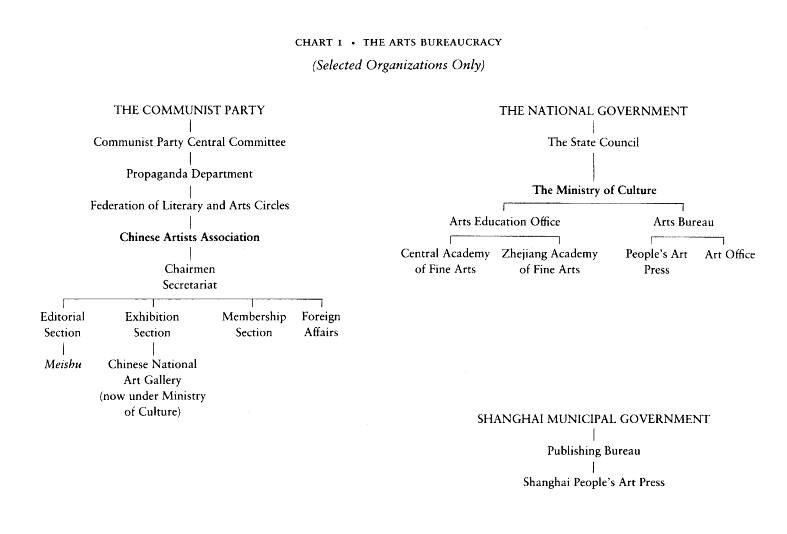
Chart 1
The Arts Bureaucracy
(Selected Organizations Only)
mitted infractions. As Perry Link has observed in his comments on Chinese writers, cultural control was maintained through a combination of fear and incentives, essentially a carrot-and-stick approach.[4]
For noncriminal offenses, the stick was wielded by the work unit, which could reassign an artist to an undesirable job, take away his or her studio, or otherwise make life unpleasant. In principle, punishment was meted out objectively; practically, though, factors such as personal ambition, enmity, friendship, and factional attachment added a strong dose of subjectivity to the process. To further complicate matters, each institution in the Chinese bureaucracy had a dual structure, similar to that operating on the national level, with party functionaries directing the behavior of the officials ostensibly in charge (chart 2). The party organization thus communicated to each work unit a description of desirable behavior and the correct ideological response to any given situation. By this means, it determined the circumstances under which punishment might be appropriate. It played an equally important role in rewarding artists for appropriate behavior, however, through the Chinese Artists Association.
The CAA is officially no more than a voluntary professional organization for artists. Yet as our charts make clear, and as every Chinese artist knows, it is really an organ of the Propaganda Department of the CCP. While its public role is well documented in its journals Renmin meishu (People's Art) and Meishu (Art),[5] information on its inner workings remains rather sketchy.
One obvious function of the CAA and its forerunner, the Art Workers Association, was ideological, a role evidenced in its publications. As the national professional organization, however, the Chinese Artists Association could offer artists the means to professional success. Membership in the CAA was exclusive and thus highly prestigious. Moreover, the combination of its elite exhibitions and its publications gave it effective control over the only means by which an artist might reach a public audience. At this level, compliance with party doctrine was voluntary, for the CAA was the arm of the party that offered the carrot.
While the art bureaucracy is the focus of our attention, we will return, from time to time, to the individual. How did artists respond to political pressure on their behavior, their speech, and their art? Art was in China an occupation of high social and economic status. China took its own art extremely seriously, as is evidenced by the great amount of critical writing on the subject, the government sponsorship of national exhibitions, the training of art students, and, perhaps most important, the canonizing of particular artists and styles of art as superior to those of earlier times. The Chinese government invested generously in the production of art. Even though housing was in short supply, artists were given studio space, supplies, and money to travel. Chinese artists painted pictures that those in charge deemed to be of high quality, even
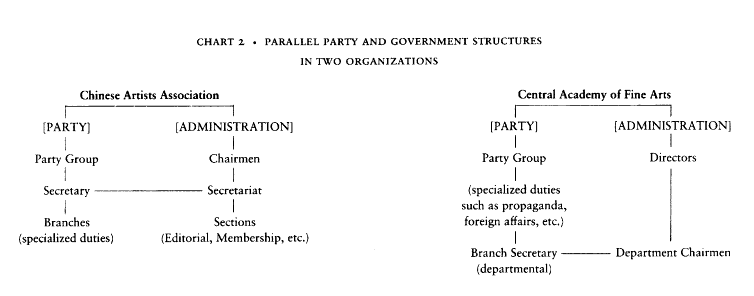
Chart 2
Parallel Party and Government Structures
In Two Organizations
as the nation's critical standards grew more distant from those of the outside world.
How different are artists in China from those in other places? We are so accustomed to the twentieth-century idea of "art for art's sake" that it is extremely difficult to contemplate artists working in a society that has rejected this concept. On what basis did an artist become famous in China? How were high-level theoretical pronouncements implemented at the level of the individual artist or work of art? Why would one want to paint if one's forms of expression were dictated by the bureaucracy? Can artists function without filling their work with some sense of self? Did Chinese artists have basic aspirations that might be shared by artists in other places? These questions may have no real answer, but we hope to partially illuminate them by describing the bureaucratic environment in which Chinese artists and art administrators sought to create the new art.