
The King and His Men
When Mohammed V was permitted to return from exile in 1955 and the French ceded their claim to Morocco, the weight of history was on the sharifian monarch's side. For tactical reasons, the nationalist movement that emerged in the 1930s had not adopted republican rhetoric, and the
dependence of both the French and the nationalists on the sultan to advance their interests shaped a framework by which, at independence, Mohammed V could reclaim control over the political system. Yet the process was not automatic. There was no significant dispute over the legitimacy of the monarchy, or the monarch, but the nature of the relationship between sultan (or king, in the new parlance preferred by Mohammed V) and subjects was nevertheless open to renegotiation. The monarchy had been restored, but its terms had not been set, the various roles to be played by the nationalists had not been clearly delineated, and there was no consensus about the effective balance of power between political forces. Apart from the principle of sharifian descent, there were no generally accepted rules of succession, which opened speculation about legitimate rule; the spread of nationalism and Wilsonian principles of self-determination also provoked questions about the role and powers of the monarch.
For close to twenty years—until the emergence of the Western Saharan issue in the mid 1970s—kings and political parties were locked in a contest for control of the political agenda.[15] Although from the outset both Mohammed V and his successor Hassan II enjoyed certain advantages, the outcome of early political battles about the determination and prioritization of issues to be addressed by public policy was far from certain. The sultan and the nationalists had found common cause in the struggle for independence, but as the only viable political party in Morocco through 1959, the Istiqlal Party also aspired to control the country's political processes, and although internal contests prevented it and its offshoots from imposing their will on the throne, their collective influence was sufficient to deny both Mohammed V and Hassan II control over the political debate about important social and economic issues for nearly two decades.
During that time, the working rules of the modern monarchy were gradually crafted, leaving the king in clear control of the political game. Mohammed V had spoken lengthily about constitutional monarchy prior to independence, but enactment was delayed. Demands within nationalist circles for a constituent assembly like that elected in Tunisia were ignored, and instead a National Consultative Assembly was created, its members being appointed by royal decree. The first in a series of constitutions was finally drafted by loyal monarchists in 1960, but the process of approval and enactment was interrupted by Mohammed V's death in 1961. His eldest son and successor, Hassan II, finally promulgated a constitution in 1962, which reinforced the monarchy by establishing the inviolability of the person of the king and the successionary principle of primogeniture.
Simultaneously, it capped the strength of any given political grouping by prohibiting the development of a single-party system.
Through the life of this constitution and three successive ones, parties and the Palace have struggled over control of the political process, although as outlined below, the early contests clearly gave the upper hand to the 'Alawi monarch. Parliament and parties have since become well established on the Moroccan landscape—leading some to claim that Morocco is an effective multiparty democracy[16] —but the king remains free to bypass these institutions and pursue his ends through alternative means.
Parties, Government, and Parliament
Under its constitution, Morocco has a pluralistic, competitive party system, and successive slates of government ministers have represented a variety of party affiliations. The functioning of government and the vigor of parties are not, however, to be confused with political power. Over the years, that prize has fallen to the king alone. How then do the democratic institutions of parliament and political parties fit into the patrimonial framework of Moroccan politics?[17]
Parties are numerous, but their role is limited. In the first place, there is a tendency toward fragmentation and multiplication that keeps parties weak—and serves the Palace. In the years following independence, the Palace actively encouraged the creation and development of parties that might carve away some of the Istiqlal Party's support, and the initial government appointed by Mohammed V gave disproportionate representation to smaller, less significant groupings to offset the Istiqlal Party's influence. Even by 1960, the field was cluttered. In 1959 the Istiqlal Party split, and followers of 'Abdullah Ibrahim formed the National Union of Popular Forces (UNFP). The UNFP was an urban mass party, promoting a program of social and economic reform and recruiting supporters from among workers, urban migrants, bureaucrats, and students. It would itself experience a schism in 1974, but until then it remained an important political force. In the meantime, it was joined in the political arena by several royalist groupings with various degrees of political organization. The longest-lived of these has been the Popular Movement (MP), a party based in the countryside, which promoted aspects of Berber culture but above all proclaimed unconditional support for the monarchy. Other, smaller groups—such as the inchoate Liberal Independents, first known simply as the "Friends of Rachid Mouline"—eventually disappeared.
The proliferation of new parties continued well beyond the constitu-
tional monarchy's formative years, fed by sentiments of political rivalry and the Palace's own interest in balancing power. (Table 1 traces the somewhat discontinuous and fissiparous evolution of Moroccan political parties.) In 1974, for example, divisions within the UNFP gave birth to a new Socialist Union of Popular Forces (USFP) and promised to weaken the political left. When the USFP began to gain popular favor, though, its new strength was balanced in formal instances by the pro-Palace National Rally of Independents (RNI), founded in 1978 by none other than the king's brother-in-law. Before long the RNI's own internal divisions and quarrels with the Palace over political spoils made it less than reliable as a source of support, and yet another party stepped into the breach. The Constitutional Union (UC), created by Prime Minister Maati Bouabid in 1983 and made up largely of young professionals, consolidated the parliamentary majority in 1984.
To mitigate the isolating effects of their size, small parties have frequently formed electoral coalitions. In 1984 five parties ran together as the Kutla (Democratic Bloc), and in preparation for the 1993 legislative elections they again joined forces.[18] Of the thirteen parties that participated in the 1993 legislative elections, all but the fragmentary UNFP and the Constitutional and Democratic Popular Movement (MPDC), a small splinter group that broke away from the MP in the late 1970s, won seats in the new parliament. A de facto royalist coalition consists of parties commonly allocated government ministries and is referred to as the Wifaq (Entente).
If parties are prone to fragmentation, they are also subject to political tutelage and even repression. The USFP, for example, might eventually have had a significant effect, but its vigorous early growth was severely checked by government repression and in elections generally acknowledged as fraudulent. Such experiences were common on the left—and are discussed at greater length later in this chapter. Other parties have generally been spared repression, but they are not altogether independent of the Palace. The MP's founder, Mahjoubi Aherdane, for example, fell out with the Palace, and with many within his movement, in 1985. Although he retained his seat in parliament, relations deteriorated with others in the MP to the point where in 1990, twenty-one members announced their intent to hold a party congress to establish a new leadership. It was a nod from the royal councilor Reda Guedira that empowered the fronde to reorganize the party and exclude Aherdane.[19]
The impact of political parties is limited, not simply by deficiencies in their own strength, whether inherent or imposed by the Palace, but also by the relative weakness of the two bodies in which they may find expression,
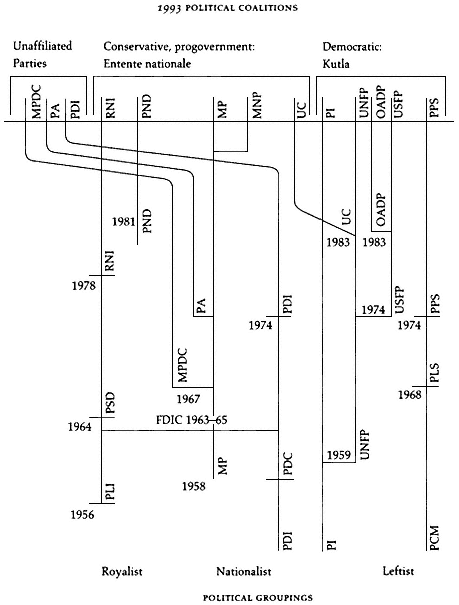
Figure 1.
Evolution of Moroccan Political Parties, 1956–1993
| ||||||||||||||||||||||||
(table continued on next page)
| ||||||||||||||||||
parliament and the cabinet. Irrespective of electoral outcomes, the cabinet represents royal interests. The monarchy has secured constitutional recognition of its right to appoint the prime minister, and like his father, Hassan II has jealously guarded control over key ministries. He has entrusted sensitive portfolios only to those with known personal loyalty, and although lesser ministries have occasionally been allocated to outlying parties, turnover is frequent and ministers have rarely enjoyed administrative autonomy.[20]
Parties are given more license to construct a national debate in parlia-
ment and through their press organs—and they do—but the structure of power relations in Morocco leaves most of their actions without consequence. The Istiqlal Party's early battle for separation of powers was lost, and despite legislative and oversight functions registered in constitutions, all Moroccan parliaments since independence have been conceived of primarily as consultative bodies. Alain Claisse notes that in 1983, when parliament was dissolved at the end of the term without new deputies having been elected, the king empowered himself to assume legislative as well as executive responsibilities. A few months later, following the 1984 legislative election, Hassan II invited the newly elected deputies to fulfill their function as "council" to the sovereign, issuing the patrimonial charge, "You are all my ministers."[21] Parliament may approve legislation, but its members are discouraged from acting independently, and they are without means to restrain monarchical powers.
With such a serious handicap, parliament is generally reduced to a rubber stamp, although it has occasionally used what powers it does have to deprive the Palace of support or contest policy. Such was the case of the first parliament, seated from 1963 to 1965. In the election, a hastily assembled royalist coalition known as the Front for the Defense of Constitutional Institutions (FDIC) had won a plurality of seats, but it failed to establish a clear majority. Moreover, Palace supporters were set back psychologically by the strong showing of the UNFP, which halfheartedly decided to run only two weeks before the election. The cabinet appointed by the king favored FDIC leaders, but neither the FDIC nor the opposing Istiqlal Party and UNFP were in a position to make the system work. It didn't. "From the outset of parliamentary life it appeared that the king wished to make a mockery of the experiment, and it is only fair to note that all concerned aided him admirably in its task," John Waterbury observed. "The opposition parties resorted to debilitating tactics designed in general to embarrass the government. The latter reciprocated with systematic hostility."[22] Between 1963 and 1965, parliament passed only two laws.
Unfortunately for the parties that sought an oppositional role, deadlock ultimately resulted in parliament's dissolution. When in 1965 general discontent about unemployment and inflation led to riots that shook Casablanca and left several hundred people dead, the Palace sought to make amends to the parties it had contrived to exclude. They held out for fair elections and a government formed on the basis of the parliamentary majority, however, and Hassan II parried by declaring a state of emergency that dissolved parliament and suspended the constitution. From 1965 to 1970, Morocco was governed directly by the king.
However ineffective it was at elaborating a body of law or balancing executive powers, and however annoying it was to the Palace, the king recognized the usefulness of parliament as a bridge to his subjects. Consequently, the question after 1965 was not so much whether to have a parliament as how to fashion a legislative body that would serve royal purposes and under what conditions to install it. Since suspending the original constitution in 1965 the Palace has—with direct input from Hassan II—drafted three successive constitutions. In each iteration, modifications have primarily concerned the number of parliamentary seats and the means by which they would be contested. Ironically, none of the constitutions has restored even the narrow powers known to the first parliament.
Morocco's second constitution (1970) severely limited direct suffrage, and with both the Istiqlal Party and the UNFP opposing the election itself, under its terms the government—that is, the Palace—easily won an overwhelming majority. The victory, however, proved a pyrrhic one. Parties atrophied in the five-year hiatus between legislatures, and institutionalized participation virtually disappeared: 158 of the 240 deputies were elected as independents. The king was isolated and from the vantage of the military appeared to be losing control; two attempted coups in rapid succession pointed up the attendant perils.[23] Only luck and the awesome moral presence of the sharifian monarchy saved Hassan II,[24] and after 1972 he set about reconstructing his regime on less precarious grounds.
Morocco's third constitution (1972) loosened the royal vice grip on participation but it did not reflect a change in Hassan II's fundamental disdain for parliamentary government.[25] In an overture that would mark a basic shift in political dynamics, the Palace in 1973 formulated its own program, introducing economic reforms and initiating a program of substantial state investments.[26] During the first decade of independence, the monarch had frequently taken his cues from the Istiqlal Party or the UNFP, appropriating their political platforms as his own,[27] but now he laid claim to the political agenda. Neither the emergence of new parties nor the reconvening of parliament under new rules altered that reality.
The legislature, though, continued to serve royal purposes, and the timing of elections conducted under the rules of the 1972 constitution accommodated the interests of the Palace more than they conformed to the letter of the law. The enormously successful 1976 Green March to annex the Western Sahara had poignantly reminded Moroccans of their venerable patrimony and the majesty of the dynasty that governed it, and the Palace unabashedly capitalized on the patent spirit of unity that infused even the most critical of the political parties. Without sacrificing any of its own
powers, the Palace openly courted opponents. In 1977, thus, the king created a politically all-inclusive Royal Council to prepare for elections, and in similar fashion, he appointed a "unity government" in 1983 to induce widespread participation in the 1984 elections. Neither gesture was of lasting political importance, except to underscore the king's desire to have a functioning, pluralistic legislature—on his own terms.
The fourth constitution was submitted to popular referendum in 1992 following an unusual period of parliamentary activity that directly relates to the human rights issues discussed in Chapter 10. Legislative elections scheduled for 1990 were postponed, ostensibly pending a UN-sponsored referendum on the Western Sahara. In fact, unrest was already brewing on a number of domestic fronts. Austerity measures announced in March sparked protest from labor and provoked parliament. A finance policy proposed to parliament in May evoked substantial ire and led eighty-two members of the USFP, PPS, and the OADP to file a motion of censure. Emboldened by their own initiatives—and by pressures being levied on the human rights front—various members of parliament began to speak publicly about issues as contentious as habus laws and women's rights. Members of the Istiqlal Party raised the issue of constitutional reforms, and argued that the current constitution did not permit installation of a real democracy insofar as powers were not separate and human rights not guaranteed. Political tensions increased through fall 1990 with the commitment of Moroccan troops to defend the Saudi palace, and a general strike called in December gave way to rioting and political violence in Fez. In numbers it was at least matched by a February 1991 demonstration in Rabat to protest the Gulf War, and by extension, Morocco's engagement in it. Even the military, closely monitored since the attempted coups, was said to have conveyed its opposition to Morocco's participation in the allied effort. Kutla parties sought to exploit those sentiments and renewed their efforts to woo the electorate. For its part, the Palace recognized the need to recapture popular sentiment, particularly as it faced the eventual disappearance of the Saharan issue, which has served as the only real basis for national unity over the past fifteen years. In March 1992, Hassan II announced plans to renew the constitution and rework the balance between Palace and parliament. In a familiar pattern, the new constitution expanded the number of seats in parliament, and although much fanfare was made of a preambulatory nod to international human rights norms, the Kutla was disappointed with provisions that allowed the monarch to preserve all conventional powers. Elections for the 222 directly chosen seats in June 1993 gave the Kutla parties 99 seats and a stronger showing than
had ever been recognized, but their relatively weak showing in contests for the remaining 111 seats chosen indirectly in September once again returned the parliamentary majority to a royalist coalition. In apparent disregard for the provisions of the new constition allowing a prime minister to choose his own cabinet, Hassan II offered an array of ministries to the losing parties. They refused, holding out for application of the new rules, and the game was returned to the status quo ante. Hassan reappointed Mohamed Karim Lamrani to his fourth term as prime minister, and Mawlay Ahmed Alaoui (minister of state without portfolio), Driss Basri (interior), and Abdellatif Filali (foreign affairs) took up their familiar ministerial posts.
The king thus continued to control the political game. Since the mid 1970s, Hassan II has established himself as both the master player and the referee. Contestants have been admitted to the playing field at his discretion and remain so as long as they abide by his rules. He frequently addresses the Moroccan nation as "my children," and that patrimonial phrase has set the tone of politics. For as long as they play by the king's rules—and despite the obvious risks, that posture does vary—all recognized parties are in substantial measure "king's men." That term is conventionally reserved for those who have belonged to the various monarchist coalitions, but in practical reality it has broader application.
The King as Referee
The sociologist Max Weber developed the concept of "sultanism" as a variant of traditional authority that maximizes the arbitrary will of the ruler,[28] and Hassan II of Morocco in many regards epitomizes the ideal type. Parliament and parties lend a certain form to Moroccan politics, but most significant political transactions leave these institutions aside. Real power lies elsewhere.
As a starting point, it is worth noting—however impolitic—that the Palace owns much of Morocco.[29] The king is said to be the country's largest landowner and has a controlling interest in Omnium Nord-Africain (ONA), the Maghrib's largest holding company. Manipulation of its wealth is central to the way the monarch controls the political game. Privately, elites exchange stories of the king's interventions to confiscate property or to award it at royal discretion. "Agrarian reform" implemented in times of crisis, for example, has permitted the Palace to allocate land and secure commensurate political support.[30] As Waterbury remarked in the first decade after independence, patronage and surveillance over commercial activities are the king's two most effective levers of elite control.[31] It is an
advantage to the Palace that the Moroccan elite is small; intermarriage within it assures close contact and gives the king access to politically valuable information about his most esteemed subjects. Hassan II has not hesitated to use personal idiosyncrasies and interpersonal rivalries to maintain competition for patronage.[32]
In the lower echelons of the state apparatus, advancement is controlled by bureaucratic mechanisms, but the Palace has maintained its prerogative of filling all high-level posts by royal decree.[33] Such appointments are prized, for in the tradition of the Moroccan makhzen (government administration), they open the doors to personal aggrandizement of a sort that might elsewhere be condemned as graft. Palace favorites may be rewarded with control of public enterprises, and public office has facilitated access to such benefits as real estate, import licenses, commercial licenses, and noncompetitive contracts.[34] Even the contractual particulars in the lower echelons are subject to royal intervention and manipulation, so that the entire corpus of government lies open, and vulnerable, to the king's pleasure.
Commercial enterprises and banks in the private sector are also heavily dominated by the royal family, with the result that policies of privatization progressively implemented since 1983 have not reduced the Palace's control. Indeed, the king's influence in the private sector has been strengthened through the recent marriages of his two daughters, which consolidated linkages with both the Casablanca industrialists and the Fez bourgeoisie.[35] The king does not openly flaunt these powers, but in both public and private sectors, he remains in a position to make, or break, individual fortunes.
Government and commercial perquisites actively cultivate a royal clientele and in turn make powerful patrons of the king's own clients. The Moroccan political economy turns on such relations, and the close incorporation of political elites into the system reinforces the monarch's own position. Even the political parties as a whole are beholden to the royal purse. In 1987, each of Morocco's twelve political parties were extended 1.7 million dirhams ($200,000), ostensibly to strengthen their unions and encourage a "free" press.[36] Such largess serves to bind parties, for what is extended may also be withdrawn. When otherwise faithful clients overstep their bounds, they are removed from office, and only when they have been sufficiently chastised may they be reinstated or reintegrated within the elect circle of power. The king alone has such freedom of maneuver, and through it his patriarchal authority and patrimonial control is reinforced.
Where patronage cannot fully ensure royal dominion, the king has
himself taken charge, directly or indirectly. Military and security forces in particular come under close surveillance. Matters of internal governance that corresponded to traditional makhzen functions were of immediate concern to the Palace in the early years of independence, and the outcome of a political contest between Mohammed V and his Istiqlal Party ministers left the Palace in tacit control of the internal security apparatus. It was overseen first by General Mohammed Oufkir, who for many years was the most feared man in the kingdom. Since 1979 it has been confided to the interior minister, Driss Basri, a security agent who came up through the ranks and was groomed for the position.[37] The Interior Ministry is responsible for a formidable security apparatus, but in addition, its administrative purview has gradually come to include the oversight of other ministries as well as technical areas carved away from other administrative units.[38] Not surprisingly, as the ministry's powers have expanded, so has the Palace's own surveillance. As one measure of control, the king has retained powers to appoint the caids with whom security forces collaborate closely.[39] To protect the monarchy, the security apparatus is fragmented, and rivalrous: as many as four separate security and intelligence agencies report to the Interior Ministry, and the largest of these is also subdivided into four units. For further insurance, the operations of the two most important security units are additionally overseen by the Gendarmerie royale, a division of the armed forces.[40] Checks and balances notwithstanding, Basri is considered by many to be the second most powerful man in the kingdom.
The military is also carefully watched by the king. After the second attempted coup implicated no less a personage than General Oufkir, Hassan II reclaimed direct command of the Defense Ministry and implemented reforms to limit its power and cohesion. In particular, the largely Berber officer corps, intended by Mohammed V to counterbalance the influence of the more politically and economically favored makhzen elite, was diversified.[41] Even so, General Ahmed Dlimi, a trusted Berber officer, had by the early 1980s accrued power sufficient to threaten the throne. Dlimi had been assigned command of the royal guard and the secret service, as well as of the politically paramount Saharan forces, and the mysterious circumstances of his death while traveling on a remote mountain road in 1983 raised suspicions of official complicity. After Dlimi's death, the army was placed under the command of the crown prince, Sidi Mohammed, and the Royal Armed Forces are regularly and poignantly reminded of their charge to defend the throne. The officer corps is reviewed with great pomp and pageantry on the anniversary of Hassan II's accession to the throne each
year; promotions are enacted, and officers are individually and publicly received to kiss the hand of the monarch in the venerable ceremony of ba'ya that reaffirms loyalty and submission to the throne.
Control of the judiciary is less straightforward, but little less effective. Successive constitutions have affirmed separation of powers, but only rarely has the judiciary exercised independence. In fact, the Moroccan monarch has retained powers to appoint all magistrates, and Moroccan judges are no less beholden to the throne than are other state employees. The ability of the judiciary to moderate relations between state and society, as through judicial review, is limited by the tacit understanding that a royal decree, regardless of its subject, supersedes other positive law. As Prince of the Faithful, the king is protected against adverse judgments on his own pronouncements, and the Moroccan Supreme Court has ruled clearly that appeals in court against royal fiat are forbidden.[42] Like many heads of state, the king also possesses powers of clemency, but in Morocco these have been exercised in such a way as to make of the court only an auxiliary to the monarch. Royal pardons are frequently extended to common law offenders on national or religious holidays, but they have also been applied, often arbitrarily, to individuals convicted of political crimes. At a 1972 trial of UNFP leaders, for example, the king pardoned and freed the only physically present defendant sentenced to death, while twenty-seven others with lesser sentences (of ten years or more) were locked away. Likewise, pardons for political prisoners tried en masse in 1977 were meted out intermittently from 1984 to 1991, unrelated either to the charges against them or the length of their sentences. Clemency emphasizes the arbitrary powers of the king and establishes him, rather than the courts, as the supreme dispenser of justice.
Finally, to thwart those who might seek to make of high government office an independent base of power and policy, Moroccan monarchs have relied on personally appointed and personally loyal councils to formulate and even implement policies. Mohammed V initiated the practice of appointing special councils with the creation of the National Constituent Assembly in 1957, and councils were convened by Hassan II in 1965 to replace the dissolved parliament; in 1968 to deliberate the new five-year plan; in 1977 to oversee elections; and in 1990 to address issues of human rights. No corpus of law sanctions the existence and functioning of such councils or of the king's personal advisers, but their influence has often exceeded that of the formally appointed government ministers. In addition to narrowly mandated councils, a royal cabinet functioning parallel to the government often confuses the analysis of power, as does the appointment
of influential ministers without portfolio. Guedira has intermittently functioned as grand vizir, privately advising the monarch and overseeing the royal cabinet, and other royalists of undisputed loyalty likewise function as the makhzen of an earlier era did. Mawlay Ahmed Alaoui ('Alawi), a minister of state without portfolio, but with links of parentage to the royal family, travels the length and breadth of the kingdom cutting ribbons, patching up small disputes, and generally serving as a bridge between Palace and people; through the daily Matin du Sahara , he also acts as publicist for the throne.[43] Such informal mechanisms allow the king to control most formal institutions that might develop or exhibit autonomous thought and behavior vis-à-vis the Palace. Those who accept these parameters and cooperate are, perforce, the king's men. Those who do not, when they do not, are excluded from the legitimate game of politics.