
2
The Mask in Ritual
Metaphor in Motion
As we have seen, the masks of the gods provided Mesoamerica a metaphorical means of visualizing the transcendent, of defining the powers and differentiating between the various aspects of the world of the spirit. Used for those purposes, the masks of the gods gradually became more and more involved in priestly speculation as a means of recording the results of that increasingly abstract and sophisticated thought and as a means of communicating it on a variety of metaphoric levels to the laity. In that sense at least, through the course of the development of Mesoamerican spiritual thought, the mask was involved in and is illustrative of the growing intellectualization of the relationship between man and the gods, an intellectualization resulting naturally from the growth of a priestly class whose function was to mediate between man and god.
But important as the mask's role was in the progressively more abstract speculations of the priesthoods of Mesoamerica, it was also central to another, seemingly opposed tendency. When donned in ritual, the mask allowed men to become gods, to experience the numinous in all its immediacy and urgency, rather than to think about the godhead with the detachment and distance of the philosopher. In Mesoamerican masked ritual, the world of the spirit and the world of daily existence met, and the dynamic tension between those two opposed worlds catapulted the masked impersonators of the gods, and, vicariously, those who participated by watching, out of the familiar routine of their daily existence into "a no-time and no-place that resists classification," which Turner has called the "liminal experience."[1] It is, he says,
in liminality and also in those phases of ritual that abut on liminality that one finds profuse symbolic reference to beasts, birds, and vegetation. . . . Structural custom, once broken, reveals two human traits. One is liberated intellect, whose liminal product is myth and protophilosophical speculation; the other is bodily energy, represented by animal disguises and gestures. The two may then be recombined in various ways.[2]
Although Turner does not apply this insight to the speculative thought and masked ritual of pre-Columbian Mesoamerica, it would be difficult to imagine a more applicable statement. As we have seen, it was precisely through "profuse symbolic reference to beasts, birds, and vegetation" that priestly speculation liberated itself from the constraints of the mundane material world to explore the world of spirit. And as we will demonstrate in this chapter, the "bodily energy" of masked ritual provided an alternative means of liberation.
Kent Flannery's characterization of very early Mesoamerican religious practice based on his discovery at sites in Oaxaca of numerous masked figurines and pottery masks similar to those found at such sites in the Valley of Mexico as Tlatilco, Tlapacoya, and Las Bocas indicates just how fundamental those "disguises and gestures" were.
Religion was another phenomenon that linked Mesoamerica, region by region, into one giant sphere of interaction. Indeed, it often seems that, for Early Formative Mesoamerica, there was only one religion. . . . It was a religion in which dancers, summoned by conch shell trumpets and accompanied by turtle shell drums, dressed in macaw plumes and equipped with gourd and armadillo shell rattles, performed in the disguises of mythical half-human, half-animal creatures. All this is suggested archaeologically; what eludes us is the underlying structure .[3]
It is unlikely that we will ever have the intuitive or even the intellectual understanding of the mys-
teries underlying that early ritual possessed by those masked dancers, who were probably members of "dance societies or sodalities" participating in "annually recurring rituals,"[4] but Turner's discussion of liminality does allow a tantalizing glimpse of the "underlying structure." In departing from "structural custom" to enter the "liminal experience," they acted on the assumption that the world of the spirit must be joined to man's world to ensure the continuation of life on the earthly plane.
It is significant in this respect that the source of Turner's concept of liminality is van Gennep's seminal work on initiatory rites, a concept that Turner extended to apply more generally to ritual. For van Gennep, "liminal (or threshold) rites" occurred during the transitional stage of initiation rites between the "preliminal rites" separating the initiate from the world he knew and the "postliminal rites" incorporating him into the new world of the initiated adult.[5] Turner characterizes that transitional stage as ambiguous since the initiate is "neither here nor there. . . . He passes through a symbolic domain that has few or none of the attributes of his past or coming state."[6] The ambiguity of that transitional stage is characteristic not only of initiation, however, but more generally of masked ritual. As Turner explains, "people have a real need . . . to doff the masks, cloaks, apparel, and insignia of status from time to time even if only to don the liberating masks of liminal masquerade" within which they can "contemplate for a while the mysteries that confront all men."[7] Thus, the liminal zone in which they find themselves is neither the day-to-day world that confers their public status on them nor the mysterious spiritual realm; it is "betwixt and between" in that "no-place and no-time" in which intellect and bodily energy can be "liberated" from "structural custom" to confront the mysteries of the spirit.
A contemporary example of a pair of opposed attempts to achieve such liberation is instructive. In Peter Shaffer's play Equus, the psychiatrist, Martin Dysart, a man of science, ponders his own intellectual attempts to understand spiritual reality in the context of the actions of his youthful patient, Alan Strang, actions through which the boy attempts to use his "bodily energy" to become a "mythical half-human, half-animal creature":
Such wild returns I make to the womb of civilization. Three weeks a year in the Peloponnese, every bed booked in advance, every meal paid for by vouchers, cautious jaunts in hired Fiats, suitcases crammed with Kao-Pectate! Such a fantastic surrender to the primitive. And I use that word endlessly: "primitive." "Oh, the primitive world," I say. "What instinctual truths were lost with it!" And while I sit there, . . . that freaky boy tries to conjure the reality! I sit looking at pages of centaurs trampling the soil of Argos—and outside my window he is trying to become one, in a Hampshire field.[8]
Alan's ritualistic approach to the spiritual is more personal, more immediate, and, at least from Dysart's point of view, more real and fulfilling than his own vicarious, detached, speculative experience. Shaffer, of course, feels that modern scientific, analytical man, through his intellectual progress "beyond" ritual, has lost the capacity to feel the spiritual and is thus left, on the one hand, with only his relatively sterile intellectualizations or, on the other, with desperate, futile attempts like Alan's to create a personal spiritual reality. But the engaging point here is that body and mind must be united in "conjuring the reality" of the world of the spirit.
An observation of Joseph Campbell's indicates the root of the modern problem. Speaking of "the function of the priest to represent . . . the art of living in the knowledge of transcendence without dissolving into it in a rapture of self-indulgence" and quoting Jung's statement that "the function of religion is to protect us from an experience of God," Campbell describes the characters in the mythic tales of Ovid's Metamorphosis
as ill-prepared, . . . unfavorably transformed by encounters with divinities, the full blast of whose light they were unready to absorb. The priest's practical maxims and metaphorical rites moderate transcendent light to secular conditions, intending harmony and enrichment, not disquietude and dissolution. In contrast, the mystic deliberately offers himself to the blast and may go to pieces.[9]
In his own way, Alan Strang quite "deliberately offers himself to the blast," and he does "go to pieces"; Dysart, however, has so totally insulated himself from the experience of the blast that he feels nothing. Shaffer's Alan and Campbell's mystic are illustrative of what seems to be a universal human desire—to throw off the trappings of this mundane world and become the god. But it is important to realize that the true alternative to their destruction is not the equally destructive sterility of Dysart but, as Campbell points out, the way of ritual through which man can become god yet remain in the world. Only through ritual can the transcendent light of timelessness illuminate man's life without eclipsing totally his secular existence.
Geertz suggests, in a rather different way, that same view of ritual as a means of merging the mundane and the transcendent:
It is in ritual—i.e., consecrated behavior—that this conviction that religious conceptions are veridical and that religious directives are sound is somehow generated. It is in some sort of ceremonial form—even if that form be hardly more than the recitation of a myth, the
consultation of an oracle, or the decoration of a grave—that the moods and motivations which sacred symbols induce in men and the general conceptions of the order of existence which they formulate for men meet and reinforce one another. In a ritual, the world as lived and the world as imagined, fused under the agency of a single set of symbolic forms, turn out to be the same world.[10]
For pre-Columbian Mesoamerica, the "single set of symbolic forms" through which the worlds of spirit and nature were fused was derived from the central metaphor of the mask, and the "metaphorical rites" through which those forms achieved their power developed the intrinsic logic of mask use, a logic expressed in the basic symbolic equation underlying masked ritual which we developed at the outset: just as the fantastically composed natural features of the mask, lifeless in itself, represent a specific, definable manifestation of the all-encompassing, mysterious ground of being or life-force, so that same mask worn by the human being in ritual and art is animated by the living person behind it who, by wearing the regalia, brings it to life and in so doing symbolically becomes the life-force itself. This symbolic identification of the life-force with the human wearer of the mask demonstrates the typically Mesoamerican attitude that human life is the closest of all forms to the divine and is charged with a special ritual duty to cooperate in the transformative movement of that life-force into the world of nature. In this sense, Mesoamerican spiritual art shows man at the center of the cosmos, mediating through the use of the mask between the opposed worlds of nature and spirit. And, paradoxically, the mask reveals man's central position not, as one might immediately think, by disguising the wearer but rather by expressing his true nature. By revealing the visage of the god, it is a truer reflection of the wearer's spiritual essence than his natural face. The ritual mask thus simultaneously reveals and conceals the innermost spiritual force of life itself. That force was the essence of the divine.
Those who wore the masks, the impersonators in ritual of the gods themselves, thus entered a liminal realm in which the reality of the temporal, mundane world was simultaneously juxtaposed to and fused with the timeless world of the spirit. In Mesoamerica, that liminal realm was delimited by the mask, and in that realm, the masked ritualist could "conjure the reality" of the world of the spirit protected by the mask from succumbing to "the blast" of transcendence. While we do not, of course, have the testimony of any of the masked dancers of early Mesoamerica referred to by Flannery to help us see that reality, we do have something very close to it. As we will show below, an examination of a similar use of masks in the kachina dances of the Hopi in the American Southwest, one probably derived from Mesoamerican ritual practice in the time of the Toltecs, suggests precisely the paradoxical nature of the liminal experience of the god-impersonator. Speaking of his own experience of the initiation into the kachina cult, Sam Gill tells us that
the event occurs as a part of the Bean Dance which concludes the annual celebration of Powamu, a late winter ceremonial to prepare for the agricultural cycle. The newly initiated children are escorted into a kiva, an underground ceremonial chamber, there to await the entrance of the kachinas, the masked dancers they have come to know as Hopi gods. Prior to this time, the already initiated go to great efforts to keep the children from discovering that kachinas are masked male members of their own village. Announcing that they are kachinas, the dancers enter the kiva where the children are eagerly awaiting them. But they appear for the first time to the new initiates without their masks. The children immediately recognize the identity of the dancing figures. Their response is shock, disappointment, and bitterness .[11]
Emory Sekaquaptewa, himself a Hopi, explains the result of that disillusioning experience.
When it is revealed to him that the kachina is just an impersonation, an impersonation which possesses a spiritual essence, the child's security is not destroyed. Instead the experience strengthens the individual in another phase of his life in the community. . . . For the kachina ceremonies require that a person project oneself into the spirit world, into the world of fantasy, or the world of make-believe. Unless one can do this, spiritual experience cannot be achieved. I am certain that the use of the mask in the kachina ceremony has more than just an esthetic purpose. I feel that what happens to a man when he is a performer is that if he understands the essence of the kachina, when he dons the mask he loses his identity and actually becomes what he is representing. . . . He is able to do so behind the mask because he has lost his personal identity.[ 12]
In other words, Sekaquaptewa has learned to see the mask as the means of entering the liminal realm defined by Turner. Knowing that, we can appreciate Gill's interpretation of the experience.
It is important that we take seriously what the initiated Hopi says. We must recognize that he actually means what he says, that in putting on the kachina mask he really becomes a god . . . The children are told that the kachinas are gods who come to the village from their homes far away to overlook and direct the affairs of the Hopi people. They are taught that they too will become kachinas when they die.
But once initiated into the kachina cult, religious events can never again be viewed naively. Unforgettably clear to the children is the realization that some things are not what they appear to be. This realization precedes the appreciation of the full nature of reality . . . The initiated children are made aware of the "essence" or sacrality of things they had until then seen only as "matter. " Thus the initiation serves to bring the children to the threshold of religious awareness. . . .
This brings us back to the question of truth regarding the Hopi statement that when one dons the kachina mask he becomes a kachina. Given the appreciation by the initiated Hopi of the full nature of reality in both its material and essential aspects, the truth of the statement can be more clearly understood. By donning the kachina mask, a Hopi gives life and action to the mask, thus making the kachina essence present in material form. Mircea Eliade illuminates this point in his book The Sacred and the Profane: "by manifesting the sacred, any object becomes something else, yet it continues to remain itself." The anomaly we observe in the Hopi statement that he becomes a kachina is but an expression of the paradox of sacredness; but, in this case, the sacred object is the Hopi himself. By wearing the kachina mask, the Hopi manifests the sacred. He becomes the sacred kachina, yet continues to be himself. We, as uninitiated outsiders, observe only the material form. The spirit, or essence, of the kachina is present as well, but that can be perceived only by the initiated. The material presence without the spiritual is but mere impersonation—a dramatic performance, a work of art. The spiritual without the material remains unmanifest; it leaves no object for thought or speech or action. The spiritual must reside in some manifest form to be held in common by the community. The view, often taken, that the kachinas are "merely impersonations" fails to recognize the full religious nature of the kachina performance. It also fails to take into account the truth of the statement. If the kachinas are not present in both material and essential form, the events could scarcely be called religious.
Both Navajo and Hopi religions evidence an appreciation for the power of symbolization. Only through symbolization is the sacred manifest; the subtleties are many. On the one hand, the mundane materials which comprise religious symbols must never be taken as being more than the simple ordinary earthy elements they are. This fact is driven home in the disenchantment with the material appearance of the kachinas experienced by the children undergoing initiation. . . . On the other hand, the ordinary materials when presented in the proper form manifest the sacred.[ 13]
The Hopi experience, then, provides a precise definition for us of the liminal experience: "by wearing the kachina mask, the Hopi manifests the sacred. He becomes the sacred kachina, yet continues to be himself." And it delineates clearly the role of the mask as metaphor and extends the dimensions of its significance far beyond the specific ritual event. The initiated Hopi, unlike Shaffer's Alan Strang or Ovid's "ill-prepared" characters, can become the god he impersonates without "going to pieces" because the ritual moment of that impersonation is so structured that it can, as Campbell puts it, "moderate transcendent light to secular conditions, intending harmony and enrichment, not disquietude and dissolution." It is in this complex and profound sense that Sekaquaptewa's simple statement, "in Hopi practice the kachina is represented as a real being,"[14] is meant and must be understood. And that statement provides a marvelous example of Turner's definition of metaphor "as a means of effecting instantaneous fusion of two separated realms of experience into one illuminating, iconic, encapsulating image. [15]
At the same time, it makes clear that the liminal experience is indeed the experience of metaphor, the experience in which oppositions are "much less sharply polar than they appear in dayto-day living." [16] For the Hopi, it is the spiritual vision rather than that of day—to—day living that is true; only that vision captures the "full nature of reality in both its material and essential aspects." And throughout Mesoamerica, as in the American Southwest, it was through the agency of the mask that man entered the liminal zone of "no-time and no-place" where that essential truth could be experienced by allowing the essence of the god "to become present in material form." Through that liminal masquerade, he played his part in "the transformational drama" through which the material world was infused with spirit and life was enabled to continue. The ritual mask, then, was simultaneously the instrument of the liminal and the metaphor for the liminal fusion of spirit and matter.
For that reason, the examination of mask use in ritual is, in a sense, the most important part of this study since the ritual moment brings together at one highly charged point in time and space every aspect of the metaphorical meaning of the mask. Telescoped into that liminal experience are all of the fundamental qualities of Mesoamerican spirituality which we will delineate in Part II. In masked ritual, we can see the persistence of the essentially shamanistic belief in a magical transformation by which man can enter the realm of the spirit; we can see the fundamental belief in an order underlying material reality which can be approached through calendrically determined ritual
in sacred spaces oriented according to a sacred spatial order; we can see clearly that the mask, as a multivocal symbol at the point of liminality, served as the metaphor for that pervasive transformational process through which the divine essence could create and sustain the life of man and his world; and we can see that the gods, defined by the features of the mask, were "brought to life" through the animating force of the ritual performer within the mask. In a metaphorical sense, then, life emerges through the mask as the performer merges his individual identity into the all-encompassing world of the spirit symbolically represented by that mask.
Emerging from the Ritual Mask
No image in Mesoamerican spiritual art more clearly illustrates all that is contained in the metaphor of the ritual mask than that of the ruler of Yaxchilán, Bird Jaguar by name, carved on the rear face of Stela 11 (pl. 31) at that site. Though the image is essentially a frontal view of the splendidly arrayed figure of the ruler, his face is shown in profile, and depicted in front of his face is a mask that is an integral part of and extends downward from his elaborate symbolic headdress. It is important to realize that this image, for all the realism of its depiction of the facial features of Bird Jaguar and the figures kneeling in front of him, is the result not of an attempt by the carver to portray natural reality but rather the result of his application to the stone of an elaborate set of artistic conventions designed to permit the symbolic communication of spiritual reality. The frontal view of the body allows the viewer to see—and "read"—the symbolic details of the ruler's costume, while the profile view of the head is surely designed to afford the viewer precisely the same experience as that of Hopi children seeing the unmasked kachinas for the first time. What has been called an X-ray view of the face within the mask allows the simultaneous depiction of the masked face of the costumed ruler which was presented to his subjects on the ritual occasion and the human face of the man within the mask.
We can paraphrase Gill's interpretation of the Hopi children's initiatory experience as an explanation of the effect of such an image. The viewer of the stela would be forced to realize that Bird Jaguar, in symbolically becoming the god depicted by the mask, has actually entered the liminal realm in which he can be human and divine simultaneously. He is, at this precise point in time and space, "manifesting the sacred,"[17] demonstrating that "only through symbolization is the sacred manifest." Thus, the man within the mask "becomes something else " yet remains himself. And as the viewer must surely have known, the something else he now seemed to be was what he had essentially been all the time. The apparent contradiction between these two identities is the "paradox of sacredness"; Bird Jaguar is the animating force within the mask of the divine at the same time that the essence of that divine spirit is the life-force within him. The convention by which this image on the stela is constructed in itself makes this truth apparent.
In the image of Bird Jaguar, we see a graphic portrayal of precisely the same relationship between ruler and god delineated in the ritual entreaty made by the newly installed Aztec ruler which we will analyze in our discussion of transformation. Speaking to Tezcatlipoca, the "lord of the near, of the nigh," of the succession of rulers of which he is now the latest, he says, "Thou wilt have them replace thee, thou wilt have them substitute for thee, thou wilt hide thyself in them; from within them thou wilt speak; they will pronounce for thee."[18] Bird Jaguar, also at the point of accession to rulership, [19] wears his entreaty to the god. That god "hidden within" Bird Jaguar is manifested by the mask, and Bird Jaguar speaks the commands of the god through the mask just as the god speaks through Bird Jaguar. In the timeless moment of ritual, the identities of Bird Jaguar and the god merge to reveal a truth more fundamental than those of the natural world.
What Schele and Miller say about Maya ritual—"These scenes do not appear to represent play-acting but, rather, a true transformation into a divine being"[20] —is exactly what Gill said of the kachina—"The spiritual must reside in some manifest form to be held in common by the community. The view, often taken, that the kachinas are 'merely impersonations' fails to recognize the full religious nature of the kachina performance." In this sense, "Maya ritual was more than a symbolic act. It . . . transformed spiritual beings into corporeal existence in the human realm and allowed people and objects to become the sacred beings they represented."[21] Such transformation was not limited to the Hopi and the Maya; it took place in rituals throughout pre-Columbian Mesoamerica. Thus, for the Maya, as for all the other cultures of Mesoamerica, masks and other costume parts were "the instruments in which sacred power accrued,"[22] and through their ritual use, that power, the life-force, could enter man's world.
Yaxchilán's Stela 11 and other uses of the X-ray convention in the art of the Maya[23] and their counterparts in the other Classic period cultures of Mesoamerica would seem to suggest a prototypical X-ray technique in the art of the Olmec, and a particularly striking example of the Olmec use of this convention fortunately survives in the large polychrome mural found on the face of a cliff above a cave at Oxtotitlán, Guerrero (pl. 5). Despite the
fact that it was painted between 1,500 and 2,000 years before the carving of Yaxchilán Stela 11, it depicts its subject according to precisely the same representational conventions. Its central figure, also a ruler, is depicted frontally so as to display the symbolic regalia in which he is dressed, and his face, precisely as Bird Jaguar's, is depicted in profile within a cutaway mask. The conventions governing Maya art allow Bird Jaguar's status as a ruler to be indicated by the glyphs on the stela and by the figures kneeling before him, and the placement of the Olmec figure atop the upper jaw of a jaguar that forms the niche on a throne/altar similar to those found in the Olmec heartland is a similarly conventional way of indicating his status to the viewer. It is probably true as well that in both cases the rulers are particularly identified. That such a detailed similarity would exist at such widely separated points in time, space, and culture is an amazing testimony to the importance of these conventions, especially since only the conventions are the same; the particular masks and costumes are quite different from one another.
Such differences no doubt reflect the passage of time. While there is the suggestion of a connection with fertility in the mask of Bird Jaguar, that connection has been subordinated almost entirely to his status as the ruler of a relatively complex, sophisticated, and aggressive city-state, a status that is particularly indicated here by his symbolic connections with warfare. There is no such subordination at Oxtotitlán where the symbols of fertility are predominant. According to Grove, "it is probable that Oxtotitlán functioned as a shrine to water and fertility," and even in recent years, water is reputed to have cascaded out of the cave into the land below suggesting that Oxtotitlán continues to be seen as a "mystical source of water." The grottoes of the cave are themselves decorated with fertility-related paintings, and the mural above the entrances to the cave "must have presented an impressive sight," proclaiming the cave's significance to those arriving.[24]
For the symbolic regalia worn by the figure in the mural announces the fertility theme. Soustelle and Grove identify several water motifs,[25] and, as we have shown in our discussion of the rain god, there is a fundamental relationship between the cave/mouth form of the niche on the throne/altar and fertility. More important from our point of view, however, is the fertility symbolism of the mask itself. The face on the mask is clearly that of a bird, and significantly a hook-beaked, goggle-eyed bird remarkably similar to the bird mask depicted in the headdresses of the god impersonator and the attendant priests on the Tlalocan mural at Teotihuacán's Tepantitla apartment compound (colorplate 3) which we examined in our discussion on Tlaloc.[26] The X-ray technique is obviously used here to identify the particular ruler with the forces of fertility; like those forces, he is an expression of the gods, and his personal identity is to be understood as coexistent with his divine status. The fact that this mural is remarkably similar iconographically and in placement to the relief carving at Chalcatzingo, which is referred to as El Rey (pl. 7), suggests that these conventions were widespread among the Olmecs.
The use of the X-ray convention in the art of the Olmec and the Maya captured in stone and paint the moment of liminality achieved by the ruler in ritual, and that moment is also suggested in related ways in other depictions of impersonators. Ceramic figurines of masked impersonators, for example, are found at Classic period Maya sites, especially at Jaina, which indicate that a man is wearing the mask by making the mask and headdress removable. A typical figurine wears a headdress containing "the Mosaic Monster whose huge mouth gapes open to emit an animal skull with an articulated lower jaw. This skull is a mask that fits over the face of the king. Thus, the king becomes the apotheosis of this god when he goes to war,"[27] and yet when the headdress with the mask is removed, a gentle human face is revealed. The scene on Lintel 26 from Structure 23 at Yaxchilán which depicts a ruler identified as Shield-Jaguar receiving a jaguar mask from his ritually attired wife similarly manifests, in a somewhat different way, the coexistence of the faces of the man and the god as the viewer of the scene knows full well that that mask will soon cover the face of the ruler. In all these images, we see the Maya equivalent of the unmasked kachina.
Still another way of revealing the human face beneath the mask is illustrated by a large ceramic figure of an impersonator wearing a helmet mask covering his head and shoulders found in a Zapotec tomb at Monte Albán (pl. 34). If one looks at the proper angle through the slightly opened jaws of the mask,[28] the fully modeled head of the man inside the opossum mask can be seen. While this figure achieves the effect of the X-ray technique, it also indicates the relationship between that technique and another, even more important, convention used to represent the relationship between man and god, a convention that another Zapotec figure (pl. 35), now in the Brooklyn Museum, illustrates. That figure similarly portrays a human head inside the mask/head of an animal whose spiked back suggests its crocodilian nature. The crawling figure carries a bowl on its back, but the significant symbolic feature, from our point of view, is that the jaws of the animal are open wide so that the human head is fully visible.[29] Thus the opossum-masked, standing figure is midway between the god impersonator whose face is fully hidden (though made visible through the X-ray convention) and the fully visible human face emerging from the jaws of the crawling crocodilian figure.
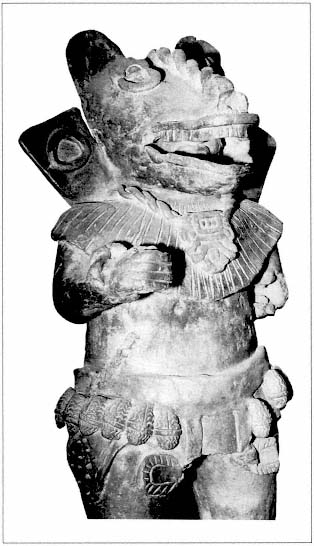
Pl. 34.
Opossum-masked ritual figure, Monte Albán.
The face of the wearer of the ritual mask
is visible through the open mouth
(Museo Nacional de Antropologia, Mexico).
This progression from hidden to visible human faces suggests that the widespread Mesoamerican technique of representing a face, and even a whole figure at times, emerging from the jaws of a mask was conceived as an expression of a particular stage of the liminal ritual moment. This suggests, in turn, that the liminal state was imagined not as monolithic but as a series of stages, a continuum joining man to god which must be seen as a visual counterpart to the process of "unfolding" by which the life-force enters the world.
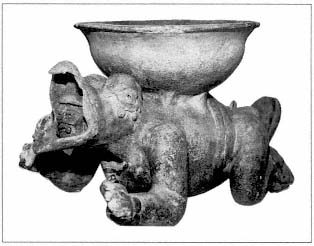
Pl. 35.
Crawling figure with human face emerging
from open mouth, Zapotec (Brooklyn Museum).
In fact, a careful examination of representations of ritual in pre-Columbian spiritual art reveals that the specific form of the masks which allowed ritual performers to exist, for the ritual moment, "betwixt and between" the world of spirit and the world of nature allowed the precise designation of that series of stages of liminality by progressively removing the human face from beneath the mask. Closest to the world of the spirit and farthest from man's secular world, god impersonators, like the Hopi kachina dancers, wore masks that completely covered the face. Hidden within the masks, they "became" the gods whose masks they wore and thus manifested in the natural world the spiritual qualities inherent in those gods.[30] The X-ray technique thus provided a way of portraying in art, but not in ritual, the fully masked impersonator while simultaneously revealing his human identity. He is a man become a god in the ritual moment; his inner spiritual identity has been made visible.
While the fully masked impersonator most clearly "becomes" the god, the most dramatic portrayal of the liminal position of man in relationship to the world of the spirit shows the head or even the entire upper body of a human being emerging from the jaws of the mask of the god as in the Zapotec crawling figure. Among the most fascinating of such representations is one of the earliest, and, significantly, it is clearly related to ritual. La Venta's Monument 19 (pl. 36) depicts a priest, identifiable as such by the valiselike bag he carries in his extended right hand, seated within the womblike enveloping body of a powerful, protective serpent. The relationship between priest and serpent is suggested by the fact that the priest's head is depicted within the open jaws of a mask/ headdress identical to the serpent's head. Thus, it is doubly clear that the human figure emerges from and is an expression, in ritual, of the composite serpent figure. As Elizabeth Easby and John Scott point out, the serpent's "stylized head, repeated in the mask helmet of the human figure, combines features of serpent, jaguar, and bird of prey."[31] That combination, especially in connection with the crest or plume above the serpent's head, leads us, along with many other scholars, to conclude this is a prototypical plumed serpent, perhaps the first of those that would later become the Mexican Quetzalcóatl and the Maya Kukulcán.[32]
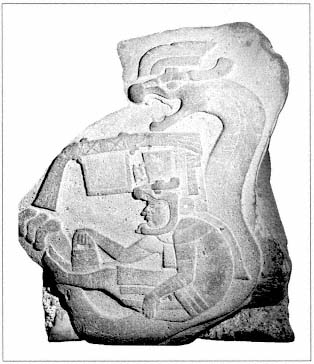
Pl. 36.
Monument 19, La Venta (Museo Nacional de Antropologia, México).
More significantly, however, this bas-relief epitomizes the depiction of liminality in Mesoamerican ritual art. In the jaws of the serpent mask, the priest is metaphorically midway between earthly reality and the world of the spirit; emerging from the "womb" formed by the serpent, in much the same way that the serpent emerges from the sheltering, fertile earth, the masked priest, whose "curved back . . echoes the line of the cape and the snake's body, "[33] is perilously close to the world of the spirit—whose danger is here indicated by the fact that this particular serpent is a rattlesnake— and yet is protected by ritual from the danger, from "succumbing to the blast and going to pieces." This, then, is a magnificent visual expression of the mystery of the liminal experience that can only occur in a place "betwixt and between" in a time that is no longer in time.
Mesoamerican spiritual art contains literally countless examples of faces and figures similarly emerging from the jaws of animal or composite masks. Perhaps the most celebrated later example of this motif is the exquisite small Toltec plumbate sculpture covered with mother-of-pearl mosaic (pl. 37) which has been described as a face-painted warrior emerging from the mouth of a coyote or as the bearded face of Quetzalcóatl emerging from the jaws of the Feathered Serpent.[34] As we have seen (pls. 21, 22, 24), the same theme is found elsewhere in the Valley of Mexico in the early Postclassic, and it culminates in Aztec stone sculpture, relief carving, and codex illustration.[35]
While numerous examples of open-jawed helmet masks on ritual figures can also be seen in the earlier art of the Classic period, perhaps the most interesting example in the Valley of Mexico depicts priests wearing headdresses containing only the upper jaw of what would be a helmet mask were the lower jaw present. This sort of headdress no doubt developed from the full mask, but in terms of liminality, it is a step removed as the dramatic sense of emergence from the world of the spirit has departed with that missing lower jaw, leaving behind only the symbolic indication of that emergence. These particular priests appear in ritual procession in a mural (pl. 38) in the Tlalocan complex at Teotihuacán's Tepantitla apartment compound, and they have come to be known as the Sowing Priests because the streams of water flowing from their hands are filled with seedlike objects which they could be imagined as sowing. Identified as priests by their ritual bags, like that carried by the figure on La Venta's Monument 19, these men are depicted in a ritual context, and the priests' ritual regalia, the "seeded" streams decorated with rows of flowers falling from their hands, the facial paint, the necklaces of shells, the two scrolls similar to speech scrolls rising from their hands, and, most important, the feathered serpent headdresses, all combine to leave no doubt that the focus of their ritual is fertility.[36]
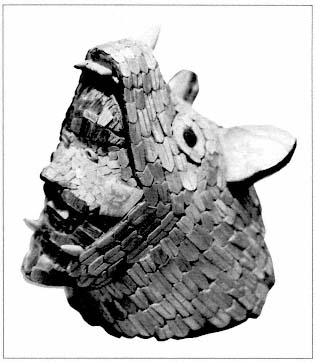
Pl. 37.
Plumbate effigy jar lid covered with mother-ofpearl mosaic,
found near El Corral temple, Tula
(Museo Nacional de Antropologia, México).
It is thus significant that the open-jawed serpent of the headdress is virtually identical to the plumed serpents projecting from the frieze of the Temple of Quetzalcóatl at Teotihuacán (pl. 20) because as we have seen in the preceding section, those serpents are directly related to fertility ritual.
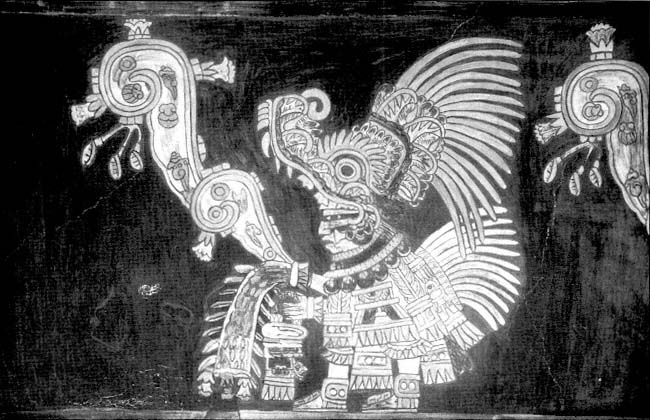
Pl. 38.
Sowing Priests mural, Tepantitla, Teotihuacán, detail
(reproduction in the Museo Nacional de Antropologia, México).
The priests' faces, painted with red bands at eye and nose level, emerge beneath the raised upper jaws of the feathered serpents whose eyes, like the eyes of the priests, are depicted frontally, while the rest of each figure is characteristically depicted in profile. Thus these priests, like the Olmec priest of La Venta's Monument 19, are identified with and function as the conduit for the movement of the spiritual power represented by the Plumed Serpent into the world. It seems likely, then, that at Teotihuacán as well as in the later history of the Valley of Mexico and perhaps earlier among the Olmecs "Quetzalcóatl is more than just a symbol of water and fertility; he is also the patron of the priesthood which carried out vital ritual actions,"[37] and that function is indicated by the mask/headdress his priests wear.
There are a number of other depictions at Teotihuacán of helmet masks, both with and without lower jaws, from the mouths of which emerge human faces, and this motif was not limited to the Valley of Mexico. A great number of the funerary urns found in tombs at Monte Albán depict similar masks and headdresses. In fact, one of the most magnificent urns from the period Monte Albán II (pl. 39) during which, according to Covarrubias, the finest urns, "majestic and imposing in size and design,"[38] were produced, was found in Tomb 77 and depicts "a powerful middle-aged portrait face within the helmet" framed beautifully within "concave and convex planes" made up of "overlapping ochre and green plates of clay."[39] The headdress or upper part of the helmet represents a broad-billed bird[40] while beneath the portrait face, a wide circular band almost abstractly suggests a lower jaw, providing a beautiful foil for the facial features of the portrait. While our information concerning the meanings of the symbols of Monte Albán art is so limited as to make it impossible to identify the particular aspect of the supernatural represented by this imposing helmet/mask, it is clear that its creator is suggesting the emergence of this very particular person from that aspect of the spiritual realm symbolized by the mask. And it is fascinating to realize that this urn was created to be placed in a tomb, perhaps designed to accompany the person portrayed in his return to the world of the spirit. This urn, in that sense, is composed of two masks—the mask of the sacred bird and the death mask of the man. The complex interplay suggested by one's emerging from the other just as life emerges from the spirit suggests metaphorically both the complexity and profundity of the liminal state within which this interplay takes place, a complexity even greater in view of the fact that the meaning of this urn is involved not with the emergence of birth but with the return of death. As one would expect, a number of other urns have been found at Monte Albán which display similar headdresses and helmet masks, one type of which
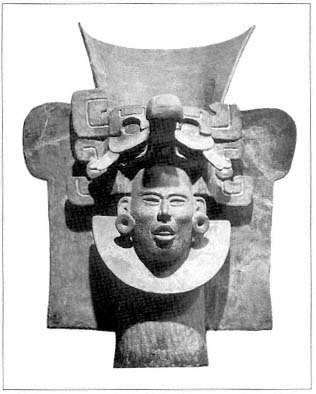
Pl. 39.
Funerary urn, Tomb 77, Monte Albán II
(Museo Nacional de Antropologia, México).
has a headdress representing the upper jaw of a serpent[41] which looks remarkably like the headdresses worn by the Sowing Priests of Teotihuacán.
Figures emerging from the mouths of animal and composite masks are characteristic of Classic period Maya art as well. They are found on stelae and architectural carving in such profusion that it would be impossible for us even to list here the seemingly endless variations on the theme played by Maya sculptors. Tatiana Proskouriakoff describes the type as it is found on stelae:
The design of the headdress most commonly worn by the principal figure on Maya stelae consists of a central mask with attached plumes and other ornaments. It is possible that originally the head of the figure was enclosed in the gaping jaws of the mask, for what looks like a lower jaw beneath the face is seen on one of the Cycle 8 monuments at Uaxactún and recurs later as a decorative element. In most designs only the upper jaw of the mask is shown, the lower is entirely omitted.[42]
According to Schele and Miller, that central mask most often represented a god whose identity "depended on the ritual context," and that ritual, as we indicated above, "transformed spiritual beings into corporeal existence in the human realm and allowed people and objects to become the sacred beings they represented."[43] A particularly striking, though highly stylized example of this motif in late Classic or early Postclassic Maya art is a carved stone sculpture (pl. 40) that once decorated the upper temple of the Pyramid of the Magician at Uxmal. It depicts a head with a heavily scarified face and a crownlike headband made up of circular forms emerging from the stylized open jaws of a serpent. Ruz describes the portrait as displaying "the sullen frown and disdainful mouth of a priest,"[44] and Stierlin suggests that he is a priest of Quetzalcóatl, the Plumed Serpent who was to become the "much-venerated Kukulcán" in the Postclassic Yucatán.[45] Thus, this sculpture may be related to the architectural carvings at Chichén Itzá which manifest the same theme, and it is surely a Yucatec Maya version of the relief carvings of the Classic period characterized by Proskouriakoff.
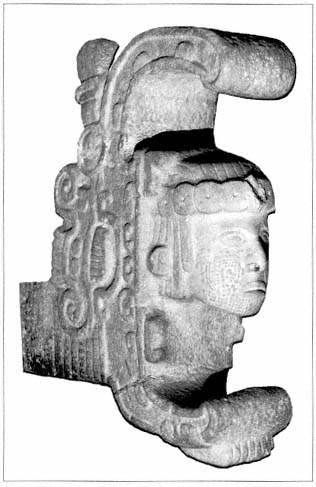
Pl. 40.
Architectural sculpture, El Advino, Uxmal
(Museo Nacional de Antropologia, México).
Schele and Miller also believe, for a different reason, that such a Maya depiction of a figure emerging from the open jaws of a serpent is a visual image of what we have been calling the liminal experience. They contend that the ritual bloodletting often depicted in Maya art was designed to induce hallucinatory visions, "symbolized visually by a rearing snake . . . [with] the persona contacted through the vision . . . shown emerging from [the snake's] gaping mouth," and that "through
such visions, the Maya came directly into contact with their gods and ancestors."[46] In our terms, then, that bloodletting, like the ingestion of hallucinogens, allowed the ritual performer to transcend the limits of the world of nature, entering a liminal "no-place and no-time" in which he would encounter the gods and his ancestors who had "become gods" on their death. These same ritual performers, often rulers, are precisely the figures commonly depicted wearing the helmet masks and masked headdresses from which their faces emerge, suggesting in still another way the fundamental relationship between their position and power and the liminal state through which it was achieved and legitimized. The masks, in this sense, are visual metaphors of their psychological immersion in the world of the spirit.
This symbolic theme of emergence, as we suggested earlier, appears everywhere in the spiritual art of Mesoamerica, and one of its most beautiful manifestations comes from a tradition separate from, though intimately related to, those of central Mexico, Oaxaca, and the Maya. It is the profoundly simple, life-sized Huastec figure of a ritually dressed standing man from Amatlán, Veracruz (pl. 41). The man's face emerges from under the upper jaw of a mask of a seemingly human face with just the suggestion of the mask's lower jaw beneath the man's face. The eyes of the mask are almost closed, and on either side of it, in the place of earrings, hang limp human hands. The face and mask are set against a semicircular plane forming a headdress which is repeated in inverted, U-shaped form beneath the face in the garment covering the chest of the man, a shape that is also repeated in the earrings he wears. In the middle of that U-shaped form is a hole in the chest of the figure which would probably have held a piece of jade representing the heart. Above the upper semicircle and below the U-shaped plane extend rectangular planar forms, giving the sculpture the appearance of an abstract composition of planes, an appearance obviously meant to contrast sharply with the lifelike demeanor of the face and the vigorous positions of the arms. In addition to the use of geometrical forms as counterpoints to living forms, life, here, is juxtaposed to death in the contrast between the face and the mask, between the dead hands and the living ones, and between a skeletal face carved on the back of the semicircular plane of the headdress and the frontal living face. The location of the heart in this composition suggests its centrality to this theme of life emerging from and returning to death as the heart was, after all, the primary symbol of life for Mesoamerica, and its sacrifice marked the ultimate movement from the life of man into, and beyond, the liminal state in which man, through ritual, became god.
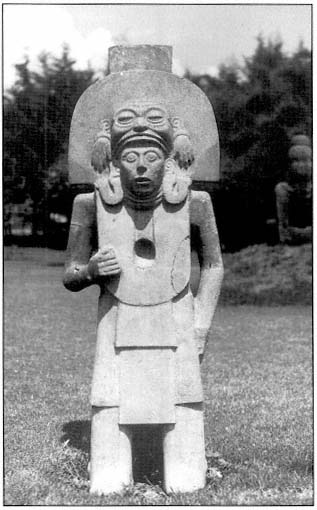
Pl. 41.
Huastec standing figure, Amatlán, Veracruz. Behind the figure's face,
on the rear of the sculpture, a skeletal face appears
(reproduction at Museo de Antropologia de Xalapa).
Two typical stelae also from Veracruz, one reputedly from San Miguel Chapultepec and the other from Cerro de las Mesas (pls. 42 and 43) provide a fitting conclusion to this discussion. The figures depicted, probably rulers, are dressed in identical regalia, and that regalia, especially the complex headdress, is a virtual symphony of masks. Each wears a buccal mask over the lower portion of his face, and each face emerges from the open jaws of an enormous, stylized serpent mask that is surmounted by a second open-jawed serpent mask. Still another open-jawed serpent mask is attached to the rear of the headdress, and a small jaguar head or mask is attached to each man's knee. This openjawed serpent mask is found elsewhere in the art of Veracruz and is important enough symbolically to be depicted alone as the central element on a stela from Castillo de Teayo. These five formidable masks, three of them open-jawed serpents, when "read" together no doubt symbolically identified the divine source of the ruler's power and placed his ritual action depicted here in that liminal zone in which he "became" the power symbolized by
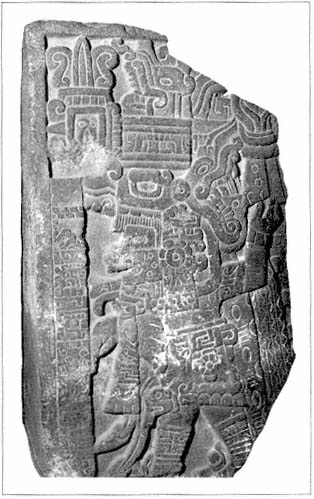
Pl. 42.
Stela, San Miguel Chapultepec, Veracruz
(Museo Nacional de Antropologia, México).
the masks. In this connection, it is interesting that the buccal mask, symbolic of the god's features merging with his own, is not that of the open-jawed serpent from which he emerges and which he also wears as an emblem on the front and back of his headdress. As was the case with the impersonator in the Tepantitla mural (colorplate 3), a distinction is made here between the more general aspect of the realm of the spirit symbolized by the serpent and the ruler's particular ritual contact with that realm symbolized by the merging of his human face with the buccal mask. Thus, we have on these stelae several aspects of liminality displayed in a single image. The ruler emerges from the realm of the spirit and wears the mask symbolic of that emergence as an emblem while at the same time his human identity is merged with a spiritual identity. Viewing that image, his subjects would have had no doubt about the power and legitimacy of his rule.
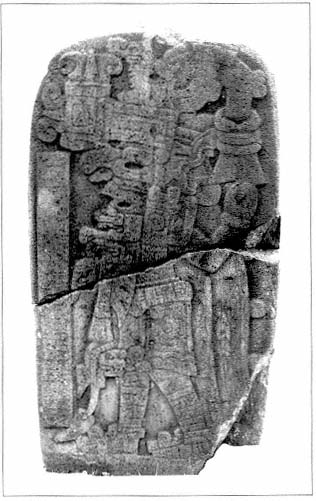
Pl. 43.
Stela 5, Cerro de las Mesas, Veracruz
(Museo de Antropologia de Xalapa).
Step by step, then, through the convention of depicting the faces of ritual performers within the jaws of composite masks, Mesoamerican spiritual art depicts those human beings from the state of being totally immersed in the world of the spirit and barely visible through the slightly opened mouth of the mask to the point of having emerged from that immersion wearing the upper jaw of the mask as a headdress symbolic of their state. This conventional manipulation of the degree and manner of exposure of the human face allows the delineation of the precise relationship of the human being with the world of the spirit just as the features of the mask allow a precise definition of a particular facet of the spiritual realm. But whatever the degree of immersion and the identity of the spiritual force, the metaphor underlying all of these representations is the emergence of life from the spirit, the manifestation of the life-force in a particular living being, for as Gill points out, "only through symbolization is the sacred manifest."
Merging with the Ritual Mask
The buccal masks on those two stelae from Veracruz are particularly significant for us since they suggest another way in which the spiritual art of Mesoamerica used the mask to "measure" the degree of contact with the world of the spirit of a
priest or ruler engaged in ritual, to depict what seem to be stages along the continuum that joins the worlds of man and the gods. If the costume of the impersonator is considered as an extension of the mask, a fully masked figure would be one showing no vestige of the human figure within, presenting to the viewer a figure visually indistinguishable from the god—a man become a god. Such figures exist in Mesoamerican art, but far more common are those, like the Zapotec opossum-masked impersonator (pl. 34), with fantastic animal or composite heads on human bodies. Many of the figures in the Postclassic codices, for example, are of this type, and the metaphoric import of such figures is to suggest that in some sense the ritual performer retains his humanity as he merges with the god in the liminal state.
Still further removed from total identification with the gods are those figures, like the rulers on the Veracruz stelae, who wear masks covering only a portion—often the mouth—of the human face. Since the face is of such fundamental symbolic importance in Mesoamerican spiritual art and thought, such partial masking clearly delineates a merging of man and god in a truly liminal moment, the moment of transition from one state of being to another. Finally, a number of gods are represented, especially in the artistic tradition of the Valley of Mexico, by fully human figures with faces that are unmasked but painted in specific ways, revealing even more fully than does the partial mask the human face of the "god." Thus, the degree to which the mask of the god covers the human wearer indicated metaphorically the stage of liminality experienced by the wearer, and in this way as well, as through the emergence of the face from the mask, Mesoamerican art portrays the liminal ground between man and the gods as a continuum, a progression from the realm of the spirit to the world of nature.
The use of such partial masks in Mesoamerican art and ritual goes back to the earliest times. Among the Olmec, in fact, there are far more buccal masks than full masks, a result, perhaps, of the Olmec emphasis on the were-jaguar mouth, the primary symbol of the rain god, but other buccal masks are depicted as well. Probably the best single example of the range of such masks in Olmec art can be seen in the six masked faces inscribed on the figure called the Lord of Las Limas (pl. 3) which Coe and Joralemon see as representing the six most important Olmec gods. Each of these faces is essentially human with a striking masklike treatment of the mouth area, and each of those treatments is represented elsewhere in Olmec art by a buccal mask. One of the clearest examples of such a representation can be seen in a small painting, designated Painting 7, in the grotto of the Oxtotitlán cave, the location of the X-ray representation (pl. 5) described above. This painting depicts the face of a human being whose mouth is covered by a fanged serpent mask. Both his jaw and upper face are fully exposed except for the scroll eyebrow he wears covering his own. His face is shown in profile, accentuating the outline and position of the mask, and the mouth is further emphasized by a small scroll element appearing before it which may be "the earliest known example of a speech glyph" indicating the man's ritual speech.[47] Numerous other examples of buccal masks exist in Olmec art on masks, celts, carved figures, and in paintings, suggesting the importance Olmec thought assigned to this graphic representation of liminality.
Contemporary with the Olmecs, villagers in the Valley of Mexico were making and using the small pottery masks (pl. 44) through which they created "the mythical half-human, half-animal" disguises referred to by Flannery in his characterization of early Mesoamerican religion. While these certainly do not look like buccal masks—they are always full human faces—the figurines that show them in place on dancing figures often show them covering only the lower part of the face and thus serving precisely the same metaphorical function as the buccal mask.
Given the early importance of the buccal mask in Mesoamerican spiritual art, we would expect to find it well represented in the art of the Classic period, and that expectation is fulfilled, although less fully in the art of the Maya than elsewhere. In Oaxaca, for example, a figure commonly depicted throughout the development of Monte Albán wears the buccal mask of a serpent (pl. 45) which Caso and Bernal see as related to Quetzalcóatl of the Valley of Mexico,[48] although one might
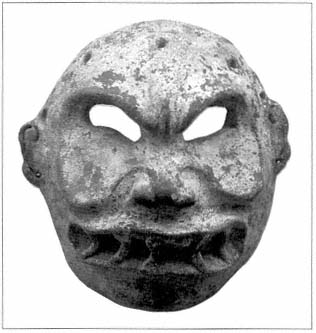
Pl. 44.
Ceramic mask of an old man, Tlatilco
(Museo Nacional de Antropologia, México).
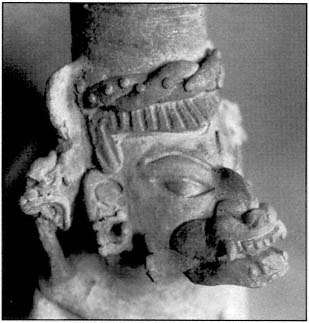
Pl. 45.
Ritual figure wearing buccal mask of a serpent, funerary urn,
Monte Albán (Museo Diego Rivera, México).
also see a strong visual resemblance to the buccal portion of the Cocijo mask (pls. 14, 15), particularly since the serpent is very closely related to both sacrifice and lightning, the two major themes expressed by the mask of Cocijo in its delineation of the great supernatural forces related to fertility and rulership. And buccal masks appear also in the art of Teotihuacán, illustrated most clearly in the so-called Jade Tlaloc mural at the apartment compound of Tetitla. The name is misleading because the priests pictured here do not serve Tlaloc but the god represented by the hook-beaked bird whose mask they wear as an emblem in their headdresses. Their buccal masks are related to that mask, but in what is clearly a significant similarity, both the masks in the headdress and the buccal masks are virtually identical to those worn by the central figure in the Tepantitla mural (colorplate 3). This similarity would suggest that the ritual focus of these figures was also fertility but a fertility that, as Séjourné indicates, may well be associated with creation in a more general sense.[49]
That symbolic meaning continues to be conveyed by the buccal mask in the Valley of Mexico during the Postclassic period where it is most clearly associated with Ehécatl (pl. 46), the aspect of Quetzalcóatl whose natural manifestation is the wind that "clears the roads" for the coming of the rains. That wind, blown through his buccal bird mask, is an obvious symbolic reference to the breath, or essence, of life, especially since man's creation was mythically attributed to Quetzalcóatl. And just as Ehécatl worked in tandem with Tlaloc to provide life for man's crops, so Quetzalcóatl symbolized the breath that along with blood symbolized the essence of life. Significantly, then, Ehécatl's buccal bird mask was the instrument through which that breath was provided by the god since by merging the faces of god and man, the buccal mask provided a metaphor for the movement of the essence of life from the world of the spirit to the world of nature.
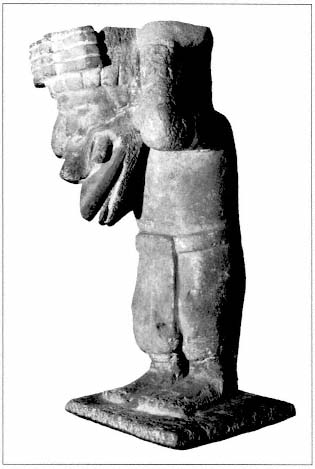
Pl. 46.
Ehécatl, Aztec Atlantean sculpture, Tenochtitlán
(Museo Nacional de Antropologia, México).
Face painting and scarification provide the natural end to the progression from the full mask to the partial mask by revealing fully the human face while "marking" it with the symbols of the world of the spirit. Like the other forms of masking, face painting and the scarification that can be seen as a method of making that painting permanent have their roots early in Mesoamerican spiritual history. In the village cultures of the Valleys of Oaxaca and Mexico, faces, and whole bodies, were decorated with paint by the roller stamps commonly found in the remains of those cultures alongside figurines displaying the decorations. And among the Olmecs, the incised lines and designs commonly found on the faces of sculptured figures (pl. 3) and on masks surely represent the face painting and scarification worn by priests and other ritual performers. These practices in the cultures of the Pre-
classic prefigured even more elaborate forms of facial decoration in the Classic period. There is, for example, a good deal of evidence of face and body painting as well as scarification on the urns of Monte Albán,[50] and similar evidence exists in the ceramic and stone sculpture of the Maya, such as the Yucatec priest emerging from the jaws of a serpent found at Uxmal (pl. 40) and in the vase paintings of the Classic period.[51]
Such forms of facial decoration reached their apogee among the Classic and Postclassic period cultures of the Valley of Mexico. Faces of priests in the murals of Teotihuacán were often painted in designs signifying their functions, and stone and ceramic masks were decorated with mosaics or paint in similar designs (colorplate 8). These latter are funerary masks (discussed below), which are used in ritual at that most liminal of moments evidently requiring the identification of the physically dead man with the living god whom he was about to "become." Face painting served this function by allowing the death mask of the man, in idealized rather than portrait form at Teotihuacán, to be visible under the symbolic mask of the god. He remained himself—the human ancestor who could be contacted through ritual—while becoming a god.
The importance of face painting at Teotihuacán no doubt provided the impetus for its even greater development in the Postclassic in the Valley of Mexico. In our detailed consideration of the symbols that identified Huitzilopochtli, we delineated the method by which the Aztecs symbolized their gods. "Not many deities were regularly depicted wearing masks," Nicholson points out, but "facial painting was particularly diagnostic."[52] And even beyond the use of conventional designs to define particular gods, face and body painting were used in the codices and presumably on ceramic and stone sculpture to create symbolic combinations of gods in the same way that the mural art of Teotihuacán combined the features of masks to create unique "gods," as we have shown in our discussions of the Codex Borgia Tlalocs (colorplate 1) and the Tepantitla mural (colorplate 3). For the Aztecs, then, and no doubt for the cultures that preceded them, such face painting was the equivalent of a mask, as Sahagún's informants make clear in speaking of Huitzilopochtli: "His face is painted with stripes, it is his mask."[53] Such facial painting, as a mask, allows the simultaneous perception by the viewer of the human and divine identity of the wearer and forces the realization, exemplified by the Hopi children confronting the unmasked kachina, that the world of man and the world of the spirit are essentially one, a unity realized in the liminal state of ritual. Everything in Mesoamerican spiritual art combines to communicate that meaning, and the ritual mask is its single most important metaphor.
The Aztec god Xipe Tótec, Our Lord the Flayed One, provides what is probably the most compelling example both of the importance of face painting and scarification and of the liminal state of the wearer of the ritual mask. For the Aztecs, Xipe Tótec was the red Tezcatlipoca, and his face was painted red with horizontal yellow stripes, the Tezcatlipoca design with red substituted for black, as a visual indication of his identity. He was, however, often depicted with vertical lines through his eyes as well, which may represent a diagnostic detail by which prototypical Xipes can be identified very early in Mesoamerican art. Indeed, Coe identifies one of the masked faces inscribed on the Lord of Las Limas (pl. 3) as the Olmec prototype of Xipe Tótec for this reason,[54] and Caso and Bernal use those same lines to identify early representations of Xipe at Monte Albán in which the lines seem often to represent scarification.[55] Nicholson urges caution as such lines through the eyes are also found on the images of other gods among the Aztecs,[56] but our analysis of the system underlying the construction of symbolic masks suggests that those "other gods" may well be secondary masks symbolizing a merging of the qualities of Xipe with other primary god-masks.
These facial details are not, however, the clearest and most common visual indication that we are in the presence of Xipe Tótec. Rather, that indicator is the unique "mask" worn by his priests and votaries in ritual and often depicted in art (pl. 47), a mask that is the skin of the face and body flayed from a sacrificial victim impersonating the god, donned in the final segment of a complex ritual, and worn for a period of time afterward by beggars before being buried in the temple of the god. In most representations of Xipe, all that is discernible in what seems to be a human face are the slit, buttonhole-shaped eyeholes, the openings of the nose, and the almost circular opening of the mouth through which the lips of the wearer can be seen. All else is hidden by the tightly stretched, flayed skin that has become the most macabre and most metaphoric of masks. The victim's hands hang limp at the wearer's wrists, and on many representations in the round, the lacing in the rear that holds the skin together is elaborately rendered.
Although there are various theories concerning the meaning of this ritual wearing of the victim's skin, the metaphor underlying the ritual is clearly the same as the central metaphor provided by the idea of the mask for Mesoamerican spirituality. The ritual and the art depicting it require us to consider separately the external covering and the essence of a living being. Most literally, the god is the essence; he is "the flayed one" who is revealed by the stripping away of his covering or mask according to the consistent logic of Mesoamerican sacrifice which always, at the sacrificial moment, opens or removes the outer to reveal the inner that is metaphorically the essence of life itself—
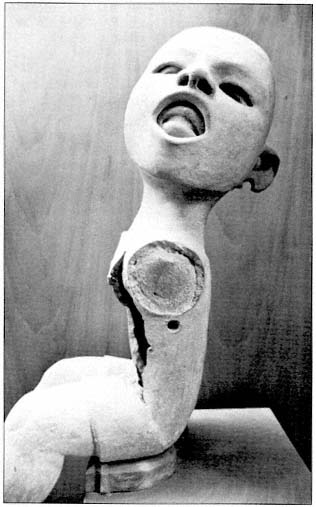
PI. 47.
Xipe Tótec, Palma Cuata, Veracruz
(Museo Nacional de Antropologia, México).
the god. When that now-removed covering or mask was donned by another in ritual, the wearer almost literally found himself within the skin of the god. And after the skin had been flayed from the sacrificed body of the impersonator, the flesh was cooked and eaten in a form of communion that reversed the metaphor by placing the god's essence within the ritual participant.
Seler's interpretation of this ritual as a metaphor for the living seed bursting forth from within its dead covering, resulting in the "new skin" of vegetation placed on the earth by the coming of the rainy season,[57] has been generally accepted since it seems to explain the timing of the calendrical ritual dedicated to Xipe and the reference in the mysterious and beautiful "Song of Xipe" to the god's donning of his "golden garment." As Seler suggests, the metaphor and the ritual refer both to sowing, as we have seen, and to the harvest where the skin becomes the metaphor for the husk of the corn. In thus embodying the agricultural cycle, Xipe reveals himself as an earth god whose concern is fertility and man's sustenance. Nicholson objects to this interpretation on the grounds that we have no native informant's testimony to support it, although he does agree "that fertility promotion was the central purpose" of the ritual. He seems more comfortable with a more general interpretation.
By donning such a terrible garment the ritual performer thereby becomes the deity into which the victim had earlier been transformed, literally crawls into his skin, so to speak—or, at least more directly partakes of his divine essence than by merely attiring himself with the god's insignia .[58]
Such an interpretation of the ritual accords with our idea of the mask as metaphor, and it is important to note that it does not conflict with Seler's interpretation; they approach the ritual on different levels. This seems a perfect example of the multivocality of what we have termed primary god-masks, and Séjourné provides still another level of interpretation that, we would argue, conflicts with neither of these. Calling Xipe "the most hermetic of all Nahuatl divinities," she sees the symbolism of his ritual as one in which the victim
is relieved (by flaying) of his earthly clothing and is freed forever from his body (an act represented by the dismembering of the corpse). The mystical significance of these rites is emphasized by the behaviour of the owner of the sacrificed prisoner. Not only does he dance, miming the various stages of the [ritual] combat and death; he also behaves towards the corpse as if it were his own body. This identification suggests that the slave represents the master's body offered to the god, the former being merely a symbol for the latter. The drama thus unfolds on two planes: that of the invisible reality, and that of finite matter, a mere projection of the former.[ 59]
Such an interpretation fits perfectly the most fundamental assumptions of Mesoamerican spiritual thought as we will outline them in Part II. And while it is probably true that the ordinary citizen observing this ritual was most aware of its gruesome fertility implications, it is just as probable that the priest saw in its series of oppositional relationships between inner and outer and living and nonliving the acting out of the most profound mystery recognized by Mesoamerican seers, that mysterious entry of the spiritual essence of life into the world of nature for which the mask stood in art and ritual as metaphor.
Sahagún indicates clearly the validity of such an interpretation of the ritual in his delineation of the relationship between the prisoner of war who was to become the sacrificial victim and his captor. The captor did not himself kill the captive but offered him "as tribute," the actual sacrifice being consummated by the priests. Furthermore, "the captor might not eat the flesh of his captive. He said: 'Shall I, then, eat my own flesh?' For when he took
the captive, he had said: 'He is as my beloved son."' That identity between captor and captive is made explicit in still another way:
They named the captor the sun, white earth, the feather, because he was as one whitened with chalk and decked with feathers.
The pasting on of feathers was done to the captor because he had not died there in the war, but was yet to die, and would pay his debt in war or by sacrifice. Hence his blood relations greeted him with tears and encouraged him .[60]
Thus the captive is simultaneously the god whom he impersonates and the alter ego of the all-toohuman captor; in the captive, the human and divine identities of the human being merge, and it becomes agonizingly clear that the human skin is but a mask hiding the divine essence that is revealed in the most literal and striking manner possible in the course of the ritual.
In this ritual, called Tlacaxipeualiztli, which means the flaying of men, the mask is no longer an instrument of ritual; here it becomes the very subject, a subject no longer metaphorical but now intensely, almost overwhelmingly, real. The impersonator of the god is stripped of his human covering to reveal the essence of life, which is then consumed so that it—literally—can sustain human life. Such a ritual unmasking as this makes the Hopi children's realization pale by comparison.
But in the final analysis, even this masked ritual is metaphoric. Like the Maya incised conch shell described by Octavio Paz, itself a potent symbol of the inner-outer dichotomy that fascinated Mesoamerican artists, Xipe Tótec in ritual
not only offers us the crystallization of an idea in a material object, but is also the fusion of the two into a true metaphor, not verbal but emotional. This kind of fusion of literal and symbolic, matter and idea, natural and supernatural reality, is a constant factor not only in Maya art but in that of all the Mesoamerican cultures.[ 61]
Such fusion is characteristic both of metaphor and liminality, for in both cases, at the moment of the juxtaposition of the two normally separated realms of experience, a recombination and transformation takes place through which a new reality is formed. In that moment, all previous definitions of reality are questioned and the new image created by the transformation enables man to transcend his mundane existence and, like Melville's Ahab, "strike through the mask" of nature to engage the very essence of life while protected by ritual from "going to pieces" in that encounter.
Two facts emerge from this relatively brief and partial survey of the vast subject of Mesoamerican masked ritual. First, throughout their long history, the cultures that made up Mesoamerican civilization explored every possible dimension of the metaphor of the mask. That metaphor was twisted and turned, looked at this way and that, and made to express every nuance of Mesoamerican spiritual thought. Second, in each of those expressions, the emphasis was always on the link between man and god, on the creation in ritual of a liminal space in which that linkage could be made. For this reason, perhaps, the emphasis in Mesoamerican masking seems overwhelmingly on the mouth—mouths open to reveal faces emerging, mouths composed of the features of a variety of natural creatures dominate masked faces, mouth masks partially cover human faces—announcing the fundamental Mesoamerican idea that man is an expression of the gods, that natural reality is a manifestation of spiritual reality.
The Architectural Mask
Defining Sacred Space
As if to indicate in tangible form the ability of ritual to create that liminal space where man could meet god, the very structures that housed that ritual were themselves embellished with masks. Whether those masks created doorways between the mundane and the sacred, emblazoned the facades of buildings with a symbol of the sacred activity housed within, or marked the sacred pathway up the steps of the pyramid leading to the temple, they served always to signify the presence of the sacred. Just as the ritual mask manifested the sacred inner reality of the performer, so the architectural mask made apparent the sanctity of the place where that ritual mask was worn. But beyond that significant function, the architectural masks found throughout pre-Columbian Mesoamerica symbolize the underlying cosmological purpose of the structures on which they appear, structures that served "to dramatize the cosmogony by constructing on earth a reduced version of the cosmos."[62] The structures themselves were metaphors, and Octavio Paz describes the creation of such works of art when he speaks of the "Maya's transformation of literal realism in objects that are metaphors, palpable symbols. . . . A marriage of the real and the symbolic is expressed in a single object." He extends this observation to all of Mesoamerican civilization, which is, "like its art, a complex of forms animated by a strange but coherent logic: the logic of correspondences and analogies,"[63] a logic seen nowhere more clearly than in the "masked" architecture of Mesoamerica. The masks announce that the very real stone doorways also open into the world of the spirit, that the stone stairways lead both to the tops of the pyramids and to the heavens, that the stone walls of the buildings contain within them the transcendent.
As our discussion of the spatial order will show, Mesoamerican architecture exemplifies this "logic
of correspondences and analogies" in other ways as well. The design of Teotihuacán, and many later cities, for example, replicates the quincunx, the sacred cosmic figure that merges space and time in a single "shape," and the buildings within the ceremonial centers of these cities were similarly laid out. The Maya Temple 11 at Copán was "designed as a diagram of the cosmos."
The north facade represents the arc of heaven held up by the Pauahtuns at the four world directions; it functioned as a place of audience and ceremony. . . . The south facade is defined as the Underworld and a place of sacrificial death. . . . The Middleworld is the interior of the temple itself, sandwiched between the roof, which represents the Heavens, and the south court, or Underworld. The king's accession is recorded in the interior. Yax-Pac conducted the rituals that preserved world order at the four doors of the Temple .[64]
Thus, both the cities and the sacred buildings within their ceremonial centers were "reduced versions of the cosmos"; at the center of the quadripartite city was what Millon has termed the "sacralized political center,"[65] and at the center of the temple was the king-"the manifestation of the divine in human space."[66] Those "centers" were designated as sacred by the presence of architectural masks. Millon refers to Teotihuacán's Ciudadela, and as we have seen, its all-important Temple of Quetzalcóatl (pl. 20) was literally covered with masks. At Copán, the critical north entry of Temple 11 which gave ritual access to the "center" was probably "rendered as the mouth of a monster"[67] in typical Maya fashion, and the figure of the ruler, Yax-Pac, ensconced in the center was surely bedecked with masks as Maya rulers always were.
This center of the four-part figure replicating the cosmos was marked by masks because it was the symbolic center of the universe, the navel of the world. Eliade explains that
in cultures that have the conception of three cosmic regions-those of Heaven, Earth, and Hell-the "centre" constitutes the point of intersection of those regions. It is here that the breakthrough on to another plane is possible and, at the same time, communication between the three regions.[68]
The center allows passage from one mode of being to another, precisely, of course, the function of the ritual mask. For that reason, no doubt, the caves and temples, the mountains and pyramids that throughout the development of Mesoamerican spiritual thought were seen as symbolic centers of the universe were marked by masks symbolizing the point of passage.
As we have seen in other contexts, the importance of the cave in Mesoamerican mythology is due to its role as a point of passage "to another plane." Like the mountaintop, it is a "center" where "the sacred manifests itself in its totality"[69] and is thus linked symbolically to the creation of life, that is, the manifestation of the sacred life-force in the world of nature. Throughout Mesoamerica, "the cave was, and still is, highly revered as the womb of the earth."[70] This symbolic belief can be seen early in the development of Mesoamerican spiritual thought—in the infants held by the figures emerging from the cave/jaguar mouth niches of the Olmec altar/thrones (pl. 12), for example. And that belief lasted to the time of the Conquest; one of the Aztec origin myths records their emergence from Chicomoztoc, Seven Caves, pictures of which look remarkably similar to the modifications made by the Teotihuacanos to the inner sanctum of the cave under the Pyramid of the Sun, suggesting again the antiquity of this belief.[71]
Just as life emerged from the world of the spirit through the cave, it was through the cave that it returned. At Dainzú, near Monte Albán, for example, the jaguar mouth surmounting the entrance to a tomb marks that doorway as an artificial cave and as the final doorway through which the occupant of that tomb would pass in this world. Priests and rulers were often buried in natural caves or in tombs, as at Dainzú, that replicated the cave, and even the sun was thought to enter the underworld at sunset through the mouth of a cave and to emerge from another at sunrise.[72] Fittingly, rites of passage often took place in caves,[73] as did rites of accession because the sanctity of the cave confirmed the divine right of secular rulers.[74] For the same reason, ceremonial centers were often located near the mouths of caves because, as Mendoza puts it, the cave mouth was seen as the "'shaman's doorway' to the acquisition of esoteric knowledge. [75]
It is not surprising, then, that the earliest examples of architectural masks transformed the entrances of caves into the mouths of jaguars, demonstrating clearly Paz's "logic of correspondences and analogies." As we have seen, Monument I from the Olmec fertility shrine of Chalcatzingo (pl. 7) shows in profile a figure, El Rey, seated within a stylized were-jaguar mouth, thereby revealing the meaning and function of another relief carving at that site. That carving, the freestanding Monument 9 (pl. 8), is a frontal view of the mouth of Monument I meant either to be placed in front of an actual cave mouth to demonstrate its symbolic meaning and to provide ritual access to the world of the spirit or, as Grove believes, to be erected on a ceremonial platform to symbolize the cave.[76] In either case, it allowed entrance to the ritual "cave" through the mouth of the mask of a composite being representing the world of the
spirit. While the mouth of the ritual mask opens to allow man to emerge, the mouth of the cave mask opens to allow him to enter.
The mask is similarly used in later Maya art to identify the cave as the entrance to the underworld, Xibalbá.[77] In a dramatic scene incised on a Maya vase, the Cauac Monster is shown as
an independent, architectonic symbol of the door between the natural and supernatural worlds. . . . He is both the cave and the architectural opening into the interior of the temple. . . . Temple doors were articulated as the mouth of the Cauac Monster to identify them as a sacred locus. The entry doors of Structures 11 and 22 at Copán were both surrounded by huge architectural sculptures that transformed the doors into the mouths of monsters. . . . These two buildings at Copán, as well as monster doors used in Chenes and Puuc buildings, were architectural manifestations of the stepped portal on this pot. In this image, the stepped form indicates that the supernatural gate is architectural.[78]
This association of the mask, cave, and temple doorway, widespread in Mesoamerica, was particularly evident among the late Classic Maya. As we have seen, the doorways of temples throughout the Yucatec regions of Rio Bec, Chenes, and the Puuc and at Copán are consistently constructed as the mouths of giant masks "so that entering the building, one is swallowed by the monster"[79] to experience the "inner" reality of the sanctuary. Such temples were artificial caves, symbolically the body of the god whose mask they "wore." When the priest entered the building and proceeded toward the shrine, he metaphorically entered the earth and moved toward its center, the axis of the universe, and simultaneously entered the god with whom he would symbolically merge. The metaphor of the architectural mask could not be clearer: through ritual enacted on sacred ground, man became god.
But the "shaman's doorway" opened upward as well as downward. In the shamanistic cosmological thought of Mesoamerica, the realm of spirit enveloped the earth so that whether one penetrated into the earth below or the heavens above, he encountered the transcendent. The ascent into the heavens took place on the stairways of the pyramids, the artificial mountains constructed, seemingly obsessively, throughout Mesoamerica. The importance of these symbolic penetrations into the world of the spirit is indicated by the symbol of the mask which designates their function as the route to absolute reality and can be gauged by the incredible number of man-hours spent in their construction. As Sacred Mountains, the pyramids are, like the cave, a space excised and set apart from mundane reality, in Eliade's terms a center, the meeting point of heaven, earth, and hell.
The mountain, because it is the meeting place of heaven and earth, is situated at the centre of the world ... and impregnated with sacred forces. Everything nearer to the sky shares, with varying intensity, in its transcendence. Every ascent is a breakthrough, as far as the different levels of existence are concerned, a passing to what is beyond, an escape from profane space and human status .[80]
Completely separated from profane space, such centers can only be reached through an arduous passage.
The road leading to the center is a "difficult road. " . . . The road is arduous, fraught with perils because it is, in fact, a rite of the passage from the profane to the sacred, from the ephemeral and illusory to reality and eternity, from death to life, from man to the divinity . . . or, to speak cosmologically, from chaos to cosmos.[81]
Walking through the mouth of the mask into the architectural "cave"[82] or climbing between the masks lining the steep stairway up the architectural "mountain" to reach the sacred temple at its apex thus symbolizes the passage through what we have called the liminal zone, the zone that exists between chaos and cosmos.
The symbolic nature of the passage is particularly clear in the case of the pyramid's stairway. Eliade contends that "the act of climbing or ascending symbolizes the way towards the absolute reality, and to the profane consciousness, the approach towards that reality arouses an ambivalent feeling, of fear and of joy, of attraction and repulsion."[83] That ambivalence must have found its most extreme manifestation in the feelings of the sacrificial victim as he made his way up those steps to his death. On the one hand, he must have felt a dread almost beyond our ability to comprehend, but, on the other, he surely felt a compelling attraction to the moment of his apotheosis. As Eliade says and as that victim must surely have known in his own far more personal terms, "death is the supreme case of a rupture of the planes. That is why it is symbolized by a climbing of the steps,"[84] and that is why those steps in Mesoamerica were so often lined with masks.
Such architectural masks occur throughout Mesoamerica from the earliest times to the Conquest. The earliest examples are found among the Maya: the Preclassic Structure 5C-54 was built at Tikal "with four stairways flanked by huge masks, "[85] Structure E-VII-sub at Uaxactún was also provided with four mask-flanked stairways, and Structure 5C-2nd was constructed at Cerros with great masks on friezes flanking the stairway. Similar mask-lined staircases are found in the Classic period throughout the Maya lowlands and in central Mexico, as we have seen in the remarkable pyramid of the Temple of Quetzalcóatl at Teoti-
huacán (pl. 20). In no Classic period structure, however, is the concept more profoundly embodied than on the west face of the pyramid at Uxmal known as El Advino (pl. 48). "Uxmal is by far the largest Puuc site, and one of the triumphs of Maya civilization,"[86] and El Advino is one of its major structures. The pyramid we see today is the result of successive reconstructions from the sixth century to the tenth,[87] each of which superimposed a new pyramid over the existing one so that "we can count five temples on top of each other,"[88] but the lateral rather than square design of the pyramid allows some of the earlier temples to remain exposed. Thus, the "breathtakingly steep" steps[89] that ascend the west facade lead directly to a massive Chac mask forming the doorway to the fourth temple while the remainder of the fifth reconstruction and Temple V rise behind it. The dramatic doorway and staircase form a single visual unit set against the backdrop of the striking elliptical pyramid. That drama and unity are both emphasized by the Chac masks that line the staircase (pl. 49), in time-honored Maya fashion, as if to emphasize the "arduous passage" those steps represent. To complete the dramatic picture and indicate its ritual function, just before the masked doorway of the temple, a smaller mask forms a platform probably used in the sacrificial ritual that climaxed and completed the arduous passage up the stairway. Nowhere in Mesoamerican architecture is the symbolic role of the mask on temple and pyramid clearer, and nowhere is the metaphor more strikingly presented.
A similar construction on a smaller scale demonstrates both that this use of the mask was not limited to the Maya and that it continued to the time of the Conquest. The late Aztec site of Malinalco has as its principal structure a temple carved into the living rock of the hillside and entered through the mouth of a giant mask (pl. 50). That entrance is reached only after a truly arduous climb up the hillside followed by an ascent of a stairway of thirteen steps, symbolic of the thirteen levels of the upper world of the spirit,[90] leading to the platform in front of the temple. At the head of the stairway on the floor of the ceremonial platform extends the bifurcated tongue of the mask whose open mouth forms the doorway to the temple. That mask has been identified both as a "serpent-like visage[91] and as Tlaltecuhtli, the earth monster,[92] an identification consistent with the symbolism of the cave, but it displays many of the characteristics of Tlaloc in its fangs, bifurcated tongue, and eyes. And Tlaloc, like Tlaltecuhtli with whom he often merges symbolically in secondary masks, is also associated with the cave.
Whatever the identity of the mask, its function is clear: it marks the entrance to a symbolic ar-
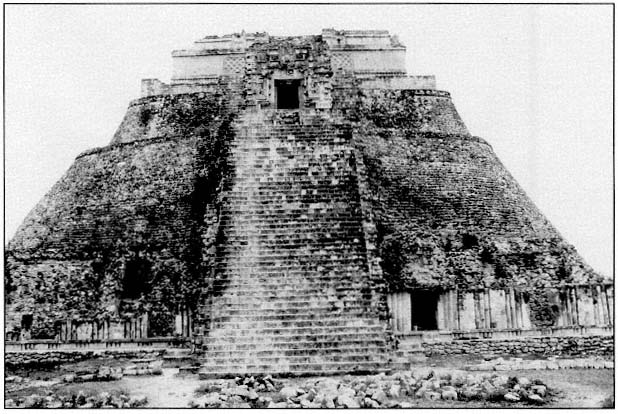
Pl. 48.
El Advino, Uxmal.
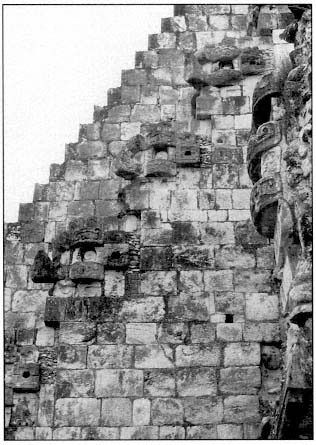
Pl. 49.
Chac masks lining the stairway, El Advino, Uxmal.
chitectural "cave," which in this case served, according to Richard Townsend, as "a component of a larger ceremonial landscape where the ritual integration [between the social and the natural orders] was established" and acted "as a place of transition between levels of the universe—the surface, and the world below." Thus, like the Maya temples, it provided a symbolic setting in which "the transference of power from one monarch to the next was sanctified and made legal."[93] According to Stierlin, however, the ritual use of the cave/temple was probably initiatory since the eagles and jaguar carved as seats on the benches within "represent respectively the diurnal and nocturnal course of the sun" and the cave is where "the sun disappears on its subterranean journey."[94] Pasztory's suggestion that the round form of the temple, in addition to referring to natural caves, "may also have a female connotation as the womb of the earth"[95] would lend further support to the initiatory interpretation. What is abundantly clear, however, is that the architectural mask continued to be used up to the time of the Conquest as a symbolic means of marking the passage from the world of nature to the world of the spirit.
Masks not only form the doorways and line the staircases of pre-Columbian Mesoamerican structures but they often decorate the facades to signify the sacred function of the building. This architec-
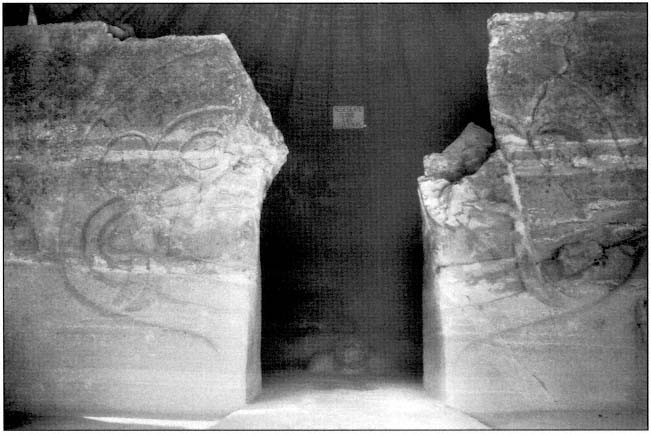
Pl. 50.
Mask doorway, Malinalco.
tural use of the mask also began early. Structure 29B at Cerros, built in the Preclassic about the time of Christ, "has masks on 3 separate platforms on its summit," and as we have seen, Structure 5C-2nd has similar masks decorating panels on the successive stages of the pyramid.[96] That this practice continued among the Maya is made overwhelmingly clear by the almost obsessive use of masks to form, rather than merely embellish, the facades of late Classic temples in the Yucatán. The most extreme example of this use can be seen in the mask-covered facade of the building known as the Codz Pop (pl. 51) at the Puuc site of Kabah. The frieze that, except for five doorways, entirely covers the facade is composed of two horizontal panels, each containing three rows of long-nosed Chac masks. A seventh row appears beneath the doorway's thresholds with the long, upturned noses of the appropriate masks serving as steps permitting entrance through the doorways. Norman Hammond calls the facade "mind-dazzling,"[97] and Stierlin suggests its possible symbolism:
Although calculations are difficult because the upper part of the palace is badly damaged and not yet restored (the pieces of the puzzle lie at its feet), we may estimate that this proliferation of eyes, upturned hook noses, ears, and eyebrows originally added up to some 260 masks—the same . . . as the number of days in the sacred year .[98]
If those calculations are correct, the Codz Pop would take its place beside a number of other important structures in Mesoamerica which display calendrically significant symbolism, generally in the form of masks. Nearby Uxmal's Palace of the Governors is decorated with a frieze containing 260 masks, as Stierlin also notes, and we have already seen that the number of masks on the frieze on the Temple of Quetzalcóatl in the Ciudadela at Teotihuacán is related to the solar year as is the number of niches in the Pyramid of the Niches at El Tajin. Such structures as these render the cosmos in miniature, true to "the logic of correspondences and analogies" observed by Paz. That logic, reflected in their calendrical symbolism, no doubt enabled these masks, and their counterparts on the facades of buildings throughout Mesoamerica, to provide a backdrop for the ritual enacted before them and to symbolize the meanings of that ritual and of the activities carried out on the sacred inner side of the masked facade. Thus, whether serving as the doorways, embellishing the facades, or lining the steps to the temple, architectural masks provided access from the mundane to the sacred and marked the liminal path to another level of existence.
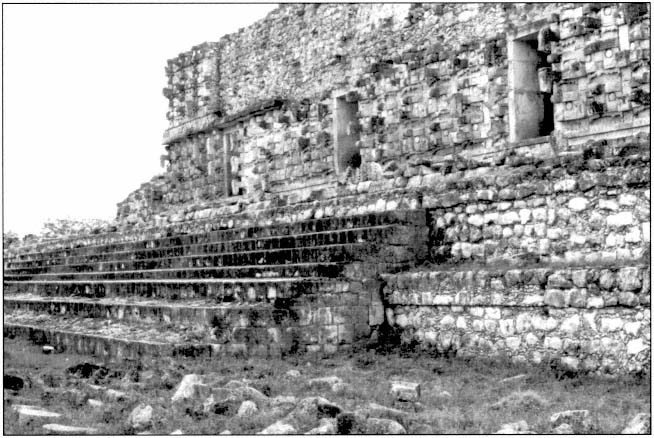
Pl. 51.
Facade, Codz Pop, Kabah.
The Funerary Mask
Metaphor of Transformation
Just as life for the pre-Columbian inhabitants of Mesoamerica culminated in the funerary ritual that marked the beginning of the passage back to the realm of the spirit from whence the individual's life came—often a difficult passage, according to Mesoamerican mythology—so our study of the masks of pre-Columbian Mesoamerica comes to its conclusion with a consideration of the funerary mask that brings together in its final image all of the cosmological conceptions for which the mask stood as the metaphor throughout the long development of Mesoamerican spiritual thought and art. Death, for the peoples of Mesoamerica as for all peoples, was the great mystery. The Aztec account of the metaphoric journey to Mictlan after the body's physical death suggests that except in the case of divine rulers, death was seen as a gradual fading of the individual identity of the person into the anonymity of the life-force.[99] Like the monumental Aztec image of Coatlicue (pl. 9), it was both the womb and the tomb, generating and receiving back all the individual lives in the natural world.
Meditate upon it, O princes of Huexotzinco;
although it be jade, although it be gold,
it too must go to the place of the fleshless.
It too must go to the region of mystery;
we all perish, no one will remain![100]
The gradual movement from individual life to dissolution in the life-force, metaphorically a journey fraught with danger and difficulty in all Mesoamerican myths, begins with separation and detachment from human society, continues through the intervening liminal state, and ends in the mysterious and hitherto inaccessible world of the spirit. Through that metaphor of the journey, as well as the metaphorical funerary mask, the cultures of Mesoamerica attempted to comprehend the mystery of death, to convert what would seem the finality of the end of life into a passage to the essence of life. In this sense, the imagery associated with death in both Mesoamerican myth and art—all the skulls, bones, and skeletal figures—are not emblematic so much of death as of the essence and regeneration of life.[101] "The place of the fleshless, the region of mystery" is, after all, the home of the eternal life-force. And in that realm, "in one way or another" according to the poet, life mysteriously continues. [102]
Life's continuation was the message conveyed by all of the cycles of death and regeneration making up the natural world in which man existed. These cycles found their clearest example in the daily and yearly movement of the sun which provided the basic framework for much of Mesoamerican cosmology and served as the ideal metaphor for the dualistic, cyclical order of the cosmos, particularly for the complementary opposites of matter and spirit, life and death. Just as the sun made the inevitable passage from the life of day to the underworld, followed by a return to life, so man's spirit would repeat the endless pattern and return to life again. Symbolically, then, life existed within death and death within life. The funerary mask symbolized that unity.
Just as the ritual mask allows the wearers' identity to merge with that of the being the mask represents, the funerary mask, as C. Kerényi indicates, allows a fusion of life and death.
The mask . . . is an instrument of unifying transformation: negatively, in that it annuls the dividing lines, e.g., between the dead and the living, causing something to be manifested; positively in that through this liberation of the hidden, forgotten or disregarded, the wearer of the mask becomes identified with it.[103]
Kerényi's observation is consistent with the fundamental Mesoamerican cosmological principle that there is no death in the world, only transformation; there is no end to life, only changing forms, changing masks placed on the eternal and unchanging essence of life.
But unlike man's first, biological birth, "the beginning of a new spiritual existence," as Eliade reminds us, does not happen naturally; "it is not 'given' but must be ritually created,"[104] and this, in Mesoamerica, was the task of funerary ritual and particularly of the funerary mask. Since death was seen as transformation rather than an end, it seems natural that cremation was widely practiced in Mesoamerica. Fire, the great transformational agent, could transform the material into the spiritual and thus free the spirit from the body. The Aztec funerary ritual associated with the cremation of rulers suggests precisely this view: before cremation, the ruler's body was elaborately arrayed, and masked, in the costume of a god,[105] and as the fire consumed his body, his spirit started on the journey that would end in his becoming the god in whose attire he had been arrayed. When the body was not cremated, the funerary mask—whether placed over the face of the deceased, buried in the tomb, or placed on the funerary bundle—served exactly the same symbolic purpose as the crematory fire; it was both catalyst and metaphor for the transformation of the material reality into the spiritual essence.
Thus, funerary masks functioned like other ritual masks to express visually the inner, spiritual identity of the wearer which survives the death of the body. Portrait masks recreating the physical face of the deceased, common among the Maya, reflected the belief that through the course of his life, the person had "created" a face that expressed his deified heart, while masks like those of Teo-
tihuacán, which created an abstract and impersonal "ideal" face, suggested the essential unity of the spirit animating all of humanity. Painting the face of the deceased in the symbolic pattern of a god, or the common practice of representing that face painting on a mosaic mask, combined the attributes of the portrait and idealized funerary masks since it allowed the death mask of the man, his actual face or an idealized mask, to be fully visible under the symbolic mask of the god. The important person, often a ruler, wearing such a mask remained himself—the human ancestor who could be contacted through ritual—while becoming a god. Thus, the funerary mask moves a symbolic step beyond the ritual mask worn by the god impersonator in recording the final and complete transformation: the man has become a god. Seen in this way, the funerary mask serves to create another being different from the person who was alive and is now dead. This is "a recreation close to procreation when, in the Mask, two images are combined to make a new single being. . . . [Thus] the Mask often claims a triumph of life over death,"[106] exactly the "fusion" noted by Kerényi.
Of whatever type, the funerary mask is the metaphor par excellence of liminality as it bears witness to man's ultimate movement between the worlds of spirit and matter. And from the earliest times, those masks and their accompanying ritual were a part of Mesoamerican life and death. Burials as early as the El Riego phase in the Tehuacán valley (ca. 6000 B.C.) "not only have abundant burial goods but suggest elaborate burial rites," which led MacNeish to speculate that "the rich ceremonialism of later Mesoamerican culture is only the culmination of a long tradition."[107] While these burials do not indicate funerary mask use, another early burial does. At about 2000 B.C., a woman was buried in a shallow grave at Cuello wearing a necklace of roughly chipped shell beads with a pottery bowl over her face and another at her feet.[108] This was clearly a ritual burial, and just as clearly there was a concern to protect and preserve the face of the dead woman, precisely the impetus behind the funerary mask. Interestingly, that pot placed over the dead woman's head recalls a much earlier burial. Speaking of a skeleton he considers post-Pleistocene but Preceramic, Aveleyra Arroyo de Anda says, "the human skeleton was found, according to the farmers who uncovered it, . . . with one of the large flat stones over the skull, a situation which suggests a ritual interment"[109] and which, we contend, places the impetus for the development of the funerary mask with the earliest evidence of ritual activity. It is interesting that in most late Classic period burials at Jaina, the head of the deceased was protected by a pottery bowl.[110] This demonstration of concern for the preservation of the face has a long history in Mesoamerica.
Actual funerary masks begin to appear in the Preclassic, and as with the other types of masks we have discussed, they appear first, and in a very sophisticated form, among the Olmecs. Perhaps the most sophisticated are the group of about thirty-five jade and jadeite masks found at Arroyo Pesquero, Veracruz. Strikingly realistic, they were obviously designed to capture the identities of the dead nobles and rulers with whom they were buried.[111] Probably of La Venta origin (ca. 900-800 B.C.), the masks were presumably solely funerary in function as they seem too heavy to have been worn, although a few do have eye and nose holes as well as perforations that could have been used to tie them to the faces of their wearers. According to Alfonso Medellin Zenil, "the hollowed interior" of one of the masks "fits the face of a normal person, indicating the functional purpose of the mask.[112] Most, however, lack the characteristics of the ritual mask.
The eyes were probably inlaid with shell and obsidian or a black metallic stone to simulate the living organs. . . . Hourglass-shaped perforations along the edge of the Arroyo Pesquero masks indicate former attachment to funerary bundles that were probably cremated. Indeed, some of the masks have fracture lines caused by extreme heat, while fire changed the original color, and occasionally transmuted even the stone itself, of others.[113]
These masks, and others like them, thus suggest that the ritual use of the funerary mask began early in Mesoamerican history, as the characteristics of these masks accord perfectly with the practices of later times. They also indicate the conceptual relationship between ritual and funerary masks which clearly derived from the idea that the deceased was involved in the ritual movement from one state to another in a way comparable to the movement of the shamanistic ritual performer.
This conflation of the funerary and ritual mask is seen even more clearly in the burial practices of the village cultures in the Valleys of Oaxaca and Mexico contemporary with the Olmecs. The small pottery masks of these cultures (pls. 44, 52), exemplified by those found at Tlatilco, Las Bocas, and Tlapacoya in the Valley of Mexico, were found in burials, though not over the faces of the dead. As we have seen, these were "pierced for suspension" and actually used in ritual, being worn in the manner shown on the pottery figurines accompanying them in these burials.[114] That they also have a particularly funerary purpose, however, is indicated by one type of mask, the characteristics of which can be seen in an example from Tlatilco depicting a face half-skeletal and half-living (pl. 52), a conception that can only represent the liminal state of the deceased in his movement from life to absorption in the spirit, "the land of the fleshless" as the Aztec poet calls it. This striking
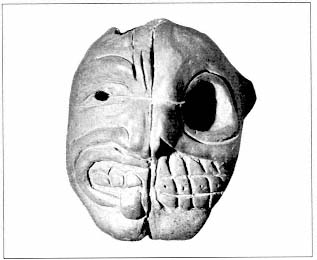
Pl. 52.
Ceramic mask, half-fleshed, half-skeletal, Tlatilco
(Museo Nacional de Antropologia, México).
manifestation of the dualism at the heart of Mesoamerican thought can also be seen in a Classic period Mixtec funerary figure from Soyaltepec, Oaxaca (pl. 53) exhibiting the identical motif centuries later.
As we have seen, the village cultures demonstrating this funerary mask use were those that transmitted Olmec religious concepts, ritual, and artistic forms to the Classic period cultures of Monte Albán and Teotihuacán. For the Maya, the Izapan culture performed the same function. It is significant, therefore, that we see at Kaminaljuyú the same funerary mask use—although the masks are quite different—as in the Valley of Mexico. The richly furnished Preclassic burials at that site, which we discussed in our consideration of the development of the mask of Chac, are typified by Tomb II in Mound E-III-3, the tomb of a ruler whose body had been placed on a litter, covered with red cinnabar, and wrapped in a burial cloth. A mosaic mask of greenstone placed over his face completed his preparation for the journey to the world of the spirit, a journey on which he was believed to be accompanied by the sacrificial victims whose bodies were interred with him.[115] In Tomb B-II nearby, what appear to be the remains of an actual ritual mask were found,[116] suggesting a conceptual identification of ritual and funerary masks similar to that of the Valley of Mexico. That these tombs were within pyramidal platforms and had been covered by floors that were used for ceremonial activities suggests the belief manifested by later cultures, especially the Maya, that the ancestral dead existed as gods and could be called on, through ritual, by the divinely ordained current ruler. A different kind of ritual interment was found in another pre-Maya burial, this one not Izapan. In the Preclassic Burial 10 at San Isidro, Chiapas, the deceased, an adult, was positioned facing east, sitting with his right leg inside of the left and his arms crossed over his chest. His face was masked by a large, flat, pink-hued seashell perforated for attachment.[117] The careful masking, with the mask tied to the face as in ritual, and the symbolic implications of the seashell relate this funerary mask to ritual as well.
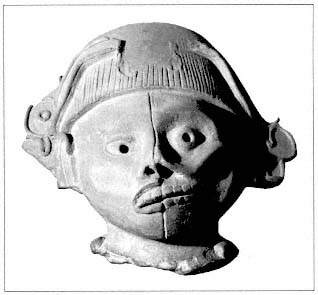
Pl. 53.
Mixtec ceramic figure, half-fleshed, half-skeletal, Soyaltepec, Oaxaca
(Museo Nacional de Antropologia, México).
These early examples of the funerary mask led to its widespread and sophisticated use among the Classic period Maya, a practice with clear ties to the Maya view of death expressed in the mythic narrative of the Popol Vuh. In the account of the adventures of the Hero Twins in the underworld, Xibalbá or "the place of fright," we have what Coe calls "the most complete description and explanation of the ideology behind the funerary cult that we have or ever will have from anywhere in the world." Fittingly, as he has shown, this narrative account of the defeat of the Lords of Death and the attainment of rebirth is also depicted on the painted ceramic vessels created solely to be buried with "the honored dead." Symbolically, these vessels "comprise one great mythic cycle, along with explanatory chant, to prepare the defunct for the dread journey into the Underworld, much as the Egyptian Book of the Dead or its Tibetan counterpart do."[118]
And that function of those beautiful and profound works of art was also served by the striking jade mosaic masks created by the Maya to cover the faces of the honored dead. Found in tombs at Palenque and Tikal, these masks, unlike the composite masks of Maya ritual, recreated the face of the deceased in order, no doubt, to preserve his identity by preserving his face. [119] This, of course, is one of the primary symbolic purposes of the funerary mask, one clearly related to the belief that the
dead ancestor somehow retains his identity while "becoming a god" who can be called on by his successors. The most famous of these masks, the death mask of Pacal, ruler of Palenque (colorplate 9), illustrates the connection between the mask and that particular set of beliefs. Pacal's tomb, in its shape, in the reliefs decorating it, in its color, and in its placement, is one vast metaphor of regeneration, and the serpentine "psychoduct" connecting that tomb to the temple above indicates the precise nature of the resurrection it symbolizes. Pacal became a god, yet retained his earthly identity; he died, yet lives.
Pacal's mask is one of the most expressive and beautiful works of Mesoamerican art of any period, perhaps because it reflects this fundamental belief. It represents handsomely the powerful face of the ruler over which it was placed and in so doing, compels even our belief that his face reflected his inner strength and beauty. Ruz describes the mask as he found it during the excavation of the Temple of Inscriptions tomb in 1952:
It is composed of some 200 jade fragments of different shades but principally an intense green, at times very dark and shiny, with the eyeball made of conch shell and the iris of obsidian. In the center of the iris a point on the reverse side of the obsidian is painted black to represent the pupil. The personage must have been interred with the mask in place, but during the interment it slipped to the left side of the face where the majority of the fragments were found, a number of them in a position which permitted us to deduce their original location. Under the fragments of jade we discovered, partially conserved, a layer of fine stucco that had been applied directly over the face of the dead man and that served to attach the mosaic fragments of the mask. The nose was sufficiently complete to allow us to see the anatomical form, but the fragments which had composed the right ear and the right side of the mask were found displaced among the bones of the face, over the nose and the upper teeth. It is likely that the mask was originally composed on a model of the head, perhaps on one of the stucco heads left as offerings under the sepulcher. At the moment of preparing the corpse for interment, a thin coat of stucco was applied over the face and the fragments of the mask were immediately moved from the model to the corresponding place in the stucco.[120]
Because it has been very difficult to ascertain whether masks found in and around tombs were actually funerary, Ruz realized that his discovery was a crucial one: "The discovery of the crypt at Palenque confirmed our supposition about the funerary use of masks and to date is the only known case of a jade mosaic mask discovered . . . still in place . . . over the face of the corpse."[121] The reconstruction of the mask indicated to Ruz that it "must have reproduced the features of the personage more or less faithfully."[122] The obvious care with which the mosaic mask was transferred from the model to the just-dead face of the ruler surely indicates the concern to preserve that royal identity. If a memorial had been all that were intended, the stucco head that served as a model for the mask would surely have been sufficient, but more was needed. His actual face—with all that the face symbolized in Mesoamerican thought—had to be preserved for all time.
That face still conveys to us the strength and wisdom of its "wearer" and the fundamental spiritual belief that prompted its construction, but alone it cannot convey the intricate structure of belief carved metaphorically into the lid of the sarcophagus containing Pacal's body and his death mask. The lid's image
depicts the instant of Pacal's death and his fall into the Underworld. . . . The cosmic event that forms the context for Pacal's passage into death is the movement of the sun from east to west. . . . The sun, poised at the horizon, is ready for its plunge into the Underworld. It will carry the dead king with it [and] . . . he anticipates the defeat of death. [But] a bone attached to his nose signifies that even in death he carries the seed of rebirth. . . . [That bone] is the seed of Pacal's resurrection.[123]
The image thus reflects the Maya belief that "a king dies, but a god is born. . . . Here a ruler is shown suspended in time, about to enter the Underworld from which he will be reborn a god."[124] The mask was placed over the face of Pacal to assist in that process. Thus, all the complex symbolism of the image on the sarcophagus lid is contained within the simple features of that jade mask.
This profound use of the funerary mask was not limited to Palenque; at Tikal, important figures were also buried with jade or greenstone masks or cremated in bundles to which masks were tied.[125] In the late Preclassic Burial 85 located on the axis of the North Acropolis,[126] a ruler's "jade mask, with eyes and teeth of inlaid mother-of-pearl, had originally been attached to a mortuary bust, the individual having been interred, after decapitation and mutilation of the legs, seated and wrapped in a shroud. In this case the mask had been substituted for the head."[127] Thus, both at Palenque and at Tikal the funerary mask served the same purpose in slightly different ways, and were our information more complete, it is certain that we would find similar evidence at other major Classic period sites.
That these Classic period burial practices continued in the later stages of the development of Maya civilization is confirmed by Diego de Landa's account of burial practices in the Yucatán at the
time of the Conquest, an account that incidentally suggests what may have happened to the missing head of the ruler interred in Tikal's Burial 85.
Among the ancient lords of the house of the Cocoms [the ruling house of Mayapán] they cut off the heads after death, boiled them so as to remove the flesh; then they sawed away the back part of the skull, leaving the front with the cheeks and teeth, supplying in these half sections of the head the removed flesh by a sort of bitumen, and gave them almost the perfection of what they had been in life. . . . These people have always believed in the immortality of the soul, in greater degree than many other nations.[128]
At Palenque, the deceased ruler's head was covered with a realistic mask that preserved his features; at Tikal, the head was replaced with a similarly realistic mask; and, later, in the Yucatán, the head became the mask. Step by step the face became the mask; by the time of the Conquest, the artfully reconstructed living face had become a mask covering the ruler's lifeless skull. The viewers of that mask, aware as they must have been of the ruler's past and present states, would have "seen" the living mask and the dead skull simultaneously and thus would have had the same sensation as the viewer of the half-fleshed, half-fleshless masks and heads from Tlatilco and Monte Albán which we discussed earlier. With the Maya we have come one step closer to the gods; the mask is no longer a separate entity in a sacred-human relationship as it was in the case of the ritual masks with the X-ray view; it is the sacred being man has become. The Maya tradition had its counterpart in central Mexico. The pottery masks found in Tlatilco burials (pls. 44, 52) were the precursors of funerary masks used throughout the Classic and Postclassic periods up to the time of the Conquest. Perhaps the best known are the ceramic and stone masks of Classic Teotihuacán. Although none have been found in situ, in part because no tombs of any importance have yet been discovered at Teotihuacán, it is clear that their use was funerary. Séjourné believes that ceramic masks found at the apartment compounds of Tetitla and Yayahuala were affixed to the funerary bundles of the deceased before cremation,[129] a practice illustrated on a number of ceramic incense burners that display funerary bundles carrying such masks.[130] As Covarrubias points out, such a use would account for a number of the physical features of the masks, especially those of stone. The bundles, in addition to bearing masks, are
provided with a great feather headdress and massive earplug flares and beads of jade. Possibly the life-size stone masks were attached to such dead bundles, which would explain why the masks are cut off horizontally across the forehead for the headdress to rest on, and would justify the many perforations: on the ears to attach the earplug flares, under the lower jaw to hang the necklaces, and on the temples and forehead to secure the headdresses.[131]
Moreover, both the ceramic and stone masks often have marginal perforations that might well have been used to attach them to such funerary bundles.
The stone masks (colorplate 8)—often of greenstone, serpentine, onyx, or obsidian and meant to be covered with mosaic designs—are particularly reminiscent of Olmec stone masks, also presumably funerary, in the way they are carved and the manner in which their backs are finished,[132] and both manifest a similar "predilection for hard, lovingly polished stone, the same concise vocabulary, the same consummate craftsmanship." [133] But there are differences. While the Olmec stone masks are strikingly realistic, the masks of Teotihuacán present idealized, expressionless faces. Westheim suggests that this idealization can be seen in two tendencies: first, the widening of the head so that the height and width are approximately equal, thus eliminating the natural verticality of the face, and second, the flattening of the naturally rounded mass of the head, "giving it an almost bidimensional effect."[134] The relatively flat, horizontal shape that results is emphasized by the projecting flanges of the ears and the unbroken ridge of the eyebrows sweeping across the mask above the horizontal slits of the eyes and, as Kubler points out, by the "chin and forehead boundaries [being] treated as flat, parallel planes." Kubler goes on to suggest that "this geometric conception of the human face is dictated by the technique of working the stone. The eyes, the nose, and the mouth are defined by six fundamental saw-cuts. One horizontal cut marks the parted lips. Two more horizontal cuts mark out each of the eyes."[135]
But Westheim sees something more profound than the dictates of technique at work in the stylization of those masks. For him, they are conceptualizations of the essential spirituality of humanity, consciously designed to avoid realistic portraiture. By reducing the face to the essentialperhaps even the symbolic—the artist "spiritualizes" the natural form. Thus, for Westheim, it is not a matter of "stylization." Instead, the masks are "the plastic expression of a conception of the world governed by dualism," and they capture the basic concept underlying all Mesoamerican art in their combining of reality and irreality so as to reflect "the cosmic," "the meaning of things."[136] These symbolic qualities can also be seen in the designs painted on the ceramic masks and worked in mosaic and inlay on the stone masks, designs seen elsewhere in the art of Teotihuacán which no doubt designated the status of the deceased in life and the particular aspect of the realm of the spirit to which his spiritual essence became assimilated
after his death. It is that spiritual essence, rather than the physical face as with the Maya, that these masks depict and perpetuate, and it is that which is captured in the idealized features of these masks, in their "nobility, serenity, timelessness, and impassivity."[137]
The funerary mask was similarly important in Oaxaca, both among the Classic period Zapotecs and in the Postclassic among the Mixtecs. In our discussions of the metaphoric mask of the rain god and of the use of the mask in ritual, we considered at some length the Zapotec funerary urns of Monte Albán and suggested that their frequent combination of a relatively realistic human face wearing or emerging from a composite mask brought together the death mask of an important person with the mask of the god symbolic of his spiritual essence (pl. 39). In addition to these urns, actual masks have also been found in the tombs of Monte Albán. One of the most striking of all Mesoamerican masks, in fact, comes from Burial XIV-10 (pl. 54). Probably representing the features of a bat, the mask is composed of twenty-five carved and polished pieces of dark green jade with eyes made of shell. Caso calls it "one of the most beautiful jades discovered in Mesoamerica,"[138] and Covarrubias says, "this extraordinary mask is a masterpiece of the lapidary art and shows an uncommon sophistication in concept and design."[139] Whether designed for the buried personage with whom it was found or, as Covarrubias believes, imported from the "'Olmec' zone,"[140] those who placed it with the remains of the deceased surely saw in it a metaphor for the spirit of that dead leader. And if it did represent a bat, the metaphor would be clear. The bat flies, that is, "lives," at night and returns at daybreak to the cave where it rests. As we have seen, the cave was always viewed in Mesoamerica as the entrance to the world of the spirit, so the bat symbolically reversed man's life. The bat's "day" was man's night, and its "night," man's day. Metaphorically, this reversal could thus be used to suggest the continuation of life after death and to indicate that the man interred with the mask had not died but had "flown" to the life of the spirit. In that sense, the bat mask can be seen to illustrate in a particular way the general conception underlying all funerary mask usage.
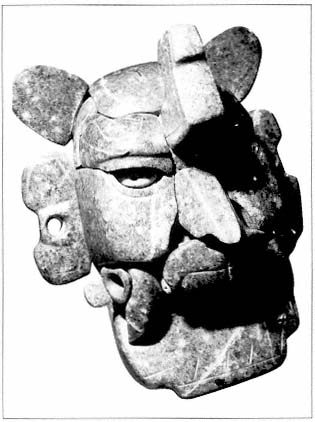
Pl. 54.
Jade mosaic mask, probably funerary, Adoratorio
near Mound H, Monte Albán II
(Museo Nacional de Antropologia, México).
The existence of that and other funerary masks at Monte Albán is complemented by another indication of the importance of the funerary mask there. An offering made up of ceramic figures discovered in the patio of the house built over Tomb 103 (pl. 55) appears to depict a funeral and strongly suggests both the importance of funerary ritual and the central role the mask played in it. The deceased is represented by a mask set atop a step-shaped funerary bundle behind which five priests wearing masks and headdresses form a semicircle. Off to the side of the scene is a seated figure quite similar to representations of the old god of fire found at Teotihuacán, and in front of this assemblage of figures is a small (both in size and numbers) band of musicians, there, no doubt, to provide music to accompany the ritual.[141] The funerary ritual depicted is complex: as the headdresses and masks of the priests indicate, they are of two related varieties and probably served two different symbolic functions. The hook-billed bird in the headdresses of the two priests holding large circular plates or mirrors is worn as a mask by the other three priests, who wear different headdresses. The representation of the old god of fire adds yet another symbolic dimension to the ritual.
In addition to this level of complexity, the scene also suggests a complex series of interactions with other areas of Mesoamerica. The hook-billed bird mask and the old god of fire are reminiscent of Teotihuacán and, in fact, are united in the Tepantitla mural (colorplate 3). That mural symbolizes the union of spirit and matter in the context of fertility, while this scene may well symbolize that same union at the moment at which one might think spirit and matter had reached the point of separation. The purpose of the ritual, however, is to indicate the continued union of the two, a continuity most economically symbolized by the large, centrally placed mask, also visually related to those of Teotihuacán. The mask stands as a meta-
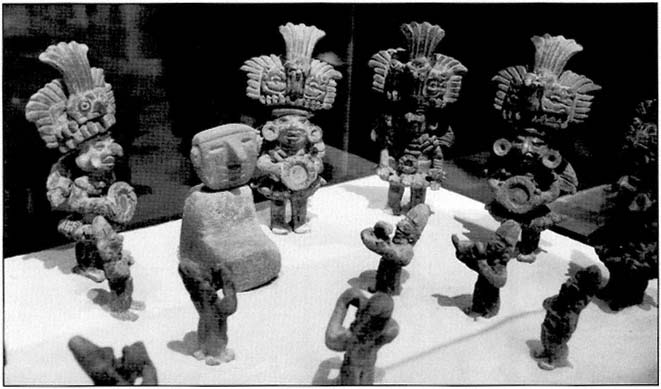
Pl. 55.
Funerary offering composed of ceramic figures arranged to form a ritual scene, Tomb 103, Monte Albán III
(Museo Nacional de Antropologia, México).
phor for the continued existence of the man, probably a ruler, who had just become a venerated intermediary between the human community and the great supernatural forces on which their individual and communal lives depended.[142] That this recreation of the funerary ritual of the dead ruler was found buried in the patio of the house constructed above his tomb suggests exactly the same relationship between living and dead rulers we have seen among the Maya—most clearly, at Palenque. But the symbolic figures that make up the scene are related to Teotihuacán, not to the Maya. Thus, this scene reflects both the complexity of the interaction of influences within Classic period Mesoamerica and the fundamental similarities of all of those traditions, similarities that permit the assimilation of influences in symbolic scenes such as this.
The later Mixtec burials in Oaxaca yield additional, though somewhat different, evidence of the importance of the funerary mask and are themselves related to funerary practices among the Maya and in the Valley of Mexico. A common feature in the elaborate tombs and burials of Mixtec rulers and important citizens is turquoise mosaic masks such as those associated with the two principal burials in Tomb 1 at Zaachila which Caso has identified, on the basis of the Mixtec Codex Nuttall, as the final resting place of one of the lords of Yanhuitlan.[143] Similar masks have been found at Monte Albán in association with Mixtec burials, and recently the remains of other masks were found in the exploration of a large, heavily looted Mixtec cave with at least forty-five tombs or cells at Ejutla. Christopher Moser, a member of the exploring team, believes that some of the cells had served as tombs, and that those tombs
provide evidence of the profound Mixtec belief in an afterlife and demonstrate that the concept of survival of the spirit—which retained its personal status—was central to the funerary ritual which included the killing of servants who would then attend their fallen master in the land of the dead as well as the offering of ornaments and personal riches, the sacrifice of birds, self-sacrifice, and the burning of incense and amatl.[144]
The remains of two wooden masks encrusted with turquoise mosaic left by the looters are probably a small indication of the number and importance of such funerary masks in that cave, but
these mosaic artifacts are of particular interest because of their similarity to the masks illustrated by Saville (1922, fig. 6) which now form part of the collection of the Museum of the American Indian in New York. Saville says that the seventeen examples in this collection came from "a cave in the mountains of the Mixtec region of Puebla" (1922, 48). Dockstader, director of the museum, could not distinguish between a photograph of the mask from the cave at Ejutla and the fragments
of masks in the collection of the museum he directs.[145]
Those masks now in New York may thus very well be the ones that originally accompanied the deceased Mixtec luminaries buried in the cave at Ejutla, "a burial site for nobles and their retainers from one of the Cuicatec (or Mixtec?) cacicazgos in the Cañada below." The deceased nobles "were wrapped in textiles, given a turquoise mosaic funerary mask, and sealed up in stone masonry cells. This procedure would fit the ethnohistoric descriptions of Mixtec and Cuicatec funerary rites as well as portrayals in the Postclassic codices."[146] The Mixtec burial cave at Ejutla, then, once more symbolically brings together burials, caves, and masks to mark the liminal point of passage from the world of nature and human life to the world of the spirit.
That funerary masks were as important to the Aztecs as to their Mixtec contemporaries is certain. Cecilia Klein points out that
the corpses of deceased Aztec rulers were, we know, dressed and masked for cremation, and the secondary funerary images set up in their honor in the Tlacochcalco were dressed in several superimposed costumes, each of which represented the garb of a different deity. . . . Fray Gerónimo de Mendieta says that their masks referred to either the patron deity of their home town or that of the temple in which their ashes were to be buried.[147]
Westheim describes the Aztec mortuary bundle as made of cloth and shaped like a seated person, which, interestingly, is precisely the shape of the bundle on which the mask rests in the offering scene we described from Monte Albán. This bundle was then covered with the attire of the deceased, and a mask was attached in the position of the head. In cases where the body was not prepared in this way for cremation, but was to be buried, the mask was placed directly over the face of the deceased.[148]
Townsend's discussion of the Aztec conception of death suggests the symbolic function of the funerary mask:
The ancestral dead were considered to be assimilated to the cosmos. . . . "To all their dead they gave the name téotl so-and-so, which means 'god so and so' or 'saint so and so,'" writes Motolinia. . . . [Thus] the use of teixiptlas [ceremonially attired cult effigies] in funerary contexts spelled out the continuing connections of community leaders with the cosmic forces.
Funerary masks were often associated with these teixiptlas; in the case of the ruler Axayacatl, for example, an effigy was constructed with five layers of attire, each representing a different god, and atop that layered figure was placed a bird-billed jaguar mask, a fascinating example of what we have earlier called a secondary mask. Then, "in the conclusion of the ritual, this composite bundle was placed together with the body of the deceased emperor upon a pyre in front of the Huitzilopochtli idol, and both were burned."[149] The mask was clearly a means of preserving the transcendental affinity of the deceased with the cosmic forces he expressed as the living ruler. Once again, then, we have an example of a funerary mask related to the inner, spiritual identity of the deceased rather than his physical identity, a conception succinctly expressed in the last lines of a Nahuatl poem:
For this reason the ancient one said,
he who has died, he becomes a god.
They said: "He became a god there,"
which means that he died.[ 150]
The Aztec funerary mask use explained by these fundamental conceptions seems to unite the practices of the Postclassic Mixtecs with those of Classic period Teotihuacán as two distinctly different types of masks were probably associated with funerary practices by the Aztecs. On the one hand, there are a number of stone masks (pl. 56) that may well have had a funerary function. Although she does not connect them specifically with such a function, Pasztory describes them as related to deities, often Xipe Tótec, but obviously not meant to be worn in ritual since they have no eyeholes. Furthermore, "these masks represent the Aztec facial ideal: a long head, wide mouth, straight nose, and eyebrows set close to the eyes."[151] Though they do not look like the stone funerary masks of Teotihuacán (colorplate 8), Pasztory's description suggests that they expressed the Aztec spiritual ideal in exactly the same way that those earlier masks expressed the ideal conception of Teotihuacán and thus contain all the elements associated
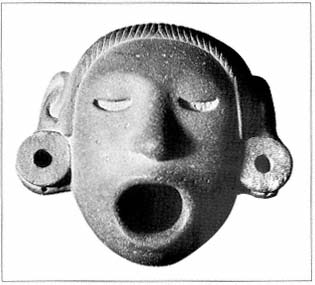
Pl. 56.
Aztec stone mask (The British Museum).
with the funerary masks.[152] Interestingly, Pasztory illustrates a carved wooden, gilded mask[153] that is remarkably similar to the stone masks. The existence of this mask suggests that the stone masks may well have been luxurious versions used by royalty of the more common wood masks used by illustrious Aztecs of somewhat lower status. These wooden masks, of course, would have perished in the flames of the funeral pyre or rotted in the earth after burial.
In addition to these stone and wood masks that seem to continue the tradition begun by the 01mecs and brought to the Valley of Mexico at Teotihuacán, turquoise mosaic masks in the Mixtec style (see pl. 58) were also used by the Aztecs. According to Pasztory, they probably had multiple functions. Some were used on effigy figures, others were worn in ritual, while still others "were placed on the bundles containing deceased rulers who were dressed in the regalia of the gods for the funeral in which they were finally cremated.[154] Whether these masks were created by Mixtec craftsmen in Tenochtitlán, as many believe, or were the work of Aztec craftsmen, perhaps in imitation of Mixtec work,[155] or were sent as tribute to the Aztec capital[156] is not fully understood. But their remarkable formal similarity to the Mixtec funerary masks clearly suggests a similar function.
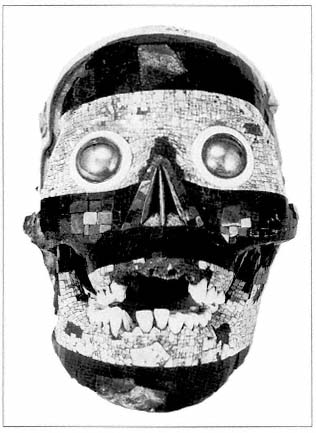
Pl. 57.
Aztec mosaic-covered skull (The British Museum; photograph
courtesy of The British Museum, reproduced by permission).
While these mosaic masks are relatively realistic representations of the human face built on wooden frames, what is perhaps the most striking Aztec mosaic mask, and one clearly related to funerary ritual, is different. The mosaic in this case rests on the front half of a human skull lined with leather so that it could be worn as a mask (pl. 57). The alternating bands of blue turquoise and black lignite which compose the face recall the patterned mosaics of the stone masks of Teotihuacán (colorplate 8) and suggest the facial painting of Tezcatlipoca whom the mask may well represent,[157] but the idea of preserving and decorating the skull of an important person is reminiscent of the Maya practice noted above. A number of similarly decorated skulls in both Aztec and Mixtec offerings[158] indicates that this skull-mask is not an isolated phenomenon. Rather, it is yet another way of suggesting the link between life and death, a link represented metaphorically by the conception of the funerary mask.
As this mask so clearly illustrates, life and death were not separate states for the peoples of Mesoamerica. The life-force was eternal, and one's brief "life" on earth was a moment in that eternity. Assimilation into that eternal force was not death; on the contrary, it was a movement into the essential nature of life. The funerary mask was the most fundamental metaphor created by the peoples of Mesoamerica for that conception. All of the varied masks found in Mesoamerican graves and designed for Mesoamerican cremations are variations on that single metaphorical theme.
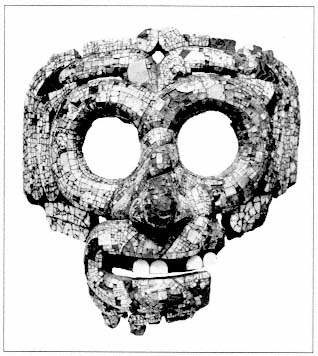
Pl. 58.
Aztec mosaic mask, perhaps one of the masks
presented to Cortès by Moctezuma (The British Museum;
photograph by The British Museum, reproduced by permission).