
Four
Factioneers, Tribalists, and the LDP's Construction Caucus
On 5 January 1988, one week before Prime Minister Takeshita's scheduled departure for the summit meeting with President Reagan, U.S. Trade Representative Clayton Yeutter announced a ban on the participation of Japanese construction firms and their overseas affiliates in federally funded public works. The ban, effective 30 December 1987, cast a shadow over the summit meeting, which ultimately did nothing to ameliorate the mounting bilateral discord. And shortly after USTR Yeutter's announcement, Alaska's Senator Frank Murkowski called for legislation that would ban Japanese firms' participation in America's private-sector construction. Representative Pete Stark of California introduced a bill denying tax depreciation and the use of tax-exempt bonds in projects employing Japanese construction firms. But the Japanese government ministries balked at making new concessions. Former Transport Minister Hashimoto Ryutaro articulated what many were thinking: "I am against going to the bargaining table with the United States to beg for forgiveness. . . . Japan should not be forced to take action under such intimidation" (Japan Times , 13 Jan. 1988).
Meanwhile, a new player had quietly entered the construction fray. At Takeshita's request, Deputy Chief Cabinet Secretary Ozawa Ichiro had secretly begun sounding out personnel at the American Embassy in Tokyo in order to create a framework for future negotiations
(Krauss 1989, 29–30). In March, Ozawa would travel to Washington to seek a settlement.
Ozawa, despite his relative youthfulness and lack of experience in international negotiations, was perhaps the ideal candidate to hammer out a resolution to the construction friction. As a member of the LDP's construction tribe, he had an expansive network of personal connections that included elites in both the construction industry and the public works bureaucracy. As a rising power in the Takeshita faction—the largest and most influential of the LDP's factions at the time—Ozawa occupied a strategic position within the ruling party. And as the protégé of Kanemaru Shin (the "don of all dons" in public works) and the husband of Takeshita's sister-in-law, Ozawa held the confidence of Japan's two most powerful politicians. In addition, Ozawa's parliamentarian father had served a term as construction minister during the Yoshida cabinet, while Ozawa's father-in-law was president of a major general construction company.
Thus Ozawa had risen to the top rungs of the LDP's construction tribe, and during the LDP's era of hegemony, it was the "politics of factions and tribes" (batsuzoku seiji ), rather than strong party organization, that shaped the LDP (Tanaka 1985). In many ways, the puzzle of Japanese politics under LDP dominance resembles that of Italian politics under Christian Democrat rule: How could a party so factionalized and unstable maintain a system of dominance for so long? Despite predictions of the inevitable extinction of factionalism, the LDP factions had become more entrenched over time, and the LDP of the early 1990s bore more resemblance to a loose coalition of warring factions than to a coherent, unified political party.
This chapter explores the LDP's factions and its "policy tribes"—those groups of legislators who wielded considerable influence within particular policy subgovernments—and their relation to the organizational structures of the LDP. The analysis focuses on the sources of intraparty factionalism, the incentives for factional affiliation, and the enigmatic ways in which the construction tribalists influenced the politics of public works.
Factions and Political Clientelism
Factions have been described as the "primary unit," the "central force," and the "real actors in intraparty politics" in postwar Japanese politics, and the LDP has been described as a "federation of factions" united for purposes of campaign and legislative strategy, rather than a unified national party.[1] Matsuyama Yukio, former editor of the Asahi Shinbun , told an audience at Harvard University in 1991 that the defining feature of LDP rule was "government by, for, and of the factions." And, we must add, a defining feature of the LDP factions is that they were "non-ideological conduit[s] of particularism" (Ramseyer and Rosenbluth 1993, 59).
In seeking to explain the persistence of factionalism in the LDP, some scholars have looked to aspects of Japanese culture and tradition. Recently, however, other scholars have emphasized the role of political institutions in creating an incentive structure conducive to legislative factions. This debate merits further attention.
Advocates of the culturalist view argue that factionalism derives from aspects of Japanese culture and tradition. The patron-client ties and "quasi-familial relationships" spawned by the Confucian sense of obligation and group loyalty receive particular emphasis.[2] The following brief quotations illustrate this approach:
The old concepts of loyalty, hierarchy, and duty hold sway in them [the factions]. And the [legislator] feels very comfortable when he steps into this world.
(Thayer 1969, 41)
All the fulminations against factionalism would seem to be based on criteria drawn from other political cultures about how political parties might be organized internally.
(Baerwald 1986, 17)
[The root of the LDP's factions] is the continuing ethos of patrimonial relations from Japan's feudal past and the tendency of all large Japanese organizations to structure themselves internally . . . into vertically divided competitive groups.
(Johnson 1990b, 78)
| ||||||||||||||||||||||||||||||||||||||||||||||||||||||||||||||||||||||||||||||||||||||||||||||||||||||||||||||||||||||||||||||||||||||||||||||||
Three major difficulties, however, hamper the culturalist explanations. First, none of the studies clearly define "culture." All one can deduce is that culture is a vague yet ubiquitous entity that somehow shapes political behavior. Thus culturalist arguments remain mired tautologically. To say that Japanese legislators organize themselves into factions primarily because their identity as Japanese people dictates that they do so only leaves us to wonder why Japanese culture generates this particular pattern of behavior.
Second, if Japanese culture and tradition effect political factionalism, how does one explain the trend toward fewer and larger factions over the past forty years?[3] And how does one account for the increase over time in the number of LDP legislators who became members of factions?
Third, if Japan's political culture spawns intraparty factionalism, why do not similar patterns abound in all of Japan's political parties? Neither the Komeito, the Communist Party, or the Socialist Party, to name but three, have the kind of nonideological factions that the LDP has.
Thus Japan's culture and social structure cannot account for the roots of LDP factionalism. Instead, we must look to how the factions served the needs of both the LDP's backbenchers and bosses. As we will see, Japan's political institutions provided ample incentives for factional affiliation and loyal factioneer behavior. The demise of the factions has long been predicted, based on the premise that the party would supplant the factions, or that modernization would plow under such feudalistic vestiges as factions, or that the rise of the policy tribes would render factionalism obsolete (see, e.g., Masumi 1988, 301). But the factions, despite obstacles, have evolved and endured. The five major factions of the 1990s grew out of the Kishi, Ikeda, Sato, Ono, Kono, and Miki factions from the LDP's early days (see Table 3). Although individual leaders came and went with regularity, the rank-and-file generally remained within a particular factional lineage for their entire political careers.
It is well known that the LDP factions supplied their members with official party endorsements, campaign funds, and placement in political posts. But the role of factions as constituency service networks has received less attention. Let us look briefly at these benefits.
Candidate Endorsement and Campaign Support
Factions play a central role in candidate endorsement. "If you don't join a faction, you can't become an LDP legislator" (in Honzawa 1990, 60). In order to maintain a parliamentary majority, the LDP had to endorse more than one candidate in nearly every Lower House district. The presence of conservative independents, many of whom joined the party upon election, further compounded the intraparty competition for a finite pool of conservative voters. In the majority of cases, both officially endorsed candidates as well as conservative independents maintained undisguised ties to a specific faction. To reduce wasted candidate funds and campaign support, the principle of a single faction member per district emerged. Between 1958 and 1980 factional duplication in districts diminished radically, although the rate of multiple endorsees increased slightly during the 1980s (Reed and Bolland forthcoming).
Endorsements are largely determined by the relative numerical strength of the respective factions. In preparation for an election, senior members of the factions, in rough proportion to the respective size of those factions, establish and head an Election Policy Headquarters. The candidate endorsements, however, are determined by the Election Management Committee, composed of lieutenants from each faction. Generally speaking, standing incumbents receive first priority in the allocation of party endorsements. Second priority goes to hereditary politicians and promising candidates with a solid base of constituent support. Former public works bureaucrats, with their ties to the electorally powerful construction industry, are viewed as attractive candidates with a high probability of securing election. As might be expected, hotly contested interfactional battles over candidate endorsements are common (Honzawa 1990).
Factions also provide sundry forms of campaign support for their members. For example, faction leaders and senior factioneers frequently give speeches and attend campaign rallies on behalf of "their" candidates. Faction leaders call upon their nationwide networks of contacts and campaign contributors to supply infrastructural support for junior factioneers. Affiliation with the faction headed by Tanaka
Kakuei, and later by Takessita Noboro and Kanemaru Shin, afforded the attractive benefit of especially aggressive campaign support provided by senior faction members.
Political Funds
Factions also provide candidates with political funds. The faction boss usually disburses at least ¥2 million to each junior factioneer twice annually, during midsummer and at year's end. At election time, the basic unit of disbursement reaches the ¥10 million range. The larger the faction, the larger the financial burden for the faction boss, and the greater the temptation for raising money by dubious means. Kanemaru Shin, the chairman of the Takeshita faction, kept $50 million on hand in his personal vault.
In the wake of the public outrage over "money-power politics" in the mid-1970s, fundraising became increasingly decentralized. Whereas faction leaders supplied an estimated one-third of campaign funds for their members in the 1960s, by the early 1990s they provided only about 5 to 7 percent.[4] Electoral differences among the LDP's five main factions decreased markedly in this trend toward decentralized fundraising (Cox and Rosenbluth 1993). Because the financial burden borne by factions decreased and the electoral fortunes of their members equalized, affiliation with one particular faction mattered less to an LDP backbencher. Nonetheless, the factions differed with regard to other important electoral incentives, including the allocation of political posts.
Allocation of Posts
During the LDP's era of dominance, the party's factions determined who occupied which political post and for how long.[5] It was impossible to obtain a cabinet ministership or an appointment to a top party leadership post without the backing of a faction, and since these posts brought tangible electoral rewards, legislators knew their political futures depended on joining the right faction. Over time, a disproportionate share of specific posts went to members of particular factional lineages. From 1955 to 1992, for example, nearly half of the coveted
agriculture minister portfolios went to members of factions in the Kishi lineage. Other such ministerships with long factional lineage included foreign affairs, also dominated by the Kishi lineage; finance and transport, both of which had a strong Sato lineage hue, and construction, dominated by the Sato and the Kono lineages.[6]
Between 1955 and 1993 key posts in the public works subgovernment were the property of the Sato lineage. When Tanaka Kakuei, a former contractor with strong ties to MOC, assumed leadership of the Sato faction in 1972, he quickly recognized the potential political benefits of installing his followers in construction-related posts. Tanaka's fabled "Plan to Remodel the Japanese Archipelago," which boosted construction investment to nearly one-quarter of the gross national product, further enhanced these benefits. From July 1972 until September 1976, all six construction ministers belonged to the Tanaka faction. Among other things, this bonanza of public works spending launched Kanemaru Shin on his ascent to the top of the public works subgovernment, a position he held from the mid-1980s until his arrest and resignation in 1992. But Tanaka's desire to dominate the commanding heights of the subgovernment did not end there. Between 1967 and 1980 ten of the thirteen parliamentary vice-ministers of construction were members or "shadow affiliates" of the Tanaka faction, while several others headed PARC's Construction Division (see Appendix C).
Tanaka also actively encouraged retiring MOC bureaucrats to descend into second careers in elective politics. Thanks largely to his efforts, nearly two of every three former MOC officials elected to seats in the national parliament joined the Sato lineage. The case of Chuma Tatsui highlights the strong ties between the Tanaka faction and MOC. In 1976, Chuma's appointment interrupted a succession of six consecutive construction minister appointees from the Tanaka faction. Soon after his appointment, a group of reporters supposedly heard Chuma, a member of the archrival Fukuda faction, say: "An intolerably large number of [Construction Ministry] officials are in cahoots with the Tanaka faction. If clear evidence [of favoritism] comes to light, they will be cut down!" He specifically vowed to "cut down" Tawara Takashi, then director of the Kyushu Regional Construction Bureau, who had allegedly promised to "turn an attentive
ear" toward any request from a member of the Tanaka faction (Jin et al. 1981, 184). In the end, however, Chuma failed to carry out his vow, and Tawara eventually descended into a second career in elective politics. Naturally, he chose to join the Tanaka faction.
Constituency Service Networks
For the neophyte backbencher feverishly attempting to build a stable support base before the next election, the distant hope of grasping an influential political post offers no immediate benefit. Rather, the neophyte has to concentrate on providing services to voters and campaign contributors: securing jobs for constituents, escorting "petition groups" (chinjodan ) to the appropriate government agency, and furnishing supporters with subsidies, tax breaks, favorable regulatory treatment, and various structural policy benefits. Unfamiliar with Nagatacho's bewildering ways and lacking contacts in the government bureaucracy, LDP backbenchers logically turned to a faction boss or a senior party leader for assistance in providing these services.
Such was the case with Sato Bunsei, a long-time LDP MP from Oita Prefecture. When MOC issued a new five-year plan canceling a long-anticipated stretch of expressway through his district, Sato was understandably distressed. Although he was an established legislator with experience as a cabinet minister, Sato had no reputation for significant sway within the public works subgovernment. Thus he turned to his faction boss, Nakasone Yasuhiro, the prime minister at the time. Soon, funding for the expressway was restored. This prompted an upper official at MOC to grumble about "political roads" (Nihon keizai shinbunsha 1983, 137–38). Perhaps Takeshita Noboru put it best when he said: "politics is roads and roads are politics" (doro izu seiji, seiji izu doro ; in Itasaka 1987, 75).
Because certain factions flowed from lineages with disproportionate sway over specific subgovernments, voters and, especially, campaign contributors, naturally favored one faction's candidate over another's. All things being equal, construction contractors, realtors and developers, and anyone with a vested interest in improving the local infrastructure would have reason to support a candidate backed by a faction in the Sato lineage. For example, Takeshita faction candidates
in the 1990 general election could rely on the reputations and power networks of seven former construction ministers, ten former parliamentary vice-ministers of construction, and a pair of former heads of the Construction Division of the LDP's Policy Affairs Research Council—not to mention the ten retired construction ministry officials, including four former administrative vice-ministers, who were then members of the faction. No other faction rivaled the Takeshita faction in the number of members tied to the public works establishment. Although the efficacy of the Sato lineage in providing electoral benefits is moot, a widespread perception of its disproportionate power resources prevails (Hirose 1981, 159; Jin et al. 1981, 180).
In the same way that the structures of the U.S. Congress meet the electoral needs of its members, LDP factions came into being and thrived because they served the electoral needs of the factioneers (Mayhew 1974, 81). For backbenchers, factions provide party nominations, political funds, and political posts. Factional affiliation also affords access to senior legislators, the so-called policy tribalists, with reputed influence over specific policy subgovernments. Ties to influential policy tribalists imply access to constituency service networks. A look at the benefits of membership in the LDP's construction tribe will serve to illustate the incentives for becoming a policy tribalist.
The Construction Tribe
The policy tribalists (zoku giin ) are those LDP legislators who have "a considerable amount of influence in a particular area of government policy and enough seniority in the party to have influence on a continuing basis within the ministry responsible for that policy area" (Curtis 1988, 114).[7]
The LDP's first policy tribe, the public works tribe, was formed in 1956 when Tanaka Kakuei led a walkout of parliamentarians from a policy deliberation meeting (Campbell 1977, 119). Over time, the number of tribes grew to about a dozen: construction, commerce and industry, agriculture, fisheries, transport, welfare, labor, education, posts and telecommunications, finance, national defense, and foreign affairs. Each tribe also has a number of branches. Within the construction tribe, for example, there are tribal branches corresponding
to the various MOC bureaus; hence, a road tribe, river tribe, housing tribe, and so forth. Moreover, officials at the sub-bureau level at MOC recognize the dam tribe, the parks tribe, and the sewage tribe. In the late 1980s, for instance, Watanabe Eiichi was esteemed as a "big boss" in the dam tribe, while Tamura Hajime had the singular distinction of being recognized as the kingpin among sewage tribalists. From the perspective of public works bureaucrats, these distinctions are important when it comes time to lobby for budget allocations and policy proposals.
Policy tribalists are the most influential legislators in any given subgovernment. Some observers believe that the expertise and influence acquired as a result of long years of service in a specific policy area enable the LDP's policy tribalists to "match and even dominate" their peers in the government bureaucracy (Schoppa 1991, 79). In addition, tribalists act as brokers in transactions involving the LDP and specific government agencies. This role often extends to the mediation of sectionalist turf wars between government ministries as well as fighting alongside bureaucratic allies in such disputes (Johnson 1989). Furthermore, tribalists play a leading part in shaping and securing passage of policy and budget proposals. In late August, the most hectic stage of compiling ministerial budget proposals, tribalists become the focal point of the "root binding" efforts of government bureaucrats eager to secure larger allocations for their ministry or bureau. In the compilation of the 1987 budget, for example, each bureau chief, deputy chief, and section director in the MOC was assigned to contact about twenty LDP parliamentarians during a period spanning several days in late August. Special care was taken to secure the acquiescence of key members of the construction tribe, particularly its "big bosses" (pers. interview).
Construction tribalists make their presence felt in decisions concerning public works projects. "In return for their donations from the industry," one observer notes, "members of the LDP's construction tribe are expected to use their contacts with the ministries handling public works to help decide which companies win major projects or, more usually, how business will be shared . . . between the major players" (Far Eastern Economic Review , 16 June 1988, 58). Members of the LDP's construction tribe are seen as the most authoritative articu-
lators of the "voice of heaven" in the dango system of allocating public works contracts, and tribalists play a key role in prioritizing the major projects competing for appropriations. In this respect, the tribalists serve as gatekeepers—individuals who determine the allocation of scarce resources—and, thus, are responsible for the perpetuation of patterns of privilege and deprivation.
Naturally, construction tribalists win handsome political contributions from construction firms in exchange for this preferential policy influence. Former Construction Minister Kono Ichiro and his "favored contractor policy" (gyosha yusen seisaku ) elevated influence-peddling to a shadowy art form. Contractors were expected to make monetary gifts in exchange for priority designation to bid on public works projects. To get an audience at Kono's personal residence, a one-time supplicant recalled having first to pay a "shoe removal fee" (kutsunugidai ) to Kono's assistant. Once inside the door, a contractor paid a "floor cushion fee" (zabutondai ) and a "something-or-other fee" (nantokadai ) before Kono himself deigned to make an appearance (Asano et al. 1977, 28; Kasumi 1993, 149).
Former Prime Minister Tanaka fashioned a nationwide system of illegal kickbacks in exchange for political meddling in the allocation of public works projects (Johnson 1986). As the investigation in the zenekon scandal revealed, the country's largest general contractors gave letter grades to construction tribalists and gauged their political contributions accordingly. For example, one large general contractor reportedly presented biannual "gratitude gifts" to some eighty influential politicians (Asahi shinbun , 23 Sept. 1993). Kanemaru Shin was singled out for special distinction: his A-plus grade (actually "SA," presumably to denote "Special A") brought him gifts of ¥10 million at midsummer and at year's end. Seven other construction tribalists were awarded A grades (entitling them to biannual gratuities of ¥5 million). Even those squeaking by with Ds received two installments of ¥1 million each year.
It appears that the LDP policy tribalists' increased store of policy expertise afforded them a more significant role in the policymaking process than their predecessors had enjoyed. Virtually all outside observers agree that the policy tribalists used their know-how "in the service of ever-more-effective policy plunder—gathering more re-
sources for their constituents and favored industries" (McCubbins and Noble 1993, 8). Certainly, the construction tribalists' influence seemed substantial enough to construction contractors to warrant enormous, and often illegal, political contributions.
The Shadow Cabinet
The LDP's Policy Affairs Research Council (Seimuchosakai, or PARC) was a training ground for aspiring policy tribalists. During the heyday of single-party hegemony, PARC was the "stage," the "shadow cabinet" or "second government," for policy drama (Inoguchi and Iwai 1987, 20 and 27–28). In most policy domains, PARC played a greater policymaking role than did the Diet's committees and subcommittees. Beginning in fiscal year 1960, government ministries submitted their budget proposals to PARC before reporting to the Ministry of Finance (McCubbins and Noble 1993, 15). From their strategic vantage point on the council, the LDP's policy tribalists could affect policy and budget proposals at the earliest stages. Before a bill was submitted for deliberation in the Diet, a complex bargaining process from within PARC had shaped its content (see Figure 3).
As with other components of the LDP's organization, PARC evolved from predecessor entities (Fukui 1970, 30). PARC's prototype emerged around 1918 as a sort of "shadow cabinet" within the Constitutional Government Party (Kenseito). Originally, it granted the party influence over the bureaucratically dominated policy process. Although PARC performed essential functions for the LDP as a whole, it served primarily to help members pursue their goals. Legislators pursuing ideological goals could find like-minded colleagues in, for instance, PARC's deliberative councils for education and defense policy. Yet, for the majority of "foot soldiers" in the LDP's parliamentary contingent, PARC was a convenient vehicle for achieving reelection.
Certain PARC divisions (bukai ), investigation committees (chosakai ), and special committees (tokubetsu iinkai ) attracted more members than others. Generally, an LDP legislator can belong to a maximum of three divisions (and an unlimited number of investigation and special committees). Divisions with consistently sparse membership
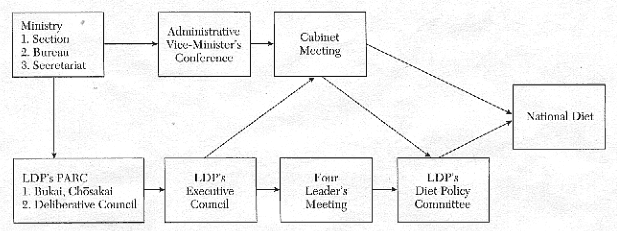
Figure 3.
The LDP's Organization and the Legislative Process
include cabinet, labor, local administration, foreign affairs, justice, science and technology, and environment; the larger divisions include transport, communications, and social affairs. However, the "three noble houses" (go-sanke )—commerce, agriculture, and, the largest of all, construction—always draw the largest membership (Itasaka 1987, 1). The magnetic appeal of these divisions, however, did not appear until around 1967, amid a decline in the LDP's popularity at the polls.[8]
The disparity in the size of PARC's divisions derives from the perception that tangible electoral rewards accompany membership in certain divisions. Given the small and relatively unorganized domestic interest groups concerned, the cabinet, foreign affairs, and justice divisions attract few members. Although ideologically attractive to some, defense and education also draw relatively few members. In contrast, members of the commerce division claim numerous small retailers as their constituents, while those in the agricultural division appeal to the powerful farm lobby. Legislators in the construction division accomplish two goals simultaneously: garnering votes from six million construction workers and campaign contributions from a generous industry.
The legislators chairing PARC's commerce, agriculture, and construction divisions have, on average, fared better among swing voters in the election following their appointment as chair. No such benefit has accrued to the chairs of the education, local administration, or cabinet divisions.[9] For good reason, then, the chairships of the three noble houses became highly coveted, and the occupants of these posts were referred to as "cabinet ministers within the party."
The Enigma of Japanese Pork
To what extent do the LDP's construction tribalists actually deliver the bacon to their home districts? If the LDP's construction tribalists do, in fact, funnel public works projects into their prefectures, then one would anticipate a positive correlation between positional influence and increases in public works spending. To examine this matter, I constructed a multivariate regression model to analyze data for the period from 1964 to 1988 (see Appendix D).
The results of the analysis suggest that the LDP's construction tribalists do not funnel public works projects to their home prefectures, although public works spending does increase slightly beginning in the third year after the appointment of a local legislator to the post of construction minister. Still, the influence of construction tribalists in delivering pork to their home districts is much less than one might have expected.
In this regard, the politics of public works in Japan is enigmatic. Certain prefectures consistently garner higher per capita harvests of public construction allocations; while others reap consistently smaller relative yields. For extended periods, Niigata, Hokkaido, and Shimane ranked near the top for per capita public construction spending, while Tokyo, Saitama, and Osaka consistently found themselves at or near the bottom of the rankings.[10] The stability of these rankings leads one to wonder whether supposedly influential legislators exaggerate their power, so as to lure construction contractors into making large contributions, or, instead, whether construction tribalists dole out pork in even more particularistic ways, such as preferential treatment in zoning decisions, land acquisition, and bidder designation.
The most plausible explanation is that construction tribalists use their influence to ensure the funding of projects most dear to particular firms, and they see to it that contracts go to those firms that make substantial political contributions. Tribalists pay particular attention to protecting the budgets of certain planned projects, knowing that the "complex understandings" of the dango system often help determine the disposition of contracts years in advance. Thus, the designated bidder system encourages tribalists to meddle in decisions about projects reserved for firms outside the tribalist's district. For example, Kanemaru Shin allegedly pressured Governor Takeuchi to award the ¥200-million construction of the Oyama Dam in Ibaraki Prefecture to a joint venture of Tobishima Corporation and Kajima Corporation. Takeuchi's "voice of heaven" apparently produced the desired outcome, and Taisei Corporation, the original predetermined low bidder, was awarded the contract for a rock-crushing plant connected with the dam. Not coincidentally perhaps, approximately twenty of the country's largest general contractors, including Tobishima and Kajima, each funneled as much as ¥20 million a year in
illegal contributions into Kanemaru's war chest.[11] With these generous contributions, contractors hoped to enlist Kanemaru's reputed influence in allocating public works contracts.
The Bounties of Credit-Claiming
To improve their chances at the polls, legislators the world round practice credit-claiming, acting to promote the impression that they are "personally responsible" for the government having taken a particular course (Mayhew, 1974, 57).[12] Logically, credit-claiming should face steep obstacles in Japan's multimember electoral district system, because voters cannot easily determine which legislator delivered a given project. Yet the deeply entrenched systems of political clientelism in both Japan and Italy belie this logic.
Candidates in Japanese election campaigns frequently claim credit for roads, bridges, railway lines, and parks. "I delivered that bridge over there," "I brought in this road" are commonly heard boastings at election time. An MP who delivered an expressway is a "road representative," an assemblyman who brings a bridge to the prefecture becomes a "bridge representative," and a town councilor who secures cement covers for gutters lining neighborhood streets is dubbed a "ditchboard representative." Kanemaru Shin boasted to his supporters in Yamanashi that "to say that I was involved in the construction of 99 percent of bridges in this prefecture wouldn't be incorrect" (in Marshall with Toyama 1992, 37). A popular vehicle for credit-claiming is the koenkai newsletter. A typical newsletter might carry a headline proclaiming the government's decision to build a dam in the district and include photographs of the hardworking representative arguing the merits of the proposed project before key cabinet officials and government bureaucrats.
Over time, many conservative legislators have augmented their power resources through credit-claiming. During the early decades of prewar parliamentary democracy, Hoshi Tooru was among the first politicians to use pork-barrel politics effectively. Hara Kei fashioned a system whereby public spending served the interests of the Seiyukai party. In the early postwar years, former Prime Minister Yoshida Shigeru's "one-man road," a stretch of asphalt running from Tokyo to
Oiso (where, perhaps not coincidentally, Yoshida's estate was located) and ending in Hakone, exemplified such a system. Ono Banboku, an LDP faction boss, secured a bullet train stop for a small town in his native Gifu Prefecture, and future Prime Minister Fukuda accomplished a similar feat with a railway stop at a small town in Gunma Prefecture. In addition to getting a local bridge named for him, Kanemaru brought a ¥200-billion project for a test line for a magnetic levitation bullet train to Yamanashi Prefecture.
But, without question, Tanaka Kakuei, dubbed the "Emperor of the Construction Ministry," was the greatest practitioner of pork-barrel politics. Among other things, Tanaka delivered to Niigata two superexpressways, a bullet train line (with three stops in small towns in his own district), a university and a techonopolis, and an atomic power plant. Tanaka's reign also brought a number of schools, cultural halls, hospitals, public housing complexes, roads, bridges, tunnels, dams, and river improvement projects to Niigata. The pièce de resistance was a tunnel that "liberated" Shioya Village and its sixty households from its traditional wintertime isolation—at a cost of ¥12 billion, or ¥20 million per household. As a resident of the prefecture observed, "When superexpressways and a bullet train took shape and appeared right before our eyes, we realized just how wonderful Mr. Tanaka is" (Fukuoka 1985, 200).
Among the most powerful of the "mini-Tanakas" is Amano Kosei, a long-time member of the LDP's construction tribe and chief of the public works subgovernment during the late 1980s. Elected to the Lower House in 1958, the same election that launched the parliamentary careers of Takeshita and Kanemaru, Amano felt obliged to become a construction tribalist because of Fukushima's undeveloped infrastructure. He took his first steps toward becoming a tribalist as a three-term member of the Fukushima Prefectural Assembly, when he labored to construct a track-and-field stadium and, later, railway lines and roads. Thanks to his discipleship under faction boss Kono Ichiro, Amano established strong connections to the construction industry. By the mid-1970s, incumbency in a succession of construction-related posts gave him even stronger ties to the construction bureaucracy. Amano claimed credit for channeling a number of public works projects, including the so-called Amano interchange in Motomiya, into
the prefecture, and he presided over and claimed sole credit for a 20 percent increase in the 1987 public works budget, the first increase since the "ice age" in public construction spending in the late 1970s.
A final example concerns the influence of construction tribalist Nakamura Kishiro. In March 1992 MOC's Road Deliberation Council designated 6,111 kilometers of prefectural roadways as national roadways. One excluded stretch of pavement was an 18-kilometer roadway in Ibaraki Prefecture. Beginning in 1986, signals from MOC concerning the possibility of redesignation alerted residents of the neighboring areas. In March 1990, though, Nakamura was appointed acting chairman of the LDP's Road Research Council. A local politician who visited Tokyo to make a direct appeal reported that Nakamura had claimed that he, Kanemaru Shin (then chairman of the Road Research Council), and Takeshita Noboru would decide the redesignation of prefectural roadways. It so happened that the mayor of a town along the roadway supported one of Nakamura's LDP rivals in Ibaraki's Third District. In November 1991 the residents of another roadway town obtained over 10,000 signatures in support of redesignation. Unfortunately, the town stood solidly in the support bases of Nakamura's two LDP rivals in the district. "Because the local leaders along the roadway did not belong to his support group," argues a disappointed local politician, "Mr. Nakamura became annoyed" and blocked the decision. Even MOC officials admit that, despite a logical case for redesignating the status of the roadway, Nakamura so strongly opposed it that the zealous enthusiasm of the local residents could not alter the ruling (Asahi shinbun , 14 Mar. 1993).
Nevertheless, it is important not to exaggerate the influence of the LDP's construction tribalists. Even influential construction tribalists humbly plead for public works projects on occasion, and public works bureaucrats sometimes disregard explicit orders from their political overlords. A former Finance Ministry bureaucrat turned parliamentarian estimates that the Finance Ministry decides about nine-tenths of the public works budget, leaving MOC and the construction tribe to "play" for the remainder (pers. interview). An upper official of MOC estimated that tribalists influence only about 5 percent of decisions involving the allocation of public works projects (pers. interview). Thus policy tribalists "work with bureaucrats in the bureau-
crats's system. They have not provided new channels for the LDP to put into effect policies reflecting broader, national interests that do not fit well into the bureaucracy's segmented world" (Schoppa 1991, 104). In the final analysis, members of the LDP's construction tribe owe their influence to their ability to work with the public works bureaucrats.
Tiptoeing toward Resolution
After arriving in Washington on 26 March, Ozawa held a series of talks with U.S. officials, among them Commerce Secretary William Verity and USTR Clayton Yeutter. The Americans demanded guaranteed access for U.S. firms to major private-sector projects, while the Japanese side insisted upon retaining its designated bidder system. Four days later, they reached an accord that allowed U.S. companies to participate in seven large-scale public works projects and to apply "transparent" procedures to the construction of a new headquarters for Nippon Telegraph and Telephone Company and the Trans-Tokyo Bay Expressway. (These seven projects included work on Haneda Airport, redevelopment of Tokyo Bay, Yokohama's Minato Mirai 21, Hiroshima Airport, Akashi Strait Bridge, Ise Bay Expressway, and Kansai Cultural and Academic Research City). In addition, the accord created liaison points for foreign firms wishing to submit tenders and extended the submission of pre-tender cost estimates to sixty days (Japan Times , 31 Mar. 1988). Because of his influence and personal connections, Ozawa earned much of the credit for the Major Projects Agreement. That the accord ultimately failed to diminish the trade friction only highlights Japan's deeply rooted domestic resistance to market liberalization.
The American assault upon Japan's long-secluded construction fortress called attention to the role played by the LDP's factions and policy tribes in the politics of public works. As we have seen, the intraparty factions served the needs of their members, providing them with essential electoral resources (e.g., party nomination, campaign funds, and political posts) and offering members a collegial setting for seeking support and trading favors needed to fulfill the demands of constituency service. Even after a faction leader steps down, most fac-
tioneers remain within the faction, and the factional lineages come to dominate certain subgovernments.
Between 1955 and 1993 the LDP's construction tribalists controlled vast legislative power in Japan's public works subgovernment. But instead of using their influence solely to funnel public works projects into their home districts, the LDP construction tribalists largely used their regulatory clout to ensure that particular construction firms were favored in the awarding of public works contracts. Of course, they did not ignore constituency service; as we have seen, the low ideological differentiation among rival LDP candidates in the SNTV system required career politicians to grant constituency service high priority. As Ono Banboku once observed, "A monkey that falls from a tree is still a monkey, but a legislator who falls in an election is merely human" (Inoguchi and Iwai 1987, 139–40). From the perspective of an LDP backbencher, membership in the construction tribe, with the promise of increased voter support and political funds and connections to the public works bureaucracy, offered a chance to escape such a mortal end.
Given the electoral benefits of public works, LDP politicians naturally resisted foreign pressure to open the construction market, which would have meant forfeiting invaluable electoral advantages. At the root of the construction friction, then, one finds institutional incentives for the factioneering and tribalism. It was neither Japanese culture nor Japanese traditions that produced the "politics of factions and tribes," but rather such institutions as the SNTV and the system of campaign financing.