
Concert Series:
From Amateur Performer to Impresario
From the outset it is apparent that the women saw these clubs first as an opportunity for self-improvement. The motto of the first women's amateur music association, the Rossini Club of Portland, Maine (1869), exemplifies the primary and prevailing goal of such organizations: to provide a forum to study and perform "for . . . mutual improvement in the art of Music."[4] Indeed, the records of more than one club document the women's struggles with performance anxiety and lack of confidence in their own abilities. Anna Dennis, speaking for the Zoch Club of Minneapolis, admitted that "it is rather hard to have to confess that the chief end of our existence this year has been to overcome the dreadful state of 'nerves' in which most of us found ourselves at the mere thought of playing before an audience. Some one cruelly dubbed us the 'Frightened Club' . . . and I fear that some of us still feel the terrifying mental influence of that nickname."[5]
The move from self-conscious preoccupation with their own performance to the business of management was at first tentative, and it admittedly owed much to the experience of women working with other women. "[T]he first benefit we have received has arisen from contact with one another. Unaccustomed to concerted action, we found ourselves launched . . . upon a period of organization. . . . It has been a training in itself to learn to work together, in a musical society, with kindness, forbearance, patience and in honor preferring one another, especially when we remember that musical people are said to be the most sensitive in the world."[6]
By the time of the first national convention of women's amateur music clubs in 1893 at the World's Columbian Exposition in Chicago, many clubs had broadened their goals to include "the advancement and elevation of the public taste"[7] and the promotion "of high class music."[8] In her opening address to the convention on 21 June, Rose Fay Thomas recognized that clubs were bringing solo artists, orchestras, and musical festivals to their communities because members' increasing musical knowledge and discrimination demanded more than their own amateur performances.[9] While applauding club concerts for broadening musical tastes and awakening artistic perception, Thomas also warned that such education, confined primarily to women, made "the musical culture of America a one-sided affair."[10] She recommended that clubs drop the word "woman's" from their names and bring into their "pleasant circle the fathers, brothers and friends, whose love for and knowledge of music must be as carefully cultivated as that of the women, if we are ever to be a musical nation or do anything genuinely great in this beautiful art."[11]
Thomas's recommendation would eventually be realized, but for the time being, legions of women answered the call to become the "cultivators" of musical culture in their communities, and the number of women's music clubs increased dramatically through the opening decades of the twentieth century. By 1919 there
were more than 600 active clubs, with a combined membership of approximately 200,000.[12] By the turn of the century, many of the clubs had already developed well-attended and well-financed concert series and were being described as the country's most successful sponsors of European artists.[13] So successful were they that by 1927 the National Federation of Music Clubs reported that, outside of large cities, individual clubs managed three-fourths of the country's public concerts, spending approximately a million dollars to book performing artists.[14]
Music clubs succeeded as public impresarios because their membership lists and network of connections supplied ready-made audiences, whose financial resources (either in the form of membership dues, subscription ticket purchases, or special guarantee funds) underwrote artists' fees. The success of the clubs was much noted by the press, as in this word of praise from the New York Sun in 1904: "Without this guarantee and the influence of the club members many small towns would never hear the well known artists. . . . All over the country these clubs have done a wonderful missionary work in bringing to the people of the smaller cities the best of the virtuosos."[15] As the clubs prospered, many divided their memberships into active members, who performed at club recitals, and the more numerous associate members, who managed the social aspects of club life, formed the audience for programs, and thereby enlarged the financial core of the club.
The sounds music clubs offered to the public in hopes of raising the musical tastes of their communities were the works of venerated European composers played by European and American artists and chamber ensembles, and, if they could afford it, by American orchestras and opera companies. Between 1899 and 1930, for example, the Artists' Series of the Women's Club of Columbus, Ohio, presented ten different major symphony orchestras, three opera companies, and six different chamber ensembles.[16] If the Pittsburgh Orchestra's offerings for the Cleveland Fortnightly Musical Club (1905–6) are representative, the programming was predominantly German—Beethoven, Weber, Schubert, Bruch, Brahms, Strauss, and a heavy dose of Wagner—with a Liszt symphonic poem and a Tchaikovsky symphony thrown in for a little variety.
Although the women did not determine the public programs of visiting artists and ensembles, they did exercise some control over the repertoire offered in members' private recitals and lectures. In the selection of repertoire, the clubs distinguished themselves by initiatives that were relatively new and progressive for the time. In contrast to the heavily Germanic repertoire offered by visiting symphony orchestras, the clubs urged the inclusion of at least one work by an American composer in each of their concerts in a recital series. In addition, in their "membersonly" sphere and at concerts at national conventions of music teachers, clubwomen, and the like, clubwomen promoted works by recognized women composers such as Amy Beach, Cécile Chaminade, and Margaret Ruthven Lang—not to mention works of aspiring composers from within their own ranks.
In their efforts to promote American music and works by women of any nationality, the clubs soon found a powerful ally in the National Federation of Music
Clubs (NFMC). When the NFMC was chartered in 1898, its initial emphasis was on fostering new clubs and organizing state federations. Soon, however, it directed its efforts toward managing artists' concerts through a national concert bureau and promoting music by American composers. By 1907 the NFMC had established an American Music Department to direct clubs to give preference to American artists and American music in their private club programs. At the same time, the NFMC inaugurated a biennial competition for American composers, and numerous individual members endowed special composition prizes for women of federated clubs.[17]
Club members' lofty aim of advancing the public's musical taste often had to be balanced with more practical concerns. In booking artists, clubs considered which performers would draw the most new members and season ticket subscribers: "It seemed to be the general opinion that if such a price were to be paid [$300 for baritone Max Heinrich, for example] it would be better to secure a woman as likely to be more pleasing to the majority of the audience."[18] Yet club members' overriding goal, as expressed in the minutes of the Cleveland Fortnightly Musical Club, was to present the "best" music "at prices which make it possible for a whole family to go."[19]
As early as 1898, Amy Beach praised the clubs for their fostering of discriminating audiences:
I can not express too strongly my belief in the value of women's clubs as a factor in the development of our country. So long as their work continues to be of the high, earnest character at present shown in many of our cities and towns, so long will the influence of good be felt in the home-life of club members, and in the musical growth of their children. That American audiences display a power of judgment in marked advance of that shown fifteen years ago is largely due to the faithful array of amateurs who by unceasing toil have tried to cultivate a true appreciation of great music and musicians.[20]
The move from the private sphere of self-education into the public domain of concert management, and the inclusion of men in the affairs of the clubs, was accomplished with some uncertainty. In its 1895–96 season, more than two years after Rose Fay Thomas's recommendation of including men, the Fortnightly Musical Club of Cleveland discussed the possibility of inviting prominent businessmen to attend a meeting for the purpose of discussing a proposed concert series by Theodore Thomas and his orchestra. The minutes record: "it was made evident that while such a meeting might in the end prove the easiest and best means of securing the guarantee fund, still the members of the Board shrink from the necessary publicity of a public meeting and it was agreed that other methods should first be tried."[21] Judging from the minutes of 14 April 1896, the alternative measures to obtain public funds by more private means were quite unsuccessful, and the club was left with a deficit of nearly $2,000 after the four Thomas concerts.[22]
Nonetheless, women who had initially entered the public arena of concert promotion and management with some trepidation were quickly gaining entrepreneurial skills, and by 1910 a major article in Musical America —"Women—The
Potent Influence in Our Musical Life"—declared that clubwomen had acquired "an executive ability equal in its results with that of the majority of successful business men" and predicted that by their contributions "a musical foundation is being built that nothing can topple."[23] That this newfound skill was hard-earned through experience is clear from Corrine Moore-Lawson's address to the Ladies' Musical Club of Cincinnati:
The work of concert giving on so large a scale has developed some remarkable business talent among the ladies of the club. There is always an untold amount of detail work in connection with such undertakings, which one who has not tried it can never know. There is, to begin with, the making of a judicious contract; then comes the working up of public interest, the securing of subscriptions, the newspaper notices, the programme arrangements, the hall decorations, etc., accompanied all the time by the awful fear that the whole thing may prove a failure. Such experiences have a tendency to develop the impresario genius of the club, and it is not beyond the possibilities that some one among the fifty may distinguish herself in that line.[24]
Indeed, out of the concerted efforts of the clubwomen certain individuals did emerge as leaders of remarkable ability. The anonymous author of the Musical America article of 1910 (identified only as C. A.) singled out Mrs. Charles B. Kelsey, president of the National Federation of Musical Clubs, whose St. Cecilia Club in Grand Rapids erected its own building for concerts as early as 1894. The writer also, however, recognized over a hundred other women for their work as managers of community concert series and for their "unusually active" efforts on behalf of music.[25] Among them were such notables as Marian MacDowell, for her work with the MacDowell Colony; Mrs. George R. Sheldon, for her reorganization of the New York Philharmonic; and Amy Fay, for her activities with the Women's Philharmonic Society in New York. Of this early generation of women impresarios, two in particular must be singled out: Ella May Smith (1860–1916), president of the 3,000-member Music Club of Columbus from 1903 to 1916, and Adella Prentiss Hughes (1869–1950), a charter member of Cleveland's Fortnightly Music Club.
Ella May Smith was active on many fronts—as piano teacher, vocal coach, instructor of harmony, theory, and composition, lecturer on the history of music, music critic and correspondent of several journals, composer, and author. It is significant that while contemporaries record in unusual detail her many accomplishments, they especially note her "constant and faithful devotion to the best there is in music," as well as "a genius for business administration possessed by very few persons."[26]
Smith's primary goal as club president was to create and build an audience for local and visiting artists, which she effectively did by reducing season tickets from $5.00 to $3.00 and augmenting publicity efforts, which resulted in a dramatic increase in membership (one report places the number at 4,000 and more).[27] During the thirteen years of her presidency, she did much more, however, than fashion an enthusiastic membership focused on attending recitals by major artists, concerts by members, and free organ recitals. Under her leadership, the impact of
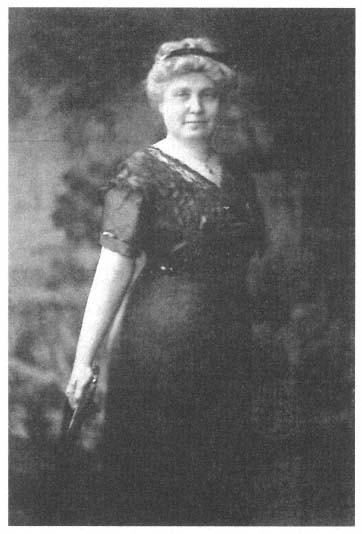
Fig. 3.
Ella May Smith. Photograph taken from inside front cover of
brochure printed by the Women's Music Club of Columbus, Ohio, "in
token of its great appreciation of the brilliant services rendered to its
members and to the citizens of Columbus by Mrs. Ella May Smith, who
has just completed ten years of splendid work as its President"
(18 March 1913).
Courtesy of Ohio Historical Society (MSS 445, box 1, folder 24);
published with permission.
the club's work was reflected in the growing discrimination of audiences, who, as Amor W. Sharp noted in his address honoring Smith's first ten years as president, no longer demanded that "Home Sweet Home" or "The Flower Song" from Carmen be included on every program. "The names of Beethoven and Wagner on a program no longer produce the effect of a quarantine placard by the side of a front door. Today our public will listen even to D'Indy, Debussy, Strauss, Ravel and any of the other eccentric writers of the present time and cry for more,—and enjoy them too."[28]
In addition to this audience education, the club's musical institutions and "outreach" programs established under Smith's leadership included an Altruistic Department to present programs in city, county, and state institutions; community music schools in settlement houses; a music library; the Saturday Music Club; a student club for girls and boys; an organization for children six to twelve; the Opera Club; a club choir; the donation of a three-manual Felgemaker organ to the city; an exchange program with other clubs; and a system of scholarships to music students.
The outstanding achievements of the Music Club of Columbus under the leadership of Ella May Smith undoubtedly owed something to her work outside the Women's Music Club as well. To her direction of the group she brought her contacts and extensive experience as president of the Ohio Music Teachers' Association and as officeholder in the National Federation of Music Clubs. In all the organizations she served, she was a tireless champion of American music and insisted that all visiting artists include some American music in their programs. In 1918 she organized the convention of the state's MTA program around the music of American composers, and in 1919 she planned an MTA program devoted to the music of African-Americans.[29]
While Smith accomplished her goals by working within the sphere of her music club, many other women who had organized concert series for their respective clubs now stepped out on their own to become independent concert managers. By so doing they could earn money for their labors, but they also assumed the risk of losing, not only their own money, but also that of their guarantors, for such women were often still acting on behalf of a syndicate. One particularly successful independent female manager was Adella Prentiss Hughes.
Hughes honed her skills as a manager through a position created specifically for her by Cleveland's Fortnightly Musical Club, by charter of 3 June 1901.[30] In her memoirs she observes that "the object of this enterprise was the development of fine orchestral music—not the means of earning a living and profit for the club and manager."[31] When Hughes announced her intention to form a guarantee fund to back the project, the club's board—recalling the deficit after the Thomas Orchestra Series—expressed serious misgivings, so Hughes herself assumed complete responsibility for its organization.
The first season of concerts was so successful that the full amount of the club's appropriation for the concerts was not needed; the public bought $5,000 worth of tickets, which came close to the $5,900 spent on the concerts.[32] By its sixth season,
Hughes was reporting a profit, with receipts totaling $17,102.96 and expenditures $16,822.68.[33] And by the end of the 1908–9 series, she was able to remove the series from under the auspices of the club and become independently accountable to her guarantors.[34] Within her first decade and a half as manager of the symphony orchestra concerts, Hughes presented the orchestras of Pittsburgh, Cincinnati, Boston, New York, Philadelphia, and Minneapolis, as well as the Thomas Orchestra and the Russian Symphony Orchestra (a New York-based émigré ensemble).
With good reason Victor Herbert, then conductor of the Philadelphia Orchestra, could say of her that she knew "more about the business of music than anyone," and that he "would rather have her for . . . manager than any man in the world."[35] With her prodigious talents and her family ties to some of Cleveland's wealthiest citizens,[36] Hughes forged almost fifty years of successful concert management, and Cleveland music became known in New York as "Hughes Who."[37]
In the ensuing decades, many a club's success in managing concert tours was based upon the energetic commitment and leadership of a single woman. Through the agency of several such female entrepreneurs, these activities were moving westward, and in the early decades of the twentieth century, Minnesota's Twin Cities had become thriving musical centers. In Minneapolis, Edna Godfrey, by her judicious choice of fine artists and skillful use of the press,[38] over a period of thirty-six years (between 1920 and 1956) built an impressive series for the city's Thursday Musical Club. Somewhat later, in neighboring St. Paul, Nettie Fuller Snyder (from ca. 1860 to 1929) was bringing opera to the Twin Cities area by booking performances of both the Metropolitan Opera Company and the Chicago Grand Opera. And Anna Schoen-René (1864-?), dubbed the "musical czarina" of Minneapolis,[39] not only organized concerts but also renovated the city's Exposition Hall at her own expense, established the Choral Union at the University of Minnesota, participated in the founding of a Department of Music at the university, directed an earlier unsuccessful campaign to found a Minneapolis symphony orchestra, and formed the first organized branch of the Mozart Society.[40]
From coast to coast and border to border, the good work of the women's clubs was influencing America's musical culture. In Atlanta, Mrs. Armond Carroll directed the Atlanta Music Club's concert course for six difficult years in the World War I era. Her success is attested to by the fact that great artists who came to the city annually were "impressed with the fact that local audiences" were as "discriminating in their musical tastes as the most artistic centers of Europe."[41] Other notable impresarios included Jessica Colbert in California,[42] Maria Longworth Storer of Cincinnati (founder of the May Festivals),[43] and Minnie Guggenheimer of New York (responsible for the outdoor concerts at the Lewisohn Stadium).[44]
By the 1930s the music clubs' work of promoting public concerts of touring professional artists had been assumed by independent managers, many of them women. Nonetheless, there is a tinge of regret in Anna Laura Kidder's remark that "the real work of the club . . . had imperceptibly passed into other and
stronger hands than ours."[45] More serious still is her inference that the very success of these concert series may have had an adverse effect upon amateur music making by creating passive audiences. She notes that "there is a growing reluctance among adults to attempt, even in the secure privacy of home, to reproduce music that is so lavishly presented through . . . other channels. The young delight to make music themselves; but the adults prefer to hear it."[46]
The records of the many clubs that survived the financial difficulties of the Depression show an evolution from club programs by members to concerts by young professionals. Inevitably, as the control and organization of concert series became more and more the province of professional managers, the faces of music clubs changed, but their dedication to the cultural enrichment of their communities persists in new enterprises. Of these, one of the most important is the support of local orchestras, which launched women's role in the creation of permanent symphony orchestras in the early decades of the twentieth century.