
Chapter Six
Rituals to Help Human Beings
If the baby is sick or not doing well, that's why we wave that fire over them. It scares away things. It helps the baby to grow stronger. And then you use sugar pine bark, and pound it up and put it in a little cup. With water. That's what you give the baby to drink. . . . It's supposed to be in the spring of the year when you have this Brush Dance, so that the child will grow up with all the leaves and the blossoms and the grass. With everything that's growing. And he'll grow up in that. He or she, whatever. And he'll be just like that.
The purpose of the Brush Dance as explained by medicine woman Alice Pratt (Hupa) on August 24, 1979
The Brush Dance
The Brush Dance[1] is traditionally performed to cure a child who is feverish or sickly. In the center of a pit, a medicine woman and her helper work on the baby; they hold it in steam produced by certain herbs, massage it, and wave burning sticks of pitchwood over it. The duties of the medicine woman were described in chapter 2 and a more detailed account is found in Keeling (1982a ).
Because of the use of burning pitchwood the dance is called hont naht weht ("fire-waving dance") in the Hupa language. The Yurok word for it is meyli or melo - and the Karok term is hapish .[2] The English expression "Brush Dance" presumably derives from the fact that the male dancers hold brush in front of them rather than carrying regalia on the first night. Today they use salal brush for this purpose, but Sam Jones (Yurok) mentioned that they used to dance with blue spruce (February 5, 1979). The blue spruce is only
found at higher elevations and is less abundant today because of logging.
The public component of the ritual takes place during the night. While the medicine woman works on the child, males of various ages (and some younger girls) file into the pit and sing in order to help the doctoring. The singers are supposed to concentrate on the well-being of the baby, and this augments the prayers and good thoughts of the medicine woman. All of the songs are short, generally about one minute in length, and there are two types: heavy songs and light songs. Each set of songs begins with a heavy song, and these are more religious in character and slower in tempo than the light songs which follow. The heavy songs are always wordless and are sung only by men. After the heavy song is sung three times, any of the men or girls can sing a light song. A light song is also sung three times, and between each rendition there is a brief silence. After any song is sung three times, there is another, somewhat longer pause which lasts until another soloist is moved to begin. In all, a set of songs typically lasts about one half hour. Nowadays, two "teams" take turns in the pit, and they alternate through the night until morning.
The Musical Texture
At an actual dance, the listener's impression of Brush Dance singing is dominated by the unusual manner in which the male singers accompany the soloist. The soloist starts alone, and after a few phrases by him the others begin their rhythmic ostinato. This is done softly at first, but it becomes increasingly louder and more markedly rhythmic until toward the end they all but drown out the soloist because of the volume of their chanting.
This unusual vocal technique is rather difficult to describe in words, though Woodruff simply referred to it as "a weird grunt" (1892:59). In its most basic form, the ostinato consists of a series of forceful glottal stops that mark a regular one-beat rhythm. One singer might assist in this manner (sharply accenting each beat), while the man next to him softly murmurs vocables with resonant nasality and much tremolo or vocal pulsation. Yet another accompanist might add a soloistic part that trails the main part hetero-
phonically. Thus the various accompanimental parts are often rather individualistic, but these differences are largely obscured as each man's voice becomes lost in the complex sound of the ensemble.
As in other dances, this accompanimental singing is called "rhythm" by the Indian singers themselves, and example 8 shows some patterns which are frequently used.
Although framed in repeat signs, these would not be repeated exactly but rather with considerable flexibility. Moreover (as mentioned previously) each would begin quite softly and grow louder throughout the course of the song. Many of the vocable patterns suggest 4/4 meter when sung by individuals in demonstration, but accent is uniform, and the collective effect in an actual performance is one-beat meter. The simpler patterns shown in the upper examples would occur in faster tempos, and the more irregular patterns shown in the lower examples would be used in slower songs.[3] Use of X's rather than note-heads indicates lack of pitch-focus, and parenthesized grace notes are meant to depict a sort of "glottal trill" which resembles sobbing.
In example 9 I have transcribed one phrase-group of a heavy song sung by soloist Fred Davis (Hupa/Chilula) accompanied by Herman Sherman, Sr. (Hupa).[4] Rather than using a conventional "rhythm" pattern throughout, Mr. Sherman chooses to accompany this part of the song by faintly trailing the descending melody of the soloist. He does so quite softly, as if he were humming rather than singing. Then toward the end of the phrase-group he and the soloist both employ more conventional "rhythm."
In an actual dance the accompanists sometimes take even greater liberties than this; the parts they add not only "echo" the solo part but loudly assert their independence. This is heard on a (light) Brush Dance song sung by Dorothy Moore (Yurok) and a group of men on a recording made by Margaret Woodward in 1953 (see appendix 1).
Heavy Songs
The heavy songs are wordless, and they are generally performed with a "sobbing" vocal delivery much like that heard in the Deerskin Dance or the Jump Dance. The solo part of a heavy song
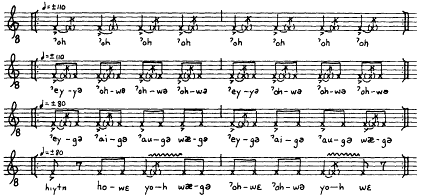
Example 8.
Typical "rhythm" parts chanted by male accompanists in the Brush Dance.
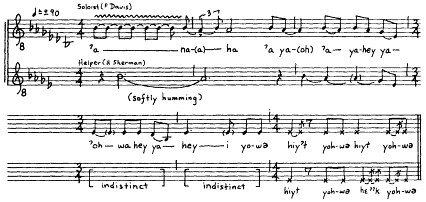
Example 9.
Segment of a heavy song with accompaniment in heterophonic style.
by Elmer Jarnaghan (Hupa) is transcribed in example 10. The song is typical in beginning with a short intonation that establishes a tonal and rhythmic framework for what will follow. This bit of "rhythm"[5] also sets the tempo for the accompanists or "helpers." It also usually defines the tonic pitch of the solo part, and indeed it does so here though Jarnaghan has somewhat masked the fact by echoing the final note of each phrase-group (except X) with a measure or two of "rhythm" sung a minor third lower.[6]
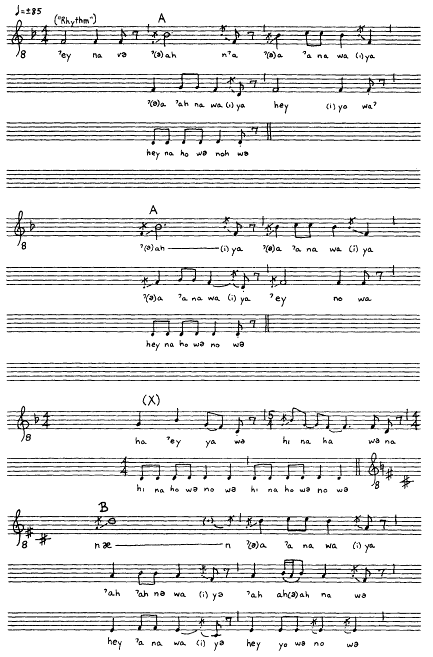
Example 10.
Brush Dance heavy song performed by Elmer Jarnaghan (Hupa) and recorded
by Richard Keeling in 1979.
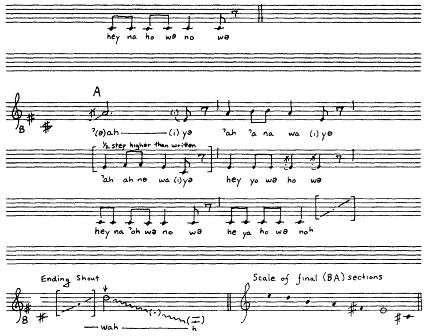
Example 10.
Brush Dance heavy song performed by Elmer Jarnaghan (Hupa) and recorded
by Richard Keeling in 1979. (continued)
As in most Brush Dance songs, each phrase-group begins with a melodic leap to a relatively high pitch and descends gradually to cadence in the chanting of "rhythm." Thus each section typically ends with the solo singer allowing his voice to become absorbed in the glottalized ostinato of the group.
Most of these songs include a contrasting (B) section in which the singer moves up to a higher pitch level and delivers new melodic material in a climactic fashion. Thus the most typical structure is an AAB-type form, though note that the letters refer to phrase-groups rather than to motives as in previous analyses of other genres. The song in example 10 has an extra phrase-group (X) and a recapitulation which make its form AA(X)BA, but this follows the basic pattern and is only one of many possible variants that are heard.[7]
All of these Brush Dance songs are rhythmically exciting. Even though example 10 is rather slow in tempo and modest in its use
of syncopation, the singer is constantly "stretching" the beat against that of the ostinato, much as a modern blues singer might. When Indian singers tap their foot to the music, they raise the toe on the downbeat and let it fall on the offbeat, thus producing a cross-accent like that produced by a jazz drummer when he strikes the ride cymbal on the weak beats of a 4/4 measure.
In the dance itself this cross-accent is particularly noticeable, as all the dancers rock their bodies in a similar counter-rhythmic fashion and wear heavy shell necklaces which rustle loudly in concert with the movement. The men heave their torsos up and down from the waist in a rather forceful way, and if there are girls in the pit they bob up and down on the balls of their feet in a more restrained way. All these songs have a duple feel, and 4/4 meter is the general rule.
The reader may have noticed that the pitch level of the song drops one half-step between phrase-groups X and B, and instances of "pitch drift" (in either direction) are common in the repertory as a whole. Adjusting for this, we find a scale that is anhemitonic and pentatonic, but here again (as in examples 3 and 7) the scale is irregular in that notes of the upper octave and lower octave do not correspond exactly. As mentioned previously, this is not the general rule but occurs often enough to be regarded as stylistic. Here again the melodic range is wide, and the overall contour is descending or perhaps terraced-descending. Finally, the ending of the song is signaled by a closing "flourish" shouted by the soloist, and this is a general characteristic of Brush Dance songs.
While the song in example 10 seems to have a relatively static or "fixed" character, others such as the one transcribed in example 11 are more spontaneous or improvisatory in nature.
In example 11 the formal structure is ABB1 , the B1 phrase-group being drawn out into a rather lengthy improvisation. Thus the tension increases as the song moves toward an end. The songs are sung three times, and a superior singer often embellishes the last section of the song more and more each time, dramatically extending the climax of the music. Ewing Davis was a master at this, but other modern singers use a similar approach.
Having examined different versions of the AAB-type form in modern recordings, it is interesting to compare a Brush Dance song performed in 1906 by Domingo (Yurok), a famous singer from
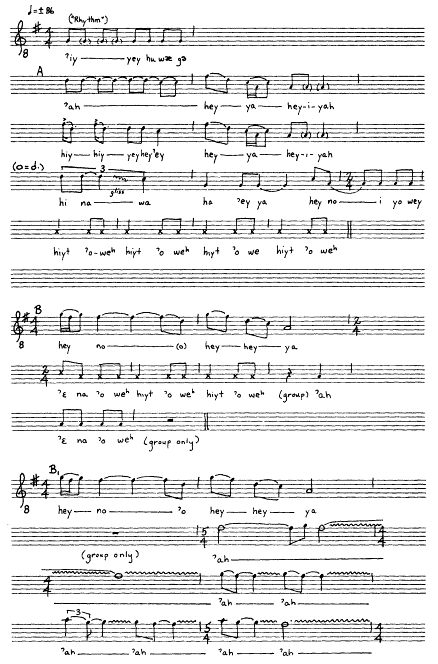
Example 11.
Brush Dance heavy song sung by Ewing Davis (Hupa) and recorded
by Frank Quinn in 1956.
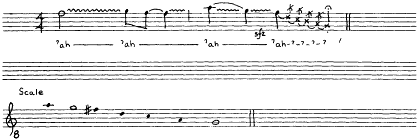
Example 11.
Brush Dance heavy song sung by Ewing Davis (Hupa) and recorded
by Frank Quinn in 1956. (continued)
Weitchpec. Generally speaking, the style is typical of that heard on cylinder recordings collected among Yuroks around the turn of the century.
Like the modern songs discussed previously, the song in example 12 is wordless. The early song also resembles recent ones in that its melody consists mainly of an alternation between motives sung in the upper register and "rhythm" motives chanted in the lower part of the singer's range. But instead of having the AAB-type form, which has been postulated as a sort of norm in modern singing, this one has an irregular structure in which "rhythm" motives are much more prominent. This occurs in other early recordings and seems to suggest that the relatively common AAB-type form in modern recordings could be a recent development. A similar trend was noted with respect to Deerskin Dance songs.
The Light Songs
While the heavy songs are always wordless, light songs often have meaningful texts or lyrics which reveal their secular character. Example 13 is a transcription of a light song sung by Herman Sherman, Sr. (Hupa). Although many of the men's light songs are sung entirely in vocables, this one has a text. Addressed by an older man to the sweetheart of his youth, the words could be translated, "Where we used to meet the grass is grown up high now." While locals are quick to point out the humorous or sexually suggestive character of Brush Dance lyrics, the tender sentiment in this text shows the expressive range that they can cover.
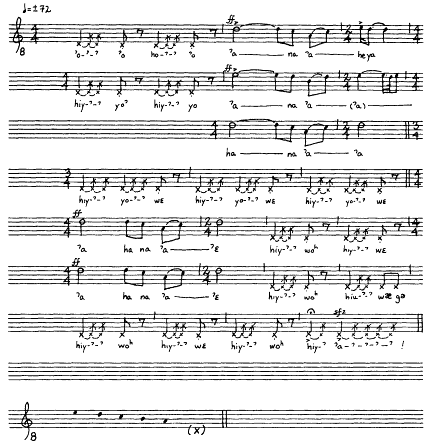
Example 12.
Brush Dance heavy song sung by Domingo (Yurok) of Weitchpec and recorded
by A. L. Kroeber in 1906.[8]
Except for its use of a text and a somewhat quicker tempo, this light song is similar in style to the modern heavy songs considered previously. It begins with a measure of "rhythm," and in each phrase-group the musical interest centers upon the progress of the solo part as it first rises above the ensemble's ostinato, then gradually descends to merge with it. The use of a text in sections A and B makes this juxtaposition apparent, as words are used in the beginning of each phrase-group and vocables are used for the "rhythm" motives at the end.
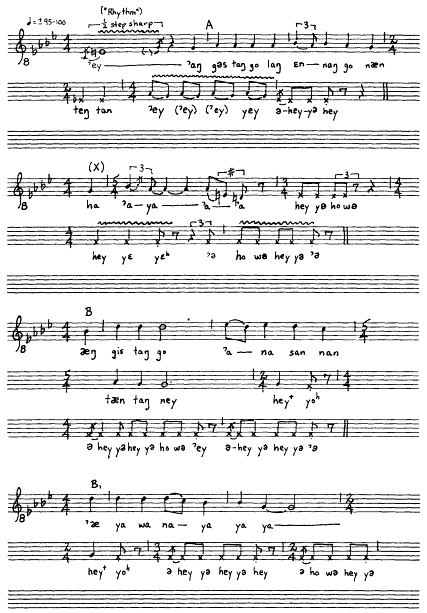
Example 13.
Brush Dance light song sung by Herman Sherman, Sr. (Hupa) and recorded
by Richard Keeling in 1979.
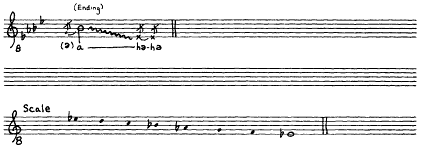
Example 13.
Brush Dance light song sung by Herman Sherman, Sr. (Hupa) and recorded
by Richard Keeling in 1979. (continued)
Once again the postulated AAB-type form is interpreted quite freely, and the actual structure of this song is A X B B1 . Very seldom are phrase-groups repeated exactly in this style, but section X is clearly new material and seems to be improvised. Possibly (I feel) the singer began a new musical thought here and then decided against it for one reason or another. The style provides much freedom in this respect, for the soloist can chant "rhythm" motives virtually any time he wants to abandon one melodic idea and move on to another.[9]
As mentioned above, light songs in the Brush Dance may be sung by women as well as by men, and this is the main occasion for female singing in public ritual music today. In example 14 I have transcribed a light song sung by Aileen Figueroa (Yurok). Humorous and sexually explicit texts are common in this genre, and this text (set in sections V and VI) has been freely translated, "She was just an old woman, but she was a helper from the bottom." Lyrics like this often originate from spontaneous wisecracking at the dance itself, but then they might be used and remembered by local audiences for generations. This light song, for example, is still known by many today as "Grandpa Natt's Song," and it was first recorded as sung by Robert Natt (Yurok) himself in 1932.[10]
This example illustrates general characteristics of the female style, as opposed to that of the male singing in the Brush Dance: (1) the melodic contours tend to be undulating rather than descending, (2) the formal structure typically consists of one short phrase-group repeated several times with variation rather than using the AAB-type pattern,[12] (3) the motive at the end of the song is soft
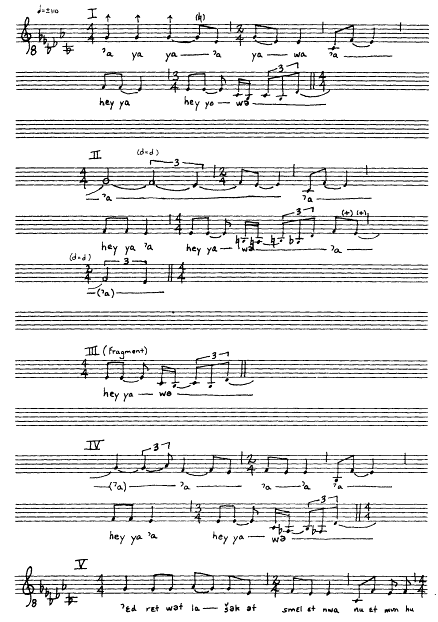
Example 14.
Brush Dance light song by Aileen Figueroa (Yurok) recorded
by Charlotte Heth in 1975.[11]
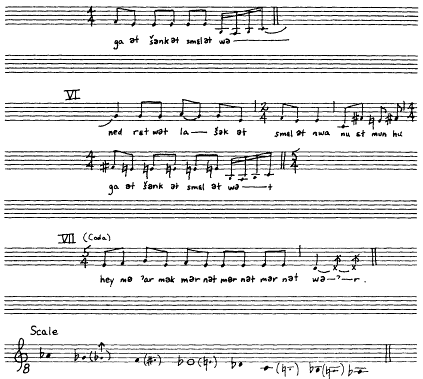
Example 14.
Brush Dance light song by Aileen Figueroa (Yurok) recorded
by Charlotte Heth in 1975.[11] (continued)
and brief compared with the shouts or "flourishes" that men use as a way of signifying conclusion,[13] and (4) elements of the glottalized ostinato accompaniment are not integrated into the solo part of girls' songs, as they generally are in the men's solos.
The last-mentioned point is especially significant, for it illustrates how male and female soloists differ in relation to the ensemble. The male soloist interacts with the other male singers, his part alternately rising above the ensemble and descending to merge with it. By contrast, the girls' songs remain more independent of the ensemble, dancing over the surface like a bubble in a brook. Typically, however, the girls' songs include syncopations which gently contradict the steady and emphatic beat of the ensemble.
Finally, the girls' singing differs from that of the men in vocal
quality. Compared with the men's singing, there is much less glottalization, pulsation, and raspiness in the voice. In the men's songs there is a tense and nasalized vocal delivery in the upper registers alternating with diffuse and glottalized articulations on the lower notes. By contrast, Aileen Figueroa's voice has a light and tuneful quality throughout the song, and this is very typical of the style used by girls in the Brush Dance.
The Kick Dance or Doctor-Making Dance[14]
The Kick Dance has not been performed for many years. It was traditionally held in the sweathouse in order to help an Indian doctor control her power. This was considered necessary because the acquisition and use of power were believed to have a disorienting effect upon the female shaman. Pete Henry (Karok) specifically stated that the dance was used "for the curing of a new doctor" (Roberts 1926a ), but from another perspective it seems clear that the dance also served to validate and confirm the young woman's new professional status in the eyes of the community.
The ritual begins at sunset, when wood is placed on the fire. After it has burned down once and night has fallen, several men enter the sweathouse and take their places around the fire. The Indian doctor then enters, seats herself, and begins to smoke tobacco. After a bit, someone sings a heavy song and the others help by singing "rhythm." The men are seated on stools, and they each kick one foot out in front of them so that it falls and strikes the ground on every beat of the music. This is the movement that gives the dance its name.
After the heavy song has been sung three times, someone else sings a light song, and the doctor rises to dance. After dancing through several songs she senses the presence of a "pain" in her mouth and begins to lose control. At this point, an attendant rises and grasps her by the belt from behind, holding her steady. Then, she is released and dances again as she withdraws the "pain," which is shown to the audience and swallowed again. After a rest, the singers begin again and the process is repeated through the night until dawn. In this manner, they dance for five nights.
The morning after the fifth night of dancing, the women prepare
a feast of acorn mush. The doctor now appears in full regalia with her face and arms painted, and the men also are specially dressed as they enter the sweathouse to dance. In this phase of the ceremony, other women also enter the sweathouse to join in the dancing.[15] Meanwhile, the doctor has begun to dance within the circle of male dancers, who jump in place around her. By this time, she senses another "pain" and sings her doctoring song[16] as the men continue with their singing.
The men's singing reaches a new level of intensity at this point,[17] and as the doctor loses control of herself again an attendant steadies her once more by grasping her belt from behind. Her arms are then draped over one of the men's shoulders, as another man takes hold of her feet. In this constrained position she hops counterclockwise around the fire, circling it five times. Finally, after removing her "pain" for the last time, the Indian doctor lies down and goes to sleep. When the ritual is over, the others leave the sweathouse to have a feast and enjoy a general celebration.
The Musical Texture
Nearly all available recordings of this music feature a solo performer only, and the only ensemble recording that I have ever heard features Ewing Davis (Hupa) as soloist with an accompaniment by Jimmy Jackson (Hupa). Throughout the song, Jackson chants "rhythm" motives similar to those used in the Brush Dance but without the marked glottalization that characterizes the latter ritual.
The Solo Part
Like the Brush Dance songs considered previously, Kick Dance songs are relatively brief in duration (average 60-80 seconds) and are divided into two categories: heavy songs and light songs. The heavy songs are always wordless, while the light songs may or may not have lexically meaningful texts. Unlike the Brush Dance lyrics, however, these are not strictly secular. Sam Brown (Hupa) stated that many of the texts were based upon dream experiences and that the texts typically mentioned clouds, fog, birds, or other themes related to the sky (Golla 1984:141).[18]

Example 15.
Kick Dance accompaniment chanted by Jimmy Jackson on a recording collected
by Mary Woodward in 1953.
The Kick Dance song transcribed in example 16 reveals a style which is basically quite similar to that of the Brush Dance songs considered previously. Here again, the song consists of several phrase-groups arranged in what I have called an AAB-type form. The actual form is A A1 A B A2 A3 . In each phrase-group the soloist sings a series of motives that begin in a relatively high register of the voice and gradually descend to cadence with the chanting of "rhythm" on the tonic pitch. As in Brush Dance songs, the B section involves a climactic rise to the upper part of the vocal range, and in this example the increased intensity evidently causes the singer's pitch level to sharpen by a half-step.
The style is also similar to that heard in Brush Dance songs in other respects. A duple (4/4 or 2/2) rhythm characterizes both styles,[19] but the meter is seldom very strict and most songs include measures with more or fewer beats than the meter dictates. As in other genres described above, anhemitonic pentatonic scales are the most common type, though others are often heard, and the melodies are usually descending or terraced-descending in contour.
In all of the genres considered thus far, we have found much variation between songs, and this is also true of Kick Dance songs. Example 17 is sung by Frank Douglas (Yurok) and is simpler in structure than the previous example. Frank's song (and it was a favorite that he often sang while we were driving around) consists only of a single phrase-group sung three times with slight variation. It should also be mentioned that Frank never failed to speak a short formula in Yurok at the end of every Kick Dance song.[20]
The Flower Dance
The Yurok did not conduct a public ritual for the occasion of a girl's first menstruation, though the Yurok girl was subject to formalized
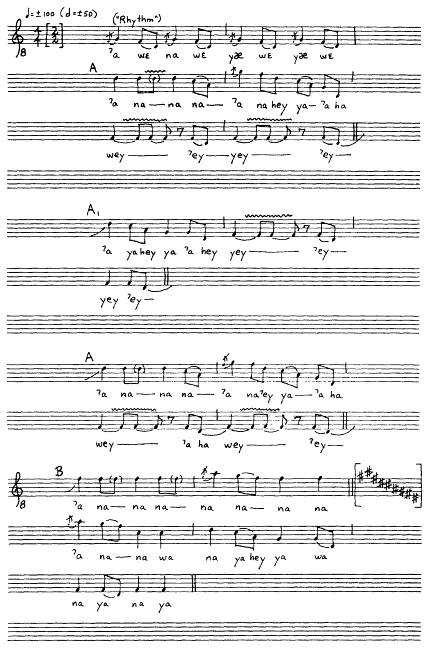
Example 16.
Kick Dance heavy song sung by Ewing Davis and recorded
by Mary Woodward in 1953.
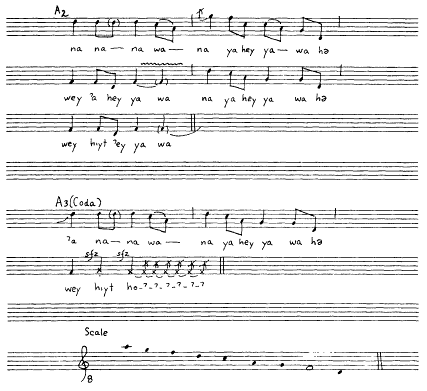
Example 16.
Kick Dance heavy song sung by Ewing Davis and recorded
by Mary Woodward in 1953. (continued)
isolation and fasting over a ten-day period (Kroeber 1925:45). The Karok ritual seems to have been less elaborate than that of the Hupa, but this impression may be due largely to lack of documentation on the ceremony.[21] Because the Hupa dance is more fully documented, the following description focuses on this version of the ceremony, which is now most commonly referred to as the "Flower Dance." The ceremony has not been performed often in recent years. I have never seen it, but I have been told that it was conducted on more than one occasion during the 1980s.
A Summary of the Flower Dance Ritual[22]
Upon her first menses, the girl was placed in the care of her grandmother or another close female relative. For ten days, she under-
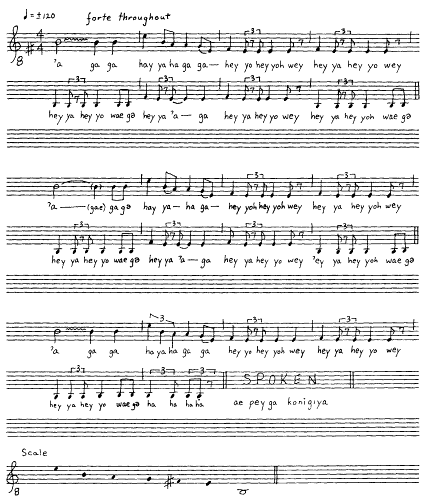
Example 17.
Kick Dance song sung by Frank Douglas and recorded
by Richard Keeling in 1979.
went special training during the day and was the object of a ritual held each night. During this period the girl was subject to many restrictions, because it was believed that she was undergoing a powerful process which was potentially dangerous for herself and others. She was not allowed to look anyone in the face, for example, lest that person might die.
It was also thought that her behavior during these ten days would
influence her destiny throughout life, and this belief led to a number of specific restrictions. Touching her hair with her hands, for example, might cause it to fall out; eating hazelnuts would give her bad teeth; if she lied or acted cranky, she would always be an untruthful person or a mean one; and even just to stumble while walking was believed to cause bad luck in the future. Thus, the girl's behavior was highly circumscribed and closely attended by those around her. In this state of heightened self-awareness she endured the ten-day period without water and fasting on acorn soup taken once each day.
The ritual began with a ceremony in which the older woman blessed the bark skirt that the girl would wear for her ritual bathing.[23] On this first night only the women dance, and on this occasion they beat time using hazel sticks such as those used for making basketry foundations.[24]
The daily bathing routine was strenuous, and it has been described somewhat differently in our two main sources. Both state that the girl bathed twice daily (once at dawn and again towards evening), and both also note that she did not actually "bathe" but rather only threw water over each shoulder alternately in a certain manner. Sam Brown stated that this was done at seven different places along the river before running back up to the house (Golla, in press), and he also mentioned that the girl is teased by younger children throughout much of the ceremony. Goddard's account stresses the physical demands involved, stating that the girl had to run back and forth more than once between the river and the house, and also notes that she had to go for a load of wood after bathing (Goddard 1903-1904:53).
The public ritual was conducted on the second night, and the Hupa name for it means "first menses stick shaking." Goddard describes the ritual as follows:
The dance is held in the pit of the xonta.[25] The girl, covered with a blanket, is placed in the northeast corner. Six men sit about the fire facing it. The first one has the broad woodpecker head-dress (such as worn in the Jump Dance). The next has a row of sea-lion teeth around his head, with the close-knitted kiseaqot hanging down his back. These head-dresses alternate around the circle. These men hold in their hands curiously shaped fiat pieces of wood. The other men wear caps. of buckskin with large bunches of trimmed feathers at the top. Long bands of buckskin, painted
in designs and terminating in a row of feathers, hang down the back. They carry in their hands sticks, five or more feet long and an inch and a half thick. These sticks are cut from syringa, Philadelphus lewisii . The top is split down about eighteen inches, making a number of parts which are worked down until they have plenty of room to rattle: the stick is painted in rings and has a fringe of bark left at some point.
Holding these sticks the men file in and stand in a close circle around the fire. The girl stands up but is covered with the blanket. The men sing a song, keeping time with their rattling sticks. When they have finished they march out, and the women, who have been sitting on the banks of the pit, sing songs of their own, tapping the girl with rattle sticks. The men return several times at intervals during the night and sing as at first. (Goddard 1903-1904:53-54)
Sam Brown's narrative corresponds rather closely to this description, but he also noted that the six men on the inner circle dance about the fire in a squatting posture, supported by short "walking sticks" that are held in their hands, They compete at this, mimicking animals; those wearing "hooks" imitate the movements of browsing deer,[26] and those wearing woodpecker "rolls" gesture like the woodpecker itself (Golla, in press).
On the tenth and final night, the ceremony is more elaborate and continues all night long. On all previous nights, the girl has stayed in the corner of the pit, but in this final ritual she is brought out to the middle of the dance area and is seated there, facing east. A blanket is held over her head and the men sing a special dance-ending song while tapping the blanket with their stick rattles. Finally, the girl emerges for one last session in the river followed by other concluding rituals held outside the family house.
Flower Dance Songs[27]
The musical style of Flower Dance songs is dramatically different from that of the other rituals described previously. The most obvious point of contrast is the musical texture, which is heterophonic and not polyphonic. This can be heard on two songs recorded by Margaret Woodward in 1953; in each of these examples, the accompanist (Jimmy Jackson) "trails" the soloist (Ewing Davis) and softly follows the line of the solo part with a sort of nasalized humming. This type of accompaniment was also noted as occurring in the
Brush Dance (example 9), but there it is only one of several options that occur and certainly not the most typical. In an actual Flower Dance, the accompanists would also mark each beat of the rhythm with their stick rattles, but this is not heard on the Woodward recordings.
Flower Dance songs are sung by men and women alike, and they are divided into two categories: heavy songs and light songs. The songs are said to have meaningful texts, often humorous or suggestive in character,[28] but the recorded examples available to me were sung mainly in vocables. All these songs are quite brief in duration (average 40-50 seconds) and the songs are sung rather softly in a relaxed voice lacking any trace of the "sobbing" delivery heard in other genres.
The song transcribed in example 18 is presumed to be a heavy song because Mr. Sherman sang it first in the group I recorded and because of its relatively slow tempo. It seems to be sung only in vocables.
This song is quite brief and the form is somewhat less complex than that of the other genres considered previously; here a single phrase is sung twice (section I), and then the first half of the phrase is repeated several times (section II).[29] In cantometrics terminology this would best be coded as a simple litany with moderate variation (Lomax 1968:58).
In other genres previously considered, the melodic range styles were generally quite wide, but the range of this Flower Dance song falls within a fifth. Moreover, the Flower Dance song is based upon a three-note scale, with much repetition of tones, and this tendency toward simpler scales is another characteristic that distinguishes the style from others described in chapters 5 and 6. Finally, one can always recognize a Flower Dance song by the ending pattern, which is sung softly in a falsetto voice.
The plain duple rhythm of example 18 is heard in other Flower Dance songs, but the one in example 19 is based on a sort of hemiola pattern. In this case melodic range (a major third) is even more narrow than that of the previous song, and again a three-note scale is used.
One example in this rather small corpus of Flower Dance songs was sung at a quicker tempo than the others. This presumably marks it as a light song, and the singer (Abraham Jack) identifies
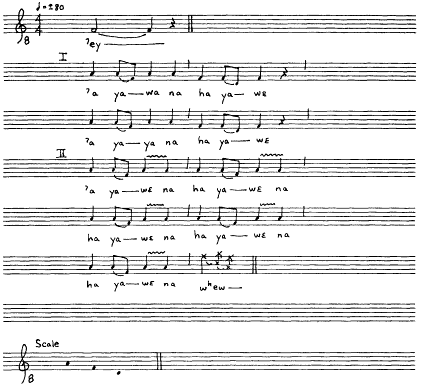
Example 18.
Flower Dance song sung by Herman Sherman, Sr. (Hupa) and recorded
by Richard Keeling in 1979.
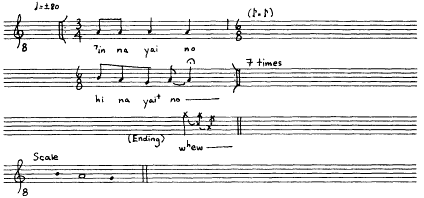
Example 19.
Flower Dance song sung by Herman Sherman, Sr. (Hupa) and recorded
by Richard Keeling in 1979.
it as a "hook-man's song" in a spoken cue on the tape. In other respects, example 20 is similar to the other men's Flower Dance songs notated above.[30]
In the demonstration recordings collected by Margaret Woodward in 1953, Lucinda Jack (Hupa) sang three Flower Dance songs. These may indicate a distinctive female style of singing in the Flower Dance, but it is entirely possible that the differences evident in these few examples are coincidental or a matter of personal style.
Like the men's Flower Dance songs, those of Lucinda Jack are brief (average 40-50 seconds) and sung rather softly in a relaxed voice. A basic 4/4 meter seems to predominate. In contrast, however, these songs each employ an anhemitonic pentatonic scale and a slightly wider melodic range. Moveover, the melodic form of these examples is clearly more complex than that of the other Flower Dance songs considered above. The one transcribed in example 21 has a melody which is strophic in form and rather intricate in the symmetry of its design.
The strophic song in example 22 is more complex yet. Here a two-part phrase is sung twice (section I), and this is followed by a contrasting motive and a sequential variant of it (section II). The opening phrase has an anacrusis of two eighth notes, the next anticipates the bar-line by one eighth note, and the last phrase begins right on the beat. Unlike the more spontaneous and impulsive style heard (for example) in Brush Dance songs, this Flower Dance song
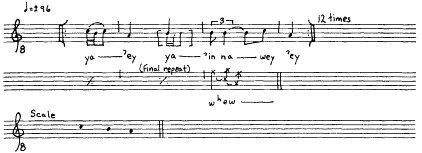
Example 20.
Flower Dance song sung by Abraham Jack (Hupa) and recorded
by Mary Woodward in 1953.
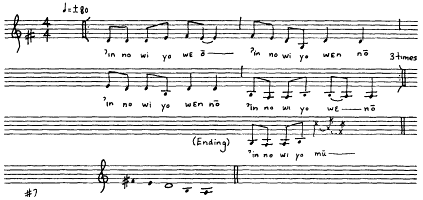
Example 21.
Flower Dance song sung by Lucinda Jack (Hupa) and recorded
by Mary Woodward in 1953.
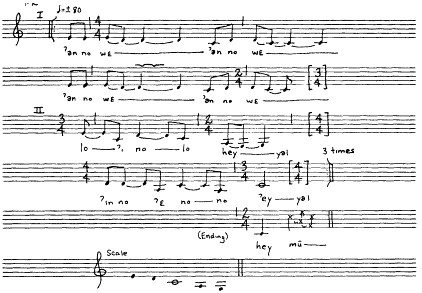
Example 22.
Flower Dance song sung by Lucinda Jack (Hupa) and recorded
by Mary Woodward in 1953.
gives the impression of being rather carefully calculated and precise in its delivery.
Finally, the song in example 23 is simpler and consists of two phrases standing in a sort of antecedent-consequent relationship. Still, there is a careful and static quality that distinguishes Mrs. Jack's Flower Dance songs from other forms of ritual music that have been discussed previously.
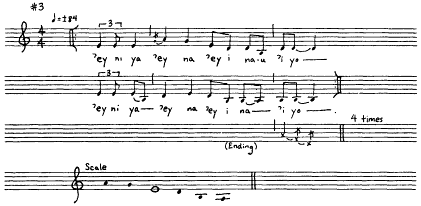
Example 23.
Flower Dance song sung by Lucinda Jack (Hupa) and recorded
by Mary Woodward in 1953.
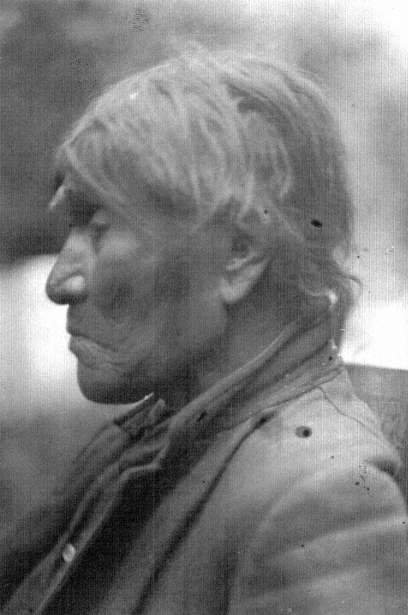
Stone of Weitchpec. Photo by Kroeber, 1907. (Courtesy Lowie Museum
of Anthropology, University of California at Berkeley)
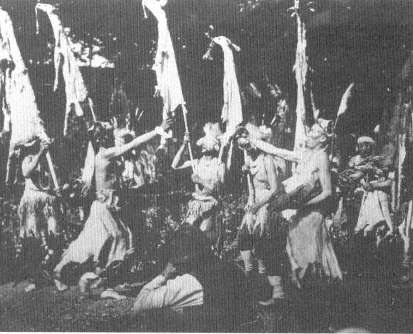
Hupa White Deerskin Dance. Photo by Ericson, 1890s. (Courtesy Lowie
Museum of Anthropology, University of California at Berkeley)
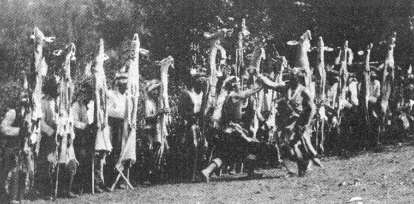
Hupa White Deerskin Dance. From postcard dated 1912. (Courtesy Lowie
Museum of Anthropology, University of California at Berkeley)
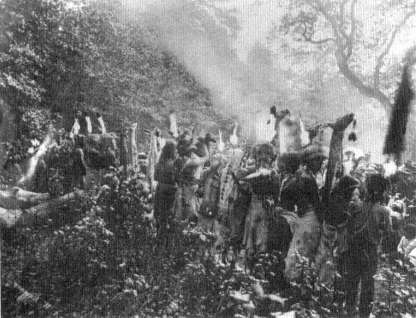
Hupa White Deerskin Dance. Photo by Ericson, 1890s. (Courtesy Lowie
Museum of Anthropology, University of California at Berkeley)
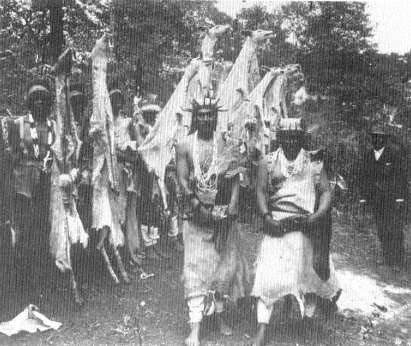
Hupa White Deerskin Dance. Photo by Ericson, 1903. (Courtesy Lowie
Museum of Anthropology, University of California at Berkeley)
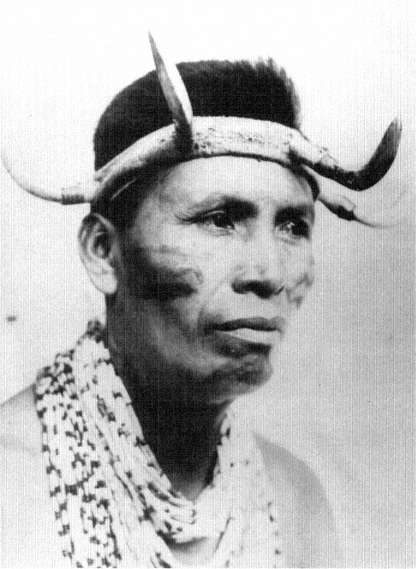
Robert Spott. (Courtesy Lowie Museum of Anthropology,
University of California at Berkeley)
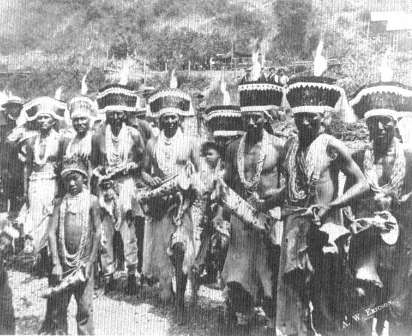
Hupa participants in the Jump Dance, held at the Yurok town of Pekwon.
Photo by Ericson, 1893. (Courtesy Lowie Museum of Anthropology,
University of California at Berkeley)
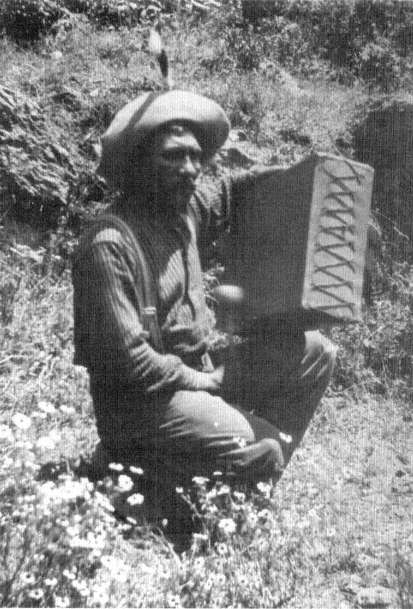
Domingo, with drum for gambling. Photo by Kroeber, 1906. (Courtesy
Lowie Museum of Anthropology, University of California at Berkeley)
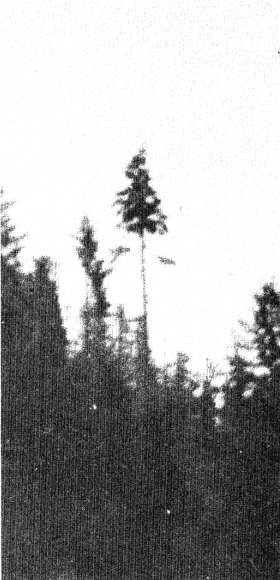
Tree trimmed for firewood that was used in ritual
sweathouse fire. (Courtesy Lowie Museum of
Anthropology, University of California at Berkeley)