
4—
"In Casting Accounts, Never Forget to Begin With the State of the Body":
Genetics and the Stephen Family Line
Now if there's any truth in Darwin,
And we from what was, all we are win,
I simply wish the child to be
A sample of Heredity
(James Russell Lowell to his goddaughter, Virginia Stephen, 1882)
The evidence for genetic transmission of manic-depressive illness is quite strong. If one identical twin has manic-depressive illness, the other runs a 67 percent chance of having it too, whereas a fraternal twin has only a 20 percent chance—roughly the same ratio as for many other inherited diseases. Of children with one bipolar or unipolar parent, 27 percent will be bipolar or unipolar themselves. When both parents have an affective disorder, and one of them is bipolar, 74 percent of offspring will suffer a major affective disorder.[1] Studies of manic-depressive offspring who had been adopted and separated from their parents show that more than 30 percent of the absent, biological parents displayed clear signs of the disorder, but only 2 percent of the adoptive parents did.[2] There is no relation between bipolar rates and rural-urban status, marital status, religion, or race.[3] Thus, the disorder is not primarily an environmentally induced or learned pattern ofbehavior.
Manic-depressive illness does not afflict every family member. Although some genes can cause disease almost 100 percent of the time, most require a specific bodily environment for expression, factors often created by other genes.[4] But it is important to remember that, whether or not some or all of these genes are ever expressed in behavior, they can be passed on to future generations, even by seemingly normal individuals. Recent studies have identified a gene implicated in the etiology of manic-depressive illness in some groups of individuals, and more are expected to be found in these and in other groups.[5] It is likely that several genes are involved (since several mechanisms and neurochemicals influence brain states) and that manic-
depressive illness, like diabetes, results from a number of different genetic combinations interacting with a number of bodily factors. Such genetic heterogeneity may also account for manic-depression's several phenotypes, various levels of severity, and myriad symptoms, as well as for its association with other disorders (alcoholism, generalized anxiety, cyclothymia, and schizo-affective disorder) with which it may share certain, but not all, genes.[6]
Who will inherit the disease and when the patient's normal mood will change are not yet predictable. Sometimes a breakdown is triggered by a stressful event, but many shifts of mood or even complete breakdowns cannot be traced, either by analyst or by patient, to an exterior or psychological cause. An event can activate a genetically determined, preexisting affective vulnerability, usually in the first few episodes, but once the disorder has been established, life events usually play little or no role in new breakdowns.[7] This may explain why manic-depressive illness can resemble a neurosis (initial appearance of illness following trauma), but in fact the central ingredient of neurosis—repression leading to symptom substitution—is missing. Biology, not psychodynamics, is the primary mechanism of predisposition; life events can trigger but not cause madness, and many breakdowns are initiated by purely biological changes. It is also possible that traumatic life events only appear to precede affective episodes, that breakdowns begin biochemically and subtly, skewing the patient's perception of and reaction to a subsequent event, causing him or her to misinterpret and magnify its causative power.[8]
It is commonly assumed that Woolf's breakdowns were always tied to specific events: the death of a loved one, the publication of a novel, or the anticipation of unfavorable reviews. It is true that when vulnerable to depression, she did react sensitively to criticism (just as Leslie did when he was depressed), but when the reviews of Jacob's Room appeared, she noted how little impact it had on her: "The reviews have said more against me than for me—on the whole. Its so odd how little I mind—& odd how little I care much that Clive thinks it a masterpiece" (Diary 2: 210). Quentin Bell reports that some traumas, such as Thoby's death, produced no illness (1: 61, 111). And Woolf herself records a series of depressions unrelated to any stressful event:
The interesting thing is that one does, normally, keep up a kind of vibration, for no reason whatever. Equally for no reason whatever, the vibration stops. Then one inquires why one ever had it, & there seems no reason why one should ever have it again. Things seem clear, sane, comprehensible, & under no obligation, being of that nature, to make
one vibrate at all. Indeed, its largely the clearness of sight which comes at such seasons that leads to depression. But when one can analyse it, one is half way back again. I feel unreason slowly tingling in my veins. (Diary 1: 298)
We have been to Rodmell, & as usual I come home depressed—for no reason. Merely moods. (Diary 2: 119)
Intense depression . . . which does not come from something definite, but from nothing. (Diary 3: 111)
I cant tell you how down in the mud and the brambles I've been—nearer one of those climaxes of despair that I used to have than any time these 6 years—Lord knows why. Oh how I suffer! and whats worse, for nothing, no reason thats respectable. (Letters 5: 67)
Unless we discount her veracity or the accuracy of her euthymic self-observation, we must conclude that Woolf was justified in not seeking a purely psychological cure.
Consequently, there need be no "reason," conscious or unconscious, why Virginia suffered a breakdown soon after her marriage to Leonard. Psychoanalyst Alma Bond, in typical Freudian fashion, ties these two events together thematically:
If one were to read only Virginia's diaries and the words of her family (i.e., Bell, that marrying Leonard was the wisest decision she was to make in her lifetime), one might be inclined to wonder why, during the honeymoon of this "happiest of marriages," the bride would suffer the most severe breakdown of her life.[9]
Virginia's diaries contain numerous references attesting to her contentment with and respect for Leonard. Since a bipolar episode can occur either randomly or in reaction to stress and does not reliably symbolize censored messages from below, it seems doubly reckless to discount Virginia's (and her family's and friends') own words. But, because Bond operates according to the Freudian theory that manic-depressives would not be sick if they were not already unconsciously lying to themselves, it is easy for her to dismiss any contrary evidence. In a like manner, Panken admits that "Woolf never acknowledged the possibility that her neurasthenia masked emotional disturbances" and then proceeds to ignore the possible truth of Woolf's position by presenting theory-driven conflicts as an explanation of why she fell ill.[10]
Genetically, Virginia Woolf's family history (see Figure 2) tallies with studies showing that relatives of manic-depressives are more likely than
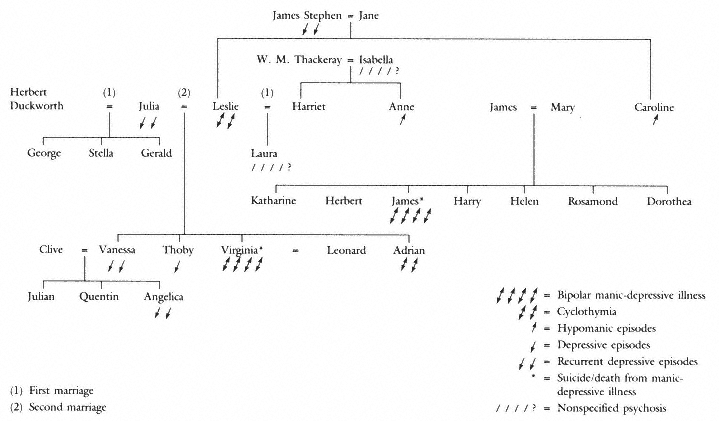
Figure 2.
A Partial History of Stephen Family Affective Disorders.
the general population to exhibit affective illnesses (mania, depression, cyclothymia, schizo-affective disorders).[11] Leslie's nephew, Virginia's cousin James Kenneth Stephen, developed bipolar symptoms in his late twenties, four years after a head injury. Switching between "violent states of excitement & states of utter apathy," each lasting some months, indulging in "childish and absurd pranks" that terrorized his friends, James gradually became so "wildly extravagant" in his behavior that he was unable, despite a brilliant career at Cambridge and prestigious family connections with the legal profession, to secure employment in government.[12] Virginia remembered her cousin's manic behavior:
That great figure with the deep voice and the wild eyes would come to the house looking for [Stella], with his madness on him; and would burst into the nursery and spear the bread on his swordstick and at one time we were told to go out by the back door and if we met Jim we were to say that Stella was away.
. . . He was mad then. He was in the exalted state of his madness. He would dash up in a hansom; leave my father to pay for it. The hansom had been driving him about London all day. . . . I suppose madness made him believe he was all powerful. Once he came in at breakfast, "Savage has just told me I'm in danger of dying or going mad," he laughed. And soon he ran naked through Cambridge; was taken to an asylum; and died. (Moments of Being 98–99)
In November of 1890 Dr. Savage warned James by letter that as his disease progressed he would spend and borrow money rashly, "buying useless things," "dress in unconventional ways," and consider having to repay his debts as "a grievance"—typical manic characteristics.[13] On November 21, 1891, James was institutionalized under emergency order at St. Andrew's Hospital in Northampton. He had been referred by his family doctor, Lawrence Humphrey, and was put under the care of the then medical superintendent, Dr. J. Bayley. James's brother, Herbert, told the admitting doctor that James had for three years "been subject to attacks of loss of self-control followed by fits of depression and inaction."[14] The attending physician diagnosed "extreme depression—almost mute," with previous episodes of depression "lasting some months followed by periods of unusual excitability. This morning [prior to his admittance to the hospital] (at home) threw a looking glass into the street and stood naked in the window. Believed there was a warrant out for his detention" for unspecified crimes. Nudity or sexual exposure occurs in 28 percent of manic patients,[15] and Victorian doctors, ever vigilant against sexual perversity,
took the symptom seriously. At admission James was described as "tall well built & muscular in good condition (inclined to be stout)." An eye exam revealed normal reaction to light, but his pulse was 104 and his complexion sallow. James stated that there was nothing the matter with him except that he suffered from constipation (a common depressive symptom),[16] for which he had taken opium but with no effect. Despite other medications and repeated enemas, James remained constipated for a week. He had the delusion that there was a plot against him. He struck out at an attendant and then fell into a "violent state of excitement & destroyed his furniture & clothes," after which he became unconscious. Thereafter James was depressed and quiet again, socially isolated, and neither medicines nor enemas could move his bowels satisfactorily for the next two months.
By January 1st James had improved, was almost cheerful, played billiards, and took regular exercise, but he relapsed on the 15th, becoming reserved and irritable, pacing about his room and refusing all food until he had to be fed by tube. He became incontinent, urinating in bed and in chairs, and gradually weakened from lack of nourishment, mumbling "It's too late." His pulse rose to 123, though his temperature remained at 98. Finally, he died on February 3, 1892. Dr. Bayley listed the cause of death as "mania, refusal of food, and exhaustion." In prelithium days, in-hospital deaths of manics were not uncommon. In one 1933 study, 40 percent of the deaths of hospitalized manic patients were attributed to "manic exhaustion," many of these compounded by refusal of food.[17] Summing up the case in a recent review of James's medical records, Dr. K. L. K. Trick, the current deputy medical director of St. Andrew's, concludes: "In modern terms it would seem that he suffered from Manic Depressive illness and this final episode was one of agitated depression with delusional ideas which gradually turned into a retarded depression with mutism and refusal of food."
James suffered from manic-depressive mood swings, but was their origin genetic, or were they a result of the head injury four years earlier? It is not certain how severe the physical trauma was. He was struck by a wind-mill sail that turned a pump, but he did not lose consciousness; he received a bad cut, which healed, but there were no reports of paralysis, amnesia, or aphasia from the five doctors (one of whom was the renowned neurologist Hughlings Jackson, and another Hack Tuke, the president of the Neurological Society) who examined him in 1890 and found him to be in good physical health with no discernible brain disease or damage
to his nervous system.[18] If the injury had been severe, unipolar mania could have resulted from an intracranial cerebral lesion, but James definitely shifted between mania and depression. In the absence of any neurological symptoms, it is more likely that the trauma only activated a genetic vulnerability for mood disorder that James had inherited from the Stephen family line.[19]
Leslie's unpredictable mood swings, although infamous among family members, were never severe enough to incapacitate him and were therefore most likely cyclothymic. Although milder than manic-depressive illness and sometimes called a "subsyndromal" mood-swing disorder, cyclothymia's chronically fluctuating moods (in short cycles, usually lasting no more than days) resemble manic-depressive mood swings but without frank psychotic episodes. Cyclothymic mood shifts range between irritable depression and high excitement, arrogant overconfidence and shaky self-esteem, creative spurts of energy and industry alternating with hypersomnolence and intellectual aridity. Family members often describe patients as "high-strung," "explosive," "moody," "sensitive," or "irritable." Cyclothymia is thought to involve predisposing genetic and biochemical components in common with manic-depressive illness: manic-depressives tend to have more cyclothymic relatives than the general population, and if one identical twin is manic-depressive, the other, if not manic-depressive too, is very frequently cyclothymic. Often cyclothymia appears as a "premorbid" precursor to full-blown breakdowns in manic-depressives, and lithium is beneficial to some 60 percent of cyclothymic patients.[20]
Leslie's symptoms were typical of the nonpsychotic mood swings of cyclothymia. According to his mother's diary, he was extremely volatile in childhood, "violent in temper" and erratic in health. He would burst into tears if reproached ("A word or even a look of blame puts him into an agony of distress") and hide in shame.[21] Even in his forties, he was hypersensitive to reproach, becoming depressed when his housekeeper "looked and spoke unpleasantly" to him.[22] Leslie's mother, Jane, found that her son was so sensitive that he refused to listen to "stories with unhappy endings."[23] Although he was at times "impetuous" and "turbulent," his mother noted, he could also become "abashed at a look and seems to have scarcely courage to ask for what he wants." Though "self-willed" and passionate, he could not "endure to hear of the boys being naughty or even the animals in a make-believe story."[24] He grew pale and distressed when he heard "of any suffering or sorrow." Jane
concluded that he was "the most sensitive child I ever saw" and that being reassured of her love gave him "peculiar pleasure," as did order:
"Leslie was rather amused with the stones at first, but when I had finished it, he told me he wished I would not read that kind of book that went wiggling from one subject to another; he liked a book that was more steady and settled, like that long thing (the 'Library of Entertaining Knowledge'); he liked to have a great deal on one subject and in regular order." Subsequent experience did not make him fonder of books that "wiggle."[25]
Throughout his life, the security of order and love reassured Leslie whenever he was depressed; he felt that his very existence depended on carefully insulating himself from the hostile, dangerous world (both inner and outer) created by his unpredictable black moods. When newly married to his first wife, Harriet ("Minny") Thackeray, he described himself in pathetic terms: "I feel like a frozen animal that has been taken in and thawed by benevolent people."[26] He responded to disorder—even seemingly trivial irritations, such as noisy children—as if it were an attack upon himself: "He was always overly sensitive about noise and disorder, feeling that they were somehow designed to make him personally uncomfortable."[27] Not surprisingly, Leslie coped with emotional disorder by combining these saving graces of love and order in family life:
Love for Stephen was a simple emotion. Passion, obsession, delusion could never steal upon him unseen, breed about his heart and possess him. The fascinating and alluring, and those attractions which are mysteriously generated by the temperament and physique, were alien to his nature and repelled him. Love meant devotion: to adore and to be adored.[28]
Leslie's depressions frightened him by distorting his judgment about the status of all he relied upon for security. He worried excessively about his health, the value of his work, and the family budget, though all were sound. When accounts were presented to him, he would "roar" and "beat his breast" and claim he was "dying." He suffered from extreme melancholy, guilt feelings, insomnia, hypochondria, and alternating constipation and diarrhea. When acutely depressed, he was haunted by "hideous morbid fancies" he knew to be "utterly baseless";[29] he believed that life was "ghostly, meaningless, and unreal," "a confused and purposeless mess of odds and ends," and that he was a "mere formless ghost." News of crop failures abroad sent him into "overwhelming worry," yet food would
appear to him as "a dingy, idiotic whity brown, with no vivid colour in it."[30] Describing himself as a "harmless misanthrope," he overworked himself to avoid boredom and loneliness, or he sulked in isolation in a "comatose" state, or he flew into violent rages, which he called his "Berserker Fits."[31]
But, typically, cyclothymics can shift quickly out of their bad moods and become happy and productive. When not depressed, Leslie worked and wrote well, felt healthy and climbed mountains, played with his children and loved life. Between 1865 and 1871 he had well periods in which he could write three or four articles a week, complete a six-thousandword essay at a sitting, and boast:"It is one of my weaknesses that I cannot work slowly; I must, if I work at all, work at high pressure."[32] Leslie could be "enchanting" when in the right mood. He delighted his children with animal stories and drawings, recited poems, and discussed literature with them. He saw them as beautiful and intelligent,[33] and he taught them that life could be exciting, as Virginia remembers:
On a walk perhaps he would suddenly brush aside all our curiously conventional relationships, and show us for a minute an inspiriting vision of free life, bathed in an impersonal light. There were numbers of things to be learnt, books to be read, and success and happiness were to be attained there. (Moments of Being 45–46)
When depressed, Leslie condemned himself as a pathetic failure, even though he was obviously an accomplished man. He had established a reputation as "a critic of literature and religion; a philosopher and historian of British thought; a biographer; a Cambridge tutor and Anglican clergyman; an alpinist and mountaineer; and an editor and author" who was knighted in 1902.[34] He had the courage to act on his convictions and resigned his church office, proudly wearing the label of agnostic in an age of fervent belief and conformity.
Thus Leslie came to be regarded by his family as two men: one was tough-minded, rational, persevering, and independent; the other was childishly insecure, irrational, excessively sensitive, and self-pitying. Virginia was well aware of her father's two personae: the public Leslie was strong, sensible, sympathetic, and resourceful, but the private paterfamilias grumbled, whined, worried, and howled. He was ashamed of his weaknesses. His insecurities, his needs, and his distemper he displayed only to his family, which, as a Victorian husband and father, he felt it was his right to do. But it earned him his family's rage as well as their pity.
Leslie was aware of his moodiness and tried to reassure Julia, in an 1887 letter, that his fits of ill temper and misery had nothing to do with her or with their marriage:
you know, I hope, that though you cannot give me a fresh set of nerves, all my tantarums [sic ] and irritabilities, & oaths & lamentations are (comparative) trifles; & that I have always a huge sense of satisfaction underneath.[35]
Although, like most depressives, he blamed himself for his weaknesses, he also likened himself to his own father, from whom he felt he had inherited components of his character:
I would sometimes awake in a fit of "the horrors"—in a state, that is to say, of nervous excitement and misery—with the erroneous impression that I had been awake for hours and a conviction that I should not get to sleep again.
. . . I am, like my father, "skinless": over-sensitive and nervously irritable. . . . I have so often forgotten things that have been told me, when I was more or less in this state, and declared by way of excuse that I had never been told, that it became a standing joke against me. I am inclined too to be often silent. . . . At the time of my nervous depression in particular I became fidgety and troublesome in a social point of view.
. . . My humours and vagaries were part of my character and, though many men are far better than I, I could not become another man. This at least I can say. My irritability implied nothing worse. I have been led to speak this way only because in my morbid state, when my own shortcomings have risen up before me, I have tried to disperse them by recalling the reality.[36]
Indeed, in prelithium times he could not become another man or change his "nerves," but at the same time Leslie's response to his disorder was not in his family's best interests. It sensitized Virginia to the whole issue of just what rights and duties family members had to each other, sick or well.
Leslie was right to compare himself to his father, the gloomy, selfmortifying, "intensely pessimistic," workaholic Sir James (1789–1859), who suffered from recurrent but unipolar depression[37] Sir James had at least three major nervous breakdowns, in 1824, 1832, and 1847, the last of which was so severe that his doctors and close friends advised him to retire early from his post as under-secretary of state at the Colonial Office.[38] In a March 3, 1841, letter to his wife, the normally stoic Stephen, who
was so convinced of his ugliness that he could not bear to look into mirrors, described the "bad thoughts" that threatened him with dissolution:
Living alone I am sometimes oppressed by myself. I seem to come too closely into contact with myself. It is like the presence of some unwelcome, familiar, and yet unknown visitor. This is a feeling for which I have no description in words. Yet I suppose everyone has now and then felt as if he were two persons in one, and were compelled to hold a discourse in which soliloquy and colloquy mingle oddly and awfully.[39]
In another letter, written in February, 1853, he again failed to find adequate words to express his sense of blank depression, though he did tie it to a loss of self-esteem:
What a strange thing it is that the blank of downright helpless inaction should be so very dismal a blank! Why can't one go quietly and contentedly through a fit of nothingness? Because it is not mere nothingness, but a wretched revelation to oneself what a bankrupt one is the moment one cannot draw any longer on things without.[40]
Like Leslie, Sir James had a "naturally ascetic turn of mind" and an obsession for ordering inner chaos with "systematic and clearly articulate . . . thought," insisting upon "the utmost precision of language." Both father and son were haunted by the fear of penury, and both wrote selfconsciously about their nervous condition: "My mind," Sir James noted in a March, 1847, letter, "is as sensitive as my eyes, and as soon pained, irritated, and darkened by any kind of glare." Like many agitated depressives, he was especially vulnerable to criticism, to being proved wrong, under which he "suffered so much" that his friends quietly avoided questioning his judgment; he, in turn, "dreaded" the thought that his very presence "cast a gloom over others."[41] Although he was nicknamed King Stephen by his colleagues, and, with Sir Henry Taylor, "virtually ruled the colonial empire" during some momentous years in British history,[42] he was so shy that he developed "a nervous tick" in his eyes, which deceived one stranger into thinking Stephen was blind. Sometimes he stared at the ceiling, "with a dreamy, far-away look," while talking to others. He was "scrupulously neat in dress, and even fanatical in the matter of cleanliness," but he moved awkwardly and was manually incompetent, cutting himself repeatedly with a razor and struggling even to tie his shoes.[43] Depression sapped him of both finesse and self-esteem.
We also know that Leslie Stephen's first daughter, Laura (Virginia's half-sister), was born prematurely on December 7, 1870, and was institutionalized from the early 1890s until she died of intestinal cancer on
February 9, 1945, at The Priory Hospital, Southgate. Hospital regulations on patient privacy prevent The Priory from releasing any details from Laura's medical records. All information on her comes, therefore, from family members, who viewed her condition as either psychosis or mental retardation. The variance of these reports may have been due to differing opinions given by different doctors. Nineteenth-century physicians often misdiagnosed affective disorders, schizophrenia, and infantile autism as retardation because mood, metabolic, and thought disorders interfere with attention, cognitive performance, and memory; indeed, Victorian psychologists considered retardation "a fundamental characteristic of depressive mood."[44] Furthermore, the sentimental Victorians preferred to think of abnormal children as retarded rather than insane, as babyish rather than psychotic, and Leslie apparently shared this popular belief. His description of Laura confuses mental deficiency and insanity: he refers to her as "obviously a backward child" and "mentally deficient," but he also notes her "strange waywardness and inarticulate ways of thinking and speaking," regressive behavior his biographer Noel Annan specifies as "babyways and apathy."[45] Laura could do "disconcerting things—calmly throw a pair of scissors into the fire,"[46] sing nonchalantly when Leslie tried to get her attention, stare "vacant-eyed" (Moments of Being 182), complain of choking throughout her meals, or spit the meat out of her mouth.
Laura developed no overt problems in the first five years of her life, although Leslie had noticed some subtle (but unspecified) indications that his daughter was developing too slowly. She was sent to kindergarten, but the school's mistress told Leslie that Laura "would never learn to read." He tried to teach her himself, but she succeeded in reading only "after a fashion";[47] in 1921 Virginia said that Laura "could hardly read" (Moments of Being 182). When she was a teenager, Laura suffered from nervous tics and speech impediments. Her learning difficulties, her "strange mannerisms" of straining and boggling over words in a "lockjaw way of talking," her "spasmodic" utterances and "queer squeaking" caused the short-tempered Leslie to complain about her "sluggishness" and call her an "idiot" (as did Virginia Woolf [Moments of Being 182]), but he also reported that at times she could be an exceptionally verbal child, talking quickly ("as fast as a pack of hounds"), noisily, and persistently. Sometimes she made irrelevant remarks with "the most provoking good temper," but she could fall unexpectedly into tantrums of wild howling. Her father was particularly alarmed by her "grotesque waywardness," "perversity," and lack of "moral sense"[48] —although, ever the Victorian gentleman, he did not illustrate such observations with specific examples. This is
unfortunate, since even today affective disorder in adolescents is frequently mistaken for conduct disorder if symptoms are not adequately specified.[49]
But what kind of mental illness was this? In his family memoir, Sir Leslie Stephen's Mausoleum Book, Leslie wrote of his suspicion that Laura had inherited her maternal grandmother's insanity: in 1840 Isabella, William Makepeace Thackeray's wife and mother of Leslie's first wife, Harriet, fell into a postpartum psychosis from which she never recovered. Although she had always been "eccentric" and notoriously absent-minded, it was only after Harriet's birth that Isabella began to suffer from "an extraordinary state of languor and depression" and constipation.[50] Then she began to alternate: on some days she seemed better, on others much worse. Periods of normalcy were recurrently succeeded by "the usual reversal"—weeks when she seemed nearly recovered followed by episodes of excessive violence.[51] William noted immediately that her mental state was unstable: "at first she was in a fever & violent; then she was indifferent, now she is melancholy & silent." Soon she switched between sluggishness, agitation, and moments of happiness, but was "especially" and "curiously" low in the mornings—a common feature in biochemical depression. She experienced difficulties with concentration, complaining in a letter that she lost her train of thought ("I feel myself excited [,] my strenght [sic ] is not great and my head flies away with me as if it were a balloon"—a confusion William also noted: "she has been clouded & rambling again"; "she knows everybody and recollects things but in a stunned confused sort of way." She apologized for her dark thoughts but at the same time asserted their truth: "I try to think my fears imaginary and exaggerated and that I am a coward by nature, but when people do not raise their expectations to too high a pitch they cannot be disappointed." Then she attempted suicide by throwing herself overboard from a ship.
She subsequently lost interest in her new baby and in the rest of the family. William noted that at times she was "devoured by gloom" and wept over faults and past mistakes.[52] She thought herself "a perfect demon of wickedness—God abandoned," in a period of acute despair that progressed from "apathy to fits of rambling gloom, wallowing in a 'moral melancholy', deploring her own unworthiness, thinking she had entailed all manner of misery on her husband, that she never had been fit to be a wife."[53] William concluded that Isabella's melancholy had "augmented to absolute insanity," leaving her "quite demented."[54]
After much care and many treatments, Isabella's episodes became less severe, as William writes:
There is nothing the matter with her except perfect indifference, silence and sluggishness. She cares for nothing, except for me a little, her general health has greatly improved: her ideas are quite distinct when she chooses to wake from her lethargy. She is not unhappy and looks fresh, smiling and about sixteen years old. To-day is her little baby's birthday. She kissed the child when I told her of the circumstance, but does not care for it.[55]
Eventually, Isabella settled into "gentle, childish ramblings" and a daily routine of simple domesticity, socially withdrawn and unconcerned with thoughts of her family. She lived for thirty years after William's death in 1863, maintaining "the same placid, retired life," unable to recognize her grandchildren as her own.[56]
If Isabella did suffer, as seems likely, from a psychotic depression triggered by the major changes in hormonal levels brought about by childbirth,[57] then both sides of Laura's family had a history of affective illness, which dramatically increases the odds for the daughter of such a union to suffer from some form of it as well. Leslie noted that by the time she was in her early twenties Laura, like Isabella, was unable to recognize her family clearly.[58] In 1921 Virginia wrote to Vanessa that Laura's guardian, Katharine Stephen, had visited the fifty-two-year-old patient in the asylum and reported that she "is the same as ever, and never stops talking, and occasionally says, 'I told him to go away' or 'Put it down, then', quite sensibly; but the rest is unintelligible" (Letters 2: 492). This is not the typical family profile of mental retardation, which would not, at any rate, oscillate so markedly in severity. Nor does it support DeSalvo's alternate view that Laura was actually sane, her learning disabilities and strange behavior merely a "refusal to use her mental abilities" at the behest of an abusive father who wanted to control her, and that she was imprisoned in a mental asylum for over fifty years because Leslie wanted to punish her for misbehaving.[59] DeSalvo reads Leslie's confused rendering of Laura's problems as a deliberate obfuscation of the facts. But we must remember that even Victorian specialists frequently conflated the symptoms of what we now know to be different disorders, and Leslie's own doctor, George Savage, publicly espoused the belief that "an insane parent may have an insane, idiotic, wicked, epileptic, or somnambulistic child," as if all those traits were genetically connected.[60] Given Savage's views, even Minny's death by "convulsions" (probably eclampsia caused by complications during pregnancy, rather than epilepsy) would have suggested to both men that an inherited link existed between Isabella's disorder and Laura's.
Leslie's conclusion was theory-coherent for the times. His lapses prevent us, however, from establishing a firm diagnosis—Laura's symptoms occur with several brain disorders, including the childhood psychoses and autism—but we can at least avoid the temptation of dismissing Leslie's or Julia's testimony altogether for the sake of a conspiracy theory that spans over fifty years of medical supervision and the deaths of both parents and the admitting doctor. Diagnosis aside, Leslie's observations were probably accurate; at least one study shows that parents of psychotic and autistic children do usually succeed at estimating in general, nonpsychiatric terms the abilities and disabilities of their offspring.[61] And recent history provides abundant evidence that parents of children with psychotic, autistic, or developmental disorders have been unjustly and cruelly victimized by those who seek simplistic answers—indeed, the simplest answer of all, that someone must be blamed for abnormality in children. Unless biological mechanisms can beyond a reasonable doubt be eliminated as the cause of a child's mental problems—especially when those symptoms appear in disorders known to be biologically based and unconnected to childrearing practices—blaming the parent is merely a witchhunt masquerading as science.
Leslie's second wife, Julia, herself exhibited chronic depressive symptoms (as I will explore in more detail in Chapter Five), and their children were also afflicted with varying levels of affective disorder. Both Virginia's brothers, Adrian and Thoby, had episodes of depression, as did her only full sister, Vanessa. In 1894 Thoby reportedly attempted suicide during delirium induced by influenza; he died of typhoid in 1906.[62] Adrian's much longer life gives us a more complete picture of chronic, nonpsychotic depression. Leonard and Virginia described him as being "extremely lethargic and critical," "passive, inert, depressed and aloof" (L. Woolf, Letters 531), always looking on the dark side (V. Woolf, Passionate Apprentice 192), needing "constant reassurance," lacking in vitality, subject to "tantrums," having had his life "crushed" out of him before he was born, "moping & glooming" and dwelling too much on the past (V. Woolf, Diary 1: 187; 2: 186; 2: 277; 3: 227; 4: 103). Vanessa was intermittently crippled by severe depressions, "different in effect but not perhaps unrelated to Virginia's instability," and her only daughter, Angelica, was hospitalized for severe depression.[63] Across three generations, then, we find five depressives, two nonspecific psychotics, two manic-depressives, and one cyclothymic: an impressive display of familial pattern.
Why should there be such diversity? Affective disorders are not genetically identical, just as they are not biochemically identical, but they do tend
to appear in the same families, and so they must have some genetic components in common that combine in various ways in different individuals. With the exception of identical twins, each individual receives from the parents a different combination of mood-disorder genes. Some combinations produce the various forms of manic-depressive illness, and others produce related mood disorders: pure mania, pure depression, cyclothymia, and schizo-affective illness, all of which can vary markedly in severity. None of Julia's three children (two sons, Gerald and George, and a daughter, Stella) by her first husband, Herbert Duckworth, showed any signs of affective illness, but since Julia herself suffered from chronic depression, we can assume that her own mood-disorder genes contributed to or abetted Leslie's in their children, all of whom displayed depressive symptoms.
An individual's genetic make-up is a complicated business, for it combines selected genes from each parent, neither of whom may display the full range or strength of the characteristics they pass on to their children. A gene coded for mood disorder may be either abetted or inhibited by the addition of other genes in the formation of each new human being. Genes are switches and may be turned either on or off, permanently or temporarily, by the presence of other genes or by even smaller nucleotide switches within the gene's DNA.[64] It is therefore possible that what Jane (who was not ill) bequeathed to her son Leslie was an inhibiting gene that prevented full-blown manic-depressive illness in him, a gene which may either not have been passed on to Virginia or have been switched off in her by a gene contributed by Virginia's mother, the depressive Julia. Julia's predisposition to depression may in turn have been switched off in her first three children by Herbert's genes.
Because manic-depressive illness is more readily passed from father to daughter or from mother to son and daughter than it is from father to son, it has been hypothesized that in some families one of possibly several primary genes responsible for predisposing individuals to full-blown bipolar illness is transmitted via the female sex chromosome.[65] If this sex-linked gene was involved in Virginia Woolf's illness, then the likelihood would be that Leslie had inherited only non-sex-linked mood-disorder genes from Sir James (enough to contribute to his cyclothymia, his father's depressions, and Laura's mental difficulties, but not enough to produce frank manic-depressive illness in any of the three).[66] According to this model of inheritance, the missing sex-linked gene, by itself insufficient to produce illness, might have come from his mother, Jane, to augment the Stephen family genetic code loaded for mood disorders.
Thus, two routes for Virginia's inheritance are possible: Leslie's and Julia's genes may have combined to cause frank bipolar disorder in Virginia, or Leslie could alone have transmitted a full complement of genes to Virginia even though he himself suffered only the milder but related cyclothymic mood swings. Again, it is important to remember that, like most genes, mood-disorder genes do not have complete penetrance (the percentage of cases that carry the gene who do in fact show its effect in any degree); that is to say, only a minority of those who inherit these genes ever exhibit full-blown manic-depressive illness. Pure mania, pure depression, cyclothymia, and schizo-affective illness can occur in separate individuals in a family that later produces a manic-depressive. Thus, whereas 66 percent of bipolar patients have a family history of mood disorder, only 15 percent of them have a bipolar parent. Thorough family studies are needed to determine the distribution and degree of risk of inherited mood disorder.[67] Anyone worried about the chance of inheriting an affective disorder should seek genetic counseling. Generic mechanisms produce the great variability that is essential for evolutionary adaptation and survival, but they complicate questions of inheritance.