
The Organization of Big-Business Interests
There are organizations in the United States—the Chamber of Commerce of the United States and the National Association of Manufacturers—that are comparable in name to Japan's major economic federations, but they
[41] In August 1974, Keidanren announced that it would no longer serve as a channel for political contributions by big business to the LDP
do not perform the same functions. Japan's economic organizations are more comparable to several European organizations. They have historically provided an important mechanism for the representation of Japanese business interests and an organizational focus for zaikai activities.
The historical development of economic organizations in Japan is similar to that in Western countries.[42] By the end of the nineteenth century all of these countries had established Chambers of Commerce. With the First World War, each established a specifically industrialist organization, and after the war there was a general restructuring of economic organizations in Japan, Germany, Italy, and France.[43]
One difference between Japan and European countries is that Japan was some twenty years behind Europe in the development of an organization of businessmen to deal specifically with labor problems. Another difference is that there traditionally has been, and still is, a rather clear separation between Japanese economic organizations that represent big business and those that represent small and medium-sized enterprises. This is in part a reflection of the dual structure of the Japanese economy, and is in contrast to the situation in many European countries where economic organizations represent all industry. A further difference is that whereas European economic organizations have strong and active local branches, the most powerful economic organizations in Japan have little or no organization on the local level.
Government sponsorship of capitalism in the Meiji period was mirrored in the history of the development of Japan's first economic organizations. The first Japanese businessmen's organization, the Chamber of Commerce, was formed at government request and with government financial assistance; it was given legal status and served as a government advisory council.[44] This history is not as unique as it may seem; in Germany and other continental European states, early Chambers of Commerce served to some extent as semigovernmental organs. In the United States, even though the Chambers were originally local, purely private organizations of businessmen, the creation of the nationwide Chamber of Commerce was
[42] For a concise comparison of Japan's economic organizations with European and American ones, see Keidanren, Keizai dantai rengokai[*] zenshi [Comprehensive history of the Federation of Economic Organizations] (Tokyo, 1962), p. 323.
[43] The first industrialist organizations in western Europe, the United States, and Japan were all created within a ten-year period from just before the outbreak of World War I: The Italian CGII (Confederazione Generale dell'Industria Italiana) was founded in 1910; the American Chamber of Commerce of the United States (which despite its name represented industrialists as well as merchants) was created in 1912; the British FBI (Federation of British Industries) in 1916; the Japan Industrial Club in 1917; and the German BDI (Bundesverband der Deutschen Industrialler) in 1919.
[44] For an excellent study of the emergence and development of the Chamber of Commerce in Japan, see Nagata Masaomi, Keizai dantai hatten shi [History of the development of economic organizations] (Tokyo, 1956). Important documentary material on the origins of the Chamber are included in Nihon Shoko[*] Kaigisho, Meiji hyakunen to shoko[*] kaigisho 90 nen no ayumi [One hundred years from the Meiji Restoration and ninety years of the Chamber of Commerce and Industry] (Tokyo, 1968).
promoted largely by President Taft, and invitations to the first meeting of the CCUS went out with President Taft's signature.[45] Furthermore, although the Japan Chamber of Commerce was founded with considerable government intervention, the Japan Industrial Club in 1917 and the Economic Federation in 1923 were founded on the initiative of the business community without government participation. Government involvement in the establishment of the Chamber of Commerce was important, however, because it did set a pattern for Japanese economic organizations to serve an advisory role to government. That pattern was adopted by later organizations and established itself in the activities of postwar organizations as well.
The history of development of economic organizations in Japan is first of all a history of the inability, despite the effort, to create one comprehensive economic organization. In a rather ironic comment on the view that the Japanese economic community is a united force, the authors of Keidanren's history of economic organizations in Japan asked in dismay, "Is the constant cycle of splintering and reunification and splintering again the inescapable fate of Japan's economic organizations?"[46] Indeed, the history of these organizations is the history of a constant shifting of power from one organization to another and the creation of several, somewhat competitive, so-called comprehensive organizations. There is no organization that represents the business community; there are several organizations that represent different elements within it.
A second factor in the history is the formation of a separate organization to handle labor problems. The first such organization was Zensanren (Zenkoku sangyo[*] dantai rengokai[*] ), founded in 1931. Its present-day successor is Nikkeiren. Keidanren does not deal with labor problems.
A third important factor in the historical development of Japan's economic organizations is that the postwar reorganization of prewar institutions was undertaken in a period when the country was in a state of physical collapse, economic chaos, and a social revolution being guided by an alien occupation force. The structure and the purposes of the newly created economic organizations were profoundly influenced by and were in response to a unique and temporary situation. Japan's postwar economic organizations have had to adapt to, or be rendered irrelevant by, the dramatic changes that have affected Japan's society and economy in the quarter century that has passed since their creation.
The organizations Japanese refer to as the keizai yon dantai , the four organizations of the economic community, are Keidanren, Nikkeiren, Keizai Doyukai and Nissho (the national Chamber of Commerce and Industry of Japan). These organizations comprise the major institutions for the representation of Japanese business interests. Among them, Keidanren is the most powerful and prestigious.
[45] Keidanren, Zenshi , p. 9.
[46] Cited in Zaikai tenbo[*] . p. 12.
Keidanren was originally founded as a comprehensive economic organization with a mandate—largely at the insistence of the American Occupation—to pay special attention to the interests of small- and medium-sized enterprises.[47] However, by 1952 Keidanren had become a spokesman for big business interests, and the constituent organizations representing small business, led by Fujiyama Aiichiro[*] , bolted the organization. Since that time, Keidanren has developed an impressive organizational structure to serve the interests of its membership of 110 industrial, commercial, and financial associations and 739 leading corporations encompassing virtually all the major businesses in the country.
Keidanren strives to mobilize consensus within the business community and influence the government to adopt policies that are responsive to industry's wishes. To accomplish this, it has established an elaborate structure of committees to examine questions of concern to the business community and has created a number of mechanisms for ensuring that business views get fully represented to government.
Keidanren's thirty-seven committees cover the entire span of economic issues, both domestic and foreign, and are chaired by leading businessmen. The committee staffs stay in constant contact with lower- and middle-level bureaucrats in relevant government ministries.[48] In the case of Keidanren, this means primarily MITI. There is constant communication, exchange of documents, and meetings between Keidanren staff members and MITI bureaucrats. There are also regular meetings of Keidanren's leadership with top-level bureaucrats and cabinet ministers. Between August 1971 and May 1972, for instance, there were twenty meetings with top-level bureaucrats: four from the Finance Ministry (MOF), five from MITI, four from the Foreign Ministry, two from the Self-Defense Agency, one from the Construction Ministry, three from the Justice Ministry, and one from the Agriculture Ministry. Between July 1971 and May 1972, there were fifteen meetings with cabinet ministers: three with the prime minister, four with the finance minister, three with the MITI minister, two with the head of the Self-Defense Agency, one with the head of the Science and Technology Agency, one with the minister of transportation, and one with the construction minister. Between August and December 1971, there were also seven meetings with LDP party leaders which dealt exclusively with discussions of the tax sections in the draft of the following year's annual budget. There were no meetings with LDP leaders recorded in the schedule for the period from January to July of 1972.[49]
[47] For the early postwar history of Keidanren, see Keidanren, Keidanren no 20 nen [Keidanren's twenty years] (Tokyo, 1969) and Keidanren, Zenshi , pp. 490–505, 765–785.
[48] For an English-language description of Keidanren's organization and activities, see the pamphlet published by Keidanren, Keidanren, Japan Federation of Economic Organizations (Tokyo, 1972). In Japanese, see Keidanren, 20 nen ; Akimoto Hideo, Keidanren (Tokyo, 1969); and Yomiuri Shinbunsha, Zaikai (Tokyo, 1972), pp. 51–94.
[49] Compiled from the monthly reports of Keidanren activities contained in Keidanren geppobar; , July 1971–July 1972. "Top-level" bureaucrats, as used here, refers to people at the bureau-chief level and above. Another writer giving figures for the period from July 1970 toJune 1972 suggests that the number of top-level government officials was somewhat greater than the data in Keidanren geppo[*] revealed. According to his figures, the source of which is not indicated, top-level government officials (including cabinet ministers) were invited to Keidanren seventy times. MITI officials were the most numerous, visiting twenty-three times; Foreign Ministry officials were next at thirteen visits; and Finance Ministry officials made twelve visits. The rest were from the Economic Planning Agency, Ministry of Transportation, Science and Technology Agency, Ministry of Agriculture, Ministry of Construction, and the Ministry of Justice. See Yamamoto, Keizai kanryo[*] , p. 70.
Most of Keidanren's activities relate to economic issues of direct and immediate concern to the business community. The representations it makes to the government are concerned almost exclusively with concrete economic issues such as tax rates, international monetary policy, and liberalization policy.
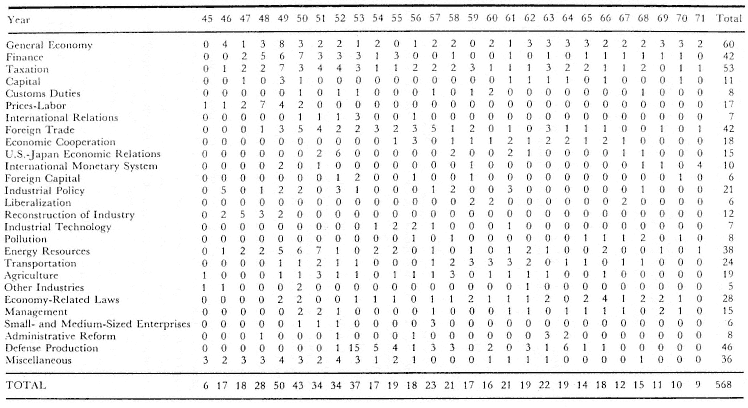
Keidanren regularly issues various proposals, "requests," and "demands" to the government. Since 1954, as indicated in the accompanying table, Keidanren has issued about twenty such resolutions a year.[50] Changes in emphasis over the years reflect both changes in the economy and in Keidanren's organization. The absence of resolutions on labor policy or reconstruction after 1950, for example, reflects the division of responsibility between Keidanren and Nikkeiren from that time and the boon to Japanese industry brought about by the Korean War. The fact that resolutions concerning liberalization did not appear until 1959, and those concerning pollution until 1965, mirror patterns of postwar economic development in Japan. Needless to say, the fact that there were as many resolutions concerning the international monetary system in 1971 as there were in all the years up to 1967 is a fitting comment on the big-business community's concerns in the early 1970s.
The categories most often represented in the resolutions give an idea of the kinds of issues about which consensus within Keidanren is most successfully achieved. There are six categories in which Keidanren has issued more than thirty resolutions in its history (leaving aside the miscellaneous category). One of these categories is the economy in general, which refers mainly to such matters as forecasts concerning economic growth and the rate of inflation. Another is finance, which includes comments on government fiscal policies and the opinions Keidanren submits to the minister of finance each year on the new government budget. The Confederation of British Industries and other comparable European economic organizations also engage in the latter practice vis-à-vis their governments. The other well-represented categories relate to taxation, foreign trade, energy resources, and defense production. The largest number of defense-related resolutions in 1953 was in response to the establishment of the defense agency and the new emphasis on domestic weapons production.
[50] Data compiled from information contained in Keidanren, 20 nen , for the period up to 1968, and in Keidanren geppo for the period from 1968 to 1972.
|
At several points in the postwar period, Keidanren has joined together with other economic organizations to issue joint resolutions intended to bring the full influence of a united business community to bear on the government and political parties on essentially noneconomic issues. Among the resolutions listed in the miscellaneous category are eight that deal with political issues, six of which were issued jointly by the four economic organizations. However, seven of these either preceded or came at the time of the conservative party merger and were calls on the political leadership to establish political stability. The eighth was issued during the security treaty crisis in June 1960 and was a call for the protection of parliamentary democracy and the re-establishment of international trust.
The four organizations have joined together on other occasions as well to try to influence the course of political developments. The most famous incident perhaps was the demand by the four organizations' leaders in September 1956 that Prime Minister Hatoyama resign before going to the Soviet Union to sign the normalization agreement. Hatoyama did not take their advice.
The most recent example of a zaikai effort occurred one day after Tanaka became prime minister. On July 6, Kikawada, Uemura, Nagano, Sakurada, Doko, and Imazato called on Tanaka and presented a "request" (yobosho[*] ) of five articles.[51] The five articles called for the establishment of a political posture that would regain the people's faith, the establishment of strong political leadership, recognition and acceptance of Japan's international responsibilities, and creation of national solidarity. The fifth article called for a strong party structure. This meant overcoming factionalism and the deep split in the party caused by the Tanaka-Fukuda fight for the party presidency. "All efforts should be expended to discard small differences and in union improve the party and overcome the crisis" is the group's explanation of the meaning of the five articles.[52] As Nagano put it, "We are hoping for dynamic politics based on party unanimity."[53]
Such a representation by the leaders of the business community has no parallel in American society. For the business leadership to make demands on the political posture of the new prime minister, even before he had completed the formation of his cabinet, surely seems excessive, at least to an outside observer. But the meaning of the representation in terms of the exercise of political influence is not easy to discern. Obviously, if zaikai had been as powerful as sometimes alleged, Mr. Tanaka would not have
[51] Discussed in Saji Toshihiko, "Zaikai wa do[*] hyoka[*] suru ka" [How we should evaluate the zaikai ], Chuo[*] koron[*] , September 1972, p. 116. Kikawada, Uemura, Nagano, and Sakurada are the heads respectively of Keizai Doyukai, Keidanren, Nissho, and Nikkeiren. Doko is chairman of the board of Toshiba and Imazato is president of Nihon Seiko. Both are active leaders in Keidanran.
[52] Saji, "Zaikai wa do hyoka suru ka," p. 127.
[53] Ibid., p. 122.
become prime minister and the representation would not have been made in the first place.
The evidence available suggests a number of things about the operation of Keidanren. First of all, Keidanren is an organization concerned with economic matters of general interest to the business community. It is much more vital a meeting ground for Japanese business than is either the National Association of Manufacturers or the Chamber of Commerce for American businessmen. But in its organization and activities it is not unlike economic organizations in Europe. What distinguishes Keidanren from these European organizations is not the nature of its activities but the thoroughness with which it engages in them. Committee meetings involving the leaders of big business, study groups, lectures, speeches by government officials, meetings of trade and industrial associations, parties for visiting dignitaries, and the like occur on a daily basis.
Second, Keidanren's power as a consensus-mobilizing mechanism is exercised within a relatively limited issue area. It is able to mobilize a consensus of the entire business community, to "harmonize" the views of business leaders on the relatively small number of issues that do not involve conflicts within the business community itself. Keidanren has no magic formula for mobilizing a community consensus on issues about which the business community disagrees. Furthermore, the number of resolutions that Keidanren is able to generate each year conveys an exaggerated sense of consensus. Many of its resolutions are the product of such broad compromise that they emerge at a level of generality that largely undercuts their possible influence on government policy.
It is also true that consensus within Keidanren does not necessarily represent consensus within the big-business community. In discussing Keizai Doyukai's role, Keidanren's president Uemura remarked: "Sometimes they cause us trouble because after we go through the painstaking task of building a consensus, Doyukai leadership makes a pronouncement that reflects a different position and succeeds only in confusing the issue. Sometimes I wish they would think a little more carefully about what they say."[54]
Keidanren is an important source of funds for the LDP. It assesses each constituent trade or industrial association a defined amount for transmission to the Kokumin Kyokai[*] (National Association), an organization established to channel funds to the LDP. But Keidanren does not raise funds for individual factions or individual politicians. Businessmen use political contributions as a source of political influence, but they do so in direct association with LDP members. Keidanren does not provide a mechanism for the exercise of such influence.
Keidanren's structure and activities allow businessmen an opportunity to discuss issues with other businessmen as well as with government
[54] Uemura interview, January 1972.
officials and to gain access to information they might not otherwise have. But Keidanren's role as a pressure group in Japan's political system seems to be overestimated. For a variety of reasons Keidanren and the other economic organizations seem to be playing a decreasing interest- or pressure-group role.
Several factors account for this decline. Before 1955 the political party system was unstable, and there were no set patterns for recruitment of political leadership. In this period businessmen were most directly active in politics. Since 1955, clear patterns of political recruitment have been created, established parties have become increasingly institutionalized, patterns of bureaucratic recruitment and advancement are clearly defined, and businessmen have increasingly been excluded from leading political and governmental positions. Policy-making has become increasingly complex and bureaucratized, and this has reduced the opportunities for businessmen, acting through organizations such as Keidanren, to significantly affect the policy-making process.
Viewed from the business side, the growth of the economy and the new strength of Japanese enterprises make Japanese industry much less dependent on organizations such as Keidanren than they were in earlier years. One of the central reasons for creating Keidanren was to gain influence for business interests by combining the strength of over a thousand individual industries which had been weakened by the general economic collapse and the policies of the Occupation authorities. As industry regained its strength, the need to rely on Keidanren to champion industry's cause declined. With economic reconstruction, business became less dependent on government assistance. If anything, many businesses now are more concerned with guarding their independence from encroachments by MITI than seeking government support.
This trend has been strengthened by the gradual reconcentration of Japanese industry. Although the regrouped combines are not structured along the lines of the prewar zaibatsu , they are, like their namesakes, capable of protecting their own interests without reliance on Keidanren. Mitsubishi, Mitsui, Sumitomo, Fuji, and other conglomerates do not need Keidanren to the degree that any one element of these groups needed it in 1948. The large conglomerates have their own channels to government and political leaders, provide political funds to LDP politicians, and have their own research staffs. All of this lessens the importance of Keidanren in the total picture of business-government interaction.
With the expansion and the internationalization of the economy, the business community itself has become increasingly pluralistic. There are conflicts of interest within the big-business community that neither Keidanren nor any other organization can effectively mediate. Differences of opinion on the issue of voluntary export controls on textiles and on the rapid liberalization of the computer industry are just two recent examples of the kinds of issues that are increasingly dividing the business commu-
nity. The consequences on the ability of Keidanren to perform a consensus-mobilizing function are obvious.
Furthermore, the increasing liberalization of the economy, with the consequent rise in foreign investment in Japan, coupled with the rise of a new group of Japanese business leaders have greatly disturbed the social cohesiveness of the Japanese business establishment. Keidanren, for example, has not only moved toward involving leaders of business traditionally considered outside the establishment (such as the automobile industry) in its highest executive positions, but has also begun to open its doors to membership by foreign-owned enterprises in Japan. All of this contributes to further breaking down the "club" atmosphere that had dominated Japan's economic organizations.
This trend is reinforced by the routinization of the mechanisms of business-government interaction themselves. Speeches by cabinet ministers at Keidanren are institutionalized; "informal" clubs bringing together political and business leaders are formalized; and much of what in an earlier age may have been a mechanism for exerting significant influence has now become ritual.
The clublike atmosphere at Keidanren and the intimate personal relationships between business and government leaders have also been affected by a number of developments in regard to the personalities active in zaikai . First, some of the most important personalities, commanding enormous respect within the business community and the deepest confidence of the political leadership—such as Miyajima Seijiro, Mizuno Shigeo, Kobayashi Ataru, and Ishizaka Taizo—have either retired or died. Similarly, the men with whom they were closest in the political world, namely Yoshida, Ikeda, and Sato, have also left the center of the stage.
Second, the men who control the leadership positions in the economic organizations and make up the so-called zaikai are almost all elderly and in positions of leadership virtually since the forming of these organizations a quarter of a century ago. There is a question whether their position today reflects their influence within the community and vis-à-vis the government, or whether their continued domination is little more than the phenomenon of a firmly entrenched and not particularly representative oligarchy. Several of the leading personalities in the business leadership are not active executives of their companies but devote practically all their time to zaikai activities.
Partly due to the domination of leadership positions by this group, many of the executives who are beginning to take over the top positions in Japanese industry have neither the personal ties with the political leadership nor command the respect within the business community of the present leadership group. Neither do they have the close ties among themselves that the older group has.
The editor-in-chief of the Nikkei Shinbun once remarked to me that
"zaikai died with Ikeda," and that, ironically, it was a casualty of the success of the high economic growth policy.[55]Zaikai , as an institution, seems to be destined to a fate similar to that of the genro[*] in Meiji Japan—unable to survive the first generation in any meaningful sense. The conditions that gave rise to zaikai and lent it authority have been largely erased. The renewed strength of Japanese business, the pluralism within the business community, the internationalization of the economy, the emergence of a new, less cohesive generation of business and political leaders, and other factors suggest that while attempts to perpetuate it are likely, zaikai as a dynamic integrating institution in Japan's business community is unlikely to survive the generation of men who created it. This decline of zaikai in turn is likely to further encourage the trend toward pluralism presently evident.
The creation and development of the Industrial Problems Research Council perhaps can be best understood as a response by the business elite to these developments. The council was formed to be the new consensus-mobilizing mechanism, the "zaikai policy board" as the newspapers like to term it, the new structure for mediating intracommunity disputes and effectively representing business interests to the outside. It was founded in 1966 at the initiative of the head of the Keizai Doyukai, Kikawada Kazutaka, and gradually expanded in size from an original membership of seven to a membership today of twenty-three men representing the largest and most powerful of Japanese industry and finance.[56] It was founded partly to serve as an advisory group to Kikawada after he had been appointed chairman of the prime minister's economic advisory council. However, the main motivation for its founding apparently was the desire to have a small group of leading executives come together to discuss ways to deal with the challenges being created for Japanese industry by the increasing liberalization of the economy. One achievement of Sanken was to play a role in fostering the merger of the Fuji and Yahata steel companies.
Sanken has been regarded as Japan's "most prestigious business policy group"[57] and characterized as a "power above government."[58] It has in fact been rather ineffective. It relies on the staff of Keizai Doyukai and is limited in its activities. Its monthly luncheon meetings are usually attended, according to newspaper reporters, by less than half the membership. It is still regarded in some quarters as "Kikawada's group," and it was partly to overcome that impression and the impression that Sanken was intended to weaken Keidanren by usurping its consensus mobilizing function that the membership was increased.
[55] Takeyama Yasuo in a conversation in August 1972.
[56] A list of Sanken members can be found in Yomiuri Shinbunsha, Zaikai , p. 158.
[57] Kaplan, Japan, The Government-Business Relationship , p. 148.
[58] Hidetoshi Kato, "Sanken: A Power Above Government," Japan Interpreter 7:1 (Winter 1971): 36–42.
Sanken, in my view, emerged as an attempt by the business leadership to compensate for the inability of any other existing institution to mobilize and represent a community consensus. Since this inability is not due to the particular organizational structure of Keidanren, but is a consequence of developments in Japan's economic, social and political structures, I would hazard to guess that Sanken is destined to be unsuccessful in performing any major coordinating function.
Many business leaders still talk of the need for kanmin kyocho[*] (government-business harmony) and for chosei[*] (best translated in this context perhaps as government-business coordination). But one gets the feeling that the more zaikai leaders talk in these terms, the more they are reflecting the breakdown of postwar patterns of organization and interaction.