
Part Three
In which paid and unpaid research assistants are happily cultivated; the practicalities of working as a woman are spelled out; and the worst side of people’s characters is encountered and overlooked in the interests of research.
13. My Research Assistant
December, after our return from Calcutta, saw a new phase in my fieldwork begin for me, one in which I became progressively immersed in the lives of the people I was working with, or as I saw it, in which I could accomplish thrice as much in a day as I had previously done. Many factors, apart from the length of our stay in Banaras, made this possible. The first was the acquisition of a research assistant. He was in need of work, was well educated, was from Banaras, and was without ideas, opinions, or knowledge that could make him difficult to guide.
Nagendra Sharma was brought to me by the famous Virendra Singh, famous in my mind because he was one of the three names we had when we first reached Banaras. He had taught Hindi to many of the American students who were now valiantly busy with South Asian studies, “future professors at Harvard and Yale,” as Sombabu called them, and many regarded him as a good friend. He had offered us his help and friendship as well—once we had found him, that is, because, as in other cases, just to look for “Virendra Singh, Hindi Master, Assi” was not the most efficient way to track him down. But he lived too far away, was too busy, and seemed to specialize in too different a cast of actors for me to take up his offer of help. One day, finally, we made a definite appointment, and he declared he would introduce me to people at Manikarnika, the main burning ghat of the city and apparently the hub of the city’s cultural activity, as many (but clearly not I) saw it. I have always been too greedy and acquisitive ever to say “no” to such an offer, even when I faintly thought to myself, “What do I want with Manikarnika?” The prospect of wandering in those mysterious galis with a knowledgeable companion was not one to turn down.
Virendra and I set out at dawn, walked a decent distance from ghat to ghat by the riverside, and then started introductions. According to the list I compiled when it was all over, I met some sixteen people, including pandas (pilgrim priests), pandits (assorted priests), karmakandis (ritual specialists), shopkeepers of cremation goods, and the death census taker. They were all exciting in an objective way, but my own project was becoming sufficiently defined in my mind that I felt little excitement. Manikarnika people were, and have remained, a haze of interesting colors, patterns, images, and activities that has become progressively fainter. I was unable to say anything coherent to any of the people I met, apart from answering or occasionally asking basic questions about place and nature of work; I usually stood by awkwardly, laughing at their jokes, playing perhaps more the role of the first part of Virendra’s introduction: “This is my sister. She is an anthropologist, too.” The “too” further subdued me, made me seek invisibility. I felt trapped by this hint of the numerous other scholars, some quite renowned, whom he had assisted. Their shadows followed us everywhere. I have never been able to function comfortably in a situation where something is expected of me but I do not know what, and where my guide has an agenda and understands it much more clearly than I understand mine. That morning, I concluded my brief exchange with each of the sixteen people saying, “I’ll be back.” As we paused to rest and breakfast on delicious kachoris, Virendra turned to me frankly, “It has struck me the whole time that you were more the silent observer than the active participant, that you were simply watching my face.” For him, thinking of Manikarnika as the city’s high spot, it was an appropriate condemnation; I had little to say in my defense and thought unhappily of my artisans, a vague group of faces, as if they were waiting for me somewhere. I almost believed that Virendra would be disenchanted after this exhibition of my incompetence and not bother with me again, but he subsequently turned up with Nagendra. An air of mourning still pervaded the house, but with distinct ability Virendra put everything in place by voicing my unexpressed thoughts: “The best way to combat tragedy is to get on with your work.” Thus I acquired Nagendra and proceeded to train him.
Nagendra had many qualities, foremost of which were a sense of duty, perseverance, and precision in carrying out instructions. What I had to train him in was to use his own brains when complying with the tasks I set, to remain flexible, to imagine that the questions he was asking mattered to him. I had a long list of jobs for him, most of which left him agape. In fact, he was always agape in the first few months, and my most lasting legacy to him may be the acceptance of all kinds of projects as possible and worthwhile. Interview the keepers of teashops, the haunters of parks and bazaar crossings, temple goers, cinema fans, bathers at the ponds and tanks, those strolling the streets at certain times of the day and night…
I was acutely conscious that my project was becoming a little too well defined and that instead of seeing all the possibilities in “popular culture,” I might end up discovering only those that I had already identified, diverse and fascinating as these were. I was also conscious that even with these perceived domains, I was useless for gathering certain kinds of information. I could be sure of the feelings of one family, or two or three or even four, about temples, but what of the hundreds of visitors who thronged the popular temples every day? What made them choose a particular temple, what did it mean to them, what did they think they were accomplishing, what else did they do that could compare with this, and so on. I was positive, as I still am, that the responses to such queries would vary with age, occupation, caste, class, and personality. The only way to deal with this problem was to take a sample. Now this was a sort of “evil” thought that came to me, since I was dedicated wholeheartedly to the notion of intense observation of a few, without questionnaires or even preconceptions about what one would find. Both sampling and questionnaires were outside my methodology, but, in a kind of extension of Hindu methods, I was willing to tolerate them as long as I did not sully my own hands with them. I did modify their impact by making Nagendra memorize the questions, encouraging him to let the interview subject lead him on if so inclined and always commending him for long, rambling interviews.
I further recognized that no matter how skillful I became at approaching and mingling with people, there were certain people and situations beyond me. The dark, cavernous mouths of teashops were among these, no less terrifying than the mouths of wild beasts. They were terribly attractive and Dostoevskian, and occasionally I went to one with an informant, but in such cases the two of us were clearly isolated and may as well have been sitting in the informant’s home. Never did I strike up a conversation with a stranger or, as was my biggest dream, with the teashop owner. I suffered from an illogical and inconsistent apprehension. The same men, young and old, whom I considered courteous and “decent” in other contexts and who repeatedly proved themselves to be so, became, I imagined, threatening, perhaps perverse, certainly rude and prying, in these teashops. I am speaking of course about the sooty, solid shops in single rooms in the older parts of the city, not the outdoor extravaganzas in places like Maidagin, although the apprehension I felt was almost the same in both places. Now, since I absolutely had to find out when, how, and why most of these shops were established, who and how many frequented them, what the customers preferred to eat, and what the tenor of discussions in them was, I needed Nagendra.
Anyone who has ever engaged in research knows the luxury of suddenly having an assistant to command (see fig. 9). To call it having an extra pair of hands or feet is to idealize the situation too much, because the “command” remains at a somewhat removed level. What happens, or what happened to me at least, was that I could let my imagination loose, think adventurously of all the data I would have liked to collect if I could, formulate strategies, sometimes wild and difficult, for accomplishing this, and unload them all on the assistant—because, simply speaking, he worked for me. I had a wide range of possibilities because it seemed ridiculous to pay someone less than a certain minimum per month, and in the Banaras of 1981 a lot of work could be devised for two or three hundred rupees. I indulged myself, thinking of all I would like to ask the wanderers, travelers, hangers on, loiterers, and passers-by, in assorted locations, if only I could, and passing on the tasks to Nagendra. The results were never as exciting as the formulations themselves, which I believe is a basic characteristic of this methodology.
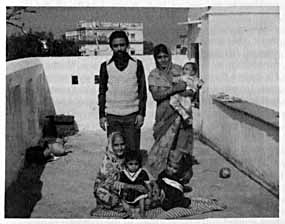
My brother Nagendra with my sister-in-law, mother, nephews, and niece
Nagendra himself was consistently noncommittal when asked to respond to the quality of the questions, their appropriateness or their focus. He didn’t seem to realize that he had been born and bred in the city that I—now we, jointly—were researching. For some time, I suffered from my typical doubts in thinking that his unresponsiveness reflected a problem in my project itself: it was wholly off the mark, made no sense to the subjects themselves, addressed no relevant issues, rang no bells. As I received confirmation from many other quarters that this was not so, my confidence increased, but Nagendra’s did not. He never had a suggestion for addition or deletion, for place or person, theme or form. He looked the same whether he encountered failure or success. I continued to fantasize about the ideal research assistant and to wonder where such a person could be found, but meanwhile Nagendra won my heart with his conscientiousness and precision. In any case, I could never have been cruel enough to take away employment from anyone once I had given it.
Where he exceeded all expectations was in the archival part of my research. I had long abandoned trying to copy down everything from the newspapers in Nagari Pracharini Sabha and had decorated them all with paper markers instead. I had applied, formally and in triplicate, for permission to photocopy these pages, in the company of Sabha officials, at the nearest photocopying place. The permission came through one year and two months later, and said: “Re: The photocopying of pages of Aj and Bharat Jiwan by research scholar Nita Kumar. The above-mentioned research scholar is permitted to copy the materials she has requested, provided she does it on the premises of the Nagari Pracharini Sabha.”
Since no one within many hundred miles of the place had a portable copying machine, that was that. I got Nagendra to work, and over the next year he produced for me some five hundred pages of notes in a pearl-like, impeccable handwriting. He became a more familiar institution at the Sabha than me, coming and going before or after his office hours, getting through one page here, another there. Yet, at the end of the year, when I surveyed what was left (for I daresay that I was going faster in marking than he was in copying), I panicked. For one week I hired three typists. They came not only with their machines but with one assistant each. The dusky silence of the Nagari Pracharini Sabha was broken with the sounds of three typewriters clacking, three voices reading out passages, and three regular series of grunts, “Uh, what? What?” No one, to give them full credit for their patience and tolerance, minded the disturbance. One or two asked me solicitously, “Too bad! Does this mean you are leaving us soon?” which made me in turn regretful about my imminent departure.
The pages of typed Hindi were beautiful, but there is no match, I still claim, for what Nagendra Sharma could achieve. Whenever I see a page of closely written notes, I feel it must be his. Strange to think of it, all this brought us very close together. I habitually addressed him as “Nagendra bhai,” a form that came easily to me, and before I knew it I was established as his older sister. This was no mere formality. I was his wife’s sister-in-law, his parents’ daughter, his children’s bua (paternal aunt), and many convoluted relationships with the rest of his large extended family. Unhappily, none of the other kin categories came easily to me; I could never address anyone appropriately, nor could I keep up the banter and lighthearted conversation that went with my new position.
14. Inside a Police Station
As days passed, the city shrank in size. Adampura and Jaitpura, particularly, had seemed quite outside the bounds of possibility the first six months, lying as they did at some unspecified distance in the north of the city. By January, with the advent of near-perfect weather, I told myself, “Why not?” and swung onto a rickshaw with the instruction, “Adampura thana!”
The journey that followed almost made me change my mind. We covered the greater part of the city, including the uphill and downhill of Chauk, the main crossings of Godaulia and Maidagin, and the grain market of Visheshwarganj. More than an hour after starting we stopped at a large, heavy, orange-red brick building, and the rickshawalla announced, “Pilikothi!” meaning “the yellow mansion.” This was, I discovered, the police station for Adampura ward, after whose hue the whole area was known as Pilikothi. Only outsiders like me called it Adampura; as with most places in Banaras, the area had an alias that its residents preferred, and every little neighborhood in the ward had several names that could be thrown out at you, but not “Adampura.”
Having resolved the dilemma of how much to pay a man for a ride that seemed too long for a rickshaw at all, I gingerly stepped into the police station. Not into the inspector’s room as was my habit, since he wasn’t in and I was prevented from entering by the guard, but into the more public, completely male record room, with railed-in counters at which sat the clerks and record keepers who registered complaints and filed the infamous “first information reports,” better known as FIRs. At every door was an armed policeman, and everywhere there were only men. Because policemen both work and live at police stations, they can be glimpsed in various postures of relaxation and various stages of undress, at any time of the day, since they work, as we all know, odd hours. All this is very awkward for a woman, and, as far as I know, no woman enters the record room of a police station. If she urgently needs to file an FIR, she can surely locate a brother, neighbor, or well-wisher to do so for her. There are women constables and sub-inspectors, of course, but so few that they are almost never seen. Nor, I think, does every thana have one. Less tangibly than all this, there is an ambience of maleness that pervades the average thana. The men develop an old-boy, clubbish mentality that leads them to use language, gestures, greetings, and so on not readily seen in the world of the family. They also leave possessions around such as packets of biri, pouches of tobacco, or, in Banaras, a langot (the Indian male version of the g-string), which reinforces the effect. Not only are the men none too careful about the finer points of dress, but also most of them are big and solid, a requirement for joining the police force. The inspector is likely to be the biggest and hulkiest of all, the most aggressively male, the most immune to female sensibilities, a regular old-boy club leader. After glimpsing such places, I was quite intrigued. I would have sat for the sub-inspector’s exam if I could have, joined the force, and then done research with the full freedom to poke around that my uniform gave me.
At Adampura thana I almost had a taste of that freedom. When I explained to the crowd of questioning policemen that I was interested in the station’s festival registers, they were too startled by the unusualness of my request to have a ready-made reply. They huddled among themselves but ultimately could only respond that the officer in charge was out and that I should sit down and wait. I was put on a chair in the best sunny spot on the verandah. After some time and persuasion, I was given a table and the festival register “just to look at” until the station officer returned.
This eminent personage breezed in one hour later. Remember that I was on a verandah inside, facing the courtyard that lay at the heart of the building, as in every old Indian structure. The inspector stood in the middle of the courtyard and roared for his lathi (bamboo pole). I then noticed a thin, ordinary man cringing in the shadows, being pulled out by policemen. The inspector started whacking him with the pole. The man would try to back off from the blows but would be pushed back into the middle of the courtyard to be targeted once again by the lathi. As he suffered more and more, he grew progressively desperate and had to be held as he was struck. I noticed then that although the inspector himself was a fat and terrible figure, none of the other policemen were. Most of them were of average size, even small and weak, and some were almost emaciated. They were grinning and enjoying the spectacle as if it were prime entertainment. The inspector made sense, as overblown and suggestive of inhumanity as his personage and position were, but these ordinary, starving policemen—starving, I mean, for good, clean fun, grinning as they were at a fellow man’s inflicted suffering—seemed totally pathetic and strange.
I watched the whole drama from my vantage point in the sun, my eyes growing bigger and bigger, my heart thumping harder and harder. No question but that I had reached the inner circles. I had wanted to know what goes on inside the privileged domains where the ordinary female does not peer, and here I was. This was what the menu had to offer! To say I was shocked is not quite sufficient. My eyes were wrenched open by the cruelty, the matter-of-fact brutality, and the mismatched show of physical strength that existed on a day-to-day basis. This was no exceptional day or exceptional situation, but rather as average a day as I, by simply breezing into the police station, could have picked. And the sheer drama of it was something that my timid, humdrum, middle-class background had not prepared me for. It made my nerves tingle and my stomach palpitate.
When Mr. Tripathi, the inspector, was quite done, the prisoner cowering in a corner in near collapse, he brushed the incident off his hands and noticed me for the first time. He walked past me into his office, signaling for me to follow him, saying expressionlessly over his shoulder, “This fellow has set fire to someone’s property! I got so angry…” In his office was another person who rather resembled the one beaten up and who looked rather scared at what he, like me, had witnessed. This, presumably, was the man whose property had been set afire. He sat in a corner of the room while the inspector dealt with me.
“What do you want?”
I gave the bare essentials of my purpose with a controlled face and voice.
“Do you know that these records are not public property?” thundered the officer.
I cited what is known as the Thirty Years’ Rule, by which all official records are open to the scrutiny of researchers after a thirty-year period. The inspector humphed and went away without a word, perhaps to think it over or perhaps to wash the blood off his hands. On his return, he was cooler and stared at me. “So what is the topic that you have been given?” This, I had discovered, was the form of verb always applied in Banaras to my research, not the topic that I had “chosen” or “picked” or “decided upon,” but the topic that I “had got” or “had been given.” It told me much about Ph.D. research in India.
“Oh, festivals and things,” I said hastily, aware that this was the point at which I sometimes went wrong. “Celebrations, processions, the things that people like to do for entertainment.”
“Well, you’ve come to the right place—everything happens in Adampura. In fact you may as well do your research only on Adampura. This place has been around, do you know, from Baba Adam’s time.” My spirits leaped at his words; it was one of the only two responses possible to the statement of my research topic: either “Nope, there’s no material at all to be had here” or “All the material is here, and only here.” But with the close of his sentence, my flight of joy rudely ended. “Now,” he stared hard at me again, “our I.G.’s daughter is doing some research here, too.”
“Yes,” I said miserably. “That’s me.”
Mr. Tripathi then did an extraordinary thing. He jumped straight out of his chair, joined his palms in reverential greeting, and, bowing and smiling excessively, repeated, “Namastee! Namastee!!”
I brought his attention back to the festival registers, which of course were set before me, as, gradually, were platefuls of sweets and snacks. Now Tripathi had good taste in snacks, being basically a villager attuned to corn, orange juice, peas, peanuts, sugar cane, and chhena sweets, and he was simple enough to offer this rustic fare even to his most distinguished guest. He was also a large man, and to sustain his size he snacked often. That day, and in the many days to follow, our relationship was partly constructed on our mutual search for something to eat—I, with the miles I covered daily in the city and the mental exercises that accompanied them, and he, with his erratic duties, habits, and sheer appetite. He knew places and had ideas about food that were irresistible to me. So, whenever he was with me, as escort or guide, we spent a necessary part of our time taking breaks for snacks. Of course I justified these breaks on the grounds that they not only satisfied my hunger but also contributed in an essential way to my research, in that I was “discovering the eating places of Banaras.”
Mr. Tripathi was a Banarasi also, a different kind from my artisans Tara Prasad and Mohan Lal or the suave poets and writers of Kashipura and Madanpura, but no less typical for all that. His face resembled depictions of the wrestlers and weight lifters of old, as did his body, save for a growing paunch. That is, his face was broad, with a tiny stooping moustache forced up at the ends, his hair was on the long side, and a darkness and languor about it all that suggested nothing to me but I think aroused in traditional Indian (or just eastern U.P.?) minds the idea of beauty. Everything about him—face, girth, movements, laughter—was big, making him as typical a police inspector as a Banarasi.
That first day in his office, I was starving as usual, and after politely declining offers of refreshment at first, savored everything put before me. That gesture of acceptance was the end of any strict speeches I may have been planning on the subject of torture and physical abuse in police stations. I did raise the subject, but he was so unembarrassed about the incident that I decided to wait for a more effective moment, maybe, planned I with some satisfaction, after I had checked up with his I.G. as to the appropriate punishment for him. The punishment, let me tell the readers, never materialized. Not only did my father look bemused at the mention of the incident, but also he as much told me that such things were more the rule than the exception. As with liquor, drugs, prostitution, and violence in general, I had no desire to follow up the matter in any way, and it was slowly pushed to the back of my mind.
Once I had rearranged my perceptions to minimize the impact of this beating scene on me, I had progressively less difficulty in capitalizing on Tripathi’s help in discovering Adampura. He had been there long enough to know the place well, and in his own country bumpkinish way, got along well with all levels of people—though not, of course, the ones he beat up. I needed a guide to people and activities, say to the Shobe-raat festivities, an all-night event celebrated variously at tombs and shrines, impossible for me to reach on my own. But with Tripathi in his jeep and Abdul Jabbar guiding us, we covered shrine after shrine; and having spent only half the night, we felt we were doing so well that we ranged outside Adampura and attended shrines in other parts of the city as well. Tripathi’s protectiveness, his affectionate respect, indeed reverence, made me feel exceptionally secure by bringing back, I suppose, memories of my childhood.
One must remember that I had been brought up by policemen. Because of the way an officer’s household is constituted, it was policemen who had cooked for me, served me, taught me to ride a bicycle, accompanied me everywhere, played with me, and communicated to me my first lessons in gentleness, kindness, sweetness. I had never encountered violence or harshness anywhere. The closest I had come was the experience, as a child, of driving through our gates, where the armed guard would point his rifle at the entering car and shout, “Tham! Kaun ata hai?” (“Halt! Who comes there?”). I would undergo a few seconds of trepidation; what if the driver forgot the magic word of reply, “Dost!” (“Friend!”)? So over the years I retained a soft spot in my heart for policemen, and they remained—in spite of later wisdom—people I instinctively turned to for help, people I always spotted in a crowd. Even the knock-kneed raw recruits or junior constables in their half-pants aroused my affection and interest, certainly not my mockery or, as I was amused to note Rashdie write in Satanic Verses, a desire to escape “India’s clutches.”
I spent a long time at Adampura thana that day and on subsequent days, poring over the festival registers, which were unusually descriptive. I was even supplied a translator, who deciphered the older entries in scrawled Urdu. In one sense the ward did have “everything”—all the usual Hindu celebrations and Muslim ones, and some innovations besides, such as “the marriage of Lat Bhairav” and, thanks to the predominance of weavers, some “deviations” that seemed to belong only to them. I was rather overwhelmed and simply copied down the data; there was no question of anything making much sense at that early stage. No researcher should expect patterns to emerge and meanings to divulge themselves before the first year at least.
The police station also had Registers No. 8, the so-called Village Crime Notebooks, the nomenclature continuing even after areas had been squarely categorized as urban. In these, one register to a mohalla, there were actual statistics on the number of houses in each mohalla and the caste and occupational structure of the neighborhood, as well as comments on the “nature” of the residents: rowdy, cunning, docile, hardworking, and all those other British stereotypes inherited by the Indian administration. Unfortunately, there were too many mohallas in any ward, some fifty to a hundred, for me to make the most of such information, except very selectively.
I sometimes wondered if I should circumscribe my topic in some way, restrict it to a group of mohallas, or a ward, or in the same vein, to a community, occupation, whatever. But I could not persuade myself to part with all the rest of whatever I would have excluded. With the things I was discovering, expanding my subject in length and breadth gave me in fact greater depth—so I reasoned. But primarily it was greed, possessiveness of the city, and growing pride at a certain mastery over it that made me reluctant to part with any section of it. Whereas in music I liked solos and small ensembles, in my research, I preferred the symphony that the total city produced.
15. Abdul Jabbar
I saw many things in Adampura that first day: the Lat temple and mosque, a space revered by both Hindus and Muslims, high on the list of Banaras tension spots; the renowned “Nagina” taziya (“bejeweled” Moharram artifact), kept in storage all year round by its skilled maker; many, many lanes and dusty streets; the famous temple of Hanuman, where Tulsidas had apparently stayed and written part of his epic. I also met many people of importance to me, such as Lallu, sardar of one mohalla, and two of crucial importance, Maulana Abdus Salam and the dyer Abdul Jabbar.
Abdus Salam was a grand man. The imam of the most important mosque in the city, the Jama Masjid, Gyanvapi, he was one of the foremost religious leaders of the weavers and, apart from his legal status, was truly popular and beloved among them (see fig.10). He was an author in his own right and had published two books on Banaras, at the fine Urdu print of which I could only gaze in dismay. He had a small publishing house as well and wrote and published textbooks for children, uniformly orthodox and paternalistic. That he himself was a man of imagination and cultivation did not show in his life-style because he functioned from one small office spilling over with books and papers, where the once white sheets on the floor were liberally stained with ink and tea. But he wore a grand turban, sported a flowing white beard, spoke slowly and thoughtfully, and was always the scholar. I could discuss with him all my questions and doubts. Where had this name “Ansari” for weaver come from? Where had the weavers themselves come from? What was the status of their beliefs in classical Islam? How should one classify their festivals and rituals? Their language and clothes? They seemed fairly un-Islamic and Hinduized in my naive opinion. I had spoken with a few maulanas (religious leaders) already and was aware of the mental blocks to be encountered in discussing something of such proximity to them. They had been reformers, critical of existing practices, judgmental and denunciatory. But Abdus Salam did not allow his interpretations to be influenced by his values, at least in his conversations with me; I doubt that he was different in his dealings with weavers, judging from the affection in which they held him. As a maulana, he was an official maker and interpreter of social codes, but he did not do his work in a bookish way. His own brother, another maulana, whom I met separately as a scholar and religious leader in his own right, was so different as to make me appreciate Abdus Salam all the more. His brother had a small mind, could not see beyond the immediate and obvious, and could locate problems only superficially. Abdus Salam could see the past with a professional historian’s vision, could make connections like a sociologist, could analyze with the patience of an intellectual, and in short was much more than a maulana.
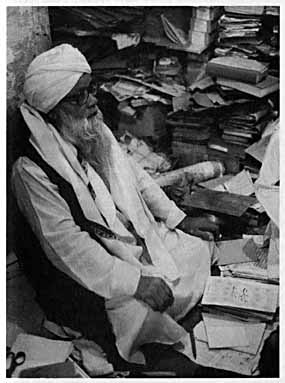
Maulana Abdus Salam Nomani in his study. He died, deeply regretted, in January 1987
Abdul Jabbar I met not in his professional capacity as a dyer of silk yarn but as one who hung around the maulana. If the maulana was my match in his scholarship on Banaras (mine projected, of course), Abdul Jabbar was more than my match in his investigative abilities. He knew all kinds of people, all castes, occupations, classes; all parts of Banaras; all events and activities. He could go anywhere at the merest suggestion, find out anything, make friends and acquaintances, ask difficult questions, sift information, follow it up, close the case as efficiently as the best detective on the loose. I was fascinated by him, I was drawn to him like a magnet, I wanted to hold on tight to him and not lose him. Fortunately he found my company amenable and my notions attractive, and he stuck with me for the rest of my stay. If he had not been unlettered and untaught, in an occupation that he was more or less born into, he would have excelled at something far more intellectually challenging than yarn dyeing.
Abdul Jabbar also had a very clear philosophy of life, one difficult to pin down because it was not so much articulated as lived. He loved, valued, and respected people, all kinds of people, and did not think anyone beneath interest or consideration. That struck a familiar chord in me and, I think, brought us close together. He could be outrageously aggressive in approaching people because he was never shy, timid, or hesitant as I was, but his brashness always worked because his sincerity and single-mindedness shone through. His greatest pride was that he knew more people than anyone else, and that they not only knew but also liked and respected him and, most of all, came to him for help. Now here was a slight difficulty. I slowly acknowledged that in poor communities in a less-than-efficiently working preindustrialized or semi-industrialized city, there were a lot of problems, and everyone had one or two at any given moment. Abdul Jabbar was into many at once, handling this or that for one friend, running an errand for another, comforting a neighbor, visiting an acquaintance, unearthing crucial information for yet another. He probably got interested in me because I had this immense problem of research. Here I was, trying to pin down a subject as vast as the cultural activities of Banaras, with such poor equipment as no intimacy with the city, its language of Bhojpuri, its past and traditions, its mental set and moods. I would simply never achieve my objective on my own, as Abdul Jabbar saw it. He rallied to my aid because, as he saw himself, only he could help me achieve it. He stuck with me throughout because he could see what positive results his proximity brought me, how I turned to him for all kinds of succor, and how the actual plot thickened the more we stayed at it. So, while I didn’t care for his semi-patronizing relationship with me, in which he already knew everything I had to find out and I should preferably remain the passive recipient of the knowledge, I truly loved him for his selflessness and gregariousness. We could both, without planning or contemplation, get lost in wandering around, meeting and talking at random, and feel exhilarated without ever bothering to calculate why.
I often felt guilty about Abdul Jabbar. He was one of the poorest men I knew, his poverty exacerbated by the fact that, like all artisans, he lived from day to day, earned according to the hours he worked, and had no security whatsoever. His wife, mother, and two daughters lived upstairs in his house in Daranagar, a more mixed mohalla than usual, being predominantly Hindu but with many Muslim weavers and zari (gold and silver thread) embroiderers. The house was subdivided among brothers, and tiny rooms remained, one on each floor of a three-storied house, each looking more obviously halved because one wall was freshly constructed of raw brick. The frequency of partition within families did not reduce my apprehension that it must be an awkward subject for those involved, and I treated it as if it were taboo. In fact, families remained friendly to each other even after quarrels and legal separations. Abdul Jabbar’s immediate neighbors were the members of his brother’s family; he himself took me to meet them, referring to them as garib (poor, literally) and bechare (poor, metaphorically), and the girls of the two houses were the best of friends. They could not visit each other, however, being in total seclusion and also, technically, antagonistic. Taken up to the roof of Jabbar’s house by his daughters, I discovered what a perfect vantage point it was for a number of purposes. Best of all, because it overlooked the courtyard of the next house, it brought the girls close enough for long conversations and gossip. I was introduced to the cousins, and there followed some stylized joking on how I had lost my looks and appeared downright “pale” because of my prolonged separation from my husband. The jokes irritated me initially till I remembered the position of my new friends, physically in complete pardah (seclusion) and mentally almost so. They were indeed separated from their menfolk for sustained periods, and from the outside world for always, and such jokes were comments on their situation.
Although I spent long hours and the better parts of days in Abdul Jabbar’s home and was part of the women’s world all that time, I remember the women of the house predominantly as those confined. The image that comes to mind is of their peeping out of the little windows upstairs, revealing the smallest parts of their faces, as I approached the front door and called out. More often than not, Abdul Jabbar, being the busy man he was, would be out. It made more sense to call out “Bilquis!” or “Vakila!” They could not come downstairs to unlatch the front door, but they had a rope connected to the latch which traveled upstairs through many tunnels and pulleys and which they could tug at to open the door. I could enter and grope my way up the stairs in the dark—for, like Tara Prasad, Abdul Jabbar refused to have electricity as an unnecessary expenditure. Bilquis, her sister, mother, and grandmother were thrice confined: out of tradition; out of poverty—the absence of diversions and activities at home; and out of illiteracy and ignorance.
Abdul Jabbar’s illiteracy was not something one remembered, because he simply knew too much for it to be important. He was far more educated than the average person, and certainly many times more than I was, on how the city administration functioned, where one went for which purposes, who was who in the place, what people believed, thought, and did. He was not merely functionally adapted to life in Banaras, as many people I got to know were, but he was extremely clever and knowledgeable as well. The problem with him, which might or might not have been reduced by schooling, and which I struggled with continuously, was what may best be described as his “speech impediment.” Abdul Jabbar spoke very indistinctly. I lost valuable statements, sometimes whole paragraphs and speeches, because I simply could not decipher his words. In the latter part of my stay, when I was totally comfortable with him, a family member of course, I made him repeat, very slowly, many things that I thought he had been saying which I missed the first time around. But there were too many things I missed.
A speech impediment was a common Banarasi complaint, cross-cutting the population from the top (the maharaja) to the bottom (the average artisan). An impediment could have many causes, but bad teeth, poor training, occasionally old age, and general lack of care were probably important ones. When Tara Prasad told me the name of the wood he used most often for carving, I could not comprehend the word. In my notes I find, in successive places, “gurukul,” “bhulkul,” “bhurukul,” and “gulkul” as the best wood. Many things in Banaras had a frustrating array of alternative names: “chaumuhani” and “chauraha” for crossing; “kajali” and “kajari” for the music; “Ahir,” “Yadav,” and “sardar” for the milkseller caste—but that is a different problem deriving in large part from the time it naturally takes to get a handle on another culture. When encountering words that I initially misinterpreted, I often thought of our Jewish Community Center experience in Chicago. Passing on to me a job that involved calling up the Center, my husband innocently remarked, “There’s a woman called Shalom who always picks up the phone.”
Words were extremely important to me, to the extent that I could have claimed that my whole enterprise rested on language: hearing the right words, understanding them, using appropriate ones myself, getting the multidimensional nuances of words. Besides the utter disgust I felt with myself when I let precious sounds pass in noncomprehension, I often felt impatience with my new friends. The inability of some Banarasis to enunciate their words carefully was greatly compounded by their refusal to do so because their mouths were full of pan. To eat pan in the correct way, you have to stuff it in a corner of your mouth and store the juice in your lower jaw until you deem the juice sufficient to squirt out, which you do in any direction you consider expedient. Having done that, you have a few seconds to make a clear statement to those who may be waiting patiently; then the juice begins to accumulate again, and you had better keep your mouth shut. I ate pan, too, and I often practiced this style of juice storing before the mirror. I believe it is better for your innards than swallowing the juice wholesale as I habitually did. Moreover, if I could have mastered the technique, it would have given me a posture, a mannerism to fall back on, that would have exuded both familiarity with and confidence in my surroundings. I think I would also have liked to have a method handy whereby I could, if I so desired, find myself unable to reply or forced to reply inaudibly.
These diversions aside, the fact remains that for many and sundry reasons people in Banaras were difficult to understand. If they were not chewing pan and had no speech disability, they might be simply sleepy or bored and refuse to open their mouths wide, as elocution trainers recommend. Many of the informants I picked out were old, with wheezing throats and quivering mouths. Tara and Jabbar were not that old, but their mouths sort of ran away with them. Abdul Jabbar’s main obstacle was his beard, I believe. Thick, unkempt, junglelike, it covered most of his mouth, so what actually emerged from his mouth was unknowable and what remained after the passage through the beard was not very helpful.
Abdul Jabbar may have been fifty or sixty; people like him age easily, develop grandfatherly mannerisms, addressing everyone as “beta” (child) and coming to be themselves referred to as “baba” (old man, father). As I said, his teeth were either bad or gone already; he preferred to eat with his bread soaked well in his curry, but that may have been simply a device to make the food go further. For me he was ageless, and we were more comrades than anything else. Yet he could get tired out from our endless travels. On a few occasions he fell asleep wherever we had stopped. Sometimes he looked exhausted, and he was often, I suspected, hungry like me. But he never admitted to any of this and kept going doggedly, not only serving as guide and companion but also carrying some of my bags and, when it came to the crunch, the baby as well. Irfana was so used to this that the very first name she learned to say was “A-boo-oo-oo-l Ja-bbaa-aa-r!” What he would have preferred her to say is “Khan Sahab”; he kept teaching her that alternative, but she stuck to her choice.
Where exactly did we go and what did we do? I had the privilege of making a grandiose plan of my choice. I would propose, for instance, that we go around to all the old mosques of the city. Abdul Jabbar, abandoning work and family, would agree with enthusiasm. We would set out, leaving at dawn because in his calculations we would need those extra hours to cover all the essential places before dark. We would sketch out an itinerary, based on locations and his instinct of who would be available where at what time. Neither of us was interested in looking at buildings. I took pictures like mad, but the structures themselves were meaningless for me and mere artifacts for him. He searched out the imams and the maulanas, the old caretakers and the neighbors. Guided tours and rich exegetical narratives followed, better than my fondest hopes could have led me to anticipate. Abdul Jabbar had a way of presenting himself and me, by extension, that removed any doubt about the logic and acceptability of our search. I’m not sure precisely what he said: perhaps “She’s writing a book but had no way to meet you”; “She’s interested in Islamic society and culture but needs a little help”; “She has come all the way from Chicago, and our maulana sahab offered to teach her what she wanted, but we decided to come here first”—a combination, that is, of flattery, deep respect, even reverence for the addressee’s knowledge; of our own relative ignorance and frustration; of the maulana’s support and goodwill; and of the intrinsic value of looking at mosques and shrines to understand much about anything (see fig. 11). In short, he was an eloquent interpreter of my research project and throughout served to make it clearer and clearer, as well as succeeding consistently in having it accepted. No one ever hesitated to trust me, since I was in Abdul Jabbar’s company, but they probably would have felt more comfortable if I had not had this unnerving habit of whipping out my notebook and pen. It wasn’t so much the person we were talking to who objected—he would appreciate my seriousness—but all the others who passed by, peeped in, or gathered around. They would frown and whisper, “What is she writing? Who is she? Where is all this information going?” Abdul Jabbar would immediately shoulder the whole responsibility and explain me anew, with careful consideration for the social level and assimilative capacity of his audience.
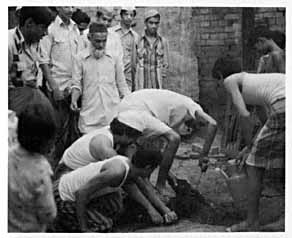
Abdul Jabbar (bearded, center) took me to various ceremonies I would otherwise not have seen, in the case, a goat sacrifice.
I did not even have to press home the point to Abdul Jabbar that it was not merely formal representatives of authority and religion that I needed to talk with but some simple folk, the ones visiting the mosque or shrine or even not visiting in some cases. Jabbar’s repertoire of friends included many such, and, since all was for him pure pleasure, he as naturally introduced me to impoverished weavers as to powerful maulanas. On the way to or from somewhere we would pause at a teashop or someone’s home and spend delightful hours chatting about what we were looking at that day and the larger phenomenon. The trouble with such a technique was that everyone always offered us refreshments, and as many times as I tried to decline these and persuade our hosts that they were unnecessary—conversation alone would be just fine—Abdul Jabbar insisted that we (I, as he would put it) must have tea. With my anxiety about feeding off poor people who were already giving me valuable time, this insistence was acutely embarrassing for me, but I had to accept it as the Banarasi custom and Abdul Jabbar’s way. He patiently explained to me that in Banaras to refuse anyone’s hospitality was the worst possible insult and that, no matter what I imagined, my hosts’ insistence would have overridden my reservations. I agreed inwardly on the strength of my experience of visiting people in Banaras. But I could not resign myself to it and have not managed to even now, besides which I live in constant dread of otherwise long and productive days of fieldwork, with their dozens of cups of boiled tea, leaving a permanent hole in my stomach. My basically awkward adaptation to Banarasi hospitality continued throughout my stay: as soon as I visited someone, tea and pan would be produced, and I would start protesting instead of looking happy and gratified.
It should be clear that, as wonderful as Abdul Jabbar was for me and as well as our personalities suited each other, I did not entertain clear-cut feelings for him, nor he for me. I know, for example, that he found my lack of style demeaning. As someone with wealth, education, family name, and a passion for culture, I should have been more in the school of the old-style rais (aristocracy) of Banaras, probably should have spoken less (depended more on him), spent more (taken taxis rather than rickshaws), argued infinitely less, and never, never, never should have appeared intimidated but simply should have known that my qualities overrode everything. For me, Abdul Jabbar was not merely a little too pushy, somewhat too quick to take advantage of hospitality and help, and, of course, imperfectly articulate, but also sometimes questionably ambitious. He had met me initially through the maulana, who in turn knew that I had a relationship with the police station. So Abdul Jabbar comprehended that I was a special person of some sort. What he couldn’t grasp, or maybe wanted to, was why I needed the police in my role as supplicant for their records rather than their needing me, respected sister of the police force as I was. Of the many problems with which ordinary people could be beset, there were those in a category that involved the police. Abdul Jabbar helped people with these as well as with others and frequently entered or hung around police stations. He must have calculated, perhaps indistinctly, that I was good for him, although repeated efforts should have also convinced him that it never helped either to cite my name or even to have me physically present. Policemen could make the distinction between being courteous to me or helping me in harmless ways and allowing me to influence their important decisions.
Abdul Jabbar never gave up trying to get me directly involved in his—sometimes, in our mutual—friends’ problems. More often than not, his very introduction of a new person to me would incorporate both sides of the relationship, thus: “This is Shakur, a great merchant. He can tell you all about the Banaras silk trade with Nepal in the fifties. Here, sit, sit…make yourself comfortable…Some tea for the guest, Shakur? [Indistinct moans of protest from me.] And Shakur also has a son in some trouble at the police station…” Deciding to educate Abdul Jabbar in the virtues and indeed the necessity of noninterference with the affairs of the administration, I spoke to him at length about the fact that I was finally a layperson, a helpless woman to whom no one would pay any attention, and I demonstrated it to him in diverse ways. Most of all, I simply ignored all requests for any kind of intervention. But he educated me instead in the realities of city functioning. People had legitimate problems, and the recognized, legitimate way of dealing with them was through a person who could talk effectively with both parties. All Jabbar and the others were doing was trying to incorporate me into the social structure and, in the absence of any other qualities in me of value to the society, to use the one I had, namely, my family connections, to make me an integral part of society, giving to others as well as taking from them.
The question of how to help others had haunted me from the beginning, as I’ve had occasion to describe. I never did resolve my dilemma on that visit, but my responses over the course of the twenty-two months can be divided into two phases. In the earlier and more naive phase, when someone made a request of me, I would conscientiously sift the facts of the case and judge it on its merits. If obviously impoverished and oppressed, the person deserved to have a word put in. If the supplicant cited an outright example of injustice, then it deserved further action. I must have made a good one- or two-dozen efforts to help informants before I realized that not one attempt had been successful. My failure had as much to do with my conviction that such interference was unethical as with my lack of talent for the business. To make a sufficiently plausible request to a police or an administrative officer, you have to humble yourself at least subtly. I couldn’t do that, lest I inadvertently become part of the all-India conspiracy, with everyone busy at giving and taking. Somehow I let this attitude slip in even as I was making my request: “Here is a deserving case,” would go I. “But you will be a better judge of its validity, and far be it from me to impose…” The officer being approached would guess that the case didn’t matter, that I would not do anything about it. Since he was involved in a transaction, I needed to make him feel like an active, voluntary transactor, not a mere cog in the machine that was being pushed to perform. In other words, I was inefficient.
My successes were in inverse proportion to the significance of the cases being pleaded. I succeeded in bringing the S.S.P. here and there or in providing three mounted constabulary for Ram’s marriage procession at the Manikarnika Ramlila; but I couldn’t get Mohan Lal’s house vacated, or Shaukatullah’s land freed, or Alimuddin’s partition settled, or prevent Bharat from being beaten up by a rival gang. The truly worthwhile cases, such as the collapse of Markande’s room in the monsoons, for which relief was theoretically available from the district magistrate’s office, were effectively botched as much by my interference as by anything else.
The second phase was marked by almost total retreat. My life became so intense and busy that I decided one could be either a successful activist, a useful member of society in some way, or a useless and seemingly self-centered anthropologist. At times it broke my heart to say no, which I learned to do automatically in case I waivered. When the thin, exhausted-looking policeman who had helped us particularly after Baba’s death came over one day and explained, with defeat already in his eyes, that he was having a house built in Banaras and if his transfer from the city could be stayed for only two months…I could feel the pity of it, my unfairness as I told him quietly, “No, I can’t help you. I never do this on principle.” He nodded and cycled away without a word.
Part of my fear was of opening a Pandora’s box if I relented and allowed my sympathy to move me to action. Everyone had problems, from policemen with ailing children to artisans whose houses had been seized by scheming brothers. Either police officials, it seemed, or some closely related breed of administrators could solve these problems. I was supposed to be on close terms with the dozen or so district and city officials in Banaras; people were always giving me the impression through mime and suggestion that I had but to pick up the phone and demand redress, or even more effectively, to pick up the phone, order a jeep, drive to some office, and demand redress. The more modest plaintiffs, such as my artisans, wished me simply to stop at the local police station and plead with the inspector on their behalf. In my first phase, as I said, I responded to both kinds of suggestions, only to realize, to my relief—and, I suppose, to my chagrin—that the technique didn’t work. I tried offering my own personal services as a member of the public instead: “No, I can’t phone the district magistrate, but I can go with you to the municipal office and look into your problem.” I don’t recall anyone taking up such offers.
Partly as compensation and partly because, unlike other anthropologists, I had no moral compunctions in the matter, I made gifts of money or material things, indeed always seeking an excuse to do so. Poverty was such an overwhelming fact of life for my informants that the money was unarguably useful, no matter how much, presented under what guise, or how used. And since such help was not part of people’s expectations, or where they directed their efforts, monetary gifts felt easy and natural.
16. Questions of Gender
The discussion of how to remain myself while interacting meaningfully with my subjects also brings me to the question of what it was like to be a woman wandering in the streets of Banaras. I should say at the outset that my experience as a woman has been unequivocally good wherever I have lived, the result both of fortunate circumstances and, although the realization didn’t strike me until rather late, of a low level of sensitivity to harassment and discrimination. When I lived in Lucknow as a college girl, my friends and I experienced our share of “Eve teasing,” that wonderful Indian euphemism for publicly making girls’ lives miserable. Eve teasing included for us everything from men pinching our bottoms in crowded places to boys on bikes snatching away our dupattas (the long scarf worn over the chest as a symbol of modesty). We took this with a mixed attitude of indignation and I-can-be-a-good-sport-too; it was absolutely a part of life. When I worked in Delhi, both as an unmarried and then as a married woman (with no external sign to distinguish the two states), I was free and happy. No one bothered me in any way that I remember, and I had long debates with other women on the safety of the city. I vehemently argued that much depended on the woman, since I went around the whole place on assorted modes of transport, chiefly buses (my research at the time was on Delhi), and was quite comfortable doing so. I had developed a few techniques then—which implies, of course, that I had inferred the existence of hidden dangers, even though I did not experience them directly—which I put to use again in Banaras.
The first was to be totally cool and confident, as if the place belonged to you, which almost no young woman feels about a public place for the obvious reason that a public place is not a woman’s domain. As you walk along, you should look this way and that, asserting your right to look where you please. This is dangerous in the Banaras galis, however, because men habitually urinate on the sides of the road. You can also keep your eyes thoughtfully to yourself, knowing your purposes, but reveal by an occasional glance here or there that it is because you are lost in thought, not because you are afraid. You are interested, when you do look, at the whole social scene in an adult way, not at any individual in a personal way, and you must accordingly avoid direct eye contact with variously interested men while comfortable enough among them. You should be dressed sensibly, not in this or that fashion, Western or Eastern attire, bright or dull colors, but in a way that shows you to be straightforward and reasonable, someone that people can understand.
The most important moment is when you approach a stranger, or when he approaches you. The crucial step is to look him in the eyes, with no fear, no hesitation, no awkwardness; he’s a person, you’re a person; he has a job, you have a job; he has a family, you have a family; he’s normal, you’re normal. Don’t wait too long, or speak too soon. You know that he’s not going to bite you, hurt you, abuse you. You’re aware that you may have to explain what you want, so you are, not apologetic—because apology has no place in Indian life—but very, very courteous. The rest is a linguistic trick. You must have enough command over your language not to stutter or stammer, search for words and get trapped in phrases—all of which can create the wrong impression. You speak clearly, to the point, honestly. You say what you mean, but say it in good Hindi. The stranger is immediately at ease. He makes the necessary leap, classifying you as one of the figures familiar to him: mother, sister, daughter, depending on how well you have slept the previous night and how recently your hair has been brushed. Before that, of course, you have the choice before you. For me, the choice was clear-cut. No matter how old or young the man, I would inevitably call him, “Bhai sahab,” respected brother. This would be automatically appropriate for most males; for those much younger, it would carry the not undesirable connotations of affection and interest.
I developed these techniques to perfection, so crucially did I depend on the ability to be able to talk to absolute strangers comfortably. I became aware, to my lasting surprise, that men could not be judged by their looks either. Some were forbidding because of their sheer size, or their arrogant postures, or by the way their mustaches curled. Most were terrifying because of the way they stared unblinkingly, a simple subject-to-object stare: “How should I judge this specimen now?” But when I drew near a man and began speaking with this “he’s a person, I’m a person” approach, these other characteristics retreated into the background and I could read the normality in his face. Some of the most unpromising-looking people, pan juice in lower jaw and all, turned out to be the most “normal,” even likable.
What about when people try to be smart and approach you? If it is ostensibly a legitimate request, such as for directions to a street, although you may guess that it is really to stop and observe you a little better, it should be taken at face value. Telling a group of smart young men the directions they want in a businesslike fashion is the best way of making them move on. To look abashed, or embarrassed, or at a loss is to invite trouble. Who are they after all? Young men with no girl friends, no jobs, probably no prospects, and lots of vague ideas about talking with females and developing relationships with them. The only device that deters them is to bring them from these abstract heights of fancy back down to earth. Smile at them, there’s no harm in that; even enter the conspiracy by adding a question of your own to prolong the conversation they so much desire for another minute.
Occasionally a young man or a group of men care so little for the appearance of sanity that they call out whatever they like to you in passing—usually something on the order of, “Hello darling!” The reaction that came most naturally to me on such occasions was to look up swiftly at the offenders, then shake my head in surprised regret, as if I were disappointed to see that nice, intelligent, proper-looking young men could be responsible for such an old, unimaginative trick. It was too much to hope that they would take this to heart, and they would probably continue in the same vein. But my reaction was the best that could be thought of in such a situation, for condescension is something everyone minds.
I hardly had any such experiences, however. The local wolves of Banaras either haunted other parts of the city than the ones I did or wisely ignored me. I don’t think I looked old—people tell me I don’t—but I did have this aura of being older and wiser than the average girl or young woman who walked around independently with no ostensible purpose. And as soon as I opened my mouth and said “Bhai sahab,” the stranger found a mooring. I must say, in certification of my methods, that by using them I met and talked to more people and made more real friends than I could ever have laid down to strict necessity.
Why do women have such a problem in India though? Both my Indian and my foreign friends have told me that it is impossible to do anything as a single, unescorted female on the streets, that the comments and abusive behavior that greet them are intolerable. Sociologically speaking, this problem is due to the widespread loneliness and separation from their often village-based families among males in urban areas and to the fact that any woman who is found outside the defining sphere of home and family is seen as a target, like a prostitute or a film star, for one’s frustrations. As long as these conditions exist, there is no escape from the problem. You can try all kinds of devices, such as the ones I have suggested, but as long as you have to stay constantly alert, you have far from solved anything. But there is, I believe, that middle zone, where what happens to women depends on their own actions. If you wear sindur (powder) in the part in your hair, bangles and a bright sari, and look and act like the typical married woman, you are definitely of little interest to men. If you appear the unprotected little “college girl” in salwar kamiz suit of latest cut, shy and scared of men, you will draw trouble like a magnet. If you are sensible, as I have suggested, expect and look as if you expect civility, with none but intelligent brothers all around, very likely the desired behavior will follow. For me it did.
Another consideration is where you are. Delhi, the present version of which dates from post-Mughal times, and Lucknow, circa eighteenth century, are relatively new urban cultures, with all the awkwardnesses of new, growing cities. Banaras, by contrast, with its millennia of tradition, has a smoothness of social relations; considerable provocation would be required to disturb them. Of course, some things can strain these traditions, such as lighting up a cigarette on the street. But the vast repertoire of possible social roles, the capacities and resilience of people in accepting them, and the larger belief in the rightness of context and circumstance all contribute to making more kinds of behavior acceptable than one would imagine at the outset. Special categories for unusual behavior and personalities are conjured up when necessary—categories such as shauk (passion, fancy), man kiya (the mood struck you), kala (art) and kalakar (artist), and so on. Besides all this, the pride in urbanity, courtesy, and decorum is so strong that I consistently found myself the loser at the game of politeness. Everyone had a better idea of what to say or do in strange situations than I did. Everyone made a habit of exaggerating my qualities and purposefulness and overlooking my awkwardness. In the old city, no woman could be molested or even made to feel uncomfortable, and this is an attribute of age. There were plenty of young smart alecks roaming free and unchallenged in the newer university area, but none would be tolerated in the lanes of old Banaras.
There was another dimension to my relative success as a woman that I grew to accept gradually. People enjoyed giving me time and having a conversation with me because I was a woman, provided that I had a clear-cut definition and attributes (sister, outsider, writer, “public worker” of a kind). This I put down to the fact of men being relatively isolated from women’s company, yet free and comfortable with them because of the sister-daughter-cousin-sister-in-law association. I have since noted how easy it is for most Indian men to get along with strange women in the role of elder brother or younger brother-in-law. I reaped the advantage of that. Because I was a woman, I could impose on strangers, draw them away from work, press them for information or guidance, or make them lead me to places and people more easily. They treated me with greater gentleness and consideration than if I were a man. I never had to exaggerate or belittle my femininity; as soon as I presented myself as a normal person, albeit with a peculiar agenda, they were willing to serve and befriend me.
There were some relationships that became more weighty. With Nagendra, my innocent use of the term “bhai” for him decided our future. I was for then and evermore his sister by dharma (natural law) and, as I have described, inherited a vast array of relationships in the bargain. That first experience was a jolt. I consider it a fair-sized project to adapt yourself to the families of which you are part by accident of birth and then by marriage, to grow to appreciate your actual siblings, cousins, and in-laws. If you acquire even more relatives simply because that is the way things are done in the place you work, you may start getting impatient. Since you have a choice, is this the brother you would “choose”? You may tell yourself that it is nothing but a linguistic device, that you can call him “brother” and forget about him. But in Banaras expectations run higher. Your brother has the freedom to come to you at any time, seek advice and hospitality, sit at loose ends for hours in your home, bring his children over to meet their aunt, consult with you about his job and miscellaneous affairs—and to demand that you do all of this in turn with him. My first sisterly responsibilities, because of the novelty of it all, seemed overburdening.
I became Tara Prasad’s sister out of choice. He was busy, engrossed in a range of activities, often on his feet and therefore elusive. I was jealous of all the other demands on his time and wanted a special relationship with him. I knew he had no sister. After I volunteered myself as one, I discovered that he had another one or two such as me, but I was happy enough. I also wanted to have a claim on the progress of his daughter, then seven or eight, quiet and intelligent, and his illiterate, helpless wife. I wanted to come and go in his house as I pleased, eat with his family, sleep overnight with them, share their worries and thoughts. Maybe I could have accomplished all this without invoking the relationship of sister, but I think it did make them more comfortable and allowed me to reciprocate in many ways for all their help to me.
My third new brother was Markande. I do not remember how the relationship became explicitly named, but it was a gradual and natural development, since he wanted to depend on me as an older sister (see fig. 12). He was the oldest of four children, and his youth and rawness were often more than his family status allowed people to acknowledge, since he was also one of the two working members of a large family. I think he was also keen to get married, and typically the older sister or sister-in-law broaches the subject and launches the search for a wife. I did not of course. Throughout I did the barest minimum to occupy the position of sister. Again, if I had a different kind of personality, if I had had more experience at social roles, I could have made so much more of the opportunities to learn about my new brothers and semi-brothers.
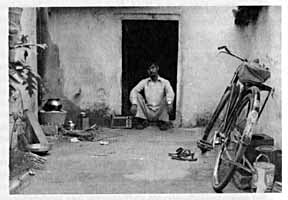
My brother Markande with his most prized possessions: his bicycle, radio, and watch
Then there was Majid bhai. I liked the idea of “father” Shaukatullah, sister Nurunissa, and sister-in-law Habibunissa, so far from me in religion, education, occupation, and consciousness. That they should accept me so well was a very positive sign to me in my research and promoted my confidence about my style. It also made me feel better as a human being, as if their simplicity and likability announced that I must be likable too. Majid had many sisters, but he reserved a special slot for me, as I supposedly did for him, something his family regularly made joking references to. Sisterhood can be embarrassing because your brother must often provide gifts and pleasures for you. As long as these were in the form of time and research help, I was happy. But there were too many other kinds of occasions. At Rakshabandhan, you tie a rakhi (ritual thread) on your brother’s wrist, and he in return gives you money and the promise of protection. The last is okay; I needed it on my midnight music recording forays. But the money was a problem. How could I not accept it, or return it, without humiliating the giver? On most such occasions, I tried to match it with a gift, a very obvious device, but I could hardly accept something worth over 10 percent of the family’s weekly wages without reciprocation. For Majid bhai, there was no rakhi occasion, but all my visits were treated with the high spirits that a returning daughter’s or sister’s visits occasion, and I was sent home with presents each time. This could be a recently cooked sweet, given with the severe injunction not to return the dish it was packed in; it could be a piece of silk woven by Majid or his other brother (it was curious how one brother could become your brother, whereas the other, while technically your brother as well, never really did assume that relationship). I was in constant pain over the number and variety of their gifts, and no presents I gave in return ever could match theirs, ultimately because a sister’s or daughter’s could not be permitted to.
Other choices were inadvertent, brothers acquired because of the lack of another relationship to set up. Some pricked to the end of my stay, such as that with the communal-minded Seth Govind Ram, to be whose sister seemed to place me in the same rabid Hindu category (not a necessary connection, by the way, only one in my mind; one does not inherit the qualities of one’s adopted kin). But all in all, as I grew more comfortable with kin terms and categories, my appreciation for the workability of the system increased. I continued to feel that I, as woman, outsider, and researcher, benefited more from it than my newly acquired fictitious kin, but that was perhaps only unfounded apprehension. They had a capacity for deriving pleasure from the unplanned and the odd that, I suspect, outmatched mine.
17. Rapacity and Recovery
There was another incident I experienced as a woman researcher that flared with the fury of a passing meteor at the Nakkatayya of Chaitganj. I had never seen the like before nor have I endured it since. I have to speak in some detail about this event.
The Nakkatayya of Chaitganj is a mouthful as a name—for days I couldn’t decide what people were trying to say—and a handful as a topic of study. It is cited as one of the two largest, most important parades in Banaras, and it goes on all night, with several hundred thousand in attendance. All this is told to you with great glee, and the importance of the occasion is underlined with comments like, “You must get there a few hours before because roads get totally blocked”; “You must find a place to watch it from, there is never any space on the roadsides”; “If you don’t see it, you’ve seen nothing in Banaras.” The Nakkatayya was to take place in early November, and I had just started feeling comfortable with my activities in Banaras. I could make plans to go to places at night and was becoming bold enough to go to places without any idea of what to expect. The Nakkatayya of Chaitganj was a prime attraction, because apart from its size, long duration, and indisputable importance, no one could describe to me what exactly would transpire there. The parade, I gathered, consisted of numerous floats that were taken out in procession in the locality called Chaitganj, down the main road called Nai Sarak and then past it into winding lanes (see fig. 13). The word nakkatayya itself meant, in Banarasi lingo, the cutting of the nose, referring to an episode in the Ramayana that would be enacted that night. Very, very promising.
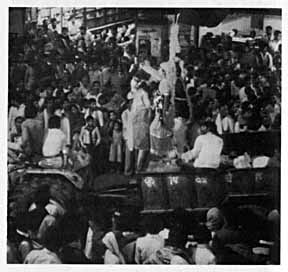
The Nakkatayya of Chaitganj
My husband did not think so and insisted that I arrange for a police escort. The local police station promised a jeep, driver, and policeman at 9 p.m. I waited till 10 p.m., then 11, then midnight, finally realizing with frustration that it was one of those times that the police had let me down. I woke my sleeping husband, informed him urgently that he had to come with me; we organized the rest of the night for the sleeping baby and crept out of the house.
A rickshaw took us within a half-mile of the place, joining many other rickshaws and pedestrians going in the same direction. The rest of the city was asleep, but toward Chaitganj there were lights, decorations, loudspeakers, and music. We had to abandon the rickshaw at a point and merge with the walking crowd. On Nai Sarak itself we were pleasantly surprised.
This road, like most others in Banaras, is ordinarily almost unwalkable, being full of vendors, traffic, potholes, and filth. That night, it looked like a fairyland. The road was swept and sanitized, with bamboo structures to delineate one-way lanes on either side and to separate sidewalk from street. There were huge gates every few yards, rows of pretty lights on each side, and ultra-bright floodlights to remove all shadows. There were vendors of foods—all looking delectable, although I resisted the temptation to poison myself by trying anything—and hawkers of balloons and toys, of pottery, masks, souvenirs, and all the paraphernalia of an Indian fair. No garbage, dust, flies, or other disturbing features were visible anywhere. Thousands of people were strolling up and down the road in very festive spirits. What seemed initially intolerable was the amplified music, a different kind every few yards, each clashing with the next in uncontrolled cacophony, but, surprisingly, one got used to it quickly enough. I noticed that the strollers were all men and that the women and children at the fair kept to the sides or had taken up vantage places on the verandahs and rooftops of all the surrounding houses.
It was past one at night, and the parade was supposed to start soon. We needed to find a vantage point ourselves. We thought of aiming for the balcony of the Chaitganj Police Station, where we had been promised seats, but as we headed in that direction, something happened. Suddenly we were caught in a tidal wave. Some kind of barrier had just been erected a few yards further on, and the whole crowd had been dammed and forced to turn back. People were now rushing back in the thousands, with the uncontrolled speed and indifference of a powerful elemental force. One who trips and falls on such occasions gets trampled underfoot, I thought, and I remained steady on my feet. But I was unprepared for what else could happen to me. Suddenly the only woman in the middle of the road, I was surrounded, pushed, and pulled by an anonymous crowd of thousands of rushing men. Hands were reaching out to me, touching me here and there, at random, purposefully, disgustingly, revoltingly. I would push off one, and there were a dozen more. Sombabu was only one defender, unable to surround me. He was also a victim, and he became separated from me. I was being tortured, victimized, degraded. I was at the mercy of a mad crowd.
The whole episode must have lasted but a few seconds, and it ended as abruptly as it began. Two or three men made a protective circle around me, their arms on each others’ shoulders in practiced grips, and pushed me along through the crowd to the side of the street. The press of bodies was so strong that we could not stop of our own will but kept going to the very edge of the road. My saviors and torturers jointly pushed me into the safety of a urinal, together with others, including my husband. Urinals are structures on the sides of Indian roads similar to little boxes, enclosed in front and back but not on the sides, and of course terribly smelly and unsavory. I have maintained a strict distance from them always and regard them as the most disgusting appurtenances you can encounter outdoors. Here I was cowering in one for safety. The urinal was wet, and that side of the street was slimy and muddy. My legs were filthy well above my ankles, but I was so grateful to be out of the bearbaiting that nothing mattered. I even thought humorously of the fact that a despised urinal had provided shelter. I also thought gratefully of the men who had saved me, although other men of Banaras had gone crazy the moment before.
We were near the police station, so we went in and cleaned ourselves. No one there paid the slightest attention to us, being entirely preoccupied with the event that was about to begin. The barrier had been put up by the police to clear the road of people at that point and let the parade start. I am surprised, when I think about it now, at how rapidly I recovered and how my only thought was to climb up to the balcony quickly so as not to miss a single spectacle of the parade. We weren’t late, as it turned out. We found seats, and I compiled a complete list of the floats that formed the Nakkatayya parade that night.
The more I think of that episode, the more unreal it seems. It was overwhelmingly sudden, a complete turnabout of the peaceful strolling, festive activity, lights, beauty, and music that we had been part of just a few seconds before. Had it really happened? Maybe there had been a rush of people turning back upon us, maybe we had been momentarily trapped in the onslaught of bodies. But had the crowd deliberately aimed at me and my body? At the time I had felt that it was the end of me, that I would be ripped bare, destroyed morally and psychologically if not physically. But perhaps, like the Englishwoman in Forster’s A Passage to India, I had imagined it all or at least greatly exaggerated it? Possibly a couple of hands seemed to me hundreds? Perhaps the men were not touching me any more than they were touching one another in that pressing crowd? The last is a distinct possibility, because I admit that I am so tense about the touch of strangers in crowds, I am always ready to spot a potential offender even when there is none. An accidental touch always makes me want to scream. In very thick crowds, I walk rigidly, with my elbows out to protect my upper body. As a raw, unsuspecting youngster, I had been touched and humiliated in both likely and unlikely contexts—from dark cinema halls, where anonymous shadows developed creepily intimate hands, to the security of my own home, where silent, familiar servants and innocently trusted uncles turned into unrecognizable monsters. Those were well-repressed memories and had made me frightened of the possible touch of strangers, I suppose.
Such an incident had not happened for a long time, however, and had never happened so far in Banaras. I was far from expecting it, at least consciously. I pushed the whole thing to the back of my mind because there was nothing I could do with it, no complaint to lodge, no reform to undertake, no fresh interpretation to make. It bothered and disturbed me, but once safe, I turned eagerly to the business of the evening. Nor, interestingly, did it leave me with a distaste for the Nakkatayya or for such occasions in general. I have been to many since, wiser perhaps and more alert, and that one proved such an aberration that it simply did not affect me significantly. The fact that a urinal became my final resting place made more of an overall impression on me, and the way that I had been enclosed by linked arms and propelled to safety.
My husband lost his watch, but that apart, we agreed that we were none the worse for the outrageous experience. Perhaps he had been separated from me by too far a distance to notice what happened to me, or was too absorbed in fighting off his own attackers, or no such attack took place, just an accidental push of bodies lasting a few seconds—but whatever the case, he himself was more outraged by the Nakkatayya parade than by the previous demonstration of crowd behavior. The parade was something to exclaim about, no doubt. It was of prime carnival vintage, with sufficient absurdity, nonsense, and surprise to keep us diverted for the next three or four hours—but I have written about it at length in other places so I shall refrain from describing it here.
18. Progress and Its Limitations
January through April were exhilarating months for me. I realize as I write this that I myself am very “season oriented,” quite like my Banarasis, because I give the credit for the successes of that time partly to the wonderful seasons that prevailed. To call them winter, spring, and summer seems misleading. It is necessary to understand them as the people of Banaras did, broken up into little entities of a month each: Paus, end December to end January; Magh, January– February; Phalgun, February–March; and Chaitra, March– April. Paus is somewhat windy and temperamental; at the end of it occurs Makar Sankranti, the winter equinox, which is always rainy and chilly. The month is forever associated in my mind with the Bengali song (of Tagore’s?) “Pos tother dak diyechhe, aiyere chale aiye!” (“Paus is calling out to you: Come outside, come!”), with accompanying images of people rushing outdoors, flinging their arms out in abandon, reveling in the season.
Magh is the climax of the cold season, brilliant with sunshine and crispness, golden and beautiful, and is marked by the festival of Basant Panchami, celebration of the spring harvest, known in cities simply as the day everyone must wear something yellow (see fig. 14). The whole of Magh is celebrated by the Magh mela in Ramnagar: picnics outdoors near the Durga tank, with a special menu of baked flour balls, eggplant curry, and lentils, all cooked outside. Everyone is in top spirits, it seems, because of the unbroken opportunity to sit in the sun, whether to work, talk, sleep, eat, or play. Indeed, there is little to beat the winter sun of North India.
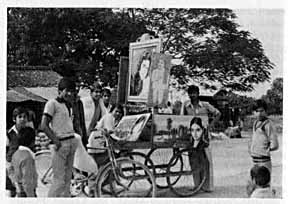
An ice-cream vendor at the Ramnagar fair in Magh (January)
Phalgun marks a change of season, from cold to warm, and as befits such liminality, has to be cautiously welcomed. Colds and sicknesses become more frequent; it can be chilly one day, unpleasantly warm the next—yet in consistent progression, nothing like the variability of Chicago or New England—for which it is difficult to prepare physiologically. To wash it all away is the festival of Holi, or Phagua, at the end of Phalgun, when everyone takes a dunking in water and is thus immunized against seasonal infections. The festival itself is crazy, and so is the month by association, because spring makes people restless, even demented, in inexplicable ways. Such was the power of this suggestion that I instinctively looked around for some demonstration of this spring madness in people’s behavior. Thanks to both the season and its supposed effect on humans, Phalgun was a wonderful period for my research, as I shall shortly describe.
Last, but in fact first, is Chaitra, the primary month of the year according to the North Indian Hindu calendar. In Banaras both Hindus and Muslims by consensus consider it the best time of the year (see fig. 15). One of my biggest thrills came when the staid and self-conscious Kishan Maharaj, samrat (emperor) of tabla playing, internationally famous, always dignified, aristocratic, the center of his universe, told me solemnly, “For me the best season is that of Chaitra. The river is at a perfect temperature: neither too hot nor too cold. You can go out on bajras (large boats) and have music to your heart’s fill…The best melas were in Chaitra…” This was a thrill because it followed closely upon Abdul Jabbar’s disclosure: “The month that I would consider most superior is Chaitra. The perfect season for going out…You know that the largest mela around here, the one at Chunar, is held in Chaitra. Then the celebration at Chandan Shahid, with music every Thursday for the whole month…” This was the testimony of Abdul Jabbar, poor, untraveled, with no self-consciousness, no empire, than whom a starker contrast to Kishan Maharaj could not be found. There were echoes of the same sentiment from whomever I chose to listen to, sighs of “Ah Chaitra!” from Tara Prasad, Mohan Lal, Matiullah, Mahadev Mishra— just about everyone in Banaras. It was infectious, and I found so much to observe and participate in at that time that I was full of enjoyment, too, and decided that my informants were extremely perspicacious people.
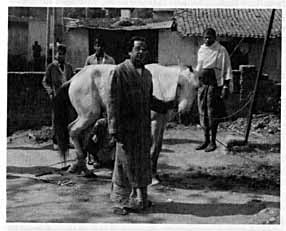
Tabla maestro Kishan Maharaj with the horse he keeps for racing
The weather contributed directly, of course—there was a tangible difference between functioning in the monsoons or in the summer heat and functioning in these near-perfect months—but there were many other reasons for this triumphant feeling of life. The reader may have discerned a steady development in the narrative from complaint on many fronts, including my own personality and ignorance, the reserve of the people, the difficulty of access to things unknown; to an assertion of control over events, circumstances, myself, and others. Partly this progress was simply a function of time. But most of all it was my growing knowledge: I found my feet in the city, I grasped its functioning, I could sense its motion, and I developed an instinct for the way its people’s minds worked. All of this may be summed up in another way: my research problem and my choice of location showed themselves to be appropriate ones, and I developed the talent for framing suitable questions. I remember feeling this very powerfully one fine day in March as I cycled around from one to another of that day’s stops (I had inherited my father-in-law’s strong old English bicycle). “I used to think that I would be doing this,” I told myself, “cycling around in Banaras, stopping to eat pan like a typical Banarasi, and cycling on…and here I am.” The image derived directly from what a friend in Chicago, returning from a year in Banaras, had told me. “So what did you do in Banaras?” I had asked him persistently. “Oh, I went around with my friends, eating pan…” was the best he could do by way of answer. Now in Banaras, I did not in the least feel strange on my bicycle, high, gent’s bike that it was, or imagine that people stared, or experience any diffidence about my being an outsider, a stranger, or a fool. All the thoughts that had plagued me daily during the initial two or three months had vanished like the monsoon clouds, and I now harbored a cheerful confidence, an optimism, unshaken by the inevitable everyday disappointments, that an endless vista of rewarding discoveries were yet to be made, each in turn rolling out yet more vistas.
What exactly had become different about my system of working? It’s a difficult thing to pin down. One tangible difference was that I was now a friend to many more people, almost in the literal sense of the word (“a person attached to another by respect or affection”), though my hidden agenda sometimes pricked my conscience. I spent many hours with people simply enjoying their company, sharing their activities, genuinely pleased at their pleasures and saddened by their sorrows, laughing at their jokes, and telling them some of my own follies. They discovered more about me than I had ever supposed they would. They came to understand me and my preferences, and we could each assert our own when necessary. “Are we going to the Maduadih shrine on Thursday?” would ask Abdul Jabbar. “Let’s take a taxi. It’s far, and the afternoon gets hot.” “Oh no!” laughed his daughters. “Let us go the way we usually do; that’s what she would like, she’s writing this book you know!” I was accepted, bag and Chicago-proposed research baggage.
The pleasure that I received from spending my days with the people I got to know was something of a surprise to me. I had heard from everyone returning from the field what a lot of fun it had been (apart from the inevitable gastronomic problems), but I had been hard put to imagine when and how the fun would begin, aside from the occasional satisfaction of a job well done. Then slowly, like a miracle, I became part of a world I had not particularly worked toward creating or belonging to, and that world was more compatible than any I had heretofore seen. I became extremely close to some of the many friends, particularly Tara Prasad, Brij Mohan, Guru Prasad, Mohan Lal, Shaukatullah, Markande, Alimuddin, Abdul Jabbar, and their respective families. With many others I had a hearty colleague’s relationship, tempered, of course, by my junior age and position, such as with the poet Shaukat Majid, the Maulana Abdus Salam, sundry priests and literati, and the great musicians Kishan Maharaj and Mahadev Mishra. I can say without romanticism that I discovered what “happiness” was. It was to reach one of their homes or places of work unannounced and to sit there without tension or worry, welcomed and loved, as long as I liked. All the little touches that came of my being a sister, daughter, and comrade added to the feeling of lightheartedness and acceptance.
An additional dimension had crept into my work: apart from accepting that I needed to exploit the resources embodied in these people, I realized that the pleasure I received from their company was unplanned and very powerful because it was reciprocated. Some spoke directly of prem, sneh, mohabbat, lagav (love, affection, attachment) as characterizing our relationship and thought nothing of philosophizing further on it, holding my hand, patting me on the shoulder, or looking into my eyes for a response. These unfamiliar expressions troubled and shocked me because they expressed an ease with emotions that I had never learned to communicate, and they made me dissatisfied because I did not have a similar repertoire of words and gestures to express my feelings in return.
Mohan Lal told me of an extraordinary adventure when, having not seen me in over a week and missing me terribly, he took a rickshaw on his own and set off, half deaf and blind that he was, to track me down. He did not have my address, only a vague notion that I lived “near Majda cinema,” so of course he wasted eight rupees learning what I already knew, “No discovery without an address.” This developing need for me, which many of my friends voiced, was an unexpected compliment, mirroring as it did my far more carefully planned need for them, and it made my throat catch with its starkness and vulnerability.
The other tangible development was the widening of my circle of acquaintances in impressively relevant directions. Guru Prasad was a friend cum comrade, friend because such was his personality and his family’s, comrade because he wrote poetry and considered me, as a writer of sorts, in the same category. I was also a daughter because of my age, though he was one of the few poor but practical people who did not feel it necessary to stand on ceremony for that reason. Quizzing Guru Prasad about the history of his art, I was given the name of another poet in Madanpura and told in the familiar, exasperating way, “You know the grand old house of the poet Nazir Banarasi? Take the second lane going in on the opposite side, if you are coming north from Assi, and ask anyone to direct you to Jameel Sahab the poet. He is a hafiz (one who knows the Quran by heart). There will be no problem finding him. He usually sits in his baithaka morning and evening. If you go before 8 a.m. it’s better.” The last was a difficult suggestion for me, but our household was certainly better organized than earlier, and though to leave at unscheduled times put everyone to some trouble, it could be done. On this occasion, the sparse directions worked out, and I traced Jameel Sahab without difficulty.
Jameel Sahab was a gold mine for me. Not only was he a poet with a well-developed sense of the history of poetry in Banaras, but also he was scion of one of the older (the oldest, according to his claim) families of Madanpura and able to hold forth at length on the history of the locality. Months later, he also disclosed that a nephew had in his possession an unpublished manuscript on the history of the weavers of Banaras. Moreover, Jameel Sahab could give me introductions to akhara managers in Madanpura, to madrasa committee heads, to the Barawafat festival organizers, to silk merchants, to designers, and to civil activists. Beyond all this, I sat with him many mornings in his baithaka, chatting about this or that. We had a lot in common because he was a poet, I a writer—he was appreciative of the fact that I used a nom de plume, Nita Kumar, instead of my married name; he was full of curiosity about everything in the world, and I was obviously driven by the same curiosity; he had been a Communist in the past, and I had lived in Moscow; he had plenty of time, being semi-retired from his profession of sketching sari designs, and I had all the time in the world; he loved to play with and observe language, and I was always preoccupied with how things were said; and most of all, he loved to haunt teashops, chat idly, call upon acquaintances, gossip…all of which were becoming not merely research tools but special weaknesses of mine. Unlike Abdul Jabbar, he had no speech impediment, was a well-educated intellectual with few prejudices and a lot of imagination, and understood that to befriend me or help me did not mean to wrap up my research with a wave of his magic wand. Abdul Jabbar, by contrast, thought that I was simply in trouble and that with his sincerity and help, I could be gotten out of it. At every moment he was ready to believe that the end was in sight, and that prospect haunted our every movement, so that as we were preparing to meet a fresh person or look at yet another mosque, the tenor of his talk would indicate that after this one time, God willing, the case could be closed and the whole burdensome problem of describing the culture of the artisans of Banaras would be solved forever. Jameel Sahab was obviously much more sophisticated. He was not quite certain of the general direction of my research (a reflection of my own stance?), but he ascribed sufficient complexity to it to tolerate all kinds of particular inquiries and questions as valid.
What intrigued me about the whole thing was the business of poverty. Jameel Sahab, it seemed, was as poor as poor could be. He lived on the third floor of a much-partitioned and ill-maintained house, and one reached his quarters by gingerly ascending steep slabs of stone, one side of the steps exposed to a sheer drop below. After several exhilarating intellectual meetings with him downstairs in his baithaka, the occasion arose to climb up to his rooms. I experienced a rude shock and had to refrain from gaping at the scenes of squalor that beset me. His relatives and co-sharers of ancestral property were apparently paupers, or chose to live as such. On reaching the top, pretend as I might, I was aghast: I was confronted with two tiny rooms, a family of apparently one-dozen adults and children, no furniture, poor possessions, grime and dirt, rags and tatters, and the toothless, smiling poet (he always put on his teeth when he came downstairs) amidst it all. He certainly had sufficient money to eat, educate his children, marry off his daughters, and be hospitable to his guests. Yet “poverty” was a way of life with his family. What struck me as extraordinary and unbearable (how unbearable, I cannot say) seemed to them entirely unremarkable. Although Jameel Sahab was poor, he was not as poor as his life-style made out. His life-style—living poorly, as I called it—was a cultural mode common to him, with all his learning and poetic talent, and to Abdul Jabbar, who was starkly illiterate and unliterary.
To the end of my stay, and throughout my subsequent visits, there remained this invisible wall between me and my best friends in Banaras: their imperturbability in the face of filth, overcrowding, disease, even death; their disinterest in cleanliness, family planning, home maintenance, and control of the environment; and, by contrast, my own nervousness about it all. They were as tightly conditioned as was I. I never got used to their idea of tolerable surroundings. Even at my most comfortable with them, I worried about this aspect of their culture, conscious that no matter how happy I could feel while with them, I would not like to be one of them.
This was also a big wall between me, with my growing love for Banaras, and the city itself. What I saw in each home, I saw on the larger scale as well: open drains, free urination, piles of garbage, no functional separation of spaces, no comprehension of germs and sanitation, a gay disregard of very obvious problems. These were not simple attributes of poverty, though because I visited mostly poor homes, I initially believed they were. But I also visited a sufficient number of wealthy traders’ and merchants’ homes to confirm that, no matter how different their income from that of ordinary weavers, they shared the weavers’ cultural world rather than what I naively had imagined to be a universal world of the comfortably settled, financially secure family, necessarily characterized by cleanliness and order. Nor was “living poorly” a function of illiteracy and “backwardness,” as Jameel Sahab’s case dramatically brought home. It wasn’t class and it wasn’t education; it was partly ages of being conditioned to live tightly in an overpacked city environment, where natural forces had once provided relief but where city services had not expanded proportionately to the population. Cultural proclivities—ways of dealing with refuse, techniques of cooking and washing—were no longer adaptive to the size of the population and the layout of the city. Cultural habits had a force of their own at this stage, and if the inhabitants of Banaras had been transported elsewhere, say to Siberia, they would speedily have proceeded to convert the new environment into a version of Banaras.
It should be obvious that while my world continued to expand in Banaras both qualitatively and quantitatively, there were some distances I could not bridge. There was always this one unspoken subject between my people and me. What could I have said to Jameel Sahab regarding his living arrangements? Why doesn’t someone sweep and mop this room? Why let the child urinate there? Why not wash in another part rather than make this mess? I shuddered at the very idea of this impossible insult, and I suppose, at the practical risk of creating a rift that may have proved injurious to my research.
19. The Pleasures of the Body
Another approach I adopted which was fundamentally different from my previous one was to take up a topic and concentrate on it intensely for a few weeks. I was not aware that I was doing this until I had explored wrestling akharas for most of March and then decided I must discover what the music called biraha was. One evening I had a team of milksellers singing up a storm in my living room when one Mr. Bahl, a wrestler and body builder of former all-India fame, who had taken the trouble to show me around many akharas, dropped in to pay me a visit. As soon as he entered, he smiled, “So! You’re doing music now?” And the whole picture became clear to me. I had “done” akharas, I would now “do” folk music, then bookshops, then Holi, then Hindu silk merchants, then Muslim ones…Mr. Bahl provided me with a useful handle.
To proceed in this topic-wise way became increasingly simple. Akharas had been a mystery as a topic, for I could find no academic work on the subject; they were also closed doors to me, doors, moreover, whose location I could not guess. On Luxa Road was a sign I had observed for many days, reading “The Health Improving Association.” That seemed explicit enough. I walked in one morning, following the narrow lane that led inside until I reached another gate with the same announcement. Entering that, I found myself in a walled compound with open land on one side and a concrete space shaded by a tin roof on the other. There were exercising devices all over the place, the parallel bars and dumbbells among which I recognized in a flash, though most were unfamiliar. I tried to focus on the many men doing various things on the far side. I hesitated to approach them not only because they were all busy but also because they were practically naked. I made some sounds and movements to attract someone’s attention. As soon as I had been observed, there was a visible shrinking away—how could they know that I was rather nearsighted—and even signaling for me to go away. I held my ground, and finally a fully dressed man emerged from the room adjoining the tin shed and came up to me.
“What do you want? This is a gents’ akhara! Whom did you want to meet? Where are you from?”
All I wanted to know had already been said, that this was in fact an akhara. I drew him aside and explained that I wanted to write about akharas and had walked in because of the sign. Could he help me? Mr. Bahl was an insurance agent, a rather typical middle-class Banaras gentleman in that he spoke in a mixture of Hindi and English to me and Bhojpuri to everyone from Banaras. He dressed in smart modern clothes, but underneath his covers, so to speak, he was also an avid wrestler and akhara goer. He was so enthusiastic about akharas that he wanted to see them publicized, and he saw me as a godsend. For the longest time he considered me a journalist who would write some eloquent articles glorifying akharas (illustrated with glossy photographs) in important magazines. After my repeated disclaimers that I was but a humble research student, he convinced himself that my whole book was going to be about akharas. This suited me fine, because it implied needing a vast amount of data, and I desisted from explaining too much. Mr. Bahl had a motorcycle, which, like a typical Banarasi, he was competent to wield through the narrowest galis and crossings. For the next few weeks, I was his guest in the world of Banaras akharas. Perched on the back of his motorcycle, clutching the seat with feigned nonchalance, I went systematically with him to the old and unused akharas, the new and flourishing ones, the famous ones, the unknown ones, the local neighborhood ones, the grand all-Banaras ones, until I myself was ready to declare that I had had enough.
I had been wary of the topic right from the beginning. I had taken immense pleasure as a youth in cycling, swimming, skating, riding, playing basketball, and even cross-country running. But my connection with sports was restricted to my own participation. I never read the sports pages of the newspaper, listened to cricket or any other sports commentary on the radio, talked about sports, or gave them a thought. I certainly did not intend to waste my valuable time researching sports. The importance of akharas had been established for me through my few months’ stay in Banaras, mostly from incidental talk and stray references, and I was resigned to the prospect of “doing” them as an unavoidable part of the subject of popular culture. What I discovered almost immediately was that sports did not mean simply muscular development. There was a philosophy to the practice, in this case a very articulate, holistic philosophy, that started to excite me as much as any other part of my research. The first and most eloquent presentation of it was totally serendipitous. I was in a press owner’s shop in Chauk, discussing printing and dissemination of literature. This was mid-morning. Entered his son, a man slightly more curious than his father, who asked me a few key questions about my research. He immediately exclaimed about the obvious part that akharas would play in such research and, being an akhara goer, just back from the akhara in fact, proceeded to expound on their philosophy. What he told me that day, sitting among the litter of paper and ink as I raced to record it all, could still serve as a treatise on the subject.
A very interesting thing happened. Here was I, professedly indifferent to sports after the age of twenty, my whole being centered on an intellectual pursuit to the exclusion of all else, listening to an account of a physical activity that was exclusively for “gents” by all accounts. I became absorbed, then mesmerized, then slowly converted into thinking that this was it, this was the pure philosophy, the holistic approach to life, the subtle balance between extremes that I had vaguely suspected must exist somewhere in the world. I loved every word I heard about akharas, and so enthusiastic did I become about them that I took extra trouble to go around and double-check all that I was told, suspecting that I had reached the point of admiration where I was capable of idealization, prejudice, and exaggeration. I was also afraid of giving proportionately greater time to akharas than the subject warranted in the overall scheme of things in Banaras, thanks both to my emotional satisfaction in pursuing it and to the capacity of the people of Banaras to be articulate about it.
Prem Mohan Bahl was not my only guide. There was the District Secretary of Wrestling, Banarasi Pandey, who spent many instructive hours giving me an overview of the phenomenon of wrestling. There was Rajesh Kumar Sonkar, a beautiful, perfectly proportioned man who had held the district body-building title every year from 1979 to 1981 and who showed me the clubs of his choice. But gradually almost everyone I knew became a guide to akharas or a source of information about them. Tara Prasad, fragile, bent, wrinkled, announced proudly that he had an akhara right in his home and showed me its remains. Indeed, broken, discarded joris, the pair of clubs used for swinging, were to be seen all around, now that I knew how to recognize them (see fig. 16. Nazir Akbar, one of my poorest and most spineless weaver friends, immediately picked up the pair languishing in his courtyard and swung them for my benefit. Incidents such as these clinched the akhara argument. Then I started hearing announcements for dangals, the wrestling competitions put on locally, and I witnessed as many as I could. If I had still been unconvinced or indifferent, the dangal crowds and accompanying excitement would have certainly made a convert of me there.
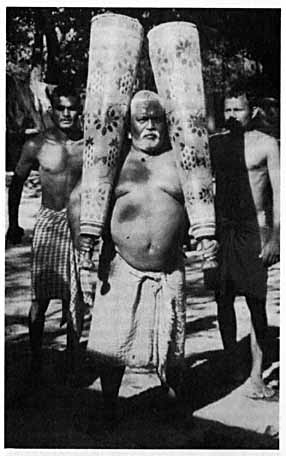
An enthusiastic akhara-goer swings his joris (clubs)
Such discoveries tell you a lot about yourself. I had believed that I was very keen on music but not a sporty type after the excessive energies of adolescence wore off. Yet when it came down to time, priorities, and the sheer labor of marching around dusty, filthy galis in pursuit of an object, I gave far more time, less grudgingly, to akharas than to the music of Banaras. I gave enough to the latter, God knows, but for all my tabla lessons and singing of chaitis and kajlis in the bathroom, I could more readily visualize myself as rolling in the mud of the akhara—and felt a kinship with those who did so habitually—than I could imagine doing more riaz (practice) at my music lessons.
A point has to be made about the masculine aspects of the whole business. Women never go to akharas, though there is a lore about women wrestlers and those who could do hundreds of push-ups a few centuries ago. Women constitute neither the audience of the competitions held in akharas nor the patrons of them in any other form. The reason seems obvious: the overall exclusion of women from all stimulating, self-developing public activity. For me there was also a pragmatic reason: men exercise in the barest minimum of covering, the langot, a string with a fig-leaf-sized cloth attached to the front. When resting or receiving visitors, they deign to put on their janghias (thin cotton underpants). Where is one supposed to look? Not merely into their eyes, or at their impressive gadas (the heavy wooden clubs encountered even in the epics), the idea being to observe the whole scene in all its detail. I quickly adopted the stance of the approving connoisseur of akhara culture, a situation, as in all those associated with art, where the sex, age, caste, or any other attribute of the individual is irrelevant. Whenever I entered an akhara, there was a change in activity, a hush, even actual retreat by a few into the shade of the trees. I would stay, quietly waiting for my presence to merge with the surroundings. Gradually people would continue with what they were doing. I would talk to a few willing ones, some would even demonstrate favorite styles to me, others summon friends to answer particular questions. As at music gatherings, no one laughed, commented on, or diverged from the conversation I initiated. All took for granted that I was learning about a precious fact of life. That I was a female made little difference; I was merely one of the wiser, more awakened ones of my species.
I never felt consciously excluded from this world of male exercise and activity, though all females by definition were. I was no feminist then, and in retrospect, it seems, it had escaped me that there was something to worry about, complain about, or resent. The akhara-goers were simply people for me, and their craft was sufficient food for thought. When I systematized all my information back in Chicago and sat down to write my first piece on akharas, I found myself saying, “And if there is anything to criticize in this system, it is that women are deliberately excluded from the culture of akhara exercise and body building.”
My inclination to think more as a “person” and less as a “woman” sprang from my personality, class background, and upbringing, of course, but it was greatly encouraged by the pragmatic demands of research and the fact that I was hardly exposed to women at all. When I selected artisans as subjects of study, I had no forewarning that those in Banaras would be exclusively male. But upon discovering that they were, and that their leisure and recreation comprised domains from which females were systematically excluded, I was not much concerned. The excitement of the work to be done was great enough, and it was supplemented by the comfort I felt in males as objects of study and as companions—as objects because I had been trained in a history and an anthropology that emphasized male worlds; and as companions again because of personality and upbringing, including education in the English “old-boy” style.
The people I spent time with, those who took me around and assisted me—all were without exception males. My sex perhaps made them more patient and generous with their time than they would have been with a man. But they did not explicitly or primarily think of me as a “woman,” in the sense of becoming protective, concerned, careful, or guarded with information. They assumed that I was competent and accepted me as their equal in intellect, imagination, and even physique. Tara Prasad always made me walk miles in every season of the year, Abdul Jabbar made me take rickshaws with him for unmeasured distances, Bahl put me behind him on the bike, and all demonstrated the inner details of whatever we were inspecting without reticence. I was shown the different muscles of the body and how they would develop with this or that exercise. I was told the particular relevance of celibacy to good living, why refraining from sex was the precondition of all success, and how the control of semen equalled the storing up of virtues (hira they called it, diamonds). Most of the terms for these things were incomprehensible to me (since I had never had a Hindi-speaking boyfriend or husband) till a later, more thoughtful time, but I do not remember anyone lowering his eyelids or pausing for breath at these moments in the conversation. My assurance that Banaras was a totally mature society, able to take in its stride women pursuing odd inquiries, appearing in forbidden places, asking unlikely questions, was further confirmed.
20. Holi Saturnalia
I had a shock in store for me on the occasion of Holi, the spring festival of the Hindus, which is described vividly in places like Anthropological Notes and Queries as saturnalia, reversal, carnival, and so on. I have played Holi every year that I have lived in India, which is to say the first half of my life at least, and I know it well. You wear old clothes, equip yourself for battle, and go outside with buckets of colored water and trays of colored powder—orange, blue, yellow, purple, red, and green. You greet everyone you see with a dusting of color on the face, and if you can manage it, with a shower of colored water on the body. In earlier years taisu flowers were used for dyeing whole tanks of water yellow, and the unwary would be lifted up and dunked in them. For playing or fighting we used metal syringes to squirt the water, quite genteel and harmless. In later years the flowers disappeared, the tanks were condemned as too rowdy, and mugs and pots came to be considered more practical than syringes for throwing color. Those in good spirits would simply lift the bucket itself and empty it on the target. All in all, I loved Holi, and each time I started playing it, I could not stop.
While the practices of Holi were familiar to me, its purposes were hazier: inversion of social order, of course, and creation of solidarity. The policemen of the city would pour into our bungalow in pickup trucks all morning to play rough and intimate with their boss, the S.S.P. It was overwhelming as I watched from a safe distance, usually the rooftop. Daddy would be so drenched with paint that he would have to change clothes three or four times during the morning. From my child’s perspective, however, I could see where the limits were. Children could act wild and grown-ups could join in, but in practiced ways. Grown-ups did atypical things: joke and laugh excessively, eat and drink bhang, get dirty, and embrace one another, but with self-control. Servants were embraced but continued to be on duty and to maintain the whole thing as a merry garden party through necessary service and obsequiousness. Structure girded the occasion; lines of separation marked genders, age groups, and classes, the outside/unknown and the inside/permissible.
“It’s unfortunate that I know Holi so well,” I told my husband on the morning of Holi 1982. “Now if I were an American researcher, I would have taken so much care to look into all the details of it, but me? What should I look into?” I felt guilty about not bothering to investigate something because I supposedly knew it already. But, as I said above, I was due for a shock.
I had heard Mr. Tripathi of Adampur thana mention a Holi julus (procession), or as he called it, dulha julus (bridegroom’s procession). This had alerted my senses a little, for I had never heard of a julus at Holi before. It sounded like the Western phenomena of charivaris and reversal at carnival from the little that I knew of them from European history. I immediately begged Mr. Tripathi to be allowed to witness this procession in his ward. “Begged” is the right word. Whereas otherwise I led and the inspector followed, on this occasion he seemed bemused and doubtful, and I had to plead with him that of course it would be all right. No matter what it was in fact like—I had vague images of rowdy, uncontrolled crowds, a combination of the Nakkatayya and spring madness—I had to observe it for my research. Tripathi acceded, and on Holi day I was present in his police station bright and early, before people were out on the streets with their buckets of color, or whatever they used in this part of the world.
In time we went in his jeep to a point where the procession could be observed, and there it was. About twenty men, unrecognizable in their identical colored clothes, all of them well washed with Holi colors, were dancing and singing. The song was rhythmic and musical, though I couldn’t catch the words. “What are they singing?” I asked my escort tactlessly. “You can’t hear them?” he asked half-suspiciously; “Well, I can’t tell you.” Then he added more kindly, “They are only joking.” I strained and strained, because I wanted to have just a tiny idea of the particular form their obscenities took, but I couldn’t catch a damn thing. The dance itself was pretty easy to follow. It was centered in the pelvic region, a vigorous shaking of the belly, not side to side as Hawaiian hula dancers favor but rather back to front. A few minutes of watching served to clarify that it was a mimetic version of copulation, with many parts in slow motion, exaggerated for effect, and dramatized. I had to watch the whole thing because once I was there, I had no way of leaving. In the middle of it all was a donkey with a rider sitting front to back, wearing a bridegroom’s headdress, and waving a gigantic penis made of rags and paper. This spectacle required no questions and no explanations. I looked on with a semblance of academic interest, but I would have preferred a small glimpse to extended observation.
The party came up to us and put color on the inspector’s face. I pressed back into the shadows. No one took any notice of me or approached me. The men went on, and we followed them in the jeep for the rest of the route, till I had the song, the dance, the donkey, and the whole scene well etched in my mind. I was ready to admit that I was shocked, that on this occasion I had been bested by the people of Banaras.
My next plan that Holi day was to zoom into Chauk, the heart of the city, and from a safe vantage point in the thana, observe the proceedings there. Because Chauk is far more densely populated than Adampura, more full of tortuous lanes and attached houses, and thus of “danger,” I took little Irfana along with me as a protective shield. Surely no one would dare to play rough with a young mother (my head was covered with my sari, in the manner of a sober woman) holding her baby. No one did, though in our very progress to the center of Chauk, we became as brightly colored as everyone else. Color, paint, and water were thrown liberally all around at no particular target.
What I saw in Chauk was another surprise, though a pleasant one. In the middle of the empty space that constitutes the center of Chauk stood a singing group, its leader elevated on a wooden stand. They sang song after Holi song, each lyrical, hearty, full of throaty abandon. People gathered around, came and went, played color, and embraced in the particular way that is customary at Holi, joined the singing, or listened, without any order or planning. The air was thick with powder being thrown by several hands, and all around was a sea of colored faces. It was a special scene in itself, but of particular beauty to me because it was Holi as I would have liked it to be played. It made me happy. It made me feel, “Where have I been?”
The difference between Chauk and Adampura disappeared at a point. At my insistence, the inspectors of both thanas unwillingly and guardedly presented me with some of the obscene publications that mark Holi, looking very unsure of themselves as they did so. I was triumphant, even if embarrassed that the literature actually had to pass hands in this “Pssst…! Care for some…?” style. The pamphlets were pure pornography, graphically illustrating as well as mentioning by name all the well-known citizens of each ward and some better-known citizens as well, such as Indira Gandhi.
What happened at Holi was that I finally resigned myself to the fact that popular culture could be “crude,” “obscene,” and distasteful to my genteel middle-class sensibilities as readily as it could be beautiful, aesthetic, and refined. I had found it relatively easy so far to separate these sets of characteristics, to shut out, for example, evidence of drinking and drugs, sexuality and obscenity, in my field of study. At Holi this became impossible. Although the Chauk experience was there for me to rejoice over, the procession was really much more central and powerful, impossible to block out. There were hundreds of such processions all over the city, and everyone knew about them. The distance between middle-class and popular culture was also brought home to me somewhat forcefully, because when I had left home in the morning I had thought I knew Holi from my own childhood experiences of it. In a matter of hours, I was rid of any such illusion and was back in my old familiar situation, confronted with a problem. I was lucky to be able to spend one full year more in Banaras and to leave only after the following Holi. This was an ideal situation: having observed Holi from the outside the first year, I went to informants the next and followed their activities with them. Again, holding on tight to my little daughter—she never showed any aversion to Holi activities—I played color in different homes. I had a Holi feast in Mohan Lal’s house, and with a newer metalworker friend, Chayen babu, went to Chausathi ghat for the Holi evening festivities. The relativity of noise and peace, of ugliness and beauty, of crudeness and refinement, the shifting definitions of each category, slowly fell into place.