
Secondo Libro a 5 (1544): Anthology in the Guise of Single-Author Print
The distinctive makeup of Rore's second book sharpens the contrast between Petrarchan sonnet settings and settings of lighter and (in part) more realistic verse
seen in his first. Of its scant eight madrigals by Rore, four set sonnets of Petrarch, two set occasional sonnets, one an occasional cinquecento madrigal, and one a little ballata-madrigal (see Table 8). All four of the Petrarch settings are placed consecutively (as nos. 15 to 18), the others, all by unidentified poets, ranged throughout the print (nos. 1, 3, 14, and 26). We will see that, as in Book One, this rough bifurcation of sonnets and nonsonnets throws into relief a general stylistic one.
With less than a third of its twenty-seven settings by Rore, however, we can hardly take at face value the title under which Gardane marketed the book: Di Cipriano il secondo libro de madregali a cinque voci insieme alcuni di M. Adriano et altri autori a misura comune novamente posti in luce a cinque voci.[41] Rore's contributions form only a few points on a map that plots a significant corner of the northern madrigalian dialect. Among the other madrigals in the volume, the most prestigious and prominently placed are Willaert's. The Secondo libro was the first publication to print Willaert's and Rore's madrigals in quasi-symmetrical proximities: Willaert's first setting, no. 2, was wedged between Rore's first two and his final one, no. 27, just after Rore's last (as if giving Willaert the last word). No. 2, the lengthy ballata-madrigal Sciocco fu il tuo desire (see Chap. 7, pp. 221-22), was followed by a sonnet setting of Rore's; and no. 27, the ten-line madrigal Qual vista sarà mai, came after Rore's little ballata-madrigal Deh, se ti strins'amore. Thus two "pairs" framed the book at front and back, with madrigals roughly equivalent in weight and size by each composer making up each pair. It is not surprising that the centerpiece of the book, Rore's four settings of Petrarch's sonnets, is unmatched by Willaert's contributions, since Willaert published none of his Petrarch sonnet settings until 1559.
Of the other contributors, the Roman-based Fleming Hubert Naich follows Rore in number with seven madrigals (nos. 4, 10-12, 19, and 24-25). His settings probably served as fillers, however. They are among the least engaged in the Venetian style that otherwise stamps the print — the least concerned with textual rhetoric or polyphonic breadth — and but for one setting of a Petrarch sonnet (no. 24), bizarrely truncated after seven verses, they are almost wholly disengaged from the high-styled literary verse prevalent among Venetians.[42]
The single madrigals by Arcadelt and Ferrabosco (nos. 20 and 21), both of whom had ties not to Venice but to Rome, also stand outside the book's Venetian charac-
[41] In addition, eight of the madrigals in the book had appeared (undoubtedly before Gardane's edition) in Scotto's reprint of Rore's First Book of the same year, of which six of the madrigals were Rore's. See Il nuovo Vogel no. 2391 (2:1480-81) and no. 2401 (2:1485-86) — Scotto's reprint of Book One and Gardane's edition of Book Two, respectively — and see the comments of Lewis, Antonio Gardane, p. 436, and the forthcoming catalogue of Scotto's printing house by Jane A. Bernstein.
[42] Another sonnet of Naich is apparently occasional, addressed to the "sacrato impero" and set in one part (no. 12). Four other settings are of madrigals (nos. 10, 11, 19, and 25) and another a short canzone (no. 4), all anonymous. For a good biography of Naich and summary of his madrigalian style see Don Harrán's foreword to his edition of The Anthologies of Black-Note Madrigals, Corpus mensurabilis musicae, no. 73, AIM, 5 vols. (Neuhausen-Stuttgart, 1978), I:xxix, and idem, "Hubert Naich, Musicien, Académicien," Fontes artes musicae 28 (1981): 177-94. It should be noted that all of Naich's madrigals had been published around 1540 by the Roman printer Antonio Blado in Naich's Exercitium seraficum (Rome, [ca. 1540]).
| ||||||||||||||||||||||||||||||||||||||||||||||||||||||||||||||||||||||||||||||||
(table continued on next page)
(table continued from previous page)
| |||||||||||||||||||||||||||||||||||||||||||||||||||||||||||||||||||||||||||||||||||||||||||||||
(table continued on next page)
(table continued from previous page)
| |||||||||||||||||||||||||||||||||||||||||||||
ter,[43] but each of the other contributors was in some way aligned with Venice stylistically and, in most cases, biographically. Clearest among these were Willaert's students Perissone Cambio and Girolamo Parabosco. Perissone's bipartite setting of a spiritual sonnet (no. 5) and Parabosco's setting of an octave adapted from Petrarch (no. 13) are both unmistakably Venetian works that will be taken up in Chapter 9. For both composers, the Secondo libro was the venue of their first secular vocal publications, along with Doni's Dialogo della musica of the same year.
Less obvious but sound enough claims to Venetian provenance fall to two final contributors, Jacquet Berchem and Leonardus Barré. The prolific Berchem spent time in Venice during the 1540s and may well have been sponsored by an ostensible
[43] Harrán, ed., Anthologies of Black-Note Madrigals I:xxix.
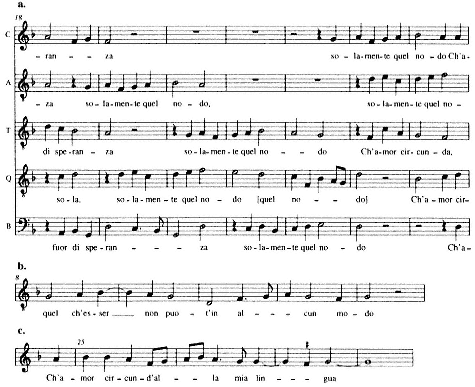
Ex. 27.
Giachet Berchem, Lasso, che desiando (Petrarch, no. 73, stanza 6): a, mm.
18-24; b, tenor, mm. 8-11; c, cantus, mm. 24-28; Di Cipriano il secondo libro
de madregali a 5 (Venice, 1544) (RISM 154417 ), no. 6.
patron of Willaert's, Marcantonio Trevisano.[44] Yet his contribution of a Petrarchan canzone stanza, Lasso, che desiando (no. 8), shares little of the syntactic and accentual precision or rhetorical logic of Willaert's settings, and the same is true of the Petrarchan settings, six in all, in his first book of 1546.[45]Lasso, che desiando does make modest efforts at Willaertian rhetoric, but it also contains instances of awkward text setting of a sort that virtually never mar the settings of Willaert's immediate circle. (Note, for example, in Ex. 27: a) the unvaried misaccentuation of "solamente" and the quintus's broken "sola-, solamente" [mm. 18-20]; b) the tenor's clumsy declamation of the cadential "non puot'in alcun modo"; and c) likewise, the misaccented cadence on "Ch'Amor circund'alla mia lingua.")
The work of the lesser-known Barré shows surprisingly deeper sympathies with Venetian practices than Berchem's. Barré had already debuted as a member of the
[44] See Appendix to Chap. 3, as well as Dale Emerson Hall, "The Italian Secular Works of Jacquet Berchem" (Ph.D. diss., The Ohio State University, 1973), esp. pp. 21-22 and passim; and George Nugent, "The Jacquet Motets and Their Authors" (Ph.D. diss., Princeton University, 1973).
[45] Mod. ed. Jessie Ann Owens, The Italian Madrigal, vol. I (New York, 1993). The ambiguities of text underlay in Berchem's book almost never appear in those of Willaert's students at San Marco.
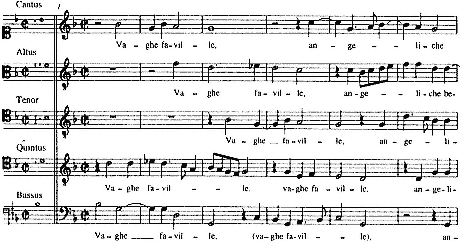
Ex. 28.
Leonardus Barré, Vaghe faville, angeliche beatrici (Petrarch, no. 72, vv. 37-45), mm. 1-6;
Di Cipriano il secondo libro de madregali a 5 (Venice, 1544) (RISM 154417 ), no. 8.
(then fledgling) Venetian school in the five-voice anthology Le dotte, et eccellente compositioni de i madrigali a cinque voci da diversi perfettissimi musici fatte, printed by Scotto in 1540 (RISM 154018 ).[46] Though he was a papal singer, the print's title page dubbed him a "discipulo" of Willaert's. The claim is not sustained by other biographical findings, but the style of his Vaghe faville, angeliche beatrici (no. 8), a setting of the sirima from the third stanza of Petrarch's canzone no. 72, makes it entirely plausible. Barré set the text in a motet texture, with meticulous accentuation and declamation and all the choice gauging of musical to verbal cadence emphasized by Willaert and Zarlino. As seen in Ex. 28, the first three voices of the exposition immediately preempt the possibility of a dominating tactus by staggering their entrances at the minim with the device that Zarlino called a "sospiro."[47] Subsequent entries are equally irregular, metrically and melodically, and delicately inflected with e-flats in a way that prefigures the nuanced Venetian-styled reading of subsequent passages.
A few observations, then. First, the Secondo libro, like Doni's Dialogo della musica, already evinces the diffusion of Venetian style beyond the chapel members and Rore to a larger circle. In this respect, the book offers a useful way to see the two composers now regarded as the style's most illustrious practitioners in relation to
[46] See Fenlon and Haar, The Italian Madrigal, pp. 313-16.
[47] See Le istitutioni harmoniche, Part III, Chap. 44, and Chap. 6 above, Ex. 5. The exposition's soggetto likewise collaborates in shaping Barré's introverted style: carried by the cantus and tenor as the third and fifth voices to enter, it conforms to the kind of exposition cautiously approved by Zarlino in which non-soggetto voices enter first, adapting themselves to a "real" soggetto that materializes only later. See Le istitutioni harmoniche, Part III, Chap. 28, and Chap. 6 above, n. 81.
surrounding lesser lights.[48] Second, to date none of the poets who authored verses in the Secondo libro has been identified save Petrarch (and provisionally the Petrarchan adaptation, no. 13). Given increasingly useful (if still limited) apparatuses for searching cinquecento poetic sources, this profusion of anonymous poetry looks less and less coincidental. Even in its own time the book probably divided roughly into anonymous poetry, on the one hand — synonymous with poetry never meant for collection or preservation outside of music — and Petrarch's poetry, on the other. Perhaps only one other print of Venetian provenance displays a division as strict, namely Perissone's Primo libro a 4 of 1547, which figures in my discussion in Chapter 9. Third, the rough division of poetry into two large branches — lighter anonymous and weightier Petrarchan — has broader ramifications. Petrarch's poems form the basis of a higher, more remote expression, while the anonymous ones run the gamut: some are set in styles close to those of the Petrarch settings, others are much lighter in tone. (The same sort of bifurcation marks Willaert's entire corpus, of course — a bifurcation duplicated in its patterns of preservation.) By juxtaposing Petrarchan settings with settings of anonymous verse, composers set a probing and timeless aesthetic against the simpler, more mundane countertypes produced by transient Petrarchan imitators.
The latter have their most characteristic embodiment in settings of occasional verse, whose worldly aspect manifests itself in three of Rore's four non-Petrarch settings, all of them celebratory: two wedding sonnets (nos. 1 and 14) and an encomium of one Isabella of Cremona (no. 3). Verse like this was much at home in the madrigalian anthology, since both celebratory settings and printed anthologies bore the social signs of commodification. Whether vended by composers or printers, both were publicly produced for capital consumption with an ear to easy appeal.
The opening madrigal of the Secondo libro, a sonnet for a Gonzaga wedding, speaks precisely out into this public space. The text opens in the first-person plural, familiar from songs for carnival and theater, calling up the image of costumed singers staging their song for assembled wedding guests.
Cantiamo lieti il fortunato giorno Let us sing joyously about the happy day
Che strins'a un nodo sacr'almo e tenace That bound in a sacred, life-giving, constant knot
Coppia si degna e con ardente face Such a worthy couple, and adorned this
Il fe divino amor leggiadro adorno. Divine, happy love with an ardent light. 4
Cantiamo lieti, che già d'ogn'intorno Let us sing joyously, for heaven is already rejoicing
S'allegr'il cielo, l'aria e 'l vento tace, All about, the air and the wind are silent,
[48] An inverse pattern of dissemination can be seen in the 1546 reprint of Verdelot's six-voice madrigals, Madrigali di Verdelot et de altri autori a sei voci novamente con alcuni madrigali novi ristampati et corretti (originally titled La piu divina . . . musica in 1541), printed, like the original ed., by Gardane. Its inclusion of works by Willaert, Parabosco, Perissone, Berchem, and Nollet (all of them represented in Doni's Dialogo della musica ), along with those of Verdelot, Festa, Arcadelt, Maistre Jhan, and others, justifies Fenlon and Haar's description of the reprint as having "a more Venetian cast" than the original ed. (The Italian Madrigal, pp. 317-18).
E 'l bel sereno appare, e già si sface And the weather appears serene, and already
A tutti gli animanti un bel soggiorno. A beautiful site is arrayed before all the lively ones. 8
La terra di novelli e vaghi fiori The earth paints itself with new and lovely flowers
Ovunque si dipinge e copre il manto And covers the mantle,
Di la felice et aurea età presaga: Foreshadowing the happy and golden age: 11
Verà che sol il mondo acqueti e It will come to pass that the sun may appease and honor
honori the world
Da l'alto seme glorioso santo Through the great, glorious, saintly seed
D'il fiero Marte e l'unica Gonzaga. Of the proud Mars and the unique Gonzaga.[49] 14
Rore's setting revels in sparkly melodies, with episodes of patter declamation, speechlike rhythms, and (intermittently) extended periods reminiscent of song. In the cantus's first fifteen measures a continuous strain arches from f to cc and back, with graceful diminutions cadencing on the final in the approach to the "Coppia si degna." In keeping with this melodious character, the setting's large-scale structure is more sectionalized than those Rore designed for Petrarch's sonnets. Highlighting the refrainlike anaphora of the first two quatrains, verses 4 and 6 both cadence with the full complement of five voices and on the final, which dominates the setting, followed by the unpretentious modal degrees a (mm. 30, 67, and 89) and c (mm. 61 and 84). Rore executes all this with crisp dispatch — a mere 114 measures for fourteen endecasillabi, whereas his settings of Petrarch's sonnets generally average between 130 and 160 measures. His other wedding sonnet, Scielgan l'alme sorelle, is equally short and similar in style, with buoyant rhythms, brisk declamation, and several multivoice cadences. In a way almost unknown in Rore's Petrarch settings (and more in keeping with later pastoral styles), many of its melismas are wholly unsyncopated (see the one drawn from the cantus in Ex. 29).
Even though the ethos of Scielgan l'alme sorelle is far lighter than that of Willaert's Petrarchan sonnet settings, the work exploited certain Musica nova -like techniques to evoke local rhetorical events without recourse to contrapuntal cadences. Most remarkable in this respect is the way in which Rore gives definition to the catalogue of virtues that opens the sestet (and the seconda parte; see Ex. 30). The passage did not escape Einstein's attention, and for good reason.[50] Yet his claim that "in 1540 only Rore could write a section as 'articulated'" as this one does not hold up in the face of an analogous passage from Petrarch's I vidi in terra angelici costumi set by Willaert; like Rore's exordium, Willaert's also opens the sestet and seconda parte (Ex. 31). In composing "Ardir, senno, virtù, bellezza e fede," the anonymous poet of
[49] The poem, for a spring wedding between a female member of the Gonzaga family and (possibly) a member of a Roman family, is difficult to translate because the grammatical relationships in vv. 3-4 and v. 12 are unclear. I am grateful to Stefano Castelvecchi for his help with it.
For Rore's setting see Rore, Opera omnia 2:108-12.
[50] See The Italian Madrigal 1:401.

Ex. 29.
Rore, Scielgan l'alme sorelle in li orti suoi, cantus, mm. 72-76; Di Cipriano il
secondo libro de madregali a 5 (Venice, 1544) (RISM 154417 ), no. 14.
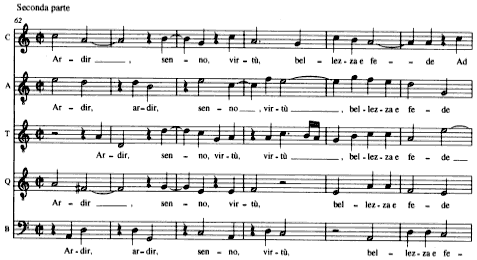
Ex. 30.
Rore, Scielgan l'alme sorelle in li orti suoi, mm. 62-67; Di Cipriano il secondo libro
de madregali a 5 (Venice, 1544) (RISM 154417 ), no. 14.
Scielgan l'alme sorelle surely glossed the rhythms, words, and word sounds of "Amor, senno, valor, pietate e doglia" from Petrarch's I vidi in terra. But did Rore's setting gloss Willaert's? This question raises issues of both chronological and musical relationships between the two. A definitive resolution of chronology is not possible, though it is likely that Willaert's setting came first. Einstein's view that in general the Second Book represents the earliest stylistic layer in Rore's oeuvre, that the pieces in it were leftovers from the First Book, and that Scielgan l'alme sorelle dates from 1540 (a claim unsupported by circumstantial evidence) was undergirded by his teleological view of the repertory.[51] It conflicts with the model I propose for Venetian madrigals in which different styles endured concurrently in connection with different kinds of poetry, for different kinds of occasions, and for dissemination in different kinds of sources. Probably the works printed in 1544 were mostly newer
[51] "Rore's eight compositions for this book . . . seem to me to represent a mere gleaning, all of which antedates the first book of 1542. This follows not only from their notation but also from their character, which is less sharply defined. One of them, Deh, se ti strins'amore, is a youthful work, still wholly in the style of Verdelot; others are occasional pieces whose early date will perhaps be determined someday by inferences from the texts" (ibid.).
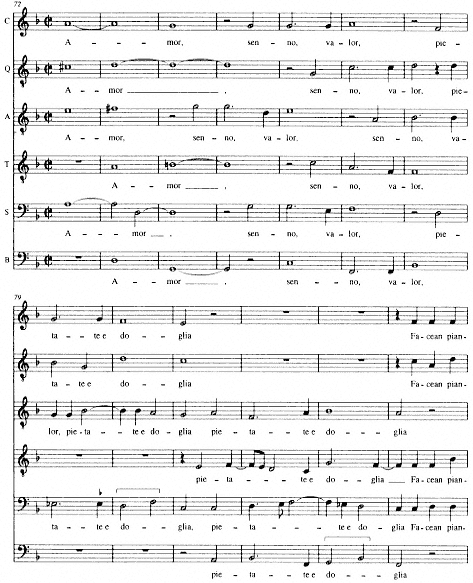
Ex. 31.
Willaert, I vidi in terra angelici costumi (Petrarch, no. 156), mm. 72-84; Musica
nova (Venice, 1559), no. 19.
than those of 1542 — at least in part — and more suited (as I have suggested) to inclusion in an anthologistic potpourri.
Questions of musical relationships are less difficult, for the two employ a fragmentary motivic counterpoint that is much alike. Despite differing pitch systems —


At least one other passage in the Second Book raises similar questions, a line from the madrigal Sfrondate, o sacre dive, v. 8, "Sgombrino l'altre voglie aspr'e selvaggie." This line echoes the incipit of Petrarch's sonnet no. 265, Aspro core e selvaggio e cruda voglia, just as Rore's setting echoes the striking exordium of Willaert's Musica nova setting of it. As noted in Chapter 7, Claude Palisca (among others) has remarked on the harsh parallel major thirds and major-sixth-to-perfect-fifth progressions of Willaert's exposition, as well as its copious deployment of melodic major seconds and thirds (see Ex. 16).[52] As seen in Ex. 32, Rore's setting makes comparable parallel motion at the words "aspr'e selvagge" and deploys linear major seconds copiously between the respective syllable pairs "a - spr'e" and "sel - vag-," with their descending tetrachords. (Minor seconds, by contrast, more often connect the two words to each other.) Given the intensity and exposed position of the parallel-third motion, later proscribed by Zarlino,[53] Willaert's passage bears signs of having served as the model.
Even so, correspondences like these suggest only a very partial obeisance toward Willaert on Rore's part, in addition to confirming Rore's participation in Willaert's practice through their mutual preoccupations with dense five-voice polyphony, Petrarch's sonnets, bipartite settings, and the like. Other aspects of Rore's madrigals — even general ones like choices of sonnets, ordering of sonnets by mode, extensive use of black notation, expansive proportions, and florid melismas — have little or no precedent in Willaert.
Again the musical clues to this relationship rest mainly on the Primo libro, for the Secondo libro is not really a single-author monument, as its title would have it — not a book by Rore at all, but one made to honor and profit from him. For us the Secondo libro helps situate Rore's early practice by clarifying his relationship to some of his contemporaries and affirming his recently gained status as Willaert's equal. In
[52] See n. 33 above and Zarlino, Le istitutioni harmoniche, Part IV, Chap. 32.
[53] See nn. 33 and 52 above. Vincenzo Galilei first drew attention to Willaert's breaking of the rule in Aspro core in order to justify it as an instance of imitation; see also Chap. 7 above, n. 60.
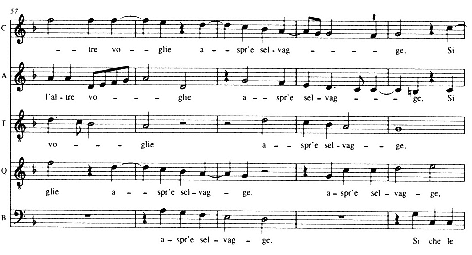
Ex. 32.
Rore, Sfrondate, o sacre dive, mm. 57-61; Di Cipriano il secondo libro de madregali
a 5 (Venice, 1544) (RISM 154417 ), no. 3.
this regard we should recall that Rore was the only composer in the Secondo libro by whom there were settings of Petrarch's sonnets at all, save the seven odd lines set by Naich. The only other complete settings of sonnets (both anonymous) are those of Willaert and his pupil Perissone, the latter of whom managed, through an ambitious act of entrepreneurship, to become the first acolyte to issue a book dominated by sonnet settings after Willaert's and Rore's leads.
Taken together, Willaert and Rore make an odd pair of figureheads: the one eminently visible to historical view, the other cloaked in mystery; the one moored in a single symbolic space, the other seemingly aloof from the enveloping constraints of place. The aesthetic hegemony that Rore was able to elude was rabidly Ciceronian and anti-Dantean. Even with such minimal information on Rore's ties and where-abouts as we now have, much can be understood by perceiving that his allegiances to Venice, with the many taboos and biases it demanded, must have been far more tenuous than Willaert's. To say so constitutes a substantial revision of long-standing assumptions initiated in the mid-nineteenth century by Francesco Caffi, who claimed that Rore had been a singer in the Chapel of San Marco.[54] Caffi evidently played off two notions that remain much discussed in more recent literature: one was a tradition dating back to the mid-sixteenth century for referring to Rore as Willaert's disciple, which emerged only in 1548 with the dedication of Scotto's edition of Rore's Third Book to Gottardo Occagna;[55] the other was the problematic
[54] See Francesco Caffi, Storia della musica sacra nella già cappella ducale di San Marco in Venezia (dal 1318 al 1797): riedizione annotata con aggiornamenti bibliografi (al 1984), ed. Elvidio Surian, rev. ed. (Florence, 1987); Surian corrects Caffi on p. 94 n. 2.
[55] See Chap. 3 n. 32, above. In 1549 Scotto again described works by "Adriano Vuigliart, et Cipriano de Rore suo discepolo" on the title page of the print Fantasie, et recerchari a tre voci (RISM 154934). The works in question include five madrigals, centrally placed and printed in alternation by composer (three by Rore and two by Willaert), in addition to seven ricercars by Willaert. A still more equal association between the two was implied two years later by Antonio Gardane's inclusion of two three-voice settings of "Regina caeli, laetare," one each by Willaert and Rore, in a related print (RISM 155116, containing seven of the ricercars by Willaert that were printed in 154934). These two settings used the same cantus firmus and were printed on facing pages.
assumption that whoever was chapelmaster must have had priority in fashioning the new style. The possibility that Caffi's assertions might someday prove right has now been effectively nullified by Giulio Ongaro's detailed documentary study of the chapel in Willaert's time,[56] but Caffi's opinion forms only the first in a line that has long viewed Rore unproblematically as Willaert's student.[57]
All the same, if Rore was as unfettered in the early forties as he seems — freelancing for worldly, nomadic Florentines and the like — we should recall that the allegiances to which Willaert was bound were multiple as well. Even the staunch, seemingly monolithic Venetianism Willaert served was fused with Tuscan tastes — not only through the elitism imposed on him by Capponi but by the Tuscan linguistic norms that Venetians promoted. In the ensuing chapter we will see some of the madrigalistic choices this alliance drew from students who appropriated and disseminated Venetian musical norms in the 1540s and 1550s.
[56] "The Chapel of St. Mark's at the Time of Adrian Willaert (1527-1562): A Documentary Study" (Ph.D. diss., University of North Carolina at Chapel Hill, 1986).
[57] See Einstein, The Italian Madrigal 1:384, and Meier, ed., Rore, Opera omnia 2:ii.