
Changing Styles of Performance
Even from the limited data available it is possible to make certain generalizations about the style and technique of Manas exposition during the eighteenth and nineteenth centuries. The predominant mode of performance during this period was the sequential narration in daily
[27] Among his pupils were Sant Chhotelal (d. 1983), Ramji Pandey (chief ramayani[*] of the Ramnagar Ramlila[*] ), Baba Narayankant and Ramnarayan Shukla (resident expounders of the Sankat Mochan Temple [see figs. 3 and 4]), and Shrinath Mishra.
installments of part or all of the Manas[*] . The special time for such katha[*] was late afternoon, from about 4:00 P.M . until the time of sandhya-puja[*] at twilight. The venue of the performance was usually a public place, such as a temple courtyard, a ghat, or the open veranda of a prosperous home. The speaker, who was usually called a kathavachak[*] or ramayani[*] , recited from a manuscript or a printed text, though of course his performance was not strictly confined to the words before him; he could elaborate upon or digress from any line of the text, and the extent and ingenuity of his improvisation was limited only by his knowledge and training. That even early-nineteenth-century performances could feature very extended exposition of single lines is suggested by the story of Ramgulam's twenty-two-day tour de force; however, systematic exposition of a single prasang (episode), kand[*] (canto), or when possible, of the complete epic seems to have been the more usual practice.
Many expounders had their own characteristic interpretive approaches for which they were famous. Baijnath Kurmi (c. 1833–1885), a literary connoisseur and a rasik bhakta (a practitioner of the mysticoerotic path of devotion to Sita-Ram),[28] utilized the terminology of Sanskrit poetic and aesthetic theory, while the Kayasth[*] expounder Sant Unmani (c. 1830–1898), author of the commentary Manas tattva vivaran[*] (Explanation of the Essence of the Manas ), interpreted the epic from the standpoint of yoga doctrine, and his katha is said to have had special appeal for practitioners of hatha yoga (Sharan 1938:913, 918).
The economic rewards for such nitya , or "continuous" katha , were generally modest. An expounder would usually be engaged by a patron—a landlord or the mahant of a temple—who provided nominal support in the form of meals and accommodation and became the official shrota[*] , or "listener," and beneficiary of the katha , though the performances would also be open to the general public. In addition to the patron's support, the performer received the offerings in cash and kind which audience members made during the ceremonial worship at the close of each day's program. Performers were often hired on a long-term basis—for example, for an exposition of the complete epic, which might require two or more years. The ultimate completion of such an extended performance would be the occasion for a special celebration sponsored by the principal patron, who would then bestow a generous gift on the kathavachak . However, many illustrious performers are said to have had little interest in financial gain, and when, as sometimes happened, wealthy patrons rewarded their performances with
[28] The only major study of this neglected tradition is B. P. Singh (1957).
lavish gifts, they chose to offer the money for pious purposes such as the feeding of sadhus.[29]
Daily katha[*] tended to focus closely on the narrative, and the performer might even choose to confine himself, in the praman s[*] , or "proofs," he cited for his interpretations, entirely to the Manas[*] itself, or to the other eleven works of Tulsidas, which acquired a kind of canonical status for the tradition. A common technique was to discuss each significant word in a verse in terms of its usage elsewhere in the epic. A gifted practitioner of this approach would delight his listeners by quoting line after line in which a given word was used, showing the different shades of meaning Tulsidas gave it in various contexts, and creating a sort of "oral concordance."[30] The appeal of such exegesis for an audience that knew the Manas intimately and accepted it as the highest religious authority is suggested by the following comments made by a contemporary katha -goer at Sankat[*] Mochan Temple, where sequential exposition of the epic is still presented each afternoon:
When a man comes to hear katha on the Manas , he wants all the praman s to be from that, because that is what he knows. What is the use for him if the kathavachak[*] shows off his knowledge by quoting from here and there? It will only confuse him. In the old days they used to use the Manas only, with maybe the Vinay patrika[*] —enough! Now they like to quote this and that, Vedas and shastras.[31]
The erudite quoting of "this and that," especially of authoritative Sanskrit texts, was a technique particularly associated with Ramkumar Mishra (c. 1850–1920), the leading expounder in Banaras at the beginning of this century, and it seems to have reflected a conscious concern among performers and audiences to demonstrate that the teachings of the Manas were in accord with—approving of and "proven" by—the Sanskritic "great tradition." A pupil of the Kayasth expounder Chhakkan Lal and a favorite of Maharaja Prabhu Narayan Singh (1889–1931), Ramkumar has been credited with developing "the brilliant and fascinating (modern) style of katha performance" (Jhingaran 1976:20). So great was his fame and so pressing the demand to hear him that Ramkumar began to travel about and give katha in various places, staying only a short time in each. An annual performance series
[29] Ramkumar Mishra is said to have summed up his attitude with the formula "Wear coarse cloth, eat coarse food; you are entitled to only enough [of the offering] to keep this body alive" (Sharan 1938:926–27).
[30] On the use of a similar technique in Christian monastic discourse, see LeClercq 1961:79–83.
[31] S. Singh, interview, Feb. 10, 1984.
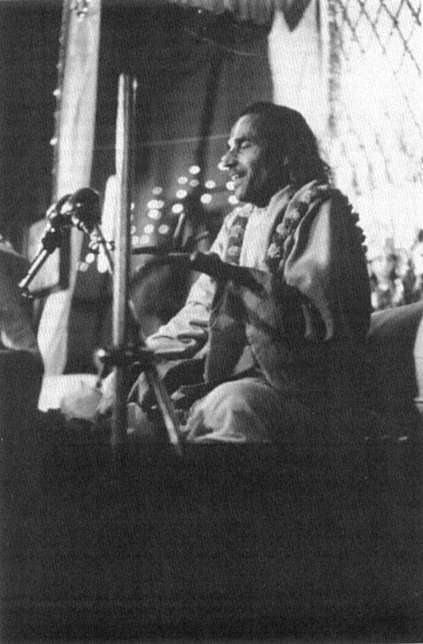
Fig. 4
Pandit Ramnarayan Shukla expounding the Ramcharitmanas[*] during the katha[ *
] festival at Gyan[*] Vapi[*] (November 1982). Photograph by Philip Lutgendorf.
in Banaras became a celebrated event, attracting crowds so great that the organizers were forced to make arrangements whereby people could reserve space in advance, to ensure getting a place to sit. A two-month exposition of the whole of Sundarkand[*] (the fifth canto of the Manas[*] ) in the courtyard of Ayodhya's largest temple was said to have been such a success that other expounders in the city—a traditional center for daily katha[*] —found themselves without audiences for the duration (Sharan 1938:926–27).
In time regular "circuits" developed, frequented by other traveling expounders, who likewise began to give shorter programs. This in turn affected the economic aspects of the art; since performers were no longer maintained by an individual patron or community on a long-term basis, they began to accept set fees for their performances. The patrons of this kind of katha were drawn less from the landed aristocracy than from urban commercial classes; indeed, one observer has termed the new style "Baniya (mercantile) katha ."[32] The underlying causes of this shift in patronage were the economic and political developments of the latter half of the nineteenth century, which precipitated the decline of the rajas and zamindars and the rise of urban mercantile communities such as the Marwaris.[33] Like the petty Rajputs and Bhumihars of the preceding century, the "new men" of the urban corporations found themselves in possession of wealth but in need of status, a dilemma which they resolved, in part, through conspicuous patronage of religious traditions.
Under mercantile patronage, katha performances began to be held later in the evening—after 9:00 P.M ., when the bazaars and wholesale markets closed. The leisurely and informal daily katha of the late afternoon, in which the performer was assured of a regular audience and a steady if modest income, was replaced by a more elaborate form of performance, held on a few consecutive nights before large crowds, requiring more complicated arrangements such as mandap s[*] and lights, and at which the performer's talent might be rewarded with a considerable sum of money. Since the expounder—who was increasingly honored with the exalted title vyas[*] —typically had only a single hour in which to display his talents, he abandoned systematic narration in favor of extended improvisation on very small segments of the text. The chosen excerpt became the basis for a dazzling display of rhetoric and erudition, backed up by citations of numerous Sanskrit works—a practice sure to win approval from the new class of connoisseurs. Such presentations, for which the performer typically prepared extensive notes in
[32] C. N. Singh, interview, July 19, 1983.
[33] On the economic changes of the period, see Bayly 1983:269–99; on the rise of a commercial community, see Timberg 1978.
advance, began to resemble academic lectures or speeches, although, like narrative katha[ *] , they were still delivered extempore and were liberally interspersed with verses from the epic, which were usually sung or chanted. Storytelling survived largely in the form of anecdotes, and the term pravachan —"eloquent speech"—became the preferred label for such performances, rather than the more "story"-oriented term, katha .
A subsequent and related development was the sammelan , or "festival": a large-scale, usually urban performance, which gave audiences the opportunity to hear, in one location, a selection of the most renowned Manas[*] interpreters of the day. The first such festival in Banaras was the Sarvabhauma Ramayan[*] Sammelan (universal Ramayan festival) organized in the mid-1920s under the auspices of the Sankat[*] Mochan Temple, a shrine to Hanuman reputedly established by Tulsidas himself but which in fact rose to prominence only in this century. Additional financial backing came from Munnilal Agraval, a prominent Marwari businessman.[34] The festival began on the evening following the full moon of Chaitra (the traditional birthday of Hanuman) and continued for three nights, with a series of vyas es[*] featured at each program. In addition to Banarsi expounders, well-known out-of-town performers were invited, their travel and lodging expenses were met, and they were given a cash dakshina[*] —the term applied to a gift to a Brahmin preceptor. The Sankat Mochan festival became an annual event, and its prestige made it an important platform for aspiring vyas es. To be invited to perform there and to make a favorable impression on the discriminating Banaras audience could represent a major break-through into a successful performance career, and some performers today still fondly recall their "debuts" there.
The same combination of Sanatani[*] leadership and mercantile financing that supported this festival was to lead in time to the mounting of even more elaborate programs, the prototype of which was the Shri[*] Ramcharitmanas[*] Navahna[*] Parayan[*] Mahayajna[*] (Great Sacrifice of The Nine-Day Recitation of Shri Ramcharitmanas ) organized in the mid-1950s at Gyan[*] Vapi[*] , in the heart of the city.[35] The instigation for this festival came from Swami Karpatri, who had become a celebrated figure because of his vociferous denunciation of the "secular" policies of the Congress government and his founding of a political party that promised to bring back "the rule of Ram" (Weiner 1957:170–74). Financial backing came from the Marwari[*] Seva[*] Sangh, a charitable trust organized by prosperous and socially conservative merchants.
[34] Nita Kumar, writing on Ramlila[*] patronage, has discussed the typical collaboration of merchants and religious leaders in organizing such events (1984:274).
[35] "Well of wisdom"; the site marks the location of a temple destroyed by Aurangzeb in 1669; see Eck 1982:127.
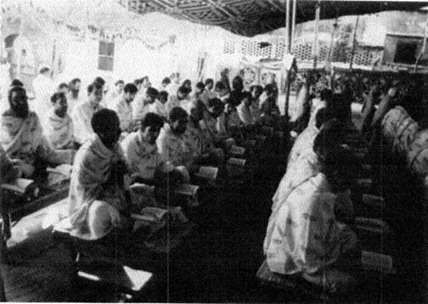
Fig. 5
One hundred and eight Brahmins chant the Ramcharitmanas[*] during an annual,
nine-day festival held at Gyan[*] Vapi[*] (November 1982). Photograph by Philip
Lutgendorf.
The special innovation of this annual festival was that it was organized around a nine-day ritualized recitation of the entire Manas[*] , conducted on the model of a vedic mahayajna[*] ("great sacrifice"). An auspicious hundred-and-eight Brahmins, identically clad in ochre robes, sat in long rows in a huge mandap[*] , surrounded by a circumambulatory track, and mechanically chanted the Manas for five hours each morning (see fig. 5), their voices echoing throughout much of downtown Banaras over a network of some three hundred loudspeakers. Other features included a diorama of opulently costumed clay images of Manas characters, special performances to commemorate important events such as Ram's[*] wedding and enthronement, and a climactic procession to the city's main ghat to immerse the images.[36] The public responded warmly, and merchant families vied with one another to engage in the meritorious activity of offering refreshments and gifts to the Brahmins—each donor's name being trumpeted over the public-address sys-
[36] The use of pratima s[*] (clay images) probably reflects the influence of Durga Puja observances, which have proliferated in Banaras during the past half century; see N. Kumar 1984:322.
tem.[37] As in a vedic yajña , the "breaks" in the sacrifice (in this case, the evenings from 7:00 P.M . on) were devoted to storytelling, that is, katha[*] . Lesser-known or aspiring vyas es[*] were invited to speak during the early part of the evening when the crowd was still assembling, to be followed later each night by three featured performers. In certain respects, the Gyan[*] Vapi[*] festival and its many spinoffs (by 1983 more than a dozen such annual programs were being held in Banaras) have come to resemble classical concerts or Urdu mushaira s (poetry recitation festivals). As at these performances, a strict protocol is observed, with the most highly respected performers invariably appearing last, and prominent connoisseurs often not arriving until just before the most famous vyas[ *] takes his place on the dais. Dress is traditional and often opulent, the atmosphere is formal, and there is frequently an element of tension and competition among performers, especially younger ones who are still establishing their reputations. In 1982 and 1983, the Gyan Vapi and Sankat[*] Mochan festivals each paid on the order of Rs. 250 per evening to featured performers, apart from travel and lodging expenses. This is a comparatively modest dakshina[*] for a successful vyas , but these festivals compensate by the prestige and exposure they offer, and so performers are willing to accept lower fees than they might command elsewhere.
One controversial development of recent years has been the advent of women performers, a number of whom have gained considerable renown (Upadhyay 1984:16–17). Several kathavachika s[*] were trained by the Banarsi expounder Sant Chhote-ji (himself a pupil of Vijayanand Tripathi) and have begun to make careers for themselves despite the continuing opposition of some conservative males who argue that women lack the adhikar[*] (spiritual "authority") to expound the epic. Women have probably always made up an important component of the katha audience, and a recent article in a popular Hindi magazine notes:
The ironic thing is . . . that there will often be a preponderance of women among the listeners. So those who are opposed [to women expounders] are clearly saying, "Yes, of course you can listen to katha , you can recite the Manas[*] too; but you can never sit on the dais and give katha !" (Jhingaran 1976:23)
Another trend, which has developed largely since the 1960s, is the increasing vogue among wealthy patrons for private performances, often in the patrons' homes or business institutions. The sponsors of this
[37] So lucrative has the program become that there is intense competition for the 108 places. I was told that a reciter could expect to take home upwards of Rs. 400 in cash, plus gifts of food, cloth, and even stainless steel utensils; S. Pandey, interview, Feb. 23, 1984.
new form of "aristocratic" patronage include, appropriately enough, many of the "princes" of Indian industry, most notably the Birla family of Marwari industrialists, who manufacture everything from fabrics to heavy machinery and have also been conspicuous in the construction and endowment of temples and dharmshalas. The Banarsi expounder Ramkinkar Upadhyay, who is widely acclaimed as the greatest contemporary vyas[ *] , has enjoyed Birla patronage for roughly two decades, and each spring at the time of Ram[*] Navami[*] (the festival of Ram's birth), he performs for nine evenings in the huge garden of "Birla Temple" ("Lakshmi-Narayan Temple"), a marble-and-masonry colossus about a kilometer west of Connaught Place, the commercial heart of New Delhi. The prosperous looking crowd includes thousands of office workers, many of whom bring cassette recorders to tape the discourse. Just before he takes his seat on an elaborate canopied dais that resembles one of the aerial chariots seen in religious art, Ramkinkar is garlanded by the patron and official shrota[*] of the performance, the head of the Birla family and chief executive of its vast corporate empire, who is dressed for the occasion in the dhoti and kurta[*] of a pious householder.[38]
Such munificent patronage has considerably upped the financial ante in the world of katha[*] , giving rise to the oft-heard complaints that contemporary performers "sell" their art, or that they have "turned it into a business" (Jhingaran 1976:21). But while there is a tendency among aficionados to idealize the great performers of the past for their alleged noncovetousness, many expounders readily concede that katha is indeed a profession and speak willingly and even proudly of the fees they are able to command. An ordinary vyas —a local expounder who rarely or never receives invitations from "outside" (an important criterion of success in Banaras performance circles)—may receive as little as Rs. 11 or Rs. 21 for an hour's program, but not more than Rs. 100. Some daily kathavachak s[*] still perform on a monthly stipend of only a few hundred rupees, supplemented by listeners' offerings.[39] The middle range of performers consists of those who receive Rs. 100–300 for a performance; a considerable number of well-known vyas es[*] fall into this category, and if they perform regularly, as many of them do, their incomes may be substantial. However, the hourly fees of the highest
[38] In 1983 the chief patron was Basant Kumar Birla, son of Ghanshyam Das Birla. His wife, Sarla, heads the Birla Academy of Art and Culture, which sponsors Ramkinkar's performances in Delhi and Calcutta and also publishes more than a dozen volumes of transcriptions of his katha s[*] .
[39] An example is the young vyas who performs each evening under the auspices of the Chini[*] Kshetra Trust in a lane near Dashashvamedh[*] Ghat. He receives a monthly stipend of Rs. 150; V. Tripathi, interview, July 20, 1983.
ranking or "All-India" expounders (so called because of their frequent invitations to perform in such distant cities as Bombay and Calcutta) are considerably higher. Shrinath Mishra of Banaras, the principal pupil of Vijayanand Tripathi, has a normal minimum fee of Rs. 500 per hour, and often receives upwards of Rs. 1,000.[40] Ramkinkar Upadhyay is said to receive in the range of Rs. 1,500–3,000 for each talk. Given such financial incentives, the reported proliferation of performers in recent years seems understandable.[41]
One of the most significant effects of the new style of entrepreneurial backing of Manas[ *]katha[*] has been to shift the geographical center of the art away from smaller centers like Banaras, where the springs of courtly patronage have long been dry, to such urban industrial centers as Bombay, Delhi, Kanpur, and Calcutta, where the wealthiest patrons now reside. This trend is lamented by some Banarsi aficionados, for while the city remains a major center for katha and a training ground of performers, the most renowned exponents of the Banaras-based "Tulsi lineage" (the parampara[*] , or "tradition," which traces itself back, through Vijayanand Tripathi and Ramkumar Mishra, to Ramgulam Dvivedi and ultimately to Tulsidas himself)[42] can rarely be heard in the city these days, and indeed seldom appear even at public sammelan s, as most of their busy schedules are taken up with performances in the homes and institutions of their wealthy patrons. Expert vyas es[*] , like virtuosi of music and dance, tend to go where they are best rewarded, and when they leave, their art departs with them. This fact serves to underscore the observation that Manas katha is much more than impersonal "commentary" upon a written text: it is an individual performance art that unfolds within a specific milieu.