
Chapter One—
The "Brahms Fog":
A Context for Early Schoenberg
In a letter written in April 1894 to his friend Adalbert Lindner, the twenty-one-year-old Max Reger (1873–1916) staunchly defended Brahms against obstreperous journalistic opponents. Reger conceded that Brahms's music might at first be difficult to grasp, but noted:
Brahms is nonetheless now so advanced that all truly insightful, good musicians, unless they want to make fools of themselves, must acknowledge him as the greatest of living composers. . . . Even if Lessman takes such pains to disperse Brahms and the Brahms fog [Brahmsnebel ] (to use Tappert's term), the Brahms fog will remain. And I much prefer it to the white heat [Gluthitze ] of Wagner and Strauss.
REGER 1928, 39–40
Reger refers here to Otto Lessmann, editor of the Allgemeine Musik-Zeitung in Berlin from 1881 to 1907, and to Wilhelm Tappert, a prominent Wagnerian critic. I have not been able to locate where Tappert coined the term Brahmsnebel,[1] but it is not hard to see (or guess) what he—and Reger quoting him—may have meant by it. When paired with Reger's description of the "white heat" of Wagner and Strauss, Lessmann's phrase makes for an attractive characterization of the notorious dialectic that dominated Austro-German music in the later nineteenth century. Instead of the more common military metaphor— Brahmsians doing battle
[1] Until 1888 Tappert was a regular contributor to two music journals, the Leipzig Musikalisches Wochenblatt and the Berlin Allgemeine Musik-Zeitung. The term Brahmsnebel does not appear in any of his writings for these journals that I have been able to discover. Nor does it appear in his several books on Wagner.
with Wagnerians—one composer and his followers are seen shrouded in a cold, dense mist, the other group radiating intense warmth and light.
Most scholars (and performers) have been attracted more readily to the brighter glow, to the phenomenon of Wagnerism and post-Wagnerism in Europe at the end of the nineteenth century. There has been less appreciation of the extent to which the "Brahms fog" penetrated to the heart of Austro-German music during the same period. "Brahms is everywhere," Walter Niemann remarked in 1912 near the end of an article in which he had briefly surveyed no fewer than fifty European composers whose piano music he said bore the unmistakable traces of the master's influence (Niemann 1912, 45). Hugo Leichtentritt observed similarly that "from about 1880 all chamber music in Germany is in some way indebted to Brahms" (Leichtentritt 1963, 449). The comments of Niemann and Leichtentritt could be applied equally to the vast quantities of Lieder issued by German and Austrian publishing houses in the same years.[2]
Perhaps as never before in the nineteenth century did young composers in German-speaking lands adhere so closely—and so proudly—to a single model when working in these genres. Reger could actually boast to Lindner in 1893 that "the other day a personal friend of Brahms's mistook the theme from the finale of my second violin sonata [op. 3] for a theme from one of Brahms's recent works. Even Riemann [Reger's teacher] told me that I really know Brahms through and through" (Reger 1928, 33).[3] Other testimony to Reger's Brahms-Begeisterung comes from the music critic Leopold Schmidt:
What brought us together was our joint enthusiasm [Schwärmerei] for Brahms. At that time this feeling was stronger in Reger than even his undenied love for Bach. He saw in Brahms a protector, a figure who could fight against the "program music" that he [Reger] so hated, against everything that had no form, no limits. At that time there was no trace of the easygoing manner one could observe in the later Reger. Especially over a glass of wine, he could become absorbed in long, serious conversations.
[2] Although there has been some investigation of individual Nachfolger of Brahms (mostly in routine life-and-works accounts, such as Deggeller-Engelke 1949, Holl 1928, and Kohleick 1943), nowhere do we get a genuinely critical or comparative account of Brahms's reception among composers of the period: of how his music affected that of his followers. Comprehensive bibliographies of Brahms-Forschung, arranged topically, may be found in Fellinger 1983, 192–96, and id., 1984, 203–6.
And his eyes would always shine brighter as soon as the discussion came around to "our Johannes."
SCHMIDT 1922, 160
Arnold Schoenberg would also in later years acknowledge his early admiration for and emulation of Brahms, not (as far as we know) over a glass of wine, but in essays, textbooks, and the classroom.[4] His earliest compositions also bear proud witness to this phenomenon. In the years through 1897, Schoenberg's works fall squarely into the three Brahmsian genres mentioned above: piano music, Lieder, and chamber music. From the point of view of style and technique, too, these works are very much enveloped in a Brahmsian fog. Evaluating and analyzing Jugendwerke like these compositions—the task of chapters 2 and 3 of the present study—gives rise to certain methodological problems. When a young composer turns to a powerful model, his works often become interesting more for what they reveal of his response to and assimilation of the model than for their own inherent aesthetic qualities. Study of such works may tend more toward reception history than to musical analysis. In the best music criticism, of course, the two endeavors should not be separated: a composition cannot easily be understood in isolation from its context, from its influences. In the commentary that forms the bulk of the next two chapters, I shall try to strike a balance between the two approaches—between an appreciation of the ways in which Schoenberg's earliest music is indebted to Brahms and an assessment of its more intrinsic qualities and merits.
In this regard it is worth letting the composer himself speak. The later Schoenberg would probably have been impatient with much of the Brahmsian imitation evident in his own early works and in those of other composers enveloped in the "Brahms fog." He had little respect for the imitation of a "style" in this sense, as he noted in an essay of 1934: "To listen to certain learned musicians, one would think that all composers did not bring about the representation of their vision, but aimed solely at establishing a style—so that musicologists should have something to do." Schoenberg felt that a work's "personal characteristics"—the style manifest in it—are merely "symptoms" laid over the essential "idea": "To overlook the fact that such personal characteristics follow from the true characteristic idea and are merely the symptoms—to believe, when someone imitates the symptoms, the style, that this is an artistic achievement—that is a mistake with dire consequences!" (Schoenberg 1975, 177–78).
[4] Schoenberg's 1947 essay "Brahms the Progessive" (Schoenberg 1975, 398–441) is only the most famous of his numerous appreciations of Brahms. See my own discussion of Schoenberg's Brahms-Kenntnis in Frisch 1984, 1–18. A comprehensive account is Musgrave 1980.
This formulation—style versus idea—was central to Schoenberg's thought throughout much of his life, and, of course, it furnished the title for his collected essays, Style and Idea, in 1950.[5] It also furnished the ostensible justification for much of his music, in which he often resolutely refused to follow any "style." But a young composer—perhaps especially a self-taught one like Schoenberg, whose only textbooks were scores, whose principal teachers were the great masters—will almost always forge his own style out of that of an important predecessor or contemporary.[6]
Something like the style/idea distinction can be a valuable heuristic tool in understanding the early works of Schoenberg and his contemporaries. There are composers and works that seem clearly more caught up in trying to "sound" like Brahms on a superficial level (the "style"); and there are those that try to plumb Brahmsian depths by employing more subtle technical and expressive devices (the "ideas"). As a preliminary to examining Schoenberg's early works, it will be useful to assess a small control group of Brahmsian pieces composed by two of his most talented contemporaries, Zemlinsky and Reger, from these perspectives. Although the sample cannot claim to be objectively "representative" (whatever that may mean in the aesthetic realm), it may nevertheless serve to shed light on the Brahmsian context from which Schoenberg emerged.
Zemlinsky
Alexander von Zemlinsky (1872–1942), who in the period 1895–97 or 1896–97 became Schoenberg's only teacher in composition (we can be sure of neither the
[5] Schoenberg fought hard to retain this title, about which the original publishers at Philosophical Library were not enthusiastic (see McGeary 1986, 184–88). The concept of a musical "idea," which Schoenberg reformulated many times, was to find its most complete exposition in a large manuscript, which remained unfinished, entitled "Der musikalische Gedanke und die Logik, Technik und Kunst seiner Darstellung." A scholarly edition of this work, the so-called Gedanke manuscript, will appear as Schoenberg 1994. For a survey of its contents, see Goehr 1977. On the various possible meanings of "idea" in Schoenberg's writings, see Cross 1980.
[6] It is possible that Schoenberg's strong reaction against "style" as both a creative tool and critical yardstick was owing to his proximity in Vienna to the music historian Guido Adler (with whom he actually shared students, including Webern and Wellesz). Adler's highly influential methodological studies (see, for example, Adler 1911) form part of a much broader phenomenon of style consciousness among both practitioners and critics of the arts at the end of the nineteenth century. In German-speaking areas, especially, the visual arts and architecture were dominated by the notion of Stilkunst and of art having its own "will to style" (Stilwollen). In art history these concepts were given their strongest formulation by the Viennese curator and writer Alois Riegl, whose ideas are discussed by Schapiro (1953, 301–2) and Alpers (1987, 140–47); Riegl had a powerful influence on his compatriot and contemporary Adler. There is no evidence of animosity on Schoenberg's part toward Adler's method. (On the relationship and surviving correspondence between Schoenberg and Adler, see Reilly 1982, 99–100.) The composer may nevertheless later have felt that the contemporary obsession with "style" was excessive and misdirected.
exact dates nor the content of the instruction), was one of the most promising young musicians in Vienna in the the last decade of the century. After an auspicious study period at the Conservatory under such Brahms cronies as Anton Door and Robert Fuchs, he served as a conductor in several Viennese theaters and opera houses (including a stint under Gustav Mahler at the Hofoper in 1907) and was widely admired as pianist and accompanist. In 1911 he moved to Prague as opera director of the German theater.[7]
In his early Viennese period, Zemlinsky was fully, and willingly, enveloped in the "Brahms fog." In his brief memoir of Brahms, he reports: "I remember how even among my colleagues it was considered particularly praiseworthy to compose in as 'Brahmsian' a manner as possible. We were soon notorious in Vienna as the dangerous 'Brahmins'" (Zemlinsky 1922, 70). Zemlinsky recalls that he had first been introduced to the master in 1895.[8] In the following year, Brahms took enough interest in a string quintet by Zemlinsky to invite the younger composer around to his apartment to discuss it (a devastating experience, described vividly in Zemlinsky's memoir). Shortly thereafter, at a competition of the Wiener Tonkünstlerverein, Zemlinsky's Clarinet Trio in D Minor won the third prize, for which Brahms himself had put up the money. This time, Brahms thought highly enough of the composition to recommend it to his own publisher, Fritz Simrock, in a letter that also praised Zemlinsky as "a human being and a talent" (Brahms 1908–22, 4: 212). Simrock issued the Clarinet Trio as Zemlinsky's op. 3 in 1897.
The period of Zemlinsky's personal contact with Brahms and of his most ardently Brahmsian works coincided directly with the beginning of his own relationship with, and instruction of, Schoenberg. These compositions thus merit careful consideration by anyone interested in Schoenberg's early development.[9] It is striking that the compositions of the more accomplished and highly trained Zemlinsky, although echt- Brahms in "style," actually show less real understanding of Brahms than the best works by the more intuitive, largely self-taught Schoenberg. We can see this phenomenon better by examining a small sampling—one song and one movement of a string quartet—from Zemlinsky's Brahms period.
Zemlinsky was proud enough of the song Heilige Nacht to place it at the head of his first collection of Lieder, op. 2, published in 1897 (see ex. 1.1). The anonymous poem, a hymn of praise to night, which covers everything in a cloak of
[7] For further biographical information on Zemlinsky, see Weber 1977.
[8] The occasion was the premiere of Zemlinsky's Orchestral Suite at a concert of the Gesellschaft der Musikfreunde on 18 March. Brahms led his own Academic Festival Overture in the same program. The event is described in Kalbeck 1904–14, 4: 400–401.
[9] A recent comprehensive study of Zemlinsky's early chamber works is contained in Loll 1990.
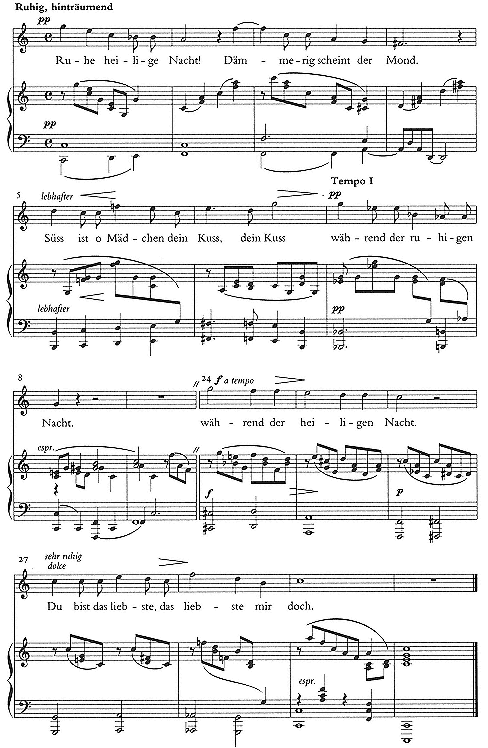
Example 1.1
Alexander von Zemlinsky, Heilige Nacht , op. 2, no. 1.
tranquility ("even sorrow is sweet"), is of a type that attracted Brahms strongly.[10] The characteristics of Zemlinsky's song that derive from Brahms are (to this listener) so palpable that they can be itemized:
· the broad, descending triadic melody, mm. 1–4. Cf. Brahms's Sehnsucht, op. 49, no. 3, where the slow ascending arpeggios of the opening are inverted in the faster middle section. There are also ascending arpeggios at the opening of Wie Melodien zieht es mir, op. 105, no. 1, and Maienkätzchen, op. 107, no. 4.
· the strong, stepwise bass line, especially in mm. 1–6. Cf. Dein blaues Auge, op. 59, no. 8.
· the arpeggiated figuration in the right hand of the accompaniment, which is shaped as a diminution of the vocal rhythm and motives, mm. 1–8. Cf. Mein wundes Herz, op. 59, no. 7. (On this technique of "harmonic congruence," see Cone 1990.)
· the dip toward the subdominant at the very beginning, mm. 1–2. Cf. An ein Veilchen, op. 49, no. 2, where, however, the tonic root remains in the bass underneath the subdominant triad. (See also the discussion of sub- and pre-dominant chords in Brahms's intermezzi below.)
· the sudden move by third, from a G to an


· the extension or augmentation of "während der heiligen Nacht" to create an irregular three-measure phrase, mm. 24–26. Cf. the augmentation of the phrase "tonreichen Schall" in An die Nachtigall, op. 46, no. 4, mm. 5–7.[11]
· the strong plagal cadence at the end of the song, mm. 29–30. Cf. the final cadence of Die Mainacht.
[10] At least twelve of Brahms's works are set to such texts, including (in alphabetical order) Der Abend, op. 64, no. 2; Abenddämmerung, op. 49, no. 5; Abendregen, op. 70, no. 4; An den Mond, op. 71, no. 2; Dämmrung senkte sich von oben, op. 59, no. 1; Gestillte Sehnsucht, op. 91, no. 1; In stiller Nacht, WoO 33, no. 42; Die Mainacht, op. 43, no. 2; Mondenschein, op. 85, no. 2; Mondnacht, WoO 21; O schöne Nacht! op. 92, no. 1; and Sommerabend, op. 85, no. 1.
[11] This and other examples of such phrase extension in Brahms's songs were pointed out admiringly by Schoenberg in "Brahms the Progressive" (Schoenberg 1975, 418–22).
Despite the distinguished, documentable pedigree of its technical devices, Zemlinsky's Heilige Nacht comes across as a pallid imitation of the master. First, the phrase structure is uncomfortably square. The rather rigid succession of two-measure units in the opening section, through m. 8, is scarcely concealed by the small modifications, such as in m. 6, where Zemlinsky repeats the words "dein Kuß" in order to extend the phrase another half measure. There is little here of the subtle asymmetry fundamental to Brahms's language. Nor would Brahms himself have undermined what is supposed to be a magical moment, the shift to the

Despite its apparent resemblance to Brahms, the harmonic syntax of Heilige Nacht also betrays awkwardness. Instead of an inflection toward the subdominant such as we might find in a Brahms song, the IV chord in m. 2 appears in root position; it is too emphatic, bringing the harmonic motion to a virtual standstill. Zemlinsky's actual cadence to F in mm. 8–9, though perhaps intended as a fulfillment of the opening harmonic gesture, is also unconvincing. The tonic has barely been reestablished in m. 7 when it is transformed into an augmented chord that is made to function as a dominant. The augmented sonority with an added seventh sounds especially bizarre in the prevailingly consonant context.
If I seem to be too hard on what is in many outward respects an attractive song, it is to point up that Zemlinsky is good at appropriating superficial stylistic traits from Brahms without really absorbing his fundamental compositional principles. This aspect of Zemlinsky's musical personality was recognized by Theodor Adorno, who in his penetrating essay of 1959 suggests that Zemlinsky was a genuine eclectic, "someone who borrows all possible elements, especially stylistic ones, and combines them without any individual tone" (Adorno 1978, 351). Adorno tries to strip the term eclectic of its pejorative connotations, arguing that Zemlinsky was in fact something of a genius in his "truly seismographic capacity to respond to all the temptations with which he allowed himself to be inundated" (354). I would argue that this "seismographic" receptivity actually prevented Zemlinsky from absorbing the essence of Brahms. He registered the aftershocks, so to speak, but failed to locate the epicenter of the tremor.
The same tendency can be seen in the first movement of Zemlinsky's String Quartet in A Major, which was published by Simrock as op. 4 in 1898. In the
[12] See, e.g, the perceptive analysis of such techniques in the song Feldeinsamkeit in Schmidt 1983, 146–54.
first group (ex. 1.2), the notated meter


In his commentary on this movement, Rudolf Stephan has suggested that "rhythmic complications of this kind point to the model of Brahms, who, however, does not employ them in this (almost) systematic fashion" (Stephan 1976, 128). The parenthetical "almost" betrays an appropriate diffidence, for I would maintain that there is little that is truly systematic in Zemlinsky's procedures. Indeed, it is Brahms who is more "systematic," if also more restrained, as can be shown by a brief comparative glance at the first movement of his Third Quartet in


To return for a moment to Zemlinsky's A-Major Quartet: Brahmsian symptoms are also evident in the ostentatious invertible counterpoint in mm. 5–6 and 7–8, and especially in the way in which the cadential neighbor-note motive of m. 4 (ex. 1.2) is taken up again in the transition to the second group (ex. 1.4). Here the motive, which sounds in

Brahms is the direct inspiration for this whole procedure. Indeed, Zemlinsky must have had the first movement of the Second Symphony in his ears: his neighbor-note figure bears a distinct resemblance to Brahms's basic motive,

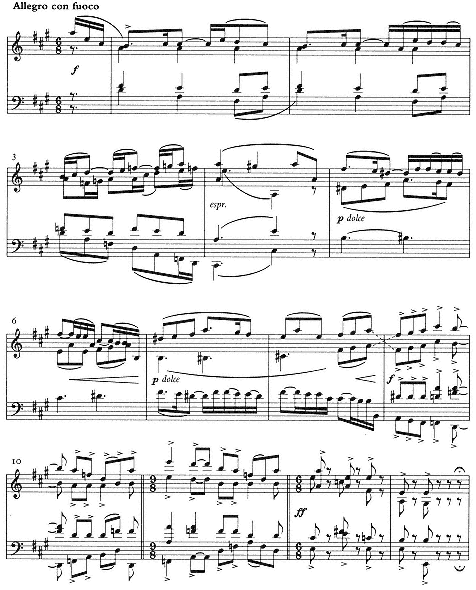
Example 1.2
Zemlinsky, String Quartet No. 1 in A Major, op. 4, 1.
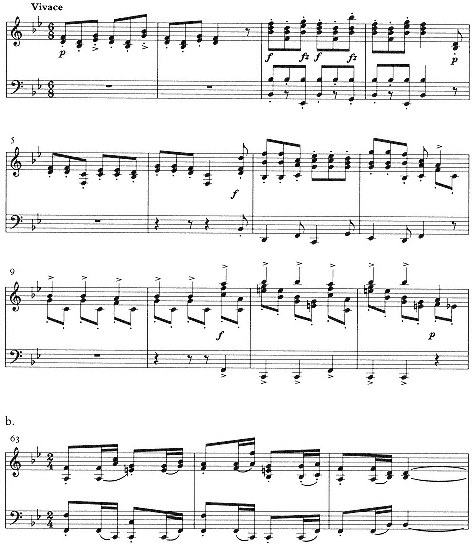
Example 1.3
Johannes Brahms, String Quartet No. 3
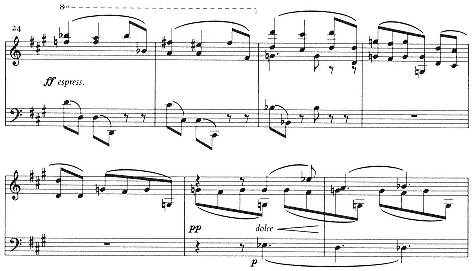
Example 1.4
Zemlinsky, String Quartet No. 1 in A Major, op. 4, 1.
the neighbor-note figure and its triadic companion in diminution and then moves the latter into the background to become the accompaniment for the new theme. At precisely the analogous moment in the sonata form, Zemlinsky adopts this same technique using the neighbor-note motive.
The conclusion to be drawn from these analyses may seem self-evident: no one could compose Brahms as well as Brahms himself. But I am suggesting that a superbly equipped composer like Zemlinsky can actually manage to sound very like Brahms—as he put it, "to compose in as 'Brahmsian' a manner as possible"—without showing a deeper grasp of what "Brahmsianness" really is or could be.
Reger
Like Zemlinsky, the young Reger wrote his share (more than his share) of pieces that imitate many of the master's "symptoms."[13] But there is also one brief, and for Reger rather restrained, work that does something more (and less). It is a short piano piece written after Brahms's death on 3 April 1897 and intended specifically as a memorial tribute. Reger published it in 1899 as op. 26, no. 5, with
[13] On the Reger-Brahms relationship, see especially Wirth 1974.
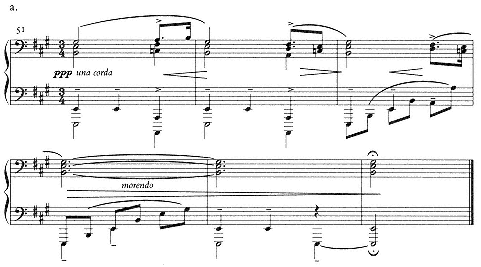
Example 1.5
Max Reger, Resignation , op. 26, no. 5.
the title Resignation and the subtitle 3 April 1897—J. Brahms† .[14] As a tombeau specifically intended to evoke the departed master, Resignation can hardly be taken as representative of Reger's work, or of that of other composers in the "Brahms fog" of the decades around 1900. Yet it shows perhaps better than any other individual work the different ways in which Brahms could be "received" compositionally.
We may distinguish four levels or degrees of Brahms reception in Resignation. Arranged in order from the most obvious or blatant to the most subtle, these might be called quotation, emulation, allusion, and absorption. The piece concludes with a direct, clear quotation of the theme from the Andante of Brahms's Fourth Symphony (ex. 1.5a). The reference could not be more patent; Reger even derails the tonic of Resignation, which up to this point has been A major, in order to bring the final quotation into its original key, E major, thus ending Resignation in the dominant!
[14] Resignation has a kind of companion piece, entitled Rhapsodie and subtitled Den Manen Brahms (To the Memory of Brahms), which is a large, turbulent work modeled closely on Brahms's Rhapsodies, op. 79. It was published in 1899 as Reger's op. 24, no. 6. Both pieces are discussed briefly by Lindner 1938, 165, who notes their "strongly Brahmsian stamp." Both are printed in Reger 1957, where the editor, Helmut Wirth, attributes them to the summer of 1898, even though the autographs bear no dates. I suspect that at least Resignation may have been written a year earlier, perhaps just after Reger heard about Brahms's death.
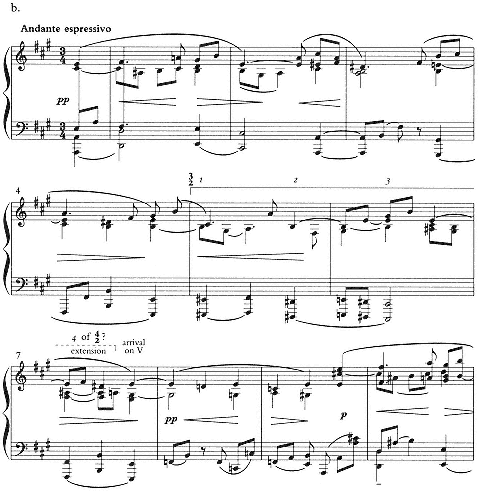
Example 1.5
continued
The body of the piece that precedes this coda shows a considerable degree of emulation, by which I mean a general stylistic imitation of what Schoenberg would call the "symptoms." Such broader features of Brahms's piano style were aptly described by Niemann in 1912 as "motion by thirds and sixths, their orchestral doublings, the preference for wide spacings and for a sonorous, dark, low register, [and] a self-willed rhythmic language, with a tendency toward syncopated and triplet figures of all kinds" (Niemann 1912, 39). Reger's Resignation clearly strives for this more superficial kind of emulation, as can be seen in ex.
1. 5b, which presents the opening portion of the piece. (The overall ABA' form of Resignation is also typical of Brahms's late piano works.)
But Reger also goes beyond emulation to allude more specifically to at least three late Brahms intermezzi that share the two keys of Resignation: op. 116, nos. 4 and 6, both in E major; and op. 118, no. 2, in A major (see exx. 1.6a-d). Reger's deep bass octaves recall 1.6b; the distinctly polyphonic texture, with active middle voices, is a feature of both 1.6a and c. Reger also adopts the opening gesture characteristic of all three intermezzi: Resignation begins on an upbeat with a root-position tonic chord, which moves on the subsequent downbeat to a predominant sonority, ii6 . Brahms uses similar harmonies on the downbeat: in ex. 1.6a, vi6 ; in ex. 1.6b, first a passing chord on A, then ii; and in ex. 1.6c, a

In Reger, as in exx. 1.6a and b, the precise configuration of the pre-dominant chord is obscured by appoggiaturas and (as in 1. 6a) by the holding of notes over the bar line. These rhythmic and/or melodic devices serve in each case to create harmonic ambiguity: we do not know whether to interpret the first chord as a tonic or as V of IV. In ex. 1.6b, Brahms also generates considerable metrical ambiguity. Our ear tends to hear the strong root-position chord as a downbeat, and the subsequent phrasing suggests a broad
At the approach to the dominant in Resignation, mm. 6–9, Reger draws upon precisely these kinds of metrical ambiguity or conflict. As we listen—at least for the first time—mm. 5–6 suggest a


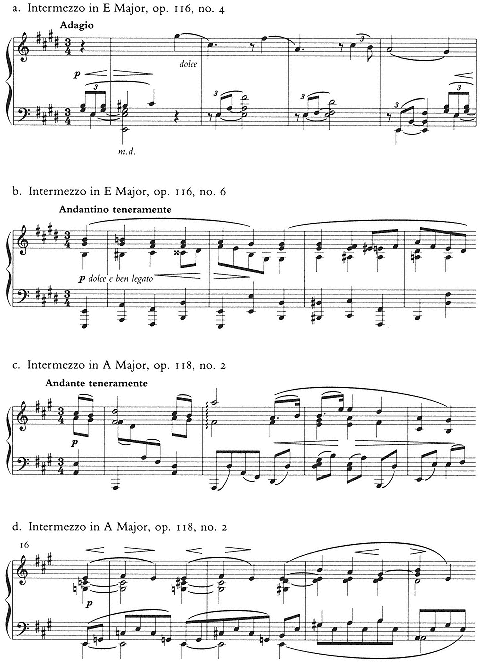
Example 1.6
Brahms Intermezzi.
ian gesture: the A enters a half-beat too "early," sounding deep in the bass underneath the prevailing dominant harmony.[15]
The elegant procedures involving meter, harmony, and phrase structure that I have analyzed in mm. 6–9 of Reger's Resignation fall into the last, most subtle category, absorption. Reger is making no apparent quotation of, or allusion to, any specific passage in Brahms; rather he has fully internalized some of Brahms's most characteristic compositional techniques. This is the kind of "influence" that Charles Rosen has characterized as the most profound, and also the least easily detected: no precise model can be found, and the search for one becomes essentially an endeavor of "pure musical analysis" (Rosen 1980, 100).
Resignation obviously appeared too late to have served as any kind of model for Schoenberg's early Brahms assimilation. A further investigation of possible "influence" in this traditional sense would have to examine the works of Reger that appeared before 1897, thus his opp. 1–16 (1893–96). (Unlike in the case of Zemlinsky's music, where we can assume that Schoenberg would have been familiar with works composed or published in the mid 1890s, we cannot be sure just what early Reger works Schoenberg might have known.) My point in examining Resignation has not been to claim that Reger served as model for Schoenberg, but rather to suggest how Brahms may really have served as model for them both. Even at its most "symptomatic," a work like Resignation can show deeper points of contact with the compositional essence of Brahms, as in mm. 6–9. It is this kind of absorption, rather than the more superficial imitation evident in some of the Zemlinsky works, toward which the young Schoenberg strove; this will be the essential subject of the next two chapters.
[15] Although I have found no specific instance of this procedure in Brahms's piano music, the overlapping of dominant and tonic at moments of return occurs in a variety of ways in the orchestral and chamber music. See Frisch 1984, 138–39, for a discussion of this procedure in the Andante of Brahms's Third Symphony.