
Nath Yogis and Narrative Folklore
Along with the bards of Rajasthan and the Shaiva and Shakta lavani singers, another unusual population contributed to the early Svang theatre. The ascetics known as sadhus , especially the followers of Guru Gorakhnath in the Punjab, originated several frequently told Svang tales, principally Gopichand (see fig. 5) and Puranmal (fig. 7). In contrast to the Lilas focusing on divine heroes incarnate in flesh and blood, the Nath yogis stressed faith in ascetic renunciation, magical beliefs, and Tantric mysticism. The Nath yogis (naths, yogis , or jogis ) are followers of saint Gorakhnath. Because of the initiatory rite of inserting a heavy earring (mudra ) into the pierced cartilage of each ear, they are known as kanphata (having split ears). Tales such as Gopichand's embody their beliefs: emphasis on conquering death and achieving immortality of the physical body, and rejection of sensual pleasure, especially congress with women.[61] They worship Gorakhnath as one of the nine Naths (lords, masters) and reckon Gopichand as one of the eighty-four Siddhas (adepts).[62]
The Naths were largely responsible for spreading Tantric beliefs and terminology among the masses of northern and central India, through their popular sayings or Gorakh bani . Yogis of the Nath sect established a formidable reputation among the villagers as curers, magicians, and masters of the occult. Most important for our purposes, they also functioned as singers, musicians, and popular entertainers. Through songs and stories such as that of Gopichand, they elaborated a redoubtable body of folklore to spread their sectarian message. Nath oral traditions
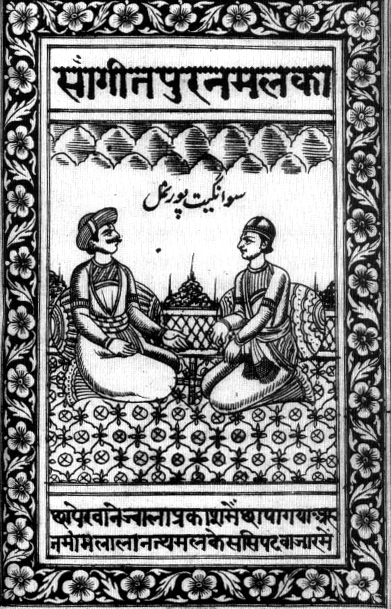
Fig. 7.
Title page of Sangit puranmal ka by Ramlal (Meerut, 1879). By per-
mission of the British Library.
are one of the main sources of the early Svang stories, and the yogis themselves may have been a primary conduit to the popular stage.
The Nath community had a substantial geographic reach. Its chief pilgrimage sites and monastic centers ranged from Hing Laj in Baluchistan, to Dhinodhar in Gujarat, Tilla in Punjab, and sites in Nepal, Bengal, and Bombay.[63] Nath yogis lived in settled caste units as well as in monasteries, and they also traveled in bands. Toward the end of the eighteenth century, these bands gained an unusual degree of political and economic clout in the absence of a strong central authority. Ascetic orders were heavily involved as mercenaries and traded, lent money, and owned property.[64] The proportion of religious mendicants in the population has been estimated by Bayly to be 5 percent around 1880 and significantly larger a century earlier. Briggs, reviewing census figures for the late nineteenth and early twentieth centuries, concludes, "simply, Kanphatas are very widely scattered and are exceedingly numerous."[65]
Not all Naths were bards, but the evidence from various caste groups suggests the sizable domain of their storytelling art. Briggs notes the involvement of many jogi groups in playing musical instruments, singing ballads, and preserving religious songs.[66] Raghunathji describes a Bombay beggar caste known as gopichandas engaged in the same activities.[67] In Banaras in the nineteenth century, Sherring mentions the bhartharis , "a sect of devotees who ... carry a musical instrument in their hands, on which they play, while they sing the exploits of Raja Bhart."[68] Recently, jogis in Meerut district, Uttar Pradesh, have been noted as singers of the oral epic of Guga , while in Rajasthan members of a Nath householder caste preserve the epic of Raja Gopichand.[69] Other authors document the important role played by jogis in the singing of ballads and transmission of folklore in North India.[70]
Although jogis have been professional raconteurs perhaps for centuries, there is no explicit evidence of their organization into dramatic troupes in the nineteenth century or earlier. The number of Svang stories of the period featuring the character of Guru Gorakhnath do indicate a substantial assimilation of Nath yogi lore, either through their direct involvement or through an intermediate agency. The measure of the Nath yogi contribution can be glimpsed in the first ethnographic account of the Svang stage, Richard Carnac Temple's Legends of the Panjab , which includes four complete Svang texts, three of them on Nath themes. Temple, a captain in the Bengal Staff Corps, collected an impressive body of folklore from the Punjab in the late 1870s and early
1880s. His three-volume work, published in 1884, contains the Svangs Raja Gopi Chand, Guru Gugga, Sila Dai , and Raja Nal , all composed by one Bansi Lal. He also includes metered texts of The Song of Puran Bhagat and The Marriage of Hir and Ranjha and a prose version of The Adventures of Raja Rasalu —all stories based on Nath lore.
Other nineteenth-century collectors like Abbott, Crooke, Steel, and Swynnerton attest to the popularity of Nath folklore and its particular association with the Punjab in their versions of Guga, Rasalu, Hir Ranjha , and Puran .[71] Further documentation of the staging of Gopichand and other Nath themes is provided by Pandit Hiranand Sastri, who describes performances in the Punjab on the "modern and mundane" heroes Gopichand and Puran.[72] The Gopichand story is called "the greatest favourite," and the manner of singing calls to mind the Turra-Kalagi tradition, with "two parties, each sitting on the tops of two different houses and there singing songs in turn by way of dialogue about midnight."[73] These colonial accounts go a long way toward filling the historical gap in our knowledge of Svang and Nautanki. They identify the recitational and performative practices that converged to enrich the early Svang stage and document the prevalence of a secular theatrical art in place in various locales by the midnineteenth century.
To recapitulate, this theatre did not spring suddenly from northern Indian soil: there was no dearth of indigenous theatrical entertainments—no critical "absence of dramas"—before the introduction of Western theatre under the British Raj. Nor was the Svang theatre an outgrowth of medieval devotionalism. On the contrary, secular antecedents of Svang carry its history well back into the eighteenth century and suggest an independent line of evolution. Chief among these was the flourishing folk stage of western Uttar Pradesh and Rajasthan termed Khyal, whose librettos predate the earliest known Sangit texts. The emerging Svang stage was also heir to the spontaneous poetry tradition of Turra-Kalagi and lavani , as well as to the narrative lore of the Naths, a prominent yogic order in northern India. These little-known performance arts all contributed to the formative stage of Svang.