
The Processes and Mechanisms of Network Formation
The family interrelations that led to a formal network of kin ties in San Diego are best illustrated by the mechanisms that aided in establishing these relations. A variety of social kin linkages helped produce solidarity between families from Baja California. These linkages are interdependent cogs in a larger sociocultural process that as a systematic whole produced an interconnected web of kin relations. The linkages occurred throughout migration and settlement, but it was only in the frontera that they brought together a number of extended families that otherwise would not have been part of this network.
A number of kin and kinlike linkages fostered by particular families and individuals brought unrelated participants together and promoted the development of kin institutions between families (especially in the case of nonkin). I refer to these particular families as apex individuals and families because of their role in linking the network at various stages of growth. The institutions of compadrazgo, parentesco, and
marriage were the final stages of the linkages in which ties were actually formalized.
Apex Families
Apex families helped develop a formal base of kin ties between previously related and unrelated families. These were important links that brought together the social fields of separate families, primarily through marriage and compadrazgo . These key families first provided a linkage for reciprocity between both settled and arriving migrants. Their own migration experience had introduced them to new families and friends. They became a common link between their own kin and new friends and between their various groups of new friends.
The common cultural and historic background of migrants was the initial base on which the extension of friendship and kin ties was built and deemed socially acceptable. This may seem obvious, but the regional particulars of Baja migrants backgrounds have specific importance in the development of this network. In addition to Mexicanidad[1] and common language, apex families and those they brought together shared a recognized history associated with the peninsula. They shared mutual relations with a number of nonrelated Baja families and brought about face-to-face contact and reciprocity between such families. Reciprocity and friendship eventually led to formal ties of kinship and an extension of the Baja Californio network.[2]
The family of los Simpson illustrates the apex linkage in the maze of closely related families I am describing. This apex linkage was fostered by premigration kin ties, migration friendships, multiple reciprocity and aid offered to friends and relations in the border region.
Los Simpson
The ties of los Simpson with other frontera settlers began in the cape pueblo of San Antonio and developed through the family's migration north. In San Antonio los Simpson knew the family of Loreto Marquez (to whom, descendants state, they were distantly related) before los Marquez went north to Las Flores around 1890.[3] The Simpsons also went on the mining circuit, where they met and united with other families that became part of the network. In Calmallí they met los Castellanos, Sotelo, Smith, Bolume, and others. Los Simpson eventually went to San Fernando, then crossed the border at Campo and headed east to Calexico.
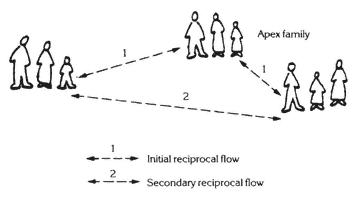
Diagram 11.
Initial reciprocity
The Simpsons' assistance to families entering the frontera shows the mutual aid and kinlike support they extended to other mining families. In Calexico they offered their home and assistance to the family of Don Pancho Sotelo until the new arrivals found work in Mexicali and moved across the border. In the same period Narcisso Castellanos, his wife Cleofas, and their children stayed with Guillermo and Artemicia Simpson until they too found work. The mutual friendships of the mining circuit experience were further enhanced not solely by the assistance and support offered by the Simpsons but also through the social sentiment and solidarity of mutual friendship between these families.
In a pattern now familiar the Simpsons left Calexico, traveled west, and settled in San Diego. There, once again, they received Pancho Sotelo and his family, who had left Calexico and now sought help in settling in San Diego. The Sotelos remained in the Simpson household until Don Pancho got a job and moved to Lemon Grove.
The kin linkages of the Simpsons are also illustrative of their apex role in the tight web of interrelations among the Baja Californio population. Los Sotelo speak about their kin relation to los Simpson. Descendants speak of this as a distant tie that became significant after migration. Confianza and friendships derived from the migration experience appear to be the important link that established close ties between the two families. Los Sotelo are related to los Simpson through Señora Artemicia Simpson (whom Guillermo met and wed in San Ignacio). Don Francisco's wife Angelina was Sra. Artemicia's maternal
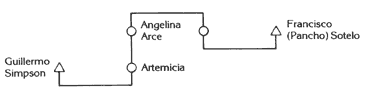
Diagram 12.
The kin ties of los Simpson and los Sotelo
aunt. These links were further strengthened among second-generation frontera offspring. The close friendships of the Sotelos and Castellanos provided a base for the marriage between offspring of these families. Refugio Sotelo and Tiburcio Castellanos were wed in San Diego, and when Guillermo Simpson's son (Guillermo II) married and had children, los Castellanos served as padrinos de bautismo (baptismal godparents), forming a compadrazgo relationship between these families. The linkage does not stop here. Guillermo Simpson (II) married Sarah Fernandez, whose family had come north from Santa Rosalía during
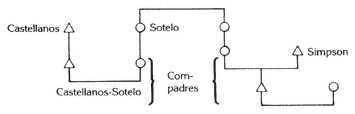
Diagram 13.
The compadrazgo relationship between los Castellanos-Sotelo
and los Simpson
the mining circuit period. This link united another network of families that had become acquainted on the mining circuit but had not become formally linked. Sarah Fernandez's sister Flora married Manuel Smith II, son of Apolonia Mesa and Manuel Smith from Comondú. Furthermore, the Fernandez family can be traced directly to the Mesas of Comondú, who are direct descendants of Apolonia Mesa-Smith.
The compadrazgo relationships between the Simpsons and the Castellanos-Sotelos, along with the marriage of Guillermo Simpson to Flora Fernandez, brought two extended families together into a web of relations. This network was further cemented by a series of compadraz -
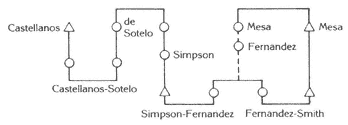
Diagram 14.
The Simpson linkage to Castellanos-Sotelo and Fernandez-Smith
gos and marriages. The most obvious and important is the second marriage of Don Francisco Sotelo himself. Don Francisco married Sarah Fernandez de Simpson's maternal aunt (Refugio) in the late 1920s (see diagram 15).
This complicated set of linkages illustrates the multiple sets of interfamily relations in Calexico and San Diego during the 1920s. This example is only a skeletal outline of the matrix of interpersonal relations between kin and nonkin in the frontera region which produced social fields among these families. The Simpsons, like other apex families, provided key links in marriages and compadrazgos which helped form a tight social community in San Diego during the 1930s.
Apex families and individuals play a role similar to that of centralizing women (see the history of the Gomez family in Lomnitz 1978). Like centralizing women, apex families provided emotional centrality and leadership for a variety of network members. This emotional sharing was based primarily on mutual experiences, confianza, parentesco, and the recognition of a similar sociocultural standing (class). This sentiment was further emphasized in the mutual aid and reciprocity of relations and extension of kinship between network members. Unlike the patron-client relationships discussed by Lomnitz, the role of apex families remains at the level of mutual aid; there are no "big men" of upper class and better economic standing who, because of class standing, become apex individuals. During frontera era settlement in San Diego, the network was a homogeneous class composed of laborers and small entrepreneurs. Indeed, economic aid and reciprocity was an important component of network development, but shared experiences, kin ties, and acquaintances that fostered parentesco and the mutual responsibility such sentiment requires were of prime importance. Apex families, like apex individuals, are also differentiated from
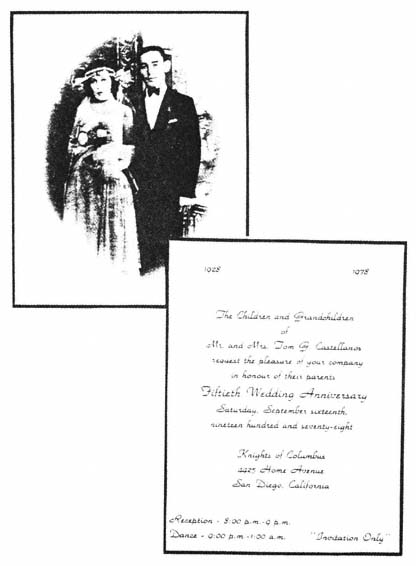
Family Invitation to Fiftieth Wedding Anniversary of Refugio Sotelo and
Tiburcio Castellanos
centralizing personalities because they aid in the formation of key kin linkages between a variety of families. The Simpsons clearly illustrate such linkages through various generations and members of their family.
Apex Individuals
Apex individuals are key individuals who, through their own marriages, compadrazgo ties, and experiences created specific network linkages within a large set of families.
Refugio Gonzales de Sotelo
Refugio Gonzales was born in 1888 in San José de Magdalena, a small town near Santa Rosalía, but after marriage she traveled north and eventually settled in Lemon Grove. Refugio was a direct descendant of the Mesas of Comondú, but she was raised primarily in Santa Rosalía, where her father worked in the mines of El Boleo. In 1916 she married Albino Vargas, a captain of small boats who commuted between various gulf ports, and the couple went to live in Guaymas, across the gulf. In the next decade she and her immediate family moved north to Nogales, where her husband died. She then crossed the border with her children and traveled first to Los Angeles, where she remained with her mother-in-law until 1928; then she moved south to Lemon Grove.
Refugio came to Lemon Grove because her parents (who had arrived in 1926 from Cananea) and a sister, Balvina Fernandez, were there. Balvina had married Antonio Fernandez (before Refugio married) and traveled north through the mining circuit to San Diego.
When Refugio came to Lemon Grove, she met a variety of other Baja Californios. Among the families and individuals she met was Francisco Sotelo, whom she married one year later, establishing a network tie between two family extensions that had been acquainted in the migration north as well as in Lemon Grove. The Sotelos were part of the network that included los Castellanos, Alvarez, Simpson, and other closely related families. Refugio's marriage formally served to link this network with the Mesa-Smiths. Although these families had known each other from other settlement periods, this linkage, like others between these family groups, helped formalize the previous acquaintances and interrelationships. The close ties of the Sotelo-Castellanos become evident in the marriages of Francisco Sotelo's daughters into the Castellanos family.
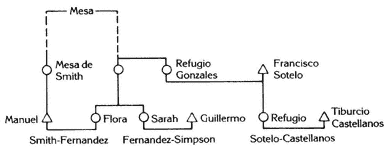
Diagram 15.
The linkage of Mesa-Smiths to Sotelo-Castellanos
Refugio Sotelo's linkage of the families also came through compadrazgo relations as well as through marriage. Tiburcio Castellanos and his niece Mercedes baptized Refugio's first son. This example illustrates only a fraction of the interconnections between these families.
Guadalupe Bolume
Guadalupe Bolume is a central figure in the creation of qualitative and dense relationships between Baja Californio families. Her experience in the mining circuit became a base for the extension of kin relations in her own marriage to a mining circuit migrant as well as in marriages between her own offspring and other Baja Californios who settled in San Diego. Her offspring married into families of original Baja pioneer migrants. Diagram 16 illustrates her central position, through her offspring, in formally bringing together these families. These marriages formally linking families were more than just expressions of solidarity between Baja migrants. The individuals of these families were close friends and were proud of the sentiment they shared. Romances and weddings developed from their closeness as did compadrazgos . Formal ties became ways to express close sentiment and relations between individuals and families. Such ties not only brought individuals together but they also formalized and ritualized social interactions in a number of social and cultural events practiced by these families. Baptisms, marriages, birthday celebrations, funerals, and U.S. and Mexican holidays alike became large network social events of kin whose roots lay in Baja California and the migration trail.
Apex individuals, then, like apex families, were not solely bringing together migrant families through marriage and compadrazgo . As
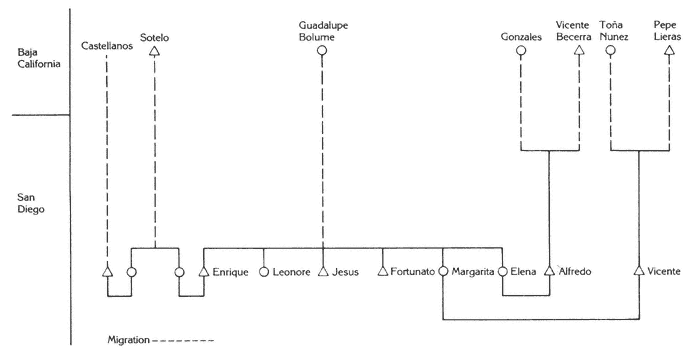
Diagram 16.
Marriage ties of Guadalupe Bolume's offspring showing network linkages and family origin in migration
central figures in the network they helped produce continuing ties that had begun in the migration process. These respected individuals continue to be recognized catalysts among the community of Baja families in San Diego.
The tight web of relations fostered by marriages between families was further intensified by the incorporation of non-Baja Californio families into the network. This took place in Calexico as well as in San Diego, but it was in Lemon Grove that such incorporation took on a specific role in maintaining interrelations of the Baja Californio community.
Incorporation
As Baja Californios crossed the border and settled in San Diego, other Mexicanos arrived and became part of the migrant community. Immigration from mainland Mexico had diminished after the turn of the century compared to the influx of mainlanders who had come in the decades of the revolution, when transportation was developing in the northern sections of the mainland. Nonetheless, some individuals and families continued to arrive and settle in San Diego. The sparse immigrant population congregated in a variety of neighborhoods, but Lemon Grove was the most prominent settling place. Some of these mainland families became incorporated into the network of Baja Californios.
Incorporation can be defined as the recruitment of (in this case, mainland) families which promoted boundary maintenance and internal cohesion of the Baja Californio network. The term recruitment is used loosely here, for Baja Californios did not actively seek out new families. Incorporation occurred as a natural process among individuals who shared a common language and culture. The absorption of new families served to pull specific families into the network and helped to solidify and intensify interrelations among Baja Californios.
Incorporated families united various Baja California families. Marriages between members of mainland families and individuals from a variety of Baja families created overlapping kindreds bringing Baja Californios together in formal kin connections. This is best illustrated through genealogical examples of intermarriages. The cases of los Bonilla and los Oyos are two such examples. Both the Bonilla and Oyos families came directly from the Mexican mainland and settled in Lemon Grove, where they met and shared daily experiences with the other members of that community.
Los Bonilla
Los Bonilla provided a base for a number of linkages between families settled in Lemon Grove. Los Bonilla were among the first families in Lemon Grove, settling there during the early decades of the century, before it became a Mexicano community. They lived within a quarter-mile radius of numerous Alvarez, Ceseña, Castellanos, Guilin, Sotelo, and Lieras family members who made up the basis of the network. Nine women were born to the Bonillas and were raised and socialized with Baja Californios and other Mexicanos.
The marriages of the Bonilla children reveal the close ties this family maintained with Baja Californios as well as the strengthened ties that developed between Baja Californios as a result of these marriages. Marriages between Bonillas and Castellanos, Bonillas and Ceseñas, Bonillas and Alvarezes, Bonillas and Gonzales-Nuñezes served to unite these families in formal relationships. Diagram 17 charts these marriage ties and the origins of intermarrying family. The immediate result
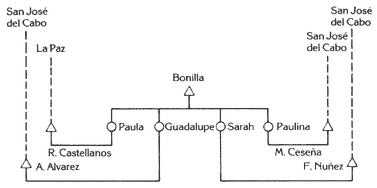
Diagram 17.
Bonilla marriage ties and origins of spouses' families
of such ties was the creation of formal affinal bonds between all these families and the development of a large kindred of interrelated Baja families of which offspring were members. Additional marriages reemphasized these ties. Alvarez married Smith (Comondú), Castellanos married Sotelo. These ties help to illustrate a complex set of inter-family relations that were in part created through incorporation. In addition to marriage ties, compadrazgo between these families was similarly multiple.
Incorporation can also be distinguished in later generations. The
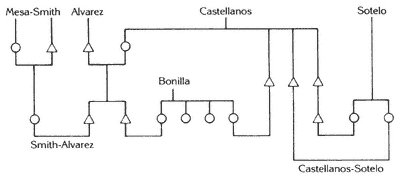
Diagram 18.
Continuing marriages of network offspring
marriages between los Oyos and los Sotelo-Castellanos is one such example that illustrates the maintenance of family solidarity and intra-family relations.
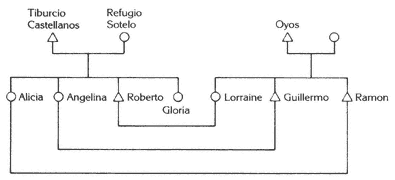
Diagram 19.
Castellanos-Oyos ties
Certainly such ties were not planned; nor was the sole purpose of these marriages to maintain tight family bonds within and between familia from Baja California. Los Oyos, los Bonilla, and other families had become close, respected friends who shared and contributed to the establishment of a strong sociocultural community of Mexicanos in San Diego.
The mechanisms I have discussed thus far were significant components in the formation of a strong network of kin relations among the families of this study. The apex families and individuals served to formally unite not only dyads (in the form of families) but myriads of families who were already familiar and shared bonds. Incorporation was equally important as a middle-ground process, bringing together a wide set of families who shared regional background, migration, and settlement. A similar mechanism is the tie between families resulting from recurring kin connections.
Recurring Kin Connections
The processes I have been describing are manifest in a specific pattern of recurring kin connections which becomes evident when viewed over several generations. Recurring kin connections, along with the other kin processes and the mechanisms of incorporation and apex families, aid in the identification of a true sociocultural pattern. Viewed in this way, the network is not solely an arbitrary set of relations that brings together a group of families with similar histories. It is a sociocultural pattern identified by a specific history, specific institutions, and shared sociocultural behavior.
Recurring kin connections are specific kin ties that developed in Baja California and recurred after the families' migration to the frontera zone. Such ties are best viewed in marriage ties between families over several generations and are evident between descendants who intermarried in the U.S. a half century and as much as a century later. When viewed in relation to the migration experience, these recurring ties encompass a field of border families that previously shared relations or were closely linked through extended or affinal kin ties. Ties of this sort not only united two family branches but they helped sustain and reinforce kin and social relations while creating new bonds based on contemporary sentiment and mutual support. The resulting pattern of linkages help create and solidify the community in San Diego (see diagram 20).
Family ties in San Diego in the early twentieth century intensified for a number of reasons, for extensions of kin relationships coincided with a dramatic period of change. New social forces were shaping international attitudes and U.S. and Mexican government relationships as well as the face-to-face relations of immigrants and natives who settled in the border zone.
The impact of the border environment, especially for those who settled in the U.S., was a major force intensifying the mutual help and kin ties that led to a discernible family network. Across the border in the nearby towns of Tijuana, Tecate, Mexicali, and Ensenada, no similar definable network developed. Early migrant pioneers from the south did intermarry, but once the Baja families settled in the northern peninsula they began to intermarry with other Mexicanos from the mainland. During this period Tijuana and Mexicali were propelled into the limelight as urban nuclei and receiving zones for one of the greatest migrations in Mexican history.
The families that returned to the peninsula and those that had remained in the Mexican border towns did not share the need to perpetuate a sociocultural identity because they were not threatened by a foreign culture. They settled in Mexican towns, intermarried with Mexicans in a natural fashion, and extended kin institutions among other northern settlers. In San Diego, however, individuals were in a non-Mexican environment and had to seek out other Mexicanos and in this case trusted kin and acquaintances to be assured of successful sociocultural survival. The relationship of experience, mutual kin, regional ties, and history surfaced as a common ground for mutual aid and support in a precarious environment. Numerous family departures from the United States bear witness to the problems of cultural dissonance as do the marriage partners chosen among San Diego families. Among los Sotelo, the two children who remained with Don Pancho in Lemon Grove married into a Baja California family that had been their persistent companion from the days of the mining circuit (los Castellanos). The other four children who were not in Lemon Grove married Mexicanos from the mainland. Two had remained in Mexico before marrying, the third had gone to live in Tijuana before marrying, and the fourth individual had traveled north to San Pedro where he also married a mainland Mexicana. The history of other families reveals similar examples. More evidence is manifest in the marriages of pioneer migrant offspring who returned to Mexico. In these cases marriage to native Baja Californios was rare. Communities in Mexico were and are settlements of regionally integrated Mexicanos.
My purpose here is not to prove the uniqueness of Baja Californios in the United States but to show how these people used Mexicano family institutions within new and threatening sociocultural circumstances. The creative adaptability of these institutions and people allowed sociocultural survival and long-range cultural maintenance. Like
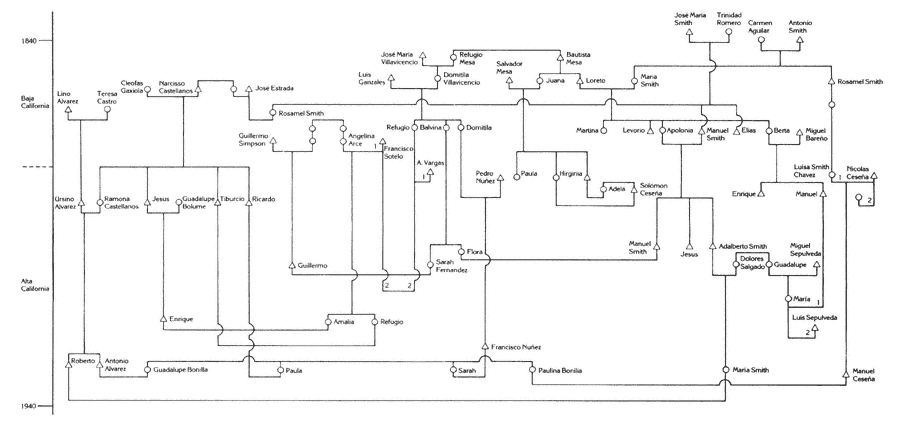
Diagram 20.
Prominent examples of recurring kin connections in the family network, 1840–1940
other migrant communities, Baja Californios illustrate the propensity and flexibility of cultural institutions to preserve and create new patterns without creating social disequilibrium.
Family Ideology
Regional ties, hometown sentiment, and the relationships based on such geographic bases all contribute to a body of ideas shared by Baja California migrants. This body of ideas as an ideology is specific to individuals and families who arrived and settled along the frontera during and after the turn of the century. As a manifestation of the regional ties and experiences shared by Baja Californios the ethos was internalized and became a mechanism and promoted the development of the network. This ideology is identified and expressed in both communication and behavior and is perhaps the strongest identifiable sentiment that had been expressed by pioneers and their offspring. People speak of the peninsula in terms of the early individuals who passed through specific geographic areas and in terms of hometowns, friends, and kin. Los Smith, los McLish, los Simpson, los Green are names important in lore particular to the peninsula and elicit tales of peninsular history, early settlement in San Diego, and continuing ties with the peninsula. Tales and manifestations of kin meeting kin, of travels in the peninsula, of hardships, and of nationality combine to form an ideology that stems not only from the main Mexican cultural background of Baja Californios but from the shared experiences of migration and settlement. The ideology, in part, strengthens ties to the peninsula but at the same time is unique in strengthening intrafamily recognition and identity. Ideology is expressed in a variety of ways. It is expressed in patriotism to Mexico, in nationality, in the choice to have children born on the peninsula, and in family lore.
Mexican nationality and patriotism is perhaps the clearest early manifestation of this ideology. Many pioneer migrants, although settled and working in the United States, maintained strong sentiment for the peninsula. This can be viewed as Mexicanidad, but overall patterns and expressions by individuals indicate the importance of the peninsula in such manifestations. In one case a pioneer who had arrived in San Diego in 1907 returned to the peninsula in 1911 when an American-led group of Industrial Workers of the World invaded Baja California. He returned to defend his country against the sin verguenzas (shameless) Wobblies who had entered with the intention of creating an inde-
pendent socialist republic. He joined the Mexican army and served as a guide in his home area. When the invasion had been repulsed, he returned to San Diego. On another occasion he returned and volunteered for the Mexican army when the United States marines landed in Vera Cruz, because, as he states, he did not want Baja California to fall into U.S. hands like Texas had.
The births of the Castellanos children can be interpreted as another ideological statement (see chapter 4). Each of Narcisso's nine children was born on the peninsula. Even after Narcisso immigrated to San Diego, he insisted that the family return for the births of the last two offspring. So in 1906 and 1908 the family returned to the mining circuit. To this day Tiburcio, who was born in Julio César, has proudly retained his citizenship, although he has spent only four years of his life in Mexico and continues to live in Lemon Grove.
Vicente Sepulveda is another example of how patriotism helped in maintaining an attachment to the peninsula. Vicente worked at the border station of Mexicali for the Mexican government, but he lived with his wife, Guadalupe Salgado, in Calexico. In 1911, when the Wobblies crossed the line to invade the peninsula, Vicente joined and fought against the filibusteros with the Mexican forces of Celso Vega. He was seriously wounded at the battle of Rancho de Little and taken to Mexicali, where Guadalupe met him and took him across the border into Calexico, where he died. That Vicente died in Calexico did not diminish the significance of his act, for the city was considered part of the frontera, regardless of the political boundary and official recognition of territoriality. From the family's perspective Vicente died defending Mexico against a group of filibustering Americans[4] from the north. Years later in the sixties Vicente's death, along with others' who died defending the peninsula, was commemorated yearly as a patriotic effort. Vicente's only daughter, Maria Sepulveda, crossed yearly from San Diego to partake in the ceremonies, keeping not only an individual's history alive but the ties of the frontera as well.
Family lore is intricately bound with the places and the history of the peninsula. Stories of past experiences have become important evidence of kin connections as well as romantic reminiscences of bygone days. Second and third generations recount stories of early pioneers' experiences in their hometowns and in Calmallí and Las Flores. Alfredo Becerra speaks of his father Vicente's close acquaintance with Guadalupe Bolume in Calmallí, that they had danced there together, and that Vicente had provided music (guitar) for close mining
friends. In San Diego Vicente Becerra played his guitar again for Guadalupe Bolume when she wed another of his close friends, Jesus Castellanos. Nicolás Ceseña speaks of the early Californias, the entrance of the French into San José del Cabo, and the good people from the cape: "When the French arrived in San José, they found potable water and said 'Where there is a running stream there are decent human beings.'"
Baja Californios and their descendants are aware of the unique populations that arrived in the peninsula and have made this part of their lore. The tales of blue-eyed Smiths crossing the line amazing both Mexicanos and Americanos is repeated with great humor. Encounters in mid-peninsular travels with Americans produce similar tales. Manuel Smith (III) and Guillermo Simpson (III), who both rerum frequently to the peninsula, jokingly relate meeting a jeepload of Americans. As they approached on horseback dressed in ranchero fashion they introduced themselves, to the amazement of the jeep travelers. Interkin connections are also told with great relish. One story tells of a mid-peninsula traveler who is carrying mail on horseback and who meets a group of frontera Smiths. After a short period they discover that the letter carrier, the person to whom the mail is to be delivered, and the frontera individuals are all Smiths and intimately related through ancestors from Comondú. Such tales are not uncommon. Individuals speak proudly of their history, of the kinship with the peninsula and to the families that have a long history there.
This oral history constitutes an ideology that is shared and perpetuated among families and serves to help maintain group identity and solidarity. And like the other mechanisms, ideology also functions as a basis for the extension of kin and kin relations among frontera migrants and settlers, for the network is a cultural system that shares unique regional traits manifested in family institutions.