
Being throughout
If we invert the order of their arrangement in the image, the four episodes presented in the four top and bottom zones of the Narmer Palette can be reconstituted as a narrative chronology with an implied causal armature (Fig. 40). I label them as Episodes One through Four, going from the implied causal beginning to the implied ending:
|
Although the direct blow of the ruler is not literally presented in any of the relevant passages of depiction, it links each of the episodes in the story chronologically and causally to the next. Reading from the "beginning" of the narrative (presented at the "end" of the pictorial text), the ruler must—between the first two episodes of the story—successfully track the fleeing enemies, locate their citadel, and scale or undermine its walls; we are shown the enemies fleeing (Episode One) and the citadel, already taken, with the enemies being trampled (Episode Two). Between the second and third episodes of the story, the ruler or his army must round up the conquered inhabitants and prepare them for judgment and imprisonment; we are shown the town being overrun just after the walls have been demolished (Episode Two) and Falcon mastering the captives taken (Episode Three). Between the third and fourth episodes of the story, the
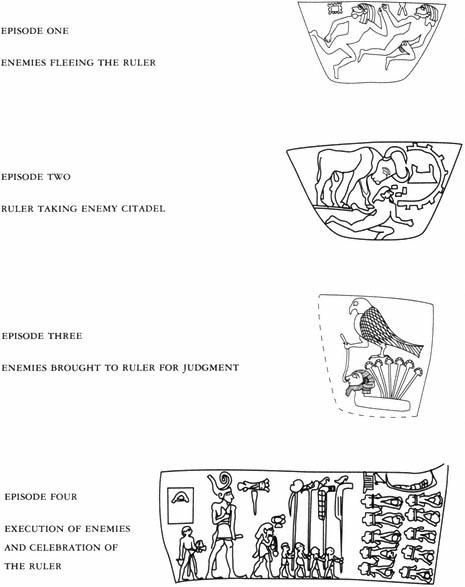
Fig. 40.
Four episodes in the fabula of the narrative on the Narmer Palette.
ruler or his executioners must lop off the heads of the enemies condemned to die or to be sacrificed in the victory ceremonials; we are shown Falcon lifting an enemy's head (Episode Three) and the ruler inspecting the decapitated corpses (Episode Four).
The ruler's decisive blow must occur, then, several times in the narrative. Indeed, it animates the narrative chronology and causality (in narratological jargon, the fabula), for it is the transition, the event or process, that takes the story inexorably from one state of affairs to another. (Readers unfamiliar with the narratological concepts fabula, story, and text may wish to consult the Appendix before reading further.) When the viewer flips the palette from obverse top, where the text "begins," to reverse top (that is, goes from Episode Four to Episode Three), despite the logical progression to the rebus in the reverse top zone, the most prominent feature occupies the reverse middle zone. Here, accompanied by his sandal bearer and wielding a mace, the human person of the ruler—wearing the White Crown and other regalia—is about to strike his enemy, labeled "Harpoon." The figure of Narmer is presented at larger scale than any other figure in the image, larger, in fact, than any figure in the entire known chain of replications of the image of the ruler's victory. The rebus in the reverse top zone appears almost squeezed in. In the next flip from reverse top to obverse bottom (from Episode Three to Episode Two), the picture of the ruler smiting is replaced by what seems to be its metaphorical equivalent—namely, the picture, in the obverse middle, of the ruler's two retainers mastering two serpopards. (The retainers are distinguished by hairstyle and dress both from the ruler's other followers, such as the standard bearers in the obverse top zone, and from the ruler's enemies, such as the fleeing or crushed figures in the obverse and reverse bottom zones, but it is not clear what these differences are supposed to indicate. The men look somewhat like the curly-haired, bearded enemies of the lion-ruler on the Battlefield Palette [Fig. 33], although they clearly do not have the same status in the narrative.) If the ruler is Falcon and Bull, the serpopards are possibly "Fortress" and "Desert Kite," or, in another popular (but overliteral and anachronistic) interpretation, the two territories of the Nile valley, Lower Egypt (Red Crown) and Upper Egypt (White Crown), united by Narmer (see Gilbert 1949). Finally, in the flip from obverse bottom
to reverse bottom (from Episode Two to Episode One), the picture of Narmer smiting his enemy, removed from view after the first flip, reappears. Thus, no matter how the viewer flips the palette to determine the relation between the zones of depiction spread across it, Narmer smiting his enemy continually appears in the text.
Assuming the general condition of intelligibility of such images to be that the viewer must begin with the top of the obverse, the most logical sequence—Episode Four (obverse top) to Episode One (reverse bottom)—is an inversion of the "natural," forward chronological and causal direction of the fabula. For this reason the viewer is encouraged to retrieve other sequences as well. In investigating these alternatives, the one completely non inverted sequence, which would present the fabula in the order of its forward logic as Episodes One-Two-Three-Four, would be the most difficult for a contemporary viewer to attain. It would require the strongest violation of the established conditions of the intelligibility of images, for it would mean beginning with the reverse bottom of the palette (Episode One) rather than the obverse top (Episode Four) and scanning bottom to top rather than top to bottom.
Other possible sequences and segmentations—other possible "stories" working with the underlying narrative material—would arrange differently the chronological and causal armature of the fabula as presented in the "natural" sequence of Episodes One-Two-Three-Four. All of these fall somewhere in between the two possibilities respectively closest to and furthest from the established conditions of intelligibility for viewing images in the chain of replications (the order Episodes Four-Three-Two-One and Episodes One-Two-Three-Four, respectively). And all of them seem to be more or less equally available options for a viewer handling and scanning the six separate zones of depiction on the two sides of the Narmer Palette. For example, because on the Narmer Palette the fabula is consistently storied after-to-before in two dimensions of the viewing of the text, top to bottom and obverse to reverse (Fig. 39), it can be coherently interpreted—depending on which dimension a viewer selects to pursue first—as breaking into parallel sets of episodes in turn possibly to be regarded as simultaneous, successive, or metaphorical in relation to each other. Thus the obverse can be viewed from top to bottom as a first two-
episode segment of story (Episodes Two-Four: ruler as Bull captures enemy town and decapitation of enemies). This segment would be succeeded, after flipping the palette, by a second two-episode segment of story from top to bottom (Episodes One-Three: enemies fleeing and Falcon's presentation of the enemies of the ruler). The transition between the two episodes in each set and between the two sets is appropriately depicted as the ruler's blow, in the pictures of the retainers mastering serpopards (obverse middle) and the ruler smiting his enemy (reverse middle). This particular sequence takes the form of Episodes Four-(blow)-Two-(blow)-Three-(blow)-One.
As an alternative arrangement, these two sets—obverse top to bottom and reverse top to bottom—need not be regarded as causally or chronologically successive episodes, or "chapters," of the story. The obverse and reverse may simply be parallel recitations of the same story: Episodes Four-Two (obverse top/obverse bottom) = Episodes Three-One (reverse top/reverse bottom). Here the same story has a different, distinctive visual text in the case of each set of two zones, which thus stand in a metaphorical relation. For example, in the obverse story (Four-Two) the ruler appears as Red Crown, Flail, and Bull, while in the reverse story (Three-One) the ruler appears as White Crown, Mace, and Falcon. Again the two parallel stories each depict the ruler's blow.
At first glance this general finding—that several possible story sequences can be constructed by a viewer chasing the narrative image—seems to be consistent with what we have already seen of the open texture of preceding late prehistoric narrative images in the chain of replications. In one sense the presence of the ruler's decisive blow is masked by the ambiguity of the text; in another sense the ambiguity of the text is progressively resolved as centered in the ruler's blow.
Compared with earlier replications, however, the Narmer Palette exhibits many more possibilities for constructing the narrative image. For one thing the composition of the image presents more clearly separate zones of depiction than had been produced earlier, multiplying the possible choices for segmentation, grouping, or sequencing. Moreover, in its placement, scale, and register framing, the image repeatedly brings the viewer back to the picture of the ruler wielding his blow. Whereas in earlier images the text elided or masked the
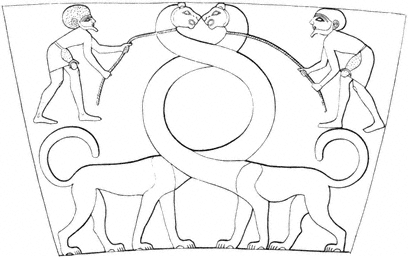
Fig. 41.
Detail of Narmer Palette, obverse: ruler's retainers mastering
two serpopards.
From Wildung 1981.
picture of the ruler wielding his blow, the Narmer Palette, on first glance, is more explicit: the human person of Narmer is about to smite his enemy. It is as if the very elaboration of the viewing activity requires a stronger, more direct and mimetic presentation of exactly what is being or is to be viewed—a closure of the openness in the image. Because the viewer chases the view, the view must now chase the viewer. The Narmer Palette both exemplifies and figures this encirclement, this tightening of the narrative noose—and to that extent masks it. But before we investigate this matter, there are other elementary structural features of the narrative organization of the image to be considered.