
4
William Billings (1746-1800) and American Psalmody: a Study of Musical Dissemination
William Billings is commonly taken as the American psalmodist of the eighteenth century. Self-taught, prolific, a patriot in politics, and blessed with original vision, both as a musician and a writer, Billings was the most famous New England composer of his age, and his reputation has long survived him. In his own day, he and his music were widely known and admired. When psalmodists and writers of his time chose one man to exemplify their tradition and serve as a ready point of reference, Billings was the natural choice. When nineteenth-century reformers wished to recall the supposedly crude, untutored beginnings of American music, Billings served their purposes too. More recently, when historians of American music have chronicled the beginnings of indigenous American composition, or when choirs have performed music of eighteenth-century New England, it is to Billings and his works that both have been most likely to turn. Billings's compositions and writings have won for him a secure place in American musical life and history. He stands foremost among our musical founding fathers, long on talent if short on polish and solemnity.
Scholars have investigated Billings's life and music more thoroughly than those of his contemporaries, and it seems fitting that, among all the New England psalmodists, his compositions have been chosen for a scholarly Gesamtausgabe .[1] In the absence of personal papers, not much is known, and little more is likely to be discovered, about his day-to-day activities. But other aspects of Billings call out for further study. More work needs to be done on his musical style, a style as abundant
in rhetorical effect as it is limited in harmonic range. Billings's harmonies tend to circle narrowly around a fixed center, rarely leading the ear into unexpected tonal regions. Yet a wide vocabulary of declamatory gesture lends distinctiveness and flair to his music. Billings loved to play with musical momentum. Especially in anthems, he often built intensity by repeating the same short phrase several times. For contrast, he might then interrupt the rhythmic flow with sustained block chords, perhaps punctuated by rests and even meter changes. On another level, Billings also varied the motion of the different voices within his four-part chorus. He confessed a particular fondness for counterpoint, holding that "there is more variety in one piece of fuging music, than in twenty pieces of plain song," by which he meant tunes set in block chords and lacking word repetition. He described "fuging music" as a kind of "musical warfare" in which different voices contended for the listener's ear.[2] Billings's "fuging" passages are themselves studies in musical momentum, with individual voice parts moving from background to foreground and back again, sometimes singing bold, arching melodic lines, but sometimes, too, sustaining or repeating notes that cut, trumpet-like, through the texture. J. Murray Barbour's 1960 study of Billings's music, steeped in a knowledge of metrics, opened up its declamatory, rhetorical character for study. Barbour recognized that Billings's genius lay less in his handling of tonal materials than in his text declamation. McKay and Crawford have pursued that insight further in more recent writings, and so has Kroeger.[3] But the subject remains ripe for further study.
Billings's place in history has earned him a symbolic importance that makes it natural to view him in dramatic terms. His priority, his personality, and his skill as a composer make Billings the early American musician easiest to admire. That a self-taught, twenty-four-year-old Yankee tanner, on the eve of the Revolution, became the first American to project a vision of New World musical artistry stands as one of the enduring images of American music history.[4] Even nineteenth-century writers who refused to take Billings seriously as a composer granted his historical significance.[5] But it is one thing to admire Billings after the fact, exploring his power as a composer and personality from our point of view, and quite another to try to fathom how he was viewed in his own time. The former depends ultimately upon musical performance and analysis—a later age's ways of understanding a composer's artistic achievement; the latter invites us to think more about how Billings's contemporaries accepted his music. Quantitatively speaking, the printed
dissemination of Billings's music in the eighteenth century supports today's view of his preeminence. He wrote more than his share of eighteenth-century New England's most popular sacred compositions, including the most widely printed American anthem of the time ("An Anthem for Easter: The Lord Is Ris'n Indeed").[6] Unlike most of his contemporaries, he was known more for a body of work than for the composition of a few "hits."[7] Moreover, as we note which of his pieces were borrowed and who borrowed them, Billings emerges as a figure through whom the dissemination of sacred music in eighteenth-century New England can itself be viewed.
In a subsistence economy like the one in which Billings worked,[8] where scarcity invested with significance every choice a tunebook compiler made, dissemination itself can be seen as a kind of drama. This drama surely lacks the immediacy of our symbolic view of Billings, which shows the unabashed young Bostonian courting "Euterpe in the wilderness," to cite John Tasker Howard's metaphor,[9] or his refusing to be bound by "Rules for Composition laid down by any that went before me."[10] Within that historical narrative, it is enough to say that Billings composed and published his music, that it found its way into the hands of singers, that it was loved and performed by two generations of New Englanders, and that it was then superseded by hymnody made more for the tastes and needs of an increasingly urbanized society. In another narrative, historians have introduced a nationalistic turn by describing the early acceptance of Billings's music and its later decline as a cultural conflict. First, the argument goes, provincial approval greeted Billings, only to yield later to more cosmopolitan values.[11] For scholars these are familiar stories, generalized to a near-mythic level. The "drama" of dissemination—a drama played out in the tunebooks of Billings's age, accessible only through close bibliographical investigation—lies deeper still. "Bibliographical adventure" may seem an oxymoron, or at least not an idea to fire the imagination. Yet, just as a small section of the forest floor can encompass a microcosm in which life-and-death struggles of nature regularly take place, the world of books and compilers, of editions and variant contents, has its own tales to reveal to the observer who looks for them.
To steep oneself in the tunebooks that survive from Billings's era is to begin to sense the drama latent in the facts of their bibliographical existence. For example, composing and publishing are so basic to the history of music that a scholar may take them for granted. But in Revo-
lutionary-era New England—where congregations made most of the organized music, church choirs were relatively few and far between, and the chance for advanced musical training barely existed—any man who composed was unusual, and even more so was one with the entrepreneurial initiative and persistence to compile a tunebook and see it through to publication. During the 1770s, new sacred tunebooks appeared in America at the rate of only slightly more than one per year.[12] The variety of aim and content in those tunebooks shows that the conventions of the later eighteenth-century American tunebook were just being formed. Each book, especially in this early period, deserves to be viewed as a response to a particular set of circumstances: theology, the compiler's artistic, pedagogical, and economic aims, his place of residence, and his circle of acquaintances, musical and otherwise. The more fully those conditions are brought to light, the better able we will be to detect eventfulness in the compilers' world.
The characteristic form of sacred music in eighteenth-century America was the psalm or hymn tune—the strophic composition to which several stanzas of a psalm or hymn could be sung. Sacred music circulated chiefly in anthologies: collections containing psalm tunes and hymn tunes and a few through-composed anthems or set-pieces. Some tunebooks contained only foreign music. Others were devoted entirely to the music of one composer. Billings himself published six tunebooks, five of which carried only his own compositions. Moreover, almost all of Billings's pieces—Karl Kroeger has located 338 compositions in all[13] — were first published in one of his own tunebooks. Thus, Billings's own publications were the preeminent force in introducing his music to the public. Only one of Billings's tunebooks, however, enjoyed commercial success: The Singing Master's Assistant , which appeared in four editions (1778-?1786). If Billings's music had appeared only in his own publications, it would not have circulated very widely. It was disseminated, then, chiefly through reprintings by other compilers.
Under rubrics like "selected from the best authors" or "containing the most approved tunes," most early American tunebooks were anthologies of pieces by many different composers. The compilers of these anthologies tended to describe their authorial duties, if they mentioned them at all, as exercises in personal taste. Josiah Flagg, in the intro-
duction to A Collection of the Best Psalm Tunes (Boston, 1764), explained his own strategy in these words: "The Editor ... has endeavour'd, according to the best of his Judgment, to extract the Sweets out of a Variety of fragrant Flowers: He has taken from every Author he has seen, a few Tunes, which he judges to be the best , and compriz'd them within the Compass of a small Pocket Volumn."[14] Flagg's words offer little in the way of clues for a student of early American tunebook compiling. If a tunebook is simply a transcript of the compiler's personal taste, it is not clear what more one could hope to learn about how its contents were chosen.
On the subject of taste: if I were a compiler, combing Billings's The Singing Master's Assistant for tunes to include in my own tunebook— let's call it The Lower Peninsula Harmony —I would surely choose Billings's SUNDAY (ex. 2) over his AMHERST (ex. 3). SUNDAY begins conventionally enough, though the tune's traversing a tenth in the first phrase is unusual (the tune is found in the tenor voice). But when Billings reaches the last line of text, at the words "I'm lost," he shifts from triple to duple time, breaks the continuous movement with rests, and repeats the key words three times, creating a vivid musical picture of the text's meaning. Compared with this striking excursion, AMHERST is a pretty tame affair, moving through its text with unmemorable dispatch. I would most likely choose SUNDAY over AMHEST for my tunebook because I find it a more distinctive, expressive piece and a more interesting one. Billings's contemporaries didn't agree. After appearing in the four editions of The Singing Master's Assistant , SUNDAY was never published again. AMHERST , on the other hand, was a hit; it received seventy-four printings in the four decades that followed its first appearance in 1770.[15]
This comparison between SUNDAY and AMHERST suggests that compilers of Billings's day, in "extract[ing] the Sweets" from other tune-books and presenting the public with their idea of "the best," either had ideas of musical quality that were different from our own or that they exercised their preferences within prescriptions and boundaries of which we are no longer aware. Granting that the first may or may not be true, the second possibility offers a challenge aptly suited to the tools at hand and the data available.
Studying the dissemination of psalmody through printed anthologies involves three steps. First, we need to look at individual pieces, remaining alert for traits that may have recommended them to people of
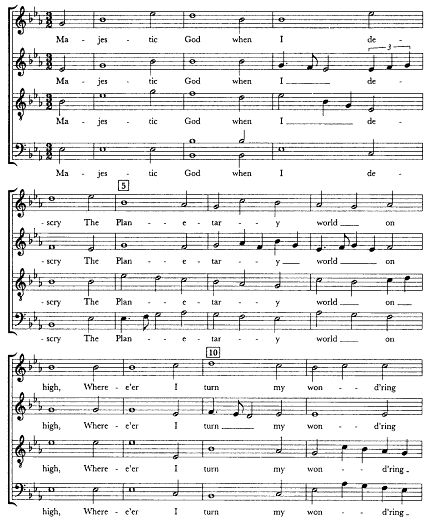
Example. 2.
William Billings, SUNDAY (Billings) (The Singing Master's Assistant [1778]; after
Hans Nathan, ed., The Complete Works of William Billings, vol. 2 [Charlottesville,
VA., 1977], 178)
(continued )
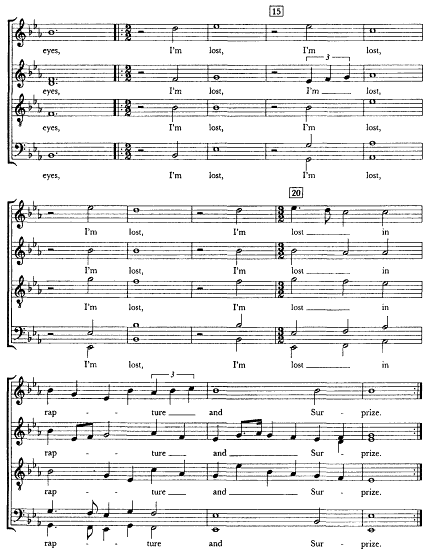
Example. 2.
(continued)
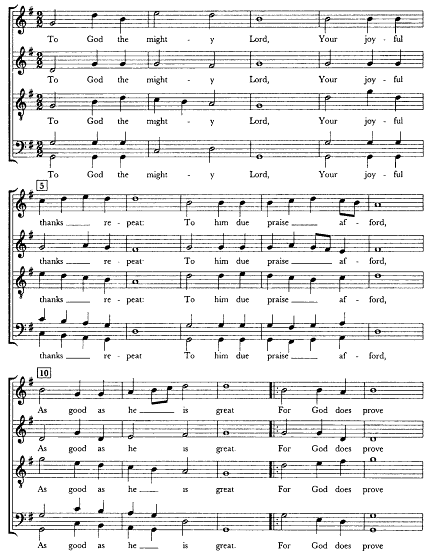
Example 3.
Billings, AMHERST (Brady and Tate) (Singing Master's Assistant [1778]
after Nathan, ed., Complete Works of William Billings, vol. 2, 54)
(continued )
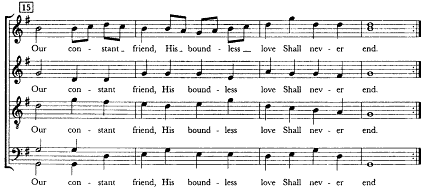
Example 3
(continued)
their own day. Second, we need to trace the paths of these pieces through the printed anthologies, compiling a printing history of each. And third, we need to look at anthologies themselves—to think of each anthology as a whole and then try to see how the compositions it contains make it a whole, or at least made it seem a whole to its compiler. By looking at individual pieces, their circulation, and the tunebooks—the "wholes" compilers created from the pieces they had to choose from— perhaps we can increase our knowledge of why compilers made the choices they did.
Early American psalmody as printed music begins in 1698, when the first sacred music in English was published in Boston, and continues to 1810, by which time American-born New England composers were beginning to be displaced by "improved" tunes with a more European stamp. During that 112-year period, 545 different issues of sacred music were printed, and they contained a total of some 7,500 compositions. Obviously, the present account can only scratch the surface of that vast repertory's dissemination. So, to narrow the focus and provide a window on the subject, I've decided to choose a single tunebook—a successful one, whose compositions circulated widely—and see what we can learn by tracing the dissemination of the music it contained. My candidate is The Singing Master's Assistant (Boston, 1778), Billings's greatest success.
In 1770, Billings had brought out his first tunebook, The New-England Psalm-Singer , which contained 127 of his own compositions. The thrill of that achievement lingered in his memory for years.
Kind Reader, no doubt you (do, or ought to) remember, that about eight years ago, I published a Book entitled, The New-England Psalm-Singer , &c. And truely a most masterly and inimitable Performance, I then thought it to be. Oh! how did my foolish heart throb & beat with tumultuous joy! With what impatience did I wait on the Book-Binder, while stitching the sheets and puting on the covers, with what extacy, did I snatch the yet unfinished Book out of his hands, and pressing it to my bosom, with rapturous delight, how lavish was I, in encomiums on this infant production of my own Numb-Skull?
But as Billings grew in musical experience, his pride in The New-England Psalm-Singer waned. By 1778, when he approached the public with his second work, he felt obliged to apologize for his first and to promise improvement:
After impartial examination, I have discovered that many of the pieces in that Book were never worth my printing, or your inspection; therefore in order to make you ample amends for my former intrusion, I have selected and corrected some of the Tunes which were most approved of in that book, and have added several new pieces which I think to be very good ones; for if I thought otherwise, I should not have presented them to you. But however, I am not so tenacious of my own opinion, as to desire you to take my word for it; but rather advise you all to purchase a Book and satisfy yourselves in that particular, and then, I make no doubt, but you will readily concur with me in this sentiment, viz. that the Singing-Master's Assistant is a much better Book, than the New-England Psalm-Singer .[16]
The public agreed with Billings's judgment of his new collection. Before the end of the next decade, The Singing Master's Assistant had appeared in four editions, all with the same music. Moreover, although he had fought to prevent it, his fellow compilers had given his new book the ultimate form of praise by raiding it heavily: Of the seventy-one pieces in the work, fifty-one, or nearly three-quarters, were reprinted in other tunebooks—by far the highest proportion of any collection of Billings's music.
The first step in considering how the music in Billings's tunebook circulated is to look at more of its pieces. As noted with AMHERST and
SUNDAY , The Singing Master's Assistant is made up entirely of unaccompanied choral music set in open score for four voices, called treble, counter, tenor, and bass, with the melody in the tenor voice. The basic musical form is the so-called plain tune, in which a stanza of metrical text is set to music without word repetition. Thus, in the plain tune, the form of the text is entirely responsible for determining the form of the music. AMHERST is a plain tune; so is BROOKFIELD (ex. 4); and so is CHESTER (ex. 5). In some pieces, Billings breaks the mold of the metrical form by repeating text, usually for expressive purposes. SUNDAY is one and MAJVSTY (ex. 6) another. Moreover, MAJESTY sets two stanzas of text, introducing texture changes to striking effect. Elsewhere, I've proposed calling such pieces "tunes with extension."[17] MAJESTY , by the way, is a piece that Harriet Beecher Stowe remembered being sung in the meeting house when she was growing up in Litchfield, Connecticut.
Whatever the trained musician might say of such a tune as old Majesty, no person of imagination or sensibility could hear it well rendered by a large choir without deep emotion. And [at the words]
On cherubim and seraphim
Full royally He rode,
And on the wings of mighty winds
Came flying all abroad,
There went a stir and thrill through many a stern and hard nature.[18]
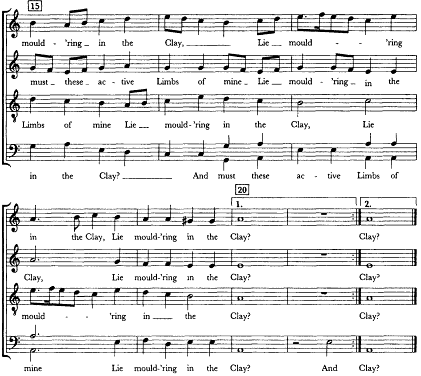
Psalmodists in the Anglo-American tradition formalized such elaborations in so-called fuging tunes, which contained at least one section with successive vocal entries producing text overlap. Sometimes the fuging section followed an opening section in block chords, as in MARYLAND (ex. 7). Often the fuging voices entered with some kind of imitation; MARYLAND is one of many New England fuging tunes in which the imitation is rhythmic but not melodic.
The forms described so far are strophic, with later stanzas sung to the same music as the first. Psalmodists also wrote through-composed pieces; most often these were settings of prose based on scripture. The Singing Master's Assistant included ten anthems, none of them reproduced here.
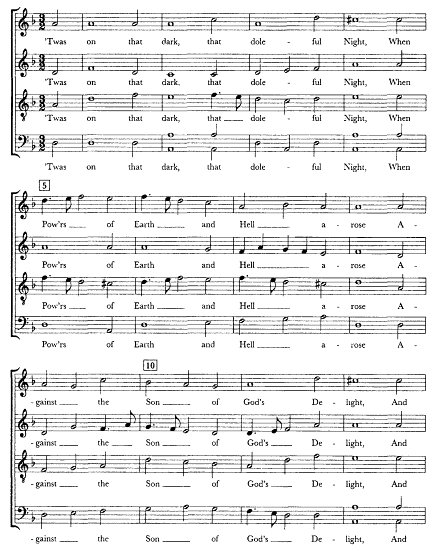
Example. 4.
Billings, BROOKFIELD (Watts) (Singing Master's Assistant [1778];
after Nathan, ed., Complete Works of William Billings, vol. 2, 48)
(continued )
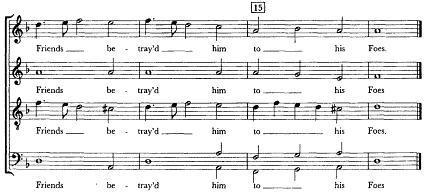
Example 4
(continued)
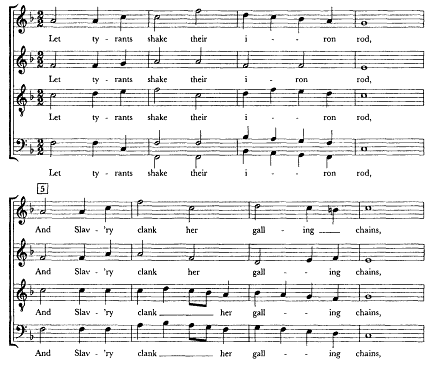
Example 5.
Billings, CHESTER (Billings) (Singing Master's Assistant [1778];
after Nathan, ed., Complete Works of William Billings, vol. 2, 72)
(continued )
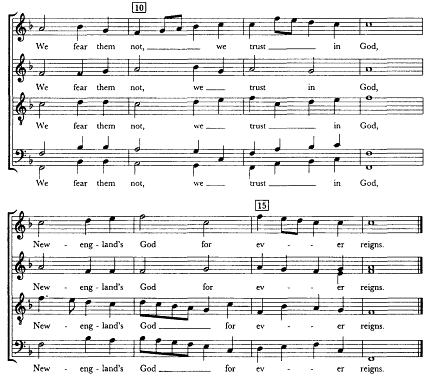
Example 5
(continued)
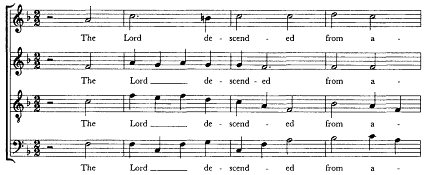
Example 6.
Billings, MAJESTY (Sternhold and Hopkins) (Singing Master's
Assistant [1778]; after Nathan, ed., Complete Works of William
Billings, vol. 2, 203)
(continued )
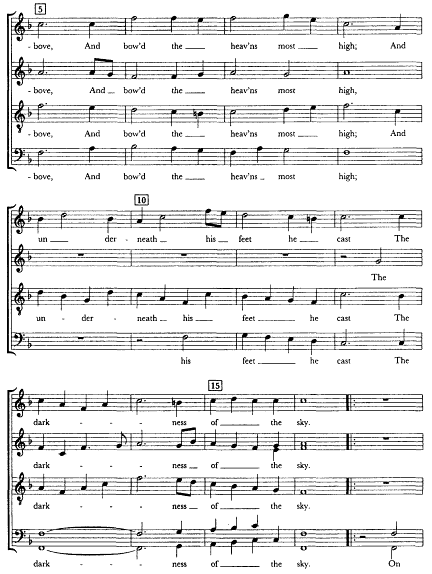
Example 6
(continued)
(continued )
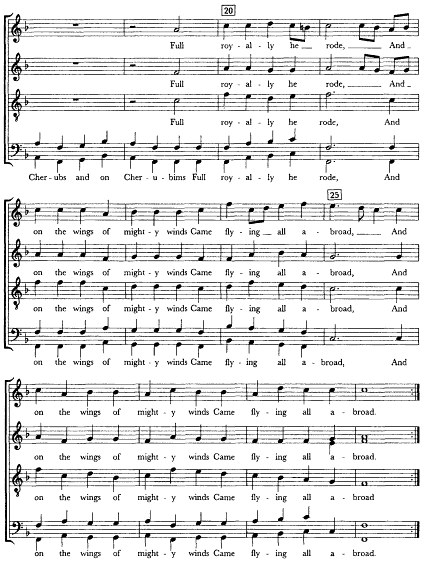
Example 6
(continued)
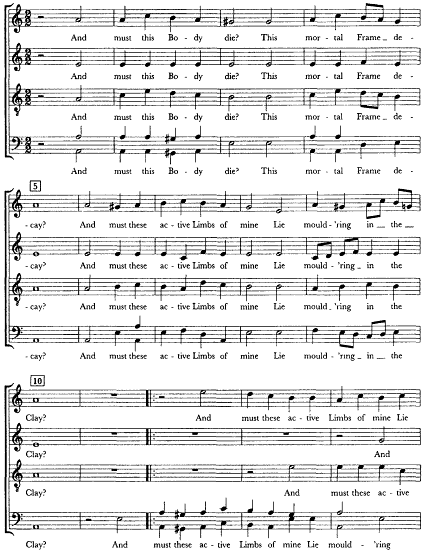
Example 7.
Billings, MARYLAND (Watts) (Singing Master's Assistant [1778];
after Nathan, ed., Complete Works of William Billings, vol. 2, 126)
(continued )
Example 7
(continued)
The structures of text and musical form available to Billings provide one approach to the music in his book. There's another property of the music, however, that cuts closer to the heart of how it was most likely experienced by those who sang it. It should be remembered that, although Billings composed some pieces requiring the skill of a well-rehearsed choir, he and his brother psalmodists wrote most of all for Christians of modest vocal experience. Functionally, their compositions were extensions of congregational singing, where, as Alan Lomax once wrote, a "society" of people "call out to God together across the infinite."[19] The music, in other words, has its life in a broad context of ritual, where the singers join in declaiming sacred text, their words and voices reinforcing belief in their own hearts, but with the expectation that their singing is also being perceived by God, to whom it is ultimately addressed.
Psalmody, then, is communal sacred declamation governed by music. Because the experience of psalmody depends upon the way in which text is declaimed—on the way words flow through time, carried by the rise and fall of the vocal lines—when we consider the musical properties of pieces, declamation must be a primary concern. LEBANON (ex. 8) shows the oldest style of declamation in Anglo-American psalmody: the so-called common-tune style, whose notes of equal value move in slow-paced duple time.[20] The common-tune style harks back to Reformation times and to tunes like OLD HUNDRED , the so-called "Doxology." LEB-ANON also illustrates some of what Billings learned between his first book and his second. Example 8 is from The New-England Psalm-Singer , where the original barring, shown above the staff, ignores the placement of stressed syllables. Example 9 shows that by the time of The Singing Master's Assistant Billings understood that musical and metrical accents must be coordinated, and he reshaped the tune's beginning through a dactyl in the first measure.
The declamation that best fits the prevalent verse patterns of English psalmody and hymnody is iambic, alternating short notes and long, and supporting weak and strong verbal accents, as in BROOKFIELD (ex. 4). Iambic movement is usually cast in triple time. Like BROOKFIELD , many iambic tunes achieve their sense of melodic motion by dissolving whole notes into halves, or perhaps dotted quarters and eighths. The beginnings of later stanzas of BROOKFIELD fit more comfortably with Billings's music than does the underlaid one, whose first two words have their natural accent switched. A better solution for those opening words of BROOKFIELD would be a dactylic beginning: long-short-short. And indeed The Singing Master's Assistant has many tunes whose declamation is based on the dactyl in duple time. AMHERST (ex. 3) is a good example. Each of its six phrases begin dactylically; and all four phrases of CHESTER (ex. 5) do the same.
The style of declamation that has come to be thought of as most characteristically American in this repertory is found in MAJESTY (ex. 6). Here we have a duple-time piece in two sections, the first moving chiefly in half notes, the second shifting to syllabic declamation in quarters. MAJESTY is not a fuging tune. But in its two-part form and the aggressive text delivery of its second section, it follows the declamatory practice of many fuging tunes. Elsewhere, I've called the latter kind of motion "declamatory duple,"[21] its essence being that while the unit of
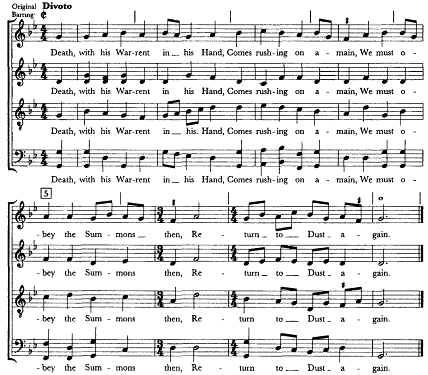
Example 8.
Billings, LEBANON OR FUNERAL HYMN (Billings) (The New-England
Psalm-Singer [1770]; after Karl Kroeger, ed., The Complete Works of
William Billings, vol. 1 [Charlottesville, Va., 1981], 333)
motion is the half note, one or more sections of the piece deliver text syllabically in quarter notes, producing a strong forward thrust. MARY-LAND (ex. 7) is also a declamatory duple tune.
BETHLEHEM (ex. 10) shows another declamatory approach that Billings liked. It begins in triple time, setting a full stanza of text as if it were an iambic plain tune. But then meter and texture unexpectedly change, the gentle swing of the opening giving way to the march of a duple-time fuging section as lines three and four of the text are repeated.
The styles of declamation shown here are fundamental expressive resources of the tradition of psalmody in which Billings worked. Once
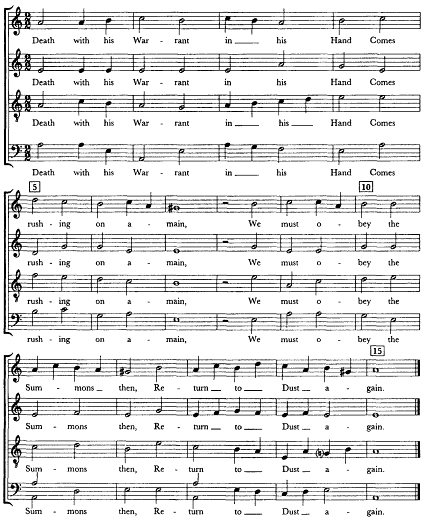
Example 9.
Billings, LEBANON (Billings) (Singing Master's Assistant [1778];
after Nathan, ed., Complete Works of William Billings, vol. 2, 78)
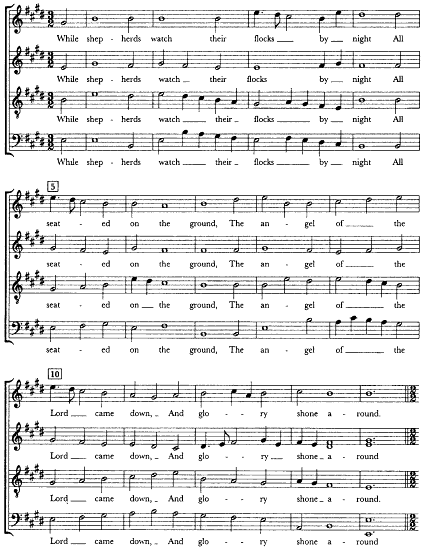
Example 10.
Billings, BETHLEHEM (Watts) (Singing Master's Assistant [1778];
after Nathan, ed., Complete Works of William Billings, vol. 2, 207)
(continued )
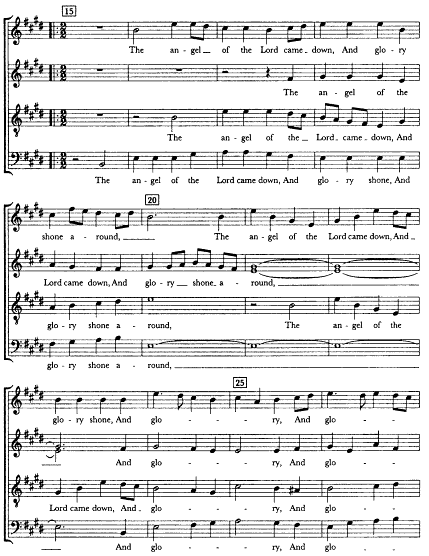
Example 10
(continued)
(continued )
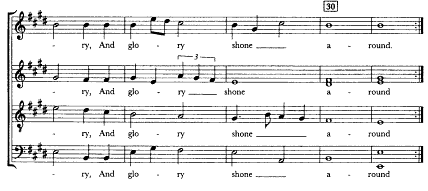
Example 10
(continued)
begun, especially in a piece of strophic music that went on for many stanzas, each one established its own way of moving, which is why the breaking of the pattern, as in BETHLEHEM , or in SUNDAY , produces a sharp sense of contrast, hence of event. Billings was fond of such contrasts.
To summarize, we can say that in Billings's The Singing Master's Assistant both strophic settings of verse and through-composed settings of prose are found; the musical forms include plain tunes, tunes with extension, fuging tunes, and anthems; and in the settings of verse, styles of text declamation vary from the common-tune style to iambic, dactylic, declamatory duple, and mixtures thereof. These are some, though by no means all, of the traits that distinguish compositional types in early American psalmody.
Now let's find out what happened to the music in The Singing Master's Assistant after Billings published it. As a beginning, here's a list of the nine pieces used as examples in this chapter, with the number of printings each received in American tunebooks between 1778 and 1810.[22]
AMHERST | 74 | CHESTER | 56 | LEBANON | 48 |
SUNDAY | 4 | MAJESTY | 75 | BETHLEHEM | 42 |
BROOKFIELD | 88 | MARYLAND | 60 | JUDEA | 4 |
Next, there's the question of where the tunes appeared in print. The geographical extent of circulation for printed sacred compositions of Billings's time may be shown by noting some of the printings outside Boston of BROOKFIELD , the tune by Billings most widely published in his own day. In 1779, BROOKFIELD appeared in a Connecticut tune-book. In the 1780s, it was picked up in northern and central Massachusetts (Newburyport, Worcester), in Philadelphia in 1788, and New York City in 1789. The next decade saw printings in Baltimore (1793), upstate New York and New Hampshire (1795), and dissemination as far south as Charleston, South Carolina (1799); by 1810 it had appeared as far west as Harrisburg, Pennsylvania.[23] A colonial New England hymn tune had won acceptance as a national favorite in the United States of the Federal era.
It was suggested earlier that tracing the circulation of each piece in Billings's tunebook would be a logical second step in our study of musical dissemination. And indeed, this work has been done. But the best way to convey its results—to do justice to both the larger question on the table and to the horde of bibliographical details on which an answer is based—is to move on to the third step: to look at the anthologies in which the tunes appear, to get a sense of their character and makeup, and then to return to the issue of dissemination with those notions in mind.
What kind of a book was The Singing Master's Assistant itself? First, Billings's work was intended chiefly for singing schools, as suggested by its title and shown by its front matter, which includes extensive rudiments for learners and ample advice for teachers. In addition, as table 1 shows, it was a work whose text sources ranged widely—from books like Brady and Tate's A New Version and Watts's The Psalms of David Imitated and Hymns and Spiritual Songs ,[24] sources for several generations of English and American composers, to local poets such as Samuel Byles, Perez Morton, and even Billings himself. Furthermore, the texts Billings set in The Singing Master's Assistant covered a wide range of metrical patterns, from the familiar trio of common, long, and short meter to arrangements rarely encountered in psalmody of the period. Billings's book also contained ten anthems, which fill nearly half its pages. Table 1 shows that the book's settings of verse were balanced among declamatory styles. Finally, to a degree unmatched by any other American tunebook of its time, The Singing Master's Assistant is a personal and
TABLE 1 | |
A. METERS | |
Metrical structure | No. compositions |
CM (8.6.8.6) | 20 |
LM (8.8.8.8) | 14 |
SM (6.6.8.6) | 8 |
HM (6.6.6.6.4.4.4.4) | 5 |
PM, Ps. 50 (four 10s, two 11s) | 2 |
PM, Ps. 149 (10.10.11.11) | 2 |
PM, Ps. 122 (6.6.8.6.6.8) | 2 |
PM (six 8s) | 2 |
PM (six 11s) | 1 |
PM (8.7.8.7.7.8) | 1 |
PM (8.7.8.7) | 1 |
PM (5.6.5.6.6.6.4) | 1 |
PM (four 7s) | 1 |
PM (11.11.11.5) | 1 |
B. SETTINGS OF VERSE AND PROSE | |
61 settings of verse | |
10 settings of prose | |
C. TEXT DECLAMATION OF VERSE SETTINGS | |
Style of declamation | No. compositions |
common-tune style | 5 |
dactylic | 11 |
iambic | 17 |
declamatory duple | 13 |
mixture | 10 |
spondaic | 4 |
other | 1 |
(continued ) | |
(table continued on next page)
TABLE 1 (continued ) | |
D. SOURCES OF TEXTS | |
Author, title | No. texts |
John Arnold, The Compleat Psalmodist , 4th ed. (London, 1756) | 1 |
Arthur Bedford, The Excellency of Divine Musick (London, [1733])a | 1 |
King James Bible | 9 |
William Billingsb | 11 |
Nicholas Brady and Nahum Tate, A New Version of the Psalms of David (London, 1696) | 11 |
Nicholas Brady and Nahum Tate, A New Version of the Psalms of David (Boston, 1773), Appendix, Containing a Number of Hymns, Taken Chiefly from Dr. Watts s Scriptural Collection | 1 |
Brady and Tate, New Version , and Watts, Psalmsc | 1 |
[Samuel Byles,] Pious Remains of a Young Gentleman Lately Deceased (Boston, 1764) | 1 |
Thomas Flatman, Poems and Songs (London, 1674) | 1 |
Perez Mortond | 1 |
James Relly and John Relly, Christian Hymns, Poems, and Spiritual Songs (Burlington, N.J., 1776) | 1 |
Thomas Sternhold and John Hopkins, The Whole Book of Psalms (London, 1562) | 1 |
Isaac Watts, Divine and Moral Songs for the Use of Children (London, 1715) | 1 |
Isaac Watts, Horae Lyricae (London, 1706) | 1 |
Isaac Watts, Hymns and Spiritual Songs, in Three Books (London, 1707-9) | 14 |
Isaac Watts, The Psalms of David Imitated in the Language of the New Testament (London, 1719) | 11 |
George Whitefield, A Collection of Hymns for Social Worship , 13th ed. (Philadelphia, 1768) | 4 |
E. DISSEMINATION | |
51 of 71 pieces reprinted in other books | |
a See Appendix entitled "A Specimen of Hymns for Divine Musick." | |
b On p. [3] of The Singing Master's Assistant (1778), Billings writes: "I have been very careful to give credit for words, and where no credit is given, the words were written by the author." That statement allows the texts to AMERICA , AURORA , BALTIMORE , BOSTON , CHESTER , COLUMBIA , INDEPENDENCE , JARGON , LEBANON NEW HINGHAM , and SUNDAY to be identified as Billings's own. | |
c The text of STOCKBRIDCE is a composite. See Billings, Complete Works , 2:350. | |
d "When Jesus Wept," the text for EMMAUS , is traced to Morton in Billings, Complete Works , 2:347. | |
patriotic statement: the work of an American composer bursting with opinions, bedazzled with music as sense experience, and spiritually if not physically engaged in his country's present struggle for political independence.[25]
The Singing Master's Assistant reflects something else about the makeup of other eighteenth-century American tunebooks. In the twentieth century these anthologies, when noticed at all, are usually viewed as preservers of music. But to pass muster in the eighteenth-century marketplace, a tunebook also had to take other factors into account. Many tunebooks, though not all, sought to embrace the whole tradition of psalmody within one set of covers. They were designed to be the one book that would do it all, meeting the needs of beginners and experienced singers (not to mention those in between), of congregations, schools, choirs, and singing societies, by including everything from simple congregational pieces in common-tune style to anthems for choir performance on special occasions. Tunebooks of the eighteenth century also had to take certain theological guidelines into account. They had to include music in enough different text meters to cover all the psalms and hymns in the hymnals, and they had to contain sacred texts suitable for singing in both worship and recreation. The better a tunebook balanced artistic, pedagogical, and religious elements, the better its chance for success in the marketplace.[26]
A further word on texts. Not only was a tunebook expected to accommodate all the meters of the text in the hymnbook. Its music also had to suit the range of moods that the hymnbook expressed: minor-mode or "flat-key" tunes for sorrowful texts and major-mode tunes for triumphant ones. Thus, a tunebook needed a variety of both major- and minor-mode tunes in each of the most widely used meters; and it also needed at least one piece for each of the more unusual meters. It must be emphasized that in New England psalmody of the time, many tune-text linkings were not marriages but common-law liaisons, and printed pieces should not necessarily be considered musical-textual entities. Different texts of the same meter could be and were substituted by singers for the printed ones, according to personal choice, as with CHESTER .[27] Theologically speaking, a tune might be considered as little more than a convenient melodic formula to which any text in its meter could be sung. For example, between 1698 and 1810, the long meter tune OLD
HUNDRED was printed in America with sixteen different texts in the standard psalters and hymn books.[28]
When we think of the needs that the early American tunebook was designed to fill, and the music that was available to meet them, we can begin to get a clearer picture of how compilers made their choices. Perhaps, with all this talk of functions, texts, moods, poetic meters, styles of declamation, and religious denominations, we ought to think of the tunebook itself as a particular kind of structure—not so much a transcript of the compiler's taste (though taste surely played into it) but a formal grid divided, like an old-fashioned typesetter's case, into pigeon holes. Each pigeon hole might be considered a category of tune. And just as the typesetter needed certain numbers of each letter (more e 's and s 's than q 's and x 's), the compiler needed certain numbers of each category of tune to fill the pigeon holes of the structure he was building. Or, to try another simile, a compiler chose tunes in something of the way a baseball team selects new players. The team chooses not just the best athletes but those who are most promising at the positions it needs to fill: shortstop, catcher, or left-handed pitcher. Likewise, the tunebook compiler filled his pigeon holes according to categories of text and music. Tunes in the same category were weighed against each other: this minor-mode fuging tune in long meter or that one? This funeral anthem or that? This setting of "While shepherds watch'd their flocks by night" or that? Harking back to the earlier comparison of AMHERST and SUNDAY on the basis of my personal notion of their aesthetic appeal, we now see that it was irrelevant. AMHERST owed its circulation chiefly to its metrical structure: It is cast in the pattern 6.6.6.6.4.4.4.4, the so-called hallelujah meter, in which Psalms 136 and 148 were versified. Its competition was not SUNDAY, a long meter tune, nor any tune in common meter, long meter, short meter, or meters other than its own. AMHERST was chosen by many compilers because it best filled the hallelujah meter pigeon hole, which, if left unfilled, would leave the tune-book incomplete. A tunebook had to have at least one hallelujah meter tune or users who wished to sing the entire psalter would have to look elsewhere.[29]
Another question needs to be asked: What music was available to a compiler when he made his choices? The issue is partly one of historical chronology and partly one of law.
If William Billings had had his way, he would have controlled the circulation of his music himself. In fact, Billings was the first American composer to seek copyright protection for his compositions. In 1770 and again in 1772, he petitioned the Massachusetts legislature for exclusive right to reprint his own music; and in 1778, as The Singing Master's Assistant was about to appear, he sought copyright protection again. Neither petition was granted.[30] Hence, other compilers had the right to raid Billings's books freely and to reprint any of the music in them. And they did. In 1783, the Massachusetts legislature finally ruled to "secur[e] to Authors the exclusive Right and Benefit of publishing their Literary Production, for Twenty-one Years," backing up their action with fines.[31] Indeed, Billings's next work, The Suffolk Harmony (1786), was copyrighted and deposited in the Harvard College Library, as the law specified. But because the copyright law applied only within the State of Massachusetts, out-of-state compilers could still help themselves. Not until 1790, when the federal copyright law was passed, was there legal restraint throughout the country upon musical piracy. It was no coincidence that the circulation of pieces from The Continental Harmony (1794), the only one of Billings's tunebooks published after the enactment of the federal law, was by far the smallest of any of his tune-books.[32]
It should now be obvious that the field in which a compiler made his choices was one structured by its own prescriptions and boundaries and that compiling an anthology required more than simply assembling a collection of favorite pieces. Another factor seems to have influenced compilers in the years immediately following the publication of The Singing Master's Assistant . Billings's tunebook appeared in a fallow period for the American tunebook trade as a whole. Wartime conditions reduced publication opportunities, and, during the entire decade of the 1770s, only twelve issues of sacred music were published, while in the 1780s more than four times that many appeared in print.[33]The Singing Master's Assistant , in other words, was published just before the American tunebook trade burst into full bloom. Unprotected by copyright, and full of fresh, attractive music, it was there to be raided by any other compiler.
These words about The Singing Master's Assistant and tunebooks in general provide a context for examining some of the collections in which music from Billings's book appeared in the decade after it was published (1779-89). All the works listed in table 2 were compiled with factors we
have mentioned in mind. But the collection at the top of the list introduced another card into the deck: the issue of national origin. Andrew Law's Select Harmony (1779) was the first American tunebook to include English and American music in roughly equal proportion. Except for Billings's two collections, which contained only his own pieces, earlier tunebooks had been devoted either entirely or almost entirely to English music. But Law mixed an assortment of English tunes and anthems with pieces by New England composers—Oliver Brownson, Amos Bull, Abraham Wood, and others—among whom only Billings, from whom he borrowed six tunes, had been published before. Law's eclectic model and his inclusion of native-born composers were to have a powerful impact through the next decade.
Simeon Jocelin followed Law's approach to compiling in The Chorister's Companion (1782-83). Like Law, Jocelin balanced English and American pieces and introduced works by several new American composers, including Lewis Edson and Daniel Read. He also borrowed nineteen pieces from Billings's The Singing Master's Assistant . In 1783, Oliver Brownson of Simsbury brought out a tunebook emphasizing his own music and that of other Americans, though it did include a few English pieces. John Stickney's work of 1783 was the second edition of a prewar tunebook whose contents were chiefly English. Its publisher, Daniel Bayley of Newburyport, Massachusetts, was by far the most active prewar American compiler, most of his tunebooks being reissues of collections by English psalmodists. By 1784 Bayley was doing his borrowing closer to home—from Connecticut, in fact. His Select Harmony took the title and much of the contents of Law's earlier work, even listing Law's name on the title page. (Given the copyright situation, there was nothing illegal in this.) And Bayley's publications of 1785 and 1788 also intermixed British and American pieces. Chauncey Langdon's 1786 collection, the work of a student member of the Yale College singing society, emphasized American compositions. Law's 1786 work continued his earlier eclectic policy. All of this activity set the stage for The Worcester Collection of Sacred Harmony .
The Worcester Collection was the first American tunebook of the period compiled by a nonmusician: Isaiah Thomas of Worcester, Massachusetts, a professional printer who described himself as "unskilled in musick." Thomas's anthology followed the now-familiar eclectic model with its mixture of English and American pieces and its emphasis on compo-
TABLE 2 | ||
Year | Author, title, place | Provenance |
1779 | Andrew Law, Select Harmony (Farmington | 26 American |
[i.e., Cheshire], Conn.) | 39 non-American | |
1782 | Andrew Law, Select Harmony [2d ed.] | 21 American |
([Cheshire, Conn.]) | 38 non-American | |
1782-83 | [Simeon Jocelin,] The Chorister's Companion | 50 American |
(New Haven, 1782), with The Chorister's | 61 non-American | |
Companion, Part Third (New Haven, | 5 unidentified | |
1783 | Oliver Brownson, Select Harmony ([Simsbury, | 52 American |
Conn.]) | 17 non-American | |
2 unidentified | ||
John Stickney, The Gentleman and Lady's | 15 American | |
Musical Companion [2d ed.] (Newburyport) | 99 non-American | |
2 unidentified | ||
1784 | [Daniel Bayley,] Select Harmony, Con- | 32 American |
taining . . . the Rules of Singing Chiefly by | 111 non-American | |
Andrew Law, A.B . (Newburyport) | 3 unidentified | |
The Massachusetts Harmony (Boston) | 17 American | |
67 non-American | ||
7 unidentified | ||
A New Collection of Psalm Tunes Adapted to | 6 American | |
Congregational Worship ([Boston]) | 44 non-American | |
1 unidentified | ||
1785 | Daniel Bayley, The Essex Harmony, or Musical | 13 American |
Miscellany (Newburyport) | 27 non-American | |
1 unidentified | ||
1786 | [Chauncey Langdon,] Beauties of | 23 American |
Psalmody . . . by a Member of the Musical | 2 non-American | |
Society of Yale College ([New Haven]) | 2 unidentified | |
Andrew Law, The Rudiments of Music , 2d ed. | 23 American | |
([Cheshire, Conn.]) | 17 non-American | |
2 unidentified | ||
The Worcester Collection of Sacred Harmony | 73 American | |
(Worcester) | 33 non-American | |
2 unidentified | ||
(continued) | ||
(table continued on next page)
TABLE 2 | ||
Year | Author, title, place | Provenance |
1787 | Daniel Read, The American Singing Book , | 68 American |
with Supplement to the American Singing Book (New Haven) | 6 non-American | |
1788 | Daniel Bayley, Sr., The New Harmony of Zion | 38 American |
(Newburyport) | 47 non-American | |
2 unidentified | ||
The Federal Harmony (Boston) | 94 American | |
32 non-American | ||
3 unidentified | ||
[Simeon Jocelin,] The Chorister's Companion , | 41 American | |
2d ed. (New Haven) | 68 non-American | |
1 unidentified | ||
Sacred Harmony or A Collection of Psalm | 79 American | |
Tunes, Ancient and Modern (Boston) | 49 non-American | |
4 unidentified | ||
A Selection of Sacred Harmony (Philadelphia) | 26 American | |
32 non-American | ||
4 unidentified | ||
The Worcester Collection of Sacred Harmony , | 82 American | |
2d ed. (Worcester) | 34 non-American | |
2 unidentified | ||
1789 | [Andrew] Adgate and [Ishmail] Spicer, | 30 American |
Philadelphia Harmony (Philadelphia) | 30 non-American | |
1 unidentified | ||
sitions that, by appearing in other tunebooks, had proved or were proving themselves to be favorites. Unlike its predecessors, all printed on a rolling press from engraved plates, The Worcester Collection was printed by letterpress, making possible larger press runs and a lower price per page.[34] Linking this new technology with an effective system of book distribution and a compiling strategy aimed toward the center of the market, The Worcester Collection crystallized the type of anthology that Law and Jocelin had introduced and Bayley had borrowed. Its example was widely copied, and its repertory gained especially wide circulation.[35] Thus, the music it printed received a special boost toward broad acceptance. (Nineteen of the seventy-three American compositions printed in the first edition of The Worcester Collection were by William Billings.)
The rest of the books in table 2 show the influence of The Worcester Collection , either directly or indirectly, and carry a selection of music chosen with its emphases in mind. In fact, they include many of the same pieces. Read's Supplement (1787), an appendix to his The American Singing Book (1785), which had contained only his own compositions, was chosen almost entirely from among familiar English and American favorites. Several 1788 tunebooks show other professional printers being drawn into the sacred music trade, following Thomas's example. The Federal Harmony , published by the Boston engraver John Norman, insisted on the superiority of its own copperplate engraving to the letterpress method; Sacred Harmony , compiled anonymously, mentioned The Worcester Collection on its title page; the Selection of Sacred Harmony , the first major Philadelphia tunebook since the 1760s, came from the press of newspaper publisher John M'Culloch; and Adgate and Spicer's Philadelphia Harmony contained a higher proportion than any work yet of that group of favorites that has been identified as the "core repertory" of early American psalmody—the 101 sacred compositions most frequently printed in America before the end of 1810.[36]
Thus, in the late 1770s and 1780s, many American compositions were printed in American anthologies, and the process of winnowing took place, accelerating after 1786. Billings's music, especially the music from his The Singing Master's Assistant , was fight in the center of this development.
The key work in the dissemination of Billings's compositions was Jocelin's The Chorister's Companion (1782-83; see table 3).[37] Jocelin borrowed heavily from Billings. He picked up no fewer than nineteen pieces from The Singing Master's Assistant (see table 3C), and he added six more from Billings's next major tunebook, The Psalm-Singer's Amusement (1781), for a total of twenty-five Billings pieces in all. But these numbers only begin to tell the story of Jocelin's borrowing. Of the twenty-five compositions by Billings that were printed fifteen times or more in any American tunebook before 1811 (table 3A), nearly two-thirds (sixteen of the twenty-five) appeared in Jocelin (table 3B). Moreover, Jocelin was the first compiler after Billings to print eleven of those sixteen compositions, suggesting that if he had not picked them up, other compilers might not have either. More than any other tunebook, then, Billings's own The Singing Master's Assistant included, Jocelin's The Chorister's
TABLE 3 | |||
A. Pre-1782 Billings pieces with 15 printings or more | |||
AFRICA | BOSTON | MENDOM | |
AMERICA | BROOKFIELD | NEW HINGHAM | |
AMHERST | CHESTER | PARIS | |
Anthem: I Am the Rose of Sharon | COLUMBIA | PHILADELPHIA | |
EMMAUS | RICHMOND | ||
Anthem: I Heard a Great Voice | GOLGOTHA | STOCKBRIDGE | |
AURORA | LEBANON | SUFFOLK | |
BERLIN | MAJESTY | WASHINGTON | |
BETHLEHEM | MARYLAND | (25 pieces ) | |
B. Pre-1782 Billings pieces with 15 printings or more in Jocelin | |||
AMERICA | BROOKFIELD | PARIS | |
AMHERST | CHESTER | PHILADELPHIA | |
AURORA | COLUMBIA | STOCKBRIDGE | |
BERLIN | MARYLAND | WASHINGTON | |
BETHLEHEM | MENDOM | (16 pieces ) | |
BOSTON | NEW HINGHAM | ||
C. Music from SMA in Jocelin | |||
AMERICA | COLUMBIA | PRINCETON | |
AMHERST | HEBRON | SHERBURNE | |
AURORA | MARYLAND | STOCKBRIDGE | |
BETHLEHEM | NEW HINGHAM | WARREN | |
BOSTON | NEW NORTH | WASHINGTON | |
BROOKFIELD | NEW SOUTH | (19 pieces ) | |
CHESTER | PHILADELPHIA | ||
D. Declamatory styles and meters of SMA tunes in Jocelin | |||
common-tune | NEW NORTH (CM) | ||
iambic | AMERICA (six 8s), BROOKFIELD (LM), HEBRON (SM), NEW SOUTH (SM), PRINCETON (CM), WARREN (four 7s) | ||
(continued ) | |||
(table continued on next page)
TABLE 3 | ||
dactylic | AMHERST (HM), CHESTER (LM), COLUMBIA (HM) | |
declamatory duple | BOSTON (CM), MARYLAND (SM), NEW HINGHAM (SM), SHERBURNE (6.6.8.6.6.8), STOCKBRIDGE (LM), WASHINGTON (LM) | |
mixed | AURORA (SM), BETHLEHEM (CM), PHILADELPHIA (SM) | |
E. Pieces from SMA in Worcester Collection (1786) | ||
AMERICA | CHESTER | PHILADELPHIA |
AMHERST | COLUMBIA | STOCKBRIDGE |
AURORA | HEBRON | WASHINGTON |
BETHLEHEM | MARYLAND | (13 pieces; cf. C above ) |
BROOKFIELD | NEW HINGHAM | |
Companion seems to have played a decisive role in determining which of Billings's pieces lived on and which were forgotten.
What, if anything, can be discovered about the reasons for Jocelin's influence upon the fate of Billings's music? The compositions he borrowed suggest some answers.
Jocelin took from Billings a group of pieces that, examined from the standpoint of meters and styles of declamation, forms a remarkably well-balanced cross-section of Anglo-American psalmody in general and of Billings's own work in particular. Among the nineteen compositions he chose from The Singing Master's Assistant (table 3C and D), Jocelin took only one common tune, preferring to fill that category in his own book with European favorites. But for the other categories of declamation he chose six iambic tunes, three dactylic, six declamatory duple tunes, and three mixed ones. Within these categories, he paid close attention to the variety of poetic meters. His six iambic tunes, for example, use five different text meters; further, half of them are in the major mode and half in the minor. The variety of text meters in the Billings tunes is similarly wide. With seven different meters distributed among the nineteen compositions, here was a selection of Billings pieces covering all but one meter in the entire hymnbook. Jocelin's borrowings
from The Singing Master's Assistant , in short, are by no means random, nor is it likely that simple personal preference would have produced so varied a sample. The borrowings show every sign of being systematic. They constitute in effect a tunebook within a tunebook: a microcosm of the work of Billings as a composer of metrical sacred music. Jocelin's raid may have worked against the composer's commercial interests, but it revealed a shrewd understanding of the legacy that Billings had created for his public in The Singing Master's Assistant .
Having noted and looked at some of the pieces Jocelin took from Billings, perhaps it's worth mentioning one he rejected. The Christmas hymn JUDEA has had a certain currency since it was edited and published in the 1940s in an octavo edition and recorded by the Robert Shaw Chorale (1952). JUDEA , however, went nowhere in Billings's own time, dropping out of print after The Singing Master's Assistant itself. The tune is one of a handful of spondaic pieces in the book; none of these were much reprinted.[38] Its text meter, six 11s, is nowhere to be found in the standard hymnbooks. And its character is decidedly that of a dance.[39] There is reason to think that Jocelin had JUDEA (ex. 11) in mind when, in his introduction, after praising the new style of psalm tune with "a more lively and airy turn"—a phrase certainly fitting much of Billings's music—he warned: "Altho' many improvements have been made in Church Music, yet there appears a danger of erring, by introducing, in public worship, light and trifling airs, more becoming the theatre or shepherd's pipe; a liberty . . . by no means admissible in the solemnities of Divine Service."[40] Thus, a Billings tune that has won favor in our time went unborrowed in the composer's own.
That Simeon Jocelin was a Connecticut man publishing his book in New Haven enabled him to poach on Billings's preserves in a way that a Massachusetts compiler might have hesitated to risk. Copyright, as noted above, was an issue very much in the air at this time. And Billings was not the only psalmodist to seek copyright protection. In October 1781, Andrew Law won from the Connecticut legislature control over printings of a group of some fifty pieces he had collected from various sources, both English and American, and Law was noisy in public about possible infringements of this right. The fines threatened by the Massachusetts law of 1783, and the general confusion about the whole matter that prevailed in New England, apparently help explain why Isaiah Thomas, in The Worcester Collection of 1786, informed his readers that
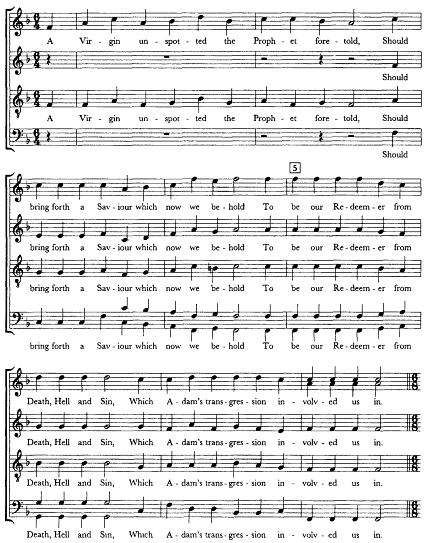
Example 11.
Billings, JUDEA (unknown) (Singing Master's Assistant [1778];
after Nathan, ed., Complete Works of William Billings, vol. 2, 52)
(continued )
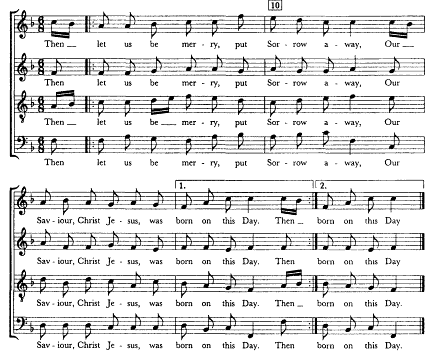
Example 11
(continued)
he had taken his Billings pieces not from the composer's own Massachusetts-published works but from Jocelin, a Connecticut source. Thus, we have it on Thomas's own authority that Jocelin was the link connecting Billings to The Worcester Collection (see table 3E), itself the source for so many later compilers' choices.[41]
More could be explored about the dissemination of Billings's music: about how the core of tunes that moved from The Singing Master's Assistant to Jocelin to The Worcester Collection was modified in later editions of that work; about The Worcester Collection's introduction, which named and praised Billings as chief among New England composers, hence proposing his books as a field for more borrowings;[42] about the article in the Philadelphia Columbian Magazine in 1788 that puts Billings in the artistic company of Handel and Shakespeare and surely led to the appearance of so much of his music in the Selection of Sacred Harmony
of that and later years.[43] But for now we'll have to be satisfied with having sketched the process by which Billings's pieces came to account for nearly 20 percent of the compositions in the most successful and influential American sacred tunebook of the decade.
This chapter has taken as its starting point Oscar G. Sonneck's maxim that "bibliography is the backbone of history."[44] Knowing which of Billings's pieces from The Singing Master's Assistant were printed, and when and where, has provided a start toward a broader investigation of psalmody's dissemination in print. By noting the roles sacred tune-books were expected to play—artistic, pedagogical, theological, commercial, even nationalistic—we have recalled some of the constraints within which their compilers made their choices and hence something of the context within which personal preference operated. By observing patterns of printings, we have seen that compositions can be considered not simply as independent items circulating on their own merits but also as members of larger clusters of pieces. Jocelin chose from Billings's The Singing Master's Assistant a group of pieces complementing each other so well that they formed a well-rounded, nearly complete microcosm of Billings's settings of sacred verse. Learning this, and having retraced some of the steps by which it came about, reminds us that, in the subsistence economy of the tunebook world, dissemination took place in a field of resistance. New pieces appearing in the field were accepted or rejected partly on their intrinsic qualities and partly on their relationship to the pieces already there. Knowing something of the nature of those relationships in the field we are studying, whatever it may be, is a necessary step if we are to take dissemination as an issue worthy not only of description but of analysis.