
Chapter Five—
The Demography of Polygyny in Sub-Saharan Africa
Noreen Goldman
Anne Pebley
Introduction
A common feature of African marriage customs is polygyny, a form of nuptiality in which some husbands have more than one wife. Although polygyny is not unknown in other populations, its incidence today is rarely as high as in sub-Saharan Africa. For example, between 1 and 7 percent of married men in North African and Middle Eastern Moslem countries are in polygynous marriages (Huzayyin, 1976; Torki, 1976; Issa and Eid, 1976; Momeni, 1975; Tabutin, 1979), and less than 10 percent of nineteenth-century American Mormon men were polygynists (Smith and Kunz, 1976). By contrast, between 12 and 38 percent of married African men are reported in polygynous marriages (van de Walle, 1968; van de Walle and Kekevole, 1984).
Because the sex ratio below age 50 is about unity in African populations that do not experience heavy migration, and because virtually all African men marry, there has been considerable speculation about the demographic and social arrangements that permit high levels of polygyny. Examination of the age distributions by sex in a stable population, shown in figure 5. 1, indicates that a surplus of women relative to men can be readily generated by a difference in the ages at which men and women first marry. If, on average, women marry at age 20 and men at age 28, the surplus of eligible women, shown in the shaded area to the left of the graph, will be substantial. A small surplus of women, shown in the shaded sliver on the right of the graph, is also generated at older ages by differences in the longevity of women and men.
Another commonly cited explanation for the frequency of polygyny is that widows usually remarry, often to an already-married kinsman of their deceased husband (Murdock, 1959; Caldwell, 1976; McDonald, 1985). For example, Caldwell (1976) has suggested that while polygyny is socially per-
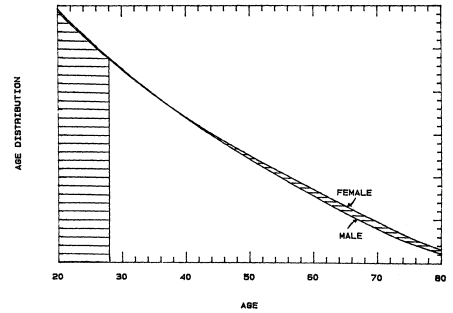
Figure 5.1.
Surplus of Women with an 8-year Age Difference at Marriage
NOTE: This figure is based on male and female stable age distributions
with a rate of increase of 0.02 and Coale and Demeny West model
life tables, level 13 (e0 = 50 for women, 47.1 for men).
missible in Bangladesh and while the age differences at marriage for men and women are as large as in sub-Saharan Africa, polygyny may be uncommon in Bangladesh because widows do not traditionally remarry. By contrast, McDonald (1985) reports that in Senegal, 91 percent of all women who stated that they had been widowed in their first marriages were remarried within 5 years, and among those who remarried, 75 percent were in polygynous unions.
The effects of both age differences at marriage and the extent of widow remarriage in producing a surplus of potential wives are likely to vary with the rate of growth experienced by a population. In the case of age differences, the slope of the age distribution curve is steeper with a higher growth rate and flatter with a lower growth rate. Thus, on the one hand, when men marry at older ages than women, we would expect that the surplus of women would be larger with higher growth rates. The extent of widow remarriage, on the other hand, may have a greater effect at lower rates of growth when older women comprise a larger portion of the female population. While most African countries are now experiencing moderate or high rates of population
growth, growth rates were certainly considerably lower before World War II because of higher mortality rates. Growth rates are also likely to drop to lower levels again in the future, this time through declines in fertility.
In this chapter, we investigate the contributions of age differences between spouses at first marriage and widow remarriage in permitting high levels of polygyny. We also examine the ways in which these associations change with different demographic regimes, in order to determine whether probable declines in future growth rates are likely to make polygyny more difficult to maintain at current levels. Our objective, however, is solely to describe the demographic conditions that allow polygyny to occur. We make no attempt to argue either that polygyny exists because African societies value universal marriage of women, or that large age differences and universal marriage exist to support polygyny.
Methods
Measurement of Polygyny
The frequency of polygyny can be measured in several ways. Van de Walle (1968) proposed three measures: m , the ratio of currently married women to currently married men; p , the proportion of husbands who have more than one wife; and w , the number of wives per polygynist. These measures are interrelated in the following way:

Since, by definition, more women are involved in polygynous marriages than men, we might consider another measure of the frequency of polygyny: the proportion of all married women who are in polygynous marriages, which we call ¦ , where:

We use census data from Cameroon and Senegal, collected in 1976, to illustrate the relations among these measures.[1] The data are shown in table 5.1.
Senegal clearly has a higher frequency of polygyny than Cameroon. More than half of all wives and almost a third of all husbands are involved in polygynous marriages. Though these proportions are smaller in Cameroon, the index w , which van de Walle terms the intensity of polygyny, indicates that men who participate in polygynous marriages have roughly the same number of wives in both countries. In fact, van de Walle's calculations from data collected in the 1950s and 1960s in a wide range of African countries indicates that the average number of wives per polygynist is usually less than 2.5. Contrary to the western stereotype of polygynists with large harems, the vast majority (71 percent in Cameroon, for example) are married to only two women.
| |||||||||||||||||||||||||||||||||
To assess the effects of changes in demographic parameters on the surplus of women available for marriage, we use a different index: the ratio of women above the female age at first marriage to men above the male age at first marriage . The advantage of this measure is that it reflects the potential for polygyny in the population rather than the current marriage practices of the population. In practice, since marriage of both men and women is virtually universal in African societies, as shown later, this index of potential is essentially equivalent to the ratio of ever-married women to ever-married men. The last row in table 5.1 shows the ever-married ratio for Cameroon and Senegal in 1976. The differences between these ratios and the ratios of currently married women to currently married men shown at the top of table 5.1 are due to widowhood, divorce, and separation. In the next section, we describe the assumptions and procedures which we use to calculate our index of polygyny.
Stable Population Model
The number of men and women at each age in a population closed to migration is completely determined by its history of fertility and mortality rates. Sub-Saharan African countries appear to have experienced declines in mortality since World War II, but little fertility change over the past few decades. To the extent that fertility has declined, such changes appear to be very recent and would only affect the population at the youngest ages. Since our focus in this paper is on adults who were all born at least 15 to 20 years ago, an assumption of constant fertility seems adequate for describing the age distributions of these populations. Previous research indicates that the age
distributions resulting from mortality declines usually differ only slightly from those generated by the assumption of constant mortality at current levels (Coale and Demeny, 1967). For these reasons, we rely on a stable population model, one in which fertility and mortality are assumed to have been constant over a long period of time, for most of our calculations.
The advantage of stable models is that the effect of various demographic parameters on the surplus of women can be readily assessed by a comparison of two or more stable populations. Such findings can be interpreted as either comparisons among different stable populations (with varying characteristics) or as assessments of the effects of long-term changes within a given population once it has reachieved stability at the new levels of the parameters. An obvious limitation of the stable model is that short-term period effects that result from demographic changes are ignored. Since demographers have recently become concerned with the effects of mortality decline on the availability of women for marriage (see, for example, Preston and Strong, 1986), we examine the short-term effects of mortality decline on our measure of the surplus of women in a later section.
In a stable population, the number of persons at a given age x can be represented by Be –rx lx , where lx is the underlying life table, r is the rate of population growth, and B is the number of births. In words, the number of people at a given age, x , is determined by the original size of the cohort at birth times the probability that members of the cohort survive from birth to age x. Although the effect of fertility on the age distribution is not apparent from this expression, fertility is the major determinant of the rate of growth r.[2] Fertility affects the relative size of birth cohorts and hence the slope of the age distribution. For example, high levels of fertility result in large rates of growth and invariably lead to young (steep) age distributions. The consequences of the mortality level are more difficult to assess because there are two kinds of effects: mortality partly determines the rate of growth (and hence the relative sizes of birth cohorts) and, in addition, mortality affects the proportions surviving to each age. These effects can counteract each other: for example, reductions in mortality usually raise the rate of growth—producing a younger age distribution—and simultaneously increase the proportions surviving to each age—producing an older age distribution (Coale, 1972).
If we assume that the female and male stable populations have a common growth rate, r , but separate life tables,




where Bf and Bm are the number of female and male births, respectively. The ratio of Bm h/Bf , which we call S , is simply the sex ratio at birth.[3]
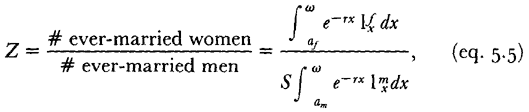
If we also assume that women first marry at age af and men at age am , the ratio of the number of ever-married women to the number of ever-married men, which we call Z , can be defined as:
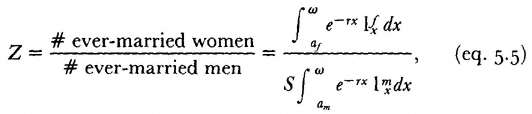
where w is the oldest age of life.
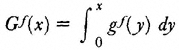
In real populations, women as well as men marry over a range of ages rather than at a single age. In order to assess the effect of a distribution of ages at marriage rather than a single age for each sex, we compared calculations of Z in which ages at marriage are fixed for each sex (eq. 5.5) with calculations in which a distribution, or schedule, of ages at marriage is employed for each sex. To incorporate schedules of age at marriage in Z, we let gf (x ) and gm (x ) represent the first marriage frequencies for each sex. Then Gf (x ) and Gm (x ), where
and
denote the proportions of women and men who marry by age x . The ratio Z can be redefined to incorporate G (x ) in the following way:

In eq. 5.6 the number of ever-married persons at each age is expressed as the product of the total number of that age and the proportion of persons married prior to that age. Our calculations made using eq. 5.6 are based on a Coale-McNeil curve of first marriage frequencies in which the rate of first marriages g (x ) for each sex is expressed as a double exponential curve with three parameters: the mean age at marriage, the standard deviation of age at marriage, and the proportion that eventually marries (Coale and McNeil, 1972; Rodriguez and Trussell, 1980).[4] The comparison of our calculations, under a wide variety of conditions, reveals that the values of Z based on eq. 5.6 barely differ from those based on eq. 5.5 which af and am take on the mean values of gf (x ) and gm (x ) respectively. For example, evaluation of eq. 5.6 with mean ages at first marriage for women and men of 20 and 25, a standard
| ||||||||||||||||||||||||||||||||||||||||||||||||||||||||||||||||||||
deviation of 4.6 for each sex, and proportions of one eventually marrying for each sex, yields a ratio Z of 1.247.[5] Evaluation of eq. 5.5, with values of af and am equal to 20 and 25, yields a value for Z of 1.248.
Further indication that use of fixed ages at marriage in lieu of age distributions would not alter our results is given by data presented later from three African fertility surveys. These estimates, shown in table 5.2, indicate that reported numbers of ever-married women per ever-married men, from survey data in Cameroon, Senegal, and Sudan, are almost equal to the ratios of the number of women (of all marital statuses) above the mean age at first marriage for females to the number of men (of all marital statuses) above the mean age at first marriage for males. Since we conclude that allowance for variance in age at marriage does not alter the value of the ratio Z , all future calculations are based on fixed ages af and am .
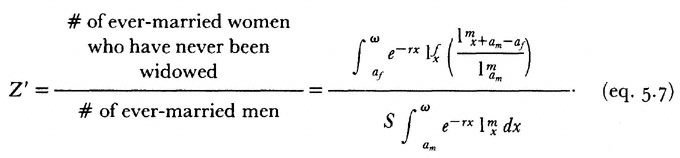
Implicit in the use of Z as a measure of the potential for polygyny is the assumption that all persons above the age at first marriage are either married or eligible for remarriage. Since part of our objective is to determine the extent to which widow remarriage contributes to the surplus of women in the population, we use a modified version of Z , which we call Ź , in which no
widows remarry. To construct Z ́, we assume that the mortality experience of women is independent of that of men, that is, that spouses have independent risks of dying and that mortality is independent of marital status, assumptions that are undoubtedly false (see, for example, Goldman and Lord, 1983), but which are sufficient for purposes of our model. We include in the numerator of Z ́ only women whose husbands are still alive, that is, we multiply the number of ever-married women at each age by the life table probability that the husband survived to the time they reached that age, given the age difference between spouses:
The ratio Z ́ could be further modified, by inclusion of the term
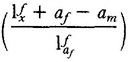
in the denominator, to describe a situation in which neither widows nor widowers are considered marriageable. Since the definition of a widower is problematic in polygynous populations, and, in any case, social prohibitions against widower remarriage are virtually non-existent, we do not consider this latter case.
Since almost everyone ultimately marries in sub-Saharan countries, we have not introduced a factor (denoted by C in the Coale-McNeil marriage model) which signifies that only a fraction of persons of marriageable age would ultimately marry. The ratio Cf /Cm would enter the expression for Z simply as a multiplicative factor and its effects can, therefore, be assessed readily.
In all of our calculations, numerical values for Z or Z ́ are obtained by evaluating equations 5.5, 5.6, and 5.7 with a single-year summation. For example, in eq. 5.5, Z is evaluated as
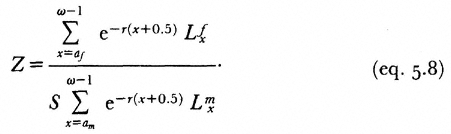
Single-year values of person-years lived (


(Coale and Demeny, 1983).[6] When we alter levels fertility or mortality, we calculate the population growth rate (rate of natural increase) from a life table and fertility schedule, and then substitute it into the appropriate equation for Z .
Result
Indices of Polygyny in Cameroon, Senegal, and Sudan
To determine whether the results of our model adequately describe the demographic determinants of polygyny in African populations, we compare them with data from two countries and part of a third which participated in the World Fertility Survey. These countries, Cameroon, Senegal, and Northern Sudan, were chosen because their data sets were available to us and because they included questions on marital status of men and women in their household questionnaires. Each of the three countries conducted a household survey in which the sex, age, and marital status of each household member were listed. Subsequently, an extensive fertility questionnaire, including a complete marital history, was administered to all women between ages 15 and 49 who were listed on the household schedule. Most of the data for our calculations come from published tabulations derived from the household survey (République Unie du Cameroun, 1978; République du Sénégal, 1981; Democratic Republic of the Sudan, 1982).
Since one of the main objectives of the household survey was to identify women who were eligible for the individual interview, men may have been less completely enumerated in the household survey than women. Selective omission of men would bias upward the ratios calculated from these data. To determine whether such underreporting occurred, we calculated the sex ratios for persons under age 45 in each household sample. In the absence of error (and sex-selective migration), the sex ratio for the age range from 0 to 45 should be very close to 1. In fact, for each of the three countries, there were 0.95 men per woman (or 1.05 women per man), a value that suggests only a modest undercount of males and a slight inflation of our ratios.
Our calculations for individual countries depend on the accuracy of WFS data on age, age at marriage, and marital status. Serious age-heaping is apparent in the age distributions in all three countries, but it should have little effect on our ratios since they involve the cumulation of numbers of men and women above a certain age. We believe that information on whether a person has ever been married or is currently married is likely to be reasonably well reported. On the other hand, dating of marriages and reports of marriage dissolution are much less likely to be accurate.
In table 5.2, we compare ratios of women to men above their respective mean ages at first marriage from WFS data for Cameroon, Senegal, and Sudan with the corresponding estimates from our model. The first part of the
table presents the nuptiality parameters required for calculation of these ratios. Figures in the first two rows show the mean ages of marriage for men and women calculated from a first marriage schedule fitted to reported proportions ever married by sex from the household survey. All three populations have sizable differences in the mean ages of men and women at first marriage. The difference for Senegal is by far the largest, with men, on average, being 10.5 years older at first marriage than women. The data in table 5.2 also indicate that virtually all men and women eventually marry in each of the three countries: the percentages of women and men aged 50–54 who have ever been married are at least 98 percent, with the exception of men in Cameroon (94 percent).
Two indices reflecting the potential for polygyny based entirely on reports of age and marital status in each household survey are shown in table 5.2. The first ratio relates ever-married women to ever-married men[7] and the second is a ratio of all women over the mean female age at first marriage to all men over the mean male age at first marriage. The two ratios are very close for each country, reflecting the fact that marriage is almost universal for both men and women. The comparison provides further confirmation that using the mean age at marriage rather than an age-at-marriage distribution for subsequent calculations does not affect our findings. The third ratio in table 5.2 is the estimate of Z calculated from eq. 5.5 using parameters based on actual values for each population. We used model life tables (Coale and Demeny, 1983, West family) at level 13 (eo = 50.0 for females and 47.1 for males) for Cameroon and Sudan and at level 9 (eo = 40.0 for females and 37.3 for males) for Senegal; these values are based on recent estimates of life expectancies for these countries (Population Reference Bureau, 1985). Age specific fertility rates were calculated from the individual data for the 5-year period before each survey and yielded estimated total fertility rates of 6.3, 7. , and 6.0 for Cameroon, Senegal, and Sudan respectively (République Unie du Cameroun, 1983; République du Sénégal, 1981; Democratic Republic of the Sudan, 1982). A sex ratio at birth of 1.03 was used for all calculations. Despite probable errors in reports of age and marital status and in our choices of population parameters, and violations of the assumption of stability, the estimates of Z are consistent with those from the WFS data, for each country. These comparisons suggest that our stable population model approximates the steepness of the adult age distribution and hence the ever-married ratio in each of the three populations.
In the next section, we use this model to explore in detail the effects of changes in each of the demographic parameters on the ratios of women to men (Z ). An alternative way to evaluate our findings would be to consider changes in the surplus of women relative to men, which can be measured by Z –1. For the sake of consistency, all of our results are presented in terms of Z , rather than Z –1, although a case could be made for each approach. Had
we chosen to use a measure of surplus, the observed changes (in percentage terms) would clearly have been much greater.
For most of the discussion below, we assess the effects of varying fertility and mortality regimes by a comparison among different stable populations. Although we sometimes refer to "changes" in fertility or mortality, these changes should be interpreted as either eventual long-term changes (when a given population has reachieved stability), or as variations among different stable populations. These distinctions are particularly important in the case of fertility, since even drastic declines in fertility will have no effect on the ratio for a period of about 20 years following the change. Short-term effects of mortality change are considered in a separate section.
The Effect of Age Differences at Marriage
An examination of the age distribution in figure 5.1 makes it apparent that age difference at marriage has a major impact on the potential surplus of wives. For example, consider two populations in which all women first marry at the same age (af ) and in which men first marry at an older age (am ) than women. Since all women between ages a f and am are married whereas no men of comparable age are, the population with the larger age difference at marriage must have the higher ratio. The extent to which a given age difference produces a surplus (or deficit) of females is a function of the steepness of the age distribution. For example, it appears from figure 5.1 that changes in demographic rates which would bring about a younger population (for example, increases in fertility), would give more weight to the portion of the age distribution between the female and male ages at marriage and would increase the size of the surplus for a given age difference.
Calculations based on a wide range of schedules of fertility and mortality indicate that, unlike age differences, the absolute ages at marriage have almost no effect on the ratio. For example, changes in the ages at marriage from 20 and 25 for females and males to 17 and 22, respectively, alter the ratio by only one percent.[8] For this reason, throughout the analysis, we fix the female age at marriage at 20 and let the male age at marriage vary according to the required age difference, unless otherwise specified.
Figure 5.2 shows the ratios which result from selected age differences at marriage with the same schedule of mortality but a wide range of fertility conditions. Since the impact of changes in fertility changes on the ratio can only be determined by first evaluating the effect of the fertility changes on the rate of growth (and hence on the age distribution), figure 5.2 depicts the ratios under different rates of growth, r , rather than under varying schedules of fertility. Clearly, fertility differences that have no effect on the rate of growth (such as a higher mean age of childbearing and a counteracting difference in the level of fertility) do not affect the ratio of marriageable persons.
Not surprisingly, the results indicate that, at any given growth rate, the
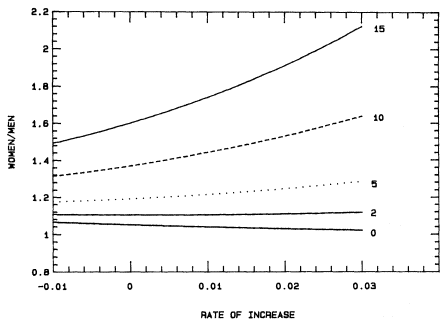
Figure 5.2.
The Effect of the Rate of Increase on the Ratio of Ever-Married
Women to Ever-Married Men at Selected Age Differences at
Marriage (Male Minus Female Age at Marriage, in Years)
NOTE: These calculations are based on Coale and Demeny
West model life tables, level 13 (e0 = 50 for women, 47.1 for
men), and an age at marriage of 20 for women.
ratio increases markedly as the age difference between spouses increases. For example, with a 2-percent growth rate, an age difference of 5 years produces a ratio of 1.22 whereas a 10-year difference results in a ratio of 1.50. Note that even when men and women marry at the same ages, there is a modest surplus of females, in spite of a sex ratio at birth of 1.03 males per female. This results from the fact that the underlying mortality schedules incorporate a higher life expectancy for females (by almost 3 years) than for males.
The effect of different growth rates on the surplus of women is shown for selected age differences at marriage ranging from 0 to 15 years, with men marrying at older ages than women. When men's age at marriage exceeds that of women by more than 2 or 3 years, the size of the female surplus is larger at higher rates of growth, as expected. The curves for larger age differences have increasingly steep slopes, which indicate the progressively larger effects of changes in the growth rate on the ratio Z . For small age differences, however, the situation is reversed: the surplus of women is slightly lower at higher rates of growth. This unanticipated result is a consequence of com-
monly observed sex differences in life expectancy which produce a male population of marriageable age which is younger on average than the female population of marriageable age. In Appendix I, these relationships are derived mathematically.
Effect of Differences in Fertility and Mortality
While many African populations are currently experiencing very high population growth rates, it is likely that growth rates in the past were much lower. Furthermore, growth rates are also likely to decline in the future with socioeconomic development. How much would a decline in the growth rate affect a society's ability to maintain a high frequency of polygyny? At a rate of growth of 3 percent, an age-at-marriage difference of 8 years results in a ratio of 1.5 ever-married women per ever-married man, which is quite similar to ratios currently observed in some African populations. A reduction in the growth rate to 2 percent, due to a decline in fertility, at a constant age difference at marriage, would eventually result in a relatively modest decrease of 5 percent in the ratio. Thus, unless accompanied by a reduction in the age difference at marriage (or other social changes), a decline in the growth rate poses little threat to the surplus of potential wives for polygynous marriages.
While the effect of changes in fertility as reflected in changes in the growth rate in figure 5.2 have a noticeable though modest effect on Z, changes in mortality rates have virtually no effect, at least within the range of life expectancy common to most African countries (40 to 60 years). For example, if ages at marriages for women and men are 20 and 25, respectively, and fertility is held constant, an increase in life expectancy from 40 to 50 years would reduce the ratio only from 1.29 to 1.28. If life expectancy were increased further to 60 years, the ratio would remain at 1.28.[9] The reason is that, in effect, the tendency of decreases in mortality rates to produce older male and female populations is counteracted by an increase in the rate of growth (also resulting from the same decrease in mortality rates), which makes the population younger. The net effect on the age distribution is very small for ages above 20.
The different effects of changes in fertility and mortality rates can be seen in figure 5.3. The top two curves depict the age distributions of two populations with the same fertility schedule: the solid line is that of a population with a life expectancy of 40 (and a growth rate of 0.02 ) and the dashed line is that of a population with a life expectancy of 60 (but a growth rate of 0.033). The similarity of the two distributions at adult ages contrasts with the third curve on each graph in figure 5.3.[10] This curve shows that a much younger age distribution would result from the higher rate of growth (r = 0.033) which would occur at the low life expectancy (40) but at a higher level of fertility. These results follow from well-known findings of stable
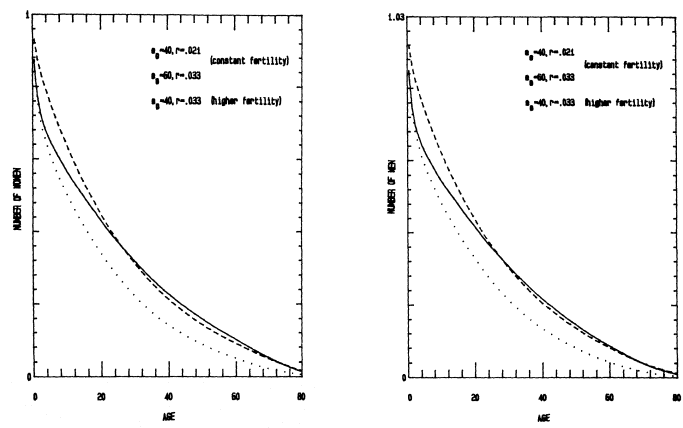
Figure 5.3.
The Stable Age Distributions for Women and for Men under Different Schedules of Mortality and Different Schedules of Fertility
NOTE: These calculations are based on Coale and Demeny West life tables, levels 9, 13, and 17 (e0 = 40, 50, and 60 for women, and
37.3, 47.1, and 56.5 for men) and a Coale-Trussell model fertility schedule (GRR = 3 or TFR = 6.1, mean age of childbearing = 29 years).
population theory about the greater (and more clear-cut) effect of changes in fertility relative to changes in mortality on the age distribution of a population.
Period Effects Resulting from Mortality Change
The results described above indicate that mortality changes have no significant long-term effect on the ever-married ratio. Nevertheless, it is plausible that these changes would have a noticeable impact on the ratio during the period of change and shortly thereafter. For example, Preston and Strong (1986) have suggested that recent mortality declines in many developing countries have resulted in a sizable surplus of women of marriageable age. In particular, if age differences at first marriage were large, female cohorts of marriageable age would be subject to reduced mortality rates much sooner than their male counterparts.
In order to examine the short-term effects of mortality decline, we replace our stable population model with a population projection that incorporates changing mortality and fixed fertility rates.[11] The calculation starts with a stable population age distribution that is then projected annually. Mortality rates for each year, within an assumed 20-year period of change, are calculated by linear interpolation between specified beginning and final life tables. After year 20, mortality rates are assumed to remain fixed at the new lower level for the remainder of the projection period (75 years) . In order to obtain upper-bound estimates of such mortality effects, we have chosen a large age difference at first marriage: ages of 20 and 30 for women and men respectively.
In figure 5.4a we show the resulting ratios for three projections of mortality decline for a 75-year period. Recall that the mortality change takes place entirely during the first 20 years. In the first two projections, we consider a moderate and a large mortality decline respectively. Both projections are based on model life tables (Coale and Demeny, West) for the beginning and final schedules. The first projection, which is based on a rise in life expectancy from 40 to 50 years over a 20-year period, is characterized by very little variation in the ever-married ratio Z . Not surprisingly, the second projection, which incorporates an improvement in life expectancy from 40 to 60 years over a 20-year period, shows greater variation in Z , but still a rather modest short-term change in the ratio considering the large magnitude of the mortality change. Moreover, both of these projections suggest that the short-term effects lead to a reduction rather than an increase in the ever-married ratio. As shown earlier, the long-term effects of both of these changes on Z is virtually zero.
Our results appear to be inconsistent with those from an earlier study by Preston and Strong (1986) who argue that some types of mortality change bring about significant changes in the marriage market. In fact, the two sets
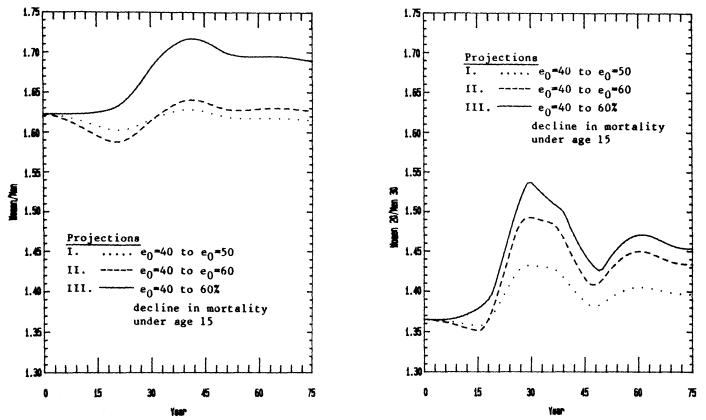
Figure 5.4.
The Ratio of Ever-Married Women to Ever-Married Men and the Ratio of Women Aged 20 to Men Aged 30 under
Three Projections of a 20-year Mortality Decline
NOTE: These calculations are based on Coale and Demeny West model life tables, a Coale-Trussell model fertility schedule
(GRR = 3 or TFR = 6.1, mean age of childrearing = 29 years), and ages at marriage of 20 and 30 for women and men respectively.
of results can be reconciled if we take into account the nature and magnitude of the mortality declines considered by Preston and Strong. Among their projections, the one that generates a significant surplus of marriageable females is a decline restricted to the young ages. In addition, the magnitude of the decline incorporated in their examples is enormous: for example, an absolute decline in the infant mortality rate of 100 per 1000 and a 35 percent increase in the probability of surviving to age 15.
Using our projection model described above, we have experimented with similar patterns of mortality decline. The third projection shown in figure 5.4a is essentially a replication of the latter example used by Preston and Strong. We begin with a life expectancy of 40 years and assume that death rates for each single-year age group under 15 decline by 60 percent over a 20-year period; in the resulting life table, the probability of surviving to age 15 is 35 percent higher than in the original life table (and life expectancy at birth is about 10 years higher for each sex). The resulting trajectory of Z indicates a modest rise in the ratio, with a maximum rise of 5.5 percent and an eventual rise of 3.9 percent. Of course, such a drastic improvement in infant and child mortality (which, according to values of 1(15), is associated with an increase from e0 = 40 to e0 = 65) is extremely unlikely to occur without substantial reductions in adult mortality. The fact that such patterns of mortality decline have a noticeable impact on the ratio is not surprising since the type of demographic change incorporated in the third projection is virtually equivalent to an increase in fertility. Our previous results have demonstrated that changes in fertility (which operate through the rate of growth) bring about modest long-term changes in the ever-married ratio.
It is important to recognize that these findings do not suggest that typical patterns of mortality decline have no impact on the marriage market. In particular, if we focus on the cohorts of prime marriageable age, it is clear, as Preston and Strong (1986) argue, that reductions in mortality can produce a substantial surplus of women at these ages. Figure 5.4b shows the ratio of women age 20 to men age 30 for the same three projections described earlier. The results indicate that, even with a moderate decline (projection 1), a significant surplus of marriageable women is created during the period that follows the decline. Not surprisingly, the surplus is considerably larger for the latter two projections. Although measures of this type may be useful for explaining phenomena such as the "marriage squeeze," such measures are less appropriate than Z or similar indices for assessing the potential for polygyny, in part because of the wide dispersion of ages of both husbands and wives in polygynous systems. These illustrations make it clear that, both in the short-term and in the long-term, realistic patterns of mortality reduction have little impact on the potential for polygyny. As we will see later, the exception to this finding is a situation in which widows do not remarry.
Widow Remarriage
Until this point, our calculations have been based on the assumption that all men and women above their respective ages at marriage are eligible for marriage. In order to determine how much widowhood contributes to the surplus of potential wives, we need to compare these figures with calculations in which no widows remarry (that is, widows are ineligible for marriage).
In table 5.3, we compare the effects of age differences between spouses, growth rates, and mortality on polygyny under two conditions: (1) all widows are eligible for remarriage, as in preceding examples, and (2) widows do not remarry. The comparison in the first panel of table 5.3 shows that even when there is no age difference between men and women at first marriage, widow remarriage makes a substantial difference to the ratio of ever-married women to men. If men and women marry at the same ages and widows do not remarry, there would be a surplus of men relative to women with a
| ||||||||||||||||||||||||||||||||||||||||||||||||||||||||||||||||||||||||||||||||||||
ratio of 0.85. If widows are allowed to remarry under these circumstances, the ratio would increase to just over 1. The effect of widow remarriage on the ratio increases as the age difference widens: larger age differences increase the number of widows at each age since women who marry much older men are more apt to outlive their spouses. For example, at an age difference of 10 years, widow remarriage would increase the ratio dramatically from 1.24 to 1.61 women per men.
The second panel shows the differences in the ratio that would occur at different rates of growth. Widow remarriage has the greatest impact when the growth rate is lowest. This effect is due to differences in the age distributions: populations with low rates of growth have a higher proportion of people at older ages, and widows, therefore, constitute a greater percentage of the population.
The figures in the third panel of table 5.3 indicate that, as previously shown, when all widows remarry, mortality has virtually no effect on the ratio. However, if widows do not remarry, the ratio is substantially lower at lower expectations of life simply because widowhood is more common. Thus, our conclusion that mortality has little effect on the ratio must be qualified: reductions in mortality will increase surplus of potential wives in societies that prohibit or restrict widow remarriage.
Comparison of the Effects of Demographic Parameters
The results of changes in the age difference at marriage, the growth rate, and widow remarriage are summarized in table 5.4. The objective of these comparisons is to determine how large a change in each of these parameters, taken one at a time, would be required to bring about a 10 percent reduction in the ratio for several stable populations. For a population at a high rate of growth (0.03) and a large age difference (8 years), a reduction of the age difference to just under 6 years would reduce Z by 10 percent. The same
| ||||||||||||||||||||||||||||||||||||||||||||||||||||||
reduction in Z would be achieved by the substantial reduction in the growth rate to a value of 0.01 or by a situation in which only about half of widows were eligible for remarriage. For populations with a smaller age difference at marriage of 3 years, reductions in Z on the order of 10 percent could only be achieved by a further lowering of the age difference at marriage (with females marrying at older ages than males in some cases) or with restrictions on widow remarriage, but they could not be achieved by changes in the rate of growth. As was shown in figure 5.2 and in appendix, the effect of changes in the growth rate on Z is either small or negative when age differences at marriage are small. The values in table 5.4 also indicate that, in order to achieve a 10 percent reduction in Z , the restriction on widow remarriage need not be as large in populations with small rates of growth or with large age differences because of the greater prevalence of widows in these populations.
In summary, our results indicate that the most important determinants of the ratio of ever-married women to men are the age difference at marriage and the inclusion of widows as potential marriage partners. At large age differences, changes in fertility have a modest influence on the ratio, but at age differences under 2 or 3 years there is no notable effect on Z . Substantial changes in mortality, at least within the range of life expectancy examined here, barely alter the ratio, as long as widows are eligible for remarriage.
Conclusions
The above comparisons suggest that the high ratios of marriageable women to men observed and estimated for Cameroon, Senegal, and Sudan are in large part due to substantial age differences at marriage which range between 7 and 10 1/2 years. Further calculations not presented here indicate that differences in the ratios among the three countries are due to variations in these age differences at marriage. For example, the reason that Senegal has the largest of the ratios (an observed ratio of 1.6 and an estimated one of 1.7) is almost entirely because its age difference at marriage exceeds those of Cameroon and Sudan by about 3 to 4 years; only a small part of the difference is due to Senegal's higher total fertility rate. The previous section indicated that virtually none of the disparities could be due to variations in life expectancy.
It is also apparent that the high prevalence of polygyny made possible by these ratios would not exist if widows could not remarry. The values of Z ́ in table 5.5 shown together with those of Z , based on estimated demographic parameters for the three countries, indicate that the ever-married ratio would be reduced by one-quarter, on average, if widows could not remarry. In absolute terms, the difference between values of Z and Z ́ is largest in Senegal, a not unexpected result since Senegal has the largest age difference at marriage and the lowest life expectancy, conditions that are conducive to a high prevalence of widowhood.
| ||||||||||||||||||||||||||||||||||||||||||||||||||||
Throughout this chapter, we have used observed and estimated ratios that reflect the potential for rather than the prevalence of polygyny. An index of the prevalence of polygyny in each population—the ratio of currently married women to currently married men at the time of the survey—is shown in the second panel of table 5.5. The fact that this currently married ratio is fairly close in size to the ever-married ratio suggests that women whose marriages have ended tend to remarry quickly. The comparison also suggests that the remarriage rates for widows are likely to be higher in Senegal than in the other two countries.
The extent to which widow remarriage contributes to the high prevalence of polygyny at any one point in time in each country can be examined more directly. If reports of marriage dissolution and remarriage in the WFS individual surveys had been accurate, we could have tabulated the number of currently married women who reported being widowed at some time in the past. Examination of the accuracy of reports of marriage dissolution in the three surveys, however, indicated that widowhood was reported much less frequently than it must have occurred.[12] One possible explanation for this pattern is the practice of levirate marriage in which a widow is often automatically inherited by her husband's brother. The woman herself may consider marriage to her brother-in-law as a continuation of her first marriage, rather than as widowhood and a subsequent remarriage. An additional prob-
lem with data in the individual survey is that they are restricted to women under age 49.
Because reports of widowhood in each survey are not adequate for our purposes, we have used a different approach for estimating the contributions of widows to the surplus of married women in each country. Based on the assumption of constant mortality at current levels and on fixed ages at marriage for women and men (as given in table 5.2), we estimated the percent of ever-married women at each age who had ever been widowed and compared these values to the numbers currently widowed as reported in the household surveys.[13] Although the measures derived from this calculation are subject to considerable uncertainty, they illustrate the relative importance of widow remarriage in the three countries.
The results are shown in the last panel of table 5.5. The next-to-last row shows the estimated percentage of ever-widowed women who are currently married, an indicator of the extent of widow remarriage. The difference between Senegal and the other two countries is striking. Almost 70 percent of Senegalese women who have ever been widowed are married at the time of the survey compared to less than a third in Cameroon and Sudan.
The figures in the last row in table 5.5 measure the contribution of former widows to the surplus of currently married women. Again, the pattern of remarriage in Senegal is markedly different from those in Cameroon and Sudan: an estimated 23 percent of currently married women were formerly widowed in Senegal compared to less than 10 percent in the other two countries.
The ratios in table 5.5 indicate that both the potential for, and the prevalence of, polygyny are greatest in Senegal. As noted earlier, the greater surplus of ever-married women (or of women of marriageable age) is due almost entirely to larger age differences at marriage in Senegal than in Cameroon or Sudan. The greater surplus of currently married women results not only from these age differences, but also from the greater prevalence of remarriage in Senegal.
Many countries in sub-Saharan Africa are currently experiencing high rates of population growth, due to high fertility rates and moderate declines in mortality. In the next two decades, these countries are likely to experience at least moderate reductions in growth rates as fertility rates begin to decline more rapidly than mortality rates. Our analysis shows that although these demographic changes may have a noticeable effect on the potential for polygyny, they are unlikely to have a large impact on the ability of African societies to maintain high levels of polygyny. Instead, our results indicate that the two major factors permitting high levels of polygyny in these societies are primarily social: the differences in age at marriage between men and women and the extent of widow remarriage.
Acknowledgments
This research was supported by grant #AGR CP48.07A from USAID and the Population Council Program on the Determinants of Fertility in Developing Countries; grant #R01 HD11720 from NICHD; and the Andrew W. Mellon Foundation. The authors would like to thank Ansley Coale and Graham Lord for their advice throughout the course of this project, Donna Sulak for producing the figures, and Gilles Pison and Etienne van de Walle for suggestions that significantly improved this paper.
Bibliography
Blacker, J., and A. Hill. 1985. Age patterns of mortality in Africa: An examination of recent evidence. In International Population Conference 1985, Florence, Italy; Liège, Belgium: Ordina for the International Union for the Scientific Study of Population.
Brass, W. 1971. On the scale of mortality. In: Biological aspects of demography. London: Taylor and Francis.
Caldwell, J. C. 1976. Marriage, the family and fertility in sub-Saharan Africa, with
special reference to research programmes in Ghana and Nigeria. In: Family and marriage in some African and Asiatic countries, ed. S. A. Huzayyin and G. T. Acsadi. Cairo: Cairo Demographic Centre.
Coale, A.J. 1971. Age patterns of marriage. Population Studies 25: 193–214.
———. 1972. The growth and structure of human populations: A mathematical investigation. Princeton: Princeton University Press.
Coale, A. J., and P. Demeny. 1967. Methods of estimating basic demographic measures from incomplete data: Manual IV. Population Studies, no. 42. New York: United Nations.
Coale, A. J., and D. R. McNeil. 1972. Distribution by age of the frequency of first marriage in a female cohort. Journal of the American Statistical Association, 67: 743–749.
Coale, A. J., and J. Trussell. 1974. Model fertility schedules: Variations in the age structure of childbearing in human populations. Population Index 40: 185–258.
Democratic Republic of the Sudan, Ministry of National Planning. 1982. The Sudan fertility survey 1979: Principal report. Khartoum: Department of Statistics.
Goldman, N., and G. Lord. 1983. Sex differences in life cycle measures of widowhood. Demography 20(2): 177–195.
Huzayyin, S. A. 1976. Marriage and remarriage in Islam. In: Family and marriage in some African and Asiatic countries, ed. S. A. Huzayyin and G. I. Acsadi. Cairo: Cairo Demographic Centre.
Issa, S. A., and I. Eid. 1976. Nuptiality and divorce in the East Bank of Jordan, 1968–1975. In: Family and marriage in some African and Asiatic countries, ed. S. A. Hyzayyin and G. T. Acsadi. Cairo: Cairo Demographic Centre.
McDonald, P. 1985. Social organization and nuptiality in developing societies. In: Reproductive change in developing countries, ed. J. Cleland and J. Hobcraft. Oxford: Oxford University Press.
Murdock, G. P. 1959. Africa: Its peoples and their culture history. New York: McGraw-Hill.
Momeni, D. A. 1975. Polygyny in Iran. Journal of Marriage and the Family 37(2): 453–456.
Pison, G., and A. Langaney. 1985. The level and age pattern of mortality in Bandafassi (eastern Senegal): Results from a small-scale and intensive multi-round survey. Population Studies 39(3): 387–405.
Population Reference Bureau. 1985. 1985 World population data sheet. Washington D.C.
Preston, S. H., and M. A. Strong. 1986. Effects of mortality declines on marriage patterns in developing countries. Chap. 9 in Consequences of mortality trends and differentials. New York: United Nations.
République du Sénégal. 1978. Principaux résultats du recensement de la population d'avril 1976. Dakar: Bureau National du Recensement.
———. 1981. Enquête Sénégalaise sur la fécondité: Rapport national d'analyse. Dakar: Direction de la Statistique.
République Unie du Cameroun. 1978. Recensement général de la population et de l'habitat d'avril 1976. Yaoundé: Bureau Central du Recensement.
——— 1983. Enquête nationale sur la fécondité du Cameroun: Rapport principal. Yaoundé: Direction de la Statistique et de la Comptabilité Nationale.
Rodriguez, G., and J. Trussell. 1980. Maximum likelihood estimation of the param-
eters of Coale's model nuptiality schedule from survey data. World Fertility Survey Technical Bulletin, no. 7/Tech 1261. London: World Fertility Survey.
Smith, J., and P. R. Kunz. 1976. Polygyny and fertility in nineteenth century America. Population Studies 30(3): 465–480.
Tabutin, D. 1979. Nuptiality and fertility in the Maghreb. In: Nuptiality and Fertility, ed. L. Ruzicka. Liège: Ordina for the International Union for the Scientific Study of Population.
Torki, F. G. 1976. Trends and differentials in age at marriage in Kuwait, 1965–1975. In: Family and marrige in some African and Asiatic countries, ed. S. A. Huzayyin and G. Acsadi. Cairo: Cairo Demographic Centre.
van de Walle, E. 1968. Marriage in African censuses and inquiries. In: The demography of tropical Africa, ed. W. Brass et al. Princeton: Princeton University Press.
van de Walle, E., and J. Kekovole. 1984. The recent evolution of African marriage and polygyny. Paper presented at the annual meeting of the Population Association of America, Minneapolis, Minn.