
Chapter 5
The American Temptation
The Coming of Consumer Society
At the end of the 1950s French cinemas were showing a film entitled La belle Américaine . The heroine of this comedy was not, however, as might be expected, a lovely Hollywood actress. It was rather a General Motors car. The film not only suggests the new prosperity of the French people but also makes the commonplace identification of Americanization with automobiles.
There was a second dimension to the anti-Americanism of the postwar years besides the political-strategic dispute. To be sure, even after the troubles of the Korean War era anxiety fingered about American hegemony. Thus in 1956 a visiting delegation of French political and intellectual leaders that included Gaullists, Atlanticists, and socialists shocked their American colleagues by accusing the United States of being an imperialist power.[1] Nevertheless, after about 1954 a sociocultural critique gradually suffused anti-American discourse, supplanting the earlier commentary about America as a political menace. Worry over America's passion to fight communism and turn the West into an armed camp subsided once McCarthyism vanished, the Korean War ended, Stalin died, West Germany rearmed, and containment yielded, at least rhetorically, to coexistence as Western strategy toward the Soviet Union. If Cold War tension remained, at least the political boundaries of Europe had been stabilized and the central issue of France's place in the new order had been settled. France was firmly Atlanticist and the earlier, more fluid, international situation had crystallized. Even the neutralists of Le Monde modified their stance and accepted German rearmament once the Soviets rearmed East
Germany.[2] Moreover, the peak of French dependence on the United States had passed and Washington's interference began to diminish. These changes shifted concern away from geopolitical and strategic issues. Gallic observers might continue to search for signs of latent McCarthyism and militarism, but interest turned to America as a domestic model.
Displayed as in La belle Américaine, America offered a sociocultural temptation to the French. This was an attraction many tried to resist. Americanization in the form of mass consumption and mass culture initially nourished anti-Americanism but in the long run also weakened it. This chapter examines the debate during the 1950s about America as a model of the modern society.
What was said or written about America toward the end of this decade reflected the coming of consumer society to France. The remarkable period of economic growth later labeled the trente glorieuses had begun. The appearance of La belle Américaine on the screen, for example, paralleled growing automobile ownership. The total stock of privately owned automobiles more than doubled between 1951 and 1958 and half these cars were new. By 1958 there was one car for every seven French citizens.[3] In the case of television, at the beginning of the decade there were only twenty-four thousand sets in France. By 1958 there were nearly a million.
Consumption and incomes grew a third between 1949 and 1958 and even more rapidly afterwards. Over this time span all wage earners experienced a sharp rise in purchasing power as incomes rose faster than the cost of living. Family strategies turned away from saving and investment, away from traditional values of building the family patrimony toward more present-minded enjoyment. Total household consumption grew 40 percent between 1950 and 1957, ahead of the annual growth of production, investment, and income. More so than other Europeans, the French pursued consumption at the expense of investment or saving. This powerful pull of demand derived not only from purchasing power but from a rapid proliferation of credit. The "traditional values of caution and frugality crumbled; debt was no longer considered something to be ashamed of," one historian writes.[4] Only the farmers continued to resist the trend toward buying on credit.
The way the French spent their income began to shift in the 1950s (see fig. 14). The major changes were not so much in food or clothes, though dietary ambitions altered and demand for clothes gave more
stress to fashion. But far more income went for health and personal hygiene. And the star of the domestic budget was household equipment. Expenditures on domestic appliances rose at an annual rate of 15 percent with the most dramatic progress coming after 1954. In that year only 7.5 percent of French households owned a refrigerator, 10 percent a washing machine, and 18 percent a vacuum cleaner. A survey taken in 1954 confirmed that the French conceived of their new well-being as starting at home.[5] From 1949 to 1957 the stock of home appliances grew 400 percent. The first spending priority was household goods. The next consumer aspiration was automobile ownership. And the third goal, after the achievement of domestic comfort and a private car, was leisure and culture. Spending on radios, television sets, records, games, photographic and sporting equipment grew rapidly.
Rising consumption was not equally distributed. Among the many excluded it aroused frustration and envy.[6] Farmers, for example, were largely outsiders. In rural Vaucluse Laurence Wylie reports that in 1950 villagers had little interest in acquiring modern conveniences. The farmers might have seen new bathroom facilities in American films but were either too poor to install modern kitchens and bathrooms or believed that buying on credit indicated poor household management. Thus farmers continued to invest in the family patrimony rather than in objects that would draw attention to their prosperity—especially the attention of the tax collector.[7]
The picture drawn by these data is of a society largely unequipped with consumer durables in the early 1950s. Only one of every seventeen inhabitants in 1951 had a car, for example. But the buying spree began in the middle of the decade and quickly gathered a momentum that was to carry over into the 1960s. Yet the French did not acknowledge this move toward consumer society late in the Fourth Republic. A poll in 1956 showed that despite a substantial increase in the average per capita income during the year, nine of every ten persons surveyed thought their standard of living had declined or remained stationary.[8] The dawn of consumerism was still shrouded in the darkness of recent shortages and penury.
It would be presumptuous to attempt to map what the French intelligentsia thought about America in the 1950s. Too little scholarly work on the subject exists. And the closed preserve of St-Germain-des-St-Germain-des-Prés was so subtly, yet sharply, fragmented into circles, hierarchies, rivalries, and influences that a comprehensive and accurate map may
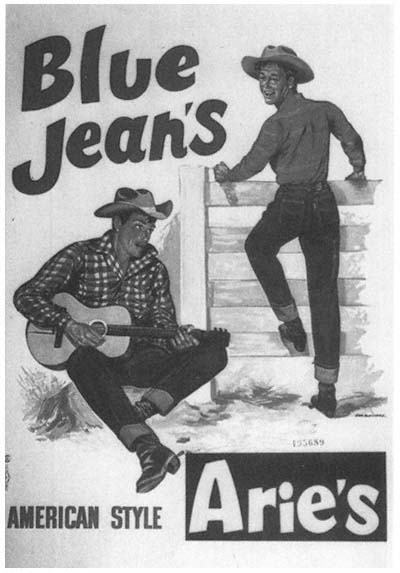
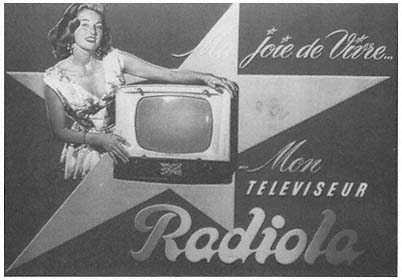
14. Ads for American products, 1950s: Blue jeans (above); American
television sets (opposite). (Courtesy Bibliothèque Forney-Paris)
elude even the most experienced native cartographer. Assessing "influences" of America, for example, on one scholarly field such as the social sciences is a daunting task.
But there was a subgroup of the intelligentsia, one that had lower status than les grands intellectuels yet included some of its most celebrated members, whose views of the American social model can be examined. These individuals might be termed the "popularizers"—prominent journalists, literati, and academics who directly and extensively addressed the issue of the American temptation and who shaped opinion. They were the experts who published popular books on America or wrote for strategic newspapers or reviews; they were the authorities on America who captured, if not a wide audience, at least one that counted as an educated elite. They may not have been the voice of France, but they were heard by the political, administrative, commercial, academic, and intellectual elites. These were the intellectuals who worried about America—less as a source of ideas or trends in the rarefied world of philosophy, literary criticism, history, social science, or art—and more as a socioeconomic and cultural model. Their books and articles directly addressed the question of the meaning of American consumerism and mass culture for the French.
This subgroup of the Parisian intelligentsia comprises the principal sources of informed opinion about contemporary America. Le Monde was the journal of the intelligentsia. Its editor, Hubert Beuve-Beuve-Méry, and its reporters, men like André Fontaine and Claude Julien, set the main lines of interpretation not only for St-Germain-des-St-Germain-des-Prés but also for much of the French elite. Even after neutralism had been eclipsed, Le Monde continued to convey its uneasiness about the new society across the Atlantic.[9] Esprit under the editorship of Albert Béguin and then Jean-Marie Domenach was one of the most important reviews for the intelligentsia and continued its prewar Christian personalist assessment of America. The distinctive interpretation of américanisme by Simone de Beauvoir and Jean-Paul Sartre appeared in Les Temps modernes, while book-length studies of America were published by Claude Alphandéry, Cyrille Arnavon, André Maurois, Jacques Maritain, André Siegfried, and Claude Julien. And social scientists like Raymond Aron, Georges Friedmann, and Michel Crozier contributed to this assessment.
During the 1950s the image of America as a sociocultural system was heavily marked by ideology. Unlike the critical assault in the 1930s, in this postwar decade it issued from the left, rather than the right. The grid through which most observers viewed the New World was constructed from Christian and socialist assumptions about America as the archetypical capitalist society. America was conservative, materialistic, exploitative, conformist, racist, and militarist. Visits to the United States rarely overturned the critics' assumptions. America's image was further damaged when visitors and even invited guests were denied entry because of their leftist views. Unmasking the reality of the consumer paradise became the self-appointed mission of most of these popularizers. They were convinced America was not the happy land of material plenty and social progress. A book of photographs entitled Les Américains portrayed the American people as joyless materialists immersed in mass culture, evangelical religion, and patriotism. The image was one of lonely individuals in bars, sidewalk preachers, poor blacks, and flag-waving crowds.[10] Nor did Americans unselfishly bring the world the gifts of prosperity and freedom. Americanization was something other than what its apologists claimed.
If St-Germain-des-St-Germain-des-Prés was stubbornly engagé, other America-watchers left and right either refused to judge American society ideologically or were partisans of Americanization. Among these observers were such literary celebrities as André Maurois, Jacques Maritain, Albert Camus, Claude Roy, André Siegfried, Vercors, and Henri Troyat. Familiar
negative themes appeared in their literature but were generally balanced by more positive appraisals of achievements and promise. Whatever the prestige may have been of these authorities, the weight of opinion among the popularizers was still essentially socialist and inspired by marxisant or Christian principles.
The debate about America in the 1950s had two other characteristics besides this ideological lens. First, unlike earlier criticism, it accepted that Americanization was at hand. Second, social science began to inform its perceptions.
Most observers now assumed that France was becoming Americanized in a material sense. Affluence, appliances, and automobiles lay round the corner for the French—remote in 1930, possible in 1950, and both inevitable and imminent in 1960. A few prescient commentators like Georges Friedmann had recognized France's future in America in the late 1940s. But virtually everyone accepted it by 1960. In that year Jean-Marie Domenach wrote:
Ten years ago we could still look down on the snack bars, the supermarkets, the striptease houses, and the entire acquisitive society. Now all that has more or less taken hold in Europe. This society is not yet ours, but it—or one that resembles it—could be our children's. The United States is a laboratory exhibiting life forms into which we have entered whether we like it or not.[11]
In the 1950s the technocratic nightmare of the interwar years became either real or irrelevant. But it was no longer a futuristic hallucination. Between the wars Duhamel may have predicted France's future in the guise of America, but he spoke of a distant future and one that might not, with proper resistance, come to pass. But now, "America is coming" was the consensus. And expressions of cultural archaism that had been common in 1930 were scarce two decades later when Jean Cocteau ascribed to industrial society qualities that he did not find in France:
So many disasters, hospitals, desperate withdrawals into the cloisters, flights, suicides, catastrophes. If that changed there would be discipline, order, fear, comfort . . . all those qualities that France doesn't possess and that would cause its ruin. France bristles with contours and peaks. One can't imagine a flat France. France would have everything to lose in aspiring to possess resources that are unsuited to it—for example, to want a large industrial plant. Its prerogatives are crafts, invention, the stroke of inspiration, the accidental.[12]
But Cocteau was out of step at a moment when Americanization was under way. Outright rejection of this future, which was plausible before the war, was now an impossible stance. Only the hidebound like
Duhamel, at age seventy-two, continued to insist that when it came to washing clothes a machine could not match hand laundering.[13] But few were paying attention to him any longer.
A final characteristic of this debate was the introduction of American social science. These empirical studies simultaneously sharpened and deadened the socialist critique. On the one hand, by the end of the decade the marxisant observers renewed their critique by drawing heavily on the literature of American social science. They enriched their critique with the exposés of such Americans as C. Wright Mills, William H. Whyte, David Riesman, and John Kenneth Galbraith. Here were the themes of "the power elite," "the organization man," "the outer-directed man," and "the affluent society." On the other hand, at the end of the 1950s sociology began to replace socialist ideology in American social studies. Scholars like Michel Crozier, Alain Touraine, and François Bourricaud came to regard America as a laboratory of the future and looked to American social science for methods and theories in order to study common problems.[14] Searching for the suppressed class struggle in America—a theme of earlier studies like that of Daniel Guerin—became passé.[15] Crozier left behind his former marxisant interests in America and became the gadfly of the leftist intelligentsia, embracing modernization as a beneficent force rather than a cover for capitalist exploitation.[16] For Crozier the issue became how best to remove the obstacles to modernization in France. Sociology was no longer the handmaiden of socialism, and studies of America became more "scientific."
Debating the American model in the 1950s meant assessing four major issues: consumerism, conformity, mass culture, and optimism. And implicitly or explicitly such discussion raised the question, was America a social model for Europe?
With respect to the first issue French observers weighed the advantages and disadvantages of the coming consumer society embodied in the American dream. On the positive side Americanization promised more leisure and comfort, less drudgery, and greater opportunity for personal improvement. Jean Fourastié's best-sellers, for example, paraded the attractions of the American "revolution" and the technological future.[17] Visitors to the United States during the early postwar years observed with fascination the birth of consumer society.[18] Coming from a society that was still suffering from austerity and one that made saving a virtue, they were astonished at the luxury of hotels and trains and
shocked by the spectacle of waste elevated to civic virtue. Even the average American home was full of surprises. The journalist team of Pierre and Renée Gosset exclaimed:
bedrooms; two bathrooms, gleaming, of course; a dining room where silverware was on exhibition; and a kitchen where the family actually ate. Renée mused wistfully in the kitchen with its enormous refrigerator, sensational stove, a sink with built-in cupboards. . . . All was spotless and without a faded curtain.[19]
Whereas interwar travelers seemed frightened by the dehumanizing qualifies of mechanization, their postwar successors often welcomed its liberating qualities. Sartre may have found prefabricated housing antiseptic but others believed that emancipation from deprivation, including liberation from squalid housing, enabled the average person to concentrate on more elevated goals.
One of the enthusiasts of America, André Maurois, wrote a dozen popular studies of the United States.[20] He acknowledged that mass production entailed some uniformity but argued that its benefits in liberating human beings from the meanest kind of work far outweighed its disadvantages. Maurois even disputed the stereotype of materialism. Americans, according to him, were obdurate idealists. They idolized men like Lincoln and Einstein rather than tycoons like Rockefeller. At an international conference on Americanization, a diatribe against the coming technical civilization provoked Maurois, as well as several other members of the French delegation, to come to its defense. They argued that technology was a progressive force that had lifted the masses. And if American materialism meant creating universities, museums, and libraries like those in the United States, then they wished Europeans "were a little more materialistic."[21]
But most readings of consumer society were far more negative than those given by Maurois or Fourastié. France might be facing a gadget society, the worship of mammon, and the death of culture. This critical reading predominated in the 1950s as it had in the 1930s. At Esprit Jean-Marie Domenach, for example, characterized America as a materialistic society whose dynamism derived from consumer-driven economic growth. He wrote, "This almost unlimited capacity to acquire and to consume is the fundamental characteristic of the American model" and likened it not to the possessive avarice of the European petite bourgeoisie but to an infantile desire to receive gifts.[22] He proclaimed that "money is unable to provide a durable basis for human society. One may well detest societies built on money but hating a
society is not hating the people who live in it—one may like the people who suffer there."[23]
One of the most influential examples of this genre was Claude Alphandéry's essay L'Amérique est-elle trop riche?, which found abundance to be the defining characteristic of America.[24] In Los Angeles, a city that struck other French critics as a caricature of America, Alphandéry was captivated by the network of highways, the tens of thousands of cars moving from suburb to work, and the ubiquitous Cadillacs. At the same time he cited official data on the pockets of poverty and the precariousness of the average suburbanite's household budget. As for advertising, Alphandéry was less bothered by its vulgarity than by its economic costs and its superfluity—was there much satisfaction from having the airline phone to ask you how you wanted your steak cooked? Citing John Kenneth Galbraith, he noted the contrast between private affluence and the dearth of public services. Higher levels of consumption required more public goods, that is, more cars required more roads; but the United States lagged in this respect. Los Angeles suffered from smog, inadequate public transportation, and a lack of free parking. To make matters worse, Alphandéry noticed the slowing of growth in the late 1950s. He located the problems of the American economy within the engine room of consumerism and attributed the downturn to the expensive marketing apparatus, to the "unproductive" changes in product models, to the unsuitability of American exports for the underdeveloped world, and to the general waste of resources through unbridled competition and rapid obsolescence.
Alphandéry embellished earlier critiques of consumerism like Duhamel's when he proposed a psychological and philosophical "American malaise." Consumerism generated an endless escalation of desires that could not be satisfied. "It is a form of alienation in which wealth, which ought to bring more freedom by liberating those who possess it from elemental constraints, rebounds against them."[25] The mass media contributed to this alienation by exciting appetites and creating a kind of status conformity based on the possession of consumer products. Alphandéry, relying on Vance Packard, called Americans disgruntled "status seekers."
Eager for material goods, anxious about appearances, disoriented by diverse temptations, millions of Americans live without knowing the relaxation and the feeling of liberation that they could hope for from abundance.[26]
Alphandéry found some "antibodies," such as the high rate of social mobility, that might fight this malaise of conformity anti greed, but he was not sanguine about alleviating the ills of consumer society.
Alphandéry's doubts about the cornucopia of affluence were matched by others' dismay at American waste. André Fontaine gazed enviously at the sea of used cars for sale on Livernois Avenue in Detroit, but Georges Friedmann, as he flew from a New York airport, saw only neglect in the hundreds of automobiles covered by snow.[27] More distressing was Americans' habit of disposing of usable goods because they wanted the newest model. Claude Julien suggested that America was a privileged society mainly because it wasted not only its own vast resources but those of underdeveloped countries as well.
Affluence had other negative social costs. French visitors noted that high incomes were equated with merit and social status. This was a vulgar equation to the intelligentsia. By 1960 it was also evident that consumerism was creating its own set of problems. Domenach noted that Americans were discovering their air was unbreathable, their water undrinkable, and their cities unlivable.
Of all the issues that consumerism raised for this generation of American observers, right or left, the one that most confounded them was whether French identity would survive the coming affluence. Most intellectuals either hoped or assumed that Americanization did not mean homogenization. Raymond Aron, for example, doubted that the French owner of a television set and an automobile would live like an American. "I hope," he said, "that he will preserve his singularity."[28] André Siegfried also believed that the French, outfitted with consumer durables, would behave differently from Americans. He cited a conversation with an American who showed him splendidly equipped kitchens and invidiously compared them to those of the French bourgeoisie. A friend of Siegfried's interrupted to ask, "But notice, where does the best cuisine come from?" Siegfried added that French kitchens were being modernized rapidly but explained the real difference:
The American confuses means and ends. When he owns a machine he forgets it has a purpose. The machine inspires such boundless admiration in him that he forgets its function. The French woman, in her modern kitchen, doesn't lose sight of its purpose, which is the preparation of pleasant meals.[29]
Civilisation, most insisted, would survive. But what were the salient features of this civilisation that they hoped and wanted to defend? That
was less easy to specify. Some insisted that at least part of the answer lay in Gallic bon goût and the quality of French goods. The equation of quality and crafts seemed a quintessential Gallic trait. Siegfried, one of the oldest and most respected interpreters of the New World, contended that mass-produced goods could never fully match the quality of artisanal production.[30] Americans had a genius for the former but not for the artistic—not for haute couture or luxury textiles, for example.
If consumerism was coming, who was responsible? By the mid-1950s it was difficult to blame America any longer for exporting this phenomenon. Maurois argued that such features of Americanization as advertising, book digests, and gadgets were the adventitious products of an era, of a process of democratization and mechanization that Americans and Europeans were both facing. Raymond Aron also accepted the transformation as universal and inevitable:
This process of "Americanization" is looked upon by many with horror. But in some respects the battle is not so much against Americanism as against the universalizing of phenomena linked to the development of material civilization. If the effort toward increased productivity and the subordination of all usages to the imperatives of greater output is termed Americanization, then the whole of Europe, including France, is indeed in the process of becoming Americanized.[31]
Another observer argued that the process might be a blessing or a curse, but it was "an innovation which we [Europeans] have brought upon ourselves and has not in any sense been forced upon us by the Americans."[32] Europeans freely chose to shave with Gillette razors and eat California oranges. But a Swiss philosopher, Jeanne Hersch, disagreed, saying she was less certain Europeans were free to choose:
The Americans make us uneasy because, without wishing us ill, they put things before us for our taking, things which are so ready to hand and so convenient that we accept them, finding perhaps that they satisfy our fundamental temptations. . . . Masses of American products are imposed upon us by artificial means, especially where films are concerned. . . . Even when we can make a choice between products, we are influenced by a sort of force within ourselves, which we fear because it is indeterminate and indefinable . . . the threat we feel hanging over us, is not something evil; it is a vacuum, such as is produced by rapid movement.[33]
Americanization seduced Europeans. Hersch's psychological interpretation reversed the traditional notion that Europe corrupted American innocence—now the Americans tempted an innocent Old World.
The legacy of Alexis de Tocqueville is discernible in the second issue raised by the American model. The postwar left, like the interwar right, castigated America for the malaise of conformity. America was a mass society. Its law was that of rule by majority opinion. This law was so commanding that on occasion it swept away constitutional guarantees of personal liberty. Observers did not have to look deeply to see manifestations of the sameness of this "flat society." Friedmann noted an astonishing similarity in the main streets of all American cities. Everywhere one found a "micro-Broadway" populated by "movie theaters with their illuminated ads, light bulbs that blink day and night, galleries of vending machines, bars and cocktail lounges, drugstores, television sets, [and] signs in gaudy, seductive neon."[34] Simone de Beauvoir after visiting a bowling alley reflected on how differently the game was played in France:
I recall a bowling match in the square of a French village on a July 14 afternoon; the uneven ground laid traps for the players. Gardens, country cabarets, and squares shaded by plane trees are all replaced in America by these great air-conditioned halls where they roll standardized balls on exactly measured alleys without arguments or laughter. . . . It is monotonous to watch.[35]
Most visitors complained about the homogeneity of the food. The drugstore in Cleveland or Albuquerque sold the same ham sandwiches and ice cream. But Claude Roy noted that America had something else to do besides eat. "It has America to build."[36]
In Les Temps modernes the young sociologist Michel Crozier observed that American social scientists served their society's mania for conformity by statistically defining what was "normal" in almost every form of human behavior including sexual relations.[37] In Le Monde Claude Julien evoked the era of the "gray flannel suit" to describe American management. Drawing on the work of American sociologists, Julien explained how the bureaucratization of decision-making dampened imagination and boldness.[38] American management had lost much of its allure since the days of the Marshall Plan.
The weakness of the American left, a most perplexing phenomenon to the French left, was to be explained by the assimilative power of affluence and the pressure of conformity that immunized the society against radicalism. For its expert opinion, Esprit relied on a Chicago labor leader, Sidney Lens.[39] Lens argued that the new "standardized man" took refuge from the real world in his privacy and his consumer goods. Television dominated his leisure. But commercial sponsors and advertis-
ers emptied television programming of any content, paraded a fairy-tale land of plenty, and treated Americans as children. "Standardized man" was capable of only infantile judgments. Nonconformity and creativity were branded "Communistic." Even most trade unionists believed Communists should be deprived of their citizenship. Everything conspired to make Americans accept their high standard of living as paradise. Yet, Lens told his French readers, consumer society did not make Americans content. Unhappiness was recorded in the high number of homicides, alcoholics, and neurotics.
Some of the harshest words about American uniformity came from Esprit . In 1951 Albert Béguin, following a visit that he said began without any preconceptions, wrote that daily life impressed him as "an attack against my personal liberty" because of the repetitiveness of advertising, the banality of conversations, the sameness of life-styles, and the uniformity of the environment. Not to acquire the latest model refrigerator, not to own a television set, or not to profess ideas derived from the daily newspaper was to be different, and difference was equated with being "un-American." Béguin acknowledged that there were good reasons, given the continent's need to integrate its immigrants, for this pressure, but the consequence was that America suffered from "a sort of dictatorship without a dictator" exercised by society on society.[40]
Béguin's successor as editor, Jean-Marie Domenach, repeated this indictment a decade later after his own tours of the United States. The only difference was that the "inorganic suburbs, monotonous roads lined with drugstores, and interchangeable motels" were also visible in Europe by 1960. Domenach asserted wildly that "the American state is liberal, but American society is totalitarian; it is possibly the most totalitarian society in the world." Politically an individual is free and that is important. "But in the realm of mores and human relations, difference is proscribed, not by edict or violence, but naturally, functionally. The same air, the same blood circulates through the countless channels of this porous society." Worst of all, from his perspective, America transformed revolt itself into a social function. It absorbed rebellion. "Try a 1960 Chevrolet. Try Zen. Try Jesus. Try whatever you want. You will feel better and better."[41] Domenach held some stubborn hope that this "hypersocialization, this domination by the other" would sooner or later unleash a nonconformist rebellion.[42]
Americans' penchant for conformity was obvious in the kind of culture they preferred. The New World, in the eyes of French observers, was a
cultural wasteland as well as the land of consumerism and conformity. Leisure entertainment was infantile. They noted the inane content of films, best-sellers, radio programs, and, the new discovery, television. "Come and watch television" was a common invitation extended visitors. But the French were not impressed with this distraction. A Catholic priest, Raymond Bruckberger, wrote, "I always think of Bernanos's words: 'Man has greater need for illusions than he has for bread.' The danger of television is obvious."[43] Commercialization of art was another grievance. Publishers sought neither to educate nor to discover original work—they wanted only to sell books to the masses. The "digest" was the symbol of this cultural deterioration. American culture seemed to be subservient to market criteria and subjected the writer or artist to commercial standards of success. Business profits and popular tastes dictated to the creative few. Even education was compromised by Americans' obsession with efficiency. The American army, Le Monde reported, was helping educate its officers by introducing speed-reading machines. But the army, the daily sarcastically noted, was satisfied if its officers could read quickly and comprehend 75 percent of the material.[44]
Yankee provincialism and anti-intellectualism provoked Gallic disdain. While visiting Cincinnati, André Fontaine was interviewed by several local journalists. At the end of the interview he was asked what newspaper he represented. "Excuse me, can you remind me of the name of your newspaper?—Le Monde —How do you spell that? Is it two words?"[45] The isolationism of the Midwest bewildered another journalist for Le Monde . He reported how an Iowa farmer asked foreign journalists if they wanted food packages sent to Europe. The date was 1952.[46] Albert Béguin reported that American undergraduates knew too little about the past to read French novels.[47] And Domenach was horrified when a businessman asked him if France was bigger than Belgium.[48] Americans distrusted intellectuals in power. Julien noted how the label "egghead" was a political handicap in American politics. He quoted President Eisenhower's definition of intellectuals as "those who use lots of sentences to say what can be expressed in a few words."[49]
Assessing the promise of American mass culture divided and perplexed French intellectuals. Was it to be praised as cultural uplift or condemned as cultural leveling? Unlike prewar literati who despaired over America, this postwar generation, while still sharply critical, saw a cultural transformation under way. If Americans lacked creativity, they were seeking the beautiful. One visitor flatly predicted: "You begin with the Pyramids, and eventually you come to build the Acropolis."[50]
America's colleges seemed like cultural oases and its libraries and concert halls were sumptuous by European standards. An article in Esprit marveled at the cheap paperback copies of C. Wright Mills and the thousands of Californians who voluntarily subscribed to an independent radio station.[51] To an apologist like Maurois, it was unfair to denigrate American culture. If Americans had no great tradition in painting, he observed, they produced masterpieces in the other arts and they admired European culture. Maurois quoted a sentimental American professor who, when going off to war, said to him, "Perhaps I shall be able to make my dream come true and re-read Madame Bovary, sitting in the shade of Notre Dame and eating a French croissant."[52] Claude Roy said Europeans' cultural snobbery was unwarranted anyway. Roy portrayed the ideal cultivated European who supposedly contrasted with the modern "mechanical man":
Western man . . . with his Christian, humanistic civilization, his ox-drawn cart, his Greco-Latin heritage, his unrefrigerated food, his respect for the human personality, his Hellenistic-classical sense of moderation . . . openhanded and gazing heavenward, dressed in a suit from the Belle Jardinière, tending Candide's garden, surpassing capitalism on the one hand and Marxism on the other . . . huddled in his Henry II dining room lined with flowered plates and works by the church fathers, Proudhon, and Kierkegaard, standing at his window watching the trains go by in steely contempt.[53]
Roy believed that neither Europeans nor Americans corresponded to these stereotypes. Raymond Aron, when faced with the question of whether high culture was sliding down toward mass culture in America or whether the cultural level of the average American was rising, answered judiciously, "I do not think one can entirely reject either thesis."[54]
But the critics continued to express their doubts. Vercors noted that it was too early for these pioneers to prize the beautiful because they were still immersed in the useful. And Alphandéry found certain products of mass culture, like paperbacks, brought cultural uplift, but he thought Americans were still backward:
Undoubtedly one finds in the United States a mixture of good taste and extreme vulgarity, but the dominant characteristic is a will toward cultural self-improvement, an admiration, perhaps a bit innocent and unqualified, for the great works of the mind, and an eagerness to refine taste and knowledge. However, what is missing is the pleasure of thinking in and for itself, the disinterestedness of reflection, an interest in synthesis. . . . There is still a great distrust for systems, for conceptions labeled "ideological," and there is a decided preference for pragmatism and specialization.[55]
The old charge that Americanization brought a "lowering" of culture would not disappear. Everyone was now willing to attribute a certain measure of cultural prowess to the United States and to allow a certain "progress" in American taste. And there was no longer any pretense that the two cultures were altogether dissimilar, though there was as yet little recognition that France itself was about to plunge into mass culture. Mass culture supposedly characterized America, and had an ugly tendency of invading high culture—the infamous American "digests" exemplified this adverse mixing of cultural levels that shocked the French. Les Temps modernes contended that "popular culture" was growing in America at the expense of both traditional "folk culture" and "superior culture." Culture became homogenized and denatured when the Book-of-the-Month Club brought Proust to middlebrow readers. Endless repetition of even the most profound experience made it a cliché. Mass media, Sartre's review argued, removed the individual from personal experience and, while appearing to compensate, actually aggravated his isolation from others, from reality, and from himself. It brought "the déréalisation of life that is lived for the most part as fiction. Art can deepen the perception of reality, but popular culture distracts us, hides from us its true aspects, and prevents us from living this reality." From this Sartrian perspective, American popular culture was not "authentic" and brought no real satisfaction because one cannot chase solitude or boredom with distractions: "The man who is bored is lonely because he misses his own company and not that of others, as he believes. He is deprived of individuality; he lacks the capacity to live and to feel."[56] The conviction among the intelligentsia that American mass culture was somehow contaminating persisted.
Most common in this effort at distinguishing Gallic culture from American technical or mass culture was to equate Frenchness with civilisation and define the latter as Latin humanism. Underlying this argument was a barely conscious form of self-defense for and by the French intelligentsia. André Siegfried expressed the problem this way:
The originality of Europe resides to a large measure in the well-matched association of the Anglo-Saxon spirit, which is synonymous with efficiency, and the Latin spirit, which is expressed in individual intellectualism, a combination of the practical with the critical approach. This balance has not been transmitted to the United States.[57]
"Culture [in the United States] in the true sense of the word," he continued, "with all its personal aspects is tending to be increasingly eclipsed by technical progress." America, according to Siegfried, was
oriented toward achievements that required collective action, leaving the self-conscious individual powerless. The American's fanatical respect for method, organization, objectivity, science, and technology makes him "appear to us as Germany's star pupil." Siegfried noted that "the system produces competent people but does not guarantee they should be cultured." Americans, in short, had a technical conception of civilization that produced homo faber ; to it Siegfried contrasted the humanistic goal of developing homo sapiens . Man himself, he concluded, not technical progress, was the essential aim of civilization.
The polarities of culture versus competence, or human beings versus technology, were ways of building a humanistic defense against "technical civilization." But there was another thrust to the Yankee cultural menace besides the technical mentality. It came from mass culture.
One response to the vulgarities and excesses of mass culture was to contrast them with the moderation, good taste, and aesthetic values of civilisation . Raymond Aron defined this sensibility by observing that Americans showed a certain indifference to aesthetic values in everyday life. Beauty was ignored or subordinated to other criteria like comfort or utility. The beauty of American architecture was largely functional. In contrast, he wrote, "the cult of form, of aesthetic values remains inseparable from the spirit of French culture—as it is in Japan, where concern with beauty touches every incident in existence, every piece of work, every garden, the fish-platter, the house."[58]
A similar defense was to define civilisation as the "art of living." In its most banal form it consisted of flânerie, that is, the pleasure of breaking habit, of lounging, of reflecting, even of being idle. Flânerie could be construed as a protest against the pace and routine of Americanization. Americans, according to one scornful commentator, construed flânerie as "loitering" and thought of it as a crime because it wasted time.[59] At a slightly more elevated level, the art of living became the famous douceur de vivre . There was an undefinable gentleness to life in France, a languid, pleasurable, and aesthetic quality about everyday existence that was antithetical to American organization and method. What was exemplary about the French, in Raymond Aron's mind, was this art of living that industry and consumerism would not ruin—"provided the French keep faith with themselves."[60]
In the boldest formulation of this humanistic identity, some argued Europe would civilize the United States. Serge Groussard contradicted the view that America anticipated Europe. Rather, to Groussard, "perhaps it is our own civilization, in its human scale and its logic, that
prefigures the future civilization of North America."[61] One day, from this perspective, a technological America would become humanized like Europe. But such hubris convinced only a few diehards. The rest concentrated on the task of saving humanistic culture.
This defense of cultural identity was not entirely selfless and high-minded. There were personal or professional stakes involved in the cultural anxiety of the French intelligentsia. Setting humanistic civilisation against Americanization was an implicitly elitist defense. One might even argue, as Michel Winock did, that the guardians of humanistic civilisation evoked or exploited nostalgia for traditional society to buttress their own privileged position.[62] Intellectuals' position as gatekeepers of culture was at risk but to acknowledge this would be transparently self-serving. Thus writers evoked the France of artisans, bistros, and flânerie to broaden their appeal and conceal their elitist self-interest.
Indeed both technology and mass culture threatened a traditional definition of high culture and those whose careers and self-esteem were predicated on its preservation and transmission. America, with its technical civilization and its mass culture, constituted a double menace to the status and future of the French intelligentsia. Technical civilization imposed homo faber on homo sapiens . Mass culture raised the prospect of the standardization and the commercialization of culture. Edgar Morin complained that the paperback book and other forms of "mass culture" depreciated the creative act.[63]Esprit recalled the story by James T. Farrell in which a fictitious American publisher designed a writing machine that dispensed with authors and royalties and produced four books in eight hours—books that sold because they offended no one.[64] Here was the nightmare of Left Bank intellectuals. An unexpressed anxiety lay at the heart of their uneasiness about Americanization, for they could see no ready accommodation. Americanization and civilisation were at war.
A fourth issue in the debate, symbolized by the ubiquitous American smile, was Yankee optimism. "Americanism," according to Maurois, was a philosophy defined as belief in human perfectibility and faith in work, equality, and freedom.[65] But Maurois was virtually alone during the 1950s in his unqualified praise for Americans' friendliness, confidence, and optimism.
American optimism, which seemed to border on hubris, was an easy target for Gallic sharpshooters. Le Monde mocked a publication of the
United States Information Agency suggesting that America led the world in human endeavor. Beuve-Beuve-Méry's paper proposed that the agency use a drawing of a Yankee seated on top of the globe with the caption, "The American's position in his own estimation."[66] Following the Soviet launch of Sputnik in 1957 Claude Julien ironically used the phrase "agonizing reappraisal" (after John Foster Dulles's warning of an "agonizing reappraisal" of Washington's policy following defeat of the European Defense Community) to describe America's mood. Julien seized on the Russians' triumph to remind the Americans of their unwarranted self-confidence in Yankee science and technology.[67] The young Philippe Labro, whose fascination with America led him to enroll at an elite Virginia college in 1954, scoffed at the shallowness of his fellow students and likened their behavior at the spring prom to "geese waiting patiently to dance at the gigantic ball of happiness and success."[68]
When Jacques Maritain, a prominent Catholic philosopher who had taught in the United States, blessed American optimism with a spiritual interpretation, he earned the scorn of the left. According to Maritain the "American smile" denoted a happy land; Americans, he believed, were the "least materialistic" of modern peoples.[69] Despite their professed esteem for money and objects and their desire for success, fun, and power, Americans prized generosity, kindness, tolerance, and spiritual values. Maritain defined the "American spirit" as profoundly Christian because it was based on the fraternal recognition of the dignity of human beings. The gospel's message of fraternal love was in the blood of Americans. For him America had the best chance of overcoming "technocratic materialism" because of a deep-rooted religious inspiration that informed secular activity. "If a new Christian civilization, a new Christendom is ever to come about in human history, it is on American soil that it will find its starting point."[70]
Such a benediction of America seemed unwarranted to the left. In Le Monde Julien gave Maritain's book a gentle review but undercut its argument by suggesting the author was paying a debt of gratitude to his American friends for giving him asylum during the war and for providing a wider audience for his views than he enjoyed in France. Maritain's talk about the spirit of America was an act of faith in the American people, but he missed "all the weight of a social life centered on visible success, verifiable efficiency, on money."[71] Maritain, according to Julien, may have uncovered the spiritual "leaven" in America but underestimated the "heaviness of the dough." Domenach was more severe. He thought the
ubiquitous American smile that Maritain evoked hid anxiety, ennui, and even fear. It masked the banality of human relations and hid a psychological and spiritual malaise.[72]
American optimism to Jean-Paul Sartre and Simone de Beauvoir was both a philosophical escape and a means of social control. Travel in the United States in the 1940s revealed the reality behind such positivistic illusions. While both Sartre and de Beauvoir equivocated in their general assessment—to the question "Do you like America?" de Beauvoir answered, "50–50"—they perceived the hollowness behind the optimism. They admired the dynamism of America. De Beauvoir called New York and Chicago "the most human and most exhilarating cities" she knew because they affirmed the creative power of human beings.[73] Yet she found an emptiness in American life. Americans were bored and lonely. In a philosophical sense they tried to flee the human condition, their solitude for example, rather than draw strength and meaning from it. They lost themselves in the world and the pursuit of the object. Their feverish activity—their incessant demand for distractions—was empty because it represented a flight from self-possession. Their liberty was empty because their social and political condition, "this machinery," victimized them. For de Beauvoir Americans could not escape their solitude and boredom because "they run from themselves; they don't truly possess themselves."
Sartre expressed the same mixture of fascination and repulsion for America as did de Beauvoir. Américanisme to him was "a monstrous complex of myths, values, formulas, slogans, figures, and rites."[74] The myths of happiness, freedom, and optimism were a new means of social control. Unlike authoritarian regimes, américanisme relied on gentle forms of social persuasion: it was a system of collective indoctrination. America was "a country of 'managed dreams.' "Americans were controlled by neither the government nor the capitalists but by other Americans. This nonconformist existentialist saw American society based on mauvaise foi and alienation. Americans became tragic by trying to efface tragedy from their lives.
There are the great myths of happiness, of freedom, of triumphant motherhood. . . . There is the myth of equality and there is segregation, . . . the myth of freedom and the dictatorship of public opinion. . . . There is the smiling belief in progress and profound discouragement. . . . There are those pretty, neat homes, those all-white apartments with radio, lounge chair, pipe racks—in short, paradise. And then there are the tenants of these apartments who, after dinner, leave armchair, radio, pipe, and children and go and get drunk by themselves at
the nearest bar. Perhaps nowhere else is there such a discrepancy between the men and the myths, between life and the collective representation of life.[75]
The American dream was the opium of the people.
Behind such unmasking of American optimism was a deep Gallic skepticism, even pessimism. Just as Sartre and de Beauvoir reproached Americans for their rosy view of the human condition, Albert Béguin chided Americans for refusing to discuss problems like suffering and death. He was dismayed when students at an American college suggested he consult a psychiatrist because he lectured on the "fecundity of regret." American optimism came at the price of masks and forgetfulness, stated the editor of Esprit; he asked, "Today what American would be ready to hear this remark of Bernanos: 'The adversity of men is the wonder of the universe'?"[76]
A decade later Béguin's successor, Jean-Marie Domenach, complained that a French intellectual felt dépaysé in America. America was "foreign" to him and to the rest of the world. In part, according to Domenach, what caused the disorientation was America's boundless optimism. But French intellectuals, he wrote, "we carry in our hearts a cemetery of utopias; tragedy is our kingdom."[77] Even for Raymond Aron, hardly a man of the left, French culture was fundamentally different. He framed the differences broadly, setting American pragmatism and moralism against French universalism, pessimism, and skepticism. Aron described French culture:
. . . conspicuous for its catholicity, its profound pessimism, its undefined tension between faith and skepticism. National consciousness in the United States is pragmatic and moral; it will stay that way in the foreseeable future, at whatever stage of economic progress.[78]
Psychologically and philosophically these intellectuals were at odds with the essential assumptions of Americanism. Such reflections about American society and culture inevitably led these observers to an urgent question. Was America a model for France?
It is hardly surprising that the collective answer to this self-inquiry was a resounding "no." In the abstract any society is unlikely to function as a model for another. And given the intensity of French anti-Americanism, a negative answer was predictable. What may be unforeseen, however, was the consensus among the intelligentsia on this question. Enthusiasts like André Maurois and Jacques Maritain
did not portray America as a transferable model. And Raymond Aron, who was a partisan of modernization, if not Americanization, expressed strong reservations on the subject. Before the question of whether France would resemble America, Aron balked. Technology might be forcing uniformity, but "when it comes to attitudes toward life, death, the social hierarchy, or society, to questions of philosophy or of religion—here I have not seen the picture of the future in the United States."[79]
The most vehement nay-sayers advocated outright resistance to the American model. Cyrille Arnavon, a professor of American literature who had taught at Harvard and Columbia, called américanisme a form of colonialism. The export of American culture was a capitalist oligarchy's conservative global strategy to advance free enterprise, anticommunism, and the existing social order. The basic attitudes of a generation raised on publications like the Reader's Digest, according to Arnavon, would be characterized by "flabbiness, intellectual passivity, and an irrationalism that profits vested interests and established privilege." He worried that within twenty years French middle managers would be trained in American methods and know only English as their second language, becoming men and women for whom "truly rational thought and, especially, acute social criticism" would be inconceivable. To this left-wing academic, américanisme was incompatible with "traditions, ways of feeling, aspirations, even the very methods for directing one's mind that are at the core of the European, in particular the French, heritage."[80] If France accepted America's cultural manna the French would soon suffer from the same collective maladies of the Americans. For Arnavon the antidote to Hollywood, science fiction, and the Saturday Evening Post was a careful analysis of facts. Lucid rationality would unmask the ideological message of américanisme .
Le Monde just as surely saw no model across the Atlantic. By the end of the 1950s the newspaper may have modulated its earlier abrasive tone but it continued to emphasize the problems of the American social, educational, economic, and political system.[81] Claude Julien published his reports for the paper in a book he named Le nouveau nouveau Monde . Despite an appreciative tone, Julien cataloged the problems of poverty, suburban blight, racism, and the power elite, as well as the shortcomings in public health, public goods, and education. He acknowledged that most of these problems also existed in France, but America offered no answers.
Jean-Marie Domenach was more direct in answering the question. For him America was "incommunicable." America was unique and
thus could not serve as a model for others. Americans were foreigners to Europeans and were becoming foreign to the entire world. America was no model for a "civilization of persons." For in America consumerism, assimilation, and mobility dissolved everything holy that formed the basis of human society—authority and tradition.[82] In Europe people ranked themselves according to values or status that came from the past rather than according to incomes or efficiency. The twin tyrannies of money and opinion destroyed the frame that protected the individual. Americans could build lovely houses and organize informal associations but they could not create human communities. Thus for Domenach writing in 1960, Americanization might be spreading—but the rest of the world was repelled by the American style of life that reversed traditional values and structures. America was not a model. It was irrelevant.
While these Gallic critics tried to unmask the reality of Americanism, the historian might try to unmask the assumptions of the critics. What were the stakes of this debate at the end of the 1950s? Why did these French censors pursue their American cousins so earnestly?
The stakes of the game were enormous, and the postwar intelligentsia guarded them both: the revolutionary tradition and civilisation . America was the siren of comfort and conservatism to those who wrote from a marxisant or social Christian position during the Cold War. The correct posture for these intellectuals was astride the revolutionary tradition. American consumer goods and mass culture coopted the working class and suffocated dissent. Succumbing to the American way was to relinquish a revolutionary posture or, at least, a critical social stance. This stance aimed not only at subverting the French status quo but also at demystifying Western society in general. Should the American way become the European way, then the intelligentsia would have lost its political-social mission.
For almost every Gallic commentator, radical or conservative, there was a second stake in the debate. That was French civilisation . If this cause was not well defined, it was a grand and emotional issue. For it expressed a defense of national identity against a modern barbarism. Intellectuals must have been pained to hear Anouk Aimée, the actress, ask plaintively in a popular movie of the time: "Are there any new American films to see?" Either America lacked a culture or had one that debased culture. To the alarmists, American mass culture was a noxious contagion. To others, whether television, Hollywood, and the Reader's
Digest leveled or enhanced culture were still open questions. But to most, whatever their political preference, civilisation was at risk.
What did civilisation mean? To those thinking about manufacturing, it was crafts or the production of quality goods that were synonymous with France. To others, it was a way of life variously defined as la douceur de vivre, the joys of flânerie, good taste, or a highly developed aestheticism. Or it might mean Gallic individualism and nonconformity. Still others conceived of civilisation as an expression of humanism that denoted a classical education, moderation, civic-mindedness, and rationality. Or it might mean a philosophical disposition that was skeptical and critical if not pessimistic. And it assigned intrinsic worth and prestige to high culture and the intelligentsia, not to those who would commercialize cultural products. After all, technology and television scarcely honored the carriers of literary culture. Civilisation elevated homo sapiens over homo faber .
To consider the matter in its most general aspect, it has been said that France and the United States clash because they are the only two Western nations that harbor universal pretensions. They are certain that other nations want to imitate them. Americans believe they possess the secret to freedom and prosperity and the French believe they are the champions of civilisation . Inevitably the pretensions, or egocentrisms, of these two cultural imperialists, will conflict. For most of those writing about America during the Cold War this rivalry had two dimensions. The mission of the Parisian intelligentsia was both to project a revolutionary critique and as gatekeepers to export and guard civilisation as well. America in the 1950s represented counterrevolution and mass culture. France represented revolution and civilisation . The stakes of the debate were immense. Thus the intensity of what was written about the American model.
The year 1956, in retrospect, was a landmark in postwar anti-Americanism—at least for the leftist intelligentsia. In October the Red Army entered Budapest and crushed a movement that threatened to take Hungary out of the Soviet bloc and move it toward Western democracy. Russian military intervention against the Hungarian freedom fighters shook the progressistes' confidence in the Soviet Union and communism as forces for human liberation. News of Khrushchev's denunciation of Stalin's crimes in the same year seemed to confirm the worst anti-Communist charges about the Soviet Union. After 1956 the diaspora of French intellectuals accelerated when Claude Roy,
Vercors, Sartre and others broke with the Communist party.[83] In time, rejecting the Soviet model would also make some of these men and women available to America. But the reversal would not come quickly or easily. Ironically it was the misbehavior of the Soviets rather than American efforts at persuasion that sapped the vigor of ideological anti-Americanism.
It would be, nevertheless, too neat to divide postwar views about America at 1956. The socialist and marxisant filter that colored how the progressive intelligentsia viewed the New World survived Hungary. In an editorial for Esprit entitled "The Flames of Budapest," Albert Béguin vilified the massacre as "the naked revelation of reactionary terrorism."[84] In Eastern Europe revolution had degraded into despotism, and the Soviets had exposed themselves as the enemies of freedom, justice, and national independence. But this setback did not shake Béguin's commitment to socialism. Marxism had simply exceeded its boundaries. It had become a dogma and an "ideological system that can defend itself only by a kind of frightening fury against a revolt representing true humanity." Marxism was not false, but socialism needed to be humanized and freed from the "mortgage of theory and totalitarian idolatry." None of this, however, softened Béguin's views of America. If America more or less maintained political democracy, it tenaciously resisted any steps toward economic and social democracy. Money ruled and created injustice, inhumanity, hypocrisy, and spiritual suffocation. Béguin asked:
If we reproached socialist ideology for idealizing man and remaining blind to his fallible nature, we encountered, just as quickly, the even blinder idealism of the average American. What is there to expect from this civilization that ridicules and caricatures the spiritual traditions of the West and pushes humanity toward a horizontal existence that lacks the internal dimension of transcendence?
St-Germain-des-St-Germain-des-Prés was to drift slowly away, rather than make a sharp turn, from its anti-Americanism.
As Béguin did, others on the left held firm about America. Domenach's "conversion" would take time. If Les Temps modernes began to carry articles by Americans in 1957–58, they served only to ratify the Sartrian critique of américanisme . Excerpts from books like William Whyte's Organization Man sustained the image of America as a society of alienation and neo-Babbittry. One authority, evaluating the works of American sociologists like Whyte and David Riesman for Sartre's review, concluded that the drama of history had been replaced by a pantomime
in which humans were trained to adapt, to respond as if drugged, to the signs that each received through outer-directed "radar."[85]
Nevertheless after 1956 the first indications of a softening of the socialist critique among these popularizers appeared. If this shift was barely perceptible, it was nonetheless important. The left's attack began to lose its coherence and its bite. The marxisant filter that once colored America in dark reactionary hues began to lighten. America's changing image reflected several developments besides Khrushchev's speech against Stalin and pictures of Soviet tanks in Budapest.[86] Changes in France and the United States also contributed to the softening. It was about 1957 that French observers first noticed the fact of their own economy's remarkable growth.[87] The French standard of living had improved markedly by the mid-1950s and France itself seemed headed toward its own consumer society. This economic change necessarily made American society more relevant. Furthermore, Americanization was being assimilated without the anticipated destruction of old ways. Pierre Emmanuel, who a decade earlier had damned "Imperial America," now scoffed at the danger of Americanization and wrote of the importance of the American experience in humanizing the machine age.[88] The United States also became more appealing once a stalemate was reached in the Cold War and the Eisenhower administration quietly retreated from its pledge to "roll back" communism.[89] The Soviet launch of its Sputnik satellite contributed to the new appeal. Now the United States was no longer omnipotent, and its vulnerability made it: less menacing. Yet another reason for the shift came in 1958 when Charles de Gaulle returned to power because of a crisis generated by the war in Algeria. In time de Gaulle was to launch his own diplomatic effort against Washington that would serve to make the left reconsider its anti-Americanism.
Equally important for the intelligentsia was the realization that America needed to be rediscovered and reevaluated. The new issues of bureaucracy, mindless conformity, mass culture, and consumer society confounded old categories of analysis. To this end the intelligentsia, left and right, began to make extended trips to the United States. Michel Crozier, François Bourricaud, Jean-Marie Domenach, Edgar Morin, Raymond Aron, and others became regular visitors on American college campuses.
At Esprit, Domenach confessed that his ideological and sociological categories did not fit America. Class, race, and nationalism, all imported from Europe, did not apply. Domenach acutely diagnosed the way the left's conventional attack on America now seemed to backfire.
"Try a left-wing critique of American society and in the end you realize that it becomes a right-wing critique; that you attack democracy, popular culture, [and] mass consumption . . . and that you call into question your own ideology." Domenach now wrote with more emphasis on American diversity, with more satisfaction about American open-mindedness and dynamism, and with more hope for the future, recalling the serious yet eager faces of the undergraduates he taught—"the wonder of America is its receptiveness."[90]
For all these reasons the leftist consensus about the American model began to loosen at the end of the 1950s. The socialist critique became increasingly diluted by impartial description or systematic collection of data and analysis. Social scientists like Michel Crozier and Alain Touraine entered the discussion and interpreted America in a less ideological and less literary way.[91] In 1955–56 Raymond Aron presented his lectures at the Sorbonne on industrial development, which coolly analyzed the common principles of all industrial societies, including America and the Soviet Union.[92] When the popular Que sais-je? series published its guide to La Vie américaine the French reader discovered descriptions, in neutral language, of American suburbs, household budgets, holidays, food, and education, as well as accounts of social problems like juvenile delinquency. But the tone was optimistic.[93]Le Monde moderated its censorious tone; Claude Julien wrote of the common destiny of France and America and called the inventiveness and lack of complacency of Americans their true wealth and hope.[94] At the end of the decade Esprit devoted an issue to American social science, with articles by authorities like Edward Shils and Daniel Lerner.[95] And while this review was condemning "standardized man," it reported in an essay on America that McCarthyism had disappeared without a trace, that democracy in America, unlike in France, was real, and that mass society was creating its own antibodies.[96]
The "air-conditioned nightmare" (as Henry Miller once labeled America) was beginning to dissolve before "facts" and new forms of analysis as well as before economic and political developments at home and abroad. It would take another decade before this critique of America inspired by socialist and Christian principles changed, but a start had been made.