
Levels of Formalism
The degree of legal formalization and codification is one indicator of the juridical field's degree of autonomy. When discussing legal formalization, it is useful to distinguish between levels of formalism. An initial formalism, to which great attention was paid in Tokugawa Japan (as in China), relates to the recognition that cases should be grouped and filed under specific categories (water and border disputes, money suits, etc.).[39] This first procedural decision was to determine the nature of a case in order to channel it to the appropriate judicial authorities and to apply to it the appropriate law. As Henderson remarks, this could not but also reflect "the relative substantive value attached to ... [the] underlying claims [of each type of case]."[40]
More fundamentally, one could say that this is the point where a dispute or incident gets converted into legal matter, the creative power of legal naming reveals itself, and law has its field-specific effect on social reality. The decision to allow some events to become legal matter and to deny this to others creates a quasi-ontological divide in social reality;[41] and the effect is not always to enhance the importance of the former over the latter. Thus, the stipulation that murders and border disputes had to be brought to court certainly turned such incidents into public events and introduced a new element of power into them. An-
[37] Henderson, Conciliation , 1:145 n. 59.
[38] Ibid., 167-68. The status of the suit inns contrasts sharply with the illegal status of pettifoggers in China (see Melissa Macauley, "Civil and Uncivil Disputes in Southeast Coastal China, 1723-1820," in Civil Law in Ch'ing and Republican China , ed. Kathryn Bernhardt and Philip C.C. Huang [Stanford: Stanford University Press, 1994], 85-121).
[39] See Henderson, Conciliation , vol. 1, chap. 5, for the main categories of "civil suits."
[40] Ibid., 102.
[41] Bourdieu, "Force of Law," 837-40, 846.
other example is the prosecution, started in 1773, of mixed marriages between kawata and commoners as "adultery," resulting in status demotion from commoner to hinin, whereas such marriages had been legally neutral prior to that date.[42] That courts refused to consider cases initiated by inferiors against their superiors (lower samurai against higher samurai, sons and daughters against their fathers—Osadamegaki , art. 65), however, did not mean that such "authority-related" cases were deemed less weighty than, say, border disputes; rather it signaled that a certain reality, namely, authority, was above the law. After all, "unreason does not prevail over reason; reason not over law; law not over authority; authority not over Heaven."[43]
A second type of formalism concerns the bureaucratic procedures whereby an incident, once transformed into a case, must be submitted in proper form to appear in court. This is the all-important area of legal language and format, which became quite intricate in Tokugawa Japan, although, and in part because, it was by no means made uniform. The procedures themselves could be lengthy and complex. Dan Henderson's detailed analysis of a money suit by a villager reveals that a settlement (not a verdict) was reached after four months, after attempts to settle the suit at the village level.[44] First the village headman's endorsement was secured, then the local overlord's;[45] subsequently misphrasings underwent correction, the petition had to be endorsed by the court, and the suit initiated, and after twelve postponements, five stalemates, one hearing before the commissioner, and six hearings before the recording officer, only a settlement was reached. In another case, involving eight commissioners, over the establishment of a new market, Henderson
[42] Igeta, "Kon'in sabetsu," 10.
[43] Mizubayashi, "Kinsei no ho[*] to kokusei kenkyu[*] josetsu," Kokka gakkai zasshi 90, nos. 1-2 (1977): 6 ff.; for a different interpretation of this dictum, critical of Mizubayashi's, see Nanba, "Hyakushö ikki no ho-ishiki[*] ," 47-62. The "reason does not prevail over law" part of the dictum was incorporated in the third article of the Warrior Code (Bukke s ho hatto ) of 1615 (NST 27:454; for the English translation, see Lu, Sources , 1:201-3).
[44] Henderson, Conciliation , vol. 1, chap. 6.
[45] Ishii Ryosuke[*] (review of Conciliation , 216) questions Henderson's assertion that the headman's approval was needed, which Henderson also argues on p. 129 of his book. The headman, however, had to endorse with an accompanying letter any suit by a villager. As we saw in the Kasuga village case (chapter 3), it was considered an abuse of authority by the headman to forward such a case without his endorsement, which meant that the case would be immediately rejected by the intendant.
estimates that plaintiffs from three villages located the distance of a five-day trip from Edo must have traveled some thirteen hundred miles before obtaining a (negative) final verdict.
Similar documents differed from one another depending on whether they recorded the testimony of a commoner (kuchigaki ) or a warrior or priest (kojosho[*] ) or an offense by the former (called kyokuji ) or the latter (otsudo ), or depending on the commission involved (the Temple and Shrine Commission called complaints not meyasu but sojo[*] ).[46]
The complexity of the above two types of formalism created a special world having a very specific effect on any commoner who entered it. A veritable arsenal of symbolic devices was marshaled to turn him or her into more of a subject than he or she was in daily life. First of all, one could not enter this world simply on one's own volition. Endorsements from the authorities (headman and overlord) were needed, and the language of that specialized world was formulaic and determined in an authoritative way, severely restricting spontaneous, quotidian expressions. Its tenor was one of supplication and submission, osorenagara , or "[submitted] with fear and trembling," being the ubiquitous formula.[47] The effect of distance from an accustomed world increased the subject's isolation and vulnerability, pure subject confronting pure authority. The distance was reinforced by the layout of the court (called shirazu , "white gravel"), where commoners literally had to grovel in the gravel one level below the officials, who were seated on a raised wooden or tatami floor.[48] In the late Tokugawa period, when peasants and kawata appeared in court together, the gravel (or a place located three shaku below the peasants) was reserved for kawata, while peasants squatted on straw sacks.
A third type of formalism concerns the predictability of the judicial reasoning that leads to legal conclusion. The higher the degree of formalism and the clearer and more publicly spelled out the principles applied or weight given to precedent, the more circumscribed the realm of arbitrariness or discretion of the judgments will be and the greater the likelihood that political power will be bound by law.
Yoshimune's Kujikata osadamegaki (1740s) constituted the apex of
[46] For the two cases, see Henderson, Conciliation , 1:137, 161-62, 166; for the terminology, 166 n. 98, 140 n. 42; 165 n. 95.
[47] Ibid., 151-52.
[48] Ibid., 145-46.
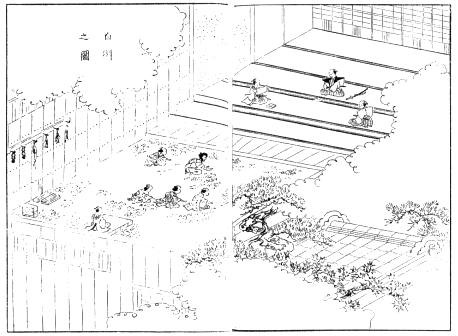
Plate 8.
Court at an Intendant's Residence. Hanging from the wall at the left
are instruments of torture used to obtain confessions of guilt in criminal cases.
From Ando[*] Hiroshi, ed., Tokugawa bakufu kenchi yoryaku[*] (1965). Reprinted
with permission from Seiabo[*] Publishing Company.
legal systematization during the Tokugawa period. Yet the degree of formalization in the third sense was very limited because it was not a publicized "code" but a manual to which access was restricted to shogunal officers of justice, especially with regard to determining penalties. This meant that (1) its principles were intended only for shogunal courts, and not for application in village or domainal justice; (2) it was "secret" knowledge, not to be divulged in the commoner world; and (3) its stipulations were no more than suggestive guidelines for judges that were partly based on precedent but did not limit their penal powers.
The net effect (likely purpose) of the restricted nature of this formalization was the preservation of a discretionary leeway for judicial officers, which meant, of course, the preservation of the power of the warrior class. Nevertheless, insofar as investigative and recording officers developed a "legal" habitus, however weak, simply by acquaintance with
precedent—knowledge that found its way into the weighty responses of the Senior Council or the Tribunal to queries from below—formalization was a legal, if limited reality.
Practitioners of deconstruction, with their predilection for discursive moments of undecidability, have argued that the one-time arbitrariness at the origins of laws, meant to eliminate future arbitrary coercive violence by substituting the rules of law, is in fact reactivated when decisions are made concerning the (degree of) applicability of the laws in each case that comes before a judge. Typically, however, they have nothing to say about interests orienting the judge through this moment of undecidability toward closure. Bourdieu's solution to this problem is to be found in his notion of the social construction of the legal habitus.[49]
Thus, courts were foremost an instrument of the rulers to preserve order, ensuring a slanted distribution of sociopolitical power. Hence the emphasis on "settling" disputes by restoring peace rather than righting wrongs. Since there was no break between heteronomous power and the juridical field, "truth" and "justice" accordingly were quite openly secondary considerations.