
May Day 1918: The Struggle for Meaning
The sponsors of most Bolshevik festivals in 1918 saw them as educational events, which would instill in the people the new
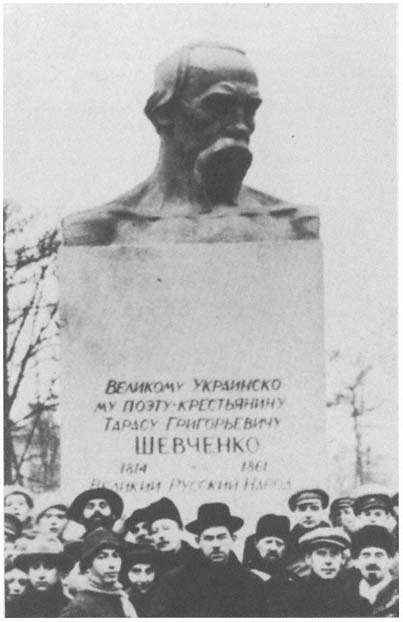
Figure 8.
Monument to Taras Shevchenko, Moscow, built as part of Lenin's
monument plan (Mikhail German, ed., Serdtsem slushaia revoliutsiiu.
Iskusstvo pervykh let oktiabria, Leningrad, 1980).
ideology and unite them in the revolutionary cause. In this sense, the Bolsheviks agreed with many modern commentators, who have seen festivals as a prime instrument of socialization into the Soviet system of values.[71] One must beware, however: intention is not execution. Artists commissioned to create festivals often thought differently from their sponsors; symbols, which have histories of their own, were sometimes interpreted differently from the way the makers intended. And, finally, sponsors were not of one mind; as we have seen, there were different opinions and traditions as to how a revolution should be celebrated.
The festive tradition itself was ambiguous, and preparations for the May Day celebration of 1918 sparked conflicts between incompatible notions and hostile factions. To Bolsheviks forged by a decade of political struggle, May Day was a weapon. In prerevolutionary times it was a rare occasion for street gatherings; the demonstrations were actually revolutions in miniature. But another tradition, begun by Wagner, saw festivity as an analog of socialism, a temporary utopia. This abstruse theoretical dispute—what function should a workers' demonstration have when workers control the state—became an acute dilemma with the establishment of a workers' state.
In a pamphlet released for the 1917 observance, Bogdanov wrote, "The May Day holiday is organized to demonstrate . . . that the proletariat is an army of labor in constant battle with capital."[72] Although this goal remained, May Day 1918, coming after the October Revolution, also gave the Russian proletariat reason to celebrate. May Day had been a holiday of struggle against the existing order; and now that workers were the existing order, something would have to change. The holiday could either celebrate what was or continue the struggle for what would be.
Lunacharsky tried to bypass the problem entirely by asking, "But isn't the very idea intoxicating that the state, up 'til now our worst enemy, is now ours and celebrates May Day as its own greatest holiday?" [73] Yet many would have answered with a flat no because the holiday was also a show of power. Before the Revolution, the May Day demonstration had represented the underclass; now it stood for the state, not only as a symbol of power but as power itself. It was a test of the ability to organize the people. Resurgent opposition groups like the Mensheviks, the Special Assembly of Petrograd Factory and Plant Representatives, the Church, and even the anarchists called for a boycott of May Day.[74]
Grigory Zinoviev threatened to "crush the boycott in the most deci-
sive manner,"[75] yet for a celebration with so much at stake, organization was sloppy—a mistake the Bolsheviks would not repeat in the future. By spring 1918, the Revolution was in crisis, and it was only in midApril, two weeks before the event, that the Petrograd party committee headed by Zinoviev decreed that the holiday should be celebrated at all and that the Petrograd Soviet should assume responsibility for the arrangements. The soviet assigned direction of the festival to several groups with little in common. Scholars to this day are not sure who did the actual organizing—and nobody seems to have known in 1918. Reports indicate several possibilities: that the organizers were local labor unions and the Petrograd section of Narkompros; that the soviet took sole responsibility, its efforts directed by a special committee under the leadership of Andreeva; and that celebrations were directed by the Central Organizing Committee, chaired by a certain Antselovich, and the Commission for Decorating the City, both created jointly by the municipal soviet and IZO (the national arts section of Narkompros).[76] The report on this combined effort also states that the groups met in the Smolny Institute and Winter Palace, respectively, which would have made coordination difficult: the two headquarters were located on different sides of a city where communications were notoriously unreliable. Even Proletkult tried to infiltrate and take over the Central Organizing Committee.[77] It is clear enough, though, that organizational lines were not explicit; in fact, the director of the festival's Arts Section, Iakhmanov, ultimately refused all responsibility.[78] Nevertheless, disorganization, a flaw by political standards, allowed for a broad array of styles that makes the festival rich and interesting to our time.
The central newspapers, Pravda and Izvestiia in Moscow and Severnaia Kommuna (Northern Commune ) in Petrograd, were charged with publicity for the event, which they produced in a format that became the subsequent standard. Several days beforehand, official May Day slogans, approved by the municipal party committee, were published, as were march routes, which went through every city district. Pages were filled with recollections of bygone days, when May Day was not celebrated openly. The official papers failed to mention the decorations, as if such efforts were alien to a solemn affair. Should the solemn air, however, have concealed the day's triumphant essence, the April 30 headline of Pravda declared May Day "a workers' holiday, the holiday of the victory of socialism." If it is true that a party in opposition is concerned with the downfall of the old and that a party in confident power is concerned with the construction of the new, then
surely triumph was reflected in the slogans of the day: of eighteen total, fifteen were of the "Long live . . ." variety, while a paltry three proclaimed "Down with. . . ." Obviously, no mention was made of the boycott.
Stylistic multiplicity, political rivalry, poor organization, and Bolshevik ambivalence complicated May Day 1918. The diverse meanings acquired by a single symbol in a single festival—like the panel erected on the Kremlin tower—showed a lack of consensus. Symbols acquire meaning within a context, an interpretative framework: the events they are associated with, the system of ideas they are placed in, the habits of observation that bring some facets into focus and shut others out. The ways that a culture can give meaning to latent signs—at all times dynamic and complex—become terribly tangled in times of revolution. Language itself drifts from its mooring even in a stable culture, and words take on many meanings. Interpretation becomes problematic; one can never be sure that a statement is interpreted according to its design. The act of making a statement assumes that speaker and interpreter can find among many strands of culture a common interpretive framework—and that they wish to.
A competition of contexts can enrich a language and make it flexible in times of change, but if there are too many meanings available, the commonality necessary for communication is lost. The alternative is to assign meaning arbitrarily, by fiat. This is meaning created not by the framework but by the center. For this process to take place, however, there must be a commonly accepted, defining center. On May Day 1918, the Bolsheviks could not even create a unified organization or style, and to speak of a defining center would be premature. They did not yet occupy the central position that permits the creation of meaning: they did not have the power or legitimacy.
To speak of a single meaning in 1918 would be simplistic. It is wiser to find the festival's potential meanings and watch the outcome. The contest for meaning demonstrated how interpretation can be an exercise in power. The Bolsheviks and their opponents, who still controlled party newspapers, had considerable interpretative latitude.[79] Each reporter tried to place the festival in an advantageous context. May Day was, as it had been originally, a day of struggle: to the Bolsheviks, it was a struggle for the new society; to the opposition, against the existing regime. The Bolsheviks called for a demonstration, while opposition leaders called for a counter-demonstration: to the naive observer, both look like a march through the city streets. But when rank-and-file mem-
bers of opposition parties voted to skip the march altogether, the Bolsheviks claimed they were rejecting the counter-demonstration, while the opposition claimed they were avoiding the demonstration. Now, both sides of the debate were faced not with a city of full streets waiting for interpretation, but with empty streets; and at this time the opposition strategically called for a boycott.
The May Day demonstration drew moderate gatherings: although the streets were decorated gaily and filled with marchers, the crowds predicted by the Bolsheviks failed to materialize. Most embarrassing was the absence of workers from the Obukhov and Putilov factories, strongholds of Bolshevik support.[80] Though sheer weariness was a likely cause, people had good reason to honor the boycott. Support for the Bolsheviks was lagging because of failures in the agricultural and industrial economies, the introduction of radical socialist policies, and the Brest Litovsk peace, among other reasons. Nevertheless, there was interpretative latitude. True, the workers did not march in large numbers; and the city was not entirely red. Yet city walls were covered with red banners and posters, and the streets abandoned by workers were filled—mostly by soldiers and by clerks dependent on the Bolsheviks for their jobs.
Given a festival to interpret, the newspapers could provide an acceptable meaning. Izvestiia boasted of the fine weather and defended the workers' right to celebrate—neither of which anyone contested. Pravala admitted some disappointment but drowned the admission in a sea of enthusiasm. Krasnaia gazeta (Red Journal ) took the easy route, adding a zero to some attendance figures.[81] The Bolshevik press called the festival a success; the opposition pointed out that the marchers were soldiers and claimed the Bolsheviks had received no support from the workers. The Bolsheviks said the soldiers were the workers . . . and so on.
Published pictures illustrate—graphically—how a proper framework could create the proper meaning. Photographers on the Field of Mars, the central congregation point, framed their pictures to show tightly packed crowds around a speaker; but in some pictures a slightly larger frame showed that much of the field was empty.[82] (See Figure 9.) May Day 1918 was the last holiday covered by an independent press; for the anniversary celebration in November, regulations made independent photography virtually impossible.[83]
Although the tradition that recommended mass festivals to the Bolsheviks had a strongly pluralistic element, the dominant characteristic of its underlying cultural model was unanimity. If the Soviet festivals were
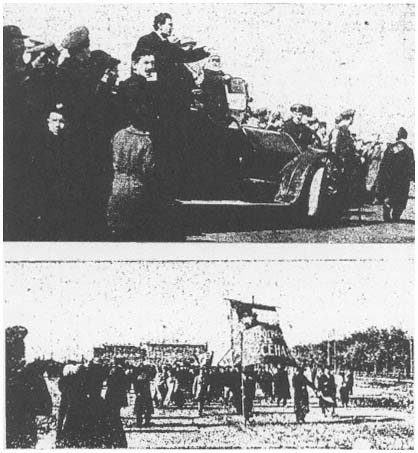
Figure 9.
Grigory Zinoviev (top photo, standing in car) addressing the May Day 1918
parade on the Field of Mars, Petrograd. The lower photograph shows the same
celebration from a more revealing angle ( Plamia, 12 May 1918, pp. 8, 9).
to attain the results imagined by their sponsors, conflicting voices would have to be silenced. In this sense, the holiday was a success with those inclined toward the Bolsheviks; they were given an experience of unity and a taste of the culture of the future, while the boycotting opposition gained nothing. The Bolsheviks succeeded in making May Day their own. Herein lies the only possible explanation of Lunacharsky's rather odd—considering the reality of the holiday—recollection eight years hence:
As to the holiday's solemn, unusually piercing and joyful mood, and the beauty of form in which the first May Day after the October Revolution was cast, it was the most successful. I've lived through many a May Day since with the proletariat of Leningrad and Moscow. Each was significant, each was well attended, each was what a proletarian holiday should be, but they were also business, days of accounting, days of self-organization, days of inspection. But not a one so impressed me with its many wonderful pictures, hundreds of thousands of people united by unblighted joy, and the efforts of artists who met the masses with open hearts.[84]
He was remembering either May Day 1918 as others were supposed to or May Day 1917 as it was.