
INTRODUCTION
Africa!
Rememb'ring Africa
. . . . . . . . . . . . . . . .
So long, so far away!
Langston Hughes, Troubled Island (Act I: Martel's aria)
This book explores aspects of William Grant Still's aesthetic development in the context of the much-contested personal, professional, and cultural landscape in which he worked. Although its focus is on the 1930s—the decade of Still's maturity as a composer—the different voices presented here reflect the conflicts that surrounded Still throughout his dual careers as commercial musician and composer of concert music and opera. Encoded in these different narratives are intersections among the ideas and realities of the Harlem Renaissance, musical modernism, and American musical nationalism. These engage issues involving race, class, musical style and genre, and, to a lesser degree, gender and geography—issues that affected the way Still's music was written and performed, listened to and written about, then as much as now.
W. E. B. Du Bois's famous statement in The Souls of Black Folk (1903) about racial doubleness, certainly well known to Still, may serve as the launching point for this study:
The Negro is a sort of seventh son, born with a veil, and gifted with second-sight in this American world,—a world which yields him no true self-consciousness, but only lets him see himself through the revelation of the other world. It is a peculiar sensation, this double-consciousness, this sense of always looking at one's self through the eyes of others, of measuring one's soul by the tape of a world that looks on in amused contempt and pity. One ever feels his two-ness,—an American, a Negro; two souls, two thoughts, two unreconciled strivings; two warring ideals in one dark body, whose dogged strength alone keeps it from being torn asunder.
The history of the American Negro is the history of this strife,—this longing to attain self-conscious manhood, to merge his double self into a better and truer self. In this merging he wishes neither of the older selves to be lost.[1]
Du Bois's insight about what he called the "double consciousness" or the "two-ness" of African Americans struck a responsive chord at the time and remains a touchstone that frames the lives of many individuals who share the African American experience. It carries a particular weight when considering creative artists such as Still (as Gayle Murchison points out in her chapter), although explorations of its consequences by black cultural critics have consistently focused on the other arts more than on concert music.[2] Certainly Still's desire for a "fusion" of widely separated musical styles—actually several fusions—plays out Du Bois's aspiration "to merge his double self into a better and truer self." We are only beginning to glimpse the process by which Still explored his own doubleness as a creator of music as well as the multiple contradictions that surrounded him.
Still's roots were African American, southern, and relatively elite. His family's lack of wealth was no bar to its social status as, in Willard Gate-wood's phrase, "aristocrats of color." Both of his parents were college graduates, rare among African Americans of their generation. Both followed the teaching profession, highly regarded because formal education, so long denied, was widely understood as fundamental to race progress. Still's stepfather (Still's father, a musician, died shortly after his birth), a postal employee—always referred to as "Mr. Shepperson"—also held a respected position in the community. The family attended the Allison Street Presbyterian Church, one of the congregations favored by Little Rock's African American elite. Still's genteel training, his enduring sense of high obligation to better the lot of his race, and even his light skin fit Gatewood's description of an elite African American of his time.[3] His position of relative privilege made him a member of what Du Bois had labeled the "Talented Tenth" of the generation of the Harlem Renaissance. Still was well aware of the debate over how African Americans might best take their full place in American society, for Du Bois's slightly older rival, Booker T. Washington, was a guest in the Still/Shepperson home in Little Rock on one occasion.[4] Still's elite affiliation combined with his creative direction and political conservatism have led to ambiva-
lence about his artistic contributions, for what is usually called the black middle class is "surely one of the most disparaged social groups in all of modern history."[5]
As a child, Still observed all the forms of music making practiced in his community, including traditional religious music sung at home by his grandmother. Yet his musical inclinations lay with the European-influenced African American concert tradition, an often-ignored part of his heritage. His first role model was the Afro-English composer Samuel Coleridge-Taylor (1875–1912), who made several trips to America after the turn of the century. Several older contemporaries were writing concert music that drew from this tradition; Nathaniel Dett, Harry T. Burleigh, and Will Marion Cook all encouraged him and became his friends. His early experience in Harlem included performances of the symphonic repertoire organized by and for African American audiences, as documented in the New York Age; such concerts were not unique to New York City.[6] Still's interest in "serious" music, especially opera, seems never to have wavered, although a career as a composer appeared hopelessly out of reach for many years. After all, most "serious" composers in the United States, regardless of race, had (and have) other means of supporting themselves. It is a mark of Still's determination that he was eventually able to devote so much of his time to composition; he created operas, symphonies, and ballets in addition to his commercial work.
In spite of the energy and the complex webs of patronage, audience, and neighborhood that shaped the Harlem Renaissance, the immediate effect of the cultural boom of the 1920s for African American musicians (including Still) was to provide more opportunities to do much as they had earlier done, though at a higher level and with more respect as the popular genres moved from minstrel shows to vaudeville to Broadway revues like Shuffle Along .[7] Their new freedom was far from complete, as is especially clear from the perspective of the late twentieth century. Nevertheless, stereotype-driven constraints on blacks as entertainers clearly weakened, allowing the "minstrel mask" to slip and sometimes revealing the creative ferment taking place behind it. Opportunities for new artistic departures that were commercially sustainable remained limited despite the importance of those that were successful. Indeed, many of the black entertainers and artists who achieved substantial fame or success in Still's lifetime did it by performing selected aspects of African American culture to a predominantly white audience. This process necessarily involved continuing mediation and adaptation among black and
white cultural and performance traditions and among stereotypes held by both blacks and whites about themselves and each other.
Successful commercial adaptations with which Still was directly involved include the achievement of his mentor W. C. Handy, the "father of the blues," who transcribed and published an existing aural tradition limited to a particular region and group for a wider audience, thereby altering it dramatically and creating the immensely popular "classic" blues; the 1921 musical Shuffle Along, which (with Still as a member of its orchestra and a contributor to its orchestrations) initiated a new era of black musicals in the 1920s; and much of his later work in New York as arranger, performer, and conductor. Other adaptations and translations were undertaken by many other artists. White audiences usually accepted them as "black" culture; African American audiences often applauded but sometimes saw them as something else. Collectively, they created new genres and styles that are now seen as quintessential elements of our diverse American culture.
In presenting himself as a composer of concert music, Still chose a path less traveled by members of the race, a path less understood by both blacks and whites to this day. As a composer of concert music, he crossed barriers of class as well as color, forcing him to rethink his racial doubleness in new ways. This move required him to forge new means of communicating and contextualizing his Africanness, taking into account (among other things) the musical language of modernism, with its elements of primitivism and colonialism, that he learned from his teacher Edgard Varèse and the younger white modernists who were his contemporaries. By pursuing his interest in composing concert music, Still had to address the "minstrel mask" directly. It is this challenge that led him to reformulate his long-standing interest in American music away from the modernists' direction of exploring the dissonant, antisentimental "modern." Instead, he sought sophisticated formal constructs that opened the way to and even demanded a truer fusion of European and African American traditions into a genuinely new American voice. That unique and continuing process of rethinking and the circumstances that surrounded it are the underlying theme of this book.
From 1925 on, Still's "serious" works were performed before elite white audiences, making a mark even though they often drew mixed reviews—reviews that turned increasingly on both racial difference and the class-related distinction between concert and popular music. This
criticism is frustrating to read and interpret, since it is often couched in oblique terms with coded meanings not only for racial stereotypes but for aspects of musical style and language as well; in these cases the underlying issues are very seldom addressed or explored directly. For example, in Still's 1924 suite for eight instruments and three voices "used instrumentally," From the Land of Dreams, performed once (February 8, 1925) and recently rediscovered, a blues gesture appears as a contrasting theme, embedded in a framework of startlingly original instrumental/vocal timbres and chromatic dissonance (Example 1). The New York Times critic Olin Downes, not recognizing Still's construct, wrote about it, "One hoped for better things from Still. . . . Is Mr. Still unaware that the cheapest melody in the revues he has orchestrated has more reality and inspiration than the curious noises he has manufactured?" The ultramodern clothing that surrounded the blues theme in the work was clear to his audience, but the blues was not, confounding the expectation of his hearers and probably his intent as well. In May 1931, Downes wrote of the ballet Sahdji: "The ballet Sahdji is fully as racial in content as the former work [i.e., Africa ]. . . . But this is real music, music of a composer of exotic talent and temperament." In addition to the racial stereotypes such as "exotic," with its implication of a difference involving sexuality, the importance of class distinctions drawn between Still's commercial work ("the cheapest melody") and the concert music under review, along with arguments over modernism ("curious noises . . . manufactured"), in these comments appears repeatedly in commentaries on Still's music.[8]
Discussions of commercial theater in the 1920s tend to give a richer perspective for the context in which Still's aesthetic ideas developed and his early performances took place than does published music criticism. The first all-black Broadway dramatic production that attempted to portray African Americans as a collection of diverse humans rather than primarily as clowns was William Jourdan Rapp and Wallace Thurman's Harlem, written over several years but not produced until 1929. (Thurman had been a mentor to Still's friend Harold Bruce Forsythe in his pre-New York, Los Angeles days.) Harlem drew extensive discussion of racial issues in the press, as well as some acknowledgment of its particular "checker" audience with its implications about class.[9] Some excerpts quoted here are applicable to Still's achievement in music and illustrate the context in which he worked more effectively than do the reviews of
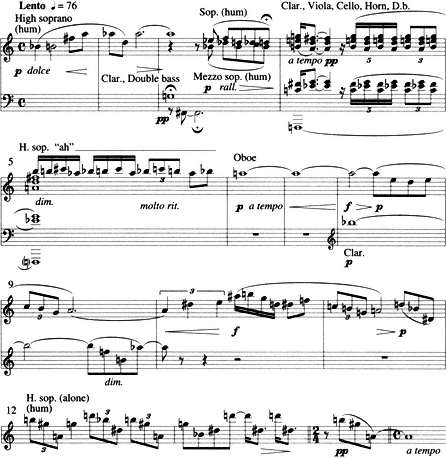
Example 1.
Opening, From the Land of Dreams . The diatonic passage, hint-
ing at the beginning of a blues, is in bars 6–9, played by the oboe.
Courtesy of William Grant Still Music.
his work by music critics.[10] Drama critics waxed most negative when Harlem characters failed to act the racial stereotype:
It is only where the sober realities of life among the negroes are touched upon that the play becomes as forced and absurd and totally lacking in sympathetic insight. Very little of the essential childlike humor and pathos of the colored race is allowed play.[11]
Most of it is untamed and broad-gauged stuff, full of rowdy jokes and gestures which do somehow catch an authentic jungle note in the brownstone
wastelands of One Hundred and Thirty-fifth street. . . . Since most of the principal actors are negroes, it is stimulated at once by the natural born instinct of that festive race for cutting up monkeyshines.[12]
The authors of Harlem responded to the critics' racially directed criticism by laying out the stereotypes they had deliberately avoided:
Most Negro dramas previous to "Harlem" dealt with what Negroes call "white folks' niggers," while "Harlem" actually presents the Negro as he is.
"White folks' niggers," consist of three distinct categories: the old servant or mammy type known derisively among the Harlemites as "Uncle Toms" and "handkerchiefs," the lazy slow-foot type typified by such vaudevillians as Bert Williams and Miller and Lyles [who starred in Shuffle Along, mentioned above], and the superstitious, praying type who is always thrown into abject fear by darkness, lightning and thunder. All these types flatter the white's sense of superiority and it pleases him to believe that all colored people are like this. The dramatist who shows them thusly is bound to be complimented for his keen understanding of the Negro.[13]
Like the authors of Harlem and other African American creative artists, Still had to deal repeatedly with the ingrained stereotypes. Blacks and whites alike in many ways remained the prisoners of the old type-casting from the minstrel-vaudeville-variety show tradition. Nevertheless, for racial issues to be discussed so extensively in the white daily papers as well as in magazines intended for African American audiences, at least in the case of Harlem, reveals that the subject was at last open for debate.
In Du Bois's terms, Still's achievement was to compose concert music not as represented "through the revelation of the other world" but in a unique African American voice speaking as itself, in its own behalf. By finding his "speaking self," Still took a step toward giving African Americans a direct view of themselves, direct representation in the literate European-derived universe of concert music. From this well-grounded position he was empowered to take the further step of speaking as a "universal" composer, though one who often chose his own form of African American-derived musical speech.
The combination of essays from the 1990s and sources from the 1930s in this book meets the challenge of creating a context that will allow a critical reassessment of Still's music and his place in twenth-century American culture. Its seems more important at this juncture to allow a
range of voices to be heard, even at the cost of some repetition, than to attempt a definitive interpretation when so many questions about Still's life and music remain unanswered. The contributed essays by Willard B. Gatewood and Gayle Murchison and the chronology by Carolyn L. Quin collectively provide a launching point. Gatewood begins with a description of the Little Rock of Still's boyhood. He depicts the conditional privilege, located within and dependent on a deeply racist society, enjoyed by Still's forebears and influencing him. Equally important is the reiteration of the theme that Still grew up in a period of increasing racial violence and tension. Along with his family's commitment to racial uplift, his mother's opposition to the growth of Jim Crow laws formalizing racial segregation of public facilities in Little Rock and elsewhere significantly influenced Still's later career decisions. Murchison presents an exposition of the relationship between Still's work and the Harlem Renaissance, particularly with reference to Alain Locke's The New Negro, a connection that has not been addressed in Still scholarship until recently. Murchison suggests three style periods for Still's concert music, in keeping with his own statements: "ultramodern," "racial" (from 1925), and "universal" (1932 on). The connection she makes between the Harlem Renaissance and modernism is particularly valuable for understanding Still's position in American music.
Two of the essays focus on close associates and collaborators, Harold Bruce Forsythe (1906–1976) and Verna Arvey (1911–1987). These two associates, friends themselves for many years though enormously different in aesthetic approach and personality, each influenced Still far more than their common role as contributors of librettos might suggest. The biographical sketches of each that form chapters here provide background for their own essays on Still as well as serve to emphasize their personal and professional importance to Still. In their persons as in their writings, they enrich the dialogue on Still and his work that is only now beginning to emerge. These writers stand in striking contrast to each other.
Forsythe, librettist for Still's first opera (Blue Steel ) and a Los Angeles-based advocate of the New Negro movement, has been virtually an invisible person, one whose very identity has been a source of confusion.[14] The first to write seriously about Still, Forsythe engages emotionally with his music, most notably with the orchestral tone poem Darker America, which he argues is the product of Still's essential, African-based sensibility. Through Darker America, Forsythe addresses Still's "peculiar isolation from [his] race," which he correctly sees as "only ap-
parent [for] underneath there are significant ties,"[15] thus providing an otherwise missing contemporary New Negro view of how Still addressed his racial doubleness in his artistic production during a highly productive period. Forsythe's contribution, published here for the first time, is the more valuable because well-known black intellectuals such as Du Bois and Alain Locke did not address Still's music (or anyone else's) with anything like the level of conviction and forcefulness that they applied to drama, fiction, and poetry.
Forsythe faced the challenge of writing about Still's music without much in the way of usable literary models, a problem analogous to the challenge Still faced in seeking musical models for his compositions. The subtitle of Forsythe's iconoclastic essay is appropriated for this book partly for its continuing aptness to Still research. In addition, it is intended to recognize for the first time that Forsythe is the initiator of Still criticism and to acknowledge the passionate commitment and insight that inform his writing.
Verna Arvey is better known than Forsythe, but she has almost faded from view as an individual despite her position as Still's publicist and collaborator starting in 1934, his wife from 1939 until his death in 1978, and executor of his estate thereafter.[16] Forsythe and Arvey had been friends from their student days in the mid-1920s at Manual Arts High School in Los Angeles. Forsythe, whose family lived on property owned by a Still cousin, met Still in the course of a year's study at the Juilliard School in New York in 1927–1928. Arvey learned about Still several years before Forsythe introduced her to him during his early L.A. visits in 1929–1930. After Still moved permanently to Los Angeles in 1934, a romantic triangle developed among the three, leaving a residue of hostility that both influenced the course and skewed the record of Still's career.
George Fischer, Still's major publisher, was dubious when Arvey approached him in 1937 with her plan for a biography (actually a ghosted autobiography in one of its drafts) but presently changed his mind and cut her text sharply to fit into a series of promotional booklets for the American composers whose work he championed.[17] The resulting monograph, republished here, comes close at times to Still's earlier exposition in his "Personal Notes" but nevertheless entails considerable filtering through both Arvey's eyes and those of its publisher. The restrained, formal prose of her monograph contrasts sharply with Forsythe's flamboyant, unapologetically personal style.
"Toward a Biography" forms the core of the book. The biographical essay on Still in Los Angeles clarifies numerous points with regard to
Still's state of mind at the time of his "expatriation" from New York City as well as his activities before and after the move, including his less-than-satisfying adventures in Hollywood. Still's most famous concert work, the Afro-American Symphony, completed within months of his return from his prolonged early sojourn in Los Angeles, is the central paradigm for the working out of the "fusion" aesthetic he had struggled over for nearly a decade. It was the success of this symphony that really launched Still on his career as a composer of concert music and carried his reputation far beyond the reach of those 1920s "new music" concerts, with their limited audiences and self-consciously modernist posture.
The "great truth" Still wished to convey through the Afro-American Symphony had to do not only with his religious convictions but much more directly with the creative synergy possible among American cultures as the African American influence took the position he desired for it, as an equal contributor, "another American voice," in his words. In his quest to achieve this goal he went far out of his way to avoid stereotypical portrayals of African American culture, most obviously through his creative uses of the blues. Still's concern with the blues is in fact analogous to that of many African American artists and writers of the mid-twentieth century, though that commonality has been little recognized by theorists of black culture.
One often unspoken issue for Still is his role in the anticommunist movement of the late 1940s and early 1950s, seen here as a dim reflection of his disillusionment at the failure of the dream embodied in his first symphony. Perhaps the cultural necessity for the supposed antimodernism of Still's Afro-American Symphony and the contradictoriness of his late political activity is summed up, however obliquely, in Forsythe's perception: "The intellectualism of modern music is more psychopathic than has been generally understood."[18]
Still's voice is heard directly in the first two of the sources. In 1933, Still produced several pages of autobiographical material in response to a request from Harold Bruce Forsythe. In addition to Still's own evaluation of his concert music up to 1933, these notes offer a key that leads toward the documentation and assessment of Still's little-known, apparently substantial contributions to Harlem's commercial music scene through his New York years (1919–1934). His correspondence with a Paris-based critic, Irving Schwerké, who arranged for performances of Still's music in Europe and otherwise encouraged him, shows him in relation to a supportive white critic.
Although Still's concert music had begun to attract critical attention from the mid-1920s, all of it was in the form of brief coverage of individual performances. The sources presented here, most of them never published until now, were the first to consider his music in any depth. Hence, they are important to an understanding of one of the mid-twenth century's most prominent American composers of concert music and opera, and a major contributor to popular music of the 1920s and 1930s. The contradictions with which Still struggled shaped his remarkable creative output in ways we need to understand, as much today as during his lifetime.
A Brief Chronology
Carolyn L. Quin
1895
Born May 11, Woodville, Mississippi, to William Grant Still (1871–1895) and Carrie Lena Fambro Still (1872–1927). Moved with his mother to Little Rock, Arkansas, after his father's death.
1911
Graduates as valedictorian from M. W. Gibbs High School; matriculates at Wilberforce University (Ohio).
1912
Hears Victor Red Seal recordings of opera excerpts.
1915
May, leaves Wilberforce before graduating; October 4, marries Grace Bundy.
1916
Summer, to Memphis to play in W. C. Handy's (1873–1958) bands and arrange for them; earliest arrangements published by Pace & Handy.
1917
Begins music study at Oberlin.
1918
U.S. Navy, serves on shipboard as mess attendant and violinist.
1919
Returns to Oberlin briefly; goes to New York City to work for Handy.
1920s
Arranges or orchestrates for Will Vodery, Eubie Blake, Earl Carroll, Sophie Tucker, Donald Voorhees, Paul Whiteman, and others.
1920
Leaves Handy's band to play in a Clef Club orchestra; joins Hall Johnson's band.
1921
Joins pit orchestra as oboist for Noble Sissle (1889–1975) and Eubie Blake's (1883–1983) all-Afro-American revue, Shuffle Along, to which he contributes arrangements as it plays 504 New York performances before going on tour; later plays in other shows and conducts at the Plantation Club until he can support himself as an arranger.
1922
In Boston with Shuffle Along , studies composition privately with George Whitefield Chadwick (1854–1931), director of the New England Conservatory, for four months. Returning to New York City, works for Harry Pace's Black Swan Phonograph Company until some time before it fails in 1925.
1923
Begins two years of study with Edgard Varèse (1883–1965).
1925
February 8, first performance of Still's concert music, by the International Composers' Guild, the result of his study with Varèse (From the Land of Dreams ).
1928
Darker America score published (composed 1924, performances in 1926 and 1927).
Wins Harmon Award for Distinguished Achievement among Negroes in Music.
Charter member, Pan American Association of Composers.
1929–1930
May-May, contracted by Paul Whiteman (1890–1967) as arranger for his weekly radio show, the "Old Gold Hour," broadcast from Los Angeles; renews friendship with Harold Bruce Forsythe, whom he had met in New York in 1927; meets Verna Arvey.
1930
Returns to New York, completes the ballet Sahdji, revises Africa again, composes the Afro-American Sympbony .
April 6, Africa premieres in a version for reduced orchestra by the Barrère Little Symphony in New York; October 24, version for full orchestra, Rochester Philharmonic, Howard Hanson (1896–1981) conducting.
1931
May 22, first performance of the ballet Sahdji, Eastman Ballet and Rochester Civic Orchestra, Hanson conducting.
October 28 and 29, first performances of the Afro-American Symphony, Rochester Philharmonic Orchestra, Hanson conducting.
Late in the year, hired to arrange for orchestra on "Willard Robison and His Deep River Hour" radio show; for a time conducts the orchestra as well.
1932
Grace Bundy and their four children go to Canada.
1934
Fellowship from the John Simon Guggenheim Memorial Foundation to compose an opera.
Leaves the "Deep River Hour" and moves permanently to Los Angeles in May. Blue Steel completed 1935 (unproduced).
1935
Works for Columbia Pictures for six months as composer and orchestrator; credits include Pennies from Heaven with Bing Crosby and Theodora Goes Wild as well as miscellaneous film cues for Columbia's files.
November 20, Afro-American Symphony played by the New York Philharmonic, Hans Lange conducting.
1936
Becomes a member of ASCAP (American Society of Composers, Authors, and Publishers); conducts the Los Angeles Philharmonic at the Hollywood Bowl. The Philadelphia Orchestra plays the fourth movement of the Afro-American
Symphony on a coast-to-coast tour, including a performance in Los Angeles at the Pan-Pacific Auditorium.
1937
Lenox Avenue, commissioned by the CBS radio net-work, broadcast on May 23; first performance of Symphony in G Minor; begins working on the opera Troubled Island with Langston Hughes as librettist (completed in 1941); the first works to be published by J. Fischer & Bro. appear.
1939
Divorces Grace Bundy and marries Verna Arvey; wins the first of his two Rosenwald Fellowships.
1940
June 23, And They Lynched Him on a Tree, choral ballad to a libretto by Katherine Garrison Chapin, performed by New York Philharmonic; arranges "Frenesi" for Artie Shaw, whose recording of it becomes a best-seller; collaborates with Zora Neale Hurston on Caribbean Melodies .
1941
Plain-Chant for America, commissioned by the New York Philharmonic for its centennial, premiered October 23.
late 1942–early 1943
Brief stint at Twentieth Century-Fox studio; quits production of Stormy Weather .
1949
March 31, April 10, and May 1, Troubled Island is produced by the New York City Opera.
After
Lives quietly in Los Angeles, filling a decreasing number of commissions. Continues to compose operas: Bayou Legend (produced November 15 and 17, 1974, by Opera South, Jackson, Miss.; PBS broadcast June 15, 1981), A Southern Interlude (revised as High-way 1, U.S.A., produced May 11, 1963, by University of Miami Opera), Costaso (produced 1991 by NANM, Altadena, Calif.), Mota, The Pillar, Minette Fontaine, and numerous other works; honorary degrees from Wilberforce (1936), Howard (1941), Oberlin (1947), Bates (1954), University of Arkansas (1971), Pepperdine University (1973), New England Convervatory (1973), University of Southern California (1975).
1978
December 3, dies in Los Angeles.