
Ecloge
Some of these same impulses can be detected in another remarkable song, Ecloge, which, although not dated by the composer, was probably composed in 1895. The poet, not named on any of the three manuscripts for the song, has recently been identified (SW A2: 67) as the Czech Jaroslav Vrchlický (a pseudonym for Emil Frida). Schoenberg appears to have taken this text from a German translation of some of Vrchlický's lyrics that appeared in 1895.[3] The poem is not an eclogue in the strictly classical sense of a pastoral dialogue, but is rather an attractive romantic lyric associating spring, described in stanzas 1 and 2, with love, described in parallel terms in stanzas 3 and 4:
Duftreich ist die Erde und die Luft krystallen,
Und das Moos erzittert unter deinem Fuß,
Aus dem Schilfrohr hör'ich's wie von Pfeifen schallen,
Und vom Hagedorn fälk heller Blütengruß.
Und das Aug' von Freude naß,
Fragst du: Ja, was soll all das?
"Was?"
Ruft der Vogel und die Blume spricht:
"Anders kommen doch des Lenzes holde Wunder nicht!"
Hell dein Blick, dein Atem süß vom Duft der Erlen,
Und es bebt dein Busen, wie ich dich umfang';
Wie aus hartem Felsen springen Quellenperlen,
Bricht aus meinem Herzen glühender Lieder Drang.
Und das Aug von Freude naß,
Fragst du: Ja, was soll all das?
"Was?"
Ruft der Vogel und die Blume spricht:
"Anders kommen doch der Liebe holde Wunder nicht!"
[3] See Gedichte von Jaroslav Vrchlický, translated by Friedrich Adler (Leipzig: Reclam, n.d.). Since Adler's preface is dated December 1894, we can assume the volume appeared in 1895. This book was only one of several collections of Vrchlický's poems published in German, beginning in 1886. The poem "Duftreich ist die Erde," no. 5 in a volume of ten eclogues originally published in Czech in 1880, appeared in several of the German collections; but only the Adler translation of 1895 matches the one used by Schoenberg (with minor differences of spelling and punctuation). Thus we can safely assume (with Schmidt, SW B1/2/I:11) that this volume served as Schoenberg's source. The date of 1895 also fits in plausibly with the stylistic-compositional development traced in this chapter. The text of the poem as printed here is taken from the Adler volume. In the Adler volume the generic title "Ekloge" is given with a k, whereas in the only one of Schoenberg's manuscripts to bear the title at all (at the Schoenberg Institute), it appears with a c. In SW, Schmidt follows Adler's spelling; here I have followed Schoenberg's, hence Ecloge.
The earth is rich with scents, the air crystalline, and the moss trembles
under your foot. From the reed I hear a sound like that of pipes, and from
the hawthorn descends the bright greeting of blossoms. What does all this
mean? you ask, your eyes wet with joy. "What?" calls the bird, and the
flower responds: "The sweet miracle of spring comes in no other way."
Your gaze is bright, your breath sweet with the scent of alder, and your
breast throbs as I embrace you. As pearls of water spring forth from hard
stones, thus does a rush of radiant songs burst from my heart. What does all
this mean? you ask, your eyes wet with joy. "What?" calls the bird, and the
flower responds: "The sweet miracle of love comes in no other way."
Following the poem, Schoenberg's setting is strophic on the largest scale: it is based on an almost exact repetition of a musical unit of 49 measures. The way in which the musical strophe is shaped—and, among the three manuscripts, reshaped—bears certain resemblances to Schilflied. The overall form of the strophe can be considered A (mm. 1–15), A' (16–23), B (24–30), A" (31–49) (see Appendix ex. E).
As in Schilflied, Schoenberg attempts in this song continually to sidestep the tonic,


The broad, dissonant leaps make the vocal part of Ecloge considerably more advanced than that of Schilflied. The piano part also has a more independent, continuous motivic process, which unfolds in the tenor range, underneath the cascading eighth notes. As in the other song, the basic motive is a very concise one, here the four-note

The virtually equal status of piano and voice in Ecloge is confirmed by the exchange at the start of the A" section. In mm. 31–34, the voice takes over the the-matic skeleton of the right-hand eighth-note figuration of mm. 1–4, and the right hand of the piano plays the disjunct theme formerly sung by the voice. The exchange ends in m. 35 as Schoenberg introduces new vocal material and a new kind of texture for the line beginning with "Anders kommen." It is here that we find
the first real signs of technical unsureness in the song. The passage seems clumsy, unmotivated, perhaps because we have not had enough of a real "return" to justify a new departure, which is then followed by a sudden push toward the apparent climax of the song on the big

My own dissatisfaction with the passage beginning at m. 35 was apparently shared by Schoenberg, who altered it in each of the three autographs for Ecloge. Although none of the three manuscripts bears a date, their order of completion can be surmised on the basis of the passage in question. The earliest version is a fragment (in the Nachod collection at North Texas State University; reproduced in Kimmey 1979, 204–6), which breaks off after the first musical strophe (and in which Schoenberg has inadvertently substituted "der Liebe," from stanza 2, for "des Lenzes" from stanza 1). The version of the song at the Pierpont Morgan Library (as reproduced in Appendix ex. E), close in handwriting style to the Texas copy, is almost certainly the second in order: it is a complete draft of the song, but shows signs of intended revision in mm. 24–25 and 35–37, which have wavy lines drawn across them. The copy at the Schoenberg Institute is the third manuscript. A fair copy with breathing marks written in, it was apparently intended for performance.[4]
Originally, the Schoenberg Institute copy (the third) corresponded almost exactly to the Morgan one (the second), but Schoenberg began to revise extensively at precisely one of the spots marked with a wavy line in the Morgan copy, at "Anders kommen" in mm. 35ff. Although the crossots and pasteovers in the Institute copy do not in fact yield a complete, coherent draft of the song, we can reconstruct at least the state in which he left the "Anders kommen" passage before apparently abandoning work on the song. The three versions of this passage are superimposed in ex. 3.2.
In Schoenberg's first attempt, ex. 3.2a, the parallel-fauxbourdon texture at "Anders" involves even the bass, which is high in its register and plays in eighth notes. The vocal line and the top part of the piano here are initially a fourth higher than in the version of 3.2b. In 3.2b, Schoenberg brings the first "Wunder nicht" (mm. 7–8) down a minor third, to

The most far-reaching changes, however, come in the third version, 3.2c. Two aspects are particularly striking: the different figuration at "Anders" and the new
[4] That this third draft of Ecloge forms part of a gathering with Waldesnacht, which was almost certainly composed in 1897, has led Schmidt to suggest that Schoenberg may have attempted this revision in 1897, thus two years after the first draft (SW B1/2/I: 45).
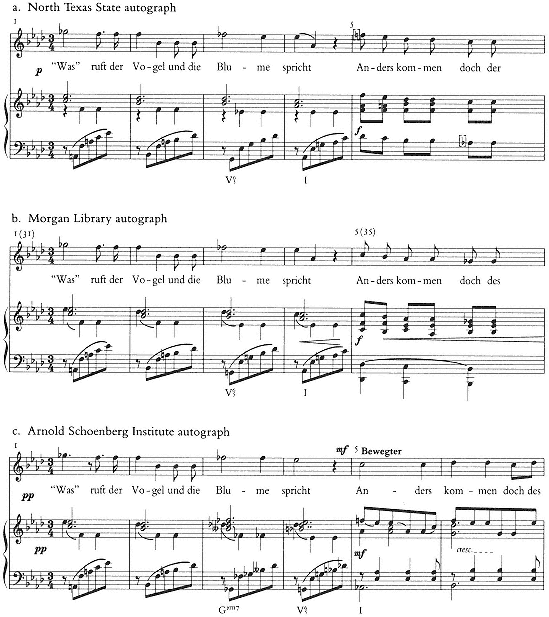
Example 3.2
Comparison of versions of Ecloge.
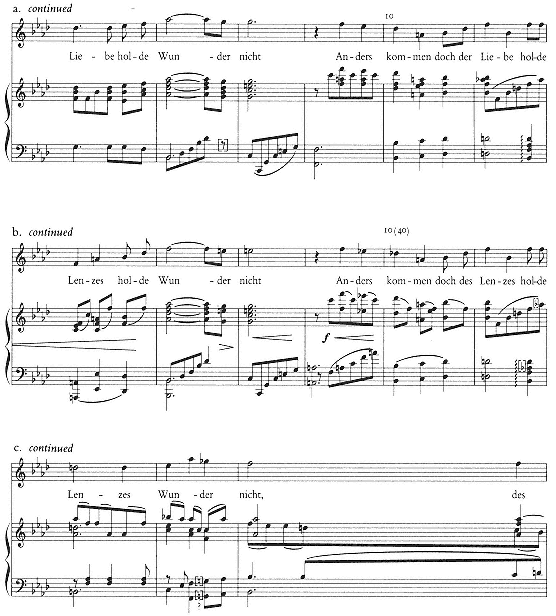
Example 3.2
continued
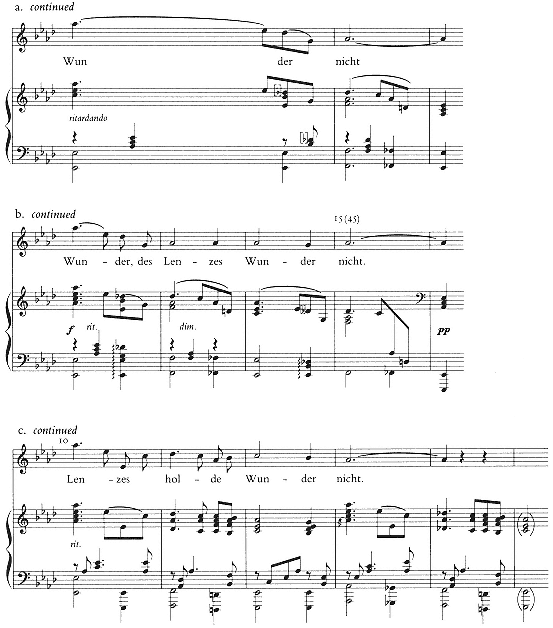
harmonization from "Blume" onward. As to the first: Schoenberg must have realized that the parallel chordal style is too anomalous, especially in a recapitulatory section. He thus abandons it and reintroduces the basic slurred eighth-note figuration of the A section. At the same time he reshapes the harmonic progression so as to avoid arriving on the tonic at "spricht" in m. 4. He understood that this tonic made for too much closure in versions a and b and that it tends to undercut the arrival on the tonic

Schoenberg thus reharmonizes the


In 3.2c, Schoenberg has shifted the weight and placement of the climax. In the earlier versions the
I have dwelled on the successive revisions of this small passage from Ecloge because they have a significance broader than their immediate context. They show Schoenberg grappling with fundamental compositional issues of thematic, formal, and harmonic balance. More than in Schilflied, he seems to be questioning the proper shape and status of a "recapitulation" or return: how to prepare it harmonically, how long it needs to be to accomplish its formal purpose, how it should transform earlier material, and so forth.
In these ways, both Schilflied and Ecloge open up a number of promising paths that Schoenberg might have been expected to follow immediately in 1895. In fact, it is not clear just what direction his song composition took over the next one or two years. This was the period of his private study with Zemlinsky, who may have encouraged Schoenberg to return to and master the Brahmsian model, to "get it right," so to speak (something that, as I suggested in chapter 1, Zemlinsky himself failed to do in Heilige Nacht). In any case, this period culminates in Schoenberg's most profoundly Brahmsian songs, Mädchenlied and Waldesnacht (1897). Here we find the kind of assimilation and absorption missing from earlier efforts, especially apparent in the phrase structure, motivic development, and
harmonic expansion. Each of the two songs seems to draw consciously on a different Stimmung typical of Brahms—the first light and folk-like, the second slow and broadly lyrical. In both, Schoenberg turns to Paul Heyse, whose poems Brahms himself had set on several occasions, and who is a substantial cut above Ludwig Pfau.