
The Published Alternate Solution
Proposition 11. Being directed to the center of an ellipse, a force by which a body P can be revolved on that ellipse would be (by Proposition 10, Corollary 1 ) as the distance CP of the body from the center C of the ellipse; let CE be drawn parallel to the tangent PR of the ellipse; and the force by which the same body P can be revolved around any other point S of the ellipse, if CE and PS should meet at E, will be as PE3 / SP2 (by Proposition 7, Corollary 3 ); that is if point S should be the focus of the ellipse, and thus PE should be given, [then ] the force will be as SP2reciprocally. Which was to be found .
Figure 9.16 is the drawing that accompanies Corollary 2 of Proposition 7 in which Newton demonstrated that the ratio of the forces FS / FR (forces that are directed to any two different points S and R , and that will maintain the same body moving along the same circle PTV ) is given by the comparison dynamics ratio (i.e., F S / FR = SP × RP2 / SG3 , where SG is parallel to RP ). In Corollary 3, Newton extended the results given in Corollary 2 for a "circular orbit" to "any orbit" simply by noting in the final sentence, "For the force in this orbit at any point P is the same as in a circle of the same curvature."
Figure 9.17 shows a portion of the drawing that Newton provided for Proposition 11 with my addition of the line CG ' corresponding to the line SG in the diagram for Corollary 3 in figure 9.16. The two general points S and R from the diagram for Corollary 3 become the points for the center of the ellipse C and the focus of the ellipse S (i.e., FC / FS = CP × SP2 /
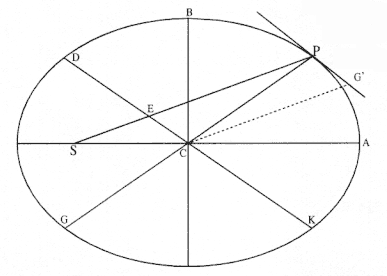
Figure 9.17
A restricted version of Newton's diagram for Proposition 11 with the line
CG' from Corollary 2 of Proposition 7 added.
CG3 ), where S (in Proposition 7) becomes C (in Proposition 11) and R (in Proposition 7) becomes S (in Proposition 11). In Proposition 10, which precedes the Kepler problem, Newton has determined that the force FC required to maintain an elliptical orbit, when the force is directed to the center C of the ellipse, is given by FC µCP . Substitution of that result into the comparison dynamics ratio gives the force to the focal point S as FSµCG 3 / SP2 . From the figure, CG = PE because the diameter DK is parallel to the tangent PG . Further, Newton has demonstrated earlier in Proposition 11 that PE = AC , where 2AC is the major axis, a constant of the ellipse. Thus, FSµ 1/SP 2 , as required. It is an efficient solution but one that leads the reader on a tortuous trail as he or she traces back through Proposition 7 to its first principles in Proposition 6, Theorem 5. When Newton completes this solution, he makes the following observation at the close of Proposition 11:
[Proposition 11] With the same brevity with which we reduced the fifth Problem to the parabola, and hyperbola, we might do the like here: But because of the dignity of the problem and its use in what follows, I shall confirm the other cases by particular demonstrations .
Newton is not as expansive, however, in his efficient but indirect presentation of the comparison theorem as he is in the extended presentation of the Kepler problem. The reasons for his choice of this restricted type of
presentation in the published editions lie buried in his unpublished revisions. There he demonstrated each of his three methods of solution in a new and independent proposition. Here he must fold the three methods into the existing structure of the first edition of the Principia .