
Chapter 2
Living with Regulation
Only someone deaf and blind could walk along St. Petersburg streets without knowing of the existence of [prostitution].
Russian Society for the Protection of Women (1910)
The system of nadzor created an institutional structure designed to encompass Russian prostitution. Yet the lives of women who engaged in prostitution were much more complex and variegated than the MVD rules allowed. Girls younger than the minimum age of 16 worked the streets, unlicensed brothels were run by unsupervised brothelkeepers, and most women who earned money as prostitutes had no desire to give up their passport in exchange for a yellow ticket. Nadzor, however, with its police inspectors and physicians, divided women into those who traded sex for money and those who did not. Whether or not women registered with the police as prostitutes, they were still living with regulation.
In this chapter, we shall examine the way prostitutes responded to that salient fact of their lives. The regulatory lists did not include most prostitutes, but regulation affected them nonetheless. Inside the system, a woman was subject to medical examinations and restrictions of her movements, and she had to earn money exclusively from prostitution. Outside the system, as a "clandestine" (tainaia ) prostitute a woman had much more flexibility, but she was also in constant danger of discovery. The goal of the medical police was to bring all prostitutes in—the desire of most women who made money from prostitution was to stay out.
Children and Prostitution
Work all day? What for, when someone like me can wear a hat and beautiful dress, and have white hands just like a lady?
Child prostitute in Kiev
Too young to register, child prostitutes could easily be found amid the ranks of Russia's clandestines. Urban neighborhoods such as Dumskaia Square in Kiev and Znamenskaia Square in St. Petersburg had reputations as centers of child prostitution.[1] Entire hotels reportedly catered to pedophiles, with prepubescent girls openly soliciting customers and sometimes supplying their parents with the money they earned from prostitution. Whereas child prostitution had once attracted only a limited clientele, Boris Bentovin, a physician who worked at Kalinkin Hospital, claimed that after the turn of the century the trade in children had soared and was no longer considered perverse or unusual.[2]
The onset of World War I apparently drove many more children to the streets. Social dislocation caused by war meant an increase in homelessness and a concomitant rise in children who were growing up in doorways and sleeping in boxes and on cemetery grounds. To support themselves, they engaged in prostitution. An official from the Kiev juvenile court attributed the child prostitution he encountered during the war years to "poverty and defenselessness," rather than simple hunger. Only two of the hundreds of young prostitutes he encountered between 1914 and 1917 traded in sex because they were on the verge of starvation.[3]
There are too many accounts of child prostitution in the sources to attribute its descriptions to adult paranoia and fantasy alone. The charitable organization known as the Russian Society for the Protection of Women (Rossiiskoe obshchestvo zashchity zhenshchin, hereafter ROZZh), for example, wrote in its annual report of a nine-year-old prostitute who reportedly lost her virginity to an "urchin" at the age of
[1] M. K. Mukalov, Deti ulitsy (St. Petersburg, 1906), pp. 8, 18 (quotation from child prostitute); Lincoln, In War's Dark Shadow, pp. 3–4, 124–26.
[2] Boris Bentovin, Deti-prostitutki (St. Petersburg, 1910), p. 4. See also Russkii vrach, no.18 (1909): 631. Laura Engelstein argues, "By 1910, . . . so-called child prostitutes came to symbolize the entire social problem in its most acute and menacing form." Engelstein, The Keys to Happiness: Sex and the Search for Modernity in Fin-de-Siècle Russia (Ithaca: Cornell University Press, 1992), p. 284.
[3] Valerii Levitskii, "Deti-prostitutki v dni voiny," Vestnik vospitaniia, no. 2 (February 1917): 168–71. See also A. I. Zak, "Tipy detskoi besprizornosti, prestupnosti, i prostitutsii," Vestnik vospitaniia, no. 7 (October 1914): 70–101; no.8 (November 1914): 81–110.
seven and was then repeatedly molested by her father. When a policeman brought her to the local halfway house for prostitutes, she was smoking and apparently drunk. In response to a question about why she smoked and drank, she said, "It pleases men."[4] In 1913, a Petersburg feminist journal described how a male ROZZh member followed a soldier and two 11-year-old girls. When he caught up with this trio, he found one girl standing guard and another alone with the soldier. The soldier went free, but the girls were whisked off for examinations at a medical-police committee clinic.[5]
A colonel stationed near the Persian border at the turn of the century reported how his riflemen sought "diversions," which sometimes meant buying sex from the native women. He saw "one of these beauties" sleeping curled up on a fox coat. When the girl's mother kicked her awake, the colonel realized that she was a "real girl-child" (devochkasushchii rebenok ). In answer to his queries about her age, "with pride" the mother replied, "Twelve, but she has been acquainted with men since she was nine." Thus inspired, the colonel proposed that civilian authorities in the nearby city of Samarkand might ease the troops' burdens by bringing half a dozen such young women to live near the soldiers in remote outposts. To strengthen his case, he pointed out that the British had been doing something similar for their troops in India for years.[6]
On one hand, observers were outraged and disgusted by the idea of young girls catering to the sexual fancies of adult men. At the same time though, privileged society found something exciting and prurient about child prostitution. Surely Boris Bentovin gave his 1910 book on juvenile prostitution a distinctly erotic flavor when he described a 12-year-old girl—a "little female onanist" (devochka-onanistka )—who masturbated by leaning against sewing machines. He wrote about how, in order to satisfy the huge demand for virgins, some St. Petersburg midwives specialized in sewing on "hymens" fashioned from scraps of cow bladder or very thin pieces of rubber. A capsule of blood or a red-colored liquid would be attached, ready to provide a client with "the illusion of a 'first night.'" Bentovin's vision of St. Petersburg included girls as young as 10
[4] Rossiiskoe obshchestvo zashchity zhenshchin v 1909 g . (St. Petersburg, 1910), p. 70.
[5] "K voprosu o detskoi prostitutsii," Zhenskii vestnik, no. 9 (1913): 195.
[6] Polkovnik Lossovskii, "Kavkazskie strelki za Kaspiem," Razvedchik, no. 521 (October 10, 1900): 914. Indignant comments on his proposal can be found in Vrach, no. 42 (1900): 1295. For a report on a 14-year-old prostitute in Moscow, see "Maloletnaia prostitutka," Stolichnoe utro, no. 47 (July 24, 1907): 4.
or 11 who would "look you in the eye, promise you astonishing pleasures, and spew nasty language."[7]
Child prostitution existed for two reasons: first, there was a market for young bodies and, second, children of the urban poor faced the choice of earning negligible "honest" wages or making good money on the streets. The latter must have been a great temptation.[8] In 1909, a Petersburg newspaper wrote of two girls aged 9 and 11 who had been taken in by the House of Mercy, the private charitable institution dedicated to "reforming" prostitutes. On the street, these children earned 60 and 90 rubles a month respectively, that is, more than four and six times what an adult female worker might average.[9] When Bentovin asked a girl around 11 or 12 years old whether she was bothered by the "vileness and immorality" of her life, she reportedly answered, "Not in the least. . . . There's nothing so bad here. . . . It's much better than a brothel. . . . I get sweet and delicious things. . . . The little uncles [diad'ki ] are all really funny and kind. . . . If they come up with something bad, I don't do it."[10] Christine Stansell has shown that girls in the urban lower classes of nineteenth-century New York City faced sexual aggression from men at many turns; the "innocence" of childhood was in essence a bourgeois myth. Realistically, then, child prostitution could be viewed as a "way of turning a unilateral relationship into a reciprocal one."[11]
Medical-police committees struggled against juvenile prostitution by various means, but at least in St. Petersburg, police raids remained the weapon of choice. In 1889, the Petersburg committee picked up twenty-two girls between the ages of 11 and 15 for soliciting. According to Aleksandr Fedorov, they were from poor, morally corrupt families who would dispatch their daughters straight to the streets. The committee sent ten of the girls to the House of Mercy for correction and rehabilitation, but the remaining twelve, much to Fedorov's regret, were returned to their parents' care. In 1890, when seventeen minors were arrested, all wound up back with their families because the House of Mercy was
[7] Bentovin, Deti-prostitutki, pp. 4, 10–12, 33–34.
[8] On children living on Russia's urban streets, see Joan Neuberger, Hoolganism: Crime, Culture, and Power in St. Petersburg, 1900–1914 (Berkeley and Los Angeles: University of California Press, 1993), pp. 158–215.
[9] "Bor'ba s prostitutsiei," Rech ', no. 111 (April 25, 1909): 4.
[10] Bentovin, Deti-prostitutki, p. 15.
[11] Christine Stansell, City of Women: Sex and Class in New York, 1789–1860 (New York: Alfred A. Knopf, 1986), p. 185.
full.[12] Minors, naturally, presented a dilemma to authorities. A physician from the Stavropol' provincial administration pinpointed part of the problem in a letter to the MVD branch that handled regulation after 1904, the Office of the Chief Medical Inspector (Upravlenie glavnago vrachebnago inspektora, hereafter UGVI): ministry rules directed the medical police to send underage girls and women to their parents or to the proper philanthropic institutions, but Stavropol' (like most Russian cities) had no such agencies and many children were orphaned.[13]
But the central issue was registration. State policies for this category of young women reflected some of the lingering ambivalence toward nadzor. As the author of a 1914 study of European prostitution put it, it was "the very acme of unwisdom and inhumanity" to brand 11-, 12-, and 13-year-old girls with the label of "prostitute."[14] Though the MVD considered itself in the business of controlling venereal disease by controlling prostitutes, it retreated from the aggressive surveillance of juveniles. In 1903, the ministry raised the minimum age of registration from 16 to 18, essentially lumping 16- and 17-year-old young women into the same category as children and giving them the automatic status of clandestine prostitutes.[15] Medical-police committees were expected to act accordingly, but local regulators, as usual, often did as they pleased. In Petersburg, for example, the existence of an "army" of juvenile prostitutes spurred authorities to lower the age of registration in 1909.[16] Among 379 prostitutes who were registered in the northern capital in 1914, 40 were under the age of 18, and 9 were 14 or 15 years old.[17]
Authorities were understandably loath to condone and, in effect, institutionalize the sexual trade in children by issuing them yellow tickets, Yet the failure to subject young prostitutes to identification, inspection, and incarceration defeated regulation's very purpose, since children and young women with contagious diseases stood by definition outside medical-police surveillance. Petr Gratsianov recognized this dilemma when a European colleague at a Brussels conference proposed establish-
[12] Fedorov, Ocherk vrachebno-politseiskago nadzora, pp. 52, 54–55.
[13] TsGIA, UGVI, f. 1298, op. 1, d. 1730, letter of May 8, 1911.
[14] Flexner, Prostitution in Europe, pp. 152–53.
[15] A Tomsk physician blamed the revised age limit for the "almost boundless" spread of clandestine prostitution. V. M. Timofeev, "Otchet po nadzoru za prostitutsiei v gorode Tomske za 1911 god," Vrachebno-sanitarnaia khronika goroda Tomska, nos. 7–8 (July–August 1912): 369.
[16] Bentovin, Deti-prostitutki, p. 37.
[17] Otchet o deiatel'nosti Petrograndskago doma miloserdiia za 1914 g . (Petrograd, 1915), p. 18.
ing 21 as the minimum age for registration. To Gratsianov, age was irrelevant. "Regulation," he pointed out, "does not strive to punish the prostitute [who is suffering from a venereal disease], but only to render her harmless [obezvredit '] and completely isolate her."[18]
The reluctance of the state to move young women into a life ruled by the yellow ticket—despite the ostensible reasons for taking this step—shows how state authorities as well as women could be trapped in a tangled web of gender, morals, and ideology. From the vantage point of the regulationists, Gratsianov was right; logic demanded that all prostitutes fall under the state's purview. Nadzor, however, did not simply render the prostitute harmless and isolate her; it labeled her a "public woman," putting her movements and her body into public hands. The MVD bowed to this verity by raising the age limit and thereby undermining its own policies. Having refrained from putting girls into the social category of women who sold sex, the regulators tacitly acknowledged their system's injustice. They also bolstered the ranks of so-called "clandestine" prostitutes, the outlaw group that regulation paradoxically created.
"Clandestines"
It is impossible for those who do not wish to close their eyes before a gaping abyss not to ponder the question and extent of clandestine and open [iavnaia] prostitution in the big cities.
Dr. Vladimir Bekhterev (1910)
In 1900, when the number of registered prostitutes had reached approximately 34,000, The Women's Cause (Zhenskoe delo ) reported that anyone familiar with the problem of prostitution in Russia had to be aware that the actual number was close to ten times higher. Ten years later, the Social Democrat Aleksandra Kollontai asserted that the true numbers of prostitutes in St. Petersburg alone fell somewhere between 30,000 and 50,000. The psychiatrist Vladimir Bekhterev, who was president of the Psycho-Neurological Institute and the director of a clinic for mental and nervous diseases, quoted a figure of 50,000 prostitutes for Petersburg. According to his extravagant calculations, one in
[18] Gratsianov, "Briussel'skii mezhdunarodnyi s"ezd po priniatiiu mer bor'by s sifilisom i venericheskimi bolezniami," offprint from Russkii meditsinskii vestnik (St. Petersburg, 1899), pp. 3–33.
every nine women between the ages of 16 and 60 was earning money as a prostitute.[19]
In a description that made all of the capital sound like a veritable sex market, Robert Shikhman of the ROZZh claimed that St. Petersburg's restaurants, hotels, boutiques, and employment agencies served as centers of prostitution. Clandestine prostitutes lurked in taverns and tea shops, picking up customers and bringing them to nearby hotels. In some cases, bar and restaurant owners functioned as middlemen and supplied their clients with prostitutes. Some of these restaurants and shops paid no salaries to their female employees; women were expected to earn their money through prostitution.[20]
Although estimates of the numbers of clandestine prostitutes are impossible to verify, there is much evidence that prostitution flourished outside the official world of the medical police in Imperial Russia. During the year 1908, more than 11,000 women in Russia were arrested on suspicion of prostitution.[21] In 1909 members of a State Duma commission bowed to the existence of clandestine prostitution when they chose to define nonprostitutes as women "not earning a living through vice," rather than according to the more limited description, those "not inscribed in the ranks of public women." The number of registered women, they explained, was far from an accurate reflection of all those engaging in prostitution.[22]
Indeed, committee statistics could not begin to reflect the actual numbers of women who worked as prostitutes, either casually or professionally. Registration records showed that a significant number of women had worked as prostitutes before they actually registered. From 1908 to 1910, only between 34 and 39 percent of the women who newly registered with the St. Petersburg medical-police committee answered that they had been prostitutes for less than a year. At least 50 percent admitted they had been working as prostitutes for one to five years, and another 11 or 12 percent had been prostitutes for even longer.[23] In 1913, only two newly registered women (less than 0.5 percent) said they had
[19] Zhenskoe delo (June–July 1900): 201; Aleksandra M. Kollontai, "Zadachi s"ezda po bor'be s prostitutsiei," Vozrozhdenie, no. 5 (March 30, 1910): 8; Vladimir Bekhterev, "O polovom ozdorovlenii," Trudy s"ezda po bor'be s torgom zhenshchinami, vol. 1, p. 57.
[20] Robert Shikhman, "Tainaia prostitutsiia v S.-Peterburge," Trudy s"ezda po bor'be s torgom zhenshchinami, vol. 1, pp. 93–99.
[21] Di-Sen'i and Fon-Vitte, Vrachebno-politseiskii nadzor, p. 30.
[22] TsGIA, Gosudarstvennaia Duma, f 1278, op. 2, d. 3476, "Zhurnaly komissii po sudebnym reformam."
[23] Rossiiskoe obshchestvo zashchity zhenshchin v 1909 g., p. 52; Otchet popechitel'nago komiteta S.-Peteburgskago doma miloserdiia za 1910 g . (St. Petersburg, 1911), pp. 10–11.
not yet engaged in prostitution. None of the 379 women who registered in 1914 answered that they were not already earning money through prostitution.[24] There were also extremely high rates of venereal disease among women newly registering as prostitutes, often an indication of having engaged in commercial sex. Among first-time registrants in St. Petersburg in 1908, 213 (28 percent) of 756 women suffered from venereal disease. In 1909, the percentage rose to 37, or 199 of the 545 women who registered.[25]
Other statistics also substantiate the existence of widespread clandestine prostitution. In 1889, of 972 women stricken from the registration lists of the St. Petersburg medical-police committee, a full 550 (57 percent) "concealed themselves from surveillance" (ukryvshchikhsia ot nadzora ). The percentages of women in 1890 and 1895 were smaller—33 and 23 percent respectively—but they nonetheless bolstered allegations of extensive clandestine prostitution and reinforced fears about women engaging in commercial sex without any medical or police supervision.[26]
From one perspective, the yellow ticket offered several advantages over the unregulated street trade—safety, medical care, and a modicum of negotiating power. Possession of the license spared women from roundups following police raids of working-class neighborhoods. The yellow ticket also guaranteed free medical treatment for those women who contracted a contagious disease. (One reason why the rates of syphilis and gonorrhea were so high among first-time registrants was because the uncomfortable stages of syphilis and gonorrhea were often the precipitant to registration and subsequent free medical attention.) Without a license, prostitutes were more likely to need the aid of pimps and other protectors in order to stay free of the police. Moreover, if they were not registered, prostitutes were more vulnerable to extortion and other forms of exploitation from hotel managers and greedy landlords. The yellow ticket, purchased at the price of freedom, brought some maneuverability to an otherwise circumscribed life.
For most women, however, the price was too high. Registration meant that prostitution, which might previously have been a part-time venture, a means of supplementing meager earnings or bridging a spell
[24] Rossiiskoe obshchestvo zashchity zhenshchin v 1913 g. (Petrograd, 1914), pp. 101–2; Otchet o deiatel'nosti Petrogradskago doma miloserdiia za 1914 g., pp. 16, 20.
[25] Rossiiskoe obshchestvo zashchity zhenshchin v 1909 g., p. 54.
[26] Fedorov, Ocherk vrachebno-politseiskago nadzora, p. 46; Fedorov, "Deiatel'nost' S.-Peterburgskago vrachebno-politseiskago komiteta za period 1888–95 gg.," Vestnik obshchest-vennoi gigieny, no. 11 (November 1896): 185.
of unemployment, now became a full-time career. Lack of a passport made it difficult to earn money from anything but commercial sex. Any hopes to maintain a semblance of respectability had to be abandoned when a woman entered her name on police lists. Once registered, she became a public woman, the property of the state. Not only did clients have access to her body, so did policemen, committee agents, and physicians.
The yellow ticket virtually announced to a woman's community that she was working as a prostitute because it replaced her passport and kept her wedded to the local committee's examination schedule. Women not only feared the external stigma; many women did not wish to define themselves as prostitutes. Beyond medical-police control, a woman could tell herself that the prostitution in which she engaged, no matter how frequently, was temporary, that it was not her true profession. A law professor from Kazan University, Arkadii Elistratov, repeatedly heard women who had been threatened with legal action declare, "Do with me what you will, but I will not show up for medical examinations because I do not consider myself a prostitute."[27] The yellow ticket obliterated this self-definition. Its holders were unequivocally labeled "prostitute" and were required to live according to rules that differentiated them from the rest of the female population.
Vulnerable to venereal infections from clients, prostitutes were painfully aware of regulation's one-sided approach to disease prevention. This too soured them on nadzor. In 1909, a prostitute wrote a letter to the feminist Anna Miliukova about the necessity of subjecting clients to medical tests.[28] One year later, a member of St. Petersburg's Society for the Care of Young Girls (Obshchestvo popecheniia o molodykh devitsakh, hereafter OPMD) reported that the prostitutes she worked with at Kalinkin Hospital felt similarly. She recounted having heard several prostitutes declare that it was unfair to examine women only; it was their guests, not they, who were spreading disease. One said she could name a hundred men with syphilis whom no one had compelled to seek treatments.[29] At the 1910 All-Russian Congress for the Struggle against
[27] Elistratov, O prikreplenii zhenshchiny, p.39. In a recent BBC documentary, a woman who had just answered a Riga policeman's questions about her clients and her preferences still said no when he asked, "Do you consider yourself a prostitute?" Olivia Lichtenstein, "Prostitutki," BBC and WGBH production aired on the Arts and Entertainment network, May 26, 1991.
[28] "Pis'mo prostitutki, Soiuz zhenshchin, no. 4. (April 1909): 9–11
[29] Dement'eva, "Otritsatel'nyia storony," p.508.
the Trade in Women and Its Causes, a petition submitted by sixty-three prostitutes also addressed the inequity of a system that left syphilitic men, "whom it occurs to no one to examine," free to spread disease as they pleased. They complained that male syphilitic guests were permitted "to infect us without hindrance and without punishment, and eventually make us into unhappy cripples from whom anyone will turn away in horror. Indeed, our guests are not little children and they must understand that there is nothing to be proud of in spreading disease. They do not have the right to spread syphilis, not even to girls who walk the streets. We, too, are human beings who value our health; our old age will not be sweet without it."[30]
Nonetheless, observers often reversed the scenario: in most accounts it was the prostitute who willfully and maliciously infected her clients out of indifference or revenge. In Veniamin Tarnovskii's view, prostitutes had no scruples about damaging men's health; one rarely met a woman who would volunteer, "Stop me, I'm sick."[31] Aleksandr Kuprin's Iama, a popular fictional representation of brothel life, portrayed a syphilitic prostitute who repaid men for her fate by infecting them in return. "But I purposely infect these two-legged scoundrels. I infect ten, fifteen men every night. Let them rot, let them give syphilis to their wives, their lovers, their mothers. Yes, yes, also to their mothers and their fathers and their governesses, and even to their great-grandmothers. Let them all die, all those honest scoundrels!"[32] In White Slave: From the Diary of a Fallen Woman (Belaia rabynia: Iz dnevnika padshei zhenschiny ), the purported author proclaimed, "I'll infect anybody and everybody, I'll be a breeding ground of infection, but I'll take revenge." On the day after the new year of 1902, she tallied up her victims—one old man, two artisans, one merchant, and one young student.[33] The medical-police committee in the Amur region in 1910 was so woried about the danger presented by unregistered prostitutes that it petitioned the MVD for the right to subject those women found guilty of clandestine prostitution to martial law.[34]
Although many prostitutes with venereal disease may indeed have felt justified or smug about paying back a hypocritical society for their
[30] "Ot zhenshchin zanimaiushchikhsia prostitutsiei," Trudy s"ezda po bor'be s torgom zhenshchinami, vol. 2, pp. 511–12.
[31] Tarnovskii, Prostitutsiia i abolitsionizm, pp. 126, 157–60.
[32] Kuprin, Iama, p. 145
[33] Belaia rabynia: Iz dnevnika padshei zhenshchiny (Moscow, 1909), pp. 14–15.
[34] Vrachebnaia gazeta, no. 37 (1910): 1084.
fate, there were actually more practical reasons for a woman to continue to work the streets after she contracted an illness. Even Tarnovskii admitted that the early manifestations of disease could seem mild and that a woman facing hospitalization had to worry about the loss of her earnings and very likely her place to live.[35] Fear of contamination from ignorant and vindictive prostitutes nevertheless dominated contemporary images. The prostitute's hidden organs were perceived to function as the proverbial vagina dentata, with dangerous, mysterious infections serving as the deadly "teeth."
A certain element of fantasy made its way into educated society's impression of the ubiquity of prostitution. We can almost detect a note of longing in some descriptions of contemporary prostitution, as though observers secretly relished the idea of so much sex for sale. Robert Shikhman's characterization of clandestine prostitution in St. Petersburg fits into this category, as do his readings of some advertisements in local newspapers. To Shikhman, there was no doubt about what an "elderly and well-to-do gentleman" who had "lost the ability to take pleasure from life" had in mind when he advertised for "all sorts of services." His account of restaurant prostitution also had a salacious tone. "For a generous 'tip."' he wrote, prostitutes "are brought to the customer. The restaurant not only gives its guests a goblet from Bacchus, but one from Venus."[36]
Like bourgeois Parisians in the nineteenth century who could not really distinguish between the working classes and "less classes dangereuses, " Russian privileged society seemed to confuse all women who worked for a living with women who engaged in commercial sex. Mary Gibson's observations about Italian privileged society's response to female migration could apply equally to Russian women of the urban lower classes: the "nineteenth-century mind found it hard to conceive of any way to categorize these young, single, working-class migrants other than as prostitutes." Essentially, there was no way to understand women who were not under the "tutelage of men."[37]
In what was more than a metaphor equating wage labor with prostitution, claims surfaced throughout Europe that linked all working women with prostitutes.[38] An essay written by Aleksandr Fedorov in
[35] Tarnovskii, Prostitutsiia i abolitsionizm, p. 126.
[36] Shikhman, "Tainaia prostitutsiia," pp. 95, 99.
[37] Gibson, Prostitution and the State in Italy, p. 3.
[38] Alain Corbin has also suggested that there was much confusion between prostitutes and all women of the lower classes who catered to the needs of the bourgeoisie in nineteenth-century Paris. See Corbin, "Commercial Sexuality in Nineteenth-Century France," p. 215. In her study of domestic servants in eighteenth-century France, Sarah Maza argues that servants were suspected of prostitution because "if a defenseless woman sold her work in someone's household, might she not sell her body as well?" Sarah C. Maza, Servants and Masters in Eighteenth-Century France: The Uses of Loyalty (Princeton, NJ: Princeton University Press, 1983), p. 131.
preparation for an 1897 state conference on syphilis recommended medical inspections for "all women of the working class." As he put it the following year, "Whoever is familiar with factory life knows the utility and necessity of sanitary exams of factory women." Fedorov used another criterion to give credence to his suspicions. Revealing a stark vision of supply and demand, he argued that clandestines existed because the number of registered prostitutes was not "proportionate" to the male population.[39]
Several hundred physicians and tsarist officials attended the 1897 Congress for the Discussion of Measures against Syphilis in Russia (S"ezd po obsuzhdeniiu mer protiv sifilisa v Rossii), with the majority ruling that "Domestic servants make up a large component of clandestine prostitutes. In several cities, almost all domestic servants prostitute themselves."[40] This sentiment was echoed in congress proposals to institute physical examinations for all female domestic servants and women workers. In the eyes of participants at the congress, "clandestines" represented the greatest danger in terms of spreading venereal disease, and attendees made various proposals to compel prostitutes to register. Penalties for offenders included the shaving of their pubic hair by police-men, enclosure in a punishment room (as suggested by Warsaw's chief of police), and attaching a red stamp labeled puella publica to a prostitute's residence permit.[41] In 1899, when a commission was discussing ways to reform regulation in St. Petersburg, its members also proposed that examinations be extended to include all female workers.[42] Shikhman once remarked that the term "female factory worker" often served as a synonym in the lower classes for a debauched woman. His fellow ROZZh member admitted that they tried to keep women they had "rescued' away from factory labor because "women there generally fall."
[39] To protect the "modesty" of women who might be hesitant, Fedorov conceded that female nurses might be employed. Fedorov, "Deiatel'nost' S.-Peterburgskago vrachebno-politseiskago komiteta," p. 194; Fedorov, Ocherk vrachebno-politseiskago nadzora, pp. 56, 58, 64.
[40] "Protokoly obshchikh zasedanii," p. xviii.
[41] Elistratov, O prikrepelenii zhenshchiny, p. 365.
[42] "Protokol zasedaniia sanitarnoi komiissii s priglashennymi spetsialistami 12 noiabria 1899 g.," in Otchet S.-Peterburgskoi gorodskoi ispolnitel'noi sanitarnoi komissii za 1899 g. (St. Petersburg, 1900), p. 434.
Even an administrator from the House of Mercy claimed that the "majority of women in the trades engage in clandestine prostitution."[43]
Aside from the wealthier, professional prostitutes who paid the requisite bribes to maintain their freedom from the police, it is unlikely that so many full-time prostitutes could have remained beyond the police's reach indefinitely. Dr. Petr Oboznenko, a student of Tarnovskii and the author of a major study of St. Petersburg prostitutes, questioned the assumption of widespread clandestinity among women workers. Oboznenko doubted that so many "simple peasants" could have eluded the police quite so successfully. Rather, many had fallen through holes in the bureaucratic sieve and had done nothing more than return to their village, find work elsewhere, or get married. Oboznenko also doubted that most working women doubled as prostitutes. Servants, for example, maintained such demanding duties and schedules that it would have been extremely difficult to find the time or privacy to engage in prostitution. A high percentage of prostitutes indeed listed domestic service as their former occupation, but this did not necessarily indicate that they had held their jobs simultaneously with their work as prostitutes. As for factory workers, how could a woman succeed as a prostitute after working a typical twelve- to fourteen-hour day in the factory? On the other hand, Oboznenko acknowledged that tradeswomen, chorus girls, ballerinas, sales clerks, and others who supplemented their income with prostitution could remain outside medical-police surveillance because they avoided the areas where police agents tended to focus their raids. Neither vagrant nor destitute, they had permanent addresses and often held regular jobs. They could stay free of the regulatory system by visiting private physicians when they required medical treatment and bribing bothersome police agents to leave them alone.[44]
The truth about clandestinity lies somewhere between the polarized visions of women as prostitutes or innocents. Seasonal layoffs, unemployment, and low wages could impel many women workers to supplement their income with occasional prostitution. Oboznenko overlooked the fact that "prostitution' was a broad and flexible trade. Though servants and factory women indeed labored long hours and had few opportunities to walk the streets during the workday, the workplace itself of-
[43] Shikhman, "Tainaia prostitutsiia," p. 108; N. Fon-Guk, "Sluchai pokhishchenii zhenshchin v Peterburge," Peterburgskaia gazeta, no. 199 (July 22, 1908): 2; Serafima I. Konopleva, "Otdelenie dlia nesovershennoletnikh S.-Peterburgskago doma miloserdiia," Trudy s" ezda po bor'be s torgom zhenshchinami, vol. 1, p. 307.
[44] Oboznenko, Podnadzornaia prostitutsiia v Peterburge po dannym vrachebno-politseiskago komiteta i Kalinkinskoi bol'nitsy (St. Petersburg, 1896), pp. 15–16, 40–41.
ten provided ample opportunities to pick up extra cash or favors. Casual prostitution may have assumed many forms, from repaying men with sex for dinners and presents, to occasional stints on the street in order to earn extra money. Certainly, all women understood that the promise of sex, implicit or otherwise, gave them leverage and helped them exact favors or gifts from men. Christine Stansell's contention that for poor women in nineteenth-century New York City, prostitution was not a "radical departure into alien territory" in light of its "resemblance . . . to other ways of dealing with men" might also hold for Imperial Russia.[45]
Sincere but moralistic reformers could easily confuse sexually selfconfident, independent, young women with prostitutes, forgetting that a line divided professional prostitution from casual sex. Like the Petersburg agent who mistook the cigarette-smoking, loud-mouthed daughter of a state official for a "nocturnal butterfly," observers might identify any sort of assertive behavior or provocative dress as a sign of prostitution. Kathy Peiss suggests that we "reach beyond the dichotomized analysis of many middle-class observers." Her study of young working-class women in New York at the turn of the century reveals that many exchanged sexual favors for opportunities to indulge in the pleasures that city life offered them. These "charity girls" were not clandestine prostitutes, but neither were they the respectable paragons of virtue that middle-class observers sought to find. "Working women's public behavior often seemed to fall between the traditional middle-class poles: they were not truly promiscuous in their actions, but neither were they models of decorum."[46]
Critics of the regulatory process charged that the practice of arresting female vagrants as possible clandestines occasionally backfired, creating prostitutes rather than exposing them. Oboznenko sensitively described the psychological vulnerability of a young woman without a home or job who might be swept into the net of one of Petersburg's police raids. Compelled to spend the night in the company of seasoned professionals, she could easily be influenced among such well-fed and elegantly dressed women, particularly because some might attempt to recruit her. In this environment, it would become painfully obvious that she too
[45] Stansell, City of Women, p. 180.
[46] Kathy Peiss, "Charity Girls' and City Pleasures: Historical Notes on Working-Class Sexuality, 1880–1920," in Powers of Desire: The Politics of Sexuality, ed. Ann Snitow, Christine Stansell, and Sharon Thompson (New York: Monthly Review Press, 1983), p. 75. See also Rosen, The Lost Sisterhood, pp. 42–45.
might enjoy such material comforts. Police officials might aggravate the situation by advising her that she could avoid future arrests simply by accepting a yellow ticket.
Oboznenko wrote that most women resisted this path, refusing to register and resuming their struggle to survive by virtue of "honest labor." But if they remained without work, invariably they would once again be brought into police custody to relive the scenario of envy and temptation. The more desperate a woman felt, the more probable it was that several arrests would convince her to accept what seemed to be her inevitable fate, full-time prostitution. By the same token, if St. Petersburg's medical-police committee found a woman to suffer from any sort of vaginal ailment—even simple lice or some kind of vaginal inflammation—she would be brought to Kalinkin Hospital and housed with experienced prostitutes, some of whom were rewarded by brothelkeepers for finding fresh recruits. Upon their discharge from the venereal ward, many women would sign right up on committee lists. Bentovin agreed that Kalinkin itself created professional prostitutes, dubbing its section for women with venereal disease a "prep ward" (prigotovitel'nyi passion ).[47]
As Fedorov put it, the role of medical-police committee agents consisted of "keeping an eye on all women of very loose morality who furnish grounds for suspicion of trading their sexual pleasures." Agents supposedly adhered to elaborate rules for confirming their impression, first monitoring a woman's behavior to find out whether their suspicions were founded. This involved following her home and "cautiously" interviewing the doorman or concierge of the building about her comings and goings. Depending on the interview's outcome, the medical-police committee would decide whether to "invite" her for a medical examination or simply place her under further surveillance. If an examination was prescribed and the woman refused to appear, she was liable for prosecution. She was likewise prosecuted if the committee asked her to register and she refused. In Fedorov's view, however, the courts tended to be lenient, penalizing reluctant women with "only" a one- or two-ruble fine.[48] Though a certain number of checks and balances were
[47] Oboznenko, Podnadzornaia prostitutsiia, pp. 33–37; Bentovin, "Torguiushchiia telom," Russkoe bogatstvo, no. 11 (November 1904): 92; A volunteer at Kalinkin Hospital told of a woman in the prostitutes' ward who continually talked about the good life at her brothel. As it turned out, this woman was a recruiter paid by a brothelkeeper to secure new residents. Dement'eva, "Otritsatel'nyia storony," p. 507.
[48] Fedorov, Ocherk vrachebno-politseiskago nadzora, pp. 6, 34–35.
built into the committee's procedures, it is easy to see opportunities for abuse, harassment, and impropriety.
As we saw earlier, numerous instances involving false arrests continually came to light, prompting discussions among officials on how to reform the process of registration. But in fact the problem was inherent to the agents' assignment. Expected to bring unregistered prostitutes under medical-police control, agents needed to exercise a certain freedom of movement and judgment. It was up to them to draw the very ambiguous line between apparently immoral behavior and actual prostitution. Even an MVD commission admitted, "it is difficult to establish in individual cases where the border lies between an immoral way of life and the trade of prostitution."[49] Untrained and underpaid, agents used the power they wielded in working-class neighborhoods to solicit bribes and sexual favors. Confusion over who was and who was not a prostitute did not originate with medical-police agents. They naturally took their cues from their superiors, who, as we have seen, suspected all working women of engaging in clandestine prostitution.
Examinations
The examination itself cannot trouble them in the least, as is possible to see by the ease with which they undergo it.
Dr. Aleksandr Fedorov (1897)
In 1904, the MVD received a complaint from the military governor of Irkutsk asserting that troop movements in the Russo-Japanese War had caused an increase in prostitution and venereal disease rates in the areas along the Trans-Siberian railway. With no special facilities in which to examine these women, the Krasnoiarsk medical-police committee held examinations in the local hospital, giving rise to all sorts of problems. According to the report, the prostitutes were often drunk, creating "an extremely unpleasant impression on passers-by." They also violated "the peace of other patients with their loud conversations, abusive language, and occasional fighting." When they left, there remained behind "a great deal of rubbish, including the heap of rags with which
[49] TsGIA UGVI, f. 1298 op. 1, .d. 2332, "Doklad kommisii."
they wipe themselves prior to their medical examinations."[50] In Narva, the scenario was reversed, but no less disturbing to local authorities. There, when prostitutes visited the municipal physician for their exams, they faced "derision and even insults from the curious crowd." The prostitutes also aroused "undesirable curiosity" among high school students on their way to and from classes.[51]
Despite Fedorov's sanguine remark about "the ease with which [prostitutes] undergo" their examinations, most accounts suggest that obligatory medical inspections were extremely odious for the women who endured them. At best they were terribly inconvenient. At worst they not only left women feeling ashamed and deeply degraded, but functioned to spread rather than curb venereal diseases. Lined up and looked over like cattle in the stockyards, prostitutes might well have felt more dehumanized by medical-police physicians than they did by their customers. Prostitutes in Kalinkin Hospital told a member of the OPMD that they found examinations terribly burdensome, especially the first few times. Examinations, they complained, were conducted crudely, with no attention to "female modesty." Several found them so mortifying that they needed to get drink before they could face committee physicians.[52]
A look at the circumstances under which most women underwent their medical inspections not only confirms the prostitutes' characterization, but impugns the regulators' claims of preventing the spread of venereal disease. Whereas Moscow's Women's Municipal Free Clinic examined only 45 women in three-hour shifts, Petersburg doctors often saw between 200 and 400 women in a mere four hours' time.[53] That meant each prostitute received perhaps a minute of medical attention. It is difficult to believe that a physician could conduct the required examination of a woman's internal and external genitalia, her anus, as well
[50] The women probably wiped themselves to remove vaginal discharges that could be diagnosed as gonorrhea. TsGIA, Glavnoe upravleniia po delam mestnago khoziaistva (hereafter GUDMKh), f. 1288, op. 12, d. 1622, letter of September 28, 1904.
[51] Tsentral'nyi Gosudarstvennyi Arkhiv Leningradskoi Oblasti (hereafter TsGALO), Vrachebnoe otdelenie S.-Petersburgskago gubernskago upravleniia, f. 255, op. 1, d. 852, letter from police chief of July 8, 1905.
[52] Dement'eva, "Otritsatel'nyia storony," p. 508.
[53] Shtiurmer, "Prostitutsiia v gorodakh," pp. 41–42. During World War I, a United States colonel who was investigating regulation in France reported having seen a Bordeaux physician examine fifty-nine prostitutes in one hour and a Cherbourg physician examine fifteen in just thirteen minutes. George Walker, Venereal Disease in the American Expeditionary Forces (Baltimore, 1922), pp. 84–89, in Brandt, No Magic Bullet, p. 100.
as her nose, mouth, and throat in so short a time.[54] Most likely, the doctors just took a quick glance at each patient's vulva to see whether there were any sores or other readily apparent signs of sexually transmitted diseases.
The main clinic in St. Petersburg sat upstairs from medical-police committee headquarters in the Rozhdestvo district, while the remaining two clinics were located in other parts of the capital. The Rozhdestvo clinic had access to hot water, but the other two obtained it by boiling water in a "common kitchen cauldron."[55] With such an overload of patients, the medical staff routinely failed to follow standard hygienic procedures. It was also easy for them to overlook more subtle forms of contagious diseases. Committee doctors themselves admitted it was impossible to diagnose a disease accurately, let alone observe the most rudimentary sanitary precautions, such as washing their hands and rinsing vaginal speculums (even in cold water) between patients. Clinics were so crowded and inspections so brief that Petersburg prostitutes sometimes merely lifted up their dresses for their "examinations."[56]
The Petersburg clinics also provided very little in the way of comfort for the stream of patients.[57] The Women's Municipal Free Clinic in Moscow had a rug covering the floor and a cloak room for outer garments, but Petersburg's clinics lacked both; when the weather was rainy or cold, women there would be examined in their coats and galoshes. Dr. Konstantin Shtiurmer, a medical-police official who reported on the workings of nadzor to the syphilis congress in 1897, characterized Petersburg prostitutes as "completely undisciplined." In the cramped quarters of St. Petersburg's clinics, prostitutes, many of whom arrived drunk or
[54] Shtiurmer, "Prostitutsiia," pp. 470–71; Shtiurmer, "Prostitutsiia v gorodakh," p. 40.
[55] Fedorov, Ocherk vrachebno-politseiskago nadzora, p. 43.
[56] Shtiurmer, "Prostitutsiia v gorodakh," p. 40; Shtiurmer, "Prostitutsiia," p. 471; Bentovin, "Torguiushchiia telom," p. 157; Fedorov, Ocherk vrachebno-politseikago nadzora, pp. 39–43. Russian doctors were not the only ones lax in this regard. Prior to World War I, Abraham Flexner witnessed a Paris physician "examine 25 or 30 girls without changing, washing, or wiping the rubber fingers he wore." Flexner, Prostitution in Europe, p. 217.
[57] Several St. Petersburg outpatient venereal clinics also earned "unsatisfactory" ratings, according to municipal council reports, with three suffering from poor ventilation, excessive noise, and lack of light. Kalinkin's outpatient facility was so small that patients had to stand outside the hospital on Libavskii Lane. (As many as 81,613 patients visited Kalinkin for outpatient care in 1897.) "Ob organizatsii ambulatornago priema sifiliticheskikh, venericheskikh, i kozhnykh bol'nykh," Izvestiia S.-Peterburgskoi dumy, no. 24 (August 1899): 648-51; "O prizrenii sifiliticheskikh, venericheskikh, i kozhnykh bol'nykh v S.-Peterburge," Izvestiia S.-Peterburgskago gorodskoi dumy, no. 15 (August 1898): 321.
hung over, had no choice but to mill around the corridors. Given the terrible crowding, it was no surprise that patients were known to faint and that misconduct of all kinds—from pushing, cursing, and fighting, to urinating on the floor—was common.[58]
The chaos was rivaled only by the filth. In 1912, Dr. Poliksena Shishkina-Iavein, a leading member of the All-Russian League of Equal Rights for Women, having investigated the city's facilities, complained to The Evening Times (Vechernee vremia ) that all three of the capital's clinics were in appalling sanitary conditions. Each was damp, dirty, and too dark to permit careful examinations during Petersburg's long winters.[59]
It is no great wonder that registered prostitutes avoided examinations as often as they could, in spite of surveillance by medical-police agents. Fedorov tallied attendance rates for Petersburg's clinics in his 1897 Study of Medical-Police Surveillance of Prostitution in St. Petersburg (Ocherk vrachebno-politseiskago nadzora za prostitutsie v S.-Peterburge ). According to his calculations, odinochki had to appear at least forty times a year and brothel prostitutes would have seen physicians in their brothels at least eighty times.[60] But the actual number of exams given fell far short of the required numbers. For example, the committee reportedly carried out 134,319 instead of the targeted 237,480 exams in 1883, the year the ranks of registered prostitutes had reached 4,700. Even in the best year for exams, 1872, Only 133,761 out of a required 160,760 had been administered.[61] Petr Oboznenko, who also worked for the committee, counted a mere 150 women in St. Petersburg who showed up regularly for their examinations, most of them prostitutes who had been on the police lists for more than five years. Approximately two-thirds of the registered prostitutes would appear twice a month, that is, for only half the required number of examinations. Of the remaining third, 100 to 200 women would appear only once or twice a year, and another 450
[58] Shtiurmer, "Prostitutsiia v gorodakh," p. 40.
[59] When a commission appointed by the UGVI investigated Shishkina-Iavein's allegations, its members found that the rooms were indeed small and that proper ventilation was lacking. This commission pointed out, however, that electric lamps and windows did in fact provide adequate illumination. See G—llo, "Zloupotrebleniia," p. 3; TsGIA, UGVI, f. 1298, op. 1, d. 2332, "Doklad kommisii."
[60] Although a once weekly appearance was required for odinochki, Fedorov presumably subtracted twelve from fifty-two in order to account for twelve menstrual periods. For brothel prostitutes, the number was simply doubled because they were examined twice a week.
[61] Fedorov, Ocherk vrachebno-politseiskago nadzora, pp. 6–7. Fedorov miscalculated this last number, thereby reducing the gap of 26,999 to a less extreme 6,999 exams.
to 775 not at all. As early as 1896, Oboznenko noted that the group of "no-shows" was growing, partly because supervisory personnel was lacking, but also because many women were registering with the medical-police committee simply to avoid being arrested for clandestine prostitution. These women would keep their yellow ticket, but they would not fulfill the obligations that accompanied registration.[62] Even if women came for their exams, their presence did not necessarily guarantee further cooperation.
In 1909, a report from the St. Petersburg medical-police committee to the UGVI echoed Oboznenko's analysis. That year the committee noted that the number of examinations administered to odinochki was dropping; 401 of the capital's registered prostitutes failed to show up for a single examination. According to this report, only a third of St. Petersburg's registered odinochki would appear more or less regularly. The rest would appear "when they feel like it." In many cases, women would show up five or six times and then disappear from committee view, shielded, the committee believed, by their landladies and pimps.[63] (Of course, the clinics were already overcrowded. Had all the women on medical-police lists attended regularly, conditions would have been even more intolerable.)
Though the clinics in St. Petersburg sound dreadful, the facilities were still far superior to those used by most doctors and policemen for the regulation of prostitution. In fact, most cities had no medical-police clinics whatsoever. In 1897, basing his report on descriptions by local officials, Shtiurmer evoked a horrific image of the medical side of regulation for his colleagues at the 1897 congress. Because they lacked funding for medical facilities and equipment, most officials, policemen, and doctors made do with what was already at hand when they followed MVD instructions. According to Shtiurmer, prostitutes in the city of Baku were examined in the police station on a tattered lounge or on a table borrowed from another office. Prostitutes awaited their turn to-
[62] Oboznenko, Podnadzornaia prostitutsiia, p. 46. Upon examining medical-police reports from Russia's cities prior to the 1897 congress on syphilis, Konstantin Shtiurmer discovered that some officials recorded the number of annual examinations administered to prostitutes simply by multiplying the number of registered prostitutes by the number of examinations required. That is, if 100 prostitutes were expected to undergo one examination every week, a district physician might dutifully (albeit wrongfully) report that 5,200 exams had been conducted. Shtiurmer, "Prostitutsiia v gorodakh," pp. 48–50.
[63] These figures are from TsGIA, UGVI, f. 1298, op. 1, d. 1730, "Otchet inspektora meditsinskoi chasti S.-Peterburgskago vrachebno-politseiskago komiteta za 1910 g."
gether with the usual "motley public" (raznosherstnaia publika ) and, according to officials in Baku, were often too "ashamed" to arrive sober.[64] From Saratov officials, Shtiurmer learned that prostitutes in brothels were examined on simple tables. They would undress, mount the table and, because no speculum was available, spread their own vaginal lips (sometimes concealing venereal sores with their fingers). In Orel, prostitutes were examined in a small, damp, poorly lit room in the local police station. In Nikolaevsk and Tula, policemen brought prostitutes into prison cells for their examinations. In Astrakhan, women were examined on a wooden chair by doctors who lacked medical instruments.[65] Physicians in the Baltic city of Revel' (now Tallinn) also had no special medical equipment for internal examinations. They examined prostitutes in a small, unheated room. Warsaw's medical-police committee until just prior to the congress had conducted examinations of prostitutes in a dark basement in the humiliating presence of several policemen. Shtiurmer referred to the conditions in Zamost' as "revolting." From the district doctor's report, he discovered that examinations took place in a ground-floor room whose window faced the street. When prostitutes would come for their weekly examinations, a crowd of spectators would gather on the street to peek through the open window and jeer.[66]
Thirteen years later, an official MVD publication entitled Medical-Police Surveillance of Urban Prostitution (Vrachebno-politseiskii nadzor za gorodskoi prostitutsiei ) showed that many doctors were still conducting examinations in dark, makeshift, and underequipped locations like cellars, city jails, flophouses, and even in morgues. A medical inspector's report from Astrakhan set the tone with its description of a "decrepit" building with a leaky ceiling and tattered, vermin-infested wallpaper. During the winter, temperatures in the (unheated) examination room would fall so low that the doctor would leave on his coat while inspecting local prostitutes.[67] Such surroundings no doubt added to the discomfort and humiliation of local prostitutes, as well as to the tremendous resistance they displayed toward medical-police obligations.
[64] Shtiurmer, "Prostitutsiia v gorodakh," p. 46.
[65] Ibid., pp. 44–46. According to an 1891 Medical Department report, the Astrakhan city council withheld funding from local regulation. Otchet Meditsinskago departamenta, p. 178.
[66] Shtiurmer, "Prostitutsiia v gorodakh," pp. 42, 44–46.
[67] Di-Sen'i and Fon-Vitte, Vrachebno-politseiskii nadzor, p. 35.
In 1912, Dr. Shishkina-Iavein charged that a housekeeper at the Rozhdestvo clinic had been accepting bribes from prostitutes for help in covering signs of disease.[68] Stories abounded of prostitutes who tried to fool doctors by covering venereal lesions with their fingers or spreading a cauterizing substance like silver nitrate on them. Others might simply squeeze the pus from festering sores prior to examinations. Oboznenko claimed that all experienced prostitutes knew how to mask the symptoms of gonorrhea when the infection was not too far advanced. One medical journal admitted that prostitutes often inserted a tampon-like wad of cotton in their vaginas before examinations in order to absorb telltale discharge. Urination just prior to examination was also believed to hide signs of gonorrhea.[69] In her book on prostitutes in nineteenth-century Paris, Jill Harsin mentions that women would cover lesions with fake beauty marks and patch their genitals with various powders and pastes. To mask ulcers in their mouths, prostitutes would eat chocolate before they were seen by committee doctors.[70] Because the initial symptoms of venereal disease could be so mild, many prostitutes would simply avoid committee doctors until their illness reached a more uncomfortable stage—as indicated by festering sores and intense pain.
Such subterfuge on the part of a prostitute is understandable. From her point of view, what good would come of these examinations? If the doctors found no sign of venereal disease, she would be sent back to the streets to resume her trade. If not, she had to endure several weeks or months of incarceration in a locked hospital ward. This meant not only the deprivation of freedom, but loss of her wages, regular clients, and place to live. Viewed in this light, reports of how assiduously prostitutes tried to avoid registration and examinations become more comprehensible, as does their rebellious behavior in clinics and hospitals.
[68] When a commission organized by the UGVI investigated this allegation, its members found that an ex-prostitute at the Narva clinic had been prosecuted for such a practice. But the Rozhdestvo clinic was an unlikely place for such an abuse because only one physical space was available: a tiny, dark dressing room in constant use. A woman did sit in attendance, but she was not the housekeeper, only the wife of the watchman, and too uneducated to assist prostitutes in disguising their symptoms. G- —llo, "Zloupotrebleniia," p. 3; TsGIA, UGVI, f. 1298, op. 1, d. 2332, "Doklad kommisii."
[69] A. D. Suzdal'skii, "K voprosu ob uporiadochenii prostitutsii v Smolenske," Meditsinskaia beseda, no. 22 (November 1900): 649; Oboznenko, Podnadzornaia prostitutsiia, pp. 50–51; Russkii zhurnal kozhnykh i venericheskikh boleznei, no. 11 (November 1903): 655.
[70] Harsin, Policing Prostitution, p. 271.
Hospitalization
It's a Monday come about.
A discharge is to come my way.
Doctor Krasov won't let me out.
Well, the devil can make him pay.
Sung by the prostitutes in Iama
In the spring of 1912, Petersburg's medical-police committee beseeched the municipal duma to fund carriages for transferring prostitutes from the city's clinics to Kalinkin Hospital. Apparently, medical-police agents marched their reluctant wards on foot from the city's clinics, giving rise to all kinds of unpleasant displays. Some prostitutes would break ranks, now having "the full opportunity to spread venereal disease." Others would make the best of a bad situation by insulting the agents and accosting passers-by. Prostitutes might also duck into taverns en route to Kalinkin, where they would "hastily drink beer and wine, become drunk, and then create disgraceful scenes." The sight of prostitutes and agents walking through the capital's streets, said one observer, presented an "ugly spectacle, insulting to public morality." Not surprisingly, the daily parade inspired mockery and harassment from onlookers. "[I]t is only with the greatest difficulty," lamented the committee, "that [the prostitutes] are delivered to the hospital."[71]
The regulatory system rested on the belief that the removal of contagious prostitutes from circulation would reduce the spread of venereal disease: logic demanded that these women be locked up. But mandatory hospitalization posed a whole new set of problems, for prostitutes deeply resented their internment in locked hospital wards. By and large, their cases of syphilis and gonorrhea could have been treated at outpatient facilities. Instead, prostitutes had no choice but to face extended stays in institutions that were uncomfortable and painful under the best of circumstances, fatal under the worst. Meanwhile, whatever sort of domestic stability they may have achieved in terms of their neighborhoods and communities, their friendships and romantic relationships, and their households and residences, underwent an abrupt break.
Understaffing and overcrowding were problems for Russian hospi-
[71] "Po otnosheniiu S.-Petersburgskago gradonachal'nika ob ezhednevnom otpuske v rasporiazhenie vrachebno-politseiskago komiteta," Izvestiia S.-Peterburgskago gorodskoi dumy, no. 8 (February 1913): 1744–47. Only the weakest prostitutes were transported to Kalinkin in a cab; the others walked. Shtiurmer, "Prostitutsiia v gorodakh," p. 35.
tals in general; it is not surprising that special venereal wards for prostitutes were similarly affected.[72] Although Kalinkin Hospital was indisputably the best facility of its kind in Russia, venereal patients were still known to sleep two to a bed, and it was not uncommon to place patients in corridors and dressing rooms.[73] At the end of the nineteenth century, Kalinkin's chief doctor reported to the Petersburg duma that second-floor patients had less than four cubic meters of air per person and that first- and third-floor patients had less than two. In this stifling environment, he pointed out, syphilitic patients undergoing treatments with the disease's primary cure, mercury, could become especially uncomfortable. Many syphilitic patients were receiving mercurial unctions; the noxious fumes given off by the ointment on their bodies were believed to compromise the health of other patients.[74] No doubt the malodorous smoke emitted by nearby factories added to the unsavory environment. In 1882, the municipal administration declared the century-old Kalinkin decrepit and not in conformance with standards of hygiene. That same decade, a Petersburg physician made reference to the likelihood that diseases were spreading within the hospital by unsanitary medical instruments and utensils, and the proximity of contagious patients.[75]
As of January 1, 1907, there were 8,143 available hospital beds in all of St. Petersburg, with 10,460 patients occupying them. On that date in Kalinkin Hospital, 507 beds held 589 patients. Patients throughout the northern capital slept in corridors, cafeterias, and operating rooms on couches, benches, and even floors.[76] When the prostitutes' ward in Kalinkin was full, prostitutes might be sent to other women's sections, in spite of their reputation for singing dirty songs, playing bawdy games, and corrupting "respectable" female patients. According to one outraged source, prostitutes could even be found interned among syphilitic children.[77]
At Kalinkin, a frugal 15 kopecks a day went toward feeding each in-
[72] Results of a survey organized by Dmitrii Zhbankov on the state of hospital care were published in 1903. His study showed that while the major cities had hospitals, these were insufficient to meet the population's needs. A. A. Chertov, Gorodskaia meditsina v evropeiskoi Rossii (Moscow, 1903).
[73] Shtiurmer, "Prostitutsiia v gorodakh," pp. 52, 55.
[74] "O prizrenii sifiliticheskikh, venericheskikh, i kozhnykh bol'nykh," pp. 324–25.
[75] Kapustin, Kalinkinskaia gorodskaia bol'nitsa, pp. 15, 22, 33, 93–94.
[76] TsGIA, GUDMKh, f. 1288, op. 13, d. 4., "Ob organizatsii bol'nichnago dela v S.-Peterburge 1907–1913 gg."
[77] Oboznenko, Podnadzornaia prostitutsiia, p. 54; Bentovin, "Torguiushchiia telom," p. 92; Novoe vremia (October 27, 1899), cited in Vrach, no. 44. (1899): 1315.
mate. In 1881, a typical breakfast at Kalinkin consisted of bread, tea, and sugar. For dinner, patients received some kind of soup with roast meat and cutlets or milk, and for their evening meal, porridge made from buckwheat, barley, or wheat. On meatless Fridays, patients could anticipate pea soup and buckwheat porridge for their midday meal, followed by wheat porridge for supper. Because many prostitutes had become accustomed to rich food and plenty of wine and vodka, the spartan, monotonous diet in the hospital contributed to their restlessness.[78] In 1899, a Professor Smirnov suggested to the St. Petersburg duma that prostitutes housed in Kalinkin Hospital ought to receive even poorer quality food than its other inmates.[79] Smirnov, like many others involved in the medical-police regime, evidently saw venereal disease and incarceration as a prostitute's just deserts.
The hospital in Revel' provided a mere ten beds for prostitutes in "one pitiful room, badly illuminated by daylight, extremely filthy, and steeped in soot from lamps and all sorts of fumes."[80] In 1901, a journal of venereal medicine described Moscow's Miasnitskaia Hospital as dirty, unventilated, and overcrowded. According to this account, Miasnitskaia housed more than 400 patients in its facilities for 300.[81] The same year, a report on Martynov Hospital in Nizhnii Novgorod characterized it as damp, dirty, and uncomfortable. During the busy summer season, prostitutes there were sometimes housed two to a bed, forcing the administration to turn away ailing prostitutes for lack of space. In these cases, the local committee would ask brothelkeepers to sign a paper (dubiously) guaranteeing a diseased prostitute's sexual abstinence.[82] A clinic doctor noted that a new record player and a supply of books had been appreciated, but the fact that many women had traveled to this city only to take advantage of the annual fair created major problems, for these women resented their confinement more than ever. "The desire to be discharged sooner manifested itself in several [patients] so vehemently and was accompanied by such disgraceful escapades," reported a local physician, "that sometimes it was even necessary to resort to the help of the police."[83] Shtiurmer mentioned one city that had diagnosed 151
[78] Kapustin, Kalinkinskaia gorodskaia bol'nitsa, pp. 5, 41.
[79] Novoe vremia (October 27, 1899), cited in Vrach, no. 44 (1899): 1315.
[80] Elistratov, O prikreplenii zhenshchiny, p. 221.
[81] "O Miasnitskoi bol'nitse dlia kozhnykh i venericheskikh bol'nykh," Russkii zhurnal kozhnykh i venericheskikh boleznei, no. 7 (July 1901): 215.
[82] Shtiurmer, "Prostitutsiia v gorodakh," p. 57.
[83] Ezhenedel'nik zhurnala "prakticheskoi meditsinoi," no. 12 (1901): 223; Chagin, "Otchet po Nizhegorodskoi iarmarochnoi zhenskoi bol'nitse," p. 173.
prostitutes as having venereal disease within a five-year period; only three of these women admitted themselves to the local hospital.[84]
As for the free care guaranteed by medical-police committee rules, this too did not necessarily hold. In Kharkov, prostitutes had to contribute a full 25 rubles insurance annually to guarantee themselves an available hospital bed. Prostitutes paid for care in many other cities as well. A 1903 MVD directive stipulated that hospitalization of venereally diseased prostitutes was an absolute requirement, but some cities permitted prostitutes to be treated at home. Although prostitutes no doubt bribed doctors for this privilege, shortage of space in hospitals remained the determining factor.[85] When participants at the 1897 congress on syphilis discussed a resolution forbidding hospitals from refusing to admit syphilitics in the disease's infectious stage, they wound up voting it down as unrealistic. What would happen, one physician asked, if a hospital had no available space?[86]
Shtiurmer blamed the chronic shortage of beds for the practice of discharging diseased prostitutes prematurely. Medical authorities believed that syphilis could require months if not years of treatment, yet prostitutes in Russia averaged only five and a half weeks in the hospital. Moreover, the hospital staff tended to release prostitutes long before they were considered fully cured. Shtiurmer complained that medical-police physicians daily found signs of venereal disease on prostitutes who had just been discharged from Kalinkin. These women would be dispatched right back to the hospital.[87]
If hospitalization, marked as it was by confinement and tedium, resembled imprisonment, medical treatment represented nothing less than punishment and torture. Women who suffered from gonorrhea had to endure painful cauterization treatments that, as we now know, tackled the symptoms, not the disease. As for syphilis, prior to 1910 the most common remedy consisted of a prolonged series of mercurial injections.[88] Mercury essentially poisoned the entire organism. It could kill off syphilis's spirochetes and thereby suppress clinical manifestations
[84] Shtiurmer, "Prostitutsiia v gorodakh," pp. 47–51, 59.
[85] Ibid., pp. 36–37, 57–58.
[86] "Protokoly obshchikh zasedanii," pp. 70–72.
[87] Shtiurmer, "Prostitutsiia v gorodakh," pp. 52–53, 55.
[88] As late as 1912, a Tomsk physician reported that he was using mercurial injections to treat syphilitic patients. V. M. Timofeev, "Otchet po svidetel'stvovaniiu prostitutok v g. Tomske za 1912 g.," Vrachebno-sanitarnaia khronika g. Tomska, nos. 8–10 (August–October 1913): 485.
of the disease, but it did not necessarily effect a cure.[89] A brothel musician recalled how after these injections "lumps bigger than walnuts" would appear on a woman's legs, so that "for a long time the poor thing could neither walk, lie down, nor sit."[90] In Nizhnii Novgorod, syphilitic prostitutes were injected in the buttocks with a compound of mercury and salicylic acid (hydrargyrum salicylicum ) every four days. Patients there, a resident physician admitted, "very frequently" complained of pain and suffering from inflammation at the injection site.[91]
We may also question the quality of Russia's various medications and their distribution throughout the huge empire. On the advice of Veniamin Tarnovskii, Petr Gratsianov of Minsk's sanitary commission relied on the Fridlander Pharmacy in distant St. Petersburg for his solution of salicylic acid and mercury.[92] If Minsk's pharmacies could not be trusted for the careful filling of such a delicate prescription, could the availability of reliable medical preparations have been better in the rest of Russia?
Severe salivation, often measured by the pint, was one of the mercury treatment's least unpleasant side effects. Others included severe gastro-enteritis, weakness, anemia, depression, liver and kidney disease, and loss of teeth. When the patient's gastrointestinal tract "could stand no more," injections could be replaced by ointments made from mercury in a base of suet and lard. These were gentler to the human organism, but they promoted skin diseases and caused great embarrassment because of their smelly, ghastly blue-gray sheen.[93] The "cure" could also prove worse than the disease, with some patients dying of mercury poisoning. It is no wonder that many syphilitics were reluctant to place themselves in the hands of Russia's doctors.
Although many registered prostitutes accepted their fate passively, some responded with outright rebellion and others could be stirred to resist under certain conditions, such as not being released on the day they expected.[94] In 1897, Anna Kaliagina, a 22-year-old prostitute, fractured her leg and injured her back when she attempted to escape
[89] John T. Crissey and Lawrence C. Parish, The Dermatology and Syphilology of the Nineteenth Century (New York: Praeger, 1981), p. 366.
[90] A. I. Shneider-Tagilets, Zhertvy razvrata: Moi vospominaniia iz zhizni zhenshchinprostitutok (Ufa, 1908), p. 8.
[91] Chagin, "Otchet po Nizhegorodskoi iarmarochnoi zhenskoi bol'nitse," p. 172.
[92] Gratsianov, "Desiat' let sanitarnago nadzora za prostitutsiei v g. Minske," Russkii meditsinskii vestnik, no. 15 (August 1, 1903): 19.
[93] Crissey and Parish, The Dermatology and Syphilology of the Nineteenth Century, pp. 360–62.
[94] Bentovin, "Torguiushchiia telom," p. 89.
through the second-story window of a hospital in Kazan. Kaliagina explained that she had no desire to remain locked in a hospital when she felt perfectly healthy. Two years later, at the same hospital, twenty prostitutes shut themselves in and smashed windows and dishes. Eight of these women were arrested.[95] A similar incident occurred in June 1898 when prostitutes at the Mariupol' city hospital attacked the medical staff, broke windows, and tossed out "everything they could get their hands on." According to the local newspaper, the ruckus began when a prostitute who was scheduled to undergo medical treatment began shouting. Hearing her cries, her "cronies" (tovarki ) came running to her aid, beating the physician and demanding to know whether he would be "torturing us for a long time." When an assistant came to help him, the women attacked him as well. Only when the local police arrived was order restored.[96]
In 1904, the police chief from the city of Narva informed the St. Petersburg provincial governor that a prostitute named Anna Miule had been thrown out of the district hospital for "her scandals and swearing" before she had been cured of her venereal disease. A concerned policeman returned her to the hospital, but the doctor refused to admit her in light of her bad behavior. He accused Miule of using foul language, provoking scenes, and threatening to break all the windows. His answer was for her to receive medical attention where prostitutes were formerly treated—in the local jail. The police chief declined and, instead, had her sent to the hospital in the nearby town of Iamburg. It, however, was full. Asked Narva's police chief, what was to be done?[97]
Prostitutes also fought among themselves. Troubled by frequent disturbances among resident prostitutes, the district hospital administration in Voronezh in 1896 affirmed the necessity of separating them from the rest of the venereal patients. "Brawls among the so-called 'spirited whores' [veselyia devitsy ]" were "commonplace events" in the hospital. The report characterized the prostitutes as having "lost their shame, conscience. proper pity, and love of humanity." They created "so much noise and hubbub with their quarrels, fights, and vile pranks, that they
[95] The 1897 incident was described in Vrach, no. 28 (1897): 794; Kamsko-volzhskii krai, no. 458 (July 1, 1897): 3. The second incident was described in Vrach, no. 43 (1899): 1282.
[96] Vrach, no. 28 (1898): 841; Priazovskii krai, no. 150 (June 1898): 3. In 1900, a Siberian daily reported that ten prostitutes in a Tomsk hospital had gotten drunk on vodka and created a row that necessitated police intervention. Sibirskii vestnik (November 9, 1900), cited in Vrach, no. 48 (1900): 1477.
[97] The provincial governor supported the Narva physician's refusal to readmit her. TsGALO, Vrachebnoe otdelenie S.-Peterburgskago gubernskago pravleniia, f. 255, op. I, d. 852, letter from Narva police chief of July 12, 1904; letter from governor of July 15, 1904.
upset the peace and quiet not only of the first and second women's wards, but even the wards on the lower floor."[98]
We can only guess at the source of such fights. On one hand, they may have originated in personal slights and insults, sexual jealousies, and other private conflicts. According to Bentovin, brothel prostitutes and odinochki were natural rivals in this setting. Furthermore, prostitutes were acutely conscious of their economic standing and this too could lead to problems. Differences of affluence and status, obvious even among the hospital's standard issue gray gowns, evidently took their toll. The wealthier prostitutes interned in Kalinkin managed to dress up their drab uniforms with fine lingerie, lace, bows, and boots with French heels; in their coarse hospital underwear and hand-sewn skirts, the poorer prostitutes provided a sharp contrast.[99]
On the other hand, observers acknowledged that boredom, exacerbated by crowding and physical discomfort, also played a significant role in provoking hospital brawls.[100] Participants at the 1897 congress on syphilis voted that a prostitute's incarceration should not be spent "in idleness or yearning about their interrupted profession." One of their proffered solutions involved seeing to inmates' "moral ascendancy through expedient labor according to each one's taste." This entailed "readings, visits to church, and various distractions."[101]
Though lack of funding and volunteers made it difficult to see such intentions through, several hospitals did implement programs designed to edify and divert their resident prostitutes. An inmate in Kalinkin asked the medical assistant (fel'dsheritsa ), Tat'iana Baar, a "big favor"—"whether you have some kind of work for Mania and me, or some kind of book to look at." With the support of the countess Elizaveta Musin-Pushkina and Tarnovskii's protegée, Dr. Zinaida El'tsina, Baar launched a program whereby inmates could earn money by sewing hospital gowns. In 1897, Kalinkin's resident charitable society provided more than 150 books and journals to the hospital and sent a priest to the prostitutes' ward to read aloud from moral and religious selections. According to the society's annual report, the women listened "with thrilled interest."[102] In Nizhnii Novgorod, occasional shadow plays with a
[98] Meditsinskaia beseda, no. 1 (January 1898): 29–30.
[99] Bentovin, "Torguiushchiia telom," pp. 81–82.
[100] British prostitutes interned under the Contagious Diseases Acts responded to boredom in the same way. Walkowitz, Prostitution and Victorian Society, p. 224.
[101] "Protokoly obshchikh zasedanii," p. xx.
[102] Boris Bentovin, "Spasenie 'padshikh' i khuliganstvo (iz ocherkov sovremennoi prostitutsii)," Obrazovanie, nos. 11–12 (1905): 341–42; Otchet o deiatel'nosti blagotvoritel'nago obshchestva pri S.-Peterburgskoi Kalinkinskoi bol'nitse (St. Petersburg: October 13, 1897–October 23, 1898), p. 4; (October 23, 1898–October 23, 1899), p. 5.
"magic lantern," readings, and the provision of a record player helped calm and distract patients.[103] Thanks to Petr Gratsianov, women in Minsk's municipal hospital were provided with materials to sew and embroider, and they were read to and visited by members of a local ladies' circle. Yet an Odessa professor attributed the unusual calm in Minsk to Gratsianov's success in supplying the inmates with distractions and making sure they were treated humanely.[104]
The efforts of reformers, however, were not always well received. Prince Sergei Volkonskii reported to his international audience at the 1899 London Congress on the White Slave Traffic that attempts to "rescue" fallen women at Kalinkin Hospital had been "paralysed by the influence of the majority of the sick prostitutes who often hinder those who wish to return to a proper mode of life by making fun of them."[105] The chief doctor at Odessa's municipal hospital began a program to teach interned prostitutes to read and write, but apparently no one was interested. That left them with the sole distraction of biblical readings by a local priest.[106] Perhaps prostitutes resented the condescending attitudes of reformers and the moral agenda that underlay hospital programs. Activities like sewing and laundering hospital gowns must have reminded many of the thankless jobs they had abandoned when they turned to prostitution. Prince Volkonskii endorsed work programs because, "besides putting an end to the idleness that hitherto reigned supreme in the hospital, [they] can give the convalescents the opportunity of earning some small amount of money with which to begin a life of honest labor."[107] But sewing and laundering served a prosaic function as well—that of defraying the costs of interning so many women for such long periods of time.
Until Dr. Eduard Shperk assumed command of Kalinkin Hospital in 1871, the staff routinely meted out harsh punishments to uncooperative prostitutes. Both medical and nonmedical personnel had the authority to discipline prostitutes by withholding their food, taking away their
[103] Chagin, "Otchet po Nizhegorodskoi iarmarochnoi zhenskoi bol'nitse," p. 173.
[104] Gratsianov, "K voprosu o belykh nevol'nitsakh," p. 19; "Zamechaniia i soobrazheniia ordinarnago professora gigieny V. Khlopina otnositel'no zhelatel'noi reorganizatsii nadzora za prostitutsiei v g. Odesse," Izvestiia Odesskoi gorodskoi dumy, no. 17 (October 1904): 596.
[105] Congress on the White Slave Traffic, p. 110.
[106] Odesskie novosti (December 3, 1897), cited in Vrach, no. 50 (1897): 1465.
[107] Congress on the White Slave Traffic, p. 110.
visiting privileges, confining them in straitjackets, and locking them in dark closets. "The patients at Kalinkin Hospital," wrote one chronicler, "stood as though outside the law, dependent on the arbitrary rule and the extent of the severity of this or that person in authority." Not surprisingly, disciplinary procedures sometimes sparked reprisals. The same author confessed that the hospital's history was fraught with "many cases of violations of order, disorderly conduct, escapes, and the like." When one woman would be dispatched to the punishment cell, her friends would protest vehemently, continuing until the police were called in. Shperk's policy of treating the prostitute-patients with respect is said to have succeeded in establishing amicable relations between them and Kalinkin's staff.[108]
Innovations in the hospitals derived as much from humanitarian impulses as they did from the desire to achieve more control over the unruly inmates. Thus they can be seen in the broad context of the substitution of discipline for punishment throughout nineteenth-century Europe. Kinder treatment for those incarcerated in prisons, psychiatric institutions, and hospitals furthered the social agendas of reformers who defined certain groups as deviant. In regard to prostitution in Victorian England, Judith Walkowitz has characterized this phenomenon as the "replacement of visible forms of restraint with the bonds of obligation and personal attachment to figures of authority."[109] For Gratsianov, Shperk, and other physicians, a calm prostitute was in effect a pliable and cooperative prostitute; her docility reinforced her keepers' careers and social positions. Gratsianov was so confident of the good behavior of Minsk's syphilitic prostitutes that he could boast of living with his family on hospital grounds. But another source suggests that Gratsianov had found alternative ways of eliciting cooperation, for Minsk sanitary commission rules in fact punished disobedience, insults, or fraud.[110]
The gap between the intentions of hospital reformers and the experiences of prostitutes remained vast. Mandatory hospitalization, originally designed to protect society from diseased women, took on addi-
[108] Kapustin, Kalinkinskaia gorodskaia bol'nitsa, pp. 42–47. Shperk also organized free outpatient care for syphilitics. Frolova, "Istoriia stareishei v Rossii," p. 11.
[109] Walkowitz, Prostitution and Victorian Society, p. 217. Michel Foucault provided the theoretical base for this kind of analysis in Discipline and Punish . For its application to the evolution of insane asylums, see Elaine Showalter, The Female Malady: Women, Madness, and English Culture, 1830–1980 (New York: Penguin, 1987).
[110] Nikolai Di-Sen'i, "O sovremennoi postanovke vrachebno-politseiskago nadzora za gorodskoi prostitutsiei i neobkhodimykh v etoi oblasti reformakh," Trudy s"ezda po bor'be s torgom zhenshchinami, vol. 2, p. 468.
tional functions as time passed. Designed for isolation and treatment, it could serve the purposes of those who wished to punish the prostitute-inmates, as well as those who hoped to rehabilitate them. But happy endings were unlikely amid the screams of women being cauterized, the deadly boredom of those locked in filthy hospital wards, and the physical toll of even the best treatment. Most importantly, while hospitalization was the fate of only some prostitutes, it functioned as a threat to all, reinforcing the separation of prostitutes from other members of the population.
Heaven, Hell and Health
"That's the way it should be, they say. Such and such a percentage has to go every year, they say. . . . Where? To the devil, probably, so as to keep the rest fresh and uninterfered with."
Raskolnikov, in Crime and Punishment
In Russia and the rest of Europe, physicians and reformers engaged in heated debates regarding the eventual fates of women who worked as prostitutes. Opinion was divided over whether prostitutes simply rejoined the working class and urban poor, or whether they died young, casualties of disease and drunkenness. Was prostitution simply a stage that many young, female members of the lower classes passed through, as Parent-Duchâtelet asserted about Parisian women, or was it a final, fatal step for an unfortunate minority?[111]
The existence of regulation complicated the answer to this question, militating against a woman's simple change of trade. Regulation's opponents characterized the yellow ticket as an insurmountable obstacle for prostitutes who wanted to quit the profession. In his polemic against regulation, On the Binding of Woman to Prostitution (O prikreplenii zhenshchiny k prostitutsii) , the law professor Arkadii Elistratov blamed regulation for making it nearly impossible for a prostitute to change her ways.
[111] Writing of French prostitutes, Parent-Duchâtelet claimed that prostitution was but one phase in the life of many working-class women. According to his influential view, women workers simply drifted into prostitution and then passed out of it, eventually becoming ordinary members of the working class. See Harsin, Policing Prostitution, p. 103; Corbin, Women for Hire, p. 4. Parent-Duchâtelet's contention is called a "myth" in Frances Finnegan, Poverty and Prostitution: A Study of Victorian Prostitutes in York (Cambridge: Cambridge University Press, 1979), p. 159.
Like a "stone" around a drowning woman's neck, regulation "paralyzes her last efforts" to rescue herself, "irrevocably dragging her to the bottom."[112] Elistratov and other critics stressed the permanence of the yellow ticket: once a woman registered, her status as a public woman was difficult to rescind.
A look at committee rules supports this interpretation; it was no simple matter to extricate oneself from the committee's watchful eye. According to ministry regulations issued in 1903, a woman might be stricken from police lists when it was ascertained that she had "quit the trade of vice." But many cities put hurdles in a woman's way by requiring more specific reasons for canceling registration, such as a "written declaration" in Astrakhan, proof of pregnancy or having reached one's fortieth birthday in Iaransk, and a marriage certificate in Ponevezh.[113] The St. Petersburg medical-police committee specified sickness, old age, death, confirmed possession of an "honest" job, relocation outside the committee's jurisdiction, or entry into the House of Mercy or an ROZZh rehabilitation program. Registration could also be revoked at the request of a verifiably reliable person or if a woman's parents, relatives, or guardians demanded that she be removed from the inscription lists.[114] The rules of 1903 prohibited confiscation of an odinochka's passport, yet the police might still write on it the telling words, "lives by her own means" (zhivet svoimi sredstvami ). As prostitutes interned in Kalinkin Hospital complained to Aleksandra Dement'eva of the OPMD, everyone knew quite well that this indicated a woman supported herself through prostitution.[115] Former prostitutes, as well as their concierges and doormen, could expect surprise visits from medical-police agents intent on verifying a woman's new status. Even after a woman had been taken off medical-police records, she was obligated to appear after a certain amount of time for a follow-up medical examination. Should the examining physician discover signs of what he judged to be promiscuous sexual activity, the woman would be registered once again. All of these practices slowed a woman's ability to put the trade of prostitution behind her.
Observers also cited soaring rates of venereal disease and alcoholism to reinforce arguments about prostitution's deadly cost. Venereal dis-
[112] Elistratov, O prikreplenii zhenshchiny, p. 1
[113] These examples are from Di-Sen'i, "O sovremennoi postanovke," p. 466.
[114] Di-Sen'i and Fon-Vitte, Vrachebno-politseiskii nadzor, p. 26; Elistratov, O prikreplenii zhenshchiny, pp. 49–55.
[115] Dement'eva, "Otritsatel'nyia storony," p. 509.
ease represented more than an occupational hazard for prostitutes; contraction was almost inevitable. To be sure, turn-of-the-century physicians often mistook simple vaginal ailments for gonorrhea and syphilis, and they rarely adhered to any standard norms in formulating statistics. But even if they diagnosed only three-fourths of the women in their studies correctly, they were still discovering epidemic rates of syphilis and gonorrhea. In 1889, A. Dubrovskii, the editor of an empirewide census of Russian prostitution, estimated that 58 percent of all registered prostitutes suffered from a venereal disease. In Oboznenko's sample, around half the prostitutes contracted syphilis or gonorrhea during the very first year after registration. One well-known venereal specialist, Aleksandr Vvedenskii, estimated that 93 percent of all prostitutes would contract syphilis during the first three years of their career.[116]
The links between syphilis and long-term chronic illnesses were confirmed by the work of scientists like Alfred Fournier and Jonathan Hutchinson at the end of the nineteenth century. The risks of future complications like paralysis, insanity, blindness, and other serious ailments could, however, take on a more definite quality in contemporary works. Syphilis assumed a particularly nightmarish quality in popular fiction. To the 17-year-old youth who contracted syphilis from a prostitute in Leonid Andreev's "In the Fog" ("V tumane"), his disease was "more horrible than deadly, murderous wars, more devastating than the plague and cholera." In despair, he stabbed a prostitute to death and then turned the knife on himself.[117] In Iama, Kuprin publicized what he took to be syphilis's terrible dangers through the prostitute Zhenia. When a military cadet told her he knew about syphilis—"That's when your nose falls off"—she passionately retorted,
No, Kolia, not only your nose! Everything gets sick: a person's bones, veins, brain. . . . Doctors say otherwise—that it's a trifle, that it's possible to be cured. That's baloney! You can never be cured! A person rots for ten, twenty, thirty years. At any moment, he can be crushed by paralysis and the right half of his face, his right arm, his right leg will die, and he won't be a person anymore, but some kind of half-person—half-man, half-corpse. The majority lose their minds. And everyone understands, every person with this disease understands, that if he eats, drinks, kisses, even breathes, he
[116] Dubrovskii, Statistika Rossiiskoi Imperii, p. xxvi; Oboznenko, Podnadzornaia prostitutsiia, pp. 51, 56; Shtiurmer cites Vvedenskii in "Prostitutsiia v gorodakh," p. 69. Of the 496 women who registered in St. Petersburg in 1890, 74 were diagnosed as having contracted syphilis by the year's end. Fedorov, Ocherk vrachebno-politseiskago nadzora, p. 53.
[117] Leonid Andreev, "V tumane," Polnoe sobranie sochinenii, vol. 7, bk. 14 (St. Petersburg, 1913), pp. 130–57.
can't be sure he's not going to infect someone around him, someone from his closest family—his sister, his wife, his son. . . . The children born to syphilitics are all monsters, prematurely born, sick with goiters, consumption, idiots.[118]
Zhenia (and, by extension, Kuprin) misrepresented syphilis as an airborne contagion that irrevocably canned its victims and everyone they touched.
Fiction writers were not the only ones guilty of hyperbole in this area. Physicians also lacked clear notions about the epidemiology of venereal diseases, often confusing moral issues with medical ones.[119] As late as 1897, a Kalinkin Hospital commission inaccurately described non-syphilitic venereal infections (including gonorrhea) as able to "pass after several weeks without leaving a trace." Syphilis, however, was considered infectious enough to be passed along on kitchen utensils.[120] A 1904 book entitled The Great Evil (Velikoe zlo) by a Moscow University professor, Mikhail Chlenov, provides us with an excellent example of how prevention often blurred the lines between science and morality. Chlenov advised men with gonorrhea to sleep on cold, hard beds, to refrain from eating rich foods and, to avoid not only sexual relations, but the sexual excitement induced by pornographic books and pictures, and female company. Horses posed a threat to health; trains did not. Underwear and clothing could also serve as transmitters for gonococci. Syphilis represented an even greater danger, as it lived in clothing, cigarettes, pipes, toys, musical instruments, utensils—essentially, most items that were passed from hand to hand or mouth to mouth. Chlenov even knew of one clerk with a syphilitic sore on her tongue. Rather than tracing her lesion to sexual contact, physicians attributed it to her habit of licking her finger when she counted money. Condoms served no purpose in prevention as they could easily break and, by Chlenov's reckoning, harmed the nervous system.[121]
Prostitution was portrayed as endangering women's health in other ways as well. One study by a female physician for the Moscow Venerological and Dermatological Society showed that irregular periods and
[118] Kuprin, Iama, p. 249.
[119] In "Morality and the Wooden Spoon," Laura Engelstein argues that Russian physicians were reluctant to attribute the spread of venereal disease among the common people to sexual means.
[120] "O prizrenii sifiliticheskikh, venericheskikh, i kozhnykh bol'nykh," pp. 296–97. Aleksandrovsk medical-police rules prohibited prostitutes with sores on their lips from sharing cups, utensils, cigarettes, cigars, and pipes. Di-Sen'i, "O sovremennoi postanovke," p. 468.
[121] Chlenov, Velikoe zlo (St. Petersburg, 1904), pp. 7, 29, 31–32, 62–64, 111.
spontaneous abortions occurred with particular frequency among prostitutes.[122] Prostitutes also suffered from sexually transmitted diseases other than syphilis and gonorrhea, as well as vaginal and pelvic infections, and traumas to the sexual organs.[123] Most accounts of brothel life attested to an endless stream of customers, and punishments enforced by madams and their assistants.
Judging by the anecdotal evidence, alcoholism was also one of prostitution's more obvious bedfellows, its "inevitable companion."[124] Not only was the sale of alcohol at inflated prices used to fill the coffers of brothelkeepers, it was also a common prelude to relations between odinochki and their clients. A temperance crusader described how guests would arrive at brothels from restaurants cafes, and bars "sufficiently loaded" and then, despite the rules prohibiting its sale, find more liquor readily available. Expensive brothels sold various sorts of champagne; in the lower-priced houses, madams would sell lemonade, kvass, and "whatever" (chto takoe ), all spiked with cheap vodka. Guests wary of the brothels' high markup on liquor prices and the way madams would pass off drinks of the poorest quality might also sneak in their own supply past the bouncer stationed at the door. "Athenian nights," drinking bouts "en grand, " would be held at the fancier establishments.[125]
Many observers approached this issue in a way that reflected their inability to comprehend how women could otherwise bring themselves to engage in commercial sex. They readily believed that drinking played an important role in quelling "natural female modesty." Dement'eva, for example, told of a young prostitute she chided for drinking who snapped in response, "Yeah, would you really approach this life sober?"[126] Although observers repeatedly remarked on the heavy drinking
[122] Dr. Vera I. Arkhangel'skaia found that 16 percent of her subjects had irregular periods, only 12 percent had experienced pregnancy, and that miscarriages were three times more prevalent among prostitutes than among the rest of the female population. Unfortunately, we cannot determine whether these figures reflected self-induced abortions, the widespread use of contraceptives, or infertility. Vrach, no. 13 (1898): 394.
[123] See Rosen, The Lost Sisterhood, p. 99.
[124] Dmitrii Borodin, "Alkogolizm i prostitutsiia," Trezvost' i berezhlivost', no. 2 (February 1903): 13; no. 3 (March 1903): 2. See also Dement'eva, "Otritsatel'nyia storony," p. 506. Ermolai Erazm, a mid-sixteenth-century churchman, wrote, "if there be no drunkenness in our land, there will be no whoring for married women. . . ." Quoted in R. E. F. Smith and David Christian, Bread and Salt (Cambridge: Cambridge University Press, 1984), p. 92.
[125] Borodin, "Alkogolizm i prostitutsiia," Trezvost' i berezhlivost', no. 2 (February 1903): 11, 13; no. 3 (March 1903): 2.
[126] Dement'eva, "Otritsatel'nyia storony," p. 506.
in brothels and the pervasive drunkenness among prostitutes, regrettably, few conducted serious research on the consumption of alcohol. Two minor studies, one conducted in Baku and the other in Odessa, showed respectively that 61 and 75 percent of the prostitutes surveyed in these cities admitted to using alcohol. In Odessa, a full 48 percent of the women told the researcher that they got drunk every night.[127]
Most of the literature in Russia portrayed prostitutes as meeting a sad end in the back alleys of a big city. Fedorov's numbers on prostitutes who died in 1889, 1890, and 1895 provide little statistical confirmation for this vision, however. Among 972 women who were removed from the registration lists of the St. Petersburg medical-police committee in 1889, 55 (6 percent) had died, 32 (6 percent) of 581 died in 1890, and 47 (8 percent) of 621 died in 1895.[128]
Since observers never succeeded in charting the life cycles of most women who earned money as prostitutes, descriptions primarily functioned as cautionary morality. As A. I. Matiushenskii, author of The Sex Market and Sexual Relations(Polovoi rynok i polovjia otnosheniia ) put it, "It follows that as a general rule, it is possible to assume that the prostitute always dies a prostitute." One book described how destitute prostitutes, those too old or dissipated to succeed at their trade, lived in St. Petersburg's Haymarket. According to this source, these women "almost never wash, and wear clothes until they fall to pieces from rot. Their apartments are so disgusting that it is impossible to imagine anything more vile." Bentovin also believed that the decline was inevitable. He discerned three stages in a prostitute's career. She would begin in her teens, too inexperienced to get rich at her trade. However, at the age of 20 a smart and lucky prostitute might have enough experience to earn a lot of money. By the age of 30, years of alcohol abuse and disease would have taken their toll, and prostitutes would be left to collect 25 or 30 kopecks for quick trysts. Fedorov commented that most prostitutes ended their days tragically—in hospitals and cheap flophouses.[129]
[127] Though these numbers are not reliable, they probably suffer from underreporting rather than overrepresentation, given some women's reluctance to admit their drunkenness. Melik-Pashaev, "Prostitutsiia v gorode Baku," p. 857; "Prostitutsiia v Odesse," Odesskie noposti, no. 5216 (February 18, 1901): 3.
[128] Fedorov, Ocherk vrachebno-politseiskago nadzora, p. 46; Fedorov, "Deiatel'nost' S.-Peterburgskago vrachebno-politseiskago komiteta," p. 185.
[129] A. I. Matiushenskii, Polovoi rynok i polovjia otnosheniia (St. Petersburg, 1908), p. 97; Prostitutsiia v Rossii, p. 160; Bentovin, "Torguiushchiia telom," pp. 171–72; Fedorov, Ocherk vrachebno-politseiskago nadzora, p. 22.
With similar goals in mind, observers maintained that high rates of suicide and attempted suicide were common to the trade.[130] Dr. M. A. Kalmykov claimed that nearly half the suicides in his city, Rostov-on-the-Don, were committed by prostitutes. To him, suicide represented a form of moral justice. "This is evidence," he wrote, "that even such a lowly trade does not extinguish the spark of God in the prostitutes and that the consciousness of the horror of their fall and the infamy of their position brings them to the decision to finish off their ruined lives."[131] Another doctor noted to the 1897 congress on syphilis that scarcely a night at the Kazan city hospital passed without an incident involving the self-poisoning of a brothel prostitute. These incidents were so frequent, he said, that the hospital installed a stomach pump in the reception room. Dr. Zinaida El'tsina confirmed that an "entire mass" of prostitutes poisoned themselves in Nizhnii Novgorod each summer. This showed "how burdensome their profession is for prostitutes."[132] An 1885 newspaper article printed the final words of a Kharkov prostitute who poisoned herself with phosphorous and then refused treatment. According to the article, she kept repeating, "Release me from this hell. I have no more strength to suffer."[133]
At the 1910 Congress for the Struggle against the Trade in Women, one doctor asserted that 13 percent of prostitutes in St. Petersburg ended their lives in suicide. This rate was several times higher than that of the capital's population in general. He attributed this phenomenon both to the abnormal conditions of prostitution and the overall circumstances of urban life. Half these prostitutes attempted suicide between the ages of 16 and 20, usually with poison. In the majority of cases, prostitutes killed themselves while drunk. Interestingly, the incidence of double or triple suicide was higher for prostitutes than for the rest of the population, suggesting perhaps a camaraderie of sorrow and misery.[134]
[130] Rosen's sources suggested high rates of depression and suicide for American prostitutes as well. Rosen, The Lost Sisterhood, pp. 99–100.
[131] M. A. Kalmykov, "K voprosu o reglamentatsii prostitutsii i abolitsionizme,' O reglamentatsii prostitutsii i abolitsionizme, p. 73.
[132] "Protokoly obshchikh zasedanii," p. 132.
[133] Russkie vedomosti (June 19, 1885), quoted in Muratov, "Vrachebno-politseiskii nadzor," p. 407.
[134] Nikolai I. Grigor'ev, "Samoubiistva prostitutok v gorode S.-Peterburge (1906–1909 gg.)," Trudy s"ezda po bor'be s torgom zhenshchinami, vol. 2, p. 558. Accordingly, even Kuprin's Zhenia, the most outspoken prostitute in Iama, ended her own life when she learned she had contracted syphilis. So did the author of the purported diary, Belaia rabynia, p. 16.
To be sure, many prostitutes felt burdened by their trade. Disease and drunkenness would most certainly have complicated attempts of former prostitutes to marry, raise children, and integrate themselves into "respectable" working-class communities. On the other hand, as we saw, moral and political imperatives clouded the judgment of many contemporary observers. Kalmykov and El'tsina presumed much about the causes of the suicides they witnessed. Though they provided no evidence, they nonetheless asserted that the dead women were running from prostitution itself.
Doomsday projections about syphilis and its long-term consequences also adhered to their own agenda. Some observers wished to impress on Russian society the dangers of diseases once considered transitory and relatively harmless. Others hoped to bolster their support for regulation by asserting that venereal diseases were so serious that they required strict government vigilance. Physicians and other experts often failed to stress that in its tertiary stage, syphilis remained dormant for many years and that most sufferers did not face its more extreme consequences. Though syphilis, with all its attendant pain and risks, was a serious illness that afflicted many prostitutes, it did not pave a straight path to death's door. Moreover, as we have seen, the cure could be more traumatic than the disease.
Though the yellow ticket distinguished registered prostitutes from other women, most succeeded in discarding it one way or another. A significant percentage of registered prostitutes stopped fulfilling their obligations and disappeared from medical-police scrutiny. While this cannot be verified statistically, it is likely that most found other jobs and established families. The police succeeded in maintaining records only for those women who remained on the registration lists. As we have seen, most women who earned money at prostitution did so casually or clandestinely, and thus stayed outside the policeman's (and statistician's) reach. Furthermore, most ventures into commercial sex were sporadic, based on the particular circumstances of a woman at a particular time of her life.
On the average, women who registered seem to have stayed in the life for around five years. Six hundred prostitutes studied by the House of Mercy in 1910 had worked an average of five years and three months as prostitutes. Oboznenko's research also indicated a five-year stint in registered prostitution, but he believed that this number was somewhat inflated. According to his findings, there were two types of prostitutes in St. Petersburg: habitual prostitutes who remained in the trade much
longer than the five-year term, and women who worked as prostitutes only temporarily. The latter group generally quit within three years."[135]
Our best sketch of aging prostitutes comes from Oboznenko, who, in an attempt to discover some prostitutes' natural immunities, described in detail twenty women who had been registered in the trade for more than ten years, all or most of them in brothels, and had never contracted syphilis.[136] These portraits are remarkable for their bleak depiction of poverty, hardship, and illness, three circumstances that were inextricably linked to these women's personal histories.
Of the twenty prostitutes, eleven were drinkers or alcoholics, and another five drank "in moderation." Thirteen reported that their fathers were alcoholics, and four had alcoholic mothers and fathers. Nine had parents who suffered from tuberculosis. One 40-year-old woman, a peasant and former day laborer with the initials "A. R.," came from a family of sixteen children, of which only four survived past the age of 10. Between 1884 and 1896, A. R. had been interned in Kalinkin for various nonsyphilitic ailments thirty-four times. Her mother and father lived to old age (65 and 80 respectively), despite the fact that her father was a drunkard. An alcoholic woman with epilepsy was described as covered with scars she had suffered during her periodic fits. "E. K.," nearly deaf in one ear from a recent beating, became a prostitute at age 12 after she lost her virginity while drunk. Her sister also worked as a prostitute in St. Petersburg. Another woman turned to prostitution because she had an "aversion for work, and a passion for drink and the dissolute life." At 34, she had been a prostitute for seventeen years. "E. S.," who was 37 years old, had been registered as a prostitute for twenty-one years, but had been working the streets since she was 12. She characterized both her parents as drunkards, and spoke of a mother with rheumatism who had been bedridden for two years. An alcoholic peasant referred to as "M. T." had lived in brothels for fourteen years, and had been dispatched to Kalinkin Hospital eighteen times. One "A. P.," who was raised in a foundling home, said her mother became a prostitute when A. P. was 10 years old. A woman from Tambov province came from a family of sixteen brothers and sisters, only three of whom were still living. "A. S.," a 30-year-old peasant from a Baltic province, lost both her parents when she was 3 years old.
[135] Raisa L. Depp, "O dannykh ankety, proizvedennoi sredi prostitutok S.-Peterburga," Trudy s"ezda po bor'be s torgom zhenshchinami, vol. 1, p. 146; Oboznenko, Podnadzornaia prostitutsiia, p. 14.
[136] Oboznenko, Podnadzornaia prostitutsiia, pp. 61–90.
| ||||||||||||||||||||||||||||||||||||||||||||||||||||||||||||||||||||||
These stories depict terrible family tragedies and endemic diseases in this particular group. Most important, though, is the fact that Oboznenko's aging prostitutes were atypical; their exceptional status helps prove the more likely rule about prostitution as a risky trade, but one that could nevertheless be left behind.
If we look closely at some figures provided by the medical-police committee in St. Petersburg, we can see that officialdom could not really account for most former prostitutes. Fedorov, for example, provided lists of 2,174 women who went off the St. Petersburg committee lists in 1889, 1890, and 1895 (see table 1). Though it was assumed that the women who "concealed themselves" from nadzor were continuing to earn money through prostitution, this was not necessarily the case. A yellow ticket would have frustrated efforts to find housing and regular employment, but a woman could have bribed her way into a desired situation, purchased a forged passport, or returned home to her village without one.[137] Unfortunately, categories like "abandoned debauchery" and "voluntarily departed" do not tell us much about the fates of these women or the reasons why the committee removed them from the rolls. Yet it is still obvious that substantial numbers of women in St. Petersburg either quit registered prostitution or at least learned to elude com-
[137] Barbara Engel believes that these scenarios were common. Engel, "St. Petersburg Prostitutes," p. 42.
| ||||||||||||||||||||||||||||||||||||
mittee agents. Though not in the majority, significant numbers of women did enter stable relationships (i.e., submitted proof of patronage or got married). If we take into consideration that many of the women who vanished from the sight of committee officials blended into urban and village communities, then we can assume that, in reality, most prostitutes did eventually give up their trade.
A report from the St. Petersburg medical-police committee to the UGVI for the year 1909 listed 341 prostitutes as having been removed from the records. Their reasons are summarized in table 2. These numbers suggest that most women reintegrated themselves back into "respectable" village and urban communities. Those who left, however, did so with little to show for their labors. Savings from the "wages of sin" were rare. More likely, former prostitutes had acquired some kind of venereal disease, an alcohol dependency, and perhaps habits from the brothel or the street that would keep them feeling separate from other women. Still, the permeability of the trade of prostitution marked a woman's venture into commercial sex more as a temporary strategy for survival in an economically cruel world than as her life or her everlasting fate.
The regulatory system had been implemented to curb the spread of venereal diseases and exercise control over a disorderly section of the population. Toward these ends, policemen and doctors monitored women of the urban lower classes and drew thousands into
the world of identification, inspection, and incarceration. But as the president of the OPMD pointed out, the very existence of regulation created a whole new problem for the tsarist authorities: clandestine prostitution was in fact "a logical consequence of nadzor itself."[138] By attempting to put all prostitutes under control, the state created a class of women who would do their best to avoid detection and scrutiny. "Clandestine prostitution" inevitably accompanied regulation, always working to thwart, undermine, and counter the regulatory system's efforts. Regulation failed to bring order to the disorderly. Instead, it engendered different forms of disorder. Not only did it beget clandestine prostitutes, it constructed institutional settings for abuses of power, arbitrary authority, corruption, scandals, fighting, riots, and other mayhem.
Regulation also subverted its own medical goals. The state's attitude toward children identified as prostitutes demonstrated this very well. Though the authorities feared unchecked venereal disease, they halted before taking regulationist ideology to its logical end by wedding minors to the yellow ticket. As for adults, women who feared the police often hid their venereal symptoms and as a result not only suffered the physical consequences themselves, but could serve as further transmitters. Even as the doctors and policemen locked up hundreds of prostitutes in hospital wards, thousands more women with contagious venereal diseases were still at large and determined to remain so. Manuil Margulies, in a 1903 book entitled Regulation and "Free" Prostitution (Reglamentatsiia i "svobodnaia" prostitutsiia ), maintained that the regulatory system manufactured its own criminals. The more rigid the system, the more women would attempt to circumvent it, particularly if they suffered from an illness and therefore had something to fear from discovery.[139] Moreover, the medical procedures themselves may have served to spread infection at the same time they supposedly limited it. In effect, the medical side of regulation probably did more damage than good from an epidemiological and social standpoint. Here too, then, we can judge regulation a failure.
Registered or not, all women who engaged in prostitution had to contend with the institution of nadzor. Nadzor shaped what lay in store
[138] "Soobshchenie obshchestva popecheniia o molodykh devitsakh v S.-Peterburge," Izvestiia S.Peterburgskago gorodskoi dumy, no. 21 (May 1914): 2054. In Policing Prostitution, pp. 241–42, Harsin also points out that by developing a regulatory system the police created clandestine prostitution.
[139] Manuil S. Margulies, Reglamentatsiia i "svobodnaia" prostitutsiia (St. Petersburg, 1903), p. 8.
for them on the streets and defined where they stood in relation to the police and their community. If they held the yellow ticket, they could pursue their trade, but they were supposed to conform to medical-police restrictions and examination schedules, as well as submit to hospitalization at their doctor's orders. If they engaged in clandestine prostitution, they had more options, but they ran the risk of arrest and legal prosecution for disobeying ministry regulations. If they were discovered to have venereal disease, hospitalization awaited them in either case. The choice was not an easy one; the dangers were great whichever way a woman went and the rewards were questionable. Yet tens of thousands of women registered as prostitutes and even greater numbers engaged in prostitution without official permission. The "laws of the market" were key here, for the "supply" of prostitutes existed in relation to a significant male "demand."
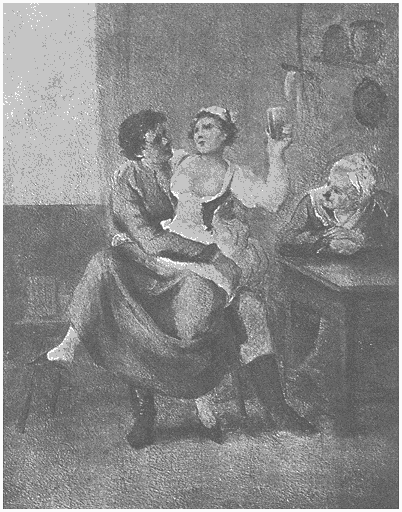
Figure 1.
Norblin de la Gourdaine, sketch of A. O. Orlovskii with a tavern-keeper on his lap
(late eighteenth century). From V. A. Vereshchagin, Russkaia karikatura , vol. 3
(St. Petersburg, 1915). Chesler Collection, Florham-Madison Campus Library,
Fairleigh Dickinson University.
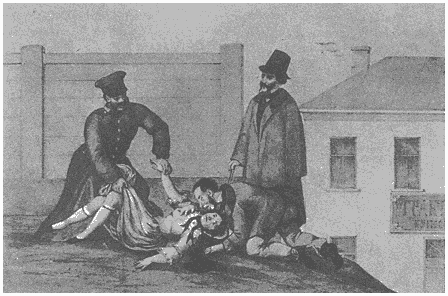
Figure 2.
Drunken prostitute outside a tavern. From Erich Müller, Sitten-Geschichte Russlands:
Entwicklung der sozialen kultur russlands im 20. jahrhundert (Stuttgart, 1931). Chesler
Collection, Florham-Madison Campus Library, Fairleigh Dickinson University.
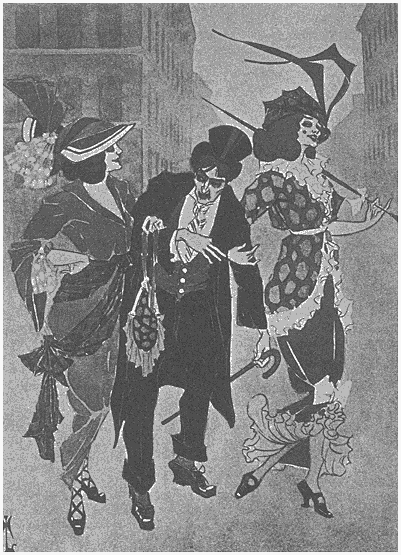
Figure 3.
"Troika" — a drunken gentleman with a prostitute on each arm. From Müller, Sitten-Geschichte
Russlands . Chesler Collection, Florham-Madison Campus Library, Fairleigh Dickinson University.
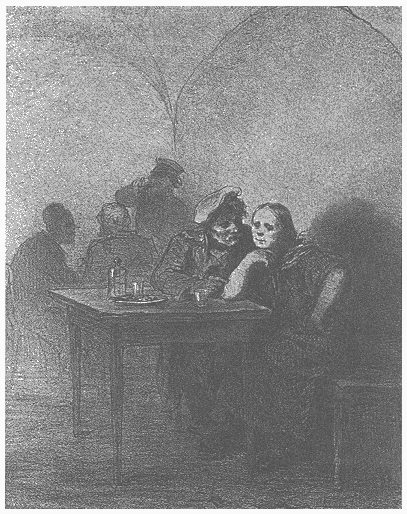
Figure 4.
Prostitute and sailor. She: "Yeah, you can take a lot from a soldier!"
He: "Only a fool would say that's going to happen. Do you honestly think
a soldier would even talk to you?" From Aleksandr I. Lebedev, Pogibshiia,
no milyia sozdan'ia , tetrad 1 (St. Petersburg, 1862–63). Slavic and Baltic
Reserve, The New York Public Library, Astor, Lenox and Tilden Foundations.
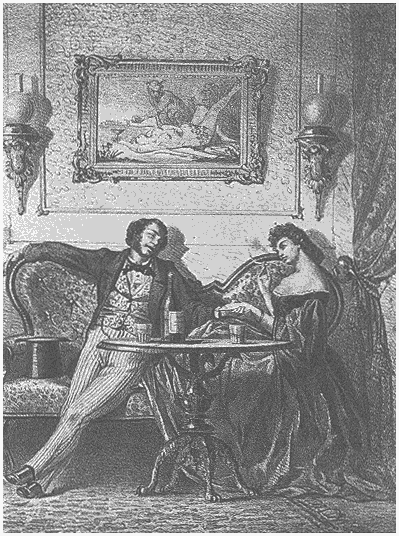
Figure 5.
Brothel prostitute and client. He: "Tell me, please, how'd you wind up here?"
She: "Real easy. My lover went to Novgorod for a while. I got bored. . . .
And now I'm in debt." From Lebedev, Pogibshiia, no milyia sozdan'ia . Slavic
and Baltic Reserve, The New York Public Library, Astor, Lenox and Tilden Foundations.
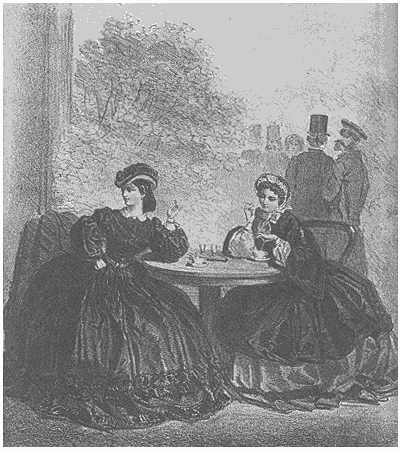
Figure 6.
Two prostitutes sitting at a table. First one: "Iashlev offered me 100 rubles, Rylkin
200, Shumov 250. So what do you think, Marie?" Second one: "What's to decide
here? Take from everyone—then you won't insult anybody." From Lebedev,
Pogibshiia, no milyia sozdan'ia . Slavic and Baltic Reserve, The New York Public Library,
Astor, Lenox and Tilden Foundations.
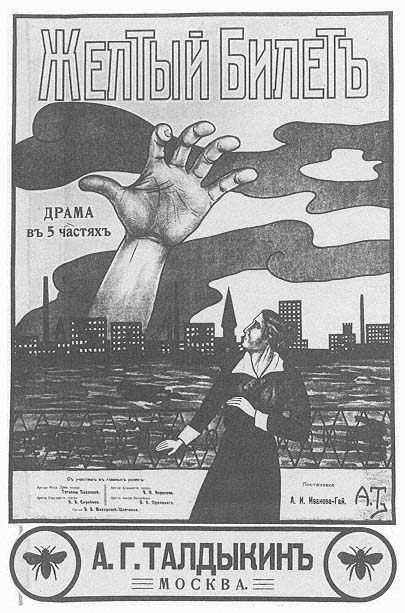
Figure 7.
Advertisement for "The Yellow Ticket: A Drama in Five Parts." My
thanks to Louise McReynolds for supplying me with this photograph.