
The Tokugawa Juridical Field Within The Field of Political Power
The undeniably strong presence of heteronomous (political) power in juridical matters predetermines the relative possibilities, findings, and strengths of formalistic and instrumentalist interpretations. The latter are particularly forceful since lordly law was foremost a continuation of war by policy, a substitution of coercive (symbolic) violence for real violence aimed at maintaining the structure of domination established by military conquest. Hence differential punishments for the same crime depending on whether the parties were rulers or ruled, and more gen-
[21] Good descriptions and analyses of these matters can be found in Henderson, "The Evolution of Tokugawa Law"; idem, Conciliation , vol. 1, chap. 4; Hiramatsu, "Tokugawa Law"; Haley, Authority without Power , chap. 3; Steenstrup, A History of Law in Japan , chap. 4; and, for the kawata, Cornell, "Caste Patron," 56-70, and Ninomiya, "Inquiry," 99-100. For a general description of the route petitions and suits took, see the introduction.
erally on whether they were of superior or inferior status in relation to one another.[22]
Thus, even a formalistic study of the dynamics of Tokugawa law could not but expose the levels and lines of impact of the forces of domination. Such an analysis of Yoshimune's great legislative codification of the 1740s, the Kujikata osadamegaki , would reveal that many of the articles are no more than casuistic status cases, a multiple unfolding into every nook and cranny of a penal code according to the fundamental hierarchizing "imaginary" that informed the Tokugawa system.[23]
Very concretely, a comparison with legislation a few decades earlier exposes the operation of this logic, since it shows that the range of serious crimes against status hierarchy was increased by moving up certain categories to make them subject to more severe punishment. The Kujikata osadamegaki increased the level of seriousness of certain crimes against superiors and decreased that of certain crimes against inferiors: the penalty for the murder of a former lord moved up two notches, from simple crucifixion to crucifixion preceded by exposure in a public place (a bridge in Edo); of a parent or teacher, up two notches, from gibbeting to crucifixion; of a relative of one's lord or master, one's father-in-law, uncle, aunt, elder brother, or elder sister, up four notches, from beheading to gibbeting after ambulatory exposure. But the penalty for the unintentional killing of a child, younger brother, younger sister, nephew, or niece moved down one notch, from beheading to banishment to a remote island and confiscation of the criminal's land, house, and personal effects.[24]
As mentioned in chapter 4, a formal diachronic analysis of village codes indicates that although punishments were lessened as time went on, for example, by substituting fines for physical punishments such as
[22] See article 71 of the Kujikata osadamegaki (on punishments for killing and wounding) in Hall, "Japanese Feudal Laws Ill," 766-71 There was also a Tokugawa saying, already mentioned, that the life of one samurai was worth that of seven commoners, and another one that the life of one commoner was worth that of seven kawata.
[23] Cornelius Castoriadis, The Imaginary Institution of Society (Cambridge: MIT Press, 1987). Castoriadis uses the term imaginary to refer to a (socially) unquestioned social metaphor that functions as a template for common sense, or, to use computer language, a default category through which a society at a particular time organizes, perceives, and partly misrepresents itself.
[24] Mizubayashi, "Kinsei no ho[*] to saiban," 163-65.
mutilation or banishment, the codes converged increasingly with lordly authority in the second half of the period, precisely when, it is generally assumed, the lords were losing their grip on local communities.[25]
Imperfect Instrumentalism
As this late convergence suggests, village codes in the first century of Tokugawa rule were perhaps less immediately responsive to, or less in tune with, lordly laws than in the second half of the period. Thus, an unqualified instrumentalist understanding of Tokugawa law as always serving directly the interests of the superordinate powers may suffer from overinterpretation. We can identify at least four areas in which that may be the case: village codes, the interplay between village codes and lordly law, commercial law, and the emergence of legal specialists.
The village codes . We do not have in the archives today sixty thousand village codes, one for each Tokugawa village; many have been lost, many seem never to have been written down, and many were rewritten several times. Those that remain are rather short, consisting often of fewer than ten articles—much shorter than the written village laws that the lords drafted and that to a degree influenced the codification of village codes in the eighteenth century. Yet all villages were governed by norms, whether written or oral, the latter undoubtedly covering a much wider area of practice than the former but not necessarily an older stratum of practice; codification often signals not the formulation of new rules, but the recording of existing ones. It is thus very likely that most of the extant village codes, at least those recorded in the seventeenth century, pertain to pre-Tokugawa practices and thus were not consciously geared toward heteronomous lordly interests.
Peasants, however, were far from insensitive to the possibilities for manipulating intra-village power distributions by contesting village codes or using them to advantage, a fact overlooked by those who stress the autonomous character of village laws in relation to heteronomous lordly power. In Hozu village and in the whole Mino region, for instance, village codes configured relationships between (ex-samurai) titled peasants and the other peasants on a samurai model of vassalage.
The relation between lordly law and village codes . The traditional instrumentalist position has held that village codes were simply an extension
[25] Oide[*] Yukiko, "Kinsei sonpo[*] ," 98-110.
of lordly law, and a tool of lordly domination. This View has been challenged by a semiformalist interpretation, but by failing to problematize power relations within the village, this interpretation has come to understand village codes as unmediated expressions of the survival needs of the village as an organized social community (Kyodotai[*] ) that was indifferent or even opposed to lordly power. Recent scholarship, such as Mizumoto's, however, has broken with (antagonistic) essentialist views of law by positing a space amenable to strategic manipulation rather than the presence or absence of a fixed barrier between the "autonomous" juridical subfield of village codes and the far larger "heteronomous" juridical subfield of lordly law.[26]
While in general village codes did not contradict lordly law, the latter was not necessarily applied; in practice, village officials could exercise discretion in the implementation of lordly laws, especially if noncompliance could be legally camouflaged. Village officials could activate lordly power without actually implementing lordly laws by the mere threat of using them; thus obliging obedience. Thus, paradoxically, lordly law was implemented at the same time that its formal power was being manipulated by being redirected, "borrowed" as the mere threat of implementation.
Commercial law . From the beginning of the eighteenth century shogunal courts were forced to (very reluctantly) address civil suits, whose volume had increased enormously with the expansion of commerce. Civil cases (property or money suits) can be considered somewhat neutral to the ruling class's political or economic interests because they were irrelevant to the maintenance of hierarchy; their adjudication constituted, therefore, an unwelcome burden and expense. Yet in this area the rulers were forced to add to their role as rulers the role of administrators. Hence commercial law constituted a juridical subfield for which a simple instrumentalist interpretation falls short. Indeed, as Dan Fenno Henderson has argued, it is the level at which one can identify a formal development of a juridical field,[27] propelled by its own dynamic, and where the interference of heteronomous social power was weakest.
The adjudication of violent quarrels followed the kenka ryoseibai[*]
[26] Mizumoto, Mura shakai , chap. 6; idem, "Kogi[*] no saiban."
[27] Henderson, Conciliation , 1:11; idem, "Introduction to the Kujikata Osadamegaki," 525.
principle; no evidence of either party was relevant, and both sides were punished, an unmitigated application of coercive force. In criminal cases the only decisive evidence was the suspect's confession; hence the use of torture, an extreme form of coercive force. In civil cases, however, attention to the relative merits of the litigants through an examination of documented evidence became important. Max Weber noted that in England "the royal power introduced the rational procedure of evidence primarily for the sake of the merchants," a development that was, therefore, "strongly influenced by structural changes in the economy."[28]
In this regard one can draw attention to two points. First, every effort was made, even during preliminary hearings (i.e., after the judicial process had been initiated), to reach a settlement before arriving at a final verdict.[29] This emphatic preference for conciliation on the part of the authorities testifies to their reluctance to function as judges in cases that did not affect the power of the dominant class directly. In other words, overlords used their authority to order a binding private settlement, the terms of which were to be determined by the litigants with or without a mediator. As we saw in the ostracism case that came before the attendant (chapter 4), such practice also prevailed in noncommercial disputes. Second, the form this conciliation took, often under threat of dire punishment if the law were applied to the letter—revealing the force of law as such—was as an application of the kenka ryoseibai[*] principle, dividing the blame, although not necessarily evenly, between plaintiff and defendant to the detriment of the nonguilty. In the end both sides were guilty. Yet the application of this principle here was not directly the result of an open application of coercive force, because conciliation was achieved by the parties involved—tatemae—under the paternalistic prodding of the judge, abdicating momentarily his official position as judge to adopt the posture of a private go-between. But this was momentarily only, because the next moment he could threaten to let the case come to a much more dreaded final verdict: honne.[30]
Ishii Ryosuke[*] has drawn attention to one particular aspect of con-
[28] Weber, Economy and Society , 2:977.
[29] Henderson, Conciliation , 1:7, 127, 147, 150.
[30] See ibid., 128, 150, 154, and esp. 156, for attempts at reconciliation in a court case analyzed by Henderson; 149, 153-55, for instances of the use of threat in the same case. The similarities between the present-day practice of conciliation and the Tokugawa variety have been explored by Henderson in vol. 2 of Conciliation .
ciliation, namely, that the fact that it is often ordered under threat is revealing of its coercive nature. The "interrogations in both the inquisitorial procedure and in the Adversary Procedure (deiri-suji ) were handled by the same officials. Thus the thinking behind the inquisitorial procedure [where torture was an option] ... influenced the conciliatory procedure of adversary proceedings; and it was held that in any event, a private settlement cannot be established without basing it on the free will of the parties. Consequently, 'provisional imprisonment' was used to coerce it."[31]
The emergence of legal specialists . The existence of a corps of legal specialists is necessary for an autonomous juridical field. Several developments during the Tokugawa period led in that direction. Starting as early as the last decades of the seventeenth century, the recruitment of investigative and recording officers for the shogunal court was narrowed to the personnel from one office within the shogunal bureaucracy; these positions ultimately became hereditary, shared among a few families.[32] Their accumulated knowledge of precedent furthered consistency in verdicts, for practice turned these officers into experts, and their opinions became authoritative not only regarding the results of the investigations they conducted but also regarding the penalties; they functioned increasingly as judges. Yoshimune tapped into this experience when he started to codify standards for judgment in shogunal courts, which had a formalizing impact in the daimyo courts as well.[33]
Since Yoshimune's Kujikata osadamegaki was intended only for internal use in bakufu courts and hence was not publicized, knowledge of its codes filtered out to commoners indirectly through court decisions, slowing the regulatory effect the predictability of justicial outcomes might have on social behavior. Yet regularity was enhanced by two practices that limited arbitrariness: internal queries by intendants or commissioners were sent to higher authorities, and commoners began to make use of legal consultants (suit inns).
When bakufu intendants or commissioners had to pass judgment on difficult cases, or when the proposed penalty exceeded their penal
[31] Ishii, review of Conciliation , 223.
[32] Henderson, Conciliation , 1:66-67, 69, 139; Hiramatsu, "Tokugawa Law," 10-11.
[33] Henderson, "Introduction to the Kujikata Osadamegaki," 506; Hiramatsu, "Tokugawa Law," 20-21.
powers, they queried higher-ups, which ultimately meant the members of the Senior Council. The senior councilors, in consequence, gathered together all the serious cases from the bakufu courts, examined the proposed sentences to determine whether precedents were applied consistently, and sometimes consulted further with the Tribunal (Hyojosho[*] ), which functioned to some extent to standardize the verdicts of all courts throughout the country.[34] Such formalization put constraints, however limited, on arbitrary judgments.
Igeta Ryoji[*] analyzes a number of queries regarding penalties for kawata who had married commoners and, in addition, often helped channel other kawata as illegal labor into commoner households. In the latter case, the Tribunal almost always lowered the proposed sentences.[35] However, according to Igeta, the verdicts alone give a slanted picture of juridical practice for two reasons. First, in the case of the kawata in the Kinai region, which was beyond Danzaemon's jurisdiction, decisions on penalties and their execution were entrusted to the elders of the kawata community from where the offender came; since they produced no documentary evidence, we do not know whether these sentences were harsher than those suggested by the bakufu Tribunal. Second, the juridical process included provisional incarceration of suspects until a verdict was reached. A sizable percentage of the suspects died in prison, an understandable deterrent that added considerable coercive power to the "power of the law" as such. Among those who died during pre-sentencing detainment were 16 of 102 kawata in the Clog Thongs Riot over a span of two years; 6 of 12 in the Okayama Riot over three years; and 8 of 55 in a mere two months after the "eta hunts" in Kyoto in 1831.[36]
In the final seventy years or so of the Tokugawa period commoner specialists in legal matters who were sufficiently knowledgeable in complicated Tokugawa legal procedures and in substantive law introduced their skill and knowledge to the market. Litigants came to avail themselves of the business of these consultants at their kujiyado (suit inns) near the shogunal courts in Edo. The litigant in the ostracism case analyzed in chapter 4 seems to have successfully relied on these spe-
[34] Hiramatsu, Edo no tsumi to batsu , 46.
[35] Igeta, "Kon'in sabetsu," 9.
[36] For the general statement and the figures for 1831, see ibid., 19; for the other figures, see chapter 5, above.
cialists for drafting his suit. The existence of these private legal assistants testifies to the advanced degree of formalization reached in at least one sector of the juridical field, although their function was limited to cases coming before the shogunal court. The authorities, although concerned about abuses,[37] understood the benefits commoner assistants offered for the smooth functioning of the courts and enrolled their services by sanctioning their activity with a license.[38]
Levels of Formalism
The degree of legal formalization and codification is one indicator of the juridical field's degree of autonomy. When discussing legal formalization, it is useful to distinguish between levels of formalism. An initial formalism, to which great attention was paid in Tokugawa Japan (as in China), relates to the recognition that cases should be grouped and filed under specific categories (water and border disputes, money suits, etc.).[39] This first procedural decision was to determine the nature of a case in order to channel it to the appropriate judicial authorities and to apply to it the appropriate law. As Henderson remarks, this could not but also reflect "the relative substantive value attached to ... [the] underlying claims [of each type of case]."[40]
More fundamentally, one could say that this is the point where a dispute or incident gets converted into legal matter, the creative power of legal naming reveals itself, and law has its field-specific effect on social reality. The decision to allow some events to become legal matter and to deny this to others creates a quasi-ontological divide in social reality;[41] and the effect is not always to enhance the importance of the former over the latter. Thus, the stipulation that murders and border disputes had to be brought to court certainly turned such incidents into public events and introduced a new element of power into them. An-
[37] Henderson, Conciliation , 1:145 n. 59.
[38] Ibid., 167-68. The status of the suit inns contrasts sharply with the illegal status of pettifoggers in China (see Melissa Macauley, "Civil and Uncivil Disputes in Southeast Coastal China, 1723-1820," in Civil Law in Ch'ing and Republican China , ed. Kathryn Bernhardt and Philip C.C. Huang [Stanford: Stanford University Press, 1994], 85-121).
[39] See Henderson, Conciliation , vol. 1, chap. 5, for the main categories of "civil suits."
[40] Ibid., 102.
[41] Bourdieu, "Force of Law," 837-40, 846.
other example is the prosecution, started in 1773, of mixed marriages between kawata and commoners as "adultery," resulting in status demotion from commoner to hinin, whereas such marriages had been legally neutral prior to that date.[42] That courts refused to consider cases initiated by inferiors against their superiors (lower samurai against higher samurai, sons and daughters against their fathers—Osadamegaki , art. 65), however, did not mean that such "authority-related" cases were deemed less weighty than, say, border disputes; rather it signaled that a certain reality, namely, authority, was above the law. After all, "unreason does not prevail over reason; reason not over law; law not over authority; authority not over Heaven."[43]
A second type of formalism concerns the bureaucratic procedures whereby an incident, once transformed into a case, must be submitted in proper form to appear in court. This is the all-important area of legal language and format, which became quite intricate in Tokugawa Japan, although, and in part because, it was by no means made uniform. The procedures themselves could be lengthy and complex. Dan Henderson's detailed analysis of a money suit by a villager reveals that a settlement (not a verdict) was reached after four months, after attempts to settle the suit at the village level.[44] First the village headman's endorsement was secured, then the local overlord's;[45] subsequently misphrasings underwent correction, the petition had to be endorsed by the court, and the suit initiated, and after twelve postponements, five stalemates, one hearing before the commissioner, and six hearings before the recording officer, only a settlement was reached. In another case, involving eight commissioners, over the establishment of a new market, Henderson
[42] Igeta, "Kon'in sabetsu," 10.
[43] Mizubayashi, "Kinsei no ho[*] to kokusei kenkyu[*] josetsu," Kokka gakkai zasshi 90, nos. 1-2 (1977): 6 ff.; for a different interpretation of this dictum, critical of Mizubayashi's, see Nanba, "Hyakushö ikki no ho-ishiki[*] ," 47-62. The "reason does not prevail over law" part of the dictum was incorporated in the third article of the Warrior Code (Bukke s ho hatto ) of 1615 (NST 27:454; for the English translation, see Lu, Sources , 1:201-3).
[44] Henderson, Conciliation , vol. 1, chap. 6.
[45] Ishii Ryosuke[*] (review of Conciliation , 216) questions Henderson's assertion that the headman's approval was needed, which Henderson also argues on p. 129 of his book. The headman, however, had to endorse with an accompanying letter any suit by a villager. As we saw in the Kasuga village case (chapter 3), it was considered an abuse of authority by the headman to forward such a case without his endorsement, which meant that the case would be immediately rejected by the intendant.
estimates that plaintiffs from three villages located the distance of a five-day trip from Edo must have traveled some thirteen hundred miles before obtaining a (negative) final verdict.
Similar documents differed from one another depending on whether they recorded the testimony of a commoner (kuchigaki ) or a warrior or priest (kojosho[*] ) or an offense by the former (called kyokuji ) or the latter (otsudo ), or depending on the commission involved (the Temple and Shrine Commission called complaints not meyasu but sojo[*] ).[46]
The complexity of the above two types of formalism created a special world having a very specific effect on any commoner who entered it. A veritable arsenal of symbolic devices was marshaled to turn him or her into more of a subject than he or she was in daily life. First of all, one could not enter this world simply on one's own volition. Endorsements from the authorities (headman and overlord) were needed, and the language of that specialized world was formulaic and determined in an authoritative way, severely restricting spontaneous, quotidian expressions. Its tenor was one of supplication and submission, osorenagara , or "[submitted] with fear and trembling," being the ubiquitous formula.[47] The effect of distance from an accustomed world increased the subject's isolation and vulnerability, pure subject confronting pure authority. The distance was reinforced by the layout of the court (called shirazu , "white gravel"), where commoners literally had to grovel in the gravel one level below the officials, who were seated on a raised wooden or tatami floor.[48] In the late Tokugawa period, when peasants and kawata appeared in court together, the gravel (or a place located three shaku below the peasants) was reserved for kawata, while peasants squatted on straw sacks.
A third type of formalism concerns the predictability of the judicial reasoning that leads to legal conclusion. The higher the degree of formalism and the clearer and more publicly spelled out the principles applied or weight given to precedent, the more circumscribed the realm of arbitrariness or discretion of the judgments will be and the greater the likelihood that political power will be bound by law.
Yoshimune's Kujikata osadamegaki (1740s) constituted the apex of
[46] For the two cases, see Henderson, Conciliation , 1:137, 161-62, 166; for the terminology, 166 n. 98, 140 n. 42; 165 n. 95.
[47] Ibid., 151-52.
[48] Ibid., 145-46.
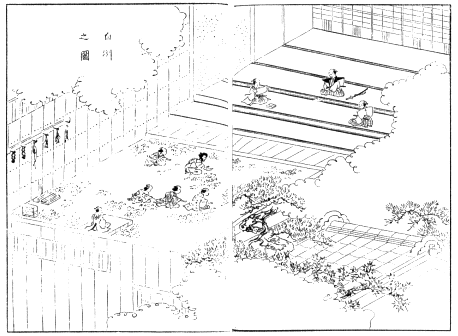
Plate 8.
Court at an Intendant's Residence. Hanging from the wall at the left
are instruments of torture used to obtain confessions of guilt in criminal cases.
From Ando[*] Hiroshi, ed., Tokugawa bakufu kenchi yoryaku[*] (1965). Reprinted
with permission from Seiabo[*] Publishing Company.
legal systematization during the Tokugawa period. Yet the degree of formalization in the third sense was very limited because it was not a publicized "code" but a manual to which access was restricted to shogunal officers of justice, especially with regard to determining penalties. This meant that (1) its principles were intended only for shogunal courts, and not for application in village or domainal justice; (2) it was "secret" knowledge, not to be divulged in the commoner world; and (3) its stipulations were no more than suggestive guidelines for judges that were partly based on precedent but did not limit their penal powers.
The net effect (likely purpose) of the restricted nature of this formalization was the preservation of a discretionary leeway for judicial officers, which meant, of course, the preservation of the power of the warrior class. Nevertheless, insofar as investigative and recording officers developed a "legal" habitus, however weak, simply by acquaintance with
precedent—knowledge that found its way into the weighty responses of the Senior Council or the Tribunal to queries from below—formalization was a legal, if limited reality.
Practitioners of deconstruction, with their predilection for discursive moments of undecidability, have argued that the one-time arbitrariness at the origins of laws, meant to eliminate future arbitrary coercive violence by substituting the rules of law, is in fact reactivated when decisions are made concerning the (degree of) applicability of the laws in each case that comes before a judge. Typically, however, they have nothing to say about interests orienting the judge through this moment of undecidability toward closure. Bourdieu's solution to this problem is to be found in his notion of the social construction of the legal habitus.[49]
Thus, courts were foremost an instrument of the rulers to preserve order, ensuring a slanted distribution of sociopolitical power. Hence the emphasis on "settling" disputes by restoring peace rather than righting wrongs. Since there was no break between heteronomous power and the juridical field, "truth" and "justice" accordingly were quite openly secondary considerations.