
The Blacksmith and the President of Catalonia
José Garmendia worked in the small foundry of Joaquín Bereciartu in Legazpi. Like many seers, he would have led a life of total obscurity except for the apparitions. Born in Segura in 1893 of an unwed mother, he was thirty-eight years old when he had his first visions at the end of July 1931. The press paid him little heed except to make light of a vision of his mother in purgatory. He was a figure of fun for his neighbors (his heavy drinking did not help), so he convinced few of his experiences. As García Cascón wrote, "He is such a humble man that in his own town no one believes him." In the 1980s few people in Legazpi remembered him by his given name. His nickname was "Belmonte," some said because Belmonte was his favorite bullfighter, others because of the little backward steps, like those of the bullfighter, he would take in his visions. But the Ezkioga believers elsewhere remembered him warmly. A single man, he had few if any local relatives, and in photographs from 1932 he poses with Catalans or with a baker and a real-estate broker from San Sebastián. He seems to have found his family in the community of visionaries. His visions typically included a struggle between good and evil, with the devil acting as a major protagonist.[32]
Garmendia in newspapers, 1931: LC, 25 and 28 July, 2 August; PV, 25 July, 4 August; ED, 28 and 29 July; EM, 8 October. García Cascón to Vallet, 31 October 1931, AHCPCR 10-A-27/2.
When García Cascón met him in mid-October 1931, Garmendia, overshadowed by attractive and convincing youths and children, was still one of the "invisible" seers. But he convinced García Cascón immediately when he said the Virgin had given him a special message to deliver to an important Catalan figure.
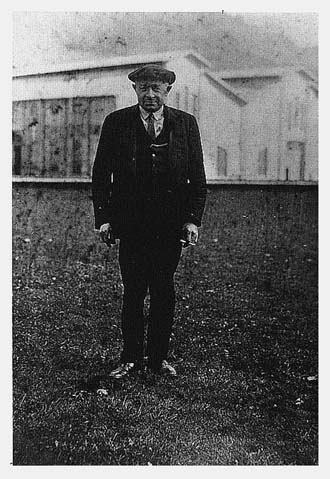
José Garmendia in front of factory at Legazpi, 26 October 1931,
shortly after visit to Macià; probably the first photograph of
Garmendia as a seer. Courtesy Arxiu Salvador Cardús i Florensa, Terrassa
This news pleased Cardús and the others from Terrassa but did not surprise them. "It was not strange that the Virgin should have a certain partiality for Catalonia," García Cascón wrote to Vallet, "precisely because so many Catalans had come to this miraculous mountain to pray on behalf of our land."[33]
SC E 117; García Cascón to Vallet, 31 October 1931.
Cardús and the others from Terrassa guessed correctly that the "important figure" in question was the president of the autonomous region of Catalonia, Francesc Macià. García Cascón paid Garmendia's train fare to Barcelona, and on October 23 Cardús accompanied the seer to the office of the president. On being told it was a matter involving the Virgin of Ezkioga, Macià received Garmendia and Cardús at once, then Cardús withdrew, leaving the two to talk alone for fifteen minutes.Garmendia was exhilarated afterward. According to him, Macià had listened with interest as on behalf of the Virgin Garmendia revealed some intimate personal details, warned that life was short, and assured him that he and his sister, a nun, would go to heaven. As Garmendia told it, Macià requested an image of
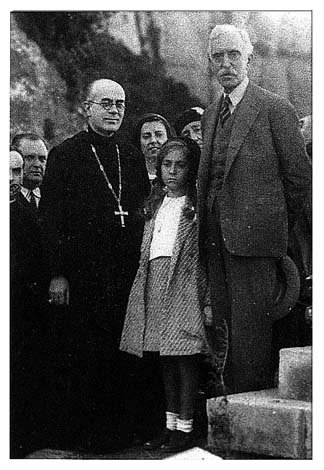
Francesc Macià, president of the autonomous government of Catalonia, at Montserrat the day after José Garmendia's visit. Macià is with his granddaughter and Abbot Marcet, 24 October 1931. Courtesy Arxiu Salvador Cardús i Florensa, Terrassa
the Virgin as she appeared in Ezkioga and asked what he could do. Garmendia asked him to help obtain permission for a chapel on the vision site. Garmendia had wanted a chapel virtually from his first visions in late July. So Macià wrote a note, "Autorizo la construcción de la capilla, Francesc Macià," which Garmendia showed to Cardús. The next day Macià, his wife, daughter, and granddaughter went to Montserrat to open an art exhibit and there he told Abbot Marcet about Garmendia's visit.[34]
Cardús's account in SC E 115-138. El Noticiero Universal, 26 October 1931, p. 7, mentions Macià's close contact with Marcet at Montserrat. See also EM, 21 December 1931.
Garmendia returned to Barcelona on November 14. José María Boada, a wealthy member of the Vallet movement, knew about the previous visit and invited Garmendia back to Barcelona. García Cascón accompanied the seer to Montserrat. There the abbot told them that Macià had spoken at length about Garmendia's first visit, repeating over and over, "I don't know what the Virgin wants me to do." Garmendia quickly observed, "Well, that is what I am here to tell him, what the Virgin wants him to do."
Three days later Macià and his wife received Garmendia in their house, and Macià reportedly asked the seer if the Virgin was happy with him. Garmendia pleased him by answering that she was indeed. Garmendia said he had gone to Madrid the previous month and the Virgin was not so happy with the prime minister, Manuel Azañ, who had refused to receive him. Macià allegedly asked, "So he is worse than I am?" And Garmendia said yes, the Virgin had told him that Azaña would receive the punishment he deserved.[35]
SC E 196-198. For a third visit to Macià, see chap. 6 below.
Garmendia made other visits on behalf of the Virgin. On November 23 he went to see Justo de Echeguren, the Vitoria vicar general, who treated him abruptly. On December 6, this time with García Cascón and Boada, he went back. Echeguren was firm about the matter of Ramona's wounds, and the next day Garmendia claimed the Virgin told him, when he asked her to bless Echeguren, that "the apostles of her son were betraying both her son and her, and they will have to suffer for it later." Garcí Cascón sent the bad news to Echeguren along with prayers for enlightenment.[36]
SC E 205-206, 230-235, 261-263. Undated note [April 1932?] in handwriting of Justo de Echeguren in Laburu papers.
Cardús and his employer kept in touch with Garmendia at least through 1934. Garmendia could barely write, so he dictated his letters. In June 1933 he said he was having fewer visions, only "when the Most Holy Virgin wants me to give some special message." But that fall he was again having visions daily, at home, in bed, outside, or in church. Garmendia did not always convince the Terrassa believers. But for García Cascón and Cardús, he remained a good friend and a valuable connection to heaven.[37]
Garmendia to Cardús, Legazpi, 18 June and 28 October 1933.