
Chapter Four—
Independence and the Emerging Class Structure
The Political Background to the Republic
The use of British troops to put down the Mau Mau uprising shifted effective control of Kenya's constitutional development from the white settlers to the Colonial Office in London. At the end of the 1950s Britain had decided to grant independence to its African colonies and in a series of complicated constitutional negotiations started Kenya down that path.
Although Jomo Kenyatta had been imprisoned throughout this period, he remained the symbol of African nationalism, and there was tremendous pressure for his release. Kenyatta emerged from detention in 1961 to face a volatile and threatening political predicament. It is a tribute to his political skill that he mastered it. In the process he profoundly shaped Kenya's future. The class and ethnic dimensions of the situation in which he found himself will be dealt with in this chapter, the institutional issues in the next.
The Colonial Class Structure
Classes are treated here as groups that arise from economic interests that are in systematic conflict with other interests and that are sufficiently conscious of those interests to see themselves as distinct social and political entities.[1]
Class analysis is not synonymous with the study of interest groups, though the two are closely related. First, the term "class" presupposes the existence of another group in direct conflict with it, whereas "interest group" does not necessarily carry such a connotation.[2] Second, classes are much larger entities than interest groups and have a social
dimension. Classes represent a bundle of interests, not all of which will be shared by every one of their members. Interest-group studies predict only that people will defend their personal interests. Class analysis, in contrast, predicts that individuals, because of their social ties with other members of their class, may take on political stances that defend interests they do not personally share. For example, a top Kenyan civil servant who owned no businesses but who advocated probusiness policies would be acting out of his class but not his personal interests. One of the questions to which we will be sensitive in this study is when the behavior of administrators is better predicted by class than by personal interests.
Since the forms of production, the patterns of political conflict, and the nature of social affiliations vary from society to society, class categories cannot be universal but have to be developed specifically for each system studied. The largest single class in Kenya was and is that of the workers and peasants. Workers are, simply, those who derive income from their wage labor. Peasants are small farmers using household labor to produce for subsistence and limited markets.[3] In Western societies these have been separate classes, but in Kenya they make up a single class, for several reasons.
Colonial wage employment was generally insufficient to support a laborer's family and often even himself. The worker therefore was dependent upon the agricultural production of his wife, tying him integrally to the peasant sector. As Mahmoud Mamdani has argued, the very act of employing Africans involved an extraction of value from the peasantry for the benefit of European employers, because the employee had to be subsidized by his family. The African was driven to work in these conditions by the colonial imposition of cash taxes and the oligopolistic European control over the labor market (which kept wages depressed).[4]
It is possible that many (though no longer most) wage laborers in Kenya are still subsidized by their peasant families. People continue to work in these conditions because wage employment remains the only way to accumulate cash savings when the worker has no liquid capital to invest (in farming or elsewhere).
Given these economic conditions, it is hardly surprising that it was (and to a considerable extent still is) very difficult to distinguish the life history of a worker from that of a peasant. By and large, Kenyan workers come from the peasantry, raise their families on peasant plots, and retire to the peasantry at a relatively young age.[5] They certainly do not think of themselves as a separate group. It is important for public policy that Kenyan peasants have not organized themselves politically to counter worker demands for cheap food and high wages.
This is not to say that workers and peasants will remain one class indefinitely. Today there is an indirect economic basis for conflict be-
tween peasants and workers. The prices received by the peasants largely determine the food costs of the workers, and the wages received by the workers are a part of the cost of manufactured goods consumed by the peasants. Thus the economic basis for their unity is declining, but sociological and conscious separation has not yet been achieved. A separate "proletariat" is just beginning to emerge in Kenya.
In the colonial period four other groups stood in contradiction to this worker-peasant class. The conflicts generated by three of the four groups were quite visible and produced correspondingly high class consciousness. These classes were the European industrial capitalists, the European capitalist farmers, and the Asian commercial bourgeoisie. The two European groups were in conflict with their employees over the proportion of value produced that was to be paid out in wages, and with one another over the relative prices and privileges of their manufactured goods and raw materials. The industrialists were based primarily in Britain and exported manufactured products to the colonies. They were represented in Kenya largely by their agents and the British Colonial Office. Large-scale commercial agriculture, however, was represented by local white settlers. Some of the clash between settler politics and the British Colonial Office grew out of the conflict between these differently located groups.
The relationship of Africans to the Asians (Indians and Pakistanis), who dominated commerce, was antagonistic because of struggles over the prices of goods bought and sold by the peasantry. We have followed Mahmoud Mamdani and Issa Shivji in calling this class the commercial bourgeoisie, though most of its members might more accurately be called petty-bourgeois.[6] The potential for class conflict that exists in commerce between the bourgeoisie and petty bourgeoisie—wholesaler and retailer—was not realized among the Asians in Kenya, because of the unity imposed on them by the antagonism of the Europeans and because the other struggles over the distribution of value were so much more significant. With cohesion imposed by external forces and consciousness of internal conflicts consequently low, leadership in the Asian communities remained in the hands of the wealthier, more bourgeois elements, and even Asian workers supported their leaders' political stance as a commercial bourgeoisie. This phenomenon is a good example of an interaction between economic and social structures. Though it prevented an alliance of African workers or traders with their Asian counterparts, it nonetheless infused the conflicts between the racial groups with a class content.
The final class in the colonial equation was an emergent one, the African petty bourgeoisie. The name is a misnomer, as its economic base is somewhat different from its Western European counterpart; it will be
used, however, for it has wide currency and there are interesting parallels with other groups called petty-bourgeois. This class had three different economic bases: petty-capitalist (usually export) agriculture, small trade, and clerical or government employment, with no necessary economic connection between them and hence no material reason why they must produce a single class. The links between these bases were provided by the particular sociological patterns of mobility and investment in Kenya. The ties between trade and petty-capitalist agriculture were particularly strong.
"Petty capitalist" designates those farmers who have transcended a purely peasant status by acquiring above-average amounts of land and by employing labor. They cannot be called full capitalist farmers, for their enterprises are relatively small and they usually engage in agricultural labor themselves, rather than solely managing the labor of others. But neither are they simply peasants, for they are in potentially antagonistic relations with their peasant neighbors. By using the new possibilities of a cash economy to expand their production beyond the limits of their families' labor, they intensify the struggle for land, and by employing others, they create the possibility of conflict over the just division of the fruits of production. In those areas where land was scarce, the acquisition of land by this group added to landlessness and heightened the resulting bitterness. A nascent consciousness of class conflict between these petty-capitalist farmers, on the one hand, and workers and peasants, many of them landless, on the other, was already evident in Kikuyu politics in the late 1940s.[7]
This petty-capitalist agriculture had been created by the gradual opening of market opportunities to Africans, particularly export ones. This trend was generally resisted by the white settlers, but it received significant impetus from the need for agricultural produce to support the British effort in World War II. The decision to incorporate "progressive" African farmers into the cash economy was then adopted as a strategy for combating the Mau Mau uprising.
The links between this petty-capitalist agriculture and small trading were and are very strong. The small African trader often has acquired his initial capital in peasant farming and usually is simultaneously a petty-capitalist farmer.[8] Of course he is in a potentially antagonistic economic relationship with his neighbors in both capacities.
The ties between junior civil servants, teachers, and clerical workers and other parts of the African petty bourgeoisie were weaker than those linking the petty-capitalist farmers and traders, although they were still significant. First, many were able to move into commercial agriculture and trade from a base in rural government employment, as was the case with Musa Nyandusi, Philip Mule, and Elijah Waicanguru.[9] Unlike the
workers, who used the labor of their wives on the land, the clerks and teachers tended to take on employees (sometimes their relatives). Junior civil servants also usually looked forward to retiring to petty-capitalist farming, as their pensions were insufficient. The second link with the other economic bases of the petty bourgeoisie is that by the end of the colonial period many of the African civil servants and clerks were coming from families in commercial agriculture or trade, which is how their parents had been able to pay their school fees.
The leadership of the petty bourgeoisie in the independence movements of Africa is well known and well documented. The colonial regimes sometimes pointed out that the nationalist parties were led by an elite class that could not truly represent peasant interests. Nationalists replied that African societies were classless.[10] This was and is false. But contradictions between the worker-peasant and the African petty bourgeoisie were minor compared with those with the other classes in colonial society. Consciousness of this petty bourgeoisie as a separate class varied from place to place and time to time. This is why it is identified here as an emergent class. Often it was thought of only as an elite stratum within traditional society. Hence the African petty bourgeoisie was able to take command of the nationalist movement as the legitimate representative of the masses. The problem facing Jomo Kenyatta at independence, however, was that in his own Kikuyu constituency worker and peasant consciousness of the petty bourgeoisie as a separate class was most fully developed, and it was there that its leadership had been challenged by the radicals who led the Mau Mau uprising.[11] In class terms the Kikuyu politicians had the least unified constituency of any ethnic group in Kenya.
Ethnic Tensions
Kenya's many ethnic groups are generally characterized by distinct languages and thus have the same tendency as Europe's nationalities to unite politically and socially. As is seen in table 4.1, the Kikuyu are the largest of Kenya's ethnic groups and together with the closely related Embu and Meru make up 26 percent of the population. The other large groups are the Luo and Luhya in the west, the Kamba to the east of the Kikuyu, and the Kalenjin groups around the Rift Valley. (See map 2.) Most of these groups did not have unified governmental organizations traditionally, but they did have a strong consciousness of common ancestry.
Prior to the imposition of British rule, these ethnic groups both traded and fought with one another, just like the rest of the world's nations. The conflicts tended to be more pronounced with those immediately neighboring groups that were culturally and linguistically most
| ||||||||
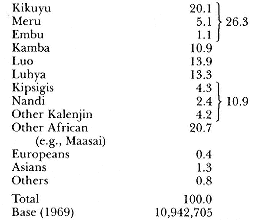
distinct—the Kikuyus with the Maasai in central Kenya, the Luo with the Luhyas, and the Luhyas with the Kalenjin in the west. Colonialism both reinforced these conflicts and introduced new ones. The introduction of European agricultural settlement had made land a scarce commodity and intensified the competition around it. During the colonial period itself these tensions had united African ethnic groups against the Europeans. As independence approached so did the prospect of transferring European lands to new owners. Thus many of the old conflicts over access to territory were renewed—the Kikuyu against the less numerous Maasai and Kalenjin for the east of the Rift Valley "White Highlands" and the Luhya against the Kalenjin for the west.
New tensions also had developed over access to wage employment. The three largest groups—the Kikuyu, the Luo, and the Luhya—were also the disproportionate leaders in education and urban jobs and found themselves in entirely new competitive relationships. Because new migrants to the cities naturally looked to their relatives for help in finding housing and jobs and because social life takes place most easily in one's mother tongue, this competition readily assumed ethnic overtones.
The British consciously fostered conflicts among the colony's other
ethnic groups, following the old slogan of "divide and rule." In the 1920s they deprived Asians of rights in the name of protecting Africans. During the crucial period in the 1950s when mass political mobilization was taking place, the colonial government confined African political organizations to single districts, forcing most nationalist politicians to build from an ethnic base. (Tom Mboya, a Luo, escaped this trap by building a multiethnic following out of the labor movement in Nairobi, but he was the exception.)[12]
Finally, the white settlers saw their own economic interests as most threatened by the large and better-educated African groups, particularly the Kikuyu and to a lesser extent the Luo. Thus they helped to split the nationalist movement by fostering the formation of the Kenyan African Democratic Union (KADU) to protect the territorial interests of the minority groups. In this way the whites helped many of the precolonial lines of conflict to resurface at independence. The new wine of land hunger was poured into the old bottles of ethnic difference and given new bite. At a later point the competition for urban jobs and businesses would be mixed into another set of these bottles and produce another set of conflicts, this time between the Kikuyu, the Luo, and the Luhya. Economic and ethnic differences were intermingled to produce tensions whose shape and force could not be explained by either alone.
This then was the dangerous political situation that Jomo Kenyatta faced when he emerged from detention. Kenyan politics had become fractionated along ethnic lines, with his own Kikuyu united with the Luo in the Kenyan African National Union (KANU) and in tight competition with KADU for control of the government. Almost all the leading politicians had built their organizations on ethnic bases, so it would not have been easy for Kenyatta to command support in a way that cut across these lines. Furthermore, the intra-African class conflicts that did exist in Kenya at the time were simmering just below the surface among the Kikuyu but were weakly developed among the other ethnic groups. If Kenyatta had played to the disadvantaged, as radicals such as Oginga Odinga and Bildad Kaggia wanted him to, he would have secured the enthusiasm of the Kikuyu poor, antagonized the Kikuyu petty bourgeoisie, and split his own political base, but without being able to make significant inroads into the ethnic bases of the politicians with whom he was competing. If Kenyatta had gone this route, he probably would have ended his career out of power.
Kenyatta instead chose to protect his own political base by taking a conservative line of intra-African class harmony and keeping the Kikuyu united by directing substantial benefits toward them without regard to need. Kenyatta argued that the bitter conflicts between Loyalists
and Mau Mau should simply be forgotten (with the former retaining the advantages in land they had gained). He said that there would be "no free things" distributed to the landless. The radicals ultimately rebelled against this neglect of their concerns, formed the Kenya People's Union (KPU), and were crushed in the "Little General Election" of 1966. The political shrewdness of Kenyatta's strategy was thus confirmed. In the process he reinforced a political system in which class conflicts were subordinated to ethnic ones while still fueling much of their heat.[13]
The result was a political system that was largely constructed out of patron-client networks. This had particularly unfortunate consequences for the interests of peasant farmers and the organizations that serve them. Since peasant needs are central to rural development, let us pause to explore the policy implications of patronage more fully.
The character of risk in agricultural systems in preindustrial society leads peasants to invest heavily in personal relationships as a hedge against adversity. Not only may close ties with social equals, such as relatives and neighbors, provide help when one experiences calamities such as drought or illness, bonds to one's social or economic superiors can result in personalized assistance as well. For these latter, unequal types of relationships, the recipient promises support in return for the help that he or she receives. This social dynamic lies at the root of the patron-client relationships that pervade poor countries and dominate most of their political processes.[14]
Patron-client politics mobilizes political resources along the lines of clientage networks (which need not be ascriptive but which in Kenya do in fact tend to follow kinship lines at the local level). By necessity these networks group together people of dissimilar interests; a patron must be advantaged in some area in order to have something to trade for the support of his clients. The resulting political processes are substantially different from those that result from associational groupings, which bring together those who share a common interest.[15] Associational politics leads to the direct representation of the common interests of large or powerful groups in society. If Kenyatta had followed the urging of the KANU radicals to emphasize the needs of Kenya's poor, particularly its peasants, he would have been building such an associational form of political organization. In contrast, patron-client politics masks the interests of the multitude, who are the clients, for they are represented in the system by advantaged patrons, whose personal interests are significantly different from those of their followers.
Associational politics tends to result in the creation of "public goods" for the most powerful groups—policies that will serve the common interests of the groups' memberships. Patron-client politics tends to focus on the creation of "private goods," discrete products and services that
can be disaggregated and distributed to individuals through clientage networks.[16] To the extent that patron-client systems produce any "public goods," such goods will tend to be those that will benefit the elite group of patrons and add to the personal wealth on which they can draw to maintain their clientage networks. Sometimes political systems are mixed; some groups will be incorporated through patron-client networks and others will be represented by associations. Such mixed systems generally work to the still greater disadvantage of small farmers. In systems like these, commercial and industrial interests, large farmers, and even sometimes urban workers have associations to press their interests, while the expression of peasant interests is dampened by patron-client networks. Kenya is such a mixed system. As a consequence, political demand for agricultural policies and programs meeting the common needs of small producers (public goods) is weakened, and emphasis has been placed instead on services that can be distributed to discrete groups of clients in return for their support (private goods).
Africanization of the Civil Service
The theme underlying Jomo Kenyatta's policies as president was Africanization. In this way he could provide the flow of benefits both to buy the unity of the Kikuyu and to provide patronage resources to keep the other ethnic leaders in his coalition. The first drive was to indigenize the civil service; the second, to take over settler agriculture; the third, to replace the Asian commercial bourgeoisie and the European managers of multinational firms; and the fourth, to compete eventually with international capital through new investment and the purchase of firms. All of the men whose biographies we are examining were influenced by at least one of these Africanization efforts, and two of them benefited from all of them. These policies altered the structure of Kenya's political economy and also affected the shape of its rural development.
The Africanization of the upper levels of the civil service took place extremely rapidly. It was essentially completed by 1965, save for professional and technical positions, which took a few years longer. The speed was remarkable, as there were very few Africans in the senior civil service in the late 1950s. Those with plausible qualifications were promoted with great rapidity and quickly found themselves at the top.
Recruitment and promotion of Africans in the lower and middle ranks of the senior civil service were based on qualifications and performance. Capture of the very top positions, however, tended to depend on having the confidence of the president or someone close to him, particularly for the generalist positions. Throughout the British Empire, the latter were (and are) held by members of a special cadre. In Kenya
it is the Provincial Administration. The English Administrative Class and the Indian Administrative Service are its equivalents. The first slice of the careers of our four men illustrates these points.
Africanization and the Four Administrators
Simeon Nyachae (the future chief secretary) had held positions as district assistant and then as district officer in charge of a division during the late colonial period. For British officers these were entry-level positions, and many years of service would be required before one was put in charge of a district. In August 1963 Nyachae was sent to Cambridge University for the training course that all the English took before joining the Provincial Administration. He was recalled before it was completed, however, and upon his arrival at the Nairobi airport in March 1964 was made district commissioner of Nyandarua. This was a critical and difficult district, but Oginga Odinga, who was then minister of home affairs, was anxious to fill all the Provincial Administration posts with Africans.
In October 1964 Nyachae was called to Nairobi for special duties as deputy director of the December celebrations for Kenya's becoming a republic. In this position he worked under the then minister of constitutional affairs, Tom Mboya. The appointment may have been influenced by Mboya's alliance with Lawrence Sagini, Nyachae's brother-in-law. The post gave high visibility to Nyachae's considerable administrative talents. It also created an incident. Nyachae was in charge of the seating arrangements and decided that Kenyatta should sit alone on a high dais, with the chief justice coming up to him to give him the presidential oath of office. But Charles Rubia felt that as mayor of Nairobi and first citizen of the city he should sit on the dais with the president. Rubia felt extremely strongly about the matter and took it to Mboya. Mboya said that the decision was Nyachae's to make but warned Nyachae that if he were sacked because of it Mboya would be unable to protect him. Nyachae said he would take the risk.
At the celebrations, when Kenyatta's car arrived Rubia called for his own and left in protest at his not sitting with the president. As Kenyatta came up the stand, he called Nyachae over and asked what was going on. To Nyachae's brief explanation, Kenyatta simply said, "Well done." Immediately afterward the president made him senior district commissioner in charge of the Nairobi Extra-Provincial District and in January promoted him to be provincial commissioner in charge of the vast and sensitive Rift Valley. By virtue of coupling his administrative ability with an understanding of the president's unspoken wishes and the courage to act on it, Nyachae became Kenya's youngest provincial commissioner. He had vaulted into one of the positions that Kenyatta regarded as most important politically.
Charles Karanja (the future tea manager) was posted to Nakuru in 1957 by the Ministry of Works, which had paid his expenses at the Kampala Engineering School. He was appointed an African engineering assistant, which involved working under the guidance and supervision of more experienced engineers. He disliked the term "African" in his title, and the Kenyan Engineering Association, of which he was the first president, disputed it. He worked on the design of water supplies and constructed one dam and a pipeline.
In 1958 when the ministry decided to train more engineers for roads, he applied for the six-month course and was taken over the objections of his supervisor, who said he was too valuable to lose. At its completion he was assigned to the Embu District Council as the district engineer. He remained there from September 1958 to January 1960 and was in charge of road construction and maintenance, with a staff of two hundred. He was lucky, because when he arrived in Embu the council decided to embark on paving (tarmacking) the town roads. This gave him a chance to prove himself, and "they are still the way I did them."
The Kiambu District Council advertised for its own engineer in late 1959, and after some hesitation Karanja applied. Another candidate had the inside track with the council. But Peter Derrick, their new district commissioner, had been the DC in Embu and persuaded the council that Karanja was the best engineer available, so after confirming that he was indeed from Kiambu, the council appointed him.
Again Karanja was lucky. The Kiambu council had money and was building offices and houses and taking over responsibility for roads from the Provincial Administration. It also received a large grant from the central government to pave an eleven-mile stretch of road. All of these projects were completed under Karanja's direction. "The tarmac road stands to this day with little maintenance." He commanded a work force of about four hundred.
Karanja was among those who welcomed Jomo Kenyatta to his Gatundu home in Kiambu when he was released from detention in July 1961. He later helped to organize the reception the Kiambu council gave Kenyatta, and he bought, on behalf of the council, the fountain pen it presented to him.
Karanja was next sent to Canada for a university degree but gave it up after a year to return to his family and Kenya. He went back to his old job as Kiambu engineer in August 1962. He was privately approached to stand for Parliament in the Gatundu constituency and seriously considered it, as it was thought that Kenyatta would stand in Nairobi. When Kenyatta decided to run from his home, Karanja deferred to him and spoke publicly in his support. Politically, he really had little other choice.
When Kenyatta became prime minister, Karanja proposed that the Kiambu council obtain funds for paving the road to his home in Gatundu. Kenyatta would have the Kiambu Works Department take care of minor jobs on the house built for him by the colonial government just before his release from detention. The house was a replacement for Kenyatta's original house, which had been demolished by the same government during the State of Emergency, and Kenyatta was dissatisfied with some of its features. Karanja saw to it personally that the requested amendments were well done. Kenyatta noticed and was impressed by his performance.
Karanja was ambitious, however, and he saw that he could go no further in Kiambu or in public works engineering. He held the top engineering post in Kiambu, and to get ahead in the Ministry of Works he would have needed the B.Sc. that he forsook when he left Canada. There also was no way for him to enter politics as long as Kenyatta was alive and held his home's seat in Parliament. He decided to find another job to expand his experience and capital and then to go into business for himself.
Hence in 1964 he responded to an advertisement for an executive assistant in the Special Crops Development Authority (which was to become the Kenya Tea Development Authority, KTDA). Karanja had been encouraged to apply by Jackson Kamau, to whom he had been introduced by his old primary-school mate, Ishmael Muriithi. Kamau, who was from Kiambu, was one of the two Central Province representatives on the KTDA board. The general manager of the Authority at the time was W. B. C. Raynor, who had served as district commissioner in Kiambu during Karanja's tenure there. With Raynor's familiarity with his ability, Karanja captured the post and became the first African in the Authority's management.
Karanja's rise through the ranks of the KTDA to the post of general manager in 1970 is discussed in chapter 6. Most of Karanja's rapid upward mobility can be attributed to his hard work and the quality of his performance. The last step to general manager was aided, however, by the contacts he had made earlier with Kenyatta and the reputation for effectiveness that he had established in politically powerful Kiambu.
Ishmael Muriithi was made district veterinary officer in Eldoret when he returned from Edinburgh in May 1964. In December a position as deputy director of Veterinary Services was advertised, and the director, Anthony Dorman, advised Muriithi: "You wouldn't do yourself any harm if you filed for" the post.
There were two other strong African applicants, but Muriithi had a number of advantages. First, he was the only African veterinarian in Kenya with United Kingdom qualifications. The decision made in 1960
to send him to Scotland while his peers went to the United States and India definitely worked in his favor, even though it kept him away from Kenya longer. Second, Muriithi had placed at the top of his class at Edinburgh. He was regarded as "quick and bright," a "competent, serious scientist," and a "well-prepared professional" by those in a position to influence the selection. Third, he was already "noted for his extremely high ethical standards" and as "having a good feel for administration." Fourth, he was a close friend of Geoffrey Kariithi's, an old Alliance High School classmate and the new permanent secretary of the Ministry of Agriculture (in which the Veterinary Services were situated).
The appointment decision was made by the Public Service Commission, though it must have been influenced by the advice of those in the Ministry of Agriculture most competent to judge the professional calibre of the applicants. One of Muriithi's competitors lobbied hard for the post; Muriithi did not; he was too new to know how. He was appointed on his merits.
Once Muriithi was made deputy director in mid-1965 it quickly became evident that he was being groomed by Dorman to succeed him as director. He was appointed director of Veterinary Services in 1966, the post he held until he retired in 1984. His only connection with the president would have been an indirect one through Geoffrey Kariithi, who was later to become the extremely influential head of the civil service.
Harris Mule (the planner) returned to Kenya from the United States in June 1963. Neither his university nor his academic performance was particularly distinguished. He was immediately offered a position in the Provincial Administration but refused it. He was determined to be a government economist. If he had taken the post, he might have become a permanent secretary much more rapidly, but his influence on Kenya government policy would have been considerably less. By the end of the month he was appointed to the Planning Department and made a statistician in the Ministry of Agriculture. In 1965 he moved to the Ministry of Economic Planning as a planning officer. In this period those in a position to influence his career felt that Mule "worked hard, wrote a lot, but was quiet and took little initiative." His peers commented on the fact that he took work home, had an amazing memory for facts and people, and knew what was important in his work. But he was extremely deferential to his seniors and was not regarded as having leadership qualities. His superiors had little occasion to see the public-speaking abilities he had developed while preaching in Denver.
Mule was sent to Harvard for the 1966–67 academic year, where he performed indifferently. On his return, he was made a senior planning officer in charge of Agriculture, Settlement, and Cooperatives. He became principal economist in charge of Agriculture and Rural Develop-
ment in 1969. He moved quickly to the post of chief economist in 1970 because of the support of his minister, Tom Mboya. In 1972 he was made deputy permanent secretary in charge of statistics and planning in the Ministry of Finance and Economic Planning, a position that enjoys the rank and salary of a permanent secretary.
Throughout this period, Mule showed a remarkable ability for learning on the job. He recognized quality in the ministry's advisers and listened carefully to them. His analytic ability to see a problem and its consequences grew considerably, as did his self-confidence in presenting his views. His honesty and integrity became evident. But he did not make the final leap to full permanent secretary until 1978, after Kenyatta's death. He himself was happy where he was and did not lobby for advancement. He also was not helped by his carelessness about his personal appearance, nor by the fact that his intelligence and sagacity did not register in first impressions. Still, less impressive men than he had become permanent secretaries, and others wanted him promoted. One informed source felt that Mule had been blocked by Kikuyus close to Kenyatta. A permanent secretaryship in the area of economic policy is a position of considerable influence and requires the confidence of the president. Under Kenyatta, Kikuyus were more likely to gain that trust than others were.
Did "Tribalism" Overlay Africanization in the Civil Service?
Kenyans have often been concerned that appointments and promotions in the civil service were going disproportionately to the ethnic group(s) of those in power. During the period of rapid Africanization in the 1960s, allegations frequently were made in Parliament and elsewhere of favoritism to Kikuyus.[17] Was this talk a manifestation of civil service reality? Or did it simply reflect the way Kenyans are prone to see their own political system? The answer appears to be some of both, but with the truth surprisingly lying somewhat closer to the latter.
Was any group disproportionately represented in the higher civil service? Yes, but at least in the 1960s this seems largely to have been a function of variations in educational opportunity, which arose out of differential exposure to the colonial economy and mission proselytizing. As can be seen from table 4.2, the Kikuyu were overrepresented relative to their proportion in the population, and this advantage increased as the decade went along. It is unlikely, however, that this was due to any discrimination or favoritism on the part of the new African government. The ethnic proportions of senior staff in the Ministry of Agriculture is particularly instructive in this regard. All Kenyan Africans with the requisite educational qualifications for such positions were hired during this period. Thus the ethnic percentages in Agriculture simply reflect
| ||||||||||||||||||||||||||||||||||||||||||||||||||||||||||||||||||||||||||||||||||||||||||||||||||||||||||||||||||||||||
the character of the applicant pool, which was determined by educational decisions made during the colonial period. The proportions of Kikuyus and other ethnic groups found in Agriculture (row 4) are similar to those found at higher decision-making levels in the late 1960s (rows 5 and 6). The fact that the ratio of Kikuyus to others was increasing throughout the decade (compare rows 2 and 3 with 4 through 6) would have been nothing more than a readjustment from the job discrimination against Kikuyus during the Mau Mau/Emergency period.
But were Kikuyus, once recruited into the senior civil service, promoted more rapidly than others? Data from civil service establishment records in the late 1960s are presented in Appendix A and used to examine this question. The answer is no; there is no evidence of Kikuyu advantage in the aggregate data. Contrary to popular impressions, Kikuyus (or others) were not more likely to be promoted when they were working under members of their own ethnic group who were in a position to help them and might be predisposed to do so. The statistical material presented in Appendix A provides no evidence of supervisorial favoritism along ethnic lines.
Were senior civil service promotions then really blind to ethnic identity? I think that the answer is yes, until one reaches the very highest positions. The Public Service Commission was designed to assure the application of merit criteria in government employment, and it worked hard to achieve that result. It had multiethnic membership, and its chairman and executive secretary were not Kikuyu. There was a good deal of favoritism in the discretionary junior government jobs that the commission did not control, but it took special effort to achieve a promotion other than on merit criteria at the senior levels.
This is not to say that merit was never overlooked; insiders testify to the fact that it was. Because it was difficult to do so, however, it tended to be done only for those positions that required the confidence of the president and where the president's implicit or explicit influence could be used to achieve the result. Table 4.2 shows that by 1972 a considerable jump had occurred in the proportion of Kikuyus holding positions that could influence policy. Sometimes several non-Kikuyu would be promoted to positions that were not critical to public policy, in order to put a Kikuyu in line for a position that was. The locus of real power in a ministry also could vary between the offices of cabinet minister, permanent secretary, or chief of technical services, depending on which post was held by a Kikuyu.
Something other than just ethnicity appears to have been at work here, however. The president wanted to assure that the critical positions in his administration were held by people in whom he had personal confidence. Few presidents would do otherwise. And not all of those
Kenyatta relied upon were Kikuyu. Simeon Nyachae held the ear of the president against many senior Kikuyu. One illustrative incident should suffice to make the point.
In the mid-1970s, when Nyachae was provincial commissioner in Central Province, a Kikuyu deputy secretary in the Office of the President reshuffled the district commissioners in the province without consulting him. When Nyachae drove to Nairobi to protest, he was swept aside with the double assertion that the decision had already been taken and that as a non-Kikuyu he was not in a position to question decisions about Central Province. Nyachae was enraged and drove straight to Nakuru, where the president was staying at the moment. He told Kenyatta that if this particular man stayed in the Office of the President, then Nyachae would resign. In less than two minutes Kenyatta had decided to remove the offender and only later reassigned him to another post that was out of the line of policy. This incident was not exceptional. Nyachae's influence with the president frequently prevailed over senior Kikuyu politicians and administrators on provincial matters. The reason is simple. Nyachae had established in the Republic celebrations incident that his primary allegiance was to the president, and this gave Kenyatta a confidence in him that went well beyond mere ethnic identity. Nyachae says:
One thing I have always maintained is loyalty. I borrowed [the principle] from my father. Understand the boss fully—his wishes, his temperament, his way of doing things. Before you reply think of it in his way. [He will] come to accept that you wish well and then . . . take your advice.
Few Kenyan civil servants see their duties in this same way. The majority put (or are suspected of putting) service to their home areas on a par with loyalty to their president. Presidents therefore disproportionately pick people from their own ethnic group to serve them, on the theory that the premises guiding their decisions will then be less in conflict, with the result that the president's needs will be better met. In so doing Kenyan presidents may be mistaken or reflecting a policy bias to service their own areas, but they probably are guided more by a concern for loyalty than by simple favoritism. Where they do find fidelity among those outside their ethnic group they generally use and reward it.
In any case, by the early 1970s almost all of the Kenyan public service had been Africanized. The departure of the British from technical positions was somewhat deceptive, however, for many of them were replaced with foreign advisers, albeit not in positions of authority. Tensions remain to the present time about the number and influence of these advisers. One of the critical factors in the success of the four administrators was their skill in handling these Africanization issues.
Africanizing Land Ownership
Land has been central to most political conflicts in Kenya's modern history. The pressures brought on by the European appropriation of the "White Highlands" led to the Mau Mau uprising. Among the Kikuyu, the landless were more likely to be Mau Mau, and petty-capitalist farmers to be Loyalists. The initial response of the British was the Swynnerton Plan of 1954. They undertook land registration and consolidation of African smallholdings, against the security of which they made agricultural credit available. Extension and marketing services were expanded to facilitate commercial agriculture. The previous restrictions on African cultivation of export crops, coffee in particular, were dropped, and production was instead encouraged. The idea was to secure the allegiance of the Loyalists by rewarding them with land and security of tenure and to build petty-capitalist agriculture as a new source of wealth and rural employment. The new policy explicitly accepted landlessness, and the new African "yeomen" were to be the bulwark against rebellion. In the ensuing ten years the recorded value of marketed production from smallholdings nearly tripled. The bulk of this development effort was concentrated upon the Kikuyu in Central Province. The African petty-capitalist agriculture, which had tentatively spoken its first lines in the 1930s, took center stage and assumed a prominent role in Kenya's economic play by 1960.[18]
Nonetheless, as independence approached, even the British recognized that African demands for more land could not be met simply by strengthening the economy of the "native reserves." The transfer of land to African hands began before independence, indeed even before KADU first formed a government. The prospect of majority rule under a black government was terrifying to most Kenyan whites; and when the British government made clear its intention to permit it, the bottom dropped out of the large-farm market, with more settlers wanting to sell than there were prospective buyers. Simultaneously, the African demand for land that underlay the Mau Mau uprising burst into the open again with a frenzied expectation on the part of many that independence would bring free land for those without it. It was in the interests of both the European settlers and the British government to accommodate the African land hunger while also shoring up the prices of large farms and letting those whites who wanted to leave do so.
A small Land Transfer Program for 7,800 African families was created in 1961, with financing from British government and World Bank sources. All the parties involved believed that the large-farm sector was critical to the health of the Kenyan economy, that as much of it as pos-
sible should be saved in the transfer, and that the smallholdings that were established should be large enough to continue producing the same crops for the market as the settler farms had done. The scheme was labeled a "Yeoman and Peasant" one, in continuity with the 1950s policy of creating an advantaged group of African "yeomen" to provide economic development and political stability. Six thousand "peasant" holdings were to be designed to provide K.shs. 2,000 a year net income above subsistence, while a further 1,800 holdings were to be created with K.shs. 5,000 incomes. Even the incomes projected for the smaller holdings were several times the average Kikuyu family cash intake from agriculture of K.shs. 354 at the time.[19]
Later in 1961, as KADU's condition for forming a government, the size of the transfer program was doubled, and the minimum target income was set at K.shs. 500. In 1962 KANU joined a coalition government, and the "Million Acre" settlement scheme was born, with explicit provision of land for Mau Mau freedom fighters to induce them to come out of the forest. But both the minimum target income and the explicit provision to use 15 percent of the land for African large farms remained.
The "high density," lower-income farms were seen as a necessary welfare measure to sap the political intensity of Kikuyu land hunger. The "low density," larger farms with high incomes were viewed as the core of the economic development initiative. The World Bank in this period refused to lend funds for any farms with projected incomes below K.shs. 2,000, adding to the pressures to maintain a prominent "low density" component to the program.[20]
The causes of the program then were a combination of political and economic "necessity." But to say so is to illustrate the proposition that policymakers choose the causes of their actions. Those involved in making the decision were genuinely convinced that the large mixed farms were essential to the economic health of Kenya and that peasant agriculture could not provide the marketable surplus needed for growth. They were wrong on both counts. By and large, the settlement schemes included neither European ranches, which were in semi-arid areas considered unsuitable for crops, nor corporate estates, which produced tea, coffee, and sisal with labor-intensive methods. The land transfers concentrated instead on the European mixed farms, which combined crop and livestock production and supported most of the white settlers. It was a myth that these farms were the backbone of the colonial economy, a myth sustained by the appearance of profitability that the protection and subsidized services they received generated. Leys, extending the argument of Britain's 1965 Stamp Mission, concludes that if one sub-
tracts the value of this assistance, most of which was paid for directly or indirectly by Africans, the contribution of the European mixed farms to the economy was negligible or even negative.[21]
It was also a myth that peasant farms could not sustain economic growth. The low-density settlements, which were supposed to provide development, performed very poorly, and the high-density ones, which were seen as a political sop, gave a higher rate of return to investment and were more useful to the economy on a number of dimensions.[22] Since that time the orthodoxy among economists has come to be that development will be better served by a unimodal distribution of land in relatively egalitarian, small farms than by a bimodal one combining large commercial farms with tiny, marginal ones on which the bulk of rural families are sustained.[23] In 1971 an International Labor Organization mission urged that Kenya subdivide the larger mixed farms into small ones.[24] Chapters 6 and 7, on the development of the smallholder tea and dairy industries, conclusively demonstrate the ability of this sector to be an engine of development. By 1974 the government was taking the position that large farms were necessary only for wheat, hybrid seed production, and breeding herds.[25]
But such was not the understanding in the early 1960s. The European large farmers had created a legitimating myth of their indispensability, which led them to try to reproduce themselves by creating African large farmers as they departed. Once the African political and administrative leadership had started large farming itself, it chose to reaffirm its economic importance, even in the face of mounting contrary evidence. It is true that the conception of the role of large commercial farming was significantly narrowed, but the claim of even a small role for it legitimized a disproportionate continuance. Settlement schemes continued to accommodate the landless into the 1980s and covered double the million acres originally envisioned. But well over half the land transferred through settlements and private sales went into African large farms.[26] It was not a chance occurrence. The Land Control Act was passed to give district-level boards the power to veto land transactions, and by the early 1970s foreign land purchases had virtually ceased.[27] Great lengths were taken to assure potential African large farmers a competitive place in the land market. In fact, for a time all sales of European farms had to be approved by President Kenyatta himself.
This pattern of transfer did generate conflict. Those with little or no land raised demands for subdivision to a fever pitch, and the radicals in KANU wanted to place a cap on land purchases.[28] This issue was one of the core concerns that caused them to leave the party and to form the opposition Kenya People's Union in 1966. Their manifesto declared that
the government was "promoting vigorously the development of a small privileged class of Africans; the rich are getting richer and the poor poorer."[29]
Kenyatta fought back as if struggling for his political survival. In a sense perhaps he was. He needed to have a united Kikuyu as the foundation of his political support and a flow of patronage to induce others to build upon it. To contain the danger of a class-based politics among the Kikuyu he had to provide land to those without it and to assure the petty-capitalists that he would protect their property. Settlement provided for the poor in his constituency. But once the British had started the low-density schemes, he could not argue for land ceilings without threatening the advantaged among the Kikuyu. Furthermore, the prospect of favored access to large farms enticed the leaders of other ethnic groups to support him, while their internal class conflicts were too weak to sustain a political division if land for the poor were offered instead. Thus Kenyatta opted for the conservative road to political survival, possibly with an eye to his own prosperity as well. He judged his electorate well, for the KPU was greatly reduced in the "Little General Election" of 1966, and he felt able to ban it and reestablish a de facto one-party state in 1969.
The fact that land reform was downgraded by the government, however, does not mean that it was abandoned by the workers and peasants. Although formal settlements have diminished since the early 1970s, an informal land reform has continued apace through the operations of the private market. Africans with little or no land have pooled their savings in cooperative societies and companies, bought out remaining European large farms, and divided them into small plots (sometimes illegally). Between 1963 and 1983, 24,000 land-buying firms were formed.[30] It is said that the Uasin Guishu District, which once had nothing but large farms, now has nothing but small ones, and a similar state has overtaken southern Laikipia District. In both cases the "informal land reform" of private sales has been prominent in the process. That the poor have undertaken these transfers with their own resources validates the economic attractiveness of small-scale agriculture in Kenya.
Class Formation and the Matajiri
The continued acquisition of land by the poor must not obscure the fact that the "land reform" of the 1960s perpetuated a bimodal agricultural economy. Kenya remains divided between small-farm and large-farm economies. Even if they are more modest in scale today, ranches, estates, and large farms still control one-third of all agricultural land and now are largely owned by a firmly entrenched African elite.[31] Those who purchased these large farms were either influential politicians or man-
agers and professionals in the civil service and European-owned businesses. The same unity of employment, agricultural, and commercial interests that defines the African petty bourgeoisie characterizes this new group as well. On this basis we can speak of a third African social class emerging in Kenya today, to add to the petty bourgeoisie and the workers and peasants. We will follow the popular Swahili usage and term this group the matajiri (literally, the rich, or well-to-do). The stake that this class has in agriculture distinguishes it from ruling groups in most other African countries and has proved to be quite important to Kenya's rural development policies.
The matajiri class has its origin in the structure of public and private employment, which was taken over intact when it was Africanized. It is still possible to identify "European" and "African" positions in terms of salaries, perquisites, career prospects, power, and administrative behavior.[32] For the first five years or so after independence the importance of this bifurcation was masked by rapid promotions across the boundaries. The system then stabilized, however, and recruitment into the "European" and "African" sections is now separate and largely self-contained. In any hierarchical organization the potential exists for a division along the lines of authority between junior and senior staff. In the civil service one finds multiple signs of this split, ranging from conflict patterns and friendship groupings to the use of Swahili in the junior ranks and English in the senior.[33] This same division appears in the distinction between clerical and managerial employees in the private sector. This division is increasingly becoming one between petty-bourgeois and matajiri classes.
It might be objected that these two strata cannot be separate classes because they have the same social origins. In chapter 2 it was shown that Kenya's educated leadership has come disproportionately from petty-bourgeois parents. Nonetheless, many senior civil servants do come from poor farmer or worker beginnings. The junior civil servants' background would be more humble and also would show substantial upward mobility. If economic class were dependent on one's parents, there could be no matajiri class in Kenya, and the size of the petty bourgeoisie would be smaller than most have argued it is. American and European social research has assumed that an upwardly mobile individual retains a significant identity with his class of origin and thus does not participate fully in the social-class solidarity of his new economic group. Doubtless this is true, but more emphasis should be placed on the fact of participation than on its qualified nature.[34] The socialization experiences involved in the process of moving up in society that were presented in the preceding chapter must not be discounted. A social identification process that is the opposite of the European model is at work as well, one
in which the parents of an upwardly mobile young man identify with his social class, not vice versa. Parents cajole their son, not to remember his peasant origins, but to remember his peasant relatives. He is likely to be encouraged, not dissuaded, to acquire new privileges so that his kinship group can participate in his prestige and benefit from his patronage.[35] Obviously, a member of the matajiri class who has village links will behave differently from one who does not, and so his class identity will not be pure. That it is impure should not obscure the existence of this class. The signs of its effect will be found when we see administrators who belong to it pursuing policies that serve the collective interests of this class but do not advance their personal ones.
This emergent matajiri group moved out from its beginnings in the higher reaches of politics and management to buy large farms in the former "White Highlands." Only they had the necessary regular incomes or the connections or both to satisfy the lending agencies. Thus we have not only an emerging African class with interests in large commercial agriculture, but one that also sits at the very center of public policy-making and administration. One of the functions of this study is to examine the implications of that fact for Kenyan rural development. First, however, let us see how these larger forces played themselves out in the careers of the four administrators.
Administrators and Land
Simeon Nyachae already had twenty acres in Kisii, managed by his wives Esther and Martha, when the land scramble began. (See plate 15.) In 1966 two cabinet ministers, Lawrence Sagini and Jackson Angaine, helped him identify a 100-acre farm on the Sotik Settlement Scheme, on the border of Kisii District. He set up his mother there and managed it in absentia, as did most of the other large African agriculturalists. At one time the farm had forty-five employees, but by 1986 it was down to seven permanent workers, owing to problems with his manager. In 1969 Nyachae acquired a very large farm at Mau Narok, a reasonable drive from his provincial headquarters. President Kenyatta personally helped to arrange both the purchase and the loan. Today Nyachae holds a group of three farms at Mau Narok and is a large wheat producer. (See plate 16.) He also owns a ranch in Meru jointly with two of his former Provincial Administration colleagues. (Incidentally, these men belong to three different ethnic groups.) These enterprises are all managed for him by trained personnel seconded by the government Agricultural Development Corporation. Part of the ADC's mandate is to assist Africans with running their farms, and Nyachae pays fully for these services. But as there are not enough good ADC managers to go around for all who want them, influence sometimes plays a part in acquiring one.
Charles Karanja began with a 13-acre plot near his birth place, 10 of which he put under coffee. Just before he joined the KTDA in 1964 he bought a 150-acre farm near Limuru in upper Kiambu from a departing settler. He lived there until 1974 and commuted twenty miles to work. He ran it initially as a dairy, but eventually he planted 120 acres of tea there. His immediate neighbors were Njenga Karume, Jackson Kamau, and Kenneth Matiba, all of whom were politically important Kikuyus; Kamau became the chairman of his board at the KTDA.
In 1974 Karanja bought a 300-acre coffee estate in Ruiru, in lower Kiambu, and moved there because the cold at Limuru was giving him bronchitis. By the 1980s he had interests in seven farms altogether—two more in the Limuru area of 300 acres each, two in the Nandi hills of 500 and 900 acres, and one in Nakuru of 600 acres. The Ruiru property is under coffee, and the Nakuru one is a dairy; the other five are all planted to tea. The Nandi estates are owned by three partners, but Karanja and his wife oversee the management of all of them.
Ishmael Muriithi had much more modest investments in agriculture. His father gave him 5 acres at home in Nyeri, and Muriithi built a house there. But his father still grazes his cattle on the land and uses the rental income from the house. He bought a small farm of about 25 acres with a pleasant stone house on it near the Veterinary Department headquarters at Kabete in 1966. He bought another 12 acres to add to it in 1969 and rented another 15. So the farm size is only medium. It is located close to Nairobi, however, and as the family lived on it, his wife, Martha, was able to manage it intensively and produce a reasonable income. In 1986 it had over twenty-five cows, two sheds of pigs, and four sheds of chickens and was being worked by eight permanent employees.
Muriithi also acquired several other small farms in the settlement schemes—in Kitale, Nakuru, Nyahururu, and Laikipia Districts and on the coast. He regarded land as an investment and had a peasant's instincts against ever letting it go. He does not appear, however, to have made much money from these farms. He and Martha found that they couldn't manage them well from a distance, and the local employees that they put in charge have not done a good job. They are a good example of the low productivity of what Kenyans call "telephone farmers."
Harris Mule 's assets are by far the smallest of the four men. He had no land at all until he married Martha Ngina in 1970, relatively late in his life. She was a government secretary in a neighboring office building, and their relationship developed out of an acquaintanceship between fellow Kamba. She is ten years younger than he, and when they were courting she looked younger still. He would have difficulty getting her into an adult movie, and the first priest they went to for their marriage thought he was an older man taking advantage of an inexperienced girl.
(See plate 17.) Martha came from a poor family. She had been offered a scholarship to go to university in the United States when she finished secondary school in 1965, but she decided to get a job instead. Her younger sisters would be able to go to school only when she started contributing to the family's finances. At her request, Harris never paid dowry (bride-price) to her family because she wanted to be able to continue to support them after her marriage.
When a Kamba gets married his father is supposed to give him land. Philip Mule announced to Harris that he would buy him a big piece nearby so that he "wouldn't be squeezed at home." He then asked Harris for a loan for the down payment and took a loan from him for every payment that subsequently came due. So in truth Harris bought the 23-acre farm in Mbooni himself. He began to farm it in 1972, managing it on the weekends from Nairobi. He first broke even on it in 1984, but he improved it substantially in that period. Terracing was added, 20 acres of coffee were planted, and he had up to twenty-six grade steers at one time. (See plates 18 and 19.) In 1986 he had three employees on the farm but still had not built the house there for himself that tradition requires.
Mule finally acquired a fully commercial farm only in 1984—200 acres near Kibwezi at the southern tip of Machakos. The area is dry, but in 1985 Mule began to irrigate 11 acres from the Athi River and employed half the services of an Asian farm manager. The rain-fed land produced maize for sale to the National Cereals and Produce Board. Vegetables for export to Europe were grown on the irrigated portion. The farm machinery was rented from the Tractor Hire Service, a form of government assistance that was difficult to get.
Thus all four of the administrators have combined their salaried advantages with the ownership of large commercial farms, clearly qualifying them as members of the matajiri class. Both their civil service incomes and the influence their positions gave them with the banks would have helped them with these purchases. Nyachae and Karanja are among the richest Africans in Kenya, but even Mule, who lives modestly and has little interest in money, eventually acquired a modest large farm. In the following chapters we will look at the effect this class interest has had on the agricultural policy decisions with which the four have been associated.
Africanizing Commerce and Industry
The third stage of Africanization was directed at Asian commerce. Colin Leys has described the way in which the state promoted this process through the close control of commercial opportunity. Businesses are
strictly licensed, local monopolies are often granted, and special access to contracts and credit may be arranged.[36]
The Asian commercial bourgeoisie has and will continue to decline in significance. The first stages in Africanization of trade were directed against the smallest Asian operators (most often in the rural areas). African traders and petty-capitalist farmers filled these vacancies fairly easily. The later stages involved retail and wholesale operations, which demand reasonable amounts of capital and a high level of skill. Most African traders have been unable to meet these requirements, and the opportunities have been taken most often by those who are still in or who have recently left higher salaried positions.
There is considerable potential for bourgeois and petty-bourgeois conflict in the wholesale/retail and the large-retail/small-retail dichotomies. These contradictions were contained within the Asian commercial bourgeoisie, in good part because they were swamped by the importance of other class conflicts, reinforced by race. The transfer of Asian commerce to African hands is still incomplete, and so it is too early to see if these contradictions will become manifest among their African successors. They probably will, because the lines of conflict correspond to those of higher versus lower salaries, and large versus intermediate farmers.
The final stage of Africanization was and will be the attempts of the matajiri to gain ownership and control of the industrial and financial sectors now dominated by the multinationals. Since both commerce and industry are peripheral to the rural development focus of this book, these transfer processes will only be sketched. The state bought a majority share in some industrial enterprises and banks but seems cautious about the speed with which it is moving or the control it is exercising. A few Kenyans, both as individuals and as groups, have made major entrepreneurial investments and have bought industries. Colin Leys originally doubted that they could escape dependency. Others, such as Swainson and Mushi, have been more optimistic.[37] A few classically bourgeois independent businessmen have emerged already, and more are likely, but the size and international character of contemporary capitalist enterprises makes it unlikely that for a considerable time their numbers will be sufficient to free the Kenyan economy as a whole from dependence.
Two of the four subjects of this study, Karanja and Nyachae, developed a stake in commerce and industry. Mule and Muriithi did not and stuck to their farming. Mule's only nonagricultural asset was the house in which he lived in Nairobi. Muriithi lived on his Kabete farm and owned a house down the street, which he rented out.
Charles Karanja actually entered commerce before he went into agriculture. In 1958 at the end of his first year of work he had saved enough money to build a small shop with accompanying rental apartments in Nakuru. In 1967, before he became general manager of the KTDA, he began a transport business, moving charcoal from up-country to Nairobi. He stayed on contract with the KTDA and regularly took a gratuity of 25 percent of salary, in lieu of a pension, to finance his investments. He had six trucks, would give the drivers enough money for their expenses, and would collect a preset figure from them at the end of the trip. The drivers had an incentive to make more for themselves if they could. By 1970 this business was producing more income for him than was his salary at the KTDA. As the competition intensified in the early 1970s, however, he withdrew from transport in order to concentrate his money on his farms, and his time on his duties at the KTDA.
In the early 1970s Karanja bought Ngorongo Tea Factory with several other prominent Kenyan Africans; in the later part of the decade he helped start Combrok, a tea brokerage firm. At the end of the decade he briefly had an interest in Maxim's, which did tea warehousing, but it went bankrupt when it failed to secure KTDA business. After he left the KTDA, Karanja founded a tea-exporting firm, Agrocom, but it failed. Combrok, Maxim's, and Agrocom were all the first African-owned firms in their respective parts of the multinational-dominated tea business. Karanja also expanded his real estate holdings after he left the KTDA. He built two luxury rental houses, turned a large house into the Karangi Hotel in the Parklands area of Nairobi, and built the modern Nadanga Hotel at Ruiru in Kiambu. (See plate 23.)
Simeon Nyachae 's business interests are also wide-ranging; only a sampling of them are given here. He began early, establishing a small bakery in Kisii with his father's help in 1954. Raphael Kaplinsky's survey of the records of the Registrar of Companies in the mid-1970s found Nyachae listed as a shareholder in nine companies: A to Z Electroservice; Allied Rubber Industries; Kibleso Saw Mills; Molspi, Ltd.; Nakuru Flour Mills; Nakuru Medical Stores; Nakuru Tyre Sales; Odeon Theatres, Ltd.; and Sansora, Ltd. In 1987 he owned most of the same firms and had expanded the list to at least a dozen. He built the modern Sansora Bakery in Kisii town in 1978 and established the Sansora Wire and Nail Works there in 1982. He also has an interest in a small Nairobi bank.[38] Nyachae and his wife Grace manage the various Sansora companies themselves. His role in most of the other companies is more indirect, frequently being limited to financial participation. In the Flour Mills and Molspi, a molasses and spirits distributorship, he was a part owner with Daniel arap Moi.
Several of the other businesses involved partnerships with Asians. In the mid-1960s when Nyachae was PC for Rift Valley, Jagdish Patel, an Asian who was in the Provincial Accounts office, invited him to join in the purchase of some enterprises. Strong pressures for the Africanization of commerce had already developed, and Asians frequently took African partners so as to escape these demands. Senior government officials such as Nyachae were generally favored for these joint ventures because their names helped to clear the way in getting government approvals and licenses, even if no direct influence was ever exerted. Nyachae became a favorite for many of these partnerships because he kept his commitments once he had made them (even if they became unprofitable) and because he never tried to force a coinvestor out of a firm that had started to make money.
Nyachae never acquired any property or businesses in Central Province, despite his long stay there as provincial commissioner. He believed that to do so would create conflict because of the intense Kikuyu interest in both land and commerce.
Interests:
The Interaction of Class and Ethnicity
As a consequence of Kenyatta's public policies, Kenyan African society gradually changed from a two-class to a three-class structure in the 1970s. To workers-and-peasants and the petty bourgeoisie were added the matajiri (well-to-do). The distinctive feature of this structure is that all three classes are based in more than one sector of the economy, through overlapping ownerships and stages in their work lives. Kenyatta's decision to maintain both large farms and private business and to give the new African political and administrative elite privileged opportunities to buy into them created the matajiri. The matajiri were unlike most other African upper classes because of their substantial economic stake in agriculture. These interests had a profound effect on the subsequent shape of Kenyan public policy.
Great though its impact is, this class system is still only emerging and lacks the clear features of a clearly developed one for several reasons. First, the boundary line between the matajiri and the petty bourgeoisie is still not absolutely clear, falling at somewhat inconsistent points in the civil service, agriculture, and business sectors. Second, while the matajiri class favors itself over the petty bourgeoisie, there is little direct exploitation, and the two are allied in gaining advantage from the workers and peasants. Third, there is substantial interclass mobility, with worker-peasants moving into petty-bourgeois roles and some of the petty bourgeoisie still gaining access to the matajiri, especially through their chil-
dren. Fourth, all three classes are tied to one another through ethnic and kinship-based patron-client links.
The existence of the three classes is an objective fact at the economic level of analysis and is fairly clear in terms of social interaction. Political class consciousness has been weak or confused in Kenya, however, because of the importance of the aforementioned patron-client networks. This yielded a complicated political structure in the 1960s and 1970s. The Kikuyu political elite (first a petty-bourgeois one, then graduated to a matajiri one) used its control of the state to provide differential benefits to its poorer ethnic brethren in order to avert the class struggle that would deprive it of its electoral base and threaten a revolutionary transformation of society. This discriminatory pattern of resource allocation strengthened the colonially encouraged propensity of Kenyans to see their politics in ethnic terms.[39] Matajiri and petty-bourgeois politicians therefore could retain worker and peasant allegiance in their constituencies by portraying grievances that arose out of class struggle as the results of "tribalism." The mass of Kenyan workers and peasants had weak political class consciousness and were at the mercy of their leaders/patrons.[40]
The petty bourgeoisie also suffered from ethnic obfuscation, and many of its interests came to be embodied in an anti-Kikuyu ideology. This ideology even penetrated to outlying Kikuyu areas, where it took the form of accusing the Kiambu Kikuyu (near Nairobi) of having monopolized the fruits of independence.[41] The theme was that the Kikuyu (or Kiambu Kikuyu) had taken over most large farms, big businesses, and senior positions in government and industry. The other tribes (or other parts of the Kikuyu) should be given access to the benefits of independence, with the large farms being broken up and small business interests being advanced over those of the bigger ones, the banks, and the multinationals. This populism attracted substantial worker and peasant support, but it is best to think of it as a petty-bourgeois ideology. It advocated the interests of that class in small business and promoted petty-capitalist over large-scale agriculture. (Note that in this era the opposition proposals to limit landholdings stopped at the size of petty-capitalist farms.)[42] It certainly was not a truly socialist program. This petty-bourgeois ideology was largely embodied in the populist program of J. M. Kariuki, who was assassinated in 1975, and explains the attraction of this Kikuyu politician to anti-Kikuyu political forces.
The accusations of "tribalism," which have come to dominate Kenyan politics, reflected both perception and reality in the 1960s and early 1970s. At the level of policy, programs were promoted that were particularly suited to the socioeconomic conditions of the Kikuyu and to the
ecological conditions in the areas in which they lived. In this way the differential flow of benefits to Kikuyu workers and peasants, which was necessary to prevent their pursuing class-based politics, was maintained. But within the administrative apparatus the degree of favoritism was more constrained. Our quantitative analysis of civil service promotions in this period does not reveal any ethnic bias, until we reach the very highest, policy-making posts, where presidential favor was needed. The civil service had a set of inherited institutional mechanisms for checking patronage, and these were strong enough to prevail in this period. Thus there were constraints on the extent of ethnic favoritism. However, the public perceived "tribalism" to be rampant. Within the structure of a favorable set of public policies, the advantages that the Kikuyu enjoyed were increased by the head start in education and market involvement they had acquired in the colonial period. The public's attribution of these structural advantages to favoritism may be due to the fact that leaders needed to impress their political clients and consequently portrayed almost all benefits as resulting from their patronage.
In the following chapters we will see how this matajiri-dominated system, challenged by petty-bourgeois discontent and continued peasant demands for land, affected Kenya's government structure, income distribution, and rural development.